However, it is not typically where the story begins. In order for the hero to leave the ordinary world, he must first start out there, so we know what’s at stake and what he’s leaving behind. This is why Luke Skywalker starts out on his uncle’s homestead, and why Neo starts out as a bored and lonely employee of Metacortex. Events outside the hero’s experience may have already put him on a trajectory to leave on the adventure, but he won’t know it until the call comes.
The hero may start out in a quiet, peaceful village, far removed from any sort of conflict–or he may start out in the middle of a crapsack world, as is the case with dystopian fiction. The important thing is that it’s the world he’s always known–that he hasn’t ever really made an effort to leave or change it.
How he feels about his world largely determines how he chooses to respond to the call. In older literature, the hero typically refuses it. The advantage of this is that it gives the reader a sense of scope–that this adventure is not a small or a trivial thing. It also sets up an immediate minor conflict that gives some motion to the opening chapters.
In modern stories, though, it’s more common for the hero (or his friends) to jump at the call. There are also many advantages to this. In Lord of the Rings, it gives Frodo an immediate band of sidekicks. In Harry Potter, it plays up the sense of wonder at the magical world. In the Chronicles of Prydain, it highlights the impulsiveness and naivete of Terran, as he realizes later on in the story just how stupid of him it was.
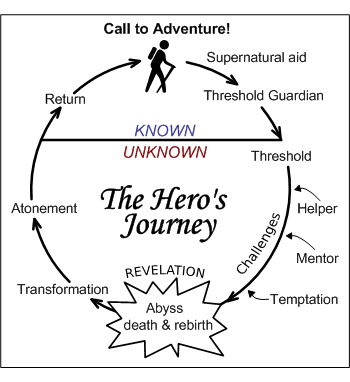
For the next few Trope Tuesday posts, I’m going to pick apart one of my favorite story patterns, the monomyth or “hero’s journey.” Other tropes come and go, but the hero’s journey is truly timeless. If you can get it to work for you, it can do wonders for your ability to understand and tell stories.
In many ways, this is the trope to end all tropes. it is the source of almost all the major story archetypes, and can be found in the myths and folklore of almost every human culture–hence the term “monomyth.” It was first formulated by Joseph Campbell, who outlined it in his book The Hero with a Thousand Faces. He summarized it like this:
A hero ventures forth from the world of common day into a region of supernatural wonder: fabulous forces are there encountered and a decisive victory is won: the hero comes back from this mysterious adventure with the power to bestow boons on his fellow man.
Campbell was an academic who studied mythology and folklore, and his book, though insightful, is pretty friggin dense (not to mention scientifically obsolete–he references a lot of Freud’s theories that have largely been discredited). Later, writers like Chris Vogler, Phil Cousineau, and David Adams Leeming analyzed and simplified the monomyth for popular audiences.
Enough background–what is it? Basically, it’s a story pattern that resonates powerfully with readers across all genres. In its simplest formulation, it follows three steps:
Freedom to Live: The Hero uses what he has learned to live the rest of his life.
Do any of those sound familiar? Yeah, I thought so. It might be hard to think of a story that fits all 17 points at once, but it’s not uncommon to find one that hits seven or eight (or possibly more).
A simpler formulation by Leeming goes like this:
Miraculous conception and birth
Initiation of the hero-child
Withdrawal from family or community for meditation and preparation
Trial and Quest
Death
Descent into the underworld
Resurrection and rebirth
Ascension, apotheosis, and atonement
My personal favorite, though, is Vogler’s:
So how useful is this trope really? Well, consider this: Orson Scott Card’s Ender’s Game was the first novel to win both the Hugo Award and the Nebula Award in the same year…and it hits up all eight points listed above. The following year, Card published Speaker for the Dead, which also hit all eight points, and also won both the Hugo and the Nebula award.
The thing that made Star Wars more than just another campy sci-fi b-movie with (let’s face it) terrible acting and hokey dialogue is the fact that George Lucas drew so heavily from Joseph Campbell and the hero’s journey. Think about it: Luke Skywalker passes through almost every one of the 17 points, right up to the awesome throne room finale at the end.
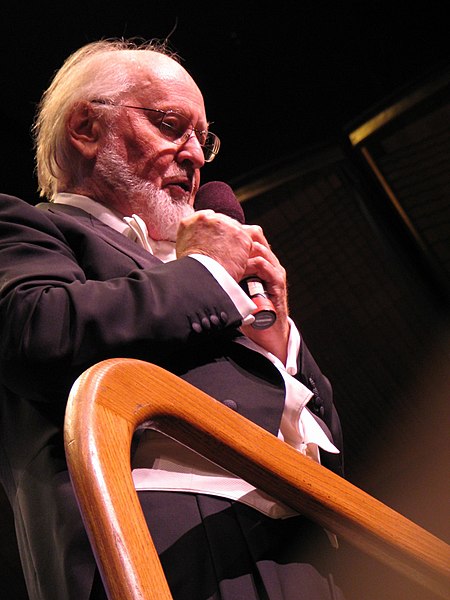
Well, this guy certainly helped.
Of course, it’s possible to go too far. Lucas also tried to use the hero’s journey in the prequel trilogies, and failed miserably. Why? Many reasons, but mostly because he used it as a rigid checklist rather than a dynamic set of flexible guidelines. The hero doesn’t have to have a literal miraculous conception; he just needs to be chosen in some way. The goddess doesn’t have to be literal, and neither does the father–those stages can be represented quite loosely, or merged with others.
In my own writing, I’ve found that the best way to use the hero’s journey is to use it to understand what I’ve already written, and to trust my subconscious to fill in the next step. In every book I read, or every movie I watch, I constantly pick it apart, looking for each of the steps. This trains me to recognize the hero’s journey in my own work without having to break out the hammer or force things too much.
So how do you use the hero’s journey in your own work? Do you find yourself hitting up all the points subconsciously, or do you use some other method? Or do you hate the hero’s journey and try to avoid it altogether? If you do hate it, I hope that my next few Trope Tuesday posts will help you to change your mind.
When it comes to weddings, most of us like to plan things out in advance. It’s not uncommon for couples to spend years figuring each other out before they finally tie the knot. So what happens when you wake up one morning and find yourself married by accident to a complete and total stranger?
This trope generally comes in two forms:
Situational: Two people from the same culture end up in a comedic situation where, quite unintentionally, they end up marrying each other. Often takes place in Las Vegas and/or involves some form of intoxication. Usually, neither of them has a clue what they’re getting into until it’s too late.
Cross-Cultural: While traveling in a foreign land, the hero unwittingly marries the chieftain’s daughter through a hilarious cultural misunderstanding. Typically, the guy is the oblivious one, while the girl knows exactly what’s she’s doing, though the gender roles do occasionally get reversed.
The characters are never the kind of people who would just up and leave their spouse, though–that would ruin the story. For that reason, they’re usually both decent, likable people, at least at first. But even if they decide to stick together, they usually have to work through a ton of (often hilarious) challenges first.
When part of the main storyline, this trope is often used as the setup for a romantic comedy (since the alternative is, well, kind of a downer). When done well, it combines the awkwardness of a blind date with all of the angst and anticipation that comes along with wedding and marriage. There’s a variety of ways that the situation can be resolved, and the longer things drag out, the more reasons the couple finds for sticking things out.
That’s not always the case, of course. In the “Our Mrs. Reynolds” episode of Firefly, what starts out as an accidental marriage between Mal and Saffron turns into…well, something else.
Within science fiction & fantasy, this is probably the most prominent example of this trope. The first half of the episode plays it straight, with Mal participating in a ceremony that seems innocent enough, but later turns out to be a marriage. At first, he tries to get out of it, but one thing leads to another, and…well, go rewatch the episode!
Another good example of this is found in the movie Jeremiah Johnson. The titular character, a former confederate soldier turned mountain man, finds himself a guest of the Flathead Indians. The chief asks about a number of horses and scalps he acquired, and Jeremiah, who never wanted them in the first place, gives them to the chief as a gift. Moments later, he realizes his mistake: the Flatheads have a custom of exchanging gifts of equal or greater value, and if they cannot reciprocate, they consider it an insult worthy of death. Fortunately for Jeremiah, the chief finds a solution: he gives him his daughter.
Both of these examples involve variations of the cross-cultural type. A good example of a purely situational version of this trope is the webcome Marry Me. It starts with a philanthropist pop-star who’s suffering from burnout and on the verge of having a mental breakdown. While putting on a concert, she sees a guy in the front with a sign that says “marry me” and decides, on a whim, to bring him onstage and do just that.
The thing is, he was only holding the sign for a friend, who was taking a bathroom break at the time. He’s not even a fan of her music. As you might expect, hilarity ensues.
Finally, this trope plays a major role in my latest title, Star Wanderers. It starts off with a young single starfarer, who makes his living running the trade routes between stars. Without realizing it, he visits a station where the food production systems have just recently broken down, condemning everyone to die.
The station master pulls Jeremiah into his private quarters and makes him choose one of his daughters, presumably to save her. Jeremiah can’t really say no, so he chooses one, only to find himself holding hands with her while her father says a quick prayer. Moments later, they’re whisked away to his starship, where they have a long voyage alone together to look forward to.
As you might have guessed, I’m a big fan of this trope. When things work out, it can really make for a heartwarming story. But whether or not it does, the romantic tension is just delicious.
PS: Be sure to check out the “playing with” page for this trope–there’s a lot of interesting variations on the main theme! My favorite is the logical extreme, with the fertility dolls and the pie. Interesting stuff…maybe I’ll use that in a story of my own someday. 😉
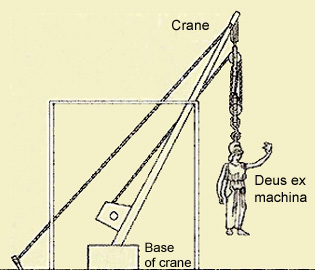
The term comes from ancient Greek theater, which often employed this technique–probably because the audience was known to get violent when the show didn’t end the way they wanted it to. Basically, a crane–the “machina,” or machine–would lower an actor playing the role of one of the gods–the “deus”–who would then resolve everything and tie up all the loose ends without the heroes having to do anything.
Sound unsatisfying? Yeah, I think so too. That’s why it’s often used as a derogatory term, much like Mary Sue. HOWEVER, it can be done well. As always, your mileage may vary, but here are some examples that pull it off:
WARNING! SPOILERS!
Watership Down: A girl saves Hazel from her cat. Satisfying because it makes sense from the girl’s point of view, and humanizes the story by showing that it really does take place in our world.
The Hobbit: The eagles arrive out of nowhere to turn the tide of the Battle of Five Armies just at the critical moment. Satisfying because it’s a cavalry ending as well, though some fans don’t like it.
Lord of the Rings: Again, the eagles swoop down and save the day, this time by rescuing Frodo and Sam from the fires of Mount Doom. Satisfying because after coming this far, we really don’t want a downer ending.
Harry Potter and the Sorcerer’s Stone: Harry is saved by his mother’s love. Satisfying because of the symbolism and the power of love.
Lord of the Flies: Just as the boys are about to kill each other, a military ship arrives out of nowhere and rescues them. Again, satisfying because of the symbolism, as well as the collective “what have I done” moment.
Schlock Mercenary: Many, many occasions. Satisfying because it’s brilliantlylampshaded.
Monty Python and the Holy Grail: “…the animator had a fatal heart attack! The cartoon peril was no more!”
Raiders of the Lost Ark: The Nazis capture Indiana Jones and get the Ark of the Covenant, but when they open it, a supernatural force kills them all. Satisfying because it squares with Indy’s general MO and his pattern of spectacular failures.
The War of the Worlds: The humans are utterly powerless to stop the aliens, but they all die off from germs. Satisfying because of the underlying message.
Does this mean that it’s a good idea to write off any criticism that your own work suffers from a Deus Ex Machina? Probably not. This is one of those things that readers tend not to notice when it’s done well. If your readers notice it, chances are that something is broken.
As you might guess, there’s a lot of gray area as to what constitutes a Deus Ex Machina, and what is actually something else. Generally, if the ending is properly foreshadowed, either by a Chekov’s Gun or by good character development, it’s not a Deus Ex. The foreshadowing removes the “out of nowhere” aspect that readers find so unsatisfying.
Foreshadowing is one way to fix a Deus Ex Machina. Another way is to toss out the ending and rewrite it from scratch, starting at the point where hero starts getting sidelined. According to Dan Wells’ seven point story structure, the hero should typically spend the first half of the story reacting to the villain, and the second half getting the villain to react to him.
There are lots of other ways to fix a Deus Ex Machina, but those are probably the biggest ones. If you have any other suggestions, by all means, suggest away.
I’m a huge fan of this trope, as you may be able to tell if you’ve read any of my books. It’s a special form of foreshadowing that lends a mystical, otherworldly flavor. It’s also something that we can relate to: how often have you had a dream that was so powerful, so moving, that it just had to mean something?
When played straight, this trope often implies some sort of all-seeing being who sent the dream on purpose. However, this doesn’t have to be the case. I often find it much more satisfying when we don’t know where the dream came from. It’s very easy to shatter the sense of wonder by over-explaining things, especially when it comes to the dream world.
Of course, the character doesn’t just have to dream of things to come to capture that sense of wonder. They can also dream of times gone by, discovering something previously unknown about the past, or dream of the truth, working through a previously unsolvable problem in their sleep. The mystical, otherworldly flavor still holds true for all of them.
As you might expect, this is a fairly common trope in fantasy. Some prominent examples include:
Lord of the Rings
The Silmarillion
A Game of Thrones
The Black Cauldron
American Gods
Most of the Redwall books
Dragonsflight
Watership down
Why is so popular? Even though dreaming is such a common, universal experience, it’s still shrouded in mystery. It resonates deeply with us because we can all relate to it, and at the same time it opens all sorts of windows into the fantastic because there is so little we understand.
Like I said before, this is sort of a pet trope for me. Consciously or not, I tend to throw in at least one dream sequence in every book I write. It seems to have worked pretty well so far, so I don’t think I’ll be changing that anytime soon.
Unless you have an unhealthy aversion to kissing books, you’re probably familiar with Slap Slap Kiss. It’s common in genre romance, but you’ll often find it in science fiction & fantasy too. When done well, it’s a great way to make sparks fly, but when done poorly…I think you can fill in the rest.
The basic underlying concept is that love and hate are just two sides of the same coin. Both involve strong feelings for another person, the kind that drive you crazy and make it hard to think straight. According to this theory, it’s a lot easier to fall in love with someone you hate than to fall in love with someone you don’t really care about. And once you fall in love, the rest is easy. <snark!>
Of course, it’s possible to go too far. There’s a fine line between “all’s fair” and kicking the dog, and if you cross it…good luck. Alternately, if the slapping doesn’t cross the line, but the kiss doesn’t live up to expectations, it’s also going to fall flat. And if the main reason you invoke this trope is because the plot demands it…let’s just say, you’re doing it wrong.
In general, I think it’s important to keep the following in mind:
The attraction needs to be properly foreshadowed. If the characters start slapping each other without even a hint of sexual tension first, no amount of backpedaling is going to make up for it.
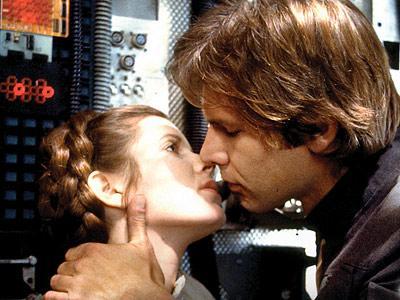
Neither of the characters should tear each other down. There’s a big difference between a slap and a punch (and a roundhouse kick, for that matter). Even though the characters may abuse each other, they have to have at least some mutual respect. After all, Han still called Leia “your highness,” and Leia still complimented Han on his “bucket of bolts” (albeit sarcastically). Once the respect is gone, so is any hint of romance.
The kiss needs to be proportional to the slap. Lots of slap with an innocent little peck is going to feel anticlimactic, while a tap on the chin with a giant make out moment immediately afterward is going to feel melodramatic. The two need to be balanced in order for the trope to work.
The couple should have at least something in common. “Opposites attract” is often just an excuse for shoddy character development. In real life, if the two people don’t have at least something in common, value-wise and personality-wise, the romance is pretty much doomed to fail. As always, however, Your Mileage May Vary.
Finally, even though there are a lot of reasons to hate this trope, there’s a reason we keep coming back to it. What that reason is exactly, I can’t say, but I know it when I see it. After all, you really shouldn’t over analyze some things. Like this video:
Last week, I blogged about the Three Faces of Eve trope. But if we’re going to discuss power trios in any depth, we first need to examine the classic Freudian Trio, one of the most prevalent combos and, in some ways, a precursor to all others.
As you might expect, the Freudian Trio borrows heavily from Sigmund Freud, specifically, his theory of the Id, the Ego, and the Superego. The main idea is that the human mind is divided into three parts: the Id, which comprises our basest animal instincts; the Superego, which comprises our concepts of morality and social norms; and the Ego, which struggles to find a balance between the two.
In the Freudian Trio, these elements of the psyche are represented by:
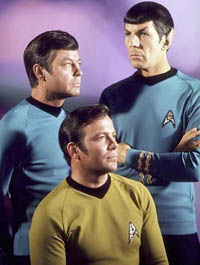
The Kirk (Ego): A pragmatic, free-wheeling character who takes the lead and mediates between the other two. When the the group is in conflict, often resolves it by taking a third option, though this often makes him seem morally ambivalent. In a five-man band, this is the Hero.
Each of these character archetypes are fascinating in their own right, and deserve to be examined in much greater depth. However, in the Freudian Trio, it’s the combination of the three that proves so fascinating.
When faced with an interesting moral dilemma, the McCoy often wants to screw the rules and run in with guns blazing, while the Spock advocates caution, reminding us of the prime directive. Or maybe the McCoy is paralyzed by indecision, while the Spock is the only one cold enough to make the sadistic choice. In either case, the way the Kirk manages to resolve it will almost always reveal something deeper about the world or human nature.
The thing that’s truly amazing is how prevalent this trope is in fiction. To name a few:
Star Wars: Han (Id), Leia (Superego), and Luke (Ego), also:
Star Wars: Emperor Palpatine (Id), Grand Moff Tarkin (Superego), and Darth Vader (Ego).
Ender’s Game: Peter (Id), Valentine (Superego), and Ender (Ego).
Lord of the Rings: Gollum (Id), Sam (Superego), and Frodo (Ego), also:
Lord of the Rings: Gimli (Id), Legolas (Superego), and Agagorn (Ego), also:
Lord of the Rings: Dwarves (Id), Elves (Superego), and Humans (Ego).
Arthurian Legend: Sir Gawain (Id), Sir Lancelot (Superego), and King Arthur (Ego) (I would argue that Guinevere fits the Id role better, but I’m not an expert).
The Dark Knight: The Joker (Id), Harvey Dent (Superego), and Batman (Ego).
The Matrix: Neo (Id), Trinity (Superego), and Morpheus (Ego).
Shaun of the Dead: Ed (Id), Liz (Superego), and Shaun (Ego).
Fullmetal Alchemist: Edward (Id), Alphonse (Superego), and Winry (Ego).
The Melancholy of Haruhi Suzumiya: Haruhi (Id), Yuki (Superego), and Kyon (Ego).
Final Fantasy VI: Kefka (Id), Leo (Superego), and Emperor Gestahl (Ego).
Final Fantasy VII: Barrett (Id), Cloud (Superego), and Tifa (Ego).
Myst: Achenar (Id), Sirrus (Superego), and Atrus (Ego).
Starcraft: Zerg (Id), Protoss (Superego), and Humans (Ego).
Homestar Runner: Strong Mad (Id), Strong Sad (Superego), and Strong Sad (Ego).
The Good, the Bad, and the Ugly: Tuco (Id), Angel Eyes (Superego), and Blondie (Ego).
20,000 Leagues Under the Sea: Ned (Id), Conseil (Superego), and Aronnax (Ego).
Twilight: Jacob (Id), Edward (Superego), and Bella (Ego).
Archie Comics: Veronica (Id), Betty (Superego), and Archie (Ego).
Sometimes, the villains come from a dysfunctional or broken Freudian Trio, where one of the three died, was kicked out, or was never part of the combo in the first place. When this happens, it’s called (aptly enough) a Evil Duo. Examples include Pinkie and the Brain, Lex Luthor and the Joker, and Kefka and Gestahl (though that particular duo was very, very, VERY short lived).
Finally, it’s worth pointing out that the Freudian Trio is so common, it even occurs in real life. Perhaps the best example of this would be World War II, where Churchill was the Id, Stalin was the Superego, and Roosevelt was the Ego. With quotes like “never, never, never, never give up,” Churchill practically embodied the McCoy (his drinking penchant also helped), while Stalin, with his fanatic adherence to communism and his “million is a statistic” approach to the revolution, was as cold and calculating as you can get. FDR was the one who held the alliance together, and it was only after his death that the Cold War really broke out.
Of course, it’s possible that we only see this trope everywhere because our brains are programmed to see it. But if that’s true, it makes for an even stronger argument that the Freudian Trio plays on some powerful, universal archetypes.
Why do so many character combinations come in groups of three? Unlike love triangles, where the combo is primarily a way to build conflict, the characters in power trios all build on each other in some way. They might be foils for each other, but as complementary archetypes, they do far more to drive the story together than they ever would apart.
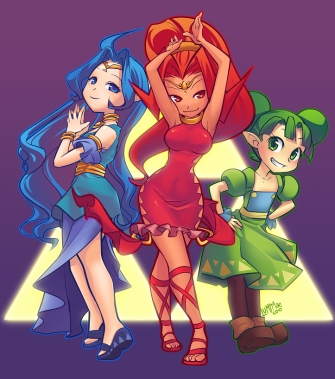
One of the most interesting all-female power trios is the Three Faces of Eve, which combines the archetypes of child, seductress, and wife:
The “child” (who does not have to be a child literally) will be seen as innocent, perhaps to the point of naïveté. The wife, the wiser, calmer aspect, someone around whom one could build a home life. The third, the seductress, is sexually experienced and independent.
Roughly speaking, the characters in the trio correspond to:
The Ingenue: A naive, innocent, childlike girl who is just setting out into the world. In a Freudian Trio, this would be the Ego.
The Femme Fatale: A seductive, alluring, mysterious woman who is experienced in the ways of the world. Unlike the Vamp, she may or may not use her feminine wiles for evil. In a Freudian Trio, this would be the Id.
The Yamato Nadeshiko: A calm, steady, faithful wife, who provides the kind of marital stability and maternal strength that is ideal for settling down and raising a family. In a Freudian Trio, this would be the Superego.
You’d be surprised to see how often this trope shows up, even in works of science fiction. In Star Wars, Leia was the child in A New Hope, the wife/mother in Empire Strikes Back, and (what else?) the seductress in Return of the Jedi. Just about every Star Trek series featured some alignment of these archetypes.
Squaresoft played with this trope a lot in their Final Fantasy series, which may be illustrative to examine in greater depth. I’ve only played through FF IV, VI, VII, and Chrono Trigger, but each of these titles features some interesting variations (warning: spoilers!).
Final Fantasy IV: Porom (child), Rydia (seductress), Rosa (wife).
Porom is pretty solidly the child, though Rydia starts out as this and later grows up into the seductress role. She doesn’t get the guy in the end, though: that would be Rosa, who pretty much starts out with him as well.
In terms of story, the characters don’t really seem to build much on each other, though in terms of gameplay you definitely want to have Rydia and Rosa/Porom in your party (though not Rosa and Porom together–you only need one white mage, after all).
Final Fantasy VI: Relm (child) , Celes (seductress), Terra (wife).
This is my personal favorite in the series. Unlike IV and VII, which both center around male protagonists, Final Fantasy VI revolves around Terra (world of balance) and Celes (world of ruin) as the central protagonists. Because they also play a role in the power trio, their characters are quite complex, especially in the second half of the game. Relm is arguably more of a Mary Sue, but her relation to the other characters, especially Shadow, also makes her role more complex and interesting.
In the end, the romantic subplot is fulfilled by Celes, not Terra, which was something of a surprise to me in my first playthrough. It works really well, though, because of Celes’s heel face turn and subsequent reformation (in which Locke is arguably a Manic Pixie Dream GirlSpear Counterpart). Does that also translate into a shift from seductress to wife as well? I’m not sure, but I’d probably say no–after all, it’s Terra who takes on the mother role in the world of ruin.
Final Fantasy VII: Yuffie (child), Aeris (seductress), Tifa (wife).
The main twist with this one is that visually, you’d think Tifa is the seductress and Aeris is the wife. In terms of story archetypes, however, it’s just the opposite: Tifa is the one whom Cloud depends on, the one who helps him work through his problems, while Aeris is the shifty, mysterious one.
Unlike IV, where Rosa and Cecil are set up from the very beginning, for a while it actually looks like Aeris and Cloud are going to end up together. But then, in perhaps the most tragically gut-wrenching moment in all of video game history, Aeris dies (and doesn’t come back). Since Yuffie is kind of, well, crazy, Tifa and Cloud are pretty much garanteed to get together after that point (and as for Sephiroth…I don’t even want to go there).
Chrono Trigger is interesting because the girl who ends up with the guy in the end (Chrono) is actually the one who fulfills the child archetype, Marle. It works, though, because of the childlike feel of the story. Unlike FF VI and IV, Chrono Trigger is not a dark or an edgy tale–it’s heartwarming innocence at its best. I always did feel that Lucca got the short end of the stick, though–but she did get a cameo in Xenogears, so perhaps the last laugh was hers after all.
Ah, Xenogears. <sigh>
Anyhow, long story short, the Three Faces of Eve power trio is a fascinating way to play with feminine archetypes. Recently, I’ve become quite interested in it because it showed up quite inadvertently in my current project, Heart of the Nebula. It’s funny how tropes can sneak up on you like that, especially some of the more archetypal ones.
Anyhow, in its current form the novel is a piece of trash, but now that I’ve recognized the potential to set up this particular power trio, I think I can really make it shine. If you have any insights, please share–I’m very interested in this trope right now!
One of the most satisfying ways to defeat the villain is to have his own nefarious scheme bring about his downfall. In Hamlet, Shakespeare described this as “hoist by his own petard,” or blown up by his own bomb. Basically, it’s a self-deposing villain whose evil plans have gone horribly right.
Perhaps unsurprisingly, you’ll often find this trope in stories geared towards a younger audience, which generally try to avoid messy endings and shades of gray. In some ways, it almost resembles a Disney Villain Death, in that the heroes often come out with clean hands and an unambiguously clear conscience.
However, this isn’t always the case–sometimes, it’s precisely because of the shades of gray that the villain’s plans become self-defeating. Case in point, Pride and Kimblee from Fullmetal Alchemist: Brotherhood. You’d think that both characters are totally evil–and perhaps they are–but that doesn’t stop the one from undermining the other at just the right moment.
When done right, this is an incredibly satisfying way to defeat a bad guy. When done poorly, however, it undermines the villain altogether, or turns the story into just another Aesop. As always, your mileage may vary, so when writing one of these stories it’s important to keep your audience in mind.
In my own books, it’s probably more common for this to happen to the heroes, which probably makes it a form of Two Rights Make A Wrong or Nice Job Breaking It, Hero. I do enjoy hoisting the villains as well, though, and will almost certainly use this trope in the future.
When done right, this trope can be one of the defining moments of greatness of the entire work. When done wrong, however, it becomes little more than a Deus Ex Machina of the most unsatisfying kind. How, then, can this moment be done right?
As with any Deus Ex, one of the keys is to adequately foreshadow the end. This often takes the form of Gondor Calls For Aid, when the heroes petition the cavalry for assistance before going into battle. To make things interesting, the relationship between the two parties is often complicated and ambiguous, making it doubtable that the cavalry will actually show up.
However, I think it goes deeper than this. In order for the arrival of the cavalry to be satisfying, it needs to not invalidate everything that the heroes have already gone through. If the cavalry shows up after the heroes have defeated the Big Bad, and essentially rescue them from a heroic sacrifice, that’s satisfying. If the heroes are still fighting the Big Bad and the cavalry comes out of nowhere to hand them an unearned victory, that’s cheap.
In English 318R, Brandon Sanderson often used the film versions of the Lord of the Rings Trilogy to illustrate this. The Battle of Helm’s Deep was satisfying, because the entire premise was to hold out until the third day. When Eomer arrived with the Rohirrim on the morning of the third day and swept away the Uruk-Hai, that didn’t invalidate King Theoden’s efforts because all he was trying to do was survive.
In the Battle of Minas Tirith, however, Aragorn’s arrival with the unbeatable army of the dead was kind of cheap, because the premise was to defeat the orcs, not to hold out for reinforcements. Gondor could have just stood down and let the orc army capture the city, and they still would have won in the end.
The two genres where you’re most likely to see this trope are westerns (trope namer) and heroic fantasy. Just about every David Gemmell novel involves a cavalry moment of some kind, and I looove it. It’s also quite common in military science fiction, too–basically, any story where war is a major part of the narrative.
The variations on this trope are also quite fascinating. For example:
Cavalry Betrayal: When the cavalry switch sides in the final battle, utterly crushing all hope of victory.
The Cavalry Arrives Late: When the heroes defeat the bad guys on their own, and the cavalry cleans up the mess.
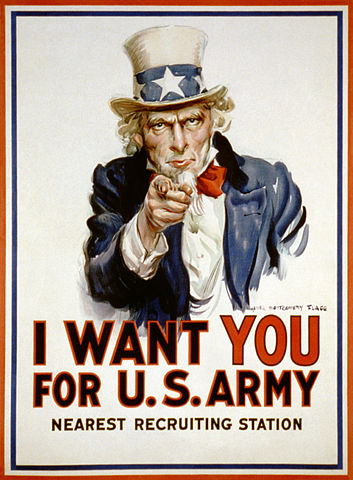 One of the first (and most important) stages of the hero’s journey is the call to adventure. It happens when the hero first confronts something outside the experience of his ordinary world that beacons him to leave it. It overlaps closely with the inciting incident, and marks the point at which the hero’s journey begins.