Up and Back from Denver

My uncle just got remarried, after losing his wife of some 40+ years to dimentia. The wedding was Saturday, so I flew up there in the early morning with my two sisters who live here in Utah. And then, because my four year-old daughter had her first primary program in church this Sunday, I flew back that night around midnight.

With all of that said, though, I still managed to get 2k words of writing in while on the plane or in the airport (mostly on the plane). This was all human writing, taking the stuff that I’d previously generated with AI and using it as a detailed outline (or sometimes as a loose suggestion) while I rewrote it in my own words. Which goes to show how AI-assisted writing can be super useful, especially for those in-between moments where it’s impossible to get a more sustained focus. If not for what I had previously generated, I wouldn’t have gotten more than a couple of hundred words in, if that much. And of course, I didn’t get any writing in during the wedding or any of the family stuff before and after.

Needless to say, after waking up at 5am to fly out, and not going to sleep until 2am the following morning, I was pretty hashed all Sunday. But the primary program went really well. My daughter remembered her part, and all but swallowed the microphone as she shouted it so we could all hear: “I love Jesus! Jesus is the Prince of Peace and the King of Kings!” It was hilarious, and very cute.

Sudowrite just rolled out a new outlining feature in their Story Bible, which replaces the old outline field. I tried it out this morning, and two things strike me about it:

First, it’s really nice that there’s no longer a word limit on the novel outline. I did have a little trouble getting my chapters to link with the outline, so there are probably still some things on the backend that need to be smoothed out, but I did get it to work in the end.

Second, it is SUPER convenient to be able to have the AI generate the individual chapter descriptions. After playing around with it, I found that the best way to generate them was simply to copy and paste all of the plot points from the spreadsheet that I use to map out the whole book, not even bothering to format it for the weird table breaks and tabs. The AI takes all of that input as-is and spits out a super accurate chapter description every time! Very nice, and hopefully it translates to better chapter beats too.

So for today and tomorrow, I’m going to work on the outline for Lizzie-99XT. After that, I’ll go back to writing out the rough human draft for The Road to New Jerusalem, and probably just focus on human writing for the rest of the month.

Motatseba, or how to bag a wife—literally (Blast from the Past: April 2012)

With the rise of #MeToo, I thought it would be interesting to revisit this old post from my time in the Republic of Georgia. Here in the US, we seem to be in the process of completely reworking the societal norms for how men and woman interact in the public sphere. On one extreme, we have serial predators getting ousted from power in industries that enabled their abuses for years. On the other extreme, we have the perpetually outraged calling for blood because someone greeted a woman in public with an unwanted hug. False and anonymous accusations abound, while clear and obvious abusers like the Clintons have gotten off scot-free. In short, it’s a mess.

Changes this drastic always produce unintended consequences. One of the unintended consequences of #MeToo may be the blurring of the lines of consent. After all, if a woman can call it rape because she decided afterward that she regretted it, is positive consent worth anything in the first place? In eastern Europe and central Asia, consent has also been blurred, which is part of the reason why bridenapping is still a thing. In Georgia, I came face to face with this reality.

Let me make it clear that I do not condone bridenapping in any form. Cultures are not equal, and some cultures (or some aspects of a culture) are better than others. A culture that condones the kidnapping and forced marriage of women is much worse than a culture that ennobles and empowers women to be agents of their own destiny.

With that in mind, here’s the updated post.


მოტაცება (pronounced motatseba) is the Georgian word for bride kidnapping, as opposed to regular kidnapping, which takes a different word. It’s an ancient practice in the Caucasus region that still occasionally happens, especially in the rural areas. Today, most Georgians condemn it, but there’s still a whole slew of lingering cultural subtexts that can be very difficult for a Westerner like me to understand and navigate.

This is how it works: boy meets girl. Boy decides to marry girl. Boy gets his friends together and kidnaps the girl, with or without her consent, holding her captive overnight. The next morning, boy contacts girl’s parents to ask for girl’s hand in marriage.

Since the girl has been held overnight, the implication is that she’s been raped (which may or may not be true). Therefore, to avoid a scandal which could tarnish the family’s reputation, the parents will usually marry their daughter off as quickly as possible. However, if the girl can escape, or the girl’s brothers can rescue her before nightfall, the crisis can be averted.

Basically, it’s capture the flag with sex.

I first heard about motatseba from this post on Georgia On My Mind, back when I was looking into teaching English. It disturbed me, but not enough to dissuade me from coming to Georgia. A couple of weeks ago, however, I learned that that was how my host parents got married.

Here’s the thing, though: they both seem to remember it fondly. In fact, when my host mom saw a comedy skit on the subject, she couldn’t stop laughing. Her mom lives with them now, and from time to time they go out to visit his family in the village, so it looks like everyone’s on pretty good terms.

So what the heck happened?

Here’s the story, as best as I can piece it together. They were introduced by his sister, who was her coworker at the hospital. He liked her, but was too poor to afford a dowry, having just gotten out of the Red Army. After a month, he got together with some friends and tricked her into coming out to his family’s house out in the village. She was surprised and upset at first, of course, but her parents gave their consent, probably because she was starting to get into old maid territory (she was 29 at the time). They were married the next day by a magistrate. Now, they’ve got four kids—a huge family, by Georgian standards—and seem to be happy together.

As a Westerner, it blows my mind that a strong, healthy family can come out of something as violent as an act of kidnapping. Indeed, I have yet to be convinced that that’s a normal outcome. However, after asking around and doing some research, I’ve come to realize that motatseba isn’t a black and white issue: there are all sorts of cultural subtexts that make it much more complicated.

The key to understanding how all this works is the following proverb, which underscores Georgian concepts of gender roles and the differences between men and women:

If a woman says no, she means maybe. If she says maybe, she means yes. If she says yes, she is not a woman.

From this, two things follow:

Men should be more assertive

As a man in Georgia, I get this all the time. All three of my co-teachers are women, and all of them constantly defer to me, even though they have far more teaching experience than I do. When I had some pretty serious differences over teaching methodologies with one of them, she suggested that I take over the next lesson and teach it without her interference, so that she could get a better idea that way.  This isn’t the case with the female volunteers. Many of them complain about how hard it is to get anyone to take their suggestions seriously.

A woman can never say no—or yes

If “no” is constantly interpreted as “maybe,” then it follows that no one is going to believe that a woman is even capable of saying “no.” On the other hand, if a real woman can never say “yes,” then the man ultimately has to take matters into his own hands. This turns the whole concept of rape into a nebulous gray area, which is why motatseba isn’t universally considered to be a horrible thing.

This is not to say that in Georgian culture, women are doormats or property (even though that’s what some TLGers claim). Women have a number of support networks, such as family, friends, and other women, and can use these networks to ward off unwanted attention. When I asked my host sister if she’s worried that she would ever be kidnapped, she said no, because if she was, her brothers would kick some serious ass.

On top of all this, Georgians have no real concept of casual dating. If a girl and a guy are seeing each other, they’re either married or about to be married. This shows up in the way they use Facebook and other social networks: instead of listing themselves as “in a relationship,” the girl will give her password to the guy she’s dating. And they don’t just do it because the guy demands it—when my host sister was seeing someone, he asked her if she wanted to give her password to him, as if that was the natural next step in their relationship. From the way she told me, she seemed to be worried that she’d made a mistake by telling him no.

Combine all of these together, and you should start to get a clearer picture of some of the subtext surrounding motatseba.

When I asked my first co-teacher about it, she said it was only an ancient practice and absolutely didn’t happen anymore. When I brought up rape and asked if that was also a part of it, she was horrified and didn’t want to talk about it. However, when I asked if it’s possible for a happy marriage to come of it, she kind of smiled a little and said that if the woman likes it, then why not?

My second co-teacher was much more straightforward with me. Yes, it happens occasionally, though it was a lot more “fashionable” about twenty or thirty years ago. No, it’s not romantic. Yes, a lot of the marriages aren’t very happy, which is why so many of them end in divorce. She told me that one of her friends from college was married through motatseba, and that she knows of at least one case in our school where an 8th grader was kidnapped and married. However, motatseba is now considered a serious crime, so it’s not as common as it used to be.

My third co-teacher’s answer was a lot sketchier. The first time I asked about it was in passing, as she walked in on the conversation I was having with my first co-teacher. When I asked her about rape, she laughed and said “well yes, of course it happens!” as if that wasn’t a big deal. Later, however, she sat me down and said quite seriously that motatseba is a horrible thing, that it’s a criminal act, that it doesn’t happen anymore, etc etc.

However—and this was perhaps the most illuminating thing—she said that sometimes, when a guy and a girl are in love, but she’s being wishy-washy and non-committal, he’ll sweep her off her feet and carry her off. In fact, that was what happened with her: her boyfriend wanted to marry her, but she kept putting it off, so one day he tricked her into getting in the car and told her “all right, enough is enough—we’re getting married this weekend.” And they did.

When I asked her if that was motatseba, she said no, but the subtext was clearly similar. A real man knows how to assert himself and take what he wants. Since a real woman will never say yes, sometimes you just have to man up and tell her how it’s going to be.  And don’t worry if she says no—she just doesn’t know yet that she wants it. She’ll come around eventually. They always do.

It sounds pretty horrible, but that seems to be how it works. And really, there are gradations of it. Most Georgians will agree that it’s wrong for a guy to kidnap a girl he doesn’t know so that he can rape her. But if the guy and the girl know each other, and are already pretty serious, and he wants to speed things up—or, alternately, if she knows her parents would never say yes otherwise—that’s when everyone starts to wink and nod.

And really, can we say that our culture’s problems are any less abhorrent? What about teenage pregnancy? Secret abortions? Date rape? At least with motatseba, the guy is trying to marry the girl, not just sleep with her and walk away. If it’s just sex that the guy is after, there are plenty of other options for that.

Either way, learning about motatseba firsthand has certainly been an interesting anthropological experience.


The road to Kutaisi

Here is another unpublished post I found while rummaging through some of the old drafts on my blog. I wrote it while I was teaching English in Georgia, and probably intended to publish it after I’d taken some pictures, but never got around to it.

I lived in Kutaisi, but made it out to Tbilis about two or three times per month. Over the course of my time there, I came to know this road very well. It took about three and a half hours to travel from Didube Station in Tbilisi to Tchavtchavadze Station in Kutaisi, with a short rest stop in Surami (where they make delicious nazuki bread!). This post covers the first half of the journey, just before stopping in Surami.

Originally, I was going to hunt down some pictures from the internet to fill in the descriptions here, but nothing I found really fit my memories of the experience. They say a picture is worth a thousand words, so hopefully this 800 word blog post is enough to paint a picture in your mind. Just for fun, I’ve added a timelapse video of various places in Georgia, many of which I visited and remember fondly.

Kargi majos!

sakartveloIt starts in Tbilisi, the only truly modern city in a country of villages, some larger and more ancient than others. On the dusty, cracked pavement of Didube station, the sun beats down hard on the crowds milling about the dozens of mini-markets, bakeries, apothekas, and lottery dispensers. The smell of cigarettes mingles with the dust and car exhaust, punctuated only occassionally by the delicious smell of freshly cooked shaurma.

Marshrutkas and taxis fill almost every available space, their drivers shouting out the end destinations loudly and impatiently, eager to get back on the road. Large white signs with red and blue letters proclaim in bold Georgian script the names of the major towns and cities: Qazbegi, Poti, Batumi, Zestaponi, and Kutaisi.

The fastest and most popular means of transport across Georgia is the marshrutka, a van-sized microbus with a high roof and twenty some-odd seats crammed as close together as the interior will allow. Luggage typically goes in back, though there’s often less than half a meter’s clearance between the rear doors and the back four seats. Large blue and white oval lights run down the center of the ceiling, with matching blue seat covers and window curtains. Icons of the Orthodox saints can be found at the front, just above the driver holding his cigarette beside the half-opened window.

Once every seat has been filled, some with mothers holding their eight and nine year-old children on their tightly cramped knees, the marshrutka pulls out of the station and out into the city. Old Russian clunkers mingle with European sedans and Japanese station wagons, while closer to the highway, large eighteen wheelers pull red and blue trailers for Turkish freight companies. Old Soviet apartments and giant oaks and poplars provide ample shade, while children play between the white-painted tree trunks in parks along the median.

As the marshrutka pulls onto the main highway, the city gives way to steep, green hills covered in verdant forest. Every other one seems to be capped with an old stone monastery, and the more devout travelers make the sign of the cross as the marshrutka drives by. The sun’s brilliant rays shine through the clouds, illuminating villages in the distance, their medieval churches and cathedrals standing above the silver rooftops like shepherds watching over their flocks.

In a little less than an hour, the marshrutka passes through the first major tunnel and into the heart of Shida Kartli. The hills give way to a wide plain. Except for a few villages peppered here and there, the landscape is mostly free of large settlements. The magestic Greater Caucasus mountains line the horizon to the north, their white-capped peaks blending in with the clouds. To the south, the Lesser Cacausus range looms much closer, as if jealous of its older brother and eager to prove itself superior.

Before coming to Gori, the road several refugee villages from the 2008 South Ossetian conflict. Hundreds of identical red-roofed huts line the dirt roads like concrete tents, their perfect rows unbroken except for a school and a police station in the very center. The contested territory lies just over the nearby hill, perhaps less than an hour away.

If you keep an eye out, you can catch a glimpse of the statue of Stalin as the road passes Gori. Perhaps the most famous Georgian from the modern era, Stalin grew up here as Iosebi Dugashvili. Some of the locals still offer toasts to his name. The more prominent landmark, however, is the road construction for a giant highway causeway that crosses a wide brook and passes into the second major tunnel of the journey. A bumpy two-lane road leads past the construction and on to the tunnel.

The Lesser Caucasus quickly sweep up from the south, transforming the plain into rolling foothills. A gentle spring rain falls over the land, a sign of storms on the other side of the mountains.

Another overseas adventure?

About a year ago, I blogged about how I need to get out of Provo before I went stir-crazy. Well, it’s been a year, and I haven’t gone anywhere yet. My love/hate relationship with Provo has mellowed out a bit–I’m not as anxious to get out as I used to be–but still, it would be good to change things up and go on another adventure.

This time, I’m thinking quite seriously about going to the Czech Republic. My sister is working to become a certified genealogist, and she keeps a fairly intensive blog on Czech family history research. If I were to go over there, I’m sure she would have all sorts of fun places for me to check out–places where our ancestors used to live. She’s already contacted a fifth cousin of ours, descended from the side of the family that didn’t emigrate, and she has a lot of other contacts over there as well. It would be an amazing life experience to live and travel over there.

Until now, every time I’ve gone overseas I’ve been a part of some sort of program. Even in Georgia, where I didn’t speak the language, didn’t know anyone, and barely knew anything about the country at all, the TLG program still had a fair amount of support infrastructure for us to fall back on whenever we ran up against a wall. I suppose I could find a similar sort of program in the Czech Republic, but that’s not what I want to do. This time, if I do go over, I want to go over on my own.

I’m still kind of on the fence about this, because it is kind of a big leap from where I am right now. But I’m earning enough with my book royalties that I could probably support myself on that income alone. From what I’ve heard, living costs in Prague can run as low as 450-600 USD per month, though most expats spend more in the 800-1200 USD range. That’s certainly doable. If I don’t need to take a TEFL job to support myself, why should I? Better to spend that time writing and/or seeing the country.

Of course, without making any concrete plans, this is still just a crazy dream. So here’s what I would need to do to make it happen:

  • Save up for plane tickets and a reasonable cash reserve, at least 150% the cost of a ticket back to the states. It looks like tickets to and from JFK and Prague run about $1,500, so I’d probably have to save up at least $4,000 (not including what it would take to get to New York from Utah).
  • Look up the rules for getting a visa, housing contract, insurance, etc (my Slovakian friend tells me that health insurance in the Czech Republic is mandatory).
  • Connect with the expat community online and figure out what the support network would look like. This would include stuff like couchsurfers, Kate’s contacts, the local church community, etc.
  • Learn some basic Czech, starting with the alphabet.
  • If possible, figure out some sort of housing arrangement in advance. Better yet, find a travel buddy.

I think those are all the big ones. And honestly, they’re all fairly doable. The hardest one would be to save up the money, but if I can find a short-term job on top of my writing that pays fairly well, I could do it in a few months. Since I plan to attend LTUE and Westercon this year, I probably won’t go overseas until mid-July at the earliest.

So yeah, that’s what I’m thinking at this point. It’s definitely something to work toward, and I think it could be another awesome life changing adventure. What do you guys think? Is there anything glaringly obvious that I’m missing? Got any tips or advice? Please share–I’m definitely open to feedback and suggestions!

Back in Provo!

Wow, do pageviews drop off sharply if you don’t blog for a while.

So after spending the last couple of weeks visiting family across the country–literally across the country, from Massachusetts to Iowa–I’m back here in good old Provo, Utah, surrounded by the mountains once again (I can just hear my grandma … “what’s so great about a pile of rocks?”).

Here were some of the highlights:

  • Seeing my parents (yay!) and spending some quality time with them.
  • Babysitting my niece and nephews and spending time with that side of the family.
  • Beach bumming on the Cape Cod National Seashore.
  • Eating fried clams and lobster in Wellfleet at Moby Dick’s.
  • Playing Shanghai with my parents every night for a week and a half.
  • Beating my brother-in-law at Settlers of Catan for the first time (he’s good!).
  • Watching the entire Ken Burn’s Civil War documentary series.
  • Touring Nauset Light and the Three Sisters.
  • Touring the Cape Cod Potato Chip factory.
  • Hanging out with Mom in Downtown Hyannis.
  • Acquiring an awesome new Indiana Jones style hat.
  • Going to church with a bunch of high priests sporting crocs.
  • Picking Monsanto corn and getting the whole corn experience.
  • Browsing a bookshelf of Ursula K. Le Guin novels I’ve never read.
  • Getting a bunch of awesome new story ideas (see previous post).
  • Taking the California Zephyr across the country–twice!

So yeah, it was a pretty awesome summer vacation.  It’s good to be back in Utah, though.  As much as I have a love/hate relationship with Provo, Utah really is my favorite place on Earth.

I’ve only been back a couple of hours, but it seems that it’s been an eventful two weeks since I’ve been gone.  One of my former roommates ran off without paying his share of the utilities, after jacking up the AC all summer (lovely).  After filing a police report, however, we may be able to get some of that back.

My tomatoes have been growing like CRAZY.  Only one has been harvested, but there are dozens hanging off of the vines.  Anybody want to make salsa?

As far as church goes, the ward boundaries have been completely rearranged.  Seriously, the map looks like a shredder went to it.  On our block, it’s us and the house two doors down from us (we think), then one of the apartments from Liberty Square, then another random house a block north of us.  Crazy.

I don’t know yet if I’ll be sticking around in my current place for the fall or not.  It’s a good situation, and the roommates are great, but the neighborhood is full of freshmen and sophomore college students.  I need to find some more people my age to hang out with.  Next month marks the beginning of the final year of my twenties, and I plan to make it count.

I got a lot of work done on Star Wanderers: Reproach (Part VII) while traveling on the train, but I still need some of my first readers to give it another read-through before I’m confident enough to publish it.  Hopefully, that shouldn’t take too long–I’m shooting for publication before the end of September.  Also, the print edition of Stars of Blood and Glory will hopefully be finalized before the end of the month as well.

That’s just about it for now.  I’ll leave you with some folk music from the Caucasus Mountains, this time on the accordion:

Rousing stuff.  I wish I could play the accordion like that.

Take care!

Quick update from Massachusetts

Hey guys, this is just going to be a quick update since it’s midnight here on the east coast and I’m  pretty tired from the three-day train ride.  Sleeping on the train is like skipping stones, where all you’re really doing is seeing how far you can go before you crash (and I’m due for a crash).  So anyways, here goes.

First, I didn’t get a whole lot of writing done on the train, partially because of the sleep issue but mostly because I started reading STRAY by Andrea K. Höst and holy crap, I could not put it down.  Seriously.  It got to the point where the only thing I wanted to do was read this book, which was fortunate because riding the train, there’s not much else to do anyway.  So I finished it in a little over 24 hours, which means you can expect to see a review here soon, either before or after I get back from vacation (probably before, because I plan to read the next couple books in the series at the beach and on the ride back).

Second, I’ve decided to spend the next week or so working exclusively on Star Wanderers: Reproach (Part VII), while the feedback is still fresh and my enthusiasm is still strong.  Also, after burning through the first chapter in the last couple days, I think I can get this done pretty fast.  After that, I’ll send it out to a couple of other first readers, probably make another pass, then figure things out from there.  If all goes well, it should be out by mid-September-ish.

Third, I’m thinking about releasing print editions of the Star Wanderers series.  At first, I thought I’d limit the print editions to the omnibuses (omnibi?), but now I think it would be cool to do little pocket-sized editions of each novella.  What do you guys think?  If there’s demand, I’ll try to put them out a little sooner, hopefully before Christmas.  And since they’re small, I can probably price them lower, like around $6 to $7 or so (and of course, Amazon will discount them).

Third point one, before I do that I need to release a print version of Stars of Blood and Glory.  Which shouldn’t be too difficult, since I’ve already typeset about half of it.  Mostly I’ve just been lazy and/or busy with other stuff, but now that I check CreateSpace it seems that people are actually buying my print books, hmm.  Better get on top of that.

Fourth … actually, there is no fourth.  I guess I should say I’m on vacation, which means doing what I usually do except from Cape Cod, spending my non-writing time doing fun things with family.  But since I’m home, I plan to go through my high-school / middle-school papers and hunt down my first novel attempt, if for no other reason than to destroy it.  I may keep a page or two as a curiosity/souvenir, but that abomination really needs to die.

And that’s about it.  The stone has begun to sink, and I really need to hit the sack.

I need to get out of Provo, but where to live next?

ProvoLogo_FullColor
… yeah, no thanks.  Not yet, anyway.

It’s been almost six months since I moved back out to Provo, and I don’t think I’ll be staying here much longer.  It’s a great place if you’re a Mormon college student in your early twenties, or married with kids and looking for a nice, quiet place to settle down, but for everything in between it’s just not the greatest.

So where am I going to go next?  Honestly, I don’t have a clue.  Probably somewhere in the United States, but I’m not ruling out the possibility of another overseas adventure.  In fact, that’s exactly the sort of thing that I’d love.

But I’ve got to be honest here: I came back to the States mostly to find a girl.  I don’t know about getting married or not–that’s like step twenty-five, while I’m still on step three–but I do know that next time I go overseas, I want to go with someone, preferably someone special.  That’s what I learned while I was living in the Caucasus mountains, that an adventure is like ten times better when you have someone to share it with.

I may be opening up a little bit in this post, and I don’t want to give the wrong impression to the people I know who read it.  It’s not that I’m uninterested in any of my female friends here, but so far, nothing has really worked out.  Some of that is because I’m not as interested as I thought I was, but the reverse is probably just as true.  Nothing wrong with that, and I still value all of my friendships.  And hey, you never know–things can always change.  But when you start to get sick of a place, that’s probably a good time to move on.

So what am I looking for?  Ideally, a place with a lot of Mormons in their late twenties / early thirties, most of them young professionals or recent graduates.  A place with a decent art scene, or that sort of vibe to it, where I can meet up with other artists / entrepreneurs like myself and be a part of that community.  I really want to live in a place with mountains–my sister is moving to a town just out of Des Moines, and omigosh just from looking it up on Google Earth I know I could never live there.  Barring that, I really love deserts, so I wouldn’t mind living in Arizona or New Mexico.

I’ve heard good things about Salt Lake City, so that’s pretty high on the list.  I’ve got a couple of friends up that way, and lots of family as well.  Other than that, I wonder if Saint George or Cedar City might be good places for a guy in my situation to live.  I really love Utah, so if I could find another place out here besides Provo, that would be ideal.  Moab, perhaps?  Seems like a tourist town more than anything.  Though if I could score a job at a hostel out there, that could be a lot of fun.

Texas is also fairly high on the list.  Beautiful place, Texas.  I’ve always loved driving through that country.  Lots of Mormons too, apparently, though where I’d want to go exactly, I have no idea.

One place I absolutely do not want to go is Washington DC.  I HATE that place, especially after my internship experience.  It’s a great place to visit, and the museums and cultural stuff are amazing, but I never want to live there again.

Other than that … I’ve got a couple of friends who suggested Portland, but I dunno.

And honestly, a not insignificant part of me wants to go somewhere crazy, like Mongolia or the Czech Republic, or even back to Georgia.  I’m making enough on my book sales right now that I could probably get a small apartment in Tbilisi and support myself entirely off of my ebook royalties alone.  Better yet, I could arrange a long-term boarding situation back in the village, or out in Kutaisi, or maybe even up in Svaneti … but that’s probably just me missing the place.  I miss it almost every day.

All I know for sure is that I absolutely cannot stay here in Provo much longer.  If I do, I’ll either go crazy or get old and fat and complacent, and I’m not sure which is worse.  I’ll stay here through the summer, just to save up some money, but when September comes around, I am getting out of here.

U is for Universal Translator

In science fiction, whenever two characters from different planets or different alien races have to interact with each other, they almost always speak the same language or have some sort of universal translator that magically makes them able to communicate with minimal misunderstandings.  This is especially common in Star Trek, though it happens in just about every franchise involving a far-future space opera setting of some kind.

I’ve got to be honest, I think this is a cheap plot device that almost always weakens the story.  As a writer, it’s tempting to have something like this so you don’t have to deal with any pesky language barriers, but when you do this, you remove a major potential source of conflict, thus violating the rule of drama.  Also, you make your fictional universe feel a little less grand, your aliens a little less alien.  After all, if everyone can perfectly understand each other, then there must not be a huge difference between Earth and the far side of the galaxy.

There are some times when having a universal translator allows you to broaden the story and focus on other conflicts.  For example, if some sort of interstellar legislation is under review in the grand galactic council, you can’t spend all your time focusing on basic communication difficulties.

However, if this is the case, then you can usually overcome the language barrier through other means–a galactic lingua franca, for example, or translation tools that may or may not misfire on occasion (much like Google Translate).  Of course, if you’re writing a comedy like Galaxy Quest (or parts of Star Control II), then falling back on a universal translator is forgivable.  But if you’re going for believability and a sense of wonder, this trope isn’t going to do you any favors.

While linguists and technologists have been working on translation programs for some time (and admittedly making some significant breakthroughs), I’m extremely skeptical that we will ever develop a perfect universal translator in real life.  If we do, I expect we will have to develop a sentient AI as a prerequisite, since the nuances of language are so inseparable from the things that make us human.

Here’s how translation services like Google Translate work:

  1. They amass an enormous database of language material by scanning websites, newspapers, and other documents.
  2. They analyze this database to look at word combinations and frequencies, observing the likelihood that any one word will appear in combination with any others.
  3. They compare these combinations and frequencies with those in other language databases to match words and phrases.

This data crunch method of translation works fairly well for simple words and phrases, but it falls apart in the more complex grammatical structures.  I see this any time I try to use Google Translate with an Arabic source.  Arabic is an extremely eloquent language, with all sorts of structures that simply don’t work in English.  One mistranslated word can completely change the meaning of the entire text, and even when it works, the technically correct English translation sounds as if it’s full of errors.

The methodology also falls apart for languages that are too small to have much of an electronic database.  The Georgian language is a good example of this.  It’s spoken by only about 4.5 million people worldwide, most of them in the country of Georgia, which is predominantly rural.  Internet access for most of the population is very limited, and most Georgians who do communicate online tend to use the Roman or Cyrillic alphabets more often than their own.  As a result, Google Translate for Georgian is utterly useless–seriously, you’re better off just sounding out the letters and guessing at the meaning.  There are some other sites like translate.ge that try to fill the gap, but they seem to rely on actual lexicons, not databases and algorithms.

All of this is between entirely human languages that developed in parallel on the same planet–indeed, languages between human cultures that have traded and shared linguistic influences for thousands of years.  What happens when we encounter an alien race whose biology makes it impossible for them to make human-sounding noises?  Or an alien race that communicates through smell or electromagnetic impulses instead of sound?  What happens when humanity is spread out across hundreds of star systems, each of which periodically becomes isolated from the others for hundreds or even thousands of years?  When our definition of human is stretched so thin that we would not even recognize our far-future descendents as anything but alien?

There is so much wasted potential whenever a science fiction story falls back on a universal translator.  Case in point, compare Halo I, II, and III with Halo: Reach.  In the first three games, the Master Chief’s universal translator enables him to hear exactly what the enemy Covenant troops are saying.  This is great fun when you’re chasing down panicked grunts, but it tends to get old after a while.  In Halo: Reach, however, the human forces haven’t yet developed a universal translator, so everything the Covenant say is in their original language.  All of a sudden, the game went from a hilarious joyride to a serious war against aliens that felt truly alien.  That one little change did wonders to the tone and feel of the entire game.

Needless to say, you won’t find a universal translator in any of my books.  In Star Wanderers, the language barrier is the heart and soul of the story–it’s a science fiction romance between two characters from radically different worlds who don’t speak the same language, and yet overcome that to develop a strong and healthy relationship.  In Sholpan and Bringing Stella Home, Stella knows a language that is fairly similar to the one spoken by the Hameji, but there are still words and phrases that elude her.  This detail is critical because it impedes her ability to understand and adapt to the Hameji culture, leading to some major conflicts later in the book.

As someone who’s lived for significant periods of time in Europe and Asia and learned languages very different from English, I can say that the language barrier is not something that we as writers should avoid, but something that we should embrace.  There are so many interesting stories that can be told when two characters don’t speak the same language.  Please, don’t be lazy and write that out of the story through a cheap plot device!  Let your aliens be truly alien, and your worlds and cultures so fantastic that we can’t help but feel hopelessly lost in them.

Back in Utah…again!

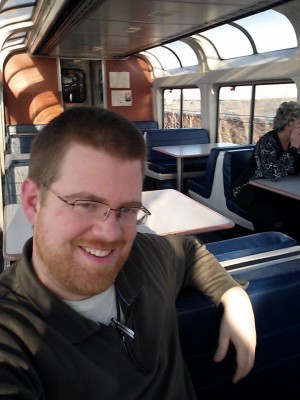
Chillin' on the observation car of the California Zephyr.

So Sunday afternoon, I boarded a train with most of my earthly possessions (at least, all of the ones I care to enjoy for the next year) and headed out to Utah.  I arrived Tuesday night, without a car, a job, or a place to live, but things have been working out really well so far and I hope to get all that stuff squared away in the next few days.

This was my sixth or seventh time traveling cross country by train, so I knew the drill.  The hardest part is getting enough sleep, so I brought a blindfold and some earplugs, and that actually worked out really well.  There were a lot of interesting people on the train, and I spent some time chatting with a few of them.  The train is one of the easiest place to make friends, just because the people who take it tend to be very laid back and friendly.

BAsUBItCIAAYenbMost of the time, though, I spent reading, figuring out my new phone, and writing.  Made some good progress on The Sword Keeper, though it looks like I’ll be putting it on hold for a while to get Stars of Blood and Glory ready for publication.  Wrote a little bit in Star Wanderers: Benefactor as well–man, whenever I need a good escape, it’s always fun to write a Star Wanderers story!  I have no idea when this one will be ready, but I think it will turn out well.
The train arrived in Provo late Tuesday evening, and I spent the night at my brother in law’s family, where I’m staying until I find a place to live.  Let me just say, it’s great to have friends and family to help you out when you really need it.  My old car was in the shop, so I set out on foot the next morning in search of an apartment.  Not much luck on that front so far, but I got my car back and found a few job leads, so it looks like I should be settled back down before long.

So why am I moving back to Utah?  A lot of reasons, but mostly because I just really like it out here.  I wanted to take a break before my next overseas adventure, catch up with some old friends and spend some time in a place that I know and love.  It also helps that there’s a good writing scene out here, with a bunch of great local conventions and conferences in the spring.

I didn’t always like Utah, but it’s really grown on me since I first came out here for college back in 2006.  The landscape is beautiful, with lots of amazing places to explore.  The people are really friendly and easy to get along with, even if your political views aren’t conservative (though admittedly, it’s harder).  The Mormon culture makes some things kind of quirky, but not in a way that makes it too hard for me to fit in.  In fact, if there’s any place in the world where I “fit in,” it’s probably here.

Things are kind of upside down right now, of course, but that will change once I find a place to live.  That’s going to take the focus away from my writing for a while, though hopefully not for too long.  In the meantime, today is another day, so I’d better get busy!

Sairme to Abastumani

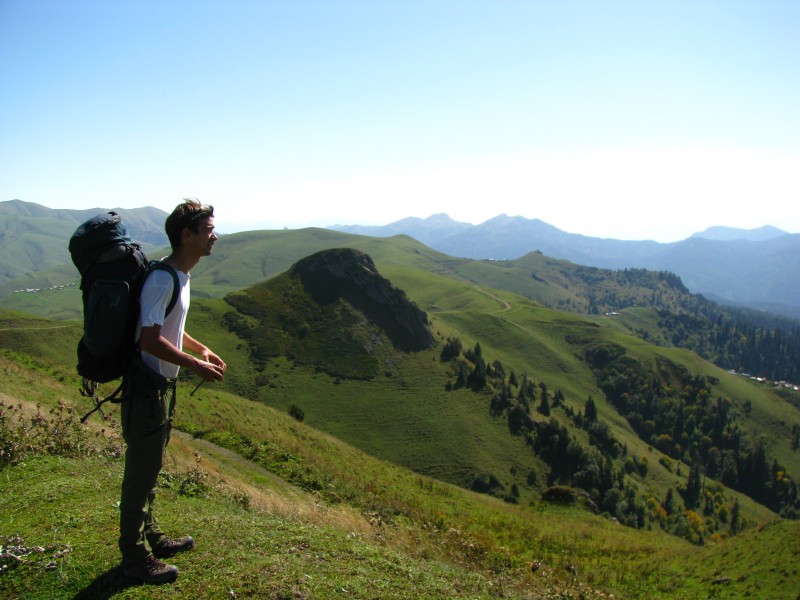
So last week was the first week of school here in Georgia, but before I blog about that, I thought I’d do a post on the short backpacking trip I did with a friend of mine the week before.  It was a lot of fun, even if our plans did change about a dozen times along the way.  That tends to happen a lot to plans here in Georgia, but if you’re flexible and can roll with it, you can have a lot of fun anyway.

So our original plan was to go from Baghdati to Sairme, a small resort town in the Lesser Caucasus range just south of Kutaisi, and from there catch a bus over the mountain and hike a few trails out in the western side of Borjomi National Park.

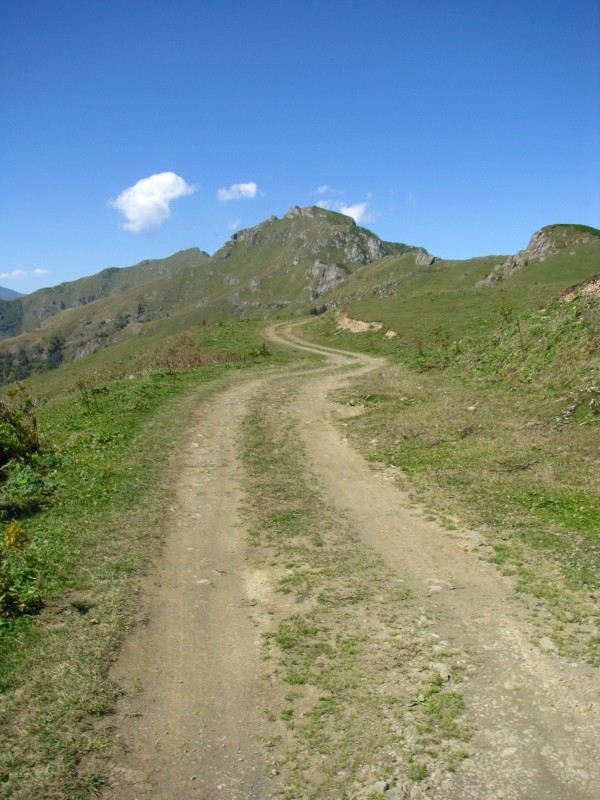
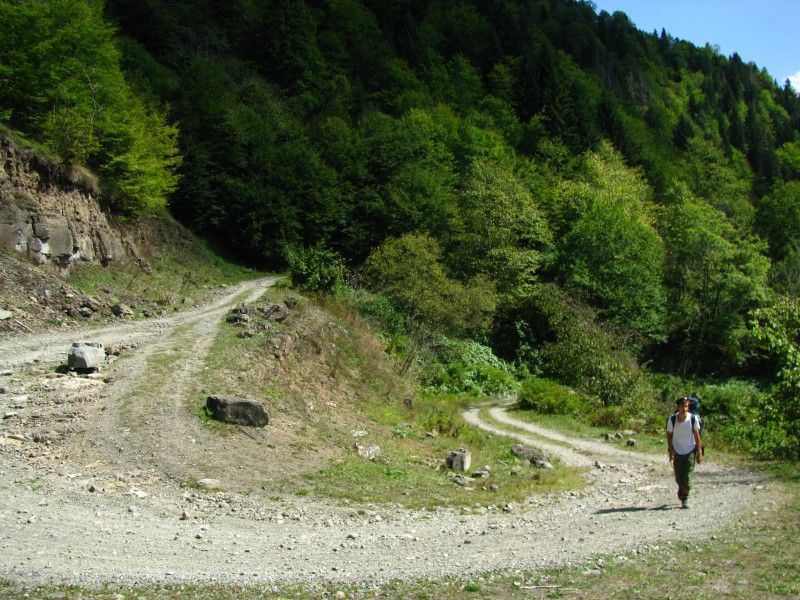
Well, when we got to Sairme, we found that there isn’t a bus that goes over that road, and for good reason.  It isn’t exactly a “road”–more like an unusually wide dirt path.  Farmers sometimes use it, but only because they’re local and it doesn’t make sense to go 80+ kilometers out of the way on the main route from Zestaponi to Surami.

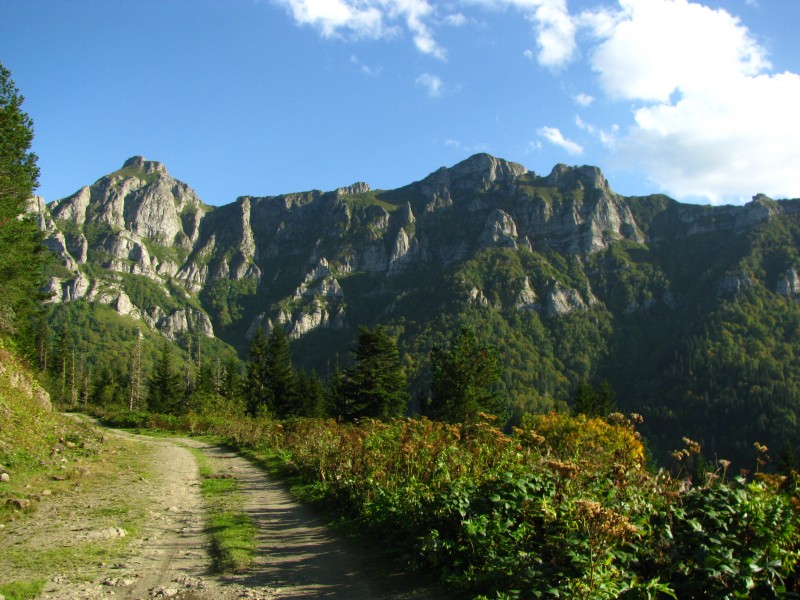
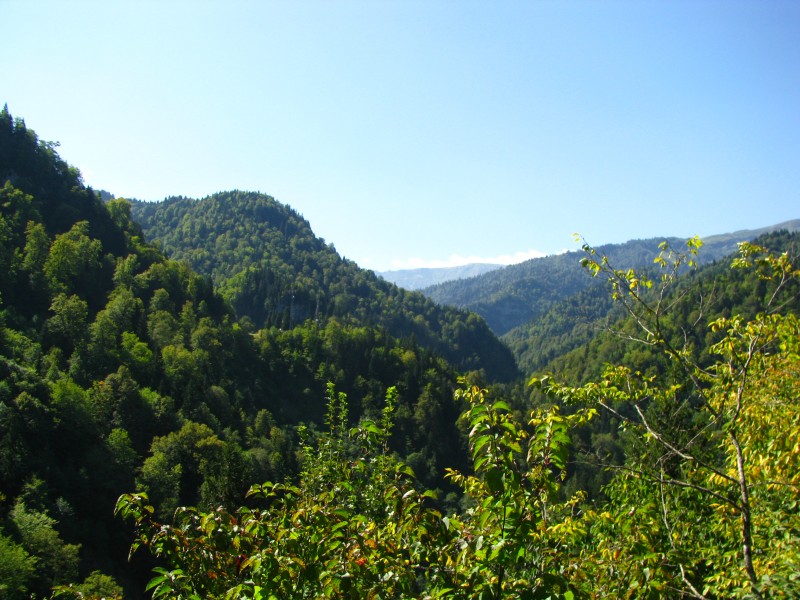
The mountains around Sairme.

The “road” from Sairme to Abastumani.

The locals told us it was about 35 km to walk to Abastumani, so we figured “hey, we have food, sleeping bags, and a tent–why not hike it?”  According to the map, if we left at 1pm and averaged 3 km/hr, we estimated we should reach the pass just around sunset.

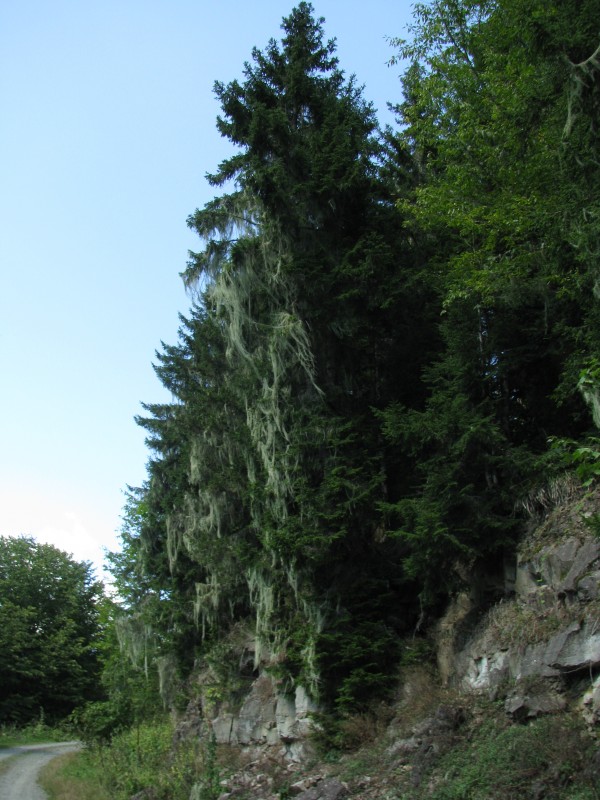
Some interesting moss around the 2,000 meter elevation mark.

Mount Didmaghali, just above the treeline. We camped about two kilometers from here.

The calculations were fairly accurate; we hiked for about 6 hours, making about 18 kilometers on  the first day and climbing around 1300 meters.  In all that time, we only passed three vehicles, and they were all heading back to  Sairme.  One of them was carrying a bunch of guys who were so surprised to see us, they gave us a giant wheel of cheese.  We gave half of it to a local farmer who looked like he needed it more than us, and ate most of the rest over the course of the next few days.

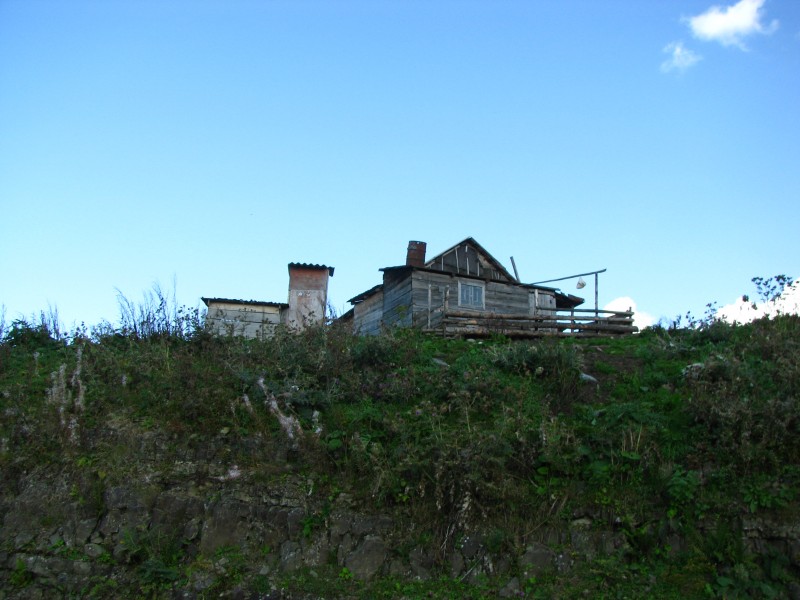
One of the farmers’ huts up above the treeline. The guys who farm here are generally seasonal workers, who live in the valley during the winter.

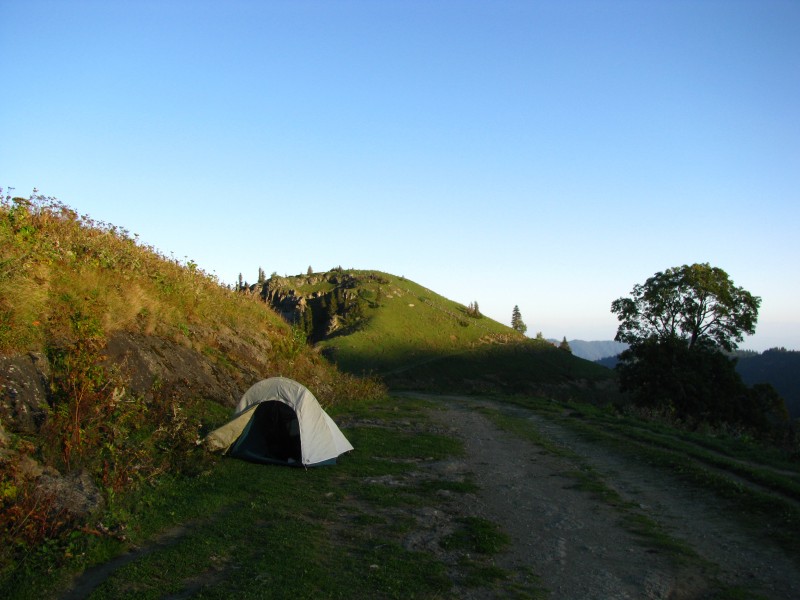
Our campsite, by the side of the road near Mount Didmaghali. It got a little windy at night, but was actually quite comfortable.

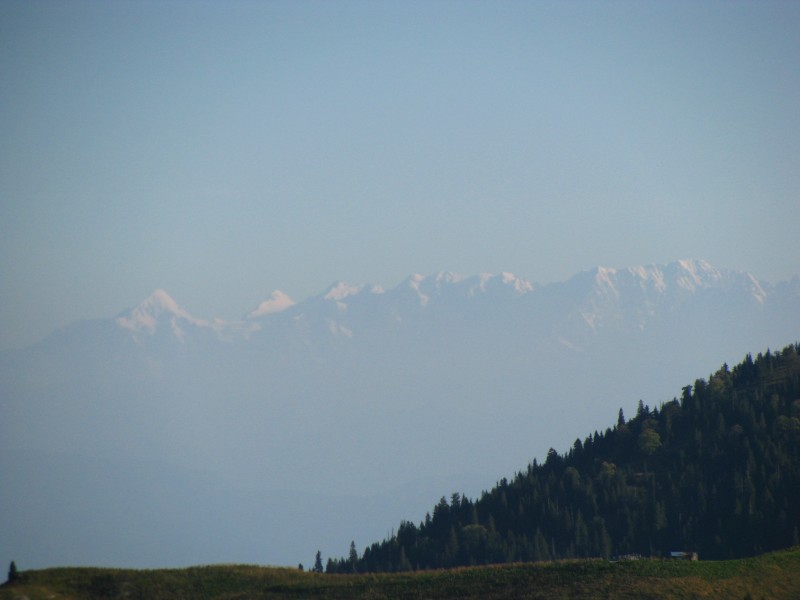
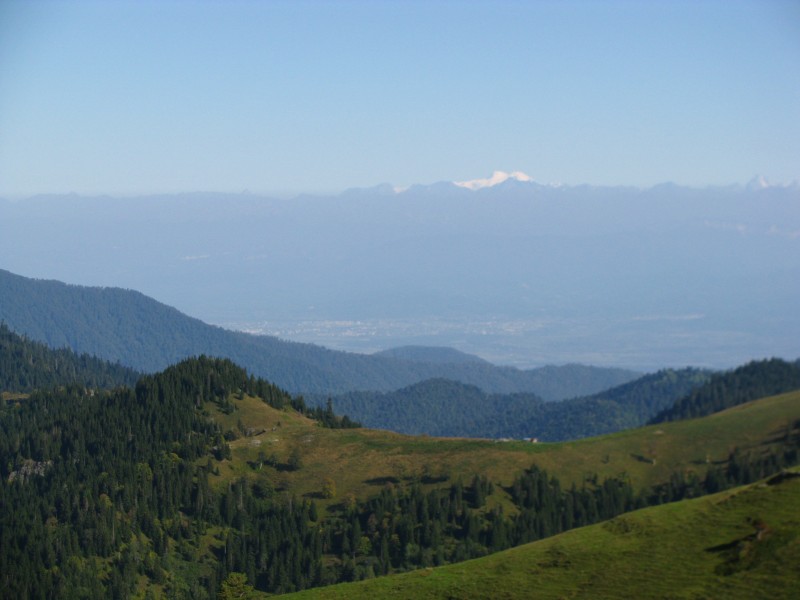
That moment when you realize “OMG, those aren’t clouds–those are MOUNTAINS!”

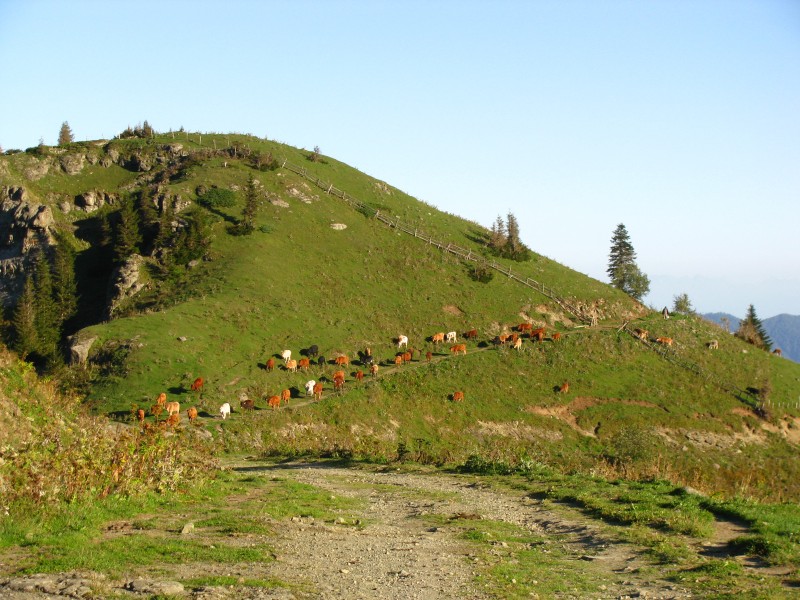
We camped out just above the treeline, next to a hill where a bunch of cows were grazing.  The local ranchers brought the herd back in while we cooked dinner, which was kind of cool.  Imagine a couple hundred cows walking past your tent.  The good thing about being so close to the farmers, of course, was that we didn’t have to worry as much about bears and wolves.

At one moment while we were looking out acros the way we came, the clouds on the horizon began to part somewhat, and I had one of those stomach-dropping moments as I realized that most of those white shapes weren’t clouds, but mountains.  We were looking at the Greater Caucasus range, with Mount Elrus standing above the mountains of Svanetti and a whole bunch of other snow-capped peaks further off to the east.

As the sun sent, the temperature dropped fairly quickly, and the wind picked up a lot.  I wasn’t able to sleep for a few hours, it was so strong.  But the stars were beautiful–at one point, I saw a satellite that was so bright it had to be the ISS.  Cool stuff!

The farmers bringing out the herd in the morning. One of the cows ate some of our bread, which was kind of annoying, but I guess I shouldn’t have left it out. Cows will eat (or try to eat) just about anything!

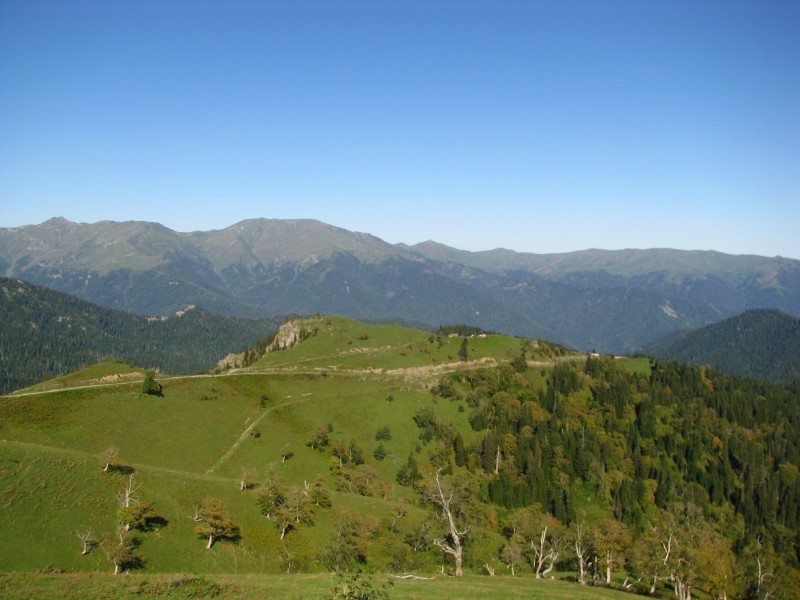
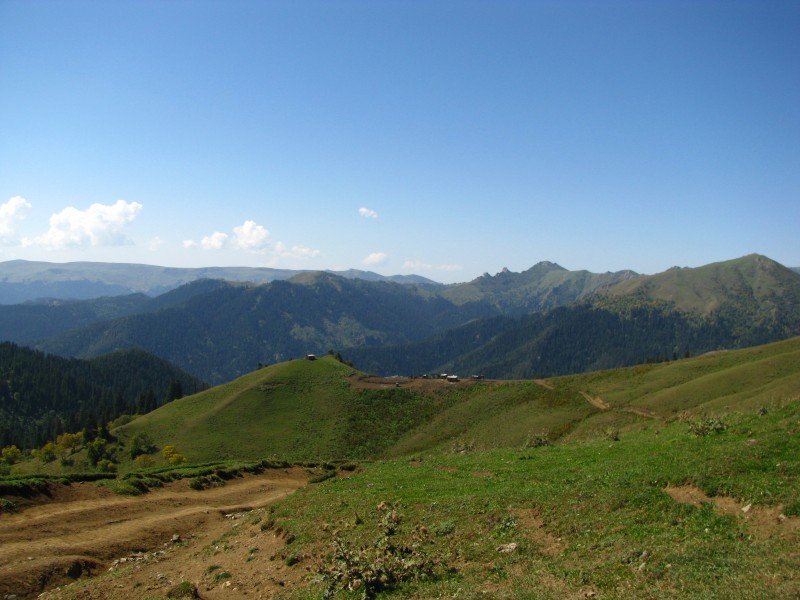
The view from the top of the first pass, just east of Mount Didmaghali. The little hill on the left is where we spent the night.

Mount Elrus, with several other major Caucasus peaks below it. You can also see Kutaisi and some other settlements in the valley.

The view from Zedeki pass.

The next day, we had a beautiful hike up to the first pass and over the mountains into Samtskhe-Javakheti.  The weather could not have been more perfect–it warmed up as soon as the sun came up, and was pleasant for the rest of the day.  We had some amazing views, too, especially from the top of the pass.

The road on the other side of the pass.

The view on the other side of the pass. Those are the mountains of Samtskhe-Javakheti, with Turkey and Armenia in the distance.

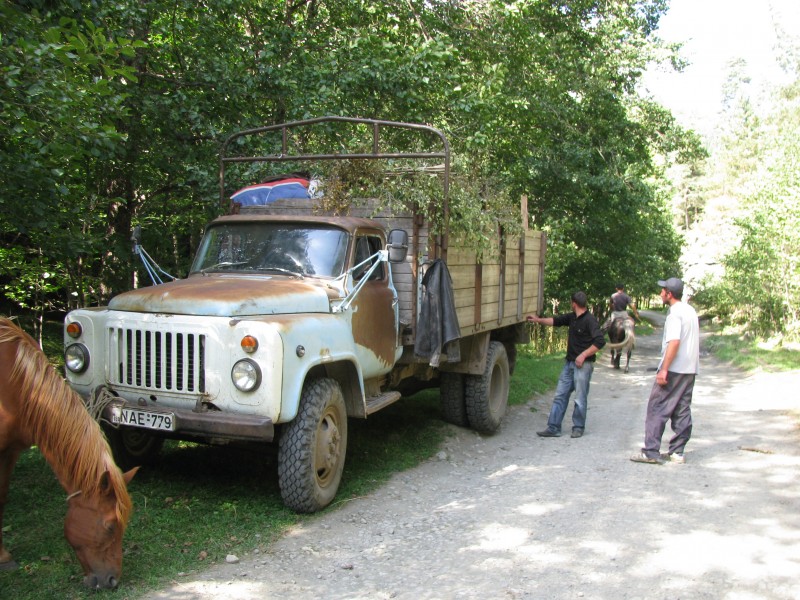
On the way back, we fell behind a bit, so we decided to hitch a ride with a passing farmer’s truck.  The guys were hauling some empty barrels, a bunch of brush, and some calfs, and they put us in the back with the animals.

Wow, was it crazy!  The road was so bumpy, literally every other bounce almost threw us off of the truck.  The cage would pull back branches and snap them back so hard, some of them could have knocked us off as well, and the cows crapped all over the place, including the back of my pants.  For most of the way, we had a sheer cliff on one side, and even though there were lots of trees, it was pretty scary, especially at the switchbacks.

In other words, it was an adventure!

The truck that took us down most of the way. Bumpiest ride of my life!

My pants, after the cows got to them.

I wish I had some pictures from the ride, but it was all I could do to hang on for dear life.  After about 45 minutes, my hiking partner had had enough, and demanded that the guys stop and let us off.  My camera had fallen off in the truck bed, but I didn’t realize that until we were back down. Fortunately, we were only about 5 km from Abastumani, and found the guys just outside the settlement.  The camera was still in good shape, and in typical Georgian fashion, they invited us for bread, cheese, and cha-cha.

So it ended up being an awesome two days of hiking and backpacking.  The views from above the treeline were incredible, and the conditions were absolutely perfect–we could not have asked for better.  We spent the next couple of days exploring Akhaltsikhe, Borjomi, and Bakuriani, but I’ll save that for another post later–this one has gotten long enough.

So yeah, it was definitely worth the trouble bringing out all the backpacking gear from the States.  I hope to have plenty of opportunities to use it again before the end of the season!