Is politics the problem?

Steve Deace made an interesting point on his show today. They were talking about the tendency for some people to vote purely along cultural lines, even when they disagree with almost everything that “their” candidate stands for—or in other words, people who vote Democrat “because we are Democrats” or Republican “because we are Republicans.” In that context, he posed the question: in the Fetterman-Oz race, where Fetterman clearly is not mentally fit for the job, would he and his co-hosts have voted for the Fetterman candidate if the R and the D were reversed?

They all admitted that yes, they would have plugged their nose and pulled the lever for the incompetent candidate over the one from the party that is, in their words, advancing a demonic agenda. In other words, when you’re in the midst of a “cold civil war” (I don’t really like that term, but it is gaining traction for a reason), the most important thing is to close ranks and defeat the other side, no matter how bad your own guys may be.

With the way our politics are trending, I think there are a lot of people on Team Red and Team Blue who see it that way. I also think there are a lot of people on Team Don’t-Talk-To-Me-About-Politics who despise that, and are deliberately voting against the partisan firebrands because they are such firebrands. And that’s laying aside the question of voter fraud, which is really starting to piss me off. Seriously, if Arizona were a developing country, our State Department and half the NGOs in Washington would be crying foul right now and declaring that Arizona is no longer a democratic nation capable of holding free and fair elections. But I digress.

The discussion made me think about something my wife said about the abortion debate, how the deeper problem is that we only ever frame it in terms of what is legal, not in terms of what is good. By focusing on the law and on what is or should be permissible we overlook things like the rape victim who decides not to get an abortion, but put the child up for adoption instead, or the struggling young mother who doesn’t want to get an abortion, but doesn’t feel like she has any other option.

This tendency that have to make everything about politics, or everything about the law, is very convenient for those agendas that are seeking to subvert our individual liberty and sovereignty, and turn us from citizens into mere subjects and wards of the state. Under these circumstances, the more we look for a political solution, or turn to a political savior, the more we play into the factions with the anti-freedom agenda.

In other words, we don’t just have a political problem in this country: politics is the problem. If our families were strong, our culture were wholesome and uplifting, our churches (or mosques, or temples) were full, and our money were based on honest value, our politics would not be so toxic and divisive, because we wouldn’t feel like we needed our politicians to save us.

Of course, if this is true, it means that the partisan divide is merely symptomatic of a much deeper political problem. Even if one side got their savior, be it Trump, or Desantis, or Bernie Sanders—or dare I say, Barack Obama—the underlying issue would remain. And what is that issue? I suspect it has to do with our transformation from a nation of citizens into a nation of subjects, or of debt-serfs subjugated to a fundamentally dishonest fiat money system.

At the end of the day, we get the politicians that we deserve and are willing to put up with. Even the most totalitarian dictator only rules because of the will of the people. When enough people are willing to risk everything to stand up to him, that is the day that he falls. Likewise, it’s not our “sacred democracy” that makes us free. God made us free. The state cannot grant us the freedom that God has already given us; it can only take our freedom away.

Lessons from living without social media

In 2014, after being active on Facebook for eight years–the majority of my young adult life–I bit the bullet and deleted my account. I did it over the original Edward Snowden revelations, because I was genuinely disturbed with the connections between Facebook and the US intelligence community, and did not want to trust Zuckerberg or his company with any of my private data.

Very quickly, I learned just how difficult it was to function in today’s society outside of Facebook. Not only was I effectively cut off from all of my friends who were no longer living in close proximity to me, but I was also cut off from many of the social events among my current set of friends, because all of their activities were organized through Facebook. This made it almost impossible to meet new people, even through my existing social circles, so after a couple of years I bit the bullet again and made a new Facebook account.

To make a long story short, I got so disgusted with Facebook that I deleted my account again, then moved across the country where I was even more socially isolated and made a new account. With each iteration, I experienced with different rules, such as not friending anyone but family, not liking anything, turning off chat, etc. In 2018, I met my wife through an online dating app, married her in 2019, and promptly deleted both my dating profile and my third Facebook account.

In the interest of full disclosure, I have since created a fourth Facebook account, but only to access various writer groups like 20 Books to 50k and Wide for the Win. In the old days, we would organize on message board sites like KBoards, but now it’s all on Facebook, and if you’re not on Facebook, you’re basically cut off from the rest of the indie publishing world. I don’t like it, but that’s the way it is. So the way I use Facebook now, I only log in via an incognito browser, and I don’t post anything on my profile except the bare minimum of what Facebook requires. No friends. No likes. No news feed. I have, in fact, had my posts flagged for coming from a scam account, which I find almost as hilarious as the people the Facebook algorithm recommends to me as “friends.” Most of them don’t appear to speak English.

With Twitter, it was a totally different story. I created my account in 2009, got addicted to it for a while, then realized in 2016 that it was getting pretty toxic and deleted my account a couple of months before Trump was elected president. One of the top 10 best decisions of my life. I haven’t looked back since.

Right now, the only social media that I use consistently is my blog–and I’m not even super consistent with that. I do follow an eclectic mix of YouTube channels, but not via YouTube itself: instead, I plug in all the RSS feeds into a web-based aggregator. Helps me to avoid the YouTube recommendation algorithm, which can be super addictive. I used to be active on Goodreads, but I’m not anymore, just because I don’t want a bad review or a comment on somebody else’s book/review to spiral into something that could hurt my career. But even if writing wasn’t my career, I still wouldn’t use it to follow anyone except for a handful of close and trusted friends.

Living without social media for the last few years has given me an interesting, and perhaps somewhat unique, perspective on culture and society. In a lot of ways, it makes me feel like I’m on the outside looking in, which helps to write stories that are counter-cultural or otherwise serve as tales of warning. It’s also helped me to avoid a lot of the depression, anxiety, dysphoria, and outrage that characterize so much of today’s society.

On the other hand, it’s also been a real handicap when it comes to marketing my books. So in the next few months, I plan to expand my internet presence and experiment a bit with social media, joining some new communities and hopefully putting myself (and my books) in front of new people. But I don’t want to get dragged into all of the toxicity that’s out there, or to become addicted again.

So in the interest of avoiding all that, I thought it would be a good idea to take some time and write down some of the lessons I’ve learned from living without social media, specifically with what we (and by we, I mean I) can take from those lessons to use social media in a more healthy way.

Disable or block all mobile notifications, especially push notifications.

This was perhaps the biggest thing I noticed immediately after I deleted my Facebook and Twitter: the silence. No more buzzing phone. No more compulsion to pick up a device, or sit down at the computer and log back in. No more sense that I was tethered to my online persona, which I had to constantly maintain.

It was so incredibly liberating.

The closest thing I’d experienced before this was living in the Republic of Georgia, where the only way to get internet access was to walk to the village center, wait half an hour for an old VW bus to come through, ride that bus for another half hour to the nearest city, then walk to McDonalds and buy a cheeseburger or an ice cream so I could sit by the window and use the internet for a couple of hours. Honestly, I think that experience did a lot to prepare me to cut the cord, but it was still always there in the back of my mind, even when I was back in the village, helping out around the farm with chores.

With push notifications, though, that tether is right there in your pocket, and never very far from your mind. It’s like you exist in a quantum state, never fully present in the real world, and never fully disconnected from the online world either. It’s very addicting.

And honestly, why do you need any mobile notifications at all? Why can’t you leave everything on MyFaceTwit alone until the next time you’re ready to move on? Do you answer every phone call? Respond to every text in real time as you receive it? Why not take charge of your own social media usage and use it at your own leisure?

The first step to taking charge is to disable all push notifications, especially the ones on your phone. The only reason those exist is to make social media more addictive, and ensure that you’re never truly logged off. Don’t let them screw with you like that. Don’t let them turn you into a mere product to sell to advertisers. If you’re going to use social media, be mindful about it and use it on your own terms, not theirs. Disable all pubsh notifications.

Disable or block all likes and upvotes.

The other way that social media companies addict you to their platform is by means of the “like” or “upvote” button. This is especially true for content that you produce. An entire generation of young women (and also young men, to a lesser extent) is now being shredded by this, because they’ve been raised to believe that their personal worth and value as a human being is connected to how many likes and upvotes they get. It’s insidious.

This is also, I believe, a large part of why freedom of speech is in such danger. It’s much easier to convince the rising generation that speech is violence and violence is speech, because whenever they get a downvote or a nasty comment, they feel like their worth as a person is under attack.

When it comes to comment sections, I’m a little more torn on this, because upvotes and downvotes can be a valid contribution to the discussion at hand. However, it can also become addicting, and I admit that on some occasions I’ve fallen into the mob mentality and said things that, taken out of context, probably look pretty bad. So even when it comes to comments sections, it’s probably best to avoid getting caught up in the upvote game, and to be a lot more sparing in giving out upvotes–or just not contribute that way at all.

Do not consume via “news feeds” or endlessly scrolling content.

This one is huge, especially for me. It’s a major reason why I don’t generally go onto YouTube anymore: because I don’t want to get caught up in clicking through the recommended videos. That way leads to hours of lost sleep and groggy mornings filled with regret.

Instead, I try to find an RSS feed and plug it into an aggregator. That way, no matter the social media site, I only see the things that are posted by the creators I follow. I also have a lot more control over the content that I assume, because a lot of these sites will actually bury content that they think you might not want to watch (or that they think you shouldn’t want to watch). With an aggregator, I see everything that gets posted, and can shoose which content I want to consume and which content I want to skip.

This does mean that from time to time, I need to cut some of my RSS feeds from my aggregator. Otherwise, the firehose of content can be overwhelming. Also, you have to give yourself permission to skip stuff, even if it’s stuff that you genuinely want to see. This happens all of the time with podcasts for me: I feel like I’m constantly “behind” on the things I want to listen to.

But in order to make time for better things, you sometimes have to cut out the merely good. Just be mindful about it, and don’t let some news feed or algorithm do it for you.

Do not try to connect with everyone.

Before I deleted my first Facebook account, I went through a period where I was very disatisfied with my experience there. It seemed like a small handful of “friends” dominated every post and discussion. Invariably, these were “friends” with whom I shared only the most tenuous connection, for example that we’d been in a freshman college class together, or our moms had used to hang out all the time when we were five. These weren’t the people I wanted to stay in touch with 24/7, but they dominated all the feeds just because they posted so much more content than everyone else.

In 2012, I decided to experiment with deleting all but my closest friends, until I was down to the Dunbar number. What is the Dunbar number? It is the theoritical maximum size of a human society where everyone personally knows everyone else, and everyone knows how everyone else relates, individually, to everyone. It’s about 150-200.

As soon as I had my “friends” list down to about 200, I started to notice some changes. Instead of feeling like I had to ask “who is this person again?” with half of the things that got posted, I saw a lot more content from the people I genuinely cared about, and my Facebook experience improved dramatically. It was like I had taken the Marie Kondo approach to social media, which was difficult at the time, but actually made me feel much more meaningfully connected in the long run.

You can’t please everyone. You can’t write a book that everyone is going to like. Why should you try to get everyone to like you on social media? Cut out all of those connections that don’t actively bring you joy, and you’ll have a much more positive experience.

Avoid all outrage like the plague.

This is probably the biggest one of all. The reason social media is so toxic right now is because nothing is more addictive–and therefore, more likely to keep you engaging with someone else’s content or platform–than outrage. It doesn’t even matter if the outrage is righteous or not. If you are addicted to outrage, you are under someone else’s control, and are probably being exploited in order to sell advertising, or to push someone else’s agenda.

Ultimately, outrage leads to mass formation psychosis. Instead of feeling connected on a personal level with other people, you are connected to some sort of movement or leader, and possessed by an ideology. The end state of this is the tragic severing of even the most personal bonds, with brother taking up arm against brother, and father against son.

Outrage is poison, even when outrage is justified. Even Christ, when he overthrew the tables of the money changers, didn’t send his disciples to hunt them down, or go after their families. He chased them out of the temple, but He didn’t track them back to their homes. He gave them a sharp rebuke and let them go. Later, in His visit to the Americas, He taught that all contention is of the devil, and that His teaching was that such should be done away.

“Blessed are the peacemakers.” What a radical message. Be a peacemaker. Don’t succumb to outrage.

The argument that converted me to pro-life

I’ve never been one of these pro-abort people who sees abortion as a virtue or a fundamental right. I do understand the “my body, my choice” argument and still think that it carries some weight—after all, bodily autonomy is an important component of personal liberty and sovereignty—and for a long time, that argument had won me over. I also bought into the lie (and it is a lie) that when abortion was illegal, thousands of women were dying in back-alley abortions, so therefore it’s better to legalize and regulate it than it is to just make it illegal across the board. I also believed (and to an extent, still believe) that there are circumstances where an abortion should be legal, such as ectopic pregnancies, other instances of severe health threats to the mother (including mental health), and cases of rape and incest.

But mostly, I just didn’t want to think about abortion. It’s a very icky subject. Also, because I’m a man and will therefore never be pregnant (contrary to extreme leftist dogma, which apparently holds that nothing in this world is real, or sacred, or true), I didn’t think that the issue really affected me, and was more or less bullied into believing that as a man, I wasn’t qualified to have an opinion. This was something to be left “between a woman and her doctor,” and to my shame, I was content to leave it that way.

Then I graduated from university and went out into the “real world,” declining to pursue a master’s degree (which I am totally convinced is the best life decision I have ever made). After a few years outside of the cloistered halls of academia, my political views began to change rather radically. I can’t point to a single thing as my “red-pill moment,” but the insanity of the 2016 US election brought the pot to a boil, and I found myself rethinking everything that I thought I knew.

One of the voices of reason and sanity that I discovered during this time was Jordan B. Peterson. I don’t know what Peterson’s views on abortion are, and frankly I wouldn’t be surprised to find that he adopts a position that makes most pro-lifers uncomfortable. He’s very good at being a contrarian. But while I was following Peterson, reading 12 Rules for Life and listening to a bunch of his lectures and interviews, I came across this point that he often makes:

You probably would have been a Nazi. They weren’t all that different from you—and besides, you’re probably not as virtuous or as heroic as you think.

We like to think of the Nazis as being extraordinarily evil, but the truth is that they were ordinary people who just happened to live in an extraordinary time and place.

Not unlike the times in which we currently live.

That argument really stuck with me. As the oldest child in my family, I was often told that I needed to set a good example for my younger siblings, and so I grew up thinking of myself as someone who would do the right thing, even if no one else was doing it. The thought that I am the kind of person who would have consented, or even participated, in something as evil as the holocaust was utterly hateful to me. That’s not who I thought I was.

But how could I prove to myself that I was not, in fact, that person? How could I know? I thought about that for a long time—not just about the Nazi thing, but about the Milgram experiment and the Stanford prison experiment as well. Was I the kind of person who would blindly follow the rules, no matter how horrific they were? If I wasn’t that person, how would I know?

As I pondered over this question, I began to reframe it. Instead of asking what I would have done if I’d lived in 1930s Germany—a historical counterfactual that is impossible to disprove—I began to wonder if there was anything happening today that future generations will look back on with the same horror and contempt that we look back on the holocaust.

In other words, is there anything happening today that we all blindly take for granted, or that we all just turn our heads away from, but that future generations who are removed from our historical context will look back on and ask “how could you all have gone along with that? How could you possibly be that evil?”

This prompted me to look at the abortion issue in a completely different way. And the more I studied it, the more convicted I became that this is our generation’s equivalent of the holocaust.

In fact, the more I examined our own genocide of the unborn and compared it with the holocaust, the more I came to realize that we may have actually exceeded the evil of the Nazis. Consider this:

The Nazis killed about six million Jews and several hundred thousand (at least) more people from groups such as the Roma, the Jehovah’s Witnesses, homosexuals, the mentally handicapped etc. But in the time since Roe v. Wade legalized abortion in the US, we have aborted 65 million children—an order of magnitude more than the victims of the holocaust.

The holocaust didn’t go on much longer than a decade: the Nazis came to power in 1933, and surrendered to the Allies in 1945. But our own genocide of the unborn has been happening for multiple generations now—nearly fifty years.

The holocaust happened in the context of a post-war Germany where the people were shattered and impoverished, and children were literally starving to death in the streets. Our genocide of the unborn has happened during a period of such incredible prosperity that it is unparalleled in human history.

While many of the victims of the Holocaust were innocent children, there were also many adults who perhaps were not so innocent or powerless. But no one is as innocent and powerless as the unborn.

Generally speaking, the Nazis weren’t killing their own family when they sent the Jews off to the death camps. But with abortion, we are slaughtering our own children—our very flesh and blood.

Many women who get abortions are deceived by the pro-abort arguments, and do not believe that they’re committing an evil act. But many of the German people were deceived by the Nazis as well. Is that really a valid excuse?

I won’t go into all of the pro-life arguments. There’s a lot that can be said about Margaret Sanger and Planned Parenthood’s connection with actual Nazis and other eugenicists (and how that connection still exists), as well as a lot of good arguments—both religious and scientific—about how life begins at conception, and the unborn are as deserving of human rights, including the right to life, as any other living person.

But you’ve probably already heard all those arguments. I doubt there’s much that I can rehash here that will change your mind. I will, however, link to an excellent podcast that does put forward all those arguments, so you can examine them if you’re curious:

With all of that in mind, I came to realize that there is a way to know whether I’m the kind of person who would have been a Nazi, and that involved answering the question:

“What are you doing about the genocide of the unborn?”

Now, I recognize that those who disagree with the pro-life side are not, for the most part, heartless monsters who do not deserve to live. There are a few extraordinarily evil serial killing abortionists out there, but most pro-choicers are genuinely decent folk who happen to see things differently. I get that. The same was probably true of most Germans in the 1930s: they weren’t extraordinarily evil, but ordinary folk like you and me who just happened to be caught up in the mass psychosis of their time.

I do believe that we are witnessing the formation, or perhaps the final expression, of a mass formation psychosis over the abortion issue. With all of the hysteria surrounding Dobbs v. Jackson and the Supreme Court’s decision to return the abortion issue to the states, the left is coalescing around this issue—but they aren’t content with “safe, legal, and rare” anymore. Instead, abortion is now proclaimed as something virtuous, and the women (and “men”) who get abortions as heroes. It’s perverse, deranged, pathological, and evil in the extreme.

So what should we do about that? Take up arms? Punch a Nazi? Go back in time and kill baby Hitler? No. The kind of people who fantasize about such things are also, in the abortion context, the kind of people who bombed abortion clinics in the 80s and 90s, or who send death threats to abortionists and pro-abort activists. All of those actions play right into the pro-aborts’ hands.

But the truth is that the sword cuts two ways. If most of us are the kind of people who would have gone along with the Nazis, then the people who actually did support the Nazis weren’t extraordinarily evil—and neither are most of the people who are going along with abortion. Their evil—our evil—is of the ordinary variety.

And how do we fight ordinary evil? By changing hearts and minds so that it comes to be regarded as extraordinary.

As a writer, I recognize that I’m in a unique position to do that. And it isn’t an accident that in the last few months, my writing (most of it currently unpublished) has taken a very pro-life bent. Not that I’m trying to evangelize a pro-life position—that would be propaganda, not art—but my recent work has a much more pro-life bent to it, and I don’t intend to hide or run away from that.

Not surprisingly, I haven’t been able to find a home for these stories in the traditional sci-fi magazines and anthologies. And at this point, I’m assuming that many of these editors have put me on some sort of author black list for my pro-life themes—in fact, I’d be surprised if none of them had.

But no matter. This is what rings true to me, and it would be an artistic betrayal to self-censor my pro-life sensibilities at this point. And that would be just as bad as producing mere propaganda.

In the next few months, I plan to self-publish several stories that have been influenced by my pro-life views, assuming that they don’t get picked up by a magazine or anthology first. The first one is “The Freedom of Second Chances,” scheduled for December, and another one, “The Body Tax,” is scheduled for January.

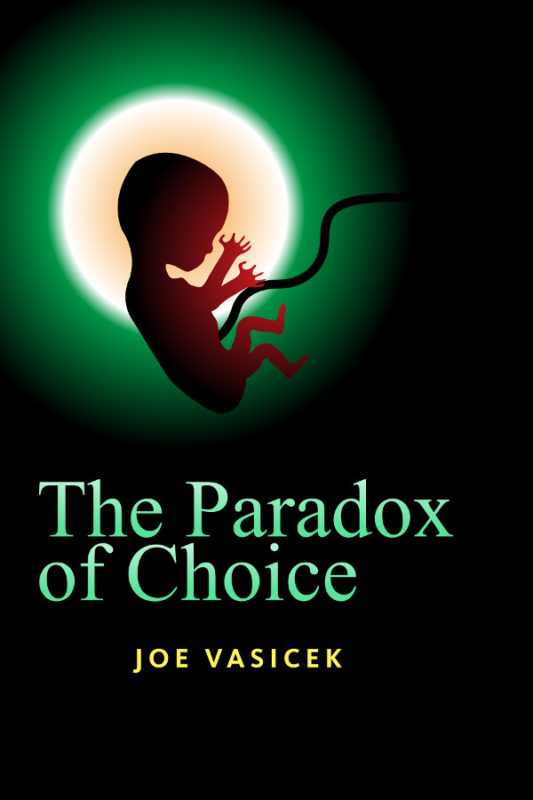
Beyond that, I don’t have anything specific planned, but I’m sure I’ll be writing more unapologetically pro-life stuff moving forward. And of course, there’s still “The Paradox of Choice,” which I’ve released into the public domain in case anyone wants to republish it or rewrite it or otherwise make it their own:

The Paradox of Choice: A Short Story

The Paradox of Choice: A Short Story

“In cases where there may be severe deformities… I can tell you exactly what would happen. The infant would be delivered. The infant would be kept comfortable. The infant would be resuscitated if that’s what the mother and the family desired, and then a discussion would ensue between the physicians and the mother.”

More info →

Three common tropes that I hate (and what I’d like to see more of instead)

So I’ve been reading a lot of books in the last few months, which means that I’ve been DNFing a lot of books too, and I’ve noticed some recurring patterns in the books that I’ve DNFed. A lot of these are tropes that I’ve either gotten sick of seeing, or that tend to make for a much weaker book. Or both.

I thought it might be interesting to point a few of them out, but I don’t want this post to be totally negative, so I’ll counteract that by also sharing some positive tropes that I’d like to see more of instead. If you guys enjoy this post, maybe I’ll do something like it again in a couple of months.

The Only True Love is LGBTQ Love

I see this one all the time in SF&F these days. Basically, if there are two characters who are romantically involved with each other, or if there is a romantic subplot to the story (not the main plot: sci-fi romance is a separate thing, for purposes of this trope), then that romantic relationship has to be gay, trans, or queer in some way. Or polyamorous, I suppose (does poly fall under the “+” in “LGBTQ+”? Maybe it’s the “P” in “LMNOP.”)

From what I gather, this trope began when LGBTQ activists pointed out that their particular kinks and orientations were “under-represented” in SF&F. Publishers, editors, and authors responded by filling their stories with more LGBTQ relationships, in order to avoid getting singled out as not being sufficiently LGBTQ-friendly. It’s the same principle as the zombie apocalypse: you don’t actually have to be the fastest runner, you just have to run faster than the guy behind you. Of course, since the SF&F field is so thoroughly dominated by leftists, pretty soon every story had an LGBTQ romance in it, to the point where straight romantic sub-plots are now actually kind of rare, at least in the books that are winning all the awards. Which is how you know the “under-representation” angle was a lie from the beginning.

It’s gotten to the point where if any character at all announces themselves as LGBTQ in the first few chapters of a novel, or the first few paragraphs of a short story, I immediately DNF. Call me homophobic; I don’t really care. These stories are so predictable that I can often pick out both which characters are going to be LGBTQ and which ones will end up together, within a page or two of them stepping into the story.

Of course, the main reason I don’t like these stories is because I’m not LGBTQ myself, and personally find straight romantic subplots to be much more interesting and satisfying. But there is another reason, and it has to do with the way that all of these stories aren’t just about entertaining readers, but about promoting LGBTQ pride.

This is going to get me a lot of hate, but it’s true so I’m going to say it anyway: the only thing that unites the LGBTQ movement together is the normalization of sexual perversity.

Think about it for a moment: what do each of the letters in LGBTQ really have to do with each other? Most gays would be happy to live in a world without women, and most lesbians would be happy to live in a world without men. Both of them view bisexuals with veiled suspicion and sometimes outright hostility, as if they’re somehow traitors to the wider homosexual cause. Transgenders affirm their identity by playing into as many stereotypes of masculinity and femininity as they can, which puts them directly at odds with masculine women and feminine men. And queers adopt all sorts of positions that contradict—or even negate—every other letter in the pantheon.

The LGBTQ movement is so full of internal contradictions that the only way it can hold together is to unite against a common enemy, and the only enemies that they all have in common are the people who affirm that there is a moral dimension to human sexuality, and that some forms of sexual expression are immoral. Even the modern notion that all consensual sex is fine goes too far for these people, because it excludes pedophilia, since children are not capable of giving their consent. And does anyone really doubt that one of the LGBTQ movement’s ultimate goals is to normalize pedophilia? When it’s not uncommon to see children under 12 at pride parades, drag shows, and drag queen story hour at the local library, sometimes as the very stars of the show?

I’ll say it again: the only thing that unites the LGBTQ movement is the normalization of sexual perversity. As soon as the leaders of the movement draw a line in the sand and say “this is not okay, this goes too far,” the movement will turn on itself and the revolution will eat its own. Thus, every new form of sexual perversion must be one-upped by something even more perverse. That is why we are literally butchering and chemically castrating children now.

(As a side note, it’s worth pointing out that being gay does not automatically make you part of the LGBTQ movement. My brother in law is openly gay, but he’s also a practicing Latter-day Saint who rejects all of this stuff. His faith is directly at odds with the LGBTQ movement, and he has chosen to keep his faith.)

So now, whenever I read a book with two (or more) characters in an LGBTQ relationship, I can’t help but feel that I’m reading “message” fiction, where the message is ultimately to normalize some other aspect of sexual perversion. Sorry (not sorry), but no thanks.

Instead: More pro-family, pro-natalist, life affirming fiction

So what do I want see instead? More stories with strong, healthy families. Stories about motherhood and fatherhood, that affirm the importance of both parents in raising children. Pro-natalist stories where having children is seen as a good thing, not as destroying the environment or burdening the world with more mouths to feed. In other words, stories that affirm and celebrate the intrinsic value of life—every life.

The one thing that all LGBTQ relationships have in common is that they cannot naturally produce children. Because of this, stories that follow the “all true love is LGBTQ love” tend to be about found families, rather than natural families. Parents are often absent or abusive in these stories, and children are either adopted or non-existant. A significant number of these stories also tend toward the macabre, since affirming the intrinsic value of life ultimately invalidates many of these LGBTQ relationships.

But that’s not why I want more pro-family, pro-natalist, life affirming stories. It isn’t about bashing LGBTQ, but about presenting a vision that stands apart from the LGBTQ movement, and doesn’t kowtow to the activists’ demands. It can even have room for some LGBTQ characters and relationships. Kings of the Wyld by Nicholas Eames is a good example of that, where one of the side characters is monogamously gay, and the protagonist is very much a family man. Another life affirming book I really enjoyed was To Sleep in a Sea of Stars by Christopher Paolini.

All Christians are Evil or Stupid

This is one you probably don’t notice if you aren’t Christian yourself, but I see it all the time, as do most other Christian readers that I know. If a character in a book or a story is some sort of Christian, then invariably they will turn out to be a villain, or so stupid that they’re less of a help and more of an obstacle to the protagonist. Or an eccentric curiosity.

It wasn’t always this way. Back in the 80s and 90s, there were lots of science fiction novels where the good guys were Christians. But these days, if the Christian character turns out to be a good guy, the author is either indie or a pariah to the rest of the SF&F field, like Larry Correia, John C. Wright, or Orson Scott Card.

Activists like to point out that if a majority of books tend to portray a particular race, gender, or sexuality in a negative light, it’s a sign that the field itself is racist/sexist/etc. They aren’t wrong. Now apply that to how mainstream science fiction and fantasy tends to portray Christians, and you begin to see the problem. There is a ton of anti-Christian bigotry in the culture right now, and it shows when you read most of these books.

Instead: More badass Mormons

So what do I want to see instead? More stories with badass Mormons. I’m only partially joking. As a member of the Church of Jesus Christ of Latter-day Saints, of course I would love to see more books with members of my faith doing awesome and inspiring things, but I’d be happy to see other kinds of Christians too.

Even books with generic Christians as good guys would be nice, but it would be better if something unique about their faith is central to the story. For that, you need to go deeper than a generic approach, so it would be better to make the character a member of a particular church or creed. And even though we Christians have our own theological differences, and sometimes argue quiet passionately over them, I wouldn’t at all mind to read stories with more Catholic main characters, or Evangelical, or even a well-written Jehovah’s Witness.

But personally, I want to see more badass Latter-day Saints.

An Innocently Profane and Vulgar Childhood

This one isn’t quite as prevalent as the other two, at least in the books I’ve read recently. However, it is definitely a common trope, especially in more recent books. Basically, it’s when something profane or vulgar invades a character’s childhood, but that isn’t portrayed as bad or even significant. For example, when there’s a child on the page and the people around them are swearing, or maybe even the children themselves. Or as a child, a character is exposed to something sexual, but it’s not a big deal.

In most of these books, it doesn’t seem like the author is doing it intentionally. But as Jonathan Haidt points out, liberals tend not to value things like purity and innocence as much as conservatives, or even really at all. Since the SF&F field is so thoroughly dominated by leftists, I think they often tend to violate the innocence of childhood without realizing that they’re doing it.

But in some books, it seems like the author is doing it intentionally to make a point: either that innocence itself is an illusion, or that children do better when they aren’t sheltered from the harsh realities of the world (they don’t). Or often, the author just thinks it’s funny to juxtapose childhood innocence with the profane (it isn’t—at least, not to me).

Instead: More noblebright

This isn’t generally a trope that you see in noblebright fiction. Not that noblebright doesn’t wrestle with questions of profanity, vulgarity, and evil, but it does tend to respect the boundaries of childhood innocence. And even after the characters lose their innocence, they still tend to become purified by the events of the story. There is a difference between being innocent and being pure, and a lot of really excellent noblebright stories explore the finer nuances of that difference.

Noblebright isn’t very popular right now, but I hope that will change in the coming years. There are some very good reasons to think that it will. Of course, noblebright can be done poorly, and stories that don’t put their characters into any real peril tend to be boring and unengaging. But it is possible to put children in peril without violating their innocence, or rejecting the concept of innocence to begin with. That is what I want to see.

Do trans people exist?

There’s this video clip currently making the rounds where Senator Josh Hawley (R-MO) confronts a crazy-eyed law professor from Berkely and gets called out for, among other things, saying that trans people “don’t exist.” It’s a highly partisan exchange that I’m sure will be used by both sides to rally the base, but it also gets at the fundamental incoherence of the modern LGBTQ+ movement, which I find absolutely fascinating.

First of all, it’s worth examining the accusation that Hawley doesn’t think that trans people “exist.” What exactly does that accusation mean? It can actually mean one (or both) of two things:

  1. The category of “trans” is not (or should not be) a legitimate identity for legal and societal purposes.
  2. People who identify as “trans” should be un-personed and deprived of all their basic human rights.

It’s extremely disingenuous of the professor to conflate those things, because it is entirely possible to believe the former without believing the latter: that is, to believe that “trans” as a category is illegitimate while also acknowledging that people who identify as “trans” are still people and deserving of basic human rights. Also, it’s disingenuous of her to argue that denying “trans” as a category causes people who identify as “trans” to commit suicide, as the suicide rate for transgender people is the same after they transition as it is before they transition. But I digress.

The thing that makes this interesting, at least to me, is that if you follow the professor’s logic to its conclusion, it actually undermines the fundamental premise of the gay rights movement: that gays, lesbians, and bisexuals didn’t choose to be gay, but in fact were “born this way.” Allow me to explain.

At first, the argument was “I didn’t choose to be gay, I was born this way.” Thus the concept of sexual identity was born, with categories for heterosexual, homosexual (gay/lesbian), and bisexual.

Then, the argument was “I’m a man/woman who was born in a woman’s/man’s body.” In other words, that gender and sex are separate things, and it is possible to identify with a gender that is different than your sex. Thus, the concept of gender identity was born, and with it the category of transgender.

At this point, it’s important to point out that the “born this way” argument still held sway. The idea wasn’t that trans people choose to change gender, but that they were, in fact, born in the wrong body. Thus the distinction between sex and gender.

But once the trans category was added to the movement, transforming it into LGBT, that created a major epistemological problem for its members: how do you know which category you belong to? That is, how do you know whether you’re actually a gay man, or really a woman in a man’s body? You can’t be both. You were either born one way, or you were born the other. So which one is it, and how do you know?

This is where the movement began to fall apart, because there is no objective way to tell the difference between gay/lesbian and trans. It’s entirely subjective. And once we allowed that, suddenly we got a bunch of people saying things like:

“What if I feel like a man today, and a woman tomorrow?”

“What if I don’t feel like a man OR a woman?”

“What if I feel like I’m actually a cat, or a wolf?”

“What if I feel like I’m a totally different gender/sexual category that none of y’all have imagined yet?”

And suddenly, just like that, the “born this way” argument was completely undermined, because if gender and sexuality are subjective, then it can be whatever you want it to be. Which is how we got personal bios like this one:

Serah Eley is a software developer and former podcaster who once produced a weekly science fiction podcast called Escape Pod. It’s since gone on to become somewhat successful. She strangely mispronounced her name as Steve Eley at the time; she’s since realized that life is much more fun as a woman, and came out as transgender last year. Serah lives in Atlanta, Georgia with her two wives, Alison and Cat.

So if there were ever any betting pools on what happened to Steve: changed sex, joined a committed lesbian love triangle is the dark horse winner. She is, obviously, still Having Fun.

So gender is something you can change on a whim because it’s “more fun”? That doesn’t sound at all like Serah was “born this way.” It sounds a lot more like “reality is whatever I want it to be.”

But if sexuality and gender are all subjective, the entire premise that the movement was originally built upon—that LGBT people are “born this way”—is completely false, and the “born this way” argument is outdated at best, and at worst was a Trojan Horse for the LGBTQ+ agenda from the very beginning.

Either way, by the standards of this Berkeley professor, gays, lesbians, and bisexuals “don’t exist.”

Just like man and woman “don’t exist.”

Just like objective reality doesn’t “exist.”

Because biological sex, “born this way” arguments, and objective reality itself are all fundamentally transphobic.

That’s where you get if you follow the LGBTQ+ logic to its ultimate conclusion. The fundamental premises on which the movement is based are totally incoherent and self-contradictory. It’s remarkable, really, because the language the movement uses is not all that different from the Orwellian doublespeak of 1984.

But hey, I’ve also been reliably informed that reason and logic are all just constructs of white supremacy, so obviously that means that professor crazy-eyes is right and there’s nothing to see here. Move along. Move along.

The Generational Cycles of Grimdark vs. Noblebright

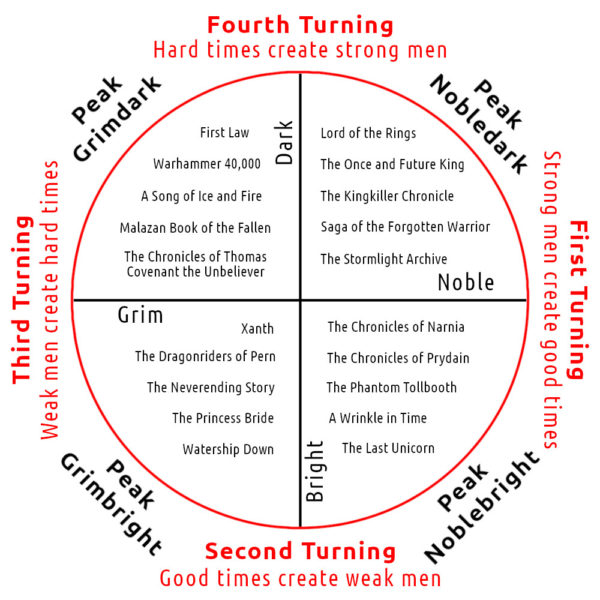
A couple of months ago, I was discussing genre trends with my indie publishing mastermind group where we drew some fascinating connections between grimdark fantasy, noblebright fantasy, and Strauss-Howe generational theory. In that discussion, we came up with a theory that predicts when each type of fantasy (grimdark, nobledark, noblebright, and grimbright) will be ascendant, and explains exactly why. According to this theory, grimdark is currently in the beginning phase of a multi-generational decline, and will be replaced by noblebright as the ascendant form of fantasy by about the mid-2030s.

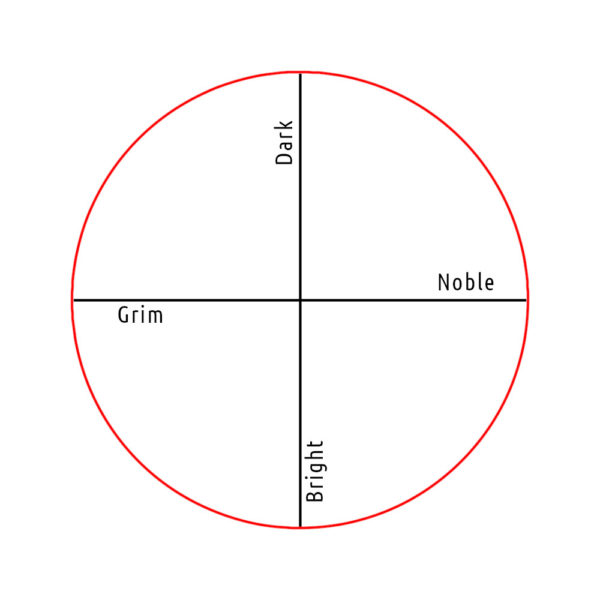
To start, we need to understand the difference between grimdark and noblebright. Both forms of fantasy exist on a field with two axes: noble vs. grim and bright vs. dark.

The bright vs. dark axis describes whether the fantasy takes place in a world where good usually triumphs over evil (bright), or a world where evil usually triumphs over good (dark).

The noble vs. grim axis describes whether the characters have the power to change the world (noble), or whether they do not (grim).

Thus, with these two axes, we get the following combinations:

  • Noblebright: A fantasy world where good usually triumphs over evil and the characters have the power to save it.
  • Grimbright: A fantasy world where good usually triumphs over evil, but the characters aren’t on a quest to save it and are usually preoccupied with smaller concerns.
  • Grimdark: A fantasy world full of moral shades of gray, where evil usually triumphs over good and the characters are either anti-heroes or otherwise fail to save the world.
  • Nobledark: A fantasy world where evil usually triumphs over good, but the characters are empowered to change it.

These categories are subjective to some degree, and fans will often disagree about which category to put each book/series. However, I think that most fans will agree on the following examples:

  • Noblebright: The Chronicles of Narnia by C.S. Lewis
  • Grimbright: The Princess Bride by William Goldman
  • Grimdark: A Song of Ice and Fire by George R.R. Martin
  • Nobledark: Lord of the Rings by J.R.R. Tolkien

Next, let’s review in the broadest possible terms William Strauss and Neil Howe’s generational theory. To really understand their work, I highly recommend that you read The Fourth Turning. I have some criticisms of the finer nuances of that book, but their ideas are really excellent, and their predictions hold up surprisingly well three decades later.

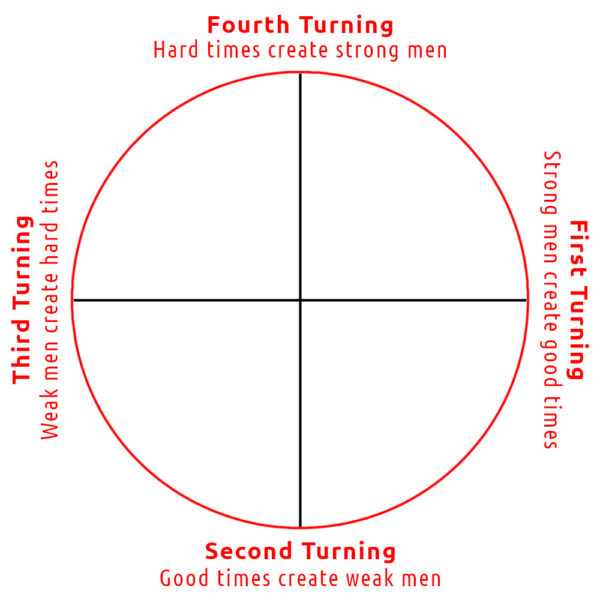
If I had to boil their theory down to one simple, easy-to-understand statement, it would be this:

Strong men create good times.

Good times create weak men.

Weak men create hard times.

Hard times create strong men.

Thus, our society and culture passes through a secular cycle that takes about 80-100 years to complete (or in other words, the length of a long human life). The cycle has four seasons, or turnings, each one corresponding to a generational archetype (since it takes about 20-25 years for people born in the one turning to start having children of their own, thus moving us into the next generational turning).

The first turning happens when the society comes together after resolving a major crisis (eg the Revolutionary War, the Civil War, World War 2) and builds a new, stable order. The second turning happens when their kids rebel against that order, seeking freedom (eg the First and Second Great Awakenings, and the various counterculture movements of the 60s). The third turning happens when the order breaks down completely and everyone goes their own way (eg World War I, the Roaring Twenties, and the culture wars of the 90s). Finally, the fourth turning happens when the society faces a major existential crisis that totally reshapes it.

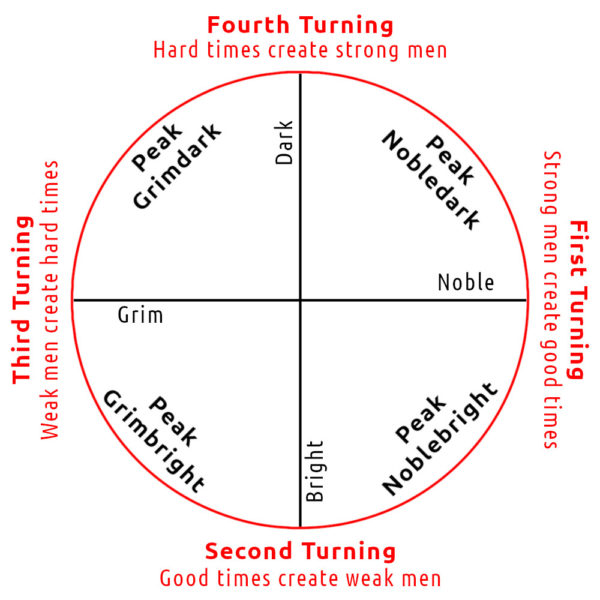
According to the theory, each axis of the grimdark/noblebright field corresponds to a different generational turning. Thus, stories that are noble have the most resonance in a first turning, stories that are bright have the most resonance in a second turning, grim stories resonate most in a third turning, and dark stories resonate most in a fourth turning.

In other words, the generation that comes of age during a major existential crisis will tend to gravitate more toward fantasy where evil typically triumphs over good, whereas the generation that comes of age during a period of rebuilding will tend to gravitate more toward fantasy where the characters have the power to change the world. And so on for bright and grim stories: the generation that comes of age during a spiritual awakening will gravitate more toward stories that take place in a world where good usually triumphs over evil, and the generation that comes of age in a declining and/or decadent society will gravitate more toward fantasy where the characters are relatively powerless.

Another way of thinking about it is to consider what each generation is not going to be drawn to, or which stories are not going to resonate well. An American who came of age in the 40s and 50s, when US power was on the rise and the Pax Americana was reshaping the world, isn’t going to resonate well with grim stories about powerless characters. Likewise, a boomer who came of age during the counterculture movements of the 60s and 70s isn’t going to resonate well with a dark fantasy world where evil usually triumphs, because (as much as they hate to admit it) they grew up in a very sheltered world that generally made sense—so much so, in fact, that they couldn’t help but rebel against it.

According to this theory, the next generational turning begins when one of the four forms of fantasy (noblebright, grimbright, grimdark, or nobledark) is at a peak. Over the course of the turning, that fantasy form declines until the next form in the cycle becomes ascendant, at which point the next generational turning begins.

Thus, at the start of a first turning, nobledark stories are typically ascendant, where the fantasy worlds are dark and morally gray, but the characters are empowered to save the world. As that generation successfully establishes a new order, the culture’s taste in fantasy shifts away from dark stories and toward noblebright stories, where the characters are still empowered but the world is more ordered and stable.

At the start of the spiritual awakening that characterizes a second turning, noblebright fantasy is ascendant: stories with an optimistic outlook on the world where the characters are larger than life. But as the awakening progresses, people in the society care more about freedom and individuality and less about the group, so stories about characters who sacrifice everything to save their world resonate less with them. Thus, by the end of the second turning, the ascendant form of fantasy is grimbright, which is really more of a slice-of-life fantasy about beloved characters having fun (but not world-altering) adventures.

At the start of a third turning, where the social order has started to break down and corruption begins to permeate all levels of the society, these grimbright stories start to take a darker tone. Readers find it too “unrealistic” to believe that good always triumphs over evil, and they certainly do not believe that good people have the power to change the world—at least, not the “smells like teen spirit” world that they inhabit. Their tastes shift away from the fun, adventurous slice-of-life of grimbright, and toward the dark and gritty anti-heroes of grimdark.

Finally, at the start of the fourth turning, grimdark is ascendant, but readers are starting to lose patience with it. As each new crisis in the real world compounds with all the others, they find it unbearable to read about characters that don’t have the power to change the fantasy worlds they inhabit. At the height of the fourth turning, society reaches an existential breaking point where, in the words of Strauss and Howe, “all of [our] lesser problems will combine into one giant problem, [and] the very survival of the society will feel at stake.” (The Fourth Turning, p277) At this point, readers are ravenous for books about characters who are empowered to fight back against the tides of evil and darkness. Grimdark fantasy declines and nobledark fantasy ascends.

I haven’t read all of the series in the diagram above, but I do have a pretty good sense of most of them, and I put the diagram together with the help of my mastermind group. The key thing about it is that each fantasy series came out in roughly the generational turning that corresponds with each quadrant.

Now, it’s worth pointing out that these trends aren’t absolute. In each of the secular seasons, you can find examples of contemporary fantasy that runs counter to trend. For example, David Gemmell’s Drenai Saga came out in the 80s, at the start of the last third turning when grimbright should have been ascendant, and yet the Drenai Saga is solidly nobledark. Terry Pratchett’s Discworld books had their heyday in the 90s, 00s, and arguably 10s, but they probably fall into grimbright (though you could make the argument that, as absurdist fantasy, they are more similar to grimdark: stories where good and evil really doesn’t matter, and the characters are just doing their best to go along).

But the theory doesn’t state that each fantasy form’s antithesis dies completely when that form is ascendant: only that it reaches a nadir of decline in its resonance with the culture. But without sufficient contrast, the ascendant form cannot stand out. Thus, there still has to be some noblebright Paolini to provide sufficient contrast with the grimdark of Abercrombie and Martin, some low fantasy slice-of-life Legends and Lattes grimbright to make the epic nobledark high fantasy of Sanderson stand out stronger.

According to this theory, as we continue to muddle our way through this present fourth turning, the decline of grimdark fantasy will accelerate, and the bestselling fantasy books of the 2020s will mostly be nobledark. And indeed, we can already see that happening with the meteoric rise of Brandon Sanderson (especially his Stormlight Archive series), the popular enthusiasm surrounding Larry Correia (whose Saga of the Forgotten Warrior falls squarely into nobledark), and the enduring anticipation of Patrick Rothfuss’s fans for the conclusion to the Kingkiller Chronicle. Meanwhile, enthusiasm for George R.R. Martin has waned significantly with the train wreck of Game of Thrones, and Abercrombie, though still quite popular, seems to be testing the nobledark waters with his YA books.

It would really be interesting to do a deep dive on the generational archetypes and make a study of how that affects the fantasy forms that run counter to the cycle. But that’s beyond the scope of this blog post, and frankly I need to get back to writing my own books. But what do you think of this theory? Does it resonate with you, or is there something that we missed?

How I keep my reading journal

I am amazed at how many books I’ve read so far this year. Looking just at my resolution to read all of the Hugo and Nebula winning novels, I started with only 32 out of 110 read, and now I’m nearly at 100. Granted, for a lot of those I only read the first and last chapter, but I also read several dozen of them cover to cover—and I’ve also read a bunch of other books, too.

What was the thing that pushed me over the tipping point? I used to only read two or three books a month, if that. Then my wife and I started taking our reading time more seriously, taking our family to the library once a week and setting aside an hour each night to read before going to bed. She helped me to make a reading log to keep track of everything, and that certainly helped a lot. It also helped to have specific reading goals, like read all of the Hugo and Nebula winning books this year.

But the thing that really kicked my reading into high gear was to start keeping a reading journal. I used to have one back in high school, but all I really used it for was to save quotes, and I lost it sometime before I got married. But I remembered how that helped me to read more back in high school, so a couple of months ago I decided to start a new one.

The reading journal I keep now is handwritten in a composition notebook. I just prefer the feel of pen on paper, especially for something private like this. And it is a private journal, unlike the daily diary that I hope to share with my kids and grandkids someday. Maybe I’ll share it with close family, but for now, I’m keeping it only for myself.

If I weren’t an author, I might cross-post things from my reading journal to Goodreads and other social media sites, but since this is what I do for a living, I think it’s better to keep my reviews to myself. After all, I don’t want to give a book a bad review, only to find that several of my fans consider it their favorite book. I also want to avoid attracting the ire of any online outrage mobs, which is why I don’t post much of anything to Goodreads anymore. That’s also why I decided not to do BookTube. But if writing books wasn’t the main way I make my living, I might share some of this stuff (some of it) with my friends on social media.

So here’s what I include in my reading journal:

Monthly read/DNF lists

At the start of each month, I start a new page with two lists on it: one for all of the books that I read, and another for the ones that I DNF. Throughout the month, I add books to each list as I read/DNF them. This gives me a great way to look back at the end of the month and see, at a glance, how much progress I made.

For the books I’ve read, I also make a note in the margin if I think the book was good enough to acquire a physical copy. My long-term goal is to build a personal library of all the best books that I’ve read, so this is a way to advance that project.

Also, in the list of books I’ve DNFed, I make a note in the margins if it was a soft DNF and I may consider coming back to it at some point. I believe in DNFing early and often, but I also think that it’s good to occasionally revisit those DNFs and try them again.

Quotes that stood out

If a passage of something I’m reading stands out to me as particularly quoteworthy or memorable, I put a little post-it note on the page so that I can find it later, after I’m done reading for the day (or night). Then, I write it down in my reading journal, with the author, book title, and page number.

I’m not all that particular about collecting quotes, but if I’m really loving a book, pulling out a couple of memorable passages can enrich the reading experience and help me to remember what I’ve read. It’s also fun to share those quotes on my blog and social media, with friends who might not have read the book yet.

Books that I’ve loaned

One of the main reasons that I want to build a personal library of physical books is so that I can share them with my friends. Of course, it’s easy to lose track of which books I’ve loaned out already, and friends are prone to lose them if you don’t remind them about it from time to time.

So whenever I loan out a book, I make a note in my reading journal of that, including the name of the person I loaned it out to. And when they return it, I make a note of that too.

Ratings and reviews

I don’t really write “reviews” in my reading journal, because it’s a private journal that isn’t meant for public consumption. But I do include a few notes, generally no more than a page, for every book that I read or DNF. This usually includes my thoughts and impressions of the book, what made me DNF it if that was the case, and anything I liked or didn’t like about it.

In addition to those notes, I also give it a 1-5 star rating in the margin, using the following scale:

  • 1 Star: I thought this book was terrible.
  • 2 Star: I didn’t like this book, but it wasn’t terrible.
  • 3 Star: I thought this book was okay, but not great.
  • 4 Star: I thought this book was really good.
  • 5 Star: This is one of the best books that I’ve ever read.

Of course, it’s all very subjective, but that’s kind of the point. When I want to come back later and see what I thought of a particular book, I can see the star rating and read about what my thoughts and impressions were at the time, which give me a pretty good snapshot. If I decide to reread a book, I do the same thing for the second-read through so that I can judge the two experiences.

Anthologies and collections

If I decide to read a collection or anthology (or magazine issue, for that matter), I first list the title of every story in the book, with room on one side to mark the date that I read it, and on the other side (usually the margin) for what my 1-5 star rating was for that particular story, or whether I skipped or DNFed it.

I don’t bother writing out my thoughts and impressions for every story, but when I’m done with the collection/anthology, I do write down a few notes on it just like any other book.

Other things that I plan to include

At this point, my journal is pretty low-key, and it only takes a few minutes to update it whenever I do. However, as I get more into it, I will probably include things like proper journal entries, my thoughts on reading in general, things that I want to see in the genres that I read, and other ruminations like that. The format is really flexible, which is nice, because I’m sure I’ll be adapting it to all sorts of new things in the future.

Taken together, keeping a reading journal like this has really helped me to track my progress, not just in terms of numbers, but in terms of thoughts, impressions, and experiences. And I think that’s the key right there. Instead of each book being its own separate experience, I feel like it’s all a part of a much bigger whole, where each new book is part of a journey. What is the destination of that journey? I’m not entirely sure, but I think it’s helping me to be a better reader, writer, and person overall.

“It’s what you know for sure that just ain’t so.”

So I DNFed Timescape by Gregory Benford today. I didn’t like any of the characters, and the retro-future view of the 90s as a dystopian post-climate catastrophe wasteland was predictably bad. But this quote from the afterword got me to thinking:

Habitual readers of science fiction will feel right at home with some features of Timescape: the ecological crisis, the contact between past and future and resultant time paradox, the scientists working to solve a scientific puzzle and save the earth [sic], and even a certain amount of scientific theorizing.

For 70s science fiction, the idea of an imminent, inevitable, and nigh-apocalyptic environmental collapse was thought to be so ingrained in the genre that it was accepted as a foundational trope of the genre. As a consequence, 70s science fiction tends to age very poorly. Almost all of the “important” works of the era, like Timescape, are infused with this Malthusian nonsense, and accept as axiomatic that all of the big crises of the 70s would only get worse and worse.

In contrast, the science fiction of the 40s and 50s was all about how science could help us to overcome the crises of their time, not how those crises were fundamentally insurmountable. Small wonder, then, that authors like Heinlein and Clarke inspired us to put men on the moon and satellites into orbit. And what did the authors of the 70s inspire us to do? Certainly not to tear down the Iron Curtain, pull the world back from the brink of nuclear war, or reduce global poverty at the most extraordinary rate in history. And yet, all of those things actually happened.

It makes me think of this apocryphal Mark Twain quote:

It ain’t what you don’t know that gets you into trouble. It’s what you know for sure that just ain’t so.

So what are some of the current assumptions of the science fiction field that will make future generations of readers scratch their heads? What are the things that will make the “important” works of 2020s science fiction age rather poorly?

Racial essentialism is probably a big one. I sense a growing cultural backlash against the racism of the intersectional left, especially in the wake of the George Floyd riots of 2020. That’s why the term “white supremacy” is in vogue right now, because the word “racist” has lost all of its power through overuse. If Worldcon doesn’t survive the pandemic, then I suspect that at least a few future SF historians will draw a connection between the Hugo’s demise and N.K. Jemisin’s three consecutive Hugo wins in the 2010s.

Transgenderism is probably another. Laying childish things aside, a society that rejects the biological essentialism of gender is not even metastable, as we’re seeing right now with all of the rapes in transgender bathrooms and prison facilities, with the obvious social contagion driving LGBTQ trends in the rising generation, and with all of the ways that political correctness demands that we reject basic science, typified so perfectly by the pregnant man emoji. That doesn’t necessarily mean that gender norms will revert to what they were in the 50s—in fact, I tend to think that the norms of that era were only metastable at best—but I do think that there’s a major cultural backlash on the horizon.

There’s a lot of other low-hanging fruit: the cli-fi of our era will probably age just as poorly as the apocalyptic visions of climate catstrophe written in the 1970s, and books that are based on 20s feminism will probably age just as poorly as 20s feminism itself. But what about some of the more difficult things to predict?

One of the more subtle ways that our current science fiction may age poorly is the complete ignorance of worldviews that clash with the established narrative. I would say that there’s a refusal to engage with contrary narratives, but it actually goes much deeper, as many writers are so deep in their own echo chambers that they don’t even know that contrary viewpoints exist. This has less to do with partisan politics and more to do with all of the ways that social media has re-engineered our society. Future generations will probably see the effects of this re-engineering much more clearly, and will wonder that the science fiction writers of our age were so unaware of how it affected them—both on the political right and on the political left.

Another less obvious thing is our generation’s lackadaisical and often schizophrenic attitudes on the importance of the family. When the chaos of the 20s is finally in the rear-view mirror, I suspect that there’s going to be a major groundswell of public interest in forming, cultivating, and maintaining strong families—largely because I suspect that’s how we’re ultimately going to find our way out of all this chaos. There’s a reason why Augustus Caesar, founder of one of the greatest empires in world history, placed such an emphasis on the importance of the family. Much of today’s science fiction takes it for granted that “love makes a family,” which was never true in any age—not even our own. It also takes for granted that found family is an adequate substitute for the real thing. With mutual commitment and great personal sacrifice, it can be, but that isn’t usually expressed on the page.

Does this feel a bit too much like wishcasting? How am I wrong, or what are some of the other things that I’ve missed? It’s probably just as difficult for us to answer this question as it is for a goldfish to comprehend what water is, but it is an interesting exercise, and hopefully a useful (or at least entertaining) one.

Reading Resolution Update: April

My 2022 reading resolution: Read or DNF every novel that has won a Hugo or a Nebula award, and acquire all the good ones.

In 2007, when I was a sophomore in college, I went up to Salt Lake City with some friends and was browsing the awesome (and fairly run down, even at the time) used bookstore near the Gallivan Plaza TRAX stop, which has since changed names and moved to another location. It was a really awesome used bookstore, and I determined to buy a SF novel while I was there, since I was really getting back into SF after my mission. I saw a massive 600+ page trade paperback edition of Cyteen by C.J. Cherryh, and since I was reading Downbelow Station at the time, I decided to get that one.

For the next fifteen years, I lugged that book everywhere, through more than a dozen moves (though for the biggest move, where I made the pioneer trek in the wrong direction and repented 8 months later, I boxed it up with my other books and left it in a friend’s basement). In all that time, I never actually read it—or even opened it up, really—but it was always there, somewhere in the middle of my dismally long TBR list.

It wasn’t that I didn’t want to read it: I just didn’t have (or make) the time. Downbelow Station had been an okay read, if not spectacular, but I had really enjoyed some of C.J. Cherryh’s shorter books, like Merchanter’s Luck and Voyager in Night. Also, space opera books about sprawling galactic empires were right up my wheelhouse, so it didn’t seem odd for me to own such a book that I hadn’t yet read. In fact, most of the books that I owned throughout this time were books that I wanted to read but hadn’t gotten around to yet. If I have a superpower, it’s an uncanny ability to acquire books no matter where I am. Unfortunately, I’m not as good at reading them.

Fast forward to 2022. I’ve gotten married, had a daughter, launched my own writing career, and become a homeowner—and I’m still lugging this massive 600+ page trade paperback book that I’ve never read. But I’ve just set a resolution to read (or DNF) every Hugo and Nebula award-winning novel, and Cyteen is on the list. So around the middle of March, I finally open it up and start reading it.

After about a month, I decided to DNF it.

It’s not that it was terrible. Perhaps you enjoyed it, and that’s fine. I just found it to be too drawn out and confusing. I think C.J. Cherryh does better when she’s focusing on just a few characters, rather than trying to give the grand sweep of galactic civilization or whatever. I didn’t finish Foreigner for similar reasons. Maybe someday I’ll return to that one and Cyteen, but for now, I’m counting it as a DNF.

But the thing is, I was hauling around this massive book for most of my adult life. When I bought it in 2007, I figured that since it had won a Hugo, it had to be good. Perhaps, if I’d read it back then, I would have been more patient with it and slogged through to the end. Perhaps I would have decided it was just as good as Downbelow Station. Or perhaps, if I read Downbelow Station today, I would end up DNFing it as well.

The point is, I wish I’d been a lot more discerning about my reading when I was younger, and not just acquired books that I hoped to read “someday”… because books (at least the paper ones) are heavy and take up a lot of space. And a lot of them really aren’t worth reading. Of course, you’ve got to read a few stinkers to figure out what you really like, so it isn’t always a waste… but libraries exist for a reason.

So what this experience really tells me is that Mrs. Vasicek and I are doing the right thing by taking our family to our local library once a week. Also, it tells me that the second part of my resolution—to actually acquire all of the books that I think were worth reading—is just as important as actually reading them. Because, if the ultimate goal is to “seek… out of the best books words of wisdom,” then it’s not enough to just make a list: you actually have to read the damned things, and keep your own personal library in order to revisit those words and share them with others. Because ultimately, you have to discover which books are the “best books” on your own, and your best books list isn’t going to be the same as anyone else’s best books list. Which means that you can’t rely on anyone else’s list. You can use it as a starting point to make your own list, but that’s all you should use it for.

So now I want to go through all of the books I’ve acquired over the years and figure out which ones I ought to get rid of, because Cyteen certainly wasn’t the only one. In fact, most of the books in our family library are books that I haven’t (yet) read. By my count, there are just under 150 of them, totalling about 55k words. Even at a rate of 100 words or two hours of reading each day, that’s still going to take almost two years… and that’s not counting all the library books that we’re sure to check out in the meantime.

Oh well. I suppose this is more of a process than anything else. Journey before destination, and all that. And I’m sure I’ll have fun in the process, since despite the fact that I DNF far more books than I actually read, I do genuinely enjoy reading.

In any case, here are all of the Hugo and Nebula award-winning books that I read (or DNFed) in the month of April:

Books that I read and plan to or have already acquired:

  • Rainbows End by Vernor Vinge (2007 Hugo)
  • Blackout by Connie Willis (2011 Hugo and Nebula) (audio)

Books that I read and do not plan to acquire:

  • Blackout by Connie Willis (2011 Hugo and Nebula) (print)

Books that I did not finish:

  • A Time of Changes by Robert Silverberg (1972 Nebula)
  • The Gods Themselves by Isaac Asimov (1973 Hugo and Nebula)
  • The Fountains of Paradise by Arthur C. Clarke (1980 Hugo and Nebula)
  • The Claw of the Conciliator by Gene Wolfe (1982 Nebula)
  • Cyteen by C.J. Cherryh (1989 Hugo)
  • Tehanu by Ursula K. Le Guin (1991 Nebula)
  • The Diamond Age by Neal Stephenson (1996 Hugo)
  • The Moon and the Sun by Vonda N. McIntyre (1998 Nebula)
  • Parable of the Talents by Octavia E. Butler (2000 Nebula)
  • 2312 by Kim Stanley Robinson (2013 Nebula)
  • Beyond This Horizon by Robert A. Heinlein (1943 Retro Hugo, awarded in 2018)
  • The Nemesis from Terra by Leigh Brackett (1945 Retro Hugo, awarded in 2020)

Total books remaining: 26 out of 110 (currently reading 12 and listening to 3).

Reading Resolution Update: March

My 2022 reading resolution: Read or DNF every novel that has won a Hugo or a Nebula award, and acquire all the good ones.

So March is usually the time where people get tired of their new year’s resolutions and either give them up entirely or put them on the back burner for a while. But at this point, I’m a little more than halfway through achieving this one, so I will definitely keep pressing on since I don’t think it will take the whole year to accomplish it. In fact, I may actually expand it to include all of the short stories, novellas, and novelettes. I’ve already filled out the spreadsheet (with a huge thanks to the Internet Speculative Fiction Database, which also lists all of the collections and anthologies where each story can be found).

With that said, my enthusiasm for reading all of these books is starting to flag, and I’m not pushing on as vigorously as I did back in January. There have been a lot of DNFs… a lot of DNFs. But now, I’m starting to get to the books that aren’t obvious DNFs, which is frustrating, because when you get more than halfway through a 600 page book before you realize it isn’t worth finishing, that really does take the fun out of reading, at least in the short term.

But it has been very eye-opening to see what kinds of books tend to win Hugos and Nebulas. I’ve noticed some interesting patterns that have given me real insight into the people who vote in these awards, which consists of the old guard in fandom for the Hugos, and members of SFWA (mostly professional authors) for the Nebulas.

One book in particular I found really eye-opening in this regard, and that was They’d Rather Be Right by Mark Clifton and Frank Riley. Mark Clifton was a science fiction short story writer who was fairly prolific, but died tragically about ten years after They’d Rather Be Right came out in 1955. Frank Riley was a newspaper man who dabbled a little bit in mystery short stories but only ever co-wrote this one novel.

They’d Rather Be Right is a notoriously difficult book to get your hands on. An abridged version with the title The Forever Machine is on sale on Amazon somewhere north of $100, and neither version was available at either my local library or the Harold B. Lee Library at BYU, and that’s unusual because the HBLL’s science fiction and fantasy collection is one of the best in the country. I eventually bought a used version of They’d Rather Be Right on Amazon from a third-party seller for $10: it was an old library copy from a small town in Arizona, and I think the seller was the actual library.

In reading about this book, I discovered that it’s been widely panned as the “worst book to win a Hugo.” However, after reading it, I can definitely say it is not the worst book. It’s not the best book either, but it is far from the worst, and I enjoyed it enough to put it on the “books worth keeping” list. So why is it considered the worst Hugo-winning book, and why has it been forgotten so thoroughly?

My working theory is that They’d Rather Be Right isn’t actually bad, it’s just heretical. Science fiction has always skewed toward the political left, and this book thoroughly ridicules some deeply held left-wing beliefs of its day. For example, it goes out of its way to ridicule scientists as a class, and makes it seem ludicrous that they have any business deciding on how the rest of society should be governed. It also pokes fun at some of Sigmund Freud’s ideas, which is notable because so many of the Hugo and Nebula winning novels of the 60s and 70s are so thoroughly Freudian.

So what happened, I believe, is that after the Hugos became a regular feature of Worldcon (They’d Rather Be Right was only the 2nd novel to ever win a Hugo), the influencers and kingmakers within fandom decided that this one won on a fluke, and did everything they could to suppress it. And perhaps it really was a fluke, since the Hugo Awards weren’t yet established, and Worldcon itself was only a little more than a decade old.

Because here’s the thing: the Hugos and the Nebulas have always been radically left-wing. Science fiction in general has always leaned hard to the left, and those of us who consider ourselves right-wingers have always been a despised minority to most of the rest of fandom. That didn’t start in the 50s either: if anything, it started with the Futurians, as Donald Wollheim himself (founder of DAW Books) said that science fiction “should actively work for the realization of the scientific world-state as the only genuine justification for their activities and existence.” The Futurians were the ones who founded both Worldcon and SFWA, as well as several other establishment institutions in the SF&F field.

But I think it started before the Futurians, because it makes a lot of sense that science fiction would attract left-wingers more than it would right-wingers. Left-wingers are the kind of people who think that traditions should be thrown out and new ideas should be implemented, whereas right-wingers are the kind of people who think that new ideas should be treated cautiously, and traditions should be upheld.

There’s a cycle that happens about every 50 to 100 years, and it goes like this: someone comes up with a Beautiful Idea that almost everyone on the left becomes enamored of. They pore over this idea, ponder it, debate it amongst themselves, and spill copious amounts of ink over it, mostly in the form of academic discourses and thesis papers.

Gradually, this idea matures into a General Theory, and the left constructs a whole worldview around it. But at this point, it starts to come into conflict with reality—not in a catastrophic way at first, but definitely in a way that causes some uncomfortable cognitive dissonance. But because the Beautiful Idea was so beautiful, none of the theory’s proponents really want to give it up, so they start to build a bulwark of apologia to explain the theory’s inconsistencies and contradictions.

After a while, though, that isn’t enough, and reality begins to intrude in ways that simply cannot be ignored. At this point, the General Theory morphs into an Ugly Ideology, possessing all of its followers and driving them into incredible pathologies. Groupthink and doublespeak become de rigueur, and hypocrisy infects everyone. Values like diversity, curiosity, open inquiry, freedom of speech, and intellectual honesty are all thrown out, as nothing is more important than promoting the ideology. Right and wrong cease to matter as well: the only thing that matters is power.

Eventually, reality intrudes in such a way that the entire edifice comes crumbling down, completely discrediting the Beautiful Idea and everyone who ever believed in it. But if the Ugly Ideology persists for too long, it culminates in a reign of terror, with guillotines, gas chambers, firing squads, holocausts, and genocides.

Fortunately, there are people who drop out at every stage of this cycle: “That’s a Beautiful Idea, but it’s still flawed.” “I like the General Theory, but I don’t think it explains everything.” “I am a true believer in this Ugly Ideology, but I’m not going to pull the trigger on those people.” And if enough people drop out, the pendulum swings back, the left goes into retreat, and culture and politics swing back to the right again… until someone discovers (or rediscovers) a Beautiful Idea.

In the 60s and 70s, the left was in the early stages of the Ugly Ideology phase of this cycle. Not surprisingly, the science fiction of that time was pretty terrible. Then the Reagan era happened, the Soviet Union collapsed, the Cold War ended, and left was thrown on the back foot for a generation. During this time (the 80s and 90s), the award-winning science fiction was actually pretty good.

But that was also the time when the ideas that underpin critical race theory began to take root—the “Beatiful Ideas” that gave us, among other things, Defund the Police, the George Floyd riots, the epidemic of smash-and-grab robberies, and the ongoing collapse of leftist-run cities like Chicago and San Francisco. In science fiction, this culminated in the sad and rabid puppies, at which point the Hugos and Nebulas became total garbage again, because the left-leaning fandom had become so ideologically possessed.

So anyways, that’s my take on it. I really did enjoy They’d Rather Be Right, and not just for the insights into fandom. In any case, here are all of the other Hugo and Nebula winning books I read or DNFed in March:

Books that I read and plan to or have already acquired:

  • They’d Rather Be Right by Mark Clifton and Frank Riley (1955 Hugo)

Books that I read and don’t plan to acquire:

  • The City & The City by China Mieville (2010 Hugo)

Books that I did not finish:

  • Stranger in a Strange Land by Robert A. Heinlein (1962 Hugo)
  • To Your Scattered Bodies Go by Philip Jose Farmer (1972 Hugo)
  • Where Late the Sweet Birds Sang by Kate Wilhelm (1977 Hugo)
  • The Snow Queen by Joan D. Vinge (1981 Hugo)
  • The Yiddish Policeman’s Union by Michael Chabon (2008 Hugo and Nebula)