The false narrative of a transgender “genocide” is a call for violence

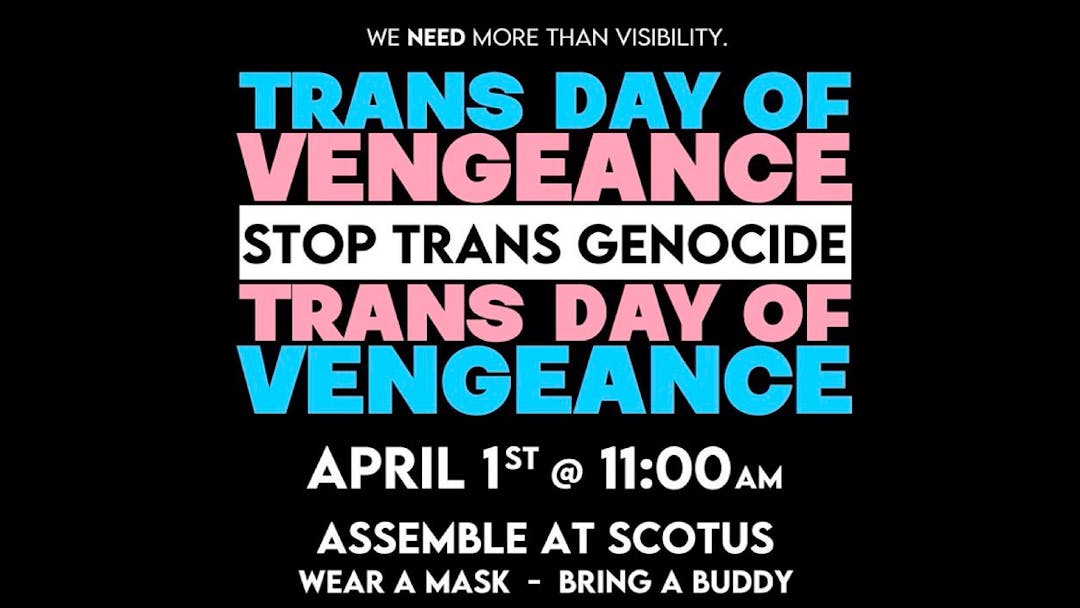
Yesterday, a 28 year-old female-to-male transgender attacked a private Christian school in Tennessee, killing three teachers and three nine year-old students before being shot and killed by police. According to the police, this was a targeted attack that was likely motivated by the shooter’s transgenderism. Tennessee recently passed a ban on transgender surgeries for minors, and this shooting happened immediately after trans activists called for a “day of vengeance” against what they falsely call a “genocide.”

What do the trans activists mean when they accuse conservatives of perpetrating a “genocide” against them? Where did they come up with that term? My understanding is that it comes from the idea that when somebody declares themselves as trans, they adopt a new persona that replaces who they were before. Thus, the new persona of Caitlyn Jenner replaced the old persona of Bruce Jenner, or the new persona of Elliot Page replaced the persona of Ellen Page. In the eyes of the pro-trans ideologues, when a trans person adopts their new persona, it is like a new person is born into the world. Thus, anyone who refuses to affirm their transgender identity is guilty of trying to “kill” this new person, and anyone who opposes transgender ideology generally is guilty of “genocide.”

We saw this play out recently in the fiasco over the 2021 Hugo-nominated short story “I Sexually Identify as an Attack Helicopter.” It started when Clarkesworld published the story, which was written by an anonymous male-to-female transgender under the name Isabel Fall. The story was based on a meme ridiculing transgender ideology, and Fall’s intent in writing the story was to own the meme and turn it into a pro-trans statement. However, the readers of Clarkesworld failed to recognize this, and attacked Fall as being secretly anti-trans, going so far as to suggest that Fall’s author bio (born in ’88) was a dog whistle to Nazis.

This is where things get interesting. Isabel Fall (who to my knowledge still remains anonymous) reacted to these attacks by requesting that Neil Carke unpublish the story. Fall then decided that he wasn’t transgender after all, and stopped transitioning. This prompted a bunch of hand-wringing by the woke leftist mob that had attacked Fall as being secretly anti-trans, ultimately culminating in the essay “How Twitter Can Ruin a Life,” which was nominated for a Hugo in 2022. When you read it, you realize that these people literally believe that Isabel Fall was “killed” by the online reaction to “her” story, and thus became a victim of the ongoing “trans genocide.”

Here’s the thing, though: nobody actually died in this fiasco. The person who wrote “I Sexually Identify as an Attack Helicopter” is still, to my knowledge, very much alive. But the three nine year-old kids and their three teachers who were shot to death in Nashville yesterday by a transgender mass shooter are NOT alive. And if it turns out that the shooter was motivated by this false narrative of a “transgender genocide,” then all of the trans activists calling for violence in reaction to this “genocide” have blood on their hands.

It very much reminds me of how woke ideologues conflate speech with violence, and violence with speech. The logic goes like this: hate speech is a form of violence, therefore we are justified in using actual, physical violence to silence and intimidate anyone who is guilty of anything we deem to be hate speech. In much the same way, trans activists believe that the rejection of anyone’s transgender persona is a form of genocide, and therefore people like this shooter are justified in committing actual mass killings of people who oppose transgenderism.

It is not possible to share a country with these people, for the simple reason that it is not possible to agree to disagree with someone who follows this kind of zero-sum logic. We must all either submit to their ideology, or we must, as a society, reject it. Don’t get me wrong: I’m not saying that we should round up and kill anyone who posts a transgender flag to their social media. However, anyone who calls for violence in response to the “trans genocide” should be prosecuted immediately, and punished to the fullest extent of the law. Calls for violence are not protected speech under the first amendment. If we fail to do this—if our legal system fails to hold these transgender ideologues responsible for their crimes, perpetuating the double standard that lets “mostly peaceful” leftist rioters walk free while the J6 “insurrectionists” languish in solitary confinement—then I fear that our country will break apart and fall.

I say this, recognizing that it may very well get me black-listed in the award-winning publications in my own field. Mainstream science fiction has very much embraced the transgender ideology that promotes this false narrative of a “trans genocide,” as evidenced by the fact that “How Twitter Ruined a Life” was nominated for the Hugo. But as a writer, I believe that it is my solemn duty to speak the truth as best I understand it, and when I see tragic events like the ones currently unfolding in Nashville, I cannot in good conscience remain silent about this issue.

Accusation is projection is confession. When transgender activists accuse us of committing genocide, they are confessing that they want us all dead. Plan accordingly.

An unpopular truth

Women who refuse to have children and men who forsake their responsibilities as fathers will be the downfall of our civilization.

We all owe an incalculable debt to the generations that came before us, and the only way we can pay back any portion of that debt is to pay it forward. It’s not enough just to “make the world a better place”: we must, ourselves, become a link in that generational chain that connects humanity’s past with its future, binding the fathers to the children and the children to the fathers.

I recognize that there are women who cannot have children, or who do not have the opportunity to have a healthy family of their own. I also recognize that there are fathers who want to be present in their children’s lives, but are deprived of that opportunity by forces outside of their control. I’m not talking about those people.

I’m talking about the people who have every opportunity to raise a family, and deliberately choose not to. In their selfishness, those people are unwittingly depriving themselves of the fulness of the human experience. More importantly, their selfishness is destroying our culture, our society, and our civilization.

If the West falls, it will be because of childless women and absent fathers.

This scenario would fulfill Ezra’s Eagle

UPDATE (6 November 2024): I have written a new post with my post-election thoughts on the Ezra’s Eagle prophecy, as well as an in-depth analysis of the lost ten tribes and how they may (or may not) play into the apocryphal prophecy. Read about it here.

UPDATE (12 August 2024): I don’t know why Google has made this old blog post their #2 result for the search term “Ezra’s Eagle,” but if that’s what brought you here, you probably should check out this page first, taken from Michael B. Rush’s book A Remnant Shall Return. As far as I can tell, he’s the one who discovered this obscure apocryphal prophecy and how it (might) speak to our day. He’s also posted the complete audiobook on YouTube:

To be clear, I don’t necessarily agree with or endorse everything that Rush says. In fact, I’m not even sure if I believe in the Ezra’s Eagle prophecy anymore, or in Rush’s interpretation of it. But if that’s what you’re looking for, his book is the place to start.

UPDATE (21 July 2024): With everything that has happened in the past week, I have posted an update to this scenario, which could still play out very similarly to how I outlined it in this post. You can find that update here.

ORIGINAL POST (6 March 2023): For the last couple of months, I have been fascinated with the prophecy of Ezra’s Eagle as laid out by Michael B. Rush. I’m reading his book A Remnant Shall Return right now, and while some of the stuff sounds crazy to me (like the idea that the lost ten tribes will come down from space and save America from the Antichrist), I think he may be on to something with his interpretation of Ezra’s vision in chapters 11 and 12 of 2nd Esdras.

If you’re not familiar with Ezra’s Eagle, you can read this sample chapter from his book that explains it, or you can watch this video that he put out. Or you can read the chapters on your own and study the diagram in this video, which lays it out pretty well:

The TL;DR is that the prophet Ezra had a vision where he saw a three-headed eagle with twenty feathers, where each feather represents a different ruler who reigns for an appointed time. Some of the feathers are short, indicating a ruler whose time was cut unnaturally short.

The traditional interpretation of this vision is that the eagle represents the Roman Empire, but Michael B. Rush discovered that the sequence of rulers corresponds much closer to the United States, starting with President Hoover. Why Hoover? Because he was a founding member of the Council on Foreign Relations, a major deep state organ, and the eagle represents not the United States per se, but the American Empire ruled by the deep state.

This interpretation of Ezra’s Eagle probably reached its height, at least in conservative Latter-day Saint circles, around 2018 or 2019. Its proponents predicted that Trump, as the first of the four short feathers before the reign of the three eagle heads, would either be assassinated or removed from office by impeachment. Then the 2020 elections happened, and a lot of people said “well, it can’t be true, because Trump served out his complete term.”

…except did he? Laying aside the question of whether the 2020 election was stolen, it’s becoming increasingly apparent that the January 6th “insurrection” was, in fact, a color revolution perpetrated on American soil by our own intelligence agencies, with the intent of permanently removing Trump from power and installing a compliant puppet regime in Biden-Harris. That’s why there were so many federal agents and informants like Ray Epps urging the rioters to storm the Capitol, and that’s also why many of the Capitol police stood aside and let the rioters in—because the deep state wanted an “insurrection,” because it would provide the justification for everything that came after. Remember, General Milley reached out to his counterpart in the CCP before Trump finished his term. Also, Trump was impeached the second time and banned from social media before he finished his term.

In fact, the January 6th “insurrection” was an extremely ham-fisted and clumsy color revolution, as these things generally go. What the feds really needed was for the rioters to get violent, leaving dead bodies all over the place. Instead, most of the rioters were surprisingly well-behaved, stopping many of the more violent types among them from destroying property and staying out of the roped-off areas once they were inside. New footage revealed by Tucker Carlson shows that the “Qanon Shaman” was escorted around the Capitol by the police, as if he were on a tour. The only people who died in the Capitol that day were “insurrectionists.” Still, the deep state needed an “insurrection” to justify the crackdown, so that was the script they played, setting up the ridiculous show trials and repeating the lie incessantly on the legacy news media in the hopes that people would believe it—and many brainwashed blue-pill types actually did.

So personally, I find ample reason to believe that Trump was the first short feather, and the date that I would put as the cut-off point of his reign would be January 6th, 2020.

A Surprisingly Plausible Scenario

If Trump was indeed the first short feather mentioned in the prophecy, and Biden is the second short feather, the following verses are of special interest.

From 2 Esdras 11:

25 And I beheld, and, lo, the feathers that were under the wing thought to set up themselves and to have the rule.

26 And I beheld, and, lo, there was one set up, but shortly it appeared no more.

27 And the second was sooner away than the first.

28 And I beheld, and, lo, the two that remained thought also in themselves to reign:

29 And when they so thought, behold, there awaked one of the heads that were at rest, namely, it that was in the midst; for that was greater than the two other heads.

30 And then I saw that the two other heads were joined with it.

31 And, behold, the head was turned with them that were with it, and did eat up the two feathers under the wing that would have reigned.

32 But this head put the whole earth in fear, and bare rule in it over all those that dwelt upon the earth with much oppression; and it had the governance of the world more than all the wings that had been.

And from 2 Esdras 12:

24 And of those that dwell therein, with much oppression, above all those that were before them: therefore are they called the heads of the eagle.

25 For these are they that shall accomplish his wickedness, and that shall finish his last end.

26 And whereas thou sawest that the great head appeared no more, it signifieth that one of them shall die upon his bed, and yet with pain.

27 For the two that remain shall be slain with the sword.

28 For the sword of the one shall devour the other: but at the last shall he fall through the sword himself.

Now, here is the scenario that fulfills the prophecy:

Biden either does not run for president in 2024, or else he runs but loses the primary—an unprecedented political event, but we’ve had a lot of unprecedented events in the last few years, political and otherwise. Personally, I think it’s likely that Democrats will field Michelle Obama, and that she will rally so much support that she takes the nomination in a landslide.

Meanwhile, the Republican primaries come down to an ugly bruising between Trump and Desantis. By a narrow margin, Desantis wins and takes the nomination, but no one comes out of the fight smelling clean, and there’s a lot of bad feelings on the Republican side of the aisle, all of which combines to create an especially contentious election season, even more contentious than 2016 or 2020. If you thought Trump Derangement Syndrome was bad, wait ’til you see how the Democrats smear Desantis, and the unity and momentum they’ll have from a Michelle Obama run will make the Republican voters lose their minds as well.

Whoever the Republicans and Democrats choose to field, these will be the third and the fourth little feathers “who thought also in themselves to reign.”

Except they never will, because a major geopolitical crisis emerges with only weeks to go before the election. What sort of crisis? A Chinese invasion of Taiwan, for example, or a major escalation of the Russo-Ukraine war. Personally, I think the most likely crisis would be a complete collapse of the Ukrainian state, and victorious Russian forces rolling into Kiev.

The Biden administration is caught flat-footed by this crisis, and fails to formulate an effective response. At this point, a deep state triumvirate emerges from the shadows and reveals to the world the truth about Biden’s deteriorating health, proving indisputably that he is not fit to be president—and in the process, cutting his administration short “sooner away than the first.”

This triumvirate seizes power and suspends the constitution, declaring that the crisis is simply too great for our already divided country to face in its current state, especially with how contentious the elections have become. It will be just like how President W. Bush said that he had to destroy the free market in order to save it, except with our republic.

At this point, things get really bad. The wars in Ukraine and (possibly) Taiwan escalate and becomes truly global. Nuclear weapons are used. At some point, a second pandemic breaks out, this time with a much more deadly virus, and the leader of the triumvirate “shall die upon his bed, and yet with pain,” succumbing to the second pandemic. After his (or her) death, either the country falls into a civil war with the other two members of the triumvirate on opposing sides, or they both struggle internally for power, and both of them get assassinated. Things get really, really dark.

Then, if Michael B. Rush is right, the Antichrist comes to power.

Who are the members of the deep state triumvirate that suspends the constitution? My guess would be 1) someone from the military, such as General Milley, 2) someone with ties to the banks and the Federal Reserve system, such as Janet Yellen, and 3) someone in the State Department specifically over the Ukraine portfolio, such as Victoria Nuland. But this is just wild speculation on my part—though after Janet Yellen’s visit to Ukraine, I did start to think that Tom Luongo may be right about the deep state grooming her for the succession. My money’s on her for the first eagle head.

Granted, the longer this scenario plays out, the crazier it begins to sound. But we happen to live in very interesting times, where things that started as crazy conspiracy theories are increasingly turning out to be true.

I have no idea if the Ezra’s Eagle prophecy is true, but this scenario would qualify as a fulfillment. And laying aside the identities of the three eagle heads, it does seem increasingly plausible that Biden’s presidency gets cut short during a contentious election cycle, in which he is not the nominee for the Democrats. That’s what caught my attention in all of this.

I have a lot of other thoughts on this subject, but that’s all I’m going to share right now. What are your thoughts?

Why I’m not worried about AI replacing writers

So machine learning artificial intelligence has really been blowing up this past month, probably because of ChatGPT and all of the fascinating things that people are doing with it. I’ve been getting into it myself, using it to help write or improve my book descriptions, and also experimenting with it for writing stories.

At this point, any original fiction that ChatGPT writes is about the same quality as something written by an overly eager six year-old (minus the grammar and spelling errors), but I can see how that could change in the future, especially on a language learning model that’s trained on, say, Project Gutenberg, or the complete bibliographies of a couple of hundred major SF&F writers. The technology isn’t quite there yet, but in a few years it could be.

But apparently, that hasn’t stopped hordes of amateur writers and/or warrior forum types from using ChatGPT to spam the major magazines with AI-written stories. In fact, Clarkesworld recently closed to submissions because they were getting flooded with “stories written, co-written, or assisted by AI.” Neil Clarke wrote an interesting blog post on this problem, saying that this is a major growing problem for all of the magazines and that they will probably have to change the way they do business to deal with it.

So will AI eventually become so good that it replaces writers altogether? I don’t think so, and here’s why.

Replacement vs. collaboration

The gap between an AI that can do 100% of what a fiction writer can do and an AI that can do 90% is actually much wider than the gap between an AI that can do 90% and an AI that can only do 50%. That’s because both the 90%-effective AI and the 50%-effective AI require collaboration with a human in order to do the job. Neither of them can fully replace the human, though a human-AI team may be able to do the work of many humans working alone.

If we ever get to the point where AI replaces storytellers completely, we have much bigger problems than a few out-of-work science fiction writers. Storytelling lies at the heart of what it means to be human: we call ourselves “homo sapiens,” but we really should call ourselves “homo narrans,” since story is how we make sense of everything in our world. If an AI can replace that, then we as a species have become obsolete.

But I don’t think we’re going to ever reach that point. My wife is currently getting a PhD in computer science—specifically in machine learning and language models—and she believes that there is an inherent tradeoff between intelligences that can specialize well, and intelligences that can generalize well. AIs are master specialists, but humans are master generalists. If we ever build an AI that’s a master generalist, we may find that it’s actually much less intelligent than an average human, because of the tradeoff.

But all of that is purely speculative at this point. Right now, we really only have AIs that can do about 20% of what a fiction writer can do. In the coming years, we may ramp that up to 50% or even 90%, but anything less than 100% is not going to fully replace me.

Tools, force multipliers, and the nature of writing

However, that doesn’t mean that the thing we currently call “writing” isn’t going to change in some pretty dramatic ways, much as how the internal combustion engine dramatically changed the thing we call “driving.” And with these changes, we may very well get to the point where the market just can’t support as many professional writers, and the vast majority of us have to find other lines of work.

Conversely, it may actually expand the market for “reading” and create new demand for “writers,” as “reading” becomes more interactive and “writing” turns into an AI-mediated collaboration with the “reader.” Kind of like a Choose Your Own Adventure that writes itself, based on the parameters set by the “writer.”

I have no idea, but the possibilities are fascinating, and the writers who are sure to lose are the ones who fail to confront the fact that their whole world is about to change—indeed, is already changing.

I think what it’s going to come down to is who owns the tools: not just who can use them, but who can modify them, personalize them, and use them to create original work. If copyright law decrees that the person who owns the AI also owns anything created with the AI’s assistance, that is going to be a major buzzkill… unless we get to the point where everyone can have their own personalized AI, which would be pretty cool. It would also solve a lot of the problems emerging from all of the super-woke filters that are getting slapped on ChatGPT.

Personally, I’m looking forward to the day where I can use an AI model to write fifty novels across a dozen pen names in a single year. What an incredible force multiplier that would be! But only if those novels are “mine,” whatever we determine that means.

So really, instead of arguing about whether AI will replace authors, what we really ought to be talking about are the aspects of writing and storytelling that drive us to create in the first place, and how those aspects can translate into a world where the nature of “writing” looks radically different than it does right now.

The “but I already know how it ends” problem

There is one problem that is unique to the written word, and it’s something that every writer has to confront when making the leap from amateur to professional (or even just from an amateur who dabbles in prose to an amateur who finishes what they start). The problem can best be summed up by this:

Why should I bother writing this story if I already know how it ends?

Unlike visual media such as TV, movies, video games, or illustrations, the art of the written word exists 100% in the reader’s head. These things we call “words” are really just symbols that convey thought from one mind to another, and have zero meaning outside of the head of the person reading. If you don’t believe me, try picking up a classic novel written in a foreign language that you don’t understand, and see how well you enjoy it.

But when we read, we like to be surprised on some level. There is something about the novelty of the story that appeals to us—indeed, that’s why we call them “novels.” The trouble is that the very act of creating a novel kills the novelty of it. At some point, you know how it’s going to end, and after that point the act of writing becomes a chore—or rather, it can be, unless you find something else about the process that fulfills you.

Some professional writers deliberately put off that moment for as long as they can, never figuring out their ending until it comes as surprise, even to them. Others look for fulfillment in something else, like the artfulness of their prose, or the dramatic suspense built up by their use of language. Still others just plow ahead, accepting this loss of novelty as a cost of doing business.

But however they choose to deal with it, every writer has to confront this problem in some manner before they make the leap from amateur to professional. And this is perhaps the biggest reason why I’m not too worried about AI replacing me as an author: because even an AI model that can do 90% of what I do will still require its human collaborator to address this problem.

Fanfiction and derivative works

Of course, the amateur vs. professional problem will affect some genres more than others: “write me a romance just like ____ where the male love interest has black hair instead and works in my office” is going to be just fine for a romance novel addict who just wants their happily-ever-after without any uncomfortable surprises. But we already have this: it’s called fanfiction.

Which is not to say that all fanfiction is formulaic and predictable. But the thing that sets fanfiction apart from original fiction are the things make it a derivative work: things like characters and settings that are already well-established, or a rehashing of storylines that were created by someone else.

This is an area where I think AI shows the most promise, and will turn out to be the most disruptive: not in creating original works, but in creating derivative works. Imagine if you could plug a novel into ChatGPT and tell it to rewrite the ending so that the girl ends up with your favorite character, or your favorite villain wins in the end. ChatGPT can’t do that very well right now, but I don’t think we’re far from building an AI language learning model that can—especially if it’s trained on actual books, instead of online content.

What I foresee is a world where AI blurs the line between fanfiction and original fiction so much that it becomes normal to read a bunch of these derivative works after you’ve read the original. Indeed, it may become a game to see who can make the most popular derivative work, and the popularity of some of them may very well exceed the popularity of the original.

Or it might become normal to run everything you read through an AI filter that removes offensive language, or the sex scenes that you were going to skip anyway (or conversely, an AI filter that adds offensive language and sex scenes). Taken to an extreme, this could lead to some really dystopian outcomes that further divide our already polarized world. We’ll have to see how it shakes out.

But all of this derivative content is only possible if there’s original content to derive it from. And while AI may lower the barrier of entry somewhat to creating original content (or not, since there really aren’t any barriers to entry right now, aside from the time and practice it takes to become proficient at your craft), the problem of “but I already know how it ends” will keep most dabblers and amateurs in the realm of creating derivative works, not original ones.

The act of “writing” and “reading” may change dramatically based on the force-multiplying effect of these tools. We may even get to a point where “writing” and “reading,” as most of us understand it, bear little resemblance to how we understand it today. But unless our very humanity becomes obsolete, I’m confident that I will still be able to carve out a place for myself as a writer.

How I hacked my ADHD to triple my daily word count

Writing with ADHD can be tough. It’s easy to beat yourself up for being “undisciplined” or “lazy” when the greater problem is that you’re trying to work against your ADHD instead of finding ways to make it work for you. It’s like swimming against a rip current instead of swimming sideways to get out of it.

In the last month, I’ve made a really fantastic breathrough that I think will change the way I write from here on out. So far, it’s helped me to double or even triple my usual word count. The novel I’ve been wrestling with for more than a year now—the longest one I’ve written since I started indie publishing—now looks like it will be finished in just a few of weeks, when I expected it to take a couple of months. Needless to say, I’m really excited.

What changed? I found a way to make my ADHD work for me, rather than against me.

In my previous post, A reading hack for the ADHD addled brain, I explained how I exploited my ADHD to read more books. Basically, I did the same thing, but for writing. There was a lot that had to happen first, though, and the biggest of those was that I had to learn how to make and keep an outline.

Step 1: Learn how to outline properly

For years, I just sort of assumed that I was a discovery writer, probably because of the ADHD. Most of creativity has to do with finding novel or unexpected ways to combine two or more ideas, and when you have ADHD, your brain naturally jumps from idea to idea. That was why I always hated taking meds when I was a kid: I felt that it stifled my creativity. And since most of this idea jumping happened subconsciously, I assumed that outlining would also kill that process.

But after a few years of struggling as an indie author, I realized that my writing process was too slow. In order to succeed, I needed to publish more frequently, but in order to do that, I needed to produce more content regularly. Back then, I would usually write a novel from start to finish, laying it aside for a month or two if I ran into a serious block, and also after finishing each draft. A typical novel would go through two or three revision drafts, so it would literally take years before a +70k word novel was ready to publish.

I decided that the best way to shorten my writing process was to “cycle” through the book, combining all the drafts so that I was working on revisions while simultaneously writing the rough draft. In order to keep track of all that, I needed to keep an outline. So I tried out a few different methods and tweaked them until I came up with a method that worked well for me.

The thought of outlining can scare a lot of writers who consider themselves “pantsers” or “discover writers,” but the thing to keep in mind is that there is no one right way to keep an outline. In fact, there are probably as many ways to outline as there are writers. For some, a couple of quick sketches on the back of a napkin is enough, while for others, it turns into a massive story bible that’s just as long (or longer) than the actual book. But without trying out a lot of different methods, you’ll never figure out what works for you.

It took me a couple of years, but I eventually developed a method that worked really well for me. With it, I was able to write Edenfall and The Stars of Redemption, as well as the last two Gunslinger books, in much less time than it took for my other ones. I was also able to combine all eight of the Star Wanderers novellas into a novel—something I probably wouldn’t have been able to do very well without a solid outline to keep it straight.

But I still would run into blocks that would occasionally derail the project, at least for a little while. I ran into that a lot with my current WIP, Children of the Starry Sea. Sometimes, they were genuine story problems that I needed to work through. More often than not, though, the problem was one of momentum: I was having too many bad writing days interspersed with the good writing days, so that each day felt like I was starting from zero. After a while, that becomes difficult to keep up.

Step 2: Allow yourself to write out of order

When I came back from my second hiatus to work on Children of the Starry Sea, it was clear that my new method wasn’t working as well as I needed it to work. Children of the Starry Sea is much longer than anything I’ve published so far, and I found that I just wasn’t producing enough new words consistently to make my “cycling” process of revisions work.

Around this time, I remembered something I’d heard on a recent convention panel, where one of the authors shared how he collaborated with another author. Instead of going back and forth, he told his cowriter: “how about you just write all the odd chapters, and I’ll write the even chapters, and when we’re both done we’ll combine it all together and see how it turns out.” To their surprise, it actually turned out really well.

So with that in mind, I decided to experiment with skipping around my current WIP, rather than writing it in order from start to finish. If I woke up and felt like I wanted to write an action scene, I would pick one of the action scenes out of my outline and write that. If I felt like I wanted to write the ending, I would skip ahead and write that. If I felt like I wanted to write the next scene, I would go back to where I’d left off and write that.

The outline was the key. Without it, there’s no way I’d be able to keep everything straight and know where each part is supposed to go. The outline also had the added benefit of dividing the novel up into smaller chunks, making the overall project much less intimidating. The way to eat an elephant is to take one bite at a time, just like the way to climb a mountain is to take one step at a time. Same thing with novels.

That’s all well and good, you may be thinking, but what happens when you’ve written all the stuff that you want to write, and all that’s left is the stuff you didn’t want to write? Isn’t that a bit like eating your dessert first, and leaving your vegetables for last? Not really, because chances are that if you really don’t want to write a particular scene, the reader probably won’t want to read it either. So if you can find a way to rework your story so that scene becomes unnecessary, you’re probably better off doing that.

But I actually haven’t had that problem yet. The thing about ADHD is that it actually feels right to jump around all over the place like that. Just because I don’t want to write a particular scene on one day doesn’t mean that I won’t want to come back to it sometime later. And more often than not, writing a later scene actually makes things fall into place with the earlier scenes, and makes me more excited to write them.

It’s as if the project itself is a puzzle. Can you imagine trying to put a puzzle together in linear order, starting from the top left corner and moving to the bottom right? That would be pure torture! Instead, you pick up whatever pieces catch your eye, and try to fit them in with other, similar pieces, until the puzzle itself begins to take shape.

There a lot of disadvantages to writing with ADHD, but there are some areas where the ADHD can actually become a strength, if you learn to work with it instead of against it. I’ve already mentioned how it can help with creativity, since your mind is always bouncing around between different ideas. What I’ve learned in the last month is that writing out of order is another great way to harness ADHD as a strength, since something that leaps out from writing one scene can often lead to a breakthrough in another. Writing out of order gives your ADHD brain the space it needs to make those intuitive leaps, and harnesses the “oh, shiny!” toward something productive, rather than driving you to procrastinate.

Step 3: Start in the middle, not the beginning

For me, the hardest part of writing is getting started. That’s probably my ADHD: it’s always easier to get distracted than it is to settle down and do what you’re supposed to do. Once I’ve settled down, though, and gotten into a groove, I can usually stick with a task until it’s done. In fact, once you’re in something of a flow state, the ADHD can actually make you hyperfocus.

So if the hardest part of writing is getting started, how do you turn that from a weakness into a strength? By leaving the next scene(s) unfinished, so that the next time you sit down to write, the scene has already been started and you just need to figure out the next word. One word leads to the next, and before you know it, you’re in the groove again.

By far, this has been the biggest part of my breakthrough: realizing that I don’t have to write every scene from start to finish in one sitting. In fact, it’s better if I don’t. Instead, I’ll typically finish one or two scenes in the morning, then pick out three to four scenes in the afternoon and write the first couple hundred words or so, deliberately leaving them unfinished so that I have a variety of scenes to choose from the next day.

If the hardest part of writing is getting started, then the hardest part of getting started is feeling overwhelmed at how much you have to do. But if all I have to do is write a couple hundred words, that’s easy! It also works with my ADHD instead of against it, since I get to jump from scene to scene instead of getting bogged down.

With the way that I used to write, most of my “writing blocks” had less to do with the actual writing and more to do with working myself up to write. Many times, I found that if I just sat down and opened up my WIP without thinking too much about it first, the writing would come a lot easier. Starting in the middle is a great way to harness that, because you aren’t confronted with a blank page the moment you sit down. It takes a lot less effort to find the next word than it does to find the first word.

So with where things stand right now, I just need to start four new scenes every day this week and I’ll have every remaining scene in my novel WIP started by Saturday. From there, if I can finish two or three scenes a day, I can easily finish the rough draft stage of this novel WIP before the end of February—which will be amazing, since I’m only at the 65% mark right now, and historically that’s always the part where I find it most difficult to write.

I’m really looking forward to writing a whole novel from start to finish using this method. As soon as Children of the Starry Sea is finished, I’ll start outlining the sequel, Return of of the Starborn Son, and write it the same way. If things go well with my current WIP, I’ll be very optimistic about finishing the next one before the end of the year—perhaps even before the end of the summer.

I do expect things to get crazy around here soon, though. Our second child is due in the early spring, which means enduring a month or two of chronic sleep deprivation. I’ve gotten to be pretty comfortable with writing at 4AM, but we’re also getting a lot more uninterrupted sleep than we were when Princess Hiccup was a newborn. I anticipate that we’ll have at least a month where nothing gets productively done.

So it will be really fantastic if I can finish Children of the Starry Sea NOW, before the baby comes—and not just the rough draft, but the revisions too. Fortunately, I don’t think I’ll have too much difficulty with the revisions. I’ve already cycled through the first half of the book a couple of times, and it’s working pretty well. Also, revisions come a lot easier to me than writing new words. I’m not sure why that’s true, but it is.

And for the record, I don’t advocate jumping around all over the place while doing revisions. It’s probably best to do that part in sequential order, if nothing else than to make sure that all the scenes and chapters flow properly. I haven’t gotten to that part of this writing method yet, so it will be interesting to see how it goes. So far, the stuff I’ve cycled through actually seems to flow pretty well, but I need to take it from the beginning to really be sure.

In response to “A Crippling Realization”

I got a lot of feedback on my last blog post, and rather than respond to it one at a time, I thought it would be better to just write another blog post and respond to it here.

First of all, thanks for all of the support. I really appreciate it. I’m not going through a particularly hard time right now, and I’m not thinking seriously about giving up writing either, so I’m sorry if my last post gave that impression. I’m definitely going to keep writing, since this is the path that I feel I’ve been called to, and the vocation that I should pursue.

This isn’t a question of “should I give up writing, or should I sell out to the woke agenda?” Rather, it’s a question of “should I go off and become a voice in the wilderness, or should I focus on building my career?” It may be possible to do both things at once, but when I look at where the culture is today, it looks more and more like a very difficult needle to thread.

Or maybe not. Maybe what we call “the culture” is mostly just a bunch of bullies, sock puppets, and trolls conspiring with Big Tech and the corporate media to drown out all other voices. Perhaps the true culture has actually bifurcated, and what looks like “the wilderness” is actually where the most people really are. Perhaps it really is just a small number of people going crazy, and because of all the gaslighting, everyone else only thinks that they are the last sane man or woman in this world.

The other thing I ought to keep in mind is that crying out against our modern culture isn’t actually removing yourself from the cultural conversation. On the contrary, it’s one of the most outspoken ways to be a part of it, even if you do end up in the wilderness. Hardly anything from the culture of the Old Testament has survived, but we still have the words of their prophets today.

It is frustrating, though, because the culture really isn’t producing any of the kinds of stories that made me fall in love with science fiction and fantasy in the first place. Brandon Sanderson is kind of an exception to that, but in some ways even he seems to be bending before the cultural winds. Do I need to bend as well? There may be some wisdom in that: after all, the grass can endure the storm that takes down the mighty oak.

So you see, it’s a much more nuanced question than “do I bend the knee or give up writing?” Rather, it’s a question of where to bend, and where to stand firm. I doubt my Zedekiah Wight stuff is going to amass much of a following, though I’d love to be proven wrong. But I’ve still got to find ways to stay true to my inner voice, even if that drives me out into the cultural wilderness.

Anyways, these are just some of the questions I’ve been pondering lately. I’m not depressed, and I’m not going to give up writing, so don’t worry about that, though thanks for your concern.

A Crippling Realization

I have come to realize something that is, in some ways, making it very difficult for me to keep writing. Not in the short or the medium term—I’m actually making quite good progress on my current novel WIP, and am optimistic about finishing my three unfinished trilogies in the next couple of years. But when I look on the horizon, this thing that I’ve come to realize is looming like a storm cloud, and I worry that if something doesn’t change, and change soon, that storm is going to wipe me out.

When Orson Scott Card spoke at the BYU Library in 2007, he made a profound statement that had a great influence on my writing, and my decision to write. He said that stories and fiction are how the culture talks to itself. In other words, if you want to understand a particular culture, look at the stories that it produces.

The problem is that unfortunately, I have come to despise almost everything about our current culture.

I hate all the hypocrisy and virtue signalling that we see online. I hate how that virtue signalling has poisoned almost every major franchise, from Star Wars and Marvel to the commercials and advertisements that we consume on a daily basis. I hate how the virtue signalling of our gatekeepers has allowed our cultural vandals to erase our history and destroy our cultural icons.

I hate how our education system has become corrupted. I hate how it has been transformed into an indoctrination system that brainwashes everyone who goes through it, producing nothing but legions of woke fanatical footsoldiers and hordes of incompetent midwits. I hate how it holds our children hostage for the benefit of the unions, and how it utterly exterminates our children’s natural creativity and curiosity in order to turn them into nothing but cogs in society’s grand machine.

Above all else, I hate and hold in utter contempt how our culture has become anti-life, and promotes the unrestricted wholesale slaughter of our unborn children as a moral good. I hate how this rejection of the value of life has trickled down into every facet of our society, poisoning how we see each other and how we treat our fellow men. I sincerely believe that our ongoing genocide of the unborn exceeds the evil of the Nazi holocaust in every moral and ethical dimension. I also hope that future generations have the moral clarity to hold us in greater contempt than the Nazis, and plan to do everything within my power to make that a reality.

I hate the sexual revolution, and how it eviscerated the traditional family while also producing the most prudish and sex-negative society that this nation has ever seen. I hate how our sexually “liberated” culture celebrates our worst perversions and teaches us to define ourselves by our basest urges, instead of urging us to strive for something higher and better. I despise the transgender movement that is butchering our children and annihilating their innocence, all for the carnal gratification of the worst sexual predators among us.

I hate how our culture rejects the things of God. I hate how that even most self-described Christians have never read the Bible cover to cover. I hate how our churches are led by moral cowards who fear to offend their followers more than they fear to offend the Almighty. I hate how many of our priests and pastors have come to serve Mammon more than they serve God.

I hate almost every book and story that has won a major literary award within my lifetime. When I survey the field of science fiction and fantasy, I see hordes of talented writers willfully prostituting themselves to the spirit of the age, and pleasuring the whore of Babylon for the praise and glory of the world. When I read the books that our culture holds up as the greatest contemporary works, I am disgusted by the sexual depravity and nihilistic materialism that pervades them. Aside from Brandon Sanderson and a few obscure authors whose works the culture is actively working to suppress, I find nothing redeemable or even genuinely thought-provoking in any of these contemptible works.

Most of my readers are over the age of 55, probably because of just how much I hold our contemporary culture in such contempt. And yet, I cannot help but despise the Boomers for robbing me of my birthright and leaving me buried in a mountain of debts that neither I, nor my children, nor my grandchildren will ever be able to repay. Every generation before the Baby Boomers aspired to give their children lives that were better than their own, but the Boomers squandered everything that the previous generations gave them, and left their children sicker, poorer, and more unloved. In fact, the Boomers cared so little for their children that they locked down the entire country, deprived them of the crucial years of their education, and forcefully injected them with an experimental jab, all out of fear that the virus would shave off a few of their rapidly waning years. The Boomers are the ones who gave us our totally dysfunctional education system, Roe v. Wade, the sexual revolution, and the genocide of the unborn. They are the ones who pushed God and religion out of public life, and corrupted our churches to the point where they would not recognize the Lord if He came down and preached a sermon to them Himself. If our country falls into a second civil war, it will be because of the Boomers more than any other generation.

And now we hear of wars and rumors of war in the east, and people tell me that we are closer to nuclear annihilation than at any other point in my lifetime. And yet, when I look at how corrupt and utterly depraved our society has become, I cannot help but wonder if that would be such a bad thing. We read that the sword of the wrath of the Almighty is bathed in heaven, and that the angels are pleading with the Lord to let it fall, so that it will purge our iniquity from the face of this Earth. Sometimes, I find myself raising my voice with the same plea.

I recognize that “the culture” is not monolithic, and that there are many people who hold similar opinions and think and feel the same way that I do. And I hope you don’t take the wrong idea from this rant: I’m not about to throw my life away, or do something terrible. I have a loving wife and family, and friends in my life who are genuinely good people. It’s funny how that even as things seem to get worse and worse as far as the country is concerned, the people immediately around me don’t seem nearly as bad, and my own personal life actually seems to be getting better.

But as a writer, it’s my duty and responsibility to be a part of the wider cultural conversation, in order to write stories that resonate properly with my readers. To do that, I need to keep my finger on the pulse of a culture that I have come to hold in utter contempt.

How long can this situation stand? Either the culture needs to change, or I need to change something about what I’m doing, which means that I should probably change myself. Should I change my view of the culture, or should I channel that contempt into my writing somehow?

One of the reasons I started writing the Zedekiah Wight stories under my J.M. Wight pen name is to help maintain my sanity in the face of this dilemma. I just finished writing a short story where Zedekiah basically instigates the nuclear annihilation of the galaxy, because of the reasons I outlined above. I was planning to release that story in April, but I may move it up a couple of months. Zedekiah Wight is the character who fascinates me the most right now, even though almost half of my writing group despises him. Is he a madman, or is he the last sane man in a galaxy that has gone absolutely insane? I honestly do not know.

And what about me? Is my utter contempt of the culture a sign that I’ve gone crazy, or that the world has gone crazy all around me? And what does that mean for my writing?

The Grand Conspiracy, Part 2: Creator vs. Creation

A couple of months ago, I listened to this really fascinating interview between Daily Wire host Michael Knowles and a former occultis/astrologer who gave all that up (including a profitable podcast on the subject) to convert to Christianity. It’s a super-long interview, so here’s the TL;DL: if you don’t worship God, you will ultimately end up worshipping yourself.

This brought to my mind something I heard from a former Hindu convert to the Church of Jesus Christ of Latter-day Saints when I was a missionary in California back in 2004: that all of the major world religions, with their contradictory teachings and beliefs, ultimately look to the creator of the universe as the object of their worship. So no matter how many differences we may have, if we are trying to worship the creator of the universe according to the light and knowledge that we possess, we ultimately aren’t as strange or as different from each other as we think.

Of course, there are other religions that worship the creation instead of the creator. And there are religions that purport to worship the creator, but in reality they have turned their version of the creator into an idol, refusing to worship Him as He really is, but as they wish that he would be. To one degree or another, I think we all struggle with this idolization complex: if it’s not our God that we’re turning into an idol, it’s our treasure, or our social media image, or something else that’s purely worldly. “Where your treasure is, there will your heart be also.”

But ultimately, it comes down to this question: do you worship the creator of the universe according to the light and knowledge which you possess, or do you worship a mere creation? And this brings us back around to the Michael Knowles interview: because all worship of things that are merely created ultimately devolve into worship of the self.

You know what this looks like. We see examples of it everywhere: from social media narcissism to moral relativism to the modern emphasis on “finding your truth,” “giving yourself grace,” and on finding what works for you. It’s that ridiculous meme (probably wrongly attributed to Marilyn Monroe) that says “if you can’t handle me at my worst, you don’t deserve me at my best.” It’s been a plague on our culture since the “me” generation, and probably a long time before.

Scratch that probably: it’s certainly been a plague on our culture, because this selfishness lies at the heart of the mechanism of control that drives the grand conspiracy itself: our lusts.

Everyone who refuses to worship the Creator will come to worship the creation instead, which ultimately means that they will end up worshipping themselves. Therefore, the way to control these people is to manipulate them through their lusts. The only way to break out of this control is to renounce the self and turn everything over to God: “For whosoever will save his life shall lose it: and whosoever will lose his life for my sake shall find it.”

It is impossible for us to worship nothing. As humans, we all have a driving need to make something the object of our worship. Indeed, this is an essential part of what it means to be human. The hardcore atheist who claims that he “doesn’t need God for a crutch” has, in fact, made some other idol the object of his worship, whether that’s his own dogmatic atheism, or the Nietzschean concept of the Übermensch (which is certainly a form of self-worship), or some other ideology or material object.

So if we, as humans, are going to worship something, and we refuse to worship the Creator, we will ultimately come to make ourselves the object of our worship, in some form or another. This makes us vulnerable to manipulation according to our lusts, which brings us under the control and influence of the Satanic forces that are working to destroy us. This is the mechanism of control behind what I am calling the Grand Conspiracy.

In the next post, we will see how the gradation of lusts creates a hierarchy, or pyramid scheme. Toward the top of this pyramid are the controllers, or those who fancy themselves to be controllers, while at the bottom we find all the useful idiots who are being manipulated, controlled, and abused.

But ultimately, everyone on this pyramid is a useful idiot, because once we give in to our lusts, we fall under the control of the Satanic forces (whether literal or metaphorical) that have orchestrated this entire scheme. Which goes back to what I said in part 1, that if you go up high enough, everyone is being controlled by an overarching malevolent force (whether literal or metaphorical).

And how does this force control us? By our lusts.

The Grand Conspiracy (Index)

Part 3: A Satanic Pyramid Scheme

The Grand Conspiracy, Part 1: Malice or Incompetence?

Remember the time before the pandemic, when “conspiracy theory” was still a dirty word? It still is in some quarters, but for many of us the term is now closer to “spoiler warning.”

After all, what are we supposed to believe: that Epstein hung himself with a bedsheet that couldn’t hold his weight, from a height that couldn’t kill him, at exactly the moment when the guards had abandoned their posts and all of the surveillance equipment had mysteriously and inexplicably gone dark? That is still the official story—just like Ghislane Maxwell, Epstein’s Madam, was thrown in prison for trafficking sex slaves to… well, nobody, at least officially.

Or are we supposed to believe that a novel coronavirus whose genetic profile shows clear evidence of artificial manipulation jumped species from a bat to a pangolin to a human, in a Chinese wet market (which the CCP destroyed before any investigation could be launched) more than 900 miles from the bat’s native habitat, which also just happens to be down the street from the Wuhan Institute of Virology where gain-of-function research was being conducted with bat coronaviruses? I’m not generally a fan of Jon Stewart, but I think he hit the nail on the head with this one:

Of course, this isn’t to say that all conspiracy theories have weight and value. By no means do I believe that the moon landings were fake—there are just too many people who would have to be in on the thing to keep it secret for long, and also, we can see the tracks of the moon landings from Earth. But conspiracies do happen, and often have tremendous impact on the course of history. For example, the United States constitution was born out of the Philadelphia Convention, which conspired to throw out the Articles of Convention and replace them with something entirely different, which was technically an act of treason at the time.

Conspiracies are real, though not all conspiracy theories are true. The challenge is separating conspiracy theory from conspiracy fact.

Which brings us to the old aphorism: “never attribute to malice that which can be attributed to incompetence.” For the last two years, when I look at the direction my country is going and all of the harm that the Biden Administration has done, I find myself constantly asking: “is this malice, or is this incompetence?” After all, if my goal was to destroy this country, I could hardly do better than what this administration has already done (Victor Davis Hanson has an excellent article about that, and he says it better than me). And yet, every time the press secretary opens her mouth, I am reminded of just how staggering is the incompetence of these people. Or is it?

And then I had a realization: if you go up high enough, all of these people are useful idiots to a force of pure malice that is striving to bring about our spiritual enslavement and destruction. I am speaking, of course, of Satan himself.

Now, perhaps you don’t believe that the devil is real. Laying aside the aphorism that “the greatest trick the devil ever pulled was convincing the world he doesn’t exist,” you don’t have to believe in a literal fallen angel and his hordes of demonic followers in order to follow this particular rabbit hole. The devil is an archetype for a reason, after all. Personally, my own experience has convinced me that demonic forces do indeed exist, but that’s all I care to say on the subject, and I’ll leave you to draw your own conclusions.

But my point is that it’s not like the forces of evil are monolithic: there is a hierarchy of conspirators and useful idiots, and some who may be conspirators on one level are useful idiots on another. At the bottom, it’s almost all useful idiots wreaking havoc by their own incompetence, but at the top, it’s all driven by malice.

Because here’s the thing: when we attribute a particular action to incompetence, we are making an implicit assumption about the motive behind that action. If we assume that Biden’s motive is to serve the interests of the American people, he’s doing a piss-poor job of it—but if we consider that he may have been compromised by China (as the Hunter Biden laptop implicates), or that he only cares about the Biden crime family’s interests, then his actions no longer reak of so much incompetence.

In the game of chess, there’s a thing called a gambit, where the player sacrifices a piece in order to gain an advantage of tempo or position. To the inexperienced player, a gambit often looks like a mistake. Some of the most brilliant chess moves involve a gambit that seems, at first, to be an act of utter incompetence, but that in fact make winning inevitable if the opponent falls for the gambit.

So even though “never attribute to malice” is a good rule of thumb, it’s clearly not sophisticated enough to explain all the insanity we’ve seen in the last two years. But neither is it sufficient to explain this insanity in terms of pure conspiracy—indeed, falling into that trap makes us susceptible to becoming infected by that insanity ourselves. Mattias Desmet points this out in chapter 8 of his seminal work, The Psychology of Totalitarianism. He also says:

In the whole process of exercising power—i.e., shaping the world to the ideological beliefs—there usually is little need to make secret plans and agreements. As Noam Chomsky put it, if you have to tell someone what to do, you’ve chosen the wrong person. In other words: the dominant ideology selects who ends up in key positions… Consequently, all people in positions of power automatically follow the same rules in their thinking and in their behavior and are under the influence of the same attractors.

One of the main points that Desmet makes in this chapter is that when people are driven by an evil ideology—or, in the words of Jordan Peterson, become ideologically possessed—their actions often appear, to someone on the outside, as if they are all part of a grand conspiracy. And yet, none (or at least, very few) of these people have actually entered into a clandestine agreement to support a deliberate plan: they are all just playing the part that they find themselves in, most of them unwittingly.

And yet, even though there is no “conspiracy” in the classical sense, the people who get caught up in the insanity all end up working to advance the purposes of something much bigger than themselves. Indeed, explaining this phenomenon is the entire purpose of Mattias Desmet’s book. He does a brilliant job of it, but mostly from a psychological perspective.

What I want to do is look at this phenomenon from a spiritual and an archetypal perspective, not as a scientist but as a storyteller. That’s why I’m calling it the “grand conspiracy,” even though I recognize that on most levels, it’s not a conspiracy so much as a confluence of interests (or more accurately, a confluence of lusts). I do think that there’s a lot that can be gleaned by looking at it this way, because there is a spiritual dimension to our lives—as Mattias Desmet emphatically points out—and stories and archetypes have been absolutely essential to our understanding of the world since prehistoric times. I happen to believe that Satan is more than just an archetype, but you don’t have to believe that in order for this grand conspiracy to be useful and make sense.

I’ve planned this series out in twelve parts, listed here. From now until the end of February, I’ll post about once a week. Since Christmas is coming and I don’t want to be thinking about all this diabolical stuff over the holiday itself, I’ll post part 2 next Tuesday, and part 3 the week after that, then go back to posting on Saturdays. The first three parts will outline the general theory that I’ve come up with, and the next eight parts will examine each piece of the theory in detail. In the end, I’ll share some concluding thoughts about how this grand conspiracy can—and indeed, ultimately will—be defeated.

I hope you find this series interesting, and I look forward to hearing what you think about it!

Part 2: Creator vs. Created

The Grand Conspiracy (Index)

What’s really behind the “Mormon Church”‘s stance on the Respect for Marriage Act?

Earlier this year, the US Supreme Court overthrew Roe v. Wade in the Dobbs v. Jackson decision. This was a major legal and cultural earthquake. A big question that arose from this decision was how will this affect Obergefell v. Hodges, which codified same-sex marriage as legal back in 2015? Most of the conservative justices stated that Dobbs does not affect Obergefell, but Justice Thomas stated that he was willing to revisit that case.

In response, congress crafted the Respect for Marriage Act, which would require the federal government to redefine “marriage” in a way that would recognize same-sex marriage equally with traditional marriage. What does this mean for those who believe that marriage should be limited to a union between a man and a woman? As I understand it, those who espouse this view could be prosecuted for discrimination if this bill passes. There are some protections for religious institutions, but many conservatives believe that these are too weak, and that this law would put us on the slippery slope to churches losing their tax exempt status and possibly even being forced to perform same-sex marriages.

To everyone’s surprise, the Church of Jesus Christ of Latter-day Saints came out with an official statement in support of this legislation, or specifically, this “way forward.” There’s been a lot of noise in the press about this, most of which is either misinformed or outright misinformation, so here is the full statement:

The doctrine of The Church of Jesus Christ of Latter-day Saints related to marriage between a man and a woman is well known and will remain unchanged.

We are grateful for the continuing efforts of those who work to ensure the Respect for Marriage Act includes appropriate religious freedom protections while respecting the law and preserving the rights of our LGBTQ brothers and sisters.

We believe this approach is the way forward. As we work together to preserve the principles and practices of religious freedom together with the rights of LGBTQ individuals, much can be accomplished to heal relationships and foster greater understanding.

Some outlets, like the Washington Post (where democracy dies in darkness), are reporting that this statement represents a doctrinal shift for the church, and an embrace of same-sex marriage. However, a careful reading should demonstrate that this is fake news calculated to create a false narrative and manufacture consent for that false narrative. Sadly, this is typical of MSM rags like the Washington Post.

Other commentators argue that the restored church has “surrendered to the spirit of the age” and is siding with Utah Senator Mitt Romney, who is ready to sign the Respect for Marriage Act as it stands, instead of Utah Senator Mike Lee, who is pushing for an amendment to the bill that would strengthen the protections for religious freedom.

Frankly, I don’t see that. The church’s statement does not endorse any specific legislation, but “this [new] approach,” and expresses support for “the continuing efforts of those who work to ensure the Respect for Marriage Act includes appropriate religious freedom protections.” (emphasis added) Yes, the statement came out before the bill passed the house and Mike Lee put forward his amendments, but I don’t see anything to indicate that the Church of Jesus Christ of Latter-day Saints is siding with Romney over Lee.

But has the restored church gone over to the spirit of the age? At best, it appears that the church is making a strategic retreat in the culture wars. It’s certainly a far cry from the Proposition 8 debate in the 00s, in which Californians ultimately voted to ban same-sex marriage. What a different world that was! With this most recent statement, it appears that the church has switched from defending the traditional definition of marriage to pushing instead for protections on religious freedom.

How are we supposed to square this with paragraph 9 of the Family Proclamation? That was the question that Greg Matsen asked on the most recent episode of the Cwic Media podcast. For reference, here is paragraph 9 in its entirety:

“We call upon responsible citizens and officers of government everywhere to promote those measures designed to maintain and strengthen the family as the fundamental unit of society.”

When you read the rest of the Family Proclamation, which is a line-by-line, point-by-point refutation of many of the radical gender theories currently taking over our society (which is remarkable, since the proclamation was issued in the 90s, long before any of these radical ideologies had hit the cultural mainstream), it certainly seems to be at odds with the church’s recent statement, which supports “preserving the rights of our LGBTQ brothers and sisters” and “the rights of LGBTQ individuals.”

But what if those two documents aren’t at odds at all? What if the best way to “preserve and maintain” traditional marriage in our current cultural climate is also to preserve LGBTQ rights? In other words, what if the church isn’t capitulating or retreating from the marriage issue, but making a strategic retreat in anticipation of a new front opening up in the culture wars—a battle which will make strange bedfellows of same-sex marriage proponents and the defenders of traditional marriage?

In an ideal world, the church would want to foster a society in which the laws of the land are in harmony with the laws of the restored gospel—in other words, a society that defines marriage as between a man and a woman. Obviously, we don’t live in that society (at least, not here in the United States). So what are our options instead?

On the one hand, we can accept that same-sex marriage is now the law of the land, and seek to promote laws that strengthen both the traditional family and the families of same-sex couples together. On the other hand, we can push for the libertarian approach of “getting the government out of the marriage business altogether,” removing the tax benefits and legal protections of marriage and making the state totally agnostic to marriage and families.

Which of those two paths is more likely to “maintain and strengthen the family as the fundamental unit of society”? Which of those paths is more likely to lead to a society where marriage is considered to be obsolete and unnecessary?

Which brings us to the next major front in the culture wars, which I believe is going to be between those who view marriage and family as a social goods, and those who view the family as a “system of oppression” and want to deconstruct and abolish it altogether. We got a sneak peak of this in 2020, when the Black Lives Matter movement posted the following statement on their website:

We disrupt the Western-prescribed nuclear family structure requirement by supporting each other as extended families and ‘villages’ that collectively care for one another, especially our children, to the degree that mothers, parents, and children are comfortable.

At the time, this statement created some controversy, and the organization ultimately took it down. If you search online for information about it, you get a bunch of articles “debunking” that BLM ever advocated destroying the traditional family. But the radical left’s modus operandi is first to hide and deny what they’re doing, then to accuse you of doing what they’re actually doing, then to ridicule you for pointing out what they’re doing, and finally to attack you for opposing it at all. We’re already well into the first phase of that process.

Black Lives Matter isn’t the only faction in the radical left that would love to destroy or abolish the nuclear family. Those who are pushing to normalize pedophilia would love to see such a cultural shift too. Same with those who are pushing the Cloward-Piven strategy of making us all more dependent on the state. Same with the Malthusian climate change alarmists who are pushing the depopulation agenda.

If this is the next big front in the culture wars, then conservatives might play right into the hand of the enemy by continuing to push a losing cultural battle for the traditional definition of marriage. After all, what better way to “get the government out of the marriage business” than to point out that we can’t even agree on the definition of marriage in the first place? And once the state becomes agnostic to marriage, we’re well on the slippery slope to a society that views the family itself as obsolete and unnecessary.

I would love to live in a society that recognizes the traditional definition of marriage as being between a man and a woman, and that vigorously promotes measures to maintain and strengthen the family as the fundamental unit of society. Unfortunately, at this point it’s going to take a generational struggle to get us to that society—perhaps even a multi-generational struggle—and we’re not going to win that struggle by fighting the last generation’s war.

So has the restored church capitulated on the issue of traditional marriage? Has it surrendered to the spirit of the age? Hardly. If anything, I think the brethren are just as far-sighted and inspired as they were when they gave us the Family Proclamation. Be prepared to make some very strange bedfellows in the coming years.