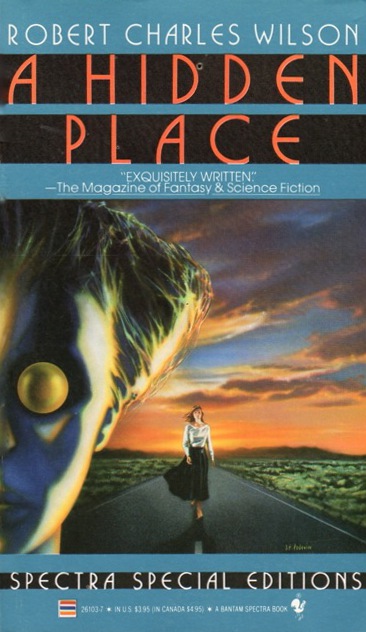
A Hidden Place by Robert Charles Wilson

Travis Fisher is an outsider in most places, but nowhere more than the small midwestern town of Haute Montagne.  But when his mother dies, leaving him parentless and jobless in the midst of the Great Depression, his stern aunt and uncle are the only ones who will take him in.

When Travis falls in love with Nancy Wilcox, the rebellious daughter of the Baptist Ladies Association president, things become worse.  With murderous transients roaming the countryside, Haute Montagne closes ranks, casting them out.

In this moment of distress, a mysterious yet hauntingly beautiful woman reaches out to them with a cry for help.  Stranded in the small midwestern town, she is a being from another world, and she is dying.  Only the two young lovers can help her, but to do so, they must find her dark, masculine half–and in so doing, confront the demons that threaten to tear them apart.

This is one of Robert Charles Wilson’s earlier novels, and I enjoyed it quite a bit.  It’s very short, yet well crafted and beautifully written.  Wilson’s prose is extremely evocative, and his descriptions of Haute Montagne brought back childhood memories from when I lived in the Midwest.  The story was also done well, and had a very satisfying ending.

While this is a good book, though, I wouldn’t say that it’s Wilson’s best.  His characters were interesting, but not nearly as compelling as those in Spin. The baptists were a little too villainous, though Travis’s aunt and uncle were individually more complex.

In spite of all this, however, the story was structured so well that the poignance of it largely overcame these flaws.  As a writer, that’s what I found most interesting about this book–how the masterful way the story was constructed made the whole greater than the sum of the parts.  Call it the monomyth, the hero’s journey, or whatever else, but something about this story made it reverberate in a powerful way.

I suppose that this is what all great stories do: echo some greater, universal story that is in all of us.  It’s the same echo that I felt when I read Spin, or Ender’s Game, or The Neverending Story, albeit a little softer.  It’s something that I hope my own stories evoke, this sense of clarity and wholeness, of returning to some great truth that we lost somewhere between birth and adulthood.

I don’t know if I’m making any sense, but those are my thoughts.  It’s a short read, and I enjoyed it quite a lot.  If you can find it, it’s a good one to pick up.

Story Notebook #5 (part 1)

Alright, time to revisit my old story notebooks and run through some of the ideas there.  This one starts in fall of 2009, my last semester at BYU,  and ends shortly after my hasty exodus from a miserable internship in Washington DC.

And now, without further ado, here goes:

A super-celibate society that holds that sex is evil and reproduces entirely by artificial insemination.

In other words, what if the Shakers had had our modern reproductive technology?  Weird, but not beyond the realm of plausibility.

I suppose that in such a society, the nuclear family would not exist, and children would instead be raised by the community as a whole–kind of like Plato’s Republic.  Question is, would this be a happy utopia, or a miserable dystopia?  I know how I’d write it…

Shattered glass sparkling in the roadside desert

Okay, that’s less of an idea and more of an experiment with prose.  I suppose I saw broken glass on some dusty asphalt and wanted to capture it with words.

The next passage is from an assignment for the wilderness writing class at BYU.  We went camping in Moab and hiked up to Delicate Arch, perhaps the most iconic natural landform in all of Utah.  Shortly after taking this picture, here is more or less what I wrote:

They say that the arches in this national park are formed by wind erosion.  The funny thing is, so is the slickrock.  The same wind that carved the gravity defying structure of the arches also wore the rock all around them almost perfectly smooth, so smooth that you feel as if you’re about to slip and fall even as you sit on the edge of a relatively flat ledge.

It makes you wonder: what was here before the wind blew it away?  What did the land look like before the wind took out the loose material, leaving behind only the strongest, most resilient bedrock?  How many other arches lie underneath our feet, waiting only for time and the wind to unearth the landscape that hides them?

Awesome class; if you ever get a chance, take it.  Professor Bennion is great.

A boy born without a name.

Not sure where that came from, but it kind of makes me think of this girl in an abusive household, who grew up to age 14 before learning how to speak.  It seriously crippled her intellectual development, so much that she never became fully independent.

Think about it: how would not having a name stunt a person’s growth?

Below them lay the alluvial plains–miles of silt and dirt vomited from the mountains over the passing of countless centuries.

I think I intended this to be a line in the first chapter of Worlds Away from Home…and unless I’m mistaken, something very similar to this passage made it into the book.

The detritus of life from which we extract the fossil record of our memories

Another passage meant to evoke something in the reader.  I think I wrote it when I was cleaning out my apartment shortly before leaving for DC.  It certainly makes me think of a dirty, junk-filled room.

And that’s enough for now.  This basically takes us up to January 2010, when I left for the BYU Washington Seminar program.  All the other ideas in this notebook have a decidedly civic/political bent to them, so stay tuned!

More thoughts on indie publishing

Since my last post on indie publishing, I’ve been thinking a lot about this subject.  I haven’t decided to take the plunge into self published ebooks yet, but I have decided to make some changes in my writing and my career strategy, in order to position myself more favorably if/when I choose to do so.

Basically, my new strategy is something like Japan or Saudi Arabia’s approach to nuclear weapons: they don’t have an explicit nuclear program (since that would violate the nuclear non-proliferation treaty), but they have gathered the equipment, resources, and expertise together so that if they decided to go nuclear, they could do it in a year or less.

First, though, I attended Brandon Sanderson’s class lecture this Thursday, in which he had some very interesting things to say about ebooks and the publishing industry.  This was part I of his “how to get published” lecture, and here are some of the more interesting points he made:

  • Almost all the indie writers who are making it big have at least one loss leader ($.99 or less) on their list.
  • No one really knows whether indie publishing will be viable for large numbers of writers, or whether authors like Amanda Hocking and Joe Konrath are outliers.
  • Successful indie published books are typically:
    1) short (70k to 80k words)
    2) written in a pulp genre (thriller, romance, paranormal, sword & sorcery, etc)
    3) promoted very well through social networking
  • We have not yet seen any indie successes in epic fantasy, young adult / middle grade, historical fiction, or non-fiction.
  • The produce model vs. unlimited shelf space argument for going indie doesn’t apply as much to science fiction & fantasy as other genres, because:
    1) sf&f stays on the shelves in bookstores longer than other genres
    2) sf&f series grow better with a big push on the first book
    3) sf&f makes a lot of money on hardcover, unlike other genres

A lot of these points tend to mesh with what I’m hearing from my other sources–and Brandon really represents the last of the successful writers to make it big on the old model, before the ebook revolution began to take off.  He doesn’t make as big a deal on the current 25/75 split on net ebook sales as I would make, but then again, he’s making most of his money through print.

So anyways, here is what I plan to change about what I’m doing in order to better position myself to best take the ebook plunge, if/when I decide to do so:

1) Write at least 2 polished novels per year

Kris Rusch and Dean Wesley Smith make very good arguments about how being able to write well quickly is a huge asset for a writer these days.

There are many good reasons for this:

1) Writing faster gives you more practice with craft, which tends to improve quality.
2) The best way to promote  your books is to constantly write new books.
3) The limited shelf space argument against writing quickly is now moot with ebooks.

In particular, I want to increase my writing speed in order that I can have a larger list to put out if/when I decide to go with indie publishing.  It’s much harder to be successful if you’ve only got one book available for sale; if/when I decide to take the plunge, I want to have at least three.

So far this year, I’ve finished one (Bringing Stella Home), but that’s because it was already sitting in the queue and only needed a quick touch up.  I would like to get Worlds Away from Home polished before the end of the year, and possibly one other project, such as Edenfall.

2) Reduce production time to as close to one year as possible

Right now, it takes me on average about two years to write a polished, salable novel.  That’s not a problem, because I have a lot of projects in the queue, but it’s not as fast as I would like.  I wrote Genesis Earth and Bringing Stella Home while I was still a journeyman writer, figuring out my craft.  I should be able to produce a lot faster.

Towards that end, I’m going to try to get Edenfall finished and polished within a year.  Since it’s already March, that might mean getting it polished by February of next year, but I still want to try.

My biggest weakness is first drafts; I always tend to get stuck midway and drop the project for a while before I feel ready to finish it.  That’s something I would like to change.  Then again, that might just be part of my writing process, and shouldn’t be forced.  However, I certainly could go through my revisions much faster.

3) Write out the direct sequels while the first book is still unpublished

Previously, I thought it was a bad idea to write out all the books in a series or trilogy before the first one is ever picked up.  After all, a rejection from a publisher on the first book is a rejection on all the other books in the series as well.  Using this reasoning, it was much better to write the first book of another trilogy, in order to maximize how much I could submit at any given time.

With indie publishing, however, it’s much better to release the whole trilogy all at once, so that readers who finish the first book can immediately pick up the others.  Again, the paradigm here is that the best way to sell books is with other books; if they loved the one, they’ll buy the others, especially to find out what happens next.

Of course, the best model is probably to have an open series with several indirect sequels with recurring characters in the same world.  With the Gaia Nova books, that’s exactly what I plan to do: Worlds Away from Home is set in the same universe as Bringing Stella Home, but with different characters and different story arcs.

However, Genesis Earth has serious trilogy potential, and with Edenfall I’ve decided to actually write the other books.  If/when I decide to take the plunge, I want to be able to release at least the first two books in that trilogy at the same time.  In fact, Genesis Earth is perhaps the biggest reason why I’m thinking so seriously about going indie, but that’s a subject for a whole other post.

4) Experiment with pulp genres such as space adventure stories

When Brandon said that the pulp genres tend to do better, I wasn’t sure whether that includes what I write.  I write primarily science fiction, but not the kind of stories you’d read only for entertainment and promptly forget once you’re finished.  If anything, I want to write more like Ursula K. Le Guin, whose stories are so meaningful they stick with you long after you’ve finished them.

Then again, there tends to be a lot of overlap in science fiction between the thoughtful, meaningful stuff and the pulps.  Ender’s Game and Starship Troopers immediately come to mind as awesome, entertaining stories that also have a lot of depth.  In his lecture, Brandon made it clear that “pulp” does not necessarily conflict with high art–just that the primary purpose of the story is to entertain.

I can live with that–and I actually have several story ideas that would translate well with the pulp mentality.  I’d like to do a novel (or a series of novels) with Danica from BSH and her mercenary team, perhaps as a sort of origin story for Roman, Anya, Artyom, and the others.  I’d like to revisit the Hameji as well, with a sort of “Ain Jalut in space” involving Sholpan’s son (BSH was basically the Mongol conquest of Baghdad in space).  I’ve already started an “Odyssey in space,” as told from a female Telemachus character–that’s To Search the Starry Sea.  All of these are, at their core, space adventure stories, and might translate well as pulps.

5) Commit to releasing one book every 6 months if/when I take the plunge

This is related to the first strategy on the list, but it’s more of a business plan than a personal writing goal.  Basically, if/when I take the plunge, I want to:

1) have at least 3 finished, polished books to put out at first,
2) know that I can put out one book every six months at least.

This not only means developing a backlist, it means doing some soul searching as a writer to find out how difficult it is to keep up with this pace–and adjusting my writing habits accordingly.  I’m optimistic that I can, but it’s something of a paradigm shift, and I want to make sure I’ve made that shift before I take the leap.

Anyhow, these are my thoughts on how to alter my current writing strategy.  I haven’t yet decided to go indie, but when the time comes, I think that these things will help me to maximize my potential if/when I decide to do so.

Of course, what do any of us really know?
Worlds Away from Home 2.1 is finished!

Yep, that’s right! I finished another novel, in this case the second draft of my fourth. It’s not without its flaws, but good enough that I won’t feel humiliated for life by sending it out to my first readers.

Anyhow, here are the stats:

Worlds Away from Home 2.1
ms pages: 450
words: 96,212
file size: 219 KB
chapters: 20 + prologue
start date: 14 Jan 11
end date: 4 Mar 11

And the wordle:

Wordle: Worlds Away from Home 2.1

Yeah, there are a few words that appeared a bit too frequently there. At least I know what to cut out in the next draft.

As for the song that best encapsulates the experience of writing it..hmm, I don’t know. The last couple chapters, I was kind of on a Metroid trip, so even though the old NES game has absolutely nothing to do with my story, I suppose I’d have to go with the Metroid title theme:

So yeah, those are the stats. As for my thoughts, here goes:

This draft was tough, but a lot more fun to write than the rough draft. Most of the struggle happened with the outline, which took about three or four weeks to actually come together, which is unusual for me.

I did a complete read through back in the first week of December, putting everything else on hold just to write the revision notes, and ended up following almost none of it. However, it wasn’t a complete loss, because outlining it helped me to cut out a bunch of useless filler and dead-end subplots.

I tend to do a lot of shotgun writing on my rough drafts, which means I spew out all my ideas in every which direction, going off on useless tangents and failing to properly foreshadow the major central conflicts.

However, by writing this way, I often discover things that I never could have foreseen from the outset. So long as I’m careful to outline each successive draft and cut out all the filler crap (even the crap that I love), it usually works out in the end.

This draft is somewhere on the crappier side of rough draft vs. finished, polished product, but it’s definitely better than the first one. If the third draft is this much better than the second, I’m optimistic that I’ll have this thing polished and ready to send out before the end of the year.

But before then, I need the help that only a few dozen pairs of eyes besides my own can give. That, and a few months to sit so that I can come back to it with new eyes.

If I know you IRL and you’re interested in being a first reader, please contact me. I’m especially looking for male readers, since the target audience is probably more male than female, but I’m open to pretty much anyone who enjoys reading science fiction.

So anyways, enough of that. On to the next project!

LTUE 2011

So LTUE (BYU’s science fiction and fantasy symposium) was last weekend, and it was awesome.

The venue was the BYU Conference Center just north of where DT used to be, and in my opinion this was a much better place to hold it than the student center, where it’s always been.  It felt a lot more professional, and allowed for better interaction.

It felt like there were a lot more people there this year, including two editors: Lisa Mangum from Shadow Mountain, and Stacy Whitman from Tu.  I didn’t try to pitch to either of them, since I don’t think they really publish what I write, but they were on a few interesting panels.  Tracy Hickman, Howard & Sandra Tayler, and Jessica Day George were also very awesome on all the panels they attended.

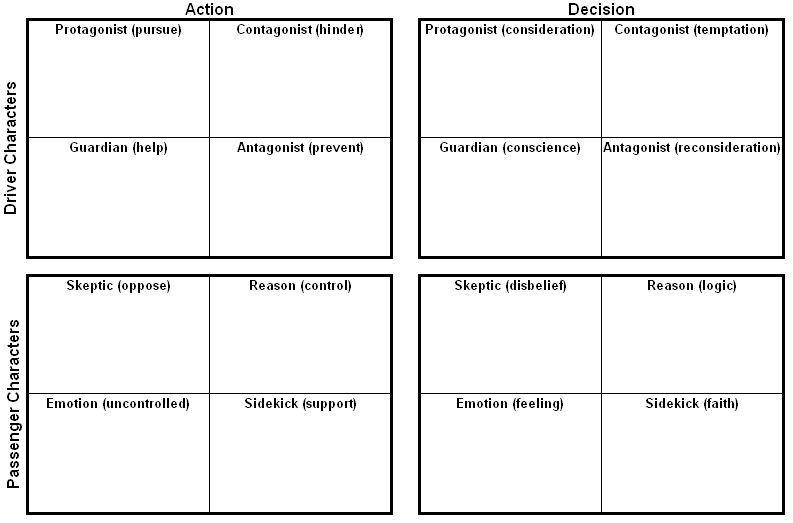
One of my favorite panels was the presentation by Tracy Hickman on Lord of the Rings.  He basically took it apart using Dramatica theory, showing how the series is composed of several distinct subplot, where each character (even the minor ones, like Eowyn) is literally the hero of their own story.

The presentation inspired me to go through some of my own novels and use the basic character archetypes from Dramatica to outline my own novels.  I wrote out the names of all the characters in WAFH and GE on notecards, then on the back wrote down which archetype they fulfilled based on who was the protagonist.

There were several other excellent panels as well.  I got a ton out of the “Can your dreams pay the bills?” one, with Sandra Tayler moderating.  She sure knows her stuff when it comes to the practical business aspects of a creative career.

I dunno; a lot of my writing friends claim to be at a point where panels at cons are less useful for them.  While I can see why they say that, I still find them helpful.  While a lot of the advice is stuff I’ve heard before, every once and a while someone will have a fascinating insight on things.  It’s like stories, I guess; even though there’s nothing new under the sun, everyone has a different way of making it their own, which is ultimately what makes the whole enterprise valuable.

Also, I had an awesome first this year: I signed my first autographed story!  Leading Edge had a booth in the hall, and while I was hanging out there, I mentioned to Eric James Stone how I had a short story published and joked around about signed copies.  To my surprise, he bought the issue and asked for me to sign it!

So yeah, my first signed copy of anything ever goes to Eric–thanks for the support!  Now I’ll see what I can do to make that signature actually worth something someday…

Oh yeah, one more thing: Dan Wells is going to name a character in one of his books after me!  According to Dan, the character (Gabe Vasicek) is “a big guy who wields a minigun.” Hehehe…can’t wait to read it!

Anyhow, LTUE was awesome this year, just as I’d expected.  The panels were enlightening and entertaining, the guests were gracious and easy to talk with, and the overall experience was just a lot of fun.

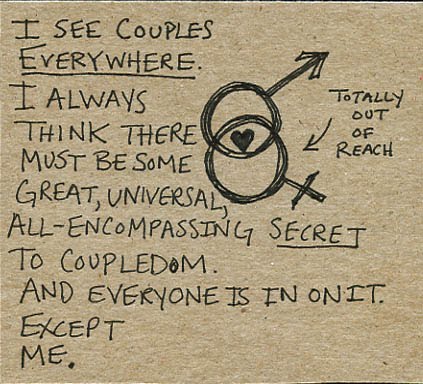
The Obligatory Valentine’s Day Post

I was going to write a long post on why I hated Valentine’s Day, but then I realized it hasn’t been so bad.

Of course, that’s mostly because I’ve been in my apartment most of the day, writing.  I did go to Macey’s at one point, and was mildly annoyed by the crowd of people buying flowers at the front, but other than that, it’s been like any other day in February.

I’ve always been single on Valentine’s Day, and while I’ve never really resented that, I have resented the pressure in the LDS church to go on dates and find a wife.  But here in Utah Valley, that’s a constant year round, not just on Valentine’s Day.  And it’s pretty bad.  Listening to some church leaders speak,  you’d think that it’s a sin to be single–as if the free agency of others doesn’t even factor into the equation.  And worse, they always put the blame on the guys, never the girls, so the girls keep on acting immature which leads to all sorts of ridiculous problems.

A couple weeks ago during Stake Conference, I got in a pretty dark mood after one too many talks on the subject.  This poetry is what came out of it:

Find a wife,
Date a week;
Marry young–
A life so bleak.

Where singlehood is selfishness,
And loneliness is sinful, too,
Rejection is a kiss of death;
Unwantedness a fate too cruel.

That’s about as far as I got.  I wrote some other stuff, but I’m not about to share it.

Truth is, I’ve kind of given up on the dating scene here in Happy Valley.  The hordes of pretty yet immature twenty year olds just don’t interest me, and while I do have a few old friends in the area who I might look up, I don’t expect much to come of it.

Part of it is the fact that I’m twenty six, which in Happy Valley is the equivalent of thirty five or forty anywhere else. I’m just old.

Part of it is the steady accumulation of bad dating experiences over the course of the past five years, which has a lot to do with immaturity, both my own (which I hope has changed) and that of the general population of available females here in Utah.

Part of it has to do with the fact that just about every girl I’ve actively pursued ends up marrying someone else in less than a year.

But mostly, I think it has to do with the fact that I’m just not really interested in anybody.  And honestly, that’s kind of liberating.  It’s part of the reason why I decided to grow out my beard (pictures coming soon).  Most of the girls around here say they hate beards–but who cares?  Screw ’em!

But yeah.  I’m sure I’m going to get a ton of concerned emails from my family after I post this, but at least I’m being honest.

And yes, I’m sure I’ll find someone someday (or, more likely, she’ll find me), and we’ll settle down to a life of passion and bliss and whatever, but that doesn’t have to be right now.

So happy Valentine’s Day.

(Images taken from postsecret and Kencraft Candy)

Paradigm shifts and finding balance

Yesterday, I was going to write a post about how pathetic this past week was: I only wrote about 1.5k per day (while unemployed), and spent most of my time on the internet reading blogs.

However, after reading some more of Dean Wesley Smith’s blog series, Kililng the Sacred Cows of Publishing, I have to admit that this week wasn’t a total loss.  Because of what I’ve read this week, I’m starting to have a major paradigm shift about the publishing world, and that likely will have a huge impact on my writing career, hopefully for the better.

If I can sum up how my views have changed into one statement, it would be this: that in order to succeed in this business and avoid the common pitfalls, I need to learn how the entire publishing system works as a whole, so that I can game it to my advantage.  A lot of the hard and fast “rules” of the industry are actually myths that make for bad business, for writers as well as editors and agents.  But when you look at the system from a rational choice perspective, the flaws become obvious.

Take, for example, the “rule” that editors only accept unagented submissions.  What does that do for the industry?  It turns agents into the first tier of gatekeepers that new writers need to get past.  But agents don’t pay writers; they get a 15% commission off of the books they manage to sell (which, according to DWS, is excessive, but that’s another topic).  And they don’t get paid at all for reading slush.

So agents are spending more of their time doing things that pay less money, pressuring them to take less risks and work only with what they “know” will sell.  This leads them to ignore the fresh, unconventional voices that turn the tropes on their heads and have the power to take the market by storm.

Furthermore, because of their newly christened gatekeeper status, they make their writers rewrite their manuscripts until they read just like clones of Harry Potter or The Davinci Code.  And when the agents’ three or four closest buddies turn the book down, they come back to the writer and tell them to write something else.

It’s an extreme view, for sure, but it has a few good points.  The incentives are all in the wrong places, with too many opportunities for the gems to fall between the cracks.  And while the response from everyone in publishing is to cling to the myth and scream “the system works!” I have to wonder, does it really?

This comment from one of the threads struck me with particular force:

“The biggest mistake you can make is giving complete power over to someone who will never care as much as you do.”

Youch.  And yet, it makes so much sense.  How many writers’ careers have been ruined by doing just that?  Ceding too much power to people who simply don’t care as much as they do, all in the name of some “rule” of publishing?

Of course, that’s not to say that the publishing industry is full of cheats and sleazebags.  I’ve spent some time with professionals at World Fantasy and other conventions, and I’ve been very impressed with all of them.  It’s just to say that writing is a business, and that writers need to approach their careers in the same way as anyone who’s self-employed.  Certainly it’s important to work with other professionals, but that doesn’t mean handing over the fate of your business to them.

So anyways, what with all the business research I’ve been doing, I suppose the last week isn’t a total loss.  However, I definitely feel a need to get back into writing.  My deadline for WAFH is in two weeks, and the next 40k are going to require the biggest changes.  So here’s my plan for the next two weeks:

  • Get up at 7 am every day.
  • Write at least 2.5k words per day (500 during LTUE).
  • Fill out at least 5 job applications per day.
  • Take a week-long Halo fast.

Probably the single biggest thing killing my creativity right now is the angst that comes from money woes.  I redid my budget yesterday and realized I can get by this month without dipping too deeply into reserves, but still, that’s no substitute for a reliable source of income.  Trouble is, it’s hard to find motivation to apply for jobs when most employers don’t even respond to your application, but hopefully a concrete goal will make that easier.

As for Halo, as much as I love the game, I just don’t have time for it right now.  Personal writing deadlines are coming up, LTUE is just around the corner, and I’m falling too far behind to spend my time on video games.

I’m also going to make a concerted effort to get up earlier.  If I stay up past midnight, I’m usually just dicking around on the internet, whereas my mornings are almost always productive.  Plus, I hate sleeping in–hate it.  Gotta get up earlier.

So anyhow, that’s the plan.  Now, if you’ll excuse me, I’ve got some writing to do…

Thoughts on traditional vs. indie publishing

In case you didn’t know, the publishing industry is in the throes of a major revolution.  With the growing popularity of e-books and the collapse of distribution channels and chain bookstores such as Borders, traditional business models are proving simply untenable.

I’ve been perusing several internet sources to make sense of all the craziness, among them Joe Konrath’s blog (a midlister who is now making six figures via ebooks), Writer Beware (which still emphasizes caution with self-publishing), the Adventures in Sci Fi Publishing podcast (which has recently started interviewing several successful indie authors), Dean Wesley Smith’s blog, and his wife Kristine Rusch’s series on the changing business of publishing (which I highly recommend–seriously, if you read nothing else, read this).

Some of these people predict the imminent collapse of the big publishers, and have selected (ironically enough) 2012 as the predicted date of the collapse.  Others agree that many traditional publishers will collapse, but believe that most will survive and evolve into something different (the “dinosaurs evolved into birds” theory vs. the giant meteor).  All of them agree, however, that whatever new form the publishing industry takes, ebooks will dominate.

For someone in my position–a budding author looking to break in in the next few years–all of this is simultaneously thrilling and unnerving.  Should I venture into indie publishing and risk having my work lost in the flood?  Or should I spend the next five years toiling endlessly to break into traditional publishing, only to see my rights get tied up in a bankruptcy?

Thus far, my strategy has been to a reputable agent, or a new agent at a reputable agency.  I’ve been holding back from submitting directly to publishers, out of fear that getting rejected from publishers would make it difficult for an agent to do her job.

That was the orthodox model under the traditional system, when the big six (HBGUSA, HarperCollins, McMillan, Penguin, Random House, and Simon & Schuster) dominated the industry.  For the time being, they still dominate, but I’m wondering whether it’s such a good idea to go with them.

The big six have been swallowing up independent presses and imprints for years, and as a result, they’re now major corporations.  As such, they aren’t looking for moderate midlisters who sell consistently–those kinds of writers would drive them bankrupt.  No, in order to support their corporate expenses (like multimillion dollar office space and executive bonuses), they need bestsellers like Stephen King or J.K. Rowling.

Trouble is, they often lose when they gamble on new writers, which means that the next bestseller needs to be even more spectacular than the first.  And with the ebook revolution underway, they’re getting desperate.

Agent Kristin Nelson recently lambasted McMillan for claiming rights to all “derivative works” in their new boilerplate (a bad faith move comparable, IMO, with the worst scams on Writer Beware), while Kristine Rusch recently noted how the big publishers are becoming increasing hostile to new writers.  Advances as low as $1,500, or single book only contracts, or nebulous clauses that ensure publishers keep ebook rights for decades, even with the author barely making $20 per year on royalties?

How am I ever going to make it full time in a business like this?

Well, according to Joe Konrath, every day my books aren’t up as indie published ebooks, I’m losing big money.  His views are pretty extreme, but he makes a very compelling argument, especially for someone in my position.  Yes, there will be a flood of crap, but good stuff inevitably rises to the top.  Yes, sales start out slow, but that’s simply part of the new model–and they build over time.  For a minimal investment of time and money, I could launch my books and start earning an income from them now.

But money (such as I may or may not make as an indie) isn’t everything in this business.  At this point in my career, gaining prestige and making a name for myself is just as much if not more important than income.  Granted, I can build some prestige through indie publishing if my books sell enough, but I don’t want to have to depend on that, especially if it takes years for sales to build.

For the science fiction and fantasy genres, the professional standard is set by SFWA, or the Science Fiction & Fantasy Writers of America.  In order to become a member, you have to have your work published in one of their approved markets.

Last night, I did some research on those publishers.  Of those that specialize specifically in science fiction and fantasy, seven of them are affiliated with the big six (Tor, Ace, Baen, Bantam Spectra, Roc, Del Ray, and Orbit).  Thirteen others are independent presses that might conceivably be interested in my work.

Now, just because a science fiction and fantasy imprint is affiliated with the big six doesn’t mean it’s a bad idea to submit to them.  Tor, after all, is the undisputed king of the genre–the company has won the Hugo for “best publisher” every year since 1988.  I also tend to think (though I have no data to support it) that the bad contracts are more common with mainstream fiction.  Science fiction, after all, has always been small potatoes to the rest of the publishing world.

But precisely because science fiction is so small, I’m starting to wonder if it’s a bad idea to submit to agents first.  Agents go where the money is–in LDS publishing, virtually every author is unagented.  While there’s still a national market for science fiction, it’s definitely a small one, and all the agents I’ve found always tend to list it as an afterthought, focusing instead on YA/MG, thrillers, romance, or the ubiquitous “commercial fiction.”

In other words, I think that part of the reason agents have been so reluctant to pick me up, even after showing some interest, is that they just don’t see enough money to justify taking a risk on me.  Granted, it may also be the quality of my work, but the bulk of the rejections I’ve accrued seem to point more to subjective factors, like the agent’s personal tastes (the ubiquitous “I don’t feel I’m the right agent for this work”).

Which is not to say that I don’t think it’s a good idea to get agent–not at all.  Even Amanda Hocking, who has turned down several big publishing deals, has an agent.

No, what I’m saying is that in today’s market, it might be easier for a science fiction writer to attract an agent by getting picked up by a publisher, rather than attract a publisher by getting picked up by an agent.

And, of course, the only big reason to do any of this is to make a name for myself.  At some point, I will go indie, even if only with a few of my works.  The revolution has arrived, and I’d be a fool not to capitalize on it–the only question is when, and how.

(images from Postsecret)

Thoughts on the protests in Egypt

So unless you’re living under a rock, you know that there’s a revolution going on in Egypt right now.

Protesters have been demonstrating 24 hours in Tahrir square in Cairo for the past seven days, demanding that President Mubarak step down from power.  With police unable to contain the protests, the army has been called out, but seems to be taking a neutral role.

It’s hard to tell exactly what’s going on right now, but from what I can see, it doesn’t seem likely that Mubarak can hold onto power much longer.  In some places, it seems that the military has actually sided with the protesters, allowing them to stand on top of tanks and blocking the police with their armored vehicles.  Many of the looters include police officers, who apparently have read the writing on the wall.

If Mubarak does step down, the effects will be incredible.  Egypt is by far the most populous Arab country, and a major center for regional cultural trends.  Mubarak’s regime has also been one of the most authoritarian and repressive, and until now, his hold on power seemed as absolute as any Arab ruler.  If he falls, where will the next revolution happen?  Libya?  Syria?  Yemen?  Sudan?  Iran?

This wave of protests didn’t start in Egypt; it started in Tunisia, where a citizen’s self-immolation sparked massive unrest.  When the protests reached their apex, the military and police stepped down, forcing President Ben Ali to flee the country.  Tunisia had one of the most repressive regimes in the region, and the speed with which it collapsed was absolutely stunning–and no doubt an inspiration to the people of Egypt.

Some articles I’ve read suggest that the Iraq War and the fall of Saddam Hussein was a major cause of the current revolution, but I disagree.  Most of the Arabs I’ve talked to consider the US invasion of Iraq to be a disaster, and have nothing positive to say about anything that’s come of it.  The fate of Iraq is still very much in the air, and many people (myself included) don’t expect democracy to take root in that country without another dictator coming to power.

Instead, I think the root cause of this revolution is economic.  According to the UN, food prices across the world have risen 25%, and the global recession has led to widespread unemployment.  No doubt the people of Egypt have been feeling this, especially with the huge disparity between the rich and the poor.  What we’re seeing right now is a loosely organized, broad-based popular uprising, with people from all segments of society demanding that Mubarak step down.

I’ve got to be honest; I think these protests are very exciting.  The chaos and violence is definitely bad, but if it leads to a more just and democratic Egypt, I think that it’s definitely a good thing.  When I visited Egypt back in 2008, my first impression of Cairo was that the place was a post-apocalyptic wasteland of a city, with trash in the streets and police armed with machine guns.  The longer I stayed, the more I felt that the country was backward–and that a major source of the backwardness was the corrupt Mubarak regime.

I’m not an Egyptian, so I can’t say what’s best for the Egyptian people, but I hope and pray that they get what they are fighting for–a more just and democratic country.

Sick (blegh!), submitting, and thoughts on self-publishing

Sorry I haven’t been posting much recently; I came down with a nasty fever this week, and I’ve spent the last two days recovering.

It really sucks, because my two temp jobs just finished, and I was hoping to get into another writing routine.  The jobs were sucking up all my time, though it was definitely awesome to have money flowing in.

Anyhow, I caught Brandon Sanderson after his 318 class and asked him about submitting to agents while I’ve got my full ms out.  He said I shouldn’t do it; that it would look bad if I had to turn down another request because it’s already out.  So for now, I’m just going to sit on it and send out Genesis Earth to other agents.

Genesis Earth keeps getting turned down, but the vibe I get is that it’s more because of the agents’ tastes, not because of the poor quality of the book. So far, I’ve gotten one request for a full, one request for a partial, two personalized rejections, and several variations on “I don’t feel I’m the right agent.”

Even if all of the latter are just nice standard form rejections, that’s enough to tell me that Genesis Earth isn’t a crappy book.  So I’ve been thinking, if I run the rounds and fail to find an agent or a publisher, maybe I should take the plunge and publish it for $2.99 as an e-book on Amazon.

Speculation about e-publishing is rampant, and opinions are wildly mixed right now.  According to Joe Konrath, everyone (including new writers) should self publish their works–to wait even a day is to give up large amounts of potential earnings.  According to Dave Wolverton, however, new writers should definitely not self publish, but try to break in through traditional publishing with as big of a deal as they can possibly get.  Both authors have had huge self-publishing successes, so which is right?

Well, I read an interesting guest post by Lee Goldberg on Joe Konrath’s blog that takes the middle ground: start out with a traditional publishing deal, in order to build a name for yourself, but self-publish a couple of e-book lines shortly thereafter.

So far, that seems to make the most sense to me.  The science fiction and fantasy community is very tight-knit, and I don’t see myself becoming a major part of it through self-publishing alone.  At the same time, it’s very difficult to make a living through traditional publishing in these genres, so once I’ve built up something of a name and a fan-base, it would be good to start self-publishing a couple of e-book lines.

But then again, why not try it out now with Genesis Earth?  Well, a couple of reasons.  I’m worried that self-publishing would make me look bad when I submit my other stuff.  E-book sales tend to take a long time to build momentum, so even though the starting costs are low, the returns don’t start coming in until later–if they come at all.  And that’s the second thing I’m worried about–that my stuff will get buried under the flood of drivel that’s swamping Amazon and other e-publishers right now.

The main reason, though, is that I feel I need to do more research to figure out what’s going on.  Probably the most valuable thing I can do is get an e-reader and dive into the market from the consumer end, just to figure out how the system works.  Without some hands-on experience and a good working knowledge of the field, I’m probably not ready to take the leap.

In the meantime, I’ll keep trying to break in through the traditional route.  I might not make as much money as quickly this way, but I hopefully will build my name faster–and at this point, that’s more important to me than revenues.