Squirrel!

So a couple of months ago, I set aside the first draft for Friends in Command (Sons of the Starfarers: Book IV) in order to let the story percolate a little in my mind. I do this from time to time, especially between deep revisions, in order to step back approach the story with a fresh mind. I’ve found that doing so tends to improve the quality of the story immensely.

I was fully intending to get back to Friends in Command this month (and still intend to do so eventually), but just as I was finishing up the 4.0 draft for Heart of the Nebula, I had this crazy awesome story idea pop into my head and I couldn’t not write it. It actually came to me right before I got to the last chapter, which led to this exasperated tweet:

So anyways, the working title for the squirrel! project is Queen of the Falconstar. It’s a sci-fi action & adventure standalone (for now, heh) that takes place in the same universe as Sons of the Starfarers, but a few hundred years into the future. The Outworld frontier has been more or less tamed, and the Hameji are beginning to establish themselves on the outer reaches of human space. It’s a brutal and dangerous universe outside of the major stellar empires—which of course is where this story takes place.

It’s the main character, Zlata, that I’m really excited about. She’s crafty, pragmatic, resourceful, and slightly pessimistic, a little like Mara from Sons of the Starfarers but without all the trauma and daddy issues. She’s ruthless when she needs to be, but can be quite altruistic whenever it’s practical. Above all else, she’s a realist, accepting things as they are and preparing herself to deal with them accordingly.

The story starts when pirates capture her home station and carry her and her best friend off as slaves. It turns out, though, that these aren’t ordinary pirates—they’re Hameji tribesmen from the Outer Reaches. The captain, Lord Khasan Valdamar, is a young Hameji commander trying to establish himself and build a war fleet to his name. He doesn’t have much to work with, though, and in the brutal world of intertribal Hameji politics, a single miscalculation could lead to the annihilation of his small clan.

Through a daring combination of intrigue and romance, Zlata convinces him to take both her and her friend as wives, thus raising their status and securing their future. But this sets off a tribal war, which she soon discovers is far more of an adventure than she ever bargained for.

That’s the basic story idea that I’m working with, at least. Like I said, I’m way excited about it! I don’t have any idea how long it’s going to be or what it’s going to turn into, but this is basically how Star Wanderers got started and that turned out rather well.

So I’ll probably dive into this rabbit hole for the next month or so to see what’s down there. But don’t worry, I fully intend to write Friends in Command as well. At the very latest, that one should be out sometime in the summer, though it will probably be ready much sooner. And when Queen of the Falconstar is finished, I think you’re really going to like this one as well!

Nanowrimo anyone?

November is coming up, and with it, nanowrimo.  I’ve always wanted to participate, but every time it rolls around, it seems like I’ve got another project going on that’s more important.

This year is no exception, but I think I have a way around that.  The goal for nanowrimo is just to write something–it doesn’t have to be any good.  I’ve got a bunch of projects I’m currently working on, including Star Wanderers: Deliverance (Part VIII) which I hope to publish by Thanksgiving, but I think I can still do a just-for-fun sort of thing on the side, with the understanding that it doesn’t have to be serious.

What I think I’ll do is write a story where all of the characters from all of my previous books get caught up in some sort of a weird time-space dimensional warping thing, so that they end up in books where they don’t belong and universes where they never existed.  It should be a fun way to revisit some of them, especially the ones from the Gaia Nova books, which I haven’t really done much with in a while.

It’s probably not going to make much sense to anyone who hasn’t read my books, but who cares?  That’s not the point.  I may or may not put it up somewhere for people to read, but it may have some stuff from projects that are either unfinished or unpublished, so it might be a little obtuse even for the fans.  However, it seems like a really fun project, one that I can really run with, and that’s all that really matters for nanowrimo.

As far as my other projects go, right now I’m working on a heroic fantasy novel that’s a prequel of sorts to The Sword Bearer.  I have no idea where it’s going to go, but I’m taking a page from my favorite writer of all time (David Gemmell), with lots of violence, lots of blood, and lots of true grit and heroism.

At the same time, I’m still working on Sons of the Starfarers off and on, though I may end up putting that one on hold for a while as I figure things out with this heroic fantasy story.  It will get done, though–it’s definitely a story I’m itching to tell.  In a couple of reviews and emails, readers have asked whether I’ll ever write an origin story for the Hameji.  Well, that’s what Sons of the Starfarers is going to be, though the connection might not happen until well into the series.

There’s a couple of other Gaia Nova books I’ve been meaning to write for a long, long time, but I don’t know if I’ll be able to get to them anytime soon.  This nanowrimo project might spark something, though, since I’ll be revisiting a lot of those old characters.  And even if the nanowrimo novel itself is pretty bad, if it gets those projects on the back burner simmering again, then that will definitely be something.

Dang, I really want to get started with nanowrimo now!  So many wacky ideas … it’s like writing fanfiction for one of your own books!  In any case, I’d better get back to writing before I get too excited.  Don’t want to spend so much time thinking about writing that it becomes hard when I actually sit down to do it.

Later!

Trope Tuesday: Forbidden Zone

For the next few Trope Tuesday posts, I’m going to pick apart some of the tropes I’m playing with in my latest WIP, Sons of the Starfarers.  One of the things I love to do when brainstorming a new story is to use tvtropes like a menu, finding the tropes that best fit my story ideas and combining them with other tropes to get even more ideas.

It’s not often hard to spot the forbidden zone in a fantastical world.  Perhaps it has an ominous name (bonus points if it has the word “doom” in it), or perhaps there’s some sort of sign saying “do not enter.” Either way, this is definitely a place where no one goes, and no one is supposed to go.

Of course, you can pretty much guarantee that the main characters are going to go there.  It’s like the forbidden fruit: the very fact that it’s off limits makes it more alluring.  If genre blindness is in effect, someone will probably make the mistake of saying “what could possibly go wrong?

There are many reasons why the zone may be forbidden.  Perhaps it’s a death world, where the characters will soon find themselves running for their lives.  Perhaps it’s not quite so dangerous, but once you go, you can never come back.  Or perhaps all the warnings were lies, and the so-called forbidden zone is actually the place that the characters needed to get to all along.  If that’s the case, then the mentor was probably a broken pedestal or the Svengali.

In any case, the forbidden zone definitely lies in the realm of adventure.  Depending on how soon or how late in the story the characters go there, it may lie just on the other side of the threshold, at the bottom of the belly of the whale, or at the very heart of the character’s nadir.

The Mines of Moria, the Toxic Jungle, Area 51, the Elephant Graveyard, and the Fire Swamp are all classic examples.  In C.S. Lewis’s Space Trilogy, Earth itself is a forbidden zone to all the other inhabitants of the solar system, which is why it’s called the silent planet.

In real life, there are plenty of these as well.  Just look at the DMZ on the Korean Peninsula, or the fallout zone around Chernobyl.  When I was living in Georgia, Abkhazia was off limits to the TLG volunteers, meaning that if you went there (and the Ministry of Education found out about it) it was grounds for immediate firing.  Of course, that only encouraged some of my TLG friends to go there even more–remember the forbidden fruit?  Others waited until their contracts were over and practically made a tour of the many forbidden zones of the Caucasus, including Nagorny Karabakh, which one friend described as safer than Philadelphia.

I’ve toyed with this trope in my own work, but never too explicitly.  The best example is probably the alien ghost ship from Genesis Earth.  It’s not exactly forbidden, since there’s no one around to tell Mike not to go there, but Terra definitely doesn’t want him to go.  Earlier in the same book, she forbids him from entering her workspace in the observatory, which leads to some complications and a major reveal when he inevitably does.  In the Gaia Nova series, the Outer Reaches qualify as a forbidden zone, since the only people who live out there are murderous barbarians like the Hameji.

In my new series, Sons of the Starfarers, the first book starts out with a forbidden zone–a derelict space colony, where everyone has died of an unknown cause.  Since the nearest settlement is light-years away (and because Aaron is perhaps too curious for his own good), that’s where Isaac and Aaron go.  What they find there propels the rest of the book–and quite possibly the rest of the series.

Check back next week for more!

X is for Xenocide

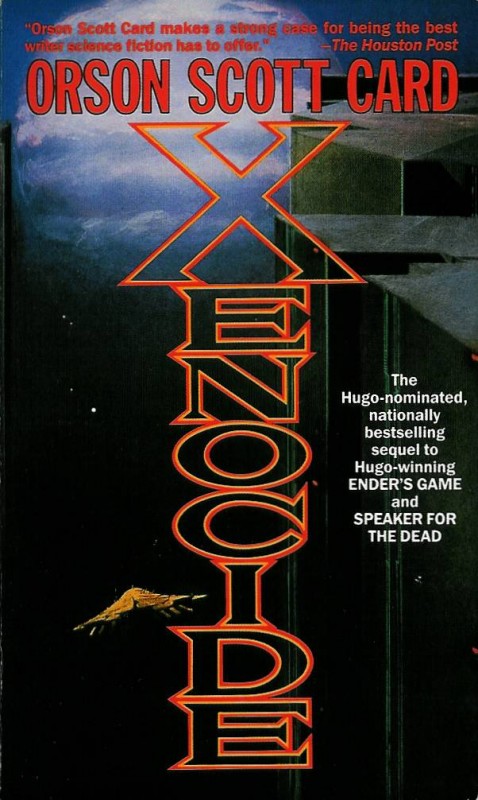
xenocideThis post isn’t just about the third book in the Ender’s Game series–it’s about the genocide of an entire alien race, which is actually a fairly important trope in science fiction.

Of all the evils of our modern era, perhaps the most heinous is the systematic extermination of an entire race or ethnicity.  These acts of genocide not only cross the moral event horizon, they create specters and villains that live on from generation to generation.  Just look at how the Nazis are portrayed in popular culture–even today, they are practically mascots of the ultimate evil.

And for good reason.  There really is something evil about the total annihilation of a foreign culture.  It’s one of the reasons why terms like “genocide” and “ethnic cleansing” are so controversial, especially in conflicts that are still ongoing–and there are so many unresolved conflicts where the systematic and purposeful annihilation of a race or culture is still happening.

Is wholesale genocide a phenomenon unique to our modern age?  Probably not, but modern science has enabled it on a scale that was previously impossible.  This became all too clear to us after World War II.  Only a generation before, great numbers of people believed that we were on a path of progress that would eventually culminate in world peace.  If there was any of that sentiment left, it was shattered with the liberation of Auschwitz and the bombings of Hiroshima and Nagasaki.  Suddenly, we realized that systematic mass destruction and genocide were not only possible, they were a modern reality.

It should come as no surprise, then, that science fiction immediately began to explore this issue.  From Frankenstein to 1984, science fiction has been full of cautionary tales of science gone wrong, issuing a critical voice of warning.  But after 1945, it went much further, exploring the issue in ways that can only be done in a science fictional setting.

Is genocide ever morally justifiable?  In our current world, probably not, but what if an alien race was bent on our destruction?  If their primary objective was the utter annihilation the human race, and negotiation was impossible?  Wouldn’t it be justifiable–perhaps imperative even–to stop such a race by annihilating them first?

This is what is meant by the term “xenocide.” A portmanteau of “xenos,” the Greek word for stranger, and “genocide,” it denotes the complete extermination of an alien race.

Xenocide forms the core conflict of Orson Scott Card’s Ender’s Game series (hence the title of the third book) and features in The Forever War by Joe Haldeman.  Battlestar Galactica presents an interesting twist, where the cylons debate the ethical questions surrounding the complete annihilation of the humans.  And then, of course, there’s all the time travel stories involving Hitler–let’s not even go there.

The interesting thing about xenocide stories is that even though they describe a dilemma that does not currently exist in our modern world, they inevitably come down to issues of Otherness that lie at the very core of the evils of genocide.  In order for xenocide to be morally justifiable, you have to know your enemy well enough to know that there’s no possibility of forging any sort of peace with them.  And to know them that well, they cease to be quite so alien.  It’s one of the major themes in Orson Scott Card’s work–that to defeat an enemy, you have to know them so well that you can’t help but love them.

In our modern world, genocide is only possible when an ethnic group is relegated to the position of Other–when they are made out to be so different and unlike us that we can never possibly relate to or mix with them.  They become “sticks” (Germany), “cockroaches” (Rwanda), “animals” and “barbarians” (Israel).  That is precisely why it makes us uncomfortable in stories about xenocide–because it turns the well-intentioned saviors of humanity into knights templar, or possibly the very monsters they are trying to destroy.

By positing a situation in which genocide might actually be justifiable, science fiction helps us to understand exactly why it is so reprehensible–and that’s only one of the ways in which the genre can uniquely explore these issues.  That’s one of the things I love so much about science fiction: its ability to take things to their extreme logical conclusions, and thus help us to see our own real-world issues in ways that would otherwise be impossible.

Since most of my characters are human, xenocide as such isn’t a major theme in my books, but genocide certainly is.  In the Gaia Nova series, the starfaring Hameji look down on the Planetborn as inferior beings and think nothing of enslaving them and slagging entire worlds.  That’s how Prince Abaqa from Stars of Blood and Glory sees the universe at first, but by the end of the novel he’s not quite so sure.  Stella from Sholpan and Bringing Stella Home also deals with these issues as she comes to realize how it’s possible for the Hameji to hold to such a belief system.

If genocide is one of the ugly skeletons in the closet of this screwed up modern world, then xenocide is science fiction’s way of taking those skeletons out and dignifying them with a proper burial.  By wrestling with these issues in stories set on other worlds, we are better able to humanize the Other and prevent these horrors from happening again on our own.  In this way and so many others, science fiction helps us to build a better world.

K is for Klingon

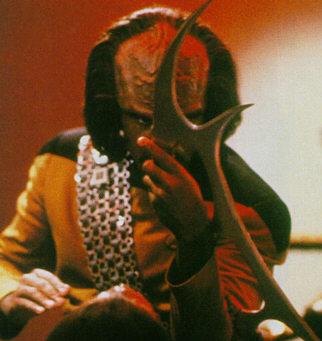
worfAh, the proud warrior race.  Where would science fiction be without it?  From Klingons to Ur-Quans, Wookies to Sangheilis, Mri to Green Martians to Vor Lords, warrior races have been a staple of space opera and space-centered science fiction pretty much since the genre was invented.

The concept behind this trope is the same as the one behind blood knight: honor is more valuable than life, and the best way to win or defend honor is through combat.  It’s not necessarily death that these guys live for, so much as glory and a chance to prove their prowess.  Unlike the always chaotic evil races, these guys usually follow a strict code of honor, sometimes to the point of absurdity.

When taken too far, of course, you get a planet of hats, where everyone has exactly the same values without any kind of depth or diversityFridge logic leads to Klingon Scientists Get No Respect.  After all, how did the Klingons build starships and discover space travel if they’re all constantly fighting each other?

Fortunately, we have plenty of real-world examples for how this sort of thing works.  Lots of human cultures have placed a high value on warrior qualities, including the Spartans, the Samurai, the Vikings, and the Mongols, just to name a few.  Of course, relying on stereotypes may lead to some unfortunate implications, so it’s not a good idea not to have too narrow or ethnocentric a reading of history.  Still, there’s a lot from history that we can glean.

In fact, you could make a valid argument that humans are the quintessential warrior race.  After all, we developed the technology to annihilate our own species before we put a man in space.  Even today, the amount of resources we spend on war and security far outstrips the amount of resources we dedicate to just about any other pursuit.  From the earliest ages, we engage in competitive physical sporting activities that mimic warfare and video games that outright simulate actual combat.  Our everyday language is full of violent terms like “on target,” “wiped out,” and “having a blast,” to the point where most of them are invisible.  Indeed, if we ever make contact with an alien race, we may very well find that we are the Klingons.

In that respect, this trope is just another way that science fiction acts as a mirror through which we can better see ourselves.  The proud warrior race fascinates us because we have so much in common with them.  Klingons are not just faceless orcs for the good guys to slay by the dozen–in many sci-fi universes, they (or individual members) actually become good guys.  Just think of Worf from Star Trek, or The Arbiter from Halo, or Aral Vorkosigan from Louis McMaster Bujold’s Vorkosigan Saga.  While on the surface, these guys seem absolutely crazy, when you start to explore them you frequently find a lot of depth.

I am fascinated by the concept of a warrior race.  I’ve played with it quite a bit in my own work, especially with the Hameji in Bringing Stella Home, Sholpan, and Stars of Blood and Glory.  The Hameji are an entirely spacefaring society that lives on the outer fringes of space, beyond any terraformed planets.  Because they live entirely on spaceships, they must capture and repurpose new spaceships just to have enough living space to expand their families.  Since their battleships also house their families, they make no distinction between military and civilian, and live by an extremely rigid social hierarchy with the patriarchal captain at the top and everyone else under his command.  Life is a privilege, not a right, and disobedience is strictly punished since it has the potential to put everyone’s life at risk.

As a result of all this, the Hameji are extremely vicious and warlike, living by a moral/ethical code that runs completely counter to our modern sensibilities but makes perfect sense to them.  They think nothing of slagging entire worlds and killing billions of people because to them, a world is a giant starship, and all those billions of people are so many enemy warriors.  They look down at the planetborn as weak because of their lack of discipline and obedience, and think nothing of enslaving them due to their strict social hierarchy.  In fact, because resources are limited and life is a privilege granted by the ship’s captain, the Hameji prefer to space their prisoners rather than keep them alive.

Man, those books were fun to write. 😀 Brutal, but fun.  Because the weird thing is, as much as you abhor a culture whose values contradict your own, when you really understand them, you can’t help but feel something of a connection.  You might not love them, but you respect them, and in a strange sort of way sympathize with them.  I’m not sure if that’s the experience with the Hameji that my readers have had, but that’s definitely been my experience in writing them.

So yeah, I’m definitely a big fan of the proud warrior race.  Expect to see me play with it many more times in the future.

Book teasers are HARD…

…but I think I’m on to something with this one.  What do you think?

THE ONLY HOPE FOR THE LAST FREE STARS NOW LIES ON THE PATH OF BLOOD AND GLORY.

The princess of Shinihon could not have picked a worse time to run away. The galaxy is at war, and the massive Hameji battle fleets threaten to overrun the last of the free stars. Only the boy emperor Katsuichi dares to stand against them, but with his sister gone missing, the burden of command may be too much for him to bear.

The job falls on Captain Danica Nova and her band of mercenaries to bring the princess safely home. Among them, Master Sergeant Roman is one of the few still old enough to remember the homeworld. But he’s an old cyborg, and his humanity is fading. Death is a mercy he doesn’t expect to find on this mission.

They aren’t the only ones after the princess, however. Sholpan’s son Abaqa is eager to win honor and glory by making the girl his slave. Though only a boy, he’ll stop at nothing to prove himself to his Hameji brethren.

With the Federation in disarray, the bloody end of the war may come too soon for some of them. But one thing is certain—not all of them will live to see it.

This is, of course, for my upcoming novel Stars of Blood and Glory.  I just got back the first round of edits from my editor, and it looks pretty good.  There’s just one scene we agree needs some extra work, and that shouldn’t take longer than a week.  The cover art might take a little longer, but if the book’s not published this month it definitely will be in the next.

But first, I’ve got to really nail the teaser.  So what do you guys think?

Stars of Blood and Glory coming out soon

So last year about this time, I wrote a novel in the Gaia Nova universe.  Usually when I sit down to write a novel, it falls apart about midway through the first draft, or I have some kind of a break down, or something else comes up and I have to put it on hold for a while.

From start to finish, this one came out in about six weeks.

Even the title, Stars of Blood and Glory, really seemed to stick (usually, I go through three or four lame titles before finding one that works).  It took a lot of energy to write it, but the writing process itself was fun.  Seriously, everything just came together and the story practically wrote itself.

However, writers can often be notorious judges of their own work.  For that reason, I set it aside and tried not to touch it for a few months (I did rework the first couple chapters, but later ended up cutting out most of that stuff and going back to the original version, which was better).  Over the summer, I picked it up for the first revision, and while the scenes were out-of-order and a few of them were missing, but for the most part, everything that was there seemed pretty good.

Just to be safe, I sent it out to some first readers and laid it aside for another six months.  I didn’t hear back from everyone I sent it to, but those who did read it said it was pretty good.  The problems they found were relatively minor, or could be fixed relatively quickly, without having to overhaul the story.

To be perfectly honest, this blew me away.  My first drafts are usually really messy, and require a lot of work before they’re any good.  But this one…this one seems different.  This one, I might have just nailed it <fingers crossed>.  And if that’s indeed the case, it’s probably better not to risk revising it to death, or polishing the voice right out of it.

It’s always a scary thing to send a book out into the world.  However, I think the time to send out this one has come.  I’m going to do one last revision pass, just to make sure there isn’t anything too egregious, and then I’ll send it out to my editor and commission the cover art.  If all goes well, I’ll finish the revision next week, and publish it in ebook and print-on-demand sometime in February.

As an indirect sequel to Bringing Stella Home and Desert StarsStars of Blood and Glory has a lot of recurring characters.  Here are some of them:

  • Captain Danica Nova
  • Master Sergeant Roman Andrei Krikoryan
  • Rina Al-Najmi
  • Stella McCoy, aka Sholpan

Besides that, here are some of the other cool things you can expect to see:

  • A far future Japanese-Polynesian society on an ocean planet with giant floating cities.
  • A Hameji offensive, with massive space battles and planetary slaggings.
  • A lonely boy emperor who fears that he’ll never live up to his father’s dying wish.
  • A runaway princess who wants to experience everything the universe has to offer.
  • A young Hameji prince who yearns to prove himself in the field of battle.
  • A cyborg mercenary who feels like his humanity is slowly fading into irrelevance.
  • An unlikely assassin whose mind and body are not completely her own.

All of this comes together in a war of epic proportions that will determine the fate of the last free worlds in the galaxy.

So yeah, I’m really excited about this story.  It’s a departure from some of the more intimate (and less action-y) science fiction romances I’ve been putting out lately, but in all of the right ways.  If you read Bringing Stella Home and wondered when you’d get a worthy sequel, well, this is it.  And hopefully, it’s just the first of many.

Expect it to be out in ebook and print-on-demand sometime next month.

Trope Tuesday: Lawful Evil

If the term “villain” applies to anyone, it applies to the Lawful Evil.  Whether the evil overlord, his trusted right-hand man, or one of his devoted minions, these characters are dedicated wholeheartedly to their cause, whether they believe it will lead to a better world or not.  Taking over the world is often a major obsession, because hey, someone’s got to do it.  A staple of the evil empire, these guys often turn their country into an industrialized wasteland, though they often have propaganda machines to take care of any bad press.  Bonus points if they can transform into a freakish monster in battle.

From the easydamus character alignment page:

A lawful evil villain methodically takes what he wants within the limits of his code of conduct without regard for whom it hurts. He cares about tradition, loyalty, and order but not about freedom, dignity, or life. He plays by the rules but without mercy or compassion. He is comfortable in a hierarchy and would like to rule, but is willing to serve. He condemns others not according to their actions but according to race, religion, homeland, or social rank. He is loath to break laws or promises.

While Lawful Evils believe in following rules and keeping their word, they’re not above emotional manipulation, negotiating unfavorable contracts, or following the law in letter only.  Even so, they tend to suffer from genre blindness and bureaucratic stupidity (as well as megalomania–but hey, that’s part of the job description).

According to tvtropes, Lawful Evils come in four types:

  1. The supreme ruler, dedicated to establishing and maintaining a civic order that is itself evil.  A good example of this would be Sauron from The Lord of the Rings.
  2. A zealot or übermensch whose moral code falls outside of established social norms.  Khan from The Wrath of Khan is a pretty good example of this, as is Tyler Durden from Fight Club (though your mileage may vary).
  3. The Dragon or other minion who may have their own goals, but answers to the big bad.  Darth Vader is probably the most well-known example.
  4. A complete monster who is dedicated to the destruction of free will and liberty.  The Mormon conception of Satan fits this perfectly.

The scary thing about this trope is that it actually exists in real life.  In fact, outside of our sheltered middle-class, liberal democratic existence (a relatively recent and unusual development in the eyes of history), this type of overlord tends to be the rule and not the exception.  You don’t have to look any further than North Korea, Burma, or Syria for examples of this–which is to say nothing of the Soviet Union, the Third Reich, or the British Empire.

My favorite example of this trope is probably Darth Vader, not just because of how badass he is, but because of his heel face turn at the end of Return of the Jedi.  Ignoring how bad episodes I, II, and III were, his character arc really is the thing that makes that story.  And while we’re on the subject of history, let’s not forget this epic showdown between Stalin and Hitler.  Seriously, click that link.

In my own work, the best example of a Lawful Evil would probably be Qasar from Bringing Stella Home / Sholpan.  He’s more of the affable type than a true evil overlord, though; that would be Tagatai, who doesn’t really come to power until Stars of Blood and Glory. A much more sinister example would be Emile from Heart of the Nebula, or the villain I have planned for Edenfall–I’d better finish those!  And of course, there’s Sheikh Sathi from Desert Stars, though he’s mostly a type 3 Lawful Evil under the thumb of his Neutral Evil wife.

Perhaps one of the reasons I haven’t done a truly despicable Lawful Evil yet is because I’ve been kind of sheltered here in the states.  It will be interesting to see how my writing changes after spending some time in Eastern Europe; Georgia, after all, is the homeland of Stalin.

Darth Vader helmet taken from this site.

Trope Tuesday: Chaotic Evil

If a character in a story scares the hell out of you, chances are he’s a Chaotic Evil.  From ax-crazy psychopaths to nightmarish clowns, from cold-hearted monsters to eldritch abominations, these guys are known for their complete lack of empathy, their nihilistic outlook on life, and their sick sense of humor.

From the easydamus character alignment page:

A chaotic evil character does whatever his greed, hatred, and lust for destruction drive him to do. He is hot-tempered, vicious, arbitrarily violent, and unpredictable. If he is simply out for whatever he can get, he is ruthless and brutal. If he is committed to the spread of evil and chaos, he is even worse…it represents the destruction not only of beauty and life but also of the order on which beauty and life depend.

According to tvtropes, characters who fall under this alignment can be categorized by five types, in decreasing order of redeemability:

  • A Chaotic Good who took things a little too far and inadvertently fell into evil.  Can usually be brought back with a heel realization if they haven’t already crossed the moral event horizon.  Scar from Fullmetal Alchemist is a good example of this type (incidentally, he’s also my favorite character from that series).
  • A character with a very feral nature who believes that everyone is out to get him and thus ends up killing everyone in order to protect himself.  Often manipulated by the Big Bad to do his dirty work.  He doesn’t really kill out of malice, though, so there may still be a possibility of redemption.
  • Committed to chaos before evil.  Can be convinced to team up with the heroes, if only because they happen to share the same enemy.  For these characters, their freedom is the most important thing–though don’t trust them too much, or else you’re liable to end up with a knife in your back.
  • Committed to evil before chaos.  These guys will never team up with the heroes, but they may team up with the Big Bad, even becoming one of his mooks if it gives them more opportunities to unleash fiery mayhem of death on the world.
  • True Chaotic Evil.  These are the most dangerous, because they have absolutely no loyalties and absolutely no compunction.  The best you can hope for is to kill them before they wipe out your entire civilization.

Fortunately, the Chaotic Evil’s weakness is his inability to put together a competent organization. If he has any plans, they’ll usually fizzle out because they’re too haphazard.  When the Chaotic Evil overlaps with the Chessmaster, however, things can get really, really dangerous.

My favorite Chaotic Evil is definitely the Joker from the Dark Knight.  He is, without a doubt, the most dangerous incarnation of this trope that I’ve ever seen.  Running a close second is Kefka from Final Fantasy VI.  Best final fantasy villain of all time, hands down–he totally owns Sephiroth.

I have to admit, I haven’t used this trope much in my own work yet.  Gazan from Bringing Stella Home probably falls under this character alignment, but he’s more of the third type than a true Chaotic Evil.  As a race, the Hameji initially fall under this trope, but they have reasons for everything they do, so once they overthrow the established order, they shift more to Chaotic Neutral.

One day, though, I’m going to write a character with this alignment.  One day…

Tomorrow, tomorrow

So, I was going to finish Stars of Blood and Glory today…and then I went and spent some time with an old friend, had some dinner and spent the evening with the missionaries…long story short, I think it would be better just to wait until tomorrow than to do a rush job tonight.

I’ve only got two scenes and an epilogue left, which is very strange, because the novel isn’t even 75k words long yet.  Something definitely seems to be missing, and it probably has to do with the storyline of the new characters I introduced.  They’re the prince and princess of a futuristic Japanese culture (with a mix of Polynesian elements) that’s built on giant floating cities on a water world that never fell to the Hameji.  I think I skipped a little too much on the research, so the culture doesn’t feel fleshed out enough at this point.  Also, there’s a whole host of minor characters that I neglected to even give names; in the next draft, I’ll have to work out who they are and how they fit into things.

I’ll definitely finish this book tomorrow, though.  There’s nothing stopping me, and I really need to get it done.

After that, the plan is to immerse myself in the world of Star Wanderers.  I’ve got to be honest, I’m really looking forward to it.  This story came to me like a love child: completely unexpected at a time when I was supposed to be working on other things.  And yet, few other projects I’ve worked on have given me so much satisfaction.  When I let my mind wander, I inevitably find myself daydreaming about it.  And yet, it’s not a story I can force.  I tried that once, and it was as if the characters just refused to cooperate; the answer, quite firmly, was “no.”

As for my next publishing project, I’m going to try to get the illustrated version of Journey to Jordan formatted and up on Amazon and Barnes & Noble before the end of the week. It’s a little intimidating, because I don’t yet know how to add pictures in html such that they turn out well in ebook format.  However, I think it will be a good learning experience, once I climb the learning curve.  Expect to see some news about that very soon.

And as for my New Year’s goal to read a book every week…I know, I know, I missed it last week.  But I plan to make up for it with a couple of really good books in the next couple of days.  Both of them are indie published, and they’re both really fun reads.  The only reason I haven’t finished them is because I’ve been too busy working on my own projects.

So on that note, I think I’m going to retire for the evening with a good book while I wait with baited breath for Kris Rusch’s next Business Rusch post to go live.  Have a good night!