“The Class That Wouldn’t Die” is up!

Just a heads up: the latest issue of Mormon Artist magazine is out, and my article about BYU’s “class that wouldn’t die” is in it! What’s more, Orson Scott Card himself commented on it.  Squeeeee!!!

If you’d like to read the full article, you can find it hereMormon Artist is published online for free, so be sure to check out the rest of the issue too.

A huge thanks to all the people who helped me out with the research–and an apology to those I should have gotten to, but ran out of time and space to include them.  My goal in writing this was to collect as many oral histories and primary sources as I could find, and put it in a context where the people who were there could tell the story themselves.  I hope I’ve done that without making too many factual errors, but if I have, please let me know.

Also, I would like to personally thank everyone who was a part of Xenobia and the class that wouldn’t die–the people who started LTUE, Leading Edge, and Quark, which have become the bedrock of BYU’s thriving sf&f community.  Thank you so much–all of this stuff has greatly impacted my life, helping me to connect with like-minded friends and to grow tremendously as a writer.  We really do stand on the shoulders of everyone who’s come before, so thank you!

Squeeeeeee!!!!!

New projects and other stuff

So I started the sequel to Mercenary Savior today; I figure I can take a couple months off to finish the rough draft, then leave it in the trunk until the first one sells.

The working title of this one is Into the Nebulous Deep, which captures the main premise quite nicely (though let me know if it doesn’t jive with you).  It takes place five years after the events of Mercenary Savior. James is a lieutenant in the Colony’s civil defense forces, and has made a name for himself as an ace gunboat commander.

The basic premise is that the Colony is falling into economic ruin and must therefore make a mass exodus in order to survive.  Their only real option is to flee into the Good Hope Nebula, where FTL drives don’t work and the Hameji can’t follow them.

Deep in the nebula are newly born stars with planets and proto-planets, and they hope to re-establish themselves there.  Of course, nothing happens quite that smoothly, and James is going to find himself putting out fires most of the time.

While all that is going on, however, I hope to put him in the middle of a love triangle.  I have the ending of it planned out, and it can ONLY happen this way in a science fiction novel.  Oh man, the twist is going to be way interesting–and incredibly hard to pull off well.  I’m up for a challenge, though, and I can already tell this one is going to be fun.

For some reason, things worked out so that I started this novel on November 1st.  Because of that, I suppose I’m doing it for a nanowrimo–since hey, the rough draft is probably going to be between 120k to 140k words long, and I want to finish it before January.  Sounds tough, but I’ve got the money saved up to take off a few weeks and work on my writing, so that’s what I plan to do.

In loosely related news, I hope to start running soon.  My brother in law ran a marathon this year, and he’s going to help me get set up.  Basically, I need to get in shape for the wilderness job I hope to train for in January, and also because hey, I need to take better care of my body.  Besides, I’ve found that exercising boosts my writing tremendously, which is something I definitely need.  Exercise = win/win/win.

The most pressing thing on my mind now, however, is the article I need to write about the history of “the class that wouldn’t die.” I’m working on a very tight deadline, and absolutely must produce.  I wish I hadn’t been so flaky with the previous deadlines, but it is a volunteer magazine and I have had other pressing things taking up my time.  Not any more–I’ll get it done right away.

In the meantime, I’m tired and must get some sleep.  I wish I could function like one of Stephanie Myer’s vampires, but reality is a harsh and unforgiving mistress.  One of these days, though, I’ll be free of her–just you wait!

World Fantasy 2010: Day 2

Wow, what a tiring day.  I feel drained, mentally and physically, and I didn’t even spend all that much time at the parties tonight.

I got started a bit early, prowling around the book-swap table, where I was rewarded with some books that look really good.  If you know what you’re doing, you can totally get the price of your admission ticket in free books (and then some).  I packed super light for that exact reason.

The convention started out with an awesome panel titled “Fantasy Gun Control,” where the panelists discussed why fantasy tends to favor swords over guns, even though guns have existed since the 1300s.  Funniest quote from the panel: Walter Jon Williams asked what if Samuel L. Jackson was one of the Defense Against the Dark Arts teachers from Harry Potter, and Charles Gannon quipped “do I have to get magical on your ass?”

The other panel I attended was “The Tension Between Art & Commerce,” an excellent panel which very quickly evolved into a cage fight between Nancy Kress and her publisher, Tom Doherty.  It basically went something like this:

Tom: I don’t think there is any tension; the best art always sells the best.

Nancy: No way!  Just look at Danielle Steele: her writing is CRAP, yet she sells like crazy–and that’s the norm!

Tom: But true art endures beyond its time and sells much better over the long run.  After all, just look at Homer and the Iliad.

Nancy: Homer? Are you serious? He’s been dead, what–2,000 years?

Tom: Yeah…but my point is, if you’re a writer, you need to write what’s in your heart and not chase the market.  If you do try to chase the market, your writing will be crap, AND it won’t sell.

Nancy: True, but what about my apocalyptic novel about a plague that turns domestic dogs feral?  I got four rejections that all said: “this book is great, but it would offend dog lovers so much that we can’t publish it.”

Tom: Well, those were just stupid editors.

Nancy: Uh, Tom…one of those was from your publishing house!

Of course, those aren’t exact quotes, and Nancy was very quick to make it known that she loves Tom and appreciates him for publishing so much of her work, but that was more or less how it went.  It was hilarious.

At the  same time, the panel was quite useful as well.  Everyone mentioned how a writer’s willingness and ability to learn the craft and accept criticism is key–especially after getting an editor.  Without this capacity to learn, aspiring writers will almost never succeed, whereas those who have it have a chance.

The rest of the time I spent hanging out and shmoozing with various people.  I interviewed both Dan Wells and Peter Ahlstrom for the Mormon Artist article on BYU’s “class that wouldn’t die,” and those interviews went very well.  Those two guys are seriously awesome–way down to earth and easy to talk with.

I also pitched to a couple agents, and I think it went very well.  For one of them, I thought I saw her eyes light up as I described the characters in my novel from last year, Genesis Earth.  It might just be wishful thinking, but her response was enough to convince me that I need to give that story a thorough revision and send it out to her before the end of next month.

I worry, though, that there’s not as much demand for the kind of fiction I write.  My writing falls very solidly into science fiction (space opera, to be more specific), but everything I see here at the con is fantasy–epic fantasy, urban fantasy, paranormal, steampunk.  No science fiction, except from a couple small presses.  Just fantasy.

In the art vs. commerce panel, Ginger Buchanan claimed that science fiction was never a popular genre–that the popularity was all due to a handful of specific writers and a handful of specific works.  I’m not sure I agree with that, but it is a bit discouraging.  Speculative fiction is a fairly niche corner of the publishing world to begin it, and to see and hear people within that niche treating science fiction as ANOTHER niche…it doesn’t bode well for someone who wants to make a full time living writing it.

But then again, maybe my stuff is good enough that it’ll find a home anyways–and not just a home in a small press, but with a big enough publisher that I can actually be a full time writer.  I don’t hold any illusions about my books making me fabulously rich and famous or somehow spawning a new sub-genre unto itself, but I do think my writing is good enough that I can shoot big and hope to get somewhere–perhaps even expect it.  I don’t know, but I feel that the hope is justified, at least.

Anyhow, that’s probably more angst than you cared to read.  World Fantasy is going great, and I’m exhausted, so I’m going to hit the sack.  Good night.

Confessions of a delinquent blogger

Man, so much has been happening, but now that I’m working an eight to five job, I never have the time to blog about it.  It’s 2am and I’m running on only four hours of sleep from the previous night.  Oh well, it’s a weekend.  Here goes.

I passed the 50k mark for the rewrite of Mercenary Savior. I’m surprised how much I’m changing the draft.  I’m especially finding a lot of slow chapter beginnings and thinly veiled expository lumps–not of scene descriptions so  much as  worldbuilding.  Gotta remember the iceberg concept (to only include about ten percent or less of your worldbuilding in your story’s narrative).

I interviewed a few more people for the article on the “class that wouldn’t die.” Good stuff, all around.  I met with Cara O’Sullivan today, and she had a very interesting comment about why there are so many LDS writers of science fiction and fantasy.

In her opinion, Mormon literary culture tends to push the more talented writers into sf&f because of the extreme lack of freedom in other genres of LDS writing.  In mainstream and literary LDS fiction, there are so many expectations for the writers: for example, that the story will have a clear message, or that it will contain a certain brand of Mormon sentimentalism, etc.  In science fiction and fantasy, OTOH, there’s much more freedom; therefore, LDS writers tend to gravitate that way.

I also had a phone interview for the wilderness job last Thursday.  I think it went well, but we’ll find out at the end of the month, I suppose.  Questions that caught me off guard include: “how do you define success?” and “how would you respond to something you heard secondhand about an employee from another shift?”

Finally, I recently got hooked on an old abandonware DOS game called Princess Maker 2. It is so freaking awesome. Basically, you are the father of this ten year old girl, and you have to raise her from childhood to adulthood.

There are so many possible ways to do this: build her fighting skills and send her on adventures, build her artistic skills and have her win dancing/painting contests, build her refinement and send her to court to build her social reputation, etc etc.  There are over 70 different possible endings, including some really weird and crazy ones!

And yes, I know, it seems strange that I’d go for a game this girly–but dude, you have no idea until you try it out.  It’s like being a father, but with magic and knights and dragons and stuff!  So totally awesome!

The flipside is that I spent almost the entire day playing this game.  Yeah…still got in 2.5k words, but I was hoping to put in somewhere around 6k or 7k.  Man, I haven’t been this addicted since Alpha Centauri. Will it last?  I don’t think it will, but then again, I don’t know.  The bigger question is whether this is a game I can play in moderation (like Star Control II).  I certainly hope it is, but I don’t know.

In the meantime, I’ve got five weeks to write 70k words.  Lets go!

Job – reliable internet = spotty posting

Sorry for the general lack of posts these past few days.  I haven’t fallen off the face of the Earth (yet), I’m just working full time and living in a place that doesn’t have reliable internet.  Someone in the complex tried to set up a wireless router, and now the internet is down.  For some reason, the broadweave guys haven’t fixed it yet.

Student housing in Provo sux.

Anyways, here’s what’s going on in my life.  I found a temporary full-time job working in a warehouse.  They let me listen to my headphones while I work, so I’ve been catching up on a lot of podcasts and old recordings from cons and English 318.  It’s actually kind of awesome.  Definitely better than the call center.

I’m in the midst of finishing the research for the “class that wouldn’t die” article.  Basically, I have about half a dozen more interviews to do, then write up the rough draft.  I’m having lots of fun meeting all these awesome people and putting this article together.

But between work and the article, I’m finding it much harder to keep up with my writing.  I’m still producing about 2k consistently, but that’s not quite enough to have Mercenary Savior finished by World Fantasy.  Looks like I’ll have to sprint on the weekends.

I’m not too worried about it at this point, though.  The revision is going great–in fact, I might post a few excerpts.  I know the story’s solid, and the characters are a joy–especially Tamu, the slutty, self-centered concubine that becomes something of a mentor for Stella (to her horror, of course).

The Hameji are also quite interesting; one of my goals in this revision is to portray the rationale for their behavior as clearly as I possibly can.  Towards that end, I have a list of points about their culture that I want to get across in the narrative, and I’m keeping track of which scenes convey which points.  The goal is to have at least three scenes for each point, which will involve some substantial revision.  But if it works, the Hameji will go from horrific, brutal antagonists in the beginning to sympathetic if still brutal by the end–kind of like George R. R. Martin’s stuff.

Speaking of George R. R. Martin, I’m reading A GAME OF THRONES right now and I’m absolutely loving it!  I wish I had the time to sit down and read this book for hours.  Alas, the only way I can do that is to give up writing, and I can’t do that.  Weekends, though–better wait for the weekend.

Anyway, that’s what’s going on.  I’d better go to bed now, before I jinx myself tomorrow morning.  Or maybe I already have?  Blarg.  Night.

Wolverton interview and more

The interview with Dave Wolverton was a resounding success!  We had a fascinating conversation about science fiction and the gospel, his latest book In The Company of Angels, self-publishing, the English 318 class at BYU and the profound impact it’s had on the LDS writing community, and much, much more.
On that, I suppose I should disclose my full reasons for going down to St George and meeting with Dave.  I’m putting together an article for the December 2010 issue of Mormon Artist, where I hope to give a brief history of BYU’s “class that wouldn’t die” and explore the impact that it’s had on both the LDS writing community and on mainstream sf&f.

The “class that wouldn’t die” was the group of students who signed up for the first English 318R science fiction creative writing class at BYU, back in ’78 (I think it was ’78…gotta check that).  After the semester was over, the students banded together through forming a writing group, which they called “Xenobia.”

They didn’t stop there, however.  As Xenobia grew and matured, the students decided to form other organizations designed to help new writers (especially sf&f writers) improve their craft and build their writing careers.  Specifically, they founded Quark, BYU’s science fiction and fantasy club; Leading Edge, a student-run magazine that gives written feedback to every story submitted; and LTUE, an annual science fiction and fantasy symposium (like a convention, only no costumes).

These organizations, as well as the 318 class, led directly to the explosion of LDS writers in science fiction and fantasy.  Several bestselling LDS authors, including Stephanie Meyers, Brandon Sanderson, and Dan Wells (among many others) can trace the launch of their careers back to this class.  In turn, these authors are having a tremendous impact on mainstream sf&f literature.

The article is slated to come out in next December’s issue of Mormon Artist Magazine, just in time for LTUE 2011 (which I hope to attend).  Right now, I’m in the research phase, meeting with some really amazing people and gathering some fascinating stories.  This article is going to be awesome.

In parting, let me share one of the more interesting things Dave said in the interview.  As we talked about all these amazing resources available for sf&f writers in Utah valley, I asked him why this happened in this community and not elsewhere.

His answer was extremely insightful: for many writers, the mentality is that once you break in, you have to close the gate behind you.  It’s something of a zero-sub game, where people horde their ideas, compete with each other to break in, etc.

Not so in the LDS community.  As Latter-day Saints, we have a deep-set mentality of helping each other and building each other up.  That’s exactly what happened with the “class that wouldn’t die”–they did everything they could to foster other writers.  The proliferation of Latter-day Saints in mainstream sf&f is a direct result of this.

That’s Dave’s take on it, anyway.  It will be interesting to hear what others think.

Oh, and FYI, Mormon Artist is 100% volunteer run and free, so when the article and interview come out, you won’t have to pay anything to read them.  I’ll certainly provide links on this blog–stay tuned!

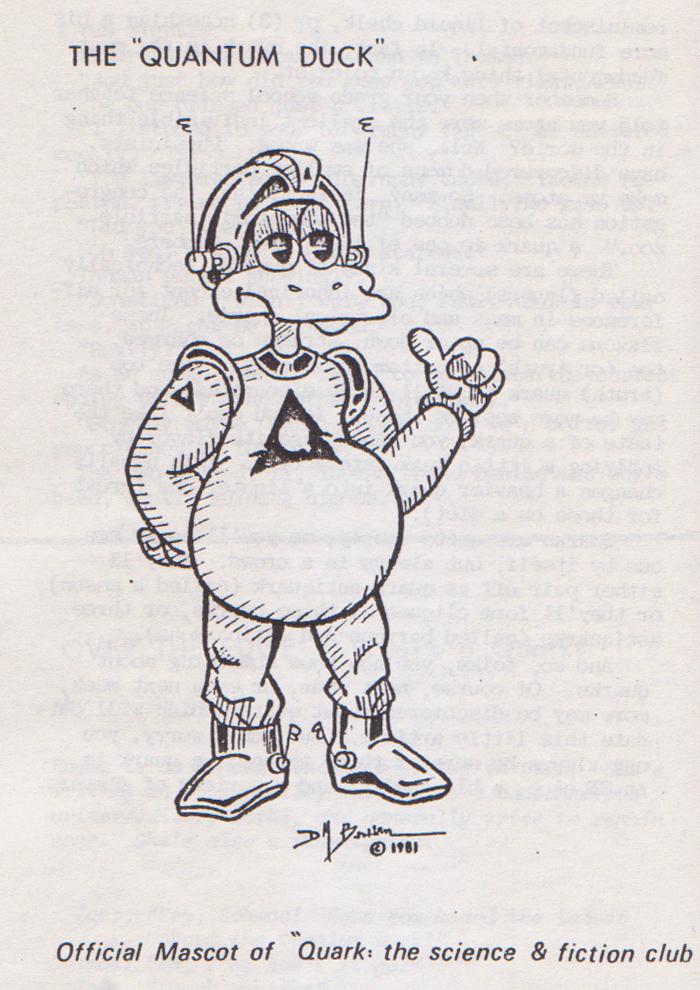
And as one final note, check out this piece of Xenobia history: the original Quantum Duck, as featured in the first issue of The Leading Edge.  Why a quantum duck, you ask?  Because that’s where the club’s name came from: a bumper sticker that said: BEWARE THE QUANTUM DUCK THAT GOES ‘QUARK,’ ‘QUARK’!