Fantasy from A to Z: Y is for Yearning

What kind of fantasy books do you hope to see more of in the next few years? What direction do you hope the genre goes next?

Personally, I would like to see the genre return to its roots. But that probably isn’t a surprise, if you’ve read the other blog posts in this series. I’ve invoked Robert E. Howard and J.R.R. Tolkien in almost all of them. Those two men are the grandfathers of modern fantasy: Howard from the sword & sorcery side, and Tolkien from the epic fantasy side. Until just the last few years, most fantasy authors stood on the shoulders of those great authors.

I’m not opposed to rules-based magic on principle. I do think that it can be done quite well, such as with Brandon Sanderson’s earlier work. But I would like to see a revival of more traditional fantasy magic systems, which aren’t really “systems” at all, but mysterious forces of nature rooted in folklore and mythology. With its overemphasis on game-like dynamics and quirky rules-based magic systems, much of modern fantasy seems to have lost sight of the ancient archetypes that gave the works of Tolkien and Howard their staying power.

As the modern world drifts further from its roots, forgetting all the stories that were handed down to us from countless generations past, so too has our fantasy lost sight of its roots, thinning out to the point where it’s little more than an aesthetic—a bundle of tropes and caricatures that evoke a nostalgia not of our pre-modern past, but of other popular fantasy stories. Thus, with each new work in this vein, the genre is diluted just a little bit more, becoming a pale shadow of what it once was.

That is why I would like to see fantasy return to its roots. I would like to see more fantasy that draws deeply from the well of history and mythology, not just to create an aesthetic, but to embed those themes and archetypes deeply into the story itself. I don’t care whether that mythology is European or not (though as a pan-European mutt, that is the culture that resonates most with me), but I do want to read books that do more than file the serial numbers off of another culture and wear it like a skin suit. 

It’s not so much that I’m worried about “cultural appropriation”—hell, as the son of medieval vikings, cultural appropriation is my culture—but if that’s what you’re going to do, you should damn right do it well. There’s a reason why we all got sick and tired of all the Tolkien clones. If we’re going to take fantasy back to its roots, we’ve got to do more than copy all the greats who came before us. We’ve got to understand, in a deep and visceral way, just what exactly they were trying to build, and then build upon it with something new.

Fantasy and science fiction are all about evoking that sense of wonder. Science fiction evokes that wonder by looking to the future; fantasy evokes that wonder by looking to the past. Our modern world has forgotten far too much of its cultural heritage. I want to see more fantasy that brings it back.

Fantasy from A to Z: X is for eXpectations

What sort of books are fantasy readers looking for today? What are the expectations that readers have for the genre?

Overall, the fantasy genre is growing. Sales are up, both in traditional and indie publishing, and the big names in the field (like Brandon Sanderson) are doing quite well. It’s clear that the fantasy genre as a whole is robust and healthy.

When you break it down by publishers and subgenres, however, things start to look a little different. Romantasy is dominating the traditional publishing world, but most of it is little more than pornography for women, dressed up with fantasy trappings. And because of how traditional publishing now relies on a few big blockbusters to make most of their earnings, romantasy is sucking all of the oxygen out of the room, making it much more difficult for debut and midlist authors in the other fantasy subgenres.

In the world of indie publishing, litRPG has begun to demonstrate some staying power. It was the new hot thing back in the early 2020s, but it’s attracted enough attention and developed enough of a following that it has become a major subgenre that is likely to endure for some time. I could be wrong about that, but from what I see, that’s where most of the innovative authors and whale readers (ie >1 book per week) are focusing their attention these days.

But because of the way that the algorithms tend to govern the indie publishing cycle (and the way that indie publishing has unfortunately turned into a zero-sum, pay-to-play game with online advertising), the rise of litRPG in the indie publishing world may very well be sucking all of the oxygen out of the room in the same way that romantasy is sucking it out of the traditional publishing world. 

Both subgenres are also very gender-biased, with women gravitating toward romantasy and men gravitating toward litRPG. This reflects the broader social and political trend of men and women going separate ways, across a whole host of different metrics. So as the gender divide continues to widen in society generally, that will probably reinforce the divide between romantasy and litRPG, creating a positive feedback loop (or death spiral, depending on how you look at it).

Sword and sorcery continues to do okay, and has probably been given a boost by the recent release of Conan the Barbarian into the public domain. But most of sword and sorcery got siphoned off into grimdark back in the 00s—in fact, you could say that sword and sorcery reinvented itself as grimdark. And while grimdark has resisted the feminization of literature, standing as one of the few remaining bastions where male readers continue to feel at home, I think grimdark has already passed its peak. In a post-pandemic, post-Trump world, I think most readers are hungry for books that are less nihilistic and more uplifting.

Which brings us to epic fantasy. While Brandon Sanderson continues to dominate this subgenre, with his massive kickstarters and huge book releases, it’s debatable whether his readers are hungry for more epic fantasy, or just for more Brandon Sanderson. He’s kind of a subgenre all to himself. Recent streaming adaptations like Wheel of Time and Rings of Power have failed miserably, and Game of Thrones has fallen almost totally out of cultural significance, with George R.R. Martin’s failure to finish the last book (and Patrick Rothfuss’s failure to finish his own series) becoming something of a meme.

In fact, the failure of these two big-name authors to finish writing their books may have struck epic fantasy a mortal wound. Because of how they have been burned, a large number of epic fantasy readers are now unwilling to commit to a series until after it is complete. But very few authors can afford to write a truly epic series and release the whole thing at once. It takes several years to write a series like that—and what are authors supposed to do if the first one flops? 

In other words, debut epic fantasy authors are damned if they do, and damned if they don’t. If they release the first book by itself, it will probably sink into obscurity before they can write and release the next book. And if by some measure of hard work and tenacity they manage to write a whole series and hold back from publishing until they’re ready to release it all at once, if the first book still fails to sell, they’re SOL and all that hard work was for nothing. 

This is also why traditional publishers are so unwilling to publish a new epic fantasy series from a debut or a midlist author. A bestseller like Larry Correia might be able to dip his feet in that pond (and do quite well—I highly recommend his Sons of the Black Sword series), they won’t do that for anyone else. Which is fine, except that indie publishing epic fantasy is just as hard—arguably more so.

For these reasons, I don’t think it’s an exaggeration to say that Patrick Rothfuss and George R.R. Martin have done more to kill epic fantasy than they have to grow it.

But this may actually have created an opportunity for those authors who are willing to drive into the smoke. After all, there’s much less competition if you can manage to break in and build a decent following. But how much hunger is there for epic fantasy, compared to other fantasy subgenres? And how can a newer/midlist author reach them, without a big push from a publisher or the algorithms?

Fantasy from A to Z: N is for Noblebright

In the grim darkness of the far future, there is only war.

While the quote comes from Warhammer 40k, a science fiction franchise, it very soon became applied to the “darker and edgier” fantasy that started coming out in the 80s and 90s. Indeed, the quote itself spawned the term “grimdark” for a fantasy subgenre that became very popular in the 00s, with the rise of George R.R. Martin’s Song of Ice and Fire and subsequent Game of Thrones TV series.

Grimdark combines the scope and feel of epic fantasy with the savagery and moral greyness of sword & sorcery, ramping up the violence and savagery to levels that would have made even Robert E. Howard blush. It often features twists that subvert the old fantasy tropes, such as killing off the “chosen one” hero who would typically be the protagonist, or presenting a horrifying dystopia of a world that is the utter antithesis of an escapist fantasy.

In part, I think the grimdark phenomenon was a reaction to the Tolkien formula that dominated fantasy for so long. After J.R.R. Tolkien’s Lord of the Rings became wildly popular, his publishers tried to replicate that success by explicitly creating a formula that they wanted their writers to follow. This resulted in a bunch of Tolkien clones, such as Terry Brooks’s Shannara series and David Edding’s Belgariad series. For a couple of decades, these dominated the fantasy shelves, until writers began to revolt, and their books began to take off. After all, Game of Thrones was originally published in 1996.

But while there’s some truth to that theory, I don’t think it’s sufficient to explain the rise of grimdark. After all, Stephen R. Donaldson was rebelling against the Tolkien formula back in the 70s, and while his Thomas Covenant books were quite successful, they didn’t spawn a new subgenre (though arguably, they paved the way for later writers like Martin and Abercrombie). Instead, I think there’s something generational about the grimdark subgenre—that it’s the sort of thing that only could have arisen in the 90s and 00s, because of how the generational cycle works.

I wrote a lengthy blog post about this, which remains one of my more popular posts. My basic thesis is that the fantasy genre goes through generational cycles just like history goes through generational cycles. In its simplest form, the cycle looks something like this:

  • Hard times create strong men.
  • Strong men create good times.
  • Good times create weak men.
  • Weak men create hard times.

During the hard times, we tend to resonate more with stories that feature grim characters and dark fantasy worlds—hence, the rise of grimdark. But during the good times, we tend to resonate more with noble characters and bright fantasy worlds. 

(It’s a little more complicated than that, of course. The fantasy cycle is offset just a little, since we tend to resonate less with darker stories as we become exhausted from living in a darker world. Indeed, the yearning for the next phase of the cycle drives us to tell more hopeful stories, which in turn drive us to build a more hopeful world. But to read the full analysis, go check out my original post.)

So what is noblebright fantasy, then? It’s basically the antithesis of grimdark—a backlash against the backlash. And while it hasn’t yet manifested as a distinct subgenre, with a George R.R. Martin or a Joe Abercrombie to champion it, I think it’s only a matter of time before we see an author who rides this cultural wave to massive literary success. And as soon as that happens, I think we’ll have a much better idea of what “noblebright” actually is.

In other words, noblebright fantasy is currently in the process of being born—and after it has emerged fully formed into the world, it will probably take a different name. Indeed, “noblebright” as a term is itself merely a knee-jerk reaction to “grimdark.” To subvert the original Warhammer 40k quote: 

In the Noble Brightness of the far future, there is only HIGH ADVENTURE!” 

Currently, there are only a handful of writers who are explicitly labeling their books as “noblebright fantasy.” I am not one of them, though I suspect that my books (and my readers) have a lot of overlap. As it exists right now, noblebright is characterized by heroic quests and the triumph of good over evil, with an emphasis on hope, virtue, and making a positive difference in the world. It’s also very common for these authors to include Christian themes, though from what I can tell, the books aren’t explicitly religious.

While I haven’t yet joined the pioneers of this budding new subgenre, I expect that I will in the not-too-distant future. I’m currently working on an epic fantasy trilogy based loosely on the life of King David, which features many of these noblebright tropes and themes. But it’s going to be a while before I release the first book, since I want to publish the books of the first trilogy all within a month of each other. Since these books are going to fall in the 150k to 200k word range, a lot of things can change between now and then. Perhaps the term “noblebright” will have been abandoned, with people looking down on it as a passing fad of the early 20s.

But I don’t think the broader trend toward brighter, more hopeful fantasy is going to reverse course anytime soon. In fact, I think it’s generational. Whether or not it takes the name “noblebright,” I think that we’re going to see a new subgenre of fantasy emerge very soon. It’s starting right now as a backlash to grimdark, but as the wave crests and it begins to gain some staying power, I expect that it will stop defining itself by the thing it opposes and start to define itself in a more independent way.

I’m really hoping to catch this wave, and I think that my Soulbound King series has some real potential to do so. But whether or not I catch it, I know that this is the kind of stuff I like to write, and I hope to be able to write it for a long time to come.

Fantasy from A to Z: K is for Kings

Why are kings and kingdoms so common in fantasy?

Part of it has to do with the genre’s nostalgic yearning for a distant past. One way of understanding the modern era is to see it as an unending series of political revolutions that have spread like a slow-moving contagion from one part of the world to another. 

It started with the English Civil War, then died down for a while until it manifested in the American Revolutionary War, which resulted in the creation of the United States. After that, it spread to France, leading to the French Revolution and a very messy tug-of-war between the Republicans and the Monarchists, ultimately leading to the permanent end of the French monarchy. 

Then we had the aborted revolutions of 1848, which ultimately gave us Karl Marx and Socialism, the Bolivarian revolutions in Latin America, the American Civil War, which culturally was something of an echo of the old English Civil War (with the Cavaliers in the south and the Puritan Roundheads in the north), and ultimately the Bolshevik Revolution which gave us global communism, etc etc.

I won’t belabor the point (though if you want to hear a good podcast that covers all this stuff, check out Revolutions by Mike Duncan). The point is that the modern era has basically been one long series of very messy wars to depose the old medieval kings and emperors. Today, the only monarchies that survive are either constitutional monarchies that no longer exercise direct political power (for example, King Charles of the United Kingdom), or else they are strange aberrations that only exist because of unique regional history and economic circumstances (for example, Mohammed bin Salman of Saudi Arabia, whose dynasty depends almost entirely on the country’s oil reserves).

Fantasy is all about hearkening back to a romantic view of the premodern past, even if that past never existed. So it shouldn’t come as a surprise that most fantasy—especially classic fantasy—tends to feature kings and kingdoms. Never mind that historically, many medieval kings were almost totally beholden to their dukes, especially in the time before gunpowder, when the dukes could just hole up in their castles and openly defy their kings. That’s why Europe has so many medieval castles.

Of course, some fantasy like George R.R. Martin’s Song of Ice and Fire does a really good job of capturing the complex dynamics of feudal politics. A lot of the old sword & sorcery also plays around with those kinds of medieval political tensions, balancing the nostalgic aspect of fantasy with the savagery of backstabbing courtiers and brutal hand-to-hand combat. Robert E. Howard’s classic Conan the Barbarian stories are a great example of this, with Conan ultimately rising to become King of Aquilonia.

Both grimdark and sword & sorcery embrace the medieval savagery—indeed, it’s a large part of the nostalgic yearning. Other subgenres play down the savagery, either by making the king a distant power, or by making the world out to be a lightly-populated wilderness. Lord of the Rings is a good example of both, though it still defaults to feudal monarchy as the majority political system.

Is there a subconscious yearning for old-fashioned monarchy that fantasy quietly fulfills? Perhaps, but I don’t think so. If kings and kingdoms are the default system of government in most fantasy novels, I think that’s because it was the default for much of the medieval era. In books like Game of Thrones where the political intrigue is a key aspect of the story, you get into the more complicated aspects of feudal politics, but that’s not necessarily a requirement.

Personally, I enjoy fantasy with a little bit of medieval-style political intrigue, though most grimdark tends to overdo it. I did really enjoy Larry Correia’s Saga of the Forgotten Warrior, though (no spoilers please—I haven’t yet read the last book!) Robert E. Howard hits the sweet spot, I think, with a world so wild and savage that no king has managed to subdue it, and even a barbarian can rise to become a king.

Fantasy from A to Z: C is for Conan

Before there was J.R.R. Tolkien, there was Robert E. Howard. And before there was Middle Earth, there was Conan the Barbarian and the Hyborian Age.

Robert E. Howard had an amazingly prolific writing career, cut tragically short by his suicide. When I think of all the books and stories we could have had if Howard had not shot himself in grief after the death of his mother, it fills me with a profound sense of loss (and makes me want to rewatch the excellent biopic about him—or more accurately, his girlfriend—The Whole Wide World). I love Howard’s fantasy stories—not just the ones about Conan and his adventures, but the ones about Bran Mak Morn, Kull of Atlantis, Solomon Kane… honestly, he wrote so many stories that I have yet to exhaust them all. 

But my favorite are the stories about Conan the Barbarian, who is undoubtedly his most famous literary creation. Over the course of the last century, Conan the Barbarian has taken on a life of his own, with dozens of writers taking a stab at writing stories in the Cimmerian’s world. My favorite of these is probably John Maddox Roberts, though I have a soft spot for L. Sprague de Camp. Harry Turtledove also wrote an excellent Conan novel, Conan of Venarium. 

In a lot of ways, Robert E. Howard’s Conan stories set the standard for modern fantasy—or at least for the sword & sorcery strain for it. Tolkien later established the epic fantasy strain, and you can make a solid argument that every other successful fantasy book is derivative of one or the other (or both). Where the epic fantasy strain tends run super long, with novels in the 200k word to 400k word range, the sword & sorcery strain tends to run much shorter, with many of the original Conan stories clocking in at under 10k words. In fact, from what I’ve gathered, until Lord of the Rings became popular in the 60s and 70s, most readers thought that the natural length of a fantasy story was under 10k words.

For the Conan stories, that’s probably true—or at least, under 40k words, since many of Howard’s original novellas are quite good. My favorite of his is probably either “The Tower of the Elephant” (perhaps the most classic Conan story) or “The Black Stranger,” which had a very interesting Mexican standoff between three stranded pirate captains that Conan totally blows up. I also really enjoyed “Iron Shadows in the Moon,” mostly because the female love interest gets an interesting and satisfying character arc. The crucifixion scene from “A Witch Shall Be Born” was really great, too, and of course, the brutal savagery of “Red Nails” made a really big impact—though since that was the last Conan story Howard wrote before he shot himself, it has a very dark edge to it.

Howard only wrote one Conan novel, and to tell the truth, I wasn’t particularly impressed by it—it just felt like a generic Conan story, padded with a bunch of filler to increase the length. But I did really love Conan the Marauder by John Maddox Roberts, where Conan rises through the ranks of a horde of nomadic tribesmen, starting as their slave and eventually becoming the right-hand man of the Hyborian age’s Genghis Khan. The two major villains of that book had exceptionally satisfying deaths, and the writing was almost as pulpy and glorious as Howard’s writing itself.

After you’ve read all the original Conan stories, you really should watch The Whole Wide World. It’s a wonderful film about the only woman Howard ever loved, his on-again off-again girlfriend Novalyne Price, and their turbulent relationship. As a writer, I really appreciated the glimpse that the movie gives into the life of the author himself—and on how some of his eccentricities as a writer mirror my own. Thankfully, though, my family life has been much more stable. I don’t blame Novalyne Price for rejecting Howard, but I am very thankful for my own wife and children. My own writing changed dramatically when I became a husband and father. I can only imagine what wonderful stories we would have had if Robert E. Howard’s life had taken a similar path.

The book I’ve written that comes closest to matching the mood, theme, and action of a typical Conan story is probably The Riches of Xulthar. It isn’t nearly as good as the original Conan stories, but I do think it compares favorably against some of the later knock-offs. The idea for it came when I was playing around with ChatGPT and asked it to write me a fantasy adventure story in the style of Robert E. Howard. Things took off from there. Riches of Xulthar was my first AI-assisted novel, though after using AI to generate the rough draft, I rewrote the whole book to put it in my own words, which is the process I use for all of my AI-assisted books. If you’re interested, you can do a side-by-side comparison between the AI draft and the human draft on my blog. 

Short-form vs. long-form fantasy

For the last month, I’ve been doing a lot of research into the fantasy genre, rereading all of the original Conan the Barbarian stories by Robert E. Howard and a bunch of the other ones too, by authors like L. Sprague De Camp, Lin Carter, Bjorn Nyberg, Robert Jordan, etc. I’ve also been reading a lot of epic fantasy, like the Wheel of Time series by Robert Jordan and the Stormlight Archive by Brandon Sanderson. And I’ve also read some essays on the genre, most notably “The Critics, the Monsters, and the Fantasists” by Ursula K. Le Guin, and “The Making of the American Fantasy Genre” by David Hartwell. Oh, and opening a bunch of chats with ChatGPT, though those are of limited usefulness (for some reason, ChatGPT hallucinates like crazy when you ask it to recommend any noblebright fantasy that isn’t more than two or three decades old).

From what I’ve gathered, there are basically two camps or schools within secondary-world fantasy: the heroic / sword & sorcery camp, based off of Howard’s Conan the Barbarian, and the epic fantasy camp, based off of Tolkien’s Lord of the Rings. According to David Hartwell, those are the only two franchises to achieve breakout success: everything else has either achieved only moderate commercial success in its time before petering out, or gained only a niche audience. Apart from Conan, the fantasy genre as a whole didn’t really take off until Terry Brooks immitated Tolkien with his Shannara series, thus launching a wave of Tolkienesque epic fantasy in the 70s and 80s that morphed into Grimdark in the 90s, 00s, and 10s.

So for a while, I was looking into all the various tropes and archetypes that make Conan and LOTR tick, and trying to use those to differentiate the two. But lately, I’ve been wondering if maybe I’ve been overthinking all of this, and the real difference between the two is that Tolkien mastered long-form fantasy, and Howard mastered short-form fantasy. In other words, what if the defining difference between the two camps doesn’t have to do with tropes so much as with the length of the actual story?

I suspect that short-form fantasy is poised to make a resurgence, especially with all of the challenges associated with writing and selling long-form fantasy in the 2020s. Larry Correia is right: Rothfuss and Martin have ruined the epic fantasy field for new authors by failing to finish their series in a reasonable timeframe. Unless you are independently wealthy or already have a large and loyal following of readers, it just doesn’t make commercial sense to write a lengthy series of +200k-word fantasy epics. Better to write shortier, punchier 40k-word novels instead, especially if you can churn them out every other month or so. That seems to be the model that works best for indies, at least in adjacent genres like urban fantasy and paranormal.

Anyway, that’s my current thinking on the subject. What’s your take on it?

Trope Tuesday: Chaotic Neutral

Look, I ain't in this for your revolution, and I'm not in it for you, Princess. I expect to be well paid--I'm in it for the money.

If you’ve ever read a space adventure with smugglers and pirates, or a sword & sorcery with rogue thieves and master-less swordsmen, or a western with gritty outlaws and mountain men, you know this character alignment.  If you’re a fan of any of these genres, chances are you love him, too.

The Chaotic Neutral‘s one consistent rule is to always look out for #1.  Beyond that, he’s a free spirit who believes in individuality and resists anyone or anything that tries to control him.  Rebellious spirits and lovable rogues tend to fall into this alignment, but so do tricksters and wild cards.  Their resistance to any form of personal restriction makes them unreliable allies, despite what Jack Sparrow says.

From the easydamus alignment page:

A chaotic neutral character follows his whims. He is an individualist first and last. He values his own liberty but doesn’t strive to protect others’ freedom. He avoids authority, resents restrictions, and challenges traditions.

A lot of characters start out as this but tend to shift as the story progresses.  Han Solo, for example, shifts from Chaotic Neutral to Chaotic Good as he becomes more and more involved with the Rebellion.  The Jägers from Girl Genius are Chaotic Neutral until they have a Heterodyne to lead them.  But in other stories, such as Pirates of the Caribbean and Schlock Mercenary, the Chaotic Neutral serves as an anchor.

My favorite Chaotic Neutral is probably Waylander from David Gemmell’s Drenai series.  The Jerusalem Man is another good one–in fact, just about every one of his books has a Chaotic Neutral that I love.  Haruhi Suzumiya is an excellent example of a female Chaotic Neutral–in fact, she’s probably the queen of this particular character alignment.

In my own work, the best example of a Chaotic Neutral would probably be Tamu from Bringing Stella Home / Sholpan.  Even though she’s technically a slave, she doesn’t really mind it because she has everything she wants and doesn’t have to be beholden to anybody (not even Qasar, really, since she’s his favorite).  Amina from Desert Stars is also Chaotic Neutral, in contrast with Surayya, who is more of a Lawful Neutral, though sometimes it’s hard to tell.  And in Genesis Earth, Terra is definitely a Chaotic Neutral at the beginning, though she shifts a little somewhere around the middle.

I’m hesitant to admit this, but when I took the character alignment test for myself, I tested out as a Chaotic Neutral.  As to what that means, exactly…I’m not going to say. o.0

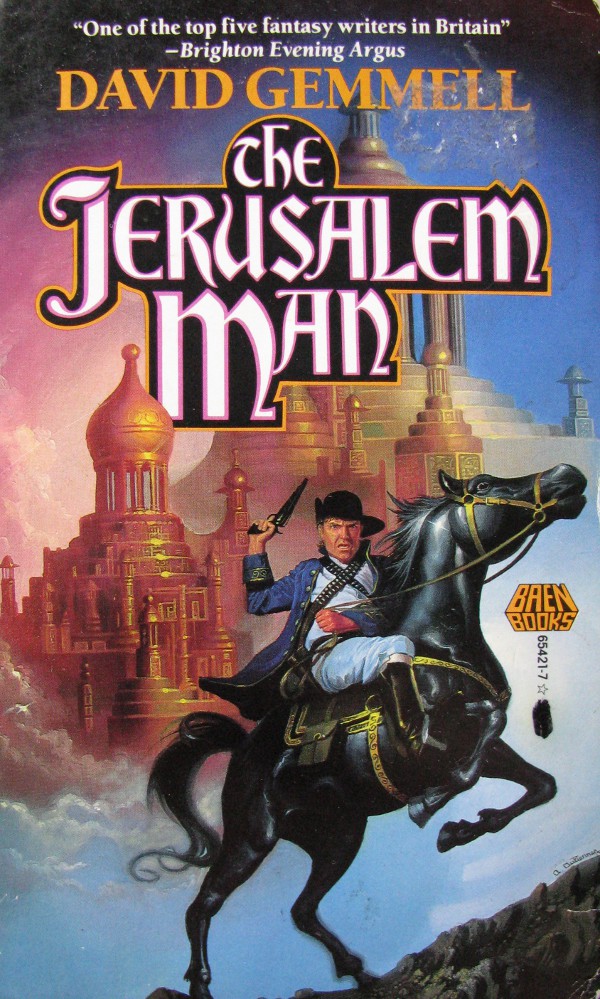
The Jerusalem Man by David Gemmell

The old world is dead, destroyed by nuclear fire.  The old ways are long forgotten–except by one man in search of the Holy City.  He wanders the Earth with two guns and a Bible, leaving a trail of death and ancient prophecy in his wake.  Brigands fear him, honest men pity him, and the Hellborn hunt him.  He is John Shannow–the Jerusalem man.

This is some vintage David Gemmell.  In fact, I think this particular edition has been reprinted as Wolf in Shadow, and can no longer be found except in used bookstores and book trading sites.  Regardless, the book is awesome, right on par with Gemmell’s other work.

David Gemmell has the uncanny ability to suck you in almost as soon as you open the book, making you emotionally invested in the characters and conflicts to the point where you can’t stop thinking about it.  My favorite part of this book was in the first few chapters, when John Shannow found a frontier woman and briefly settled down.  It only lasted a handful of pages, but it was so powerful and moving that I felt compelled to read almost nonstop until I’d finished the book.

The later half gets a little outlandish, with magic stones, the lost city of Atlantis, and a Satanic cult bent on world domination.  It was a fun adventure, but not as compelling for me as the personal story of John Shannow.  In fact, it seems as if Gemmell unconsciously fell back on all the old tropes of the Drenai series, turning his post-apocalyptic western into a sword and sorcery romp, like Waylander with guns.  It wasn’t bad, but at times it did feel a little over the top.

This might have to do with my own personal tastes, however.  I tend to enjoy stories that have more to do with the personal lives and intimate struggles of the characters than grand quests to save the world.  I don’t know if it’s always been like that, or if it’s just something that’s changed as I’ve gotten older.

Regardless, The Jerusalem Man was a great book, and I thoroughly enjoyed it.  If you’re a fan of fantasy-western mashups, or post-apocalyptic fantasy in general, then this is a must-read.  And even if that’s not your usual fare, if you’re drawn to loner heroes who don’t pull any punches, you’ll almost certainly love this book.

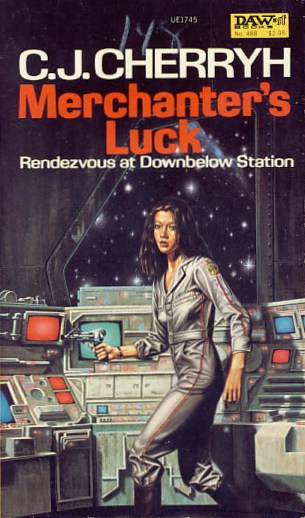
Merchanter’s Luck by C. J. Cherryh

He was a down and out merchanter, the captain, crew, and sole proprietor of a run-down bucket of bolts spacecraft.  She was a daughter of one of the finest starfaring clans, with seven hundred cousins standing between her and the one thing she wanted more than anything else: command of a starship.

They met at Pell during the height of the Company War–the key strategic point on the border between Union and Earth.  Their fateful meeting would affect not only the outcome of the war, but the course of their own lives–for the starship Lucy of Wyatt’s Combine was not at all what she seemed to be.

Before I review this book, I need to issue a disclaimer: you probably aren’t going to enjoy it very much unless you’ve already read Downbelow Station.  Cherryh isn’t the best at easing her readers into her worlds, and without the background on Union, Alliance, and the Company War, you’ll probably be hopelessly lost.

That said, I absolutely loved this book.

The premise is so awesome.  Space adventure hardcore, with a beautiful love story set amidst an epic interstellar war, where alliances are constantly broken and no one can be trusted…oh man, I LOVED this book!

While the premise seems pretty standard, C. J. Cherryh transcends the well-worn tropes and cliches of her genre by intimately developing her characters and working their motivations into the story until they are the ones driving the plot, and not the other way around.

Every character is unique, and though they act in ways that may seem strange to our modern sensibilities, there are always reasons for everything they do, cultural or otherwise.  As windows into their far-future spacefaring culture, they give the reader a wonderful view of Cherryh’s unique and marvelously constructed universe.

The thing that surprised me the most, however, was the sharp contrast between this book and Downbelow Station. While Downbelow Station traces the epic arc of the Company War through the viewpoints of a large cast of characters, much like Tolkien or Dune, Merchanter’s Luck focuses more on the characters themselves, in much the same way as David Gemmell or Ursula K. Le Guin.  In other words, while Downbelow Station is comparable to “high” or epic fantasy, Merchanter’s Luck would fall closer to “low” fantasy or sword & sorcery.

The interesting self-realization I took from the book was that I’m much more interested in the intimately personal stories than the sweeping epic tale of the Rise and Fall of cultures and civilizations.  I suppose that’s why I’m more of a David Gemmell nut than a Tolkien fanatic, and perhaps why I’m more into space opera and military sf than epic fantasy.  In all of my novels, the focus is always on the individual characters and their personal conflicts, and whenever I get sidetracked and focus too much on the overworld story, it always falls apart. 

Merchanter’s Luck definitely doesn’t get sidetracked, and that’s why I loved it so much.  I fell in love with the characters almost from the very first page–from the blurb on the back cover, even.  And most of all, I fell hopelessly in love with the starship Lucy:

You know you’re doing science fiction right when your readers bemoan the fact that they weren’t born in the 26th century, when they could command their own spaceship.  C. J. Cherryh is an amazing writer, and if I had the chance, I would teleport into her Union-Alliance universe in a heartbeat.

If you love well-crafted far-future worlds and stories about the people that live in them, check out Downbelow Station (or really, just the first chapter–that’s all you need for a solid grounding) and read this book!