LTUE 2011

So LTUE (BYU’s science fiction and fantasy symposium) was last weekend, and it was awesome.

The venue was the BYU Conference Center just north of where DT used to be, and in my opinion this was a much better place to hold it than the student center, where it’s always been.  It felt a lot more professional, and allowed for better interaction.

It felt like there were a lot more people there this year, including two editors: Lisa Mangum from Shadow Mountain, and Stacy Whitman from Tu.  I didn’t try to pitch to either of them, since I don’t think they really publish what I write, but they were on a few interesting panels.  Tracy Hickman, Howard & Sandra Tayler, and Jessica Day George were also very awesome on all the panels they attended.

One of my favorite panels was the presentation by Tracy Hickman on Lord of the Rings.  He basically took it apart using Dramatica theory, showing how the series is composed of several distinct subplot, where each character (even the minor ones, like Eowyn) is literally the hero of their own story.
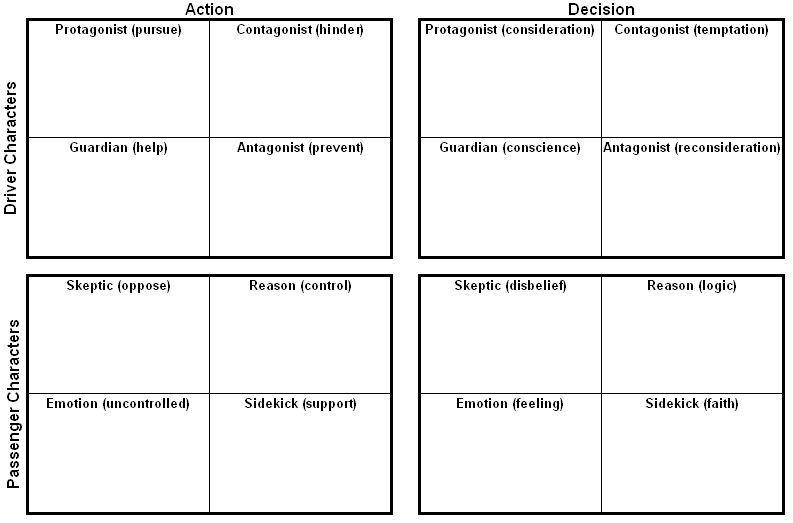
The presentation inspired me to go through some of my own novels and use the basic character archetypes from Dramatica to outline my own novels.  I wrote out the names of all the characters in WAFH and GE on notecards, then on the back wrote down which archetype they fulfilled based on who was the protagonist.

There were several other excellent panels as well.  I got a ton out of the “Can your dreams pay the bills?” one, with Sandra Tayler moderating.  She sure knows her stuff when it comes to the practical business aspects of a creative career.

I dunno; a lot of my writing friends claim to be at a point where panels at cons are less useful for them.  While I can see why they say that, I still find them helpful.  While a lot of the advice is stuff I’ve heard before, every once and a while someone will have a fascinating insight on things.  It’s like stories, I guess; even though there’s nothing new under the sun, everyone has a different way of making it their own, which is ultimately what makes the whole enterprise valuable.

Also, I had an awesome first this year: I signed my first autographed story!  Leading Edge had a booth in the hall, and while I was hanging out there, I mentioned to Eric James Stone how I had a short story published and joked around about signed copies.  To my surprise, he bought the issue and asked for me to sign it!

So yeah, my first signed copy of anything ever goes to Eric–thanks for the support!  Now I’ll see what I can do to make that signature actually worth something someday…

Oh yeah, one more thing: Dan Wells is going to name a character in one of his books after me!  According to Dan, the character (Gabe Vasicek) is “a big guy who wields a minigun.” Hehehe…can’t wait to read it!

Anyhow, LTUE was awesome this year, just as I’d expected.  The panels were enlightening and entertaining, the guests were gracious and easy to talk with, and the overall experience was just a lot of fun.

Almost at four

I’ve got half a dozen things I could blog about, but it’s 2 am and cleaning checks are tomorrow, so I think I’m going to give a quick update and go to bed.

Worlds Away from Home is doing quite well–I’m only two chapters and five scenes from the end.  I’d push really hard to finish it tomorrow, but I’m still waiting on some of my alpha readers for Mercenary Savior and probably won’t start that project until after I go back to Massachusetts at the end of the month.

I’ve been thinking a lot about the seven point story structure Dan Wells talked about at LTUE 2010 (which I missed, but caught on youtube), and I’ve got a TON of ideas for Mercenary Savior now.  I’m practically chomping at the bit to start analyzing this story and working out all the complex plot and character elements.  That’s very good.

While chatting with one of my alpha readers for Mercenary Savior, I had an interesting idea for a direct sequel.  Basically, while James’s storyline has some closure (or should, after I finish this next revision), he’s still got a lot of growing and maturing to do.  My mind is already working it out…should I make that my fifth novel?  Or move on to something else first?  The thing about direct sequels is you can’t sell them without the first book, and if the first book doesn’t sell…

I’m applying for Redcliff Ascent; if all goes well, I’ll be participating in the November training (since September is full).  At first, I was hesitant about this (since I kind of need a job now), but looking at it now, that’s probably the best time to do it.  It’s after World Fantasy, which gives me time to finish Mercenary Savior, and late enough in the year that I can still finish that article for Mormon Artist.  Plus, I can easily get a schedule that allows me to attend LTUE 2011.  The only disadvantage is that I won’t be able to attend all of Brandon Sanderson’s English 318 classes, but that’s not such a big deal (seeing as I’ve taken the class twice already!).

Other than that, life is good.  I’m going home in a week to see my parents and get my teeth done (since my mom’s health insurance covers me until my birthday in September–why pay for a checkup when you could have it for free?), and I’m definitely looking forward to that.  And now that I’m almost finished with Worlds Away, I can see that it’s got potential, and that’s encouraging.  Not this draft, certainly, but once I fix all the holes, it could really go somewhere.

Either way, it’s going to be nice having four novels under my belt.

The Madness Season by C. S. Friedman

In the 21st century, Earth was conquered by an alien collective consciousness known as the Tyr.  Now, five hundred years later, humankind has been scattered across the Tyr-occupied worlds as slaves.  It is a dark and uncertain existence, under the rule of masters who do not care whether their charges live or die.

For the last five hundred years, Daetrin has been a survivor.  An anomaly among humans–a man with the power to live indefinitely–Daetrin is used to keeping his true nature hidden.  But when the Tyr learn of his strange abilities and take him away for further study, he finds himself on the run, out in the open.

In order to survive, however, he must face his greatest fear–the fear that he isn’t entirely human.

This book was interesting.  C. S. Friedman’s prose is quite good, and her main character has a very unique and engaging voice.  For some reason, she wrote all of Daetrin’s stuff in first person, while the other characters in third person.  I think that the main reason for this was to preserve the sense of surprise and horror when he made certain discoveries while at the same time revealing certain critical aspects of her world that the reader absolutely needed to know in order for the story to make sense.  It didn’t bother me–in fact, I think she did it quite well–but it might not work for you.

In terms of story, this book was interesting but a little confusing.  It lagged at times, especially towards the beginning, and towards the end so many things came together at once that it was difficult for me to keep track of them.  I’m not entirely sure why that was, but I think it’s related to the fact that I never felt a very clear sense of progression.  Plotwise, things happened, but I didn’t see how one led necessarily to the next, or where things were going overall.

That said, the ending was satisfying, and I enjoyed reading this book.  You don’t realize it until the end, but the whole book is basically Friedman’s sf take on a certain type of well known, very popular mythical monster.  I won’t spoil the book by telling you which one, but when I saw it, it made me smile.

In terms of science fiction, there are a lot of old tropes with very few new ideas, except for the shapeshifting alien species known as the Marra.  Their culture was interesting, and I thought Friedman did a very good job conveying both the familiarity and the alien-ness of that species.  The Tyr weren’t quite as interesting, because they were basically just the Borg with scales and spikes, but the Hraas and the Tekk (who are a type of human) were also well done.

This is definitely the kind of book you’d want to sit down and read, rather than take everywhere with you and read whenever you get a spare moment.  Without sitting down and dedicating some time to it, it’s very difficult to really get into the story or feel immersed in the world.  I made that mistake, and it took me nearly a month to finish it.  That said, it was a good book; I’ll definitely be reading some Friedman again.

Dying of the Light by George R. R. Martin

Worlorn is a planet without a sun, wandering on the fringes of the galaxy where the skies are starless.  Though it came to life briefly as it passed the red giant Fat Satan, those days are over, and the world is slowly dying.

Dirk T’Larien never thought he would find himself on such a forsaken world. But when his onetime lover, Gwen Delvano, sends him a plea for help, he realizes that more than anything, he wants to have her back.

It will not be easy, however.  Gwen is betheyn to two men: Jaantony Vikary, whom she loves, and Garse Janacek, whom she hates.  Both are from Kavalar, a warlike planet where offworlders are considered subhuman.  And even though Worlorn is slowly dying, a colony of extremist Kavalars has taken root, planning to bring back the old ways when offworlders were hunted like beasts.

I picked up this book at Pioneer Books a couple weeks ago; I saw that it was by George R. R. Martin and decided to give it a try.  I was very much impressed.  For the last hundred pages, I couldn’t put it down, and the story haunted me for a couple days after I’d finished it.

The strongest element of the story was definitely the setting.  The story may be set in a grand galactic empire with spaceships and alien worlds, but make no mistake, this beautiful piece of space opera reads more like fantasy than science fiction.  There’s even a thirty page glossary of terms in the back, for ease of reference.

The effect of Martin’s grandiose worldbuilding is a haunting sense of wonder that keeps you, as the reader, hooked.  The more you read, the more you immerse yourself in the world; and the more you immerse yourself, the more you want to read.  After the story ends, you still find yourself thinking about the fantastic worlds, as if you’ve actually been there.  It’s awesome.

Another thing that kept me hooked was the basic premise of the plot.  The main character, Dirk T’Larien, is trying to win back the affection of an ex-girlfriend and get back together.  That’s something with which I can definitely relate–the ex even has the same name (roughly) as a girl I once chased after (quite unrequitedly, may I add).  Because of this, I was drawn into the story right away.

Martin is known for his plot twists, however, and though the story began as a basic love triangle, it very quickly became… something else.  I’m not entirely sure how to describe it without giving major spoilers, but I will say that I found it impossible to predict how this story would end.  I found that a lot more annoying than enjoyable, however–just when I thought things were headed in a certain direction, something happened to nullify everyone’s efforts and turn things completely around.

Despite this, however, the story…worked.  I don’t know quite how to describe it.  The basic markers were all there, even though they were jumbled in unpredictable patterns.  No death was meaningless, no success was insignificant; there was no excess baggage in the story that didn’t somehow belong.

All around, it was a very good book.  Kind of dark, but not nearly as edgy as I was expecting.  This is definitely the kind of science fiction that a fantasy reader would go for–and probably most science fiction readers as well.

Thoughts on writing characters

A couple months ago, I was listening to one of my personal recordings of Brandon Sanderson’s English 318 lectures from last  year’s class.  The topic was writing characters.

Brandon outlined several techniques for making characters sympathetic.  He also outlined how to round them out: give them flaws and handicaps, as well as little quirks to make them unique and memorable.

However, I couldn’t help thinking that something was missing in his formulation.

Before I continue, let me say that I’m not disparaging or criticizing Brandon Sanderson’s abilities to write compelling, well-rounded characters.  As his novel Mistborn shows, writing characters is one of his strengths.

At the same time, I feel that the “checklist” approach to writing characters can be dangerously counter-productive.  Too often, characters in sub-par novels feel like a patchwork of characteristics and personality traits, not like actual, real people.

When I asked Brandon about this, he said that his techniques should be seen as tools, not as fundamentals.  He then went on to say that the most important thing to keep in mind is the character’s motivations–why they want what they want.  Beyond that, you just have to tweak the character until they fit into their role.

After thinking about it for some time, I came to the conclusion that the best way to write characters is to keep two essential rules in mind:

Rule #1: Every character is the hero of their own story.

Rule #2: Every story is composed of three parts: beginning, middle, and end.

The first rule is straightforward: every character sees their life as a story in which they are the main character.  This is because all of us, as human beings, view our own lives in this way.  We may look at other people and consider them nothing but extras in the story of our life, but they certainly do not think of themselves in this way.

To apply this rule, however, we need to understand what it exactly means to be the hero of one’s own story.  We can only understand this when we realize that a story is composed of three basic parts: beginning, middle, and end (or, as we see ourselves: past, present, and future).

Every hero has an origin and a destiny.  Without these, they don’t have a story; they don’t have a beginning and they can’t have a meaningful end.  This is why the hero cycle begins with the miraculous birth and ends with ascension and apotheosis.

Writers should keep this in mind as they sketch their characters.  If you don’t know where your character came from–who their parents are, where they  grew up, what were their major formative experiences, etc–your characters are going to fall flat because they’re just extras in someone else’s story; they have no story of their own.

Likewise, your characters need to have a destiny.  If you’re a discovery writer (like me), this might be harder because you don’t know, from the outset, where everyone’s going to end up.  Keep in mind, though, that rule #1 applies to the story the characters tell themselves just as much as the story you’re telling the reader.

Each character’s individual story is like a thread, which the writer weaves together with other threads to form a beautiful tapestry.  That tapestry is the novel; without the individual characters’ stories, the work would feel week, shallow–threadbare.

Of course, it’s not always possible (or a good idea) to reveal everything about every character.  It’s also not always possible to outline every character in great depth–not without catching “worldbuilder’s disease.” Instead, the rules of worldbuilding should apply–only use 10% of your worldbuilding in the actual story, no info dumps, etc.

I don’t think that’s a comprehensive theory of character just yet, but I think it’s a step closer to one.  If you have any ideas or suggestions of your own, please do share.

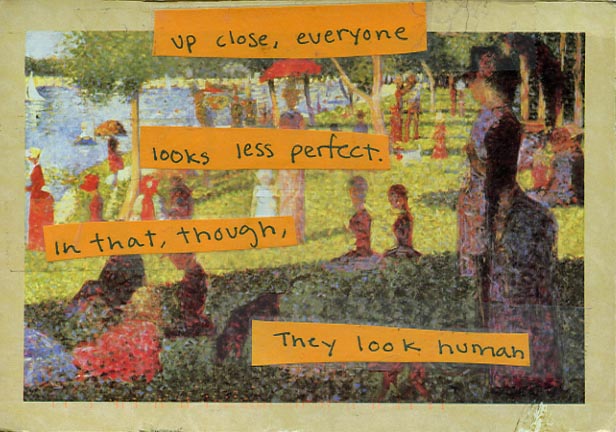
Image courtesy Postsecret

Falling in love: does it actually happen?

I like to tell people that I don’t believe in the concept of “falling in love”–that true love isn’t something you fall into, it’s something you grow into.  The thing you fall into is called “infatuation,” which by itself doesn’t last long.  It’s happened to me many times, and look at how single I am.

However, I was listening to this week’s episode of This American Life, and the first story got me to think about the concept of “falling in love.” The story was about an American exchange student in China who went back a year later in order to chase down this girl he’d met over there.  Miraculously, he found her, and in a short period of time, they married each other.

The story doesn’t end there, though, nor does it gloss over or ignore their struggles since getting married.  In fact, they’re both surprisingly candid.  Even though they could have broken up, though, they said that the incredible story of how they got together kept them going until they worked through the crisis.  The narrator finished:

..Eric and Yuen-Yuen had to make that same transition that all couples do, from the crazy, in-love stage to the other thing—the hard part of love. And it’s when you’re in that struggle that you most need the story of how you’re meant to be, because the alternative–that the person you’re with could be one any one of hundreds or thousands of other people–well, if that’s true, then why even try?

This got me to wondering–is there something besides sentimental hogwash to the notion of falling in love? Is it a necessary myth? Or is it more than a myth? Growth is generally something you control, but if all you can say is that you and your significant other “grew” into where you are today, is that enough to keep you going?

Snarkiness aside, I suppose it’s different for everybody. Some people have to believe they were fated to be together, while others abhor anything but the idea that love is something that grew slowly and steadily, without crazy flashes in the pan.

The important thing, I suppose, is that when it comes to love, we all have to have a story that we tell ourselves. Without a story to help us make sense why we’re with our significant other, it’s possible to think about leaving them.

By definition, every story has a beginning, a middle, and an end. In a love story, I suppose that “falling in love” happens in the beginning, while “growing in love” has to do with the middle, while the end is this hopeful, optimistic future, full of wonderful possibility. No one part makes any sense without the two others, but together they must give a comforting sense of direction, of destiny.

So maybe there is something to the idea of “falling in love.” I don’t think for one second that the initial “falling in love” is the most important part of any functional romance, but I’ll grant that it has its place in the story.