Four-part structure and the writing process

Over the course of writing Gunslinger to the Stars, I’ve learned some interesting new things about my writing process, as well as being reminded of some of the basic lessons I learned back when I was getting started. These lessons have helped me to have some fantastic writing days, like today, where I hit 2200 WPH at one point and knocked off 1.7k words before lunch.

Just a week ago, though, I was struggling to write anything, which was strange considering how well the story had been coming along up to that point. The realization that helped me to get through that and get back to writing strong was that my difficulty was a function of story structure, and that different parts of the story require a different process.

What follows are my personal conclusions about my own writing process, which may or may not be similar to your own. Every writer is different, so what works for me may not work for you. At the same time, there are enough similarities that I hope my own process may provide some insight into your own.

Four-Part Story Structure

First of all, let’s talk about story structure. There are a lot of different possible structures, but the most common one in the West is the three-act structure. This often echoes the hero’s journey, which goes something like this:
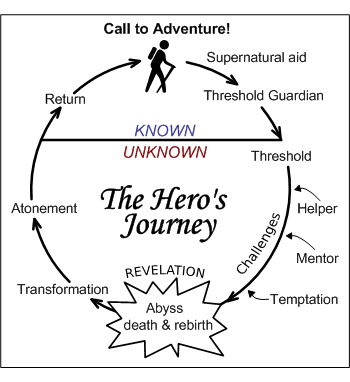
heros_journeyFor purposes of this blog post, I’ll assume you’re already familiar with both the three-act structure and the hero’s journey. If not, there are plenty of other resources where you can learn about them in-depth.

I prefer to think in terms of four-part structure, however, where act two is divided into two halves. In typical three-act structure, the hero hits his lowest point at the midpoint of act two. This is also the midpoint of the story itself, where the hero reaches the nadir of the hero’s journey. In four-part structure, that midpoint is just treated like a plot point, dividing part two from part three. Everything else is the same.

Thus, when you frame a particular story in four-part structure, it looks like this:

  1. The Call to Adventure
  2. Tests, Allies, and Enemies
  3. The Darkest Hour
  4. The Final Battle

Part One: The Call to Adventure

The first part of the story typically starts in the ordinary world, until the inciting incident somewhere around the middle of part one calls the hero to adventure. He then either refuses the call (which usually leads to bad things because the call knows where you live), or he accepts it and has to fight off some threshold guardians to get into the realm of adventure (sometimes, he refuses it and has to fight the guardians). Typically around this point, he meets a mentor to help him on his way.

Prewriting: To get off to a good start, I have found that the key is to know (or at least have a good idea) how the story is going to end before I begin to write it. That way, I know that I’m starting in the right part and I have a general idea where I’m going. I don’t know how I’m going to get there yet, but that doesn’t really matter yet.

Writing: The hardest part about writing this part is the first scene. After that, it usually comes quite easily. It helps to do a bit of world building, or to outline the characters and their backstories, but it isn’t always necessary. Personally, I’ve found that I can discovery-write these things pretty well (and yes, if you haven’t guessed already, I’m a pantser).

Revising: This is usually the part that needs the most revising. It’s also the part that can get me into the most trouble if I don’t do it well. I’m a chronological writer, and if something in the story is seriously off, I have to go back and fix it before I can proceed to the end. I’ve forced myself to finish even when I knew that things were broken, and it only made the writing process worse. So for me, the beginning usually gets the most revision work, whether I plan on it or not.

Part Two: Tests, Allies, and Enemies

Part two is where the adventure really begins. The hero crosses the threshold into the unfamiliar world, and everything is new and exciting. This is also the part where things start to become truly dangerous. Not everyone is who they seem in this part, and the hero may fall into some traps. But the mentor is usually still there to help him get back up.

Prewriting: In my experience, this is the part that needs the least pre-writing. It’s almost always pure discovery. With the ending clearly in mind but still distant enough not to worry about, I can afford to let the story meander a little and take me to some unexpected places.

Writing: This is usually the easiest part of the story to write, for the same reasons as above. I can afford to do almost 100% discovery writing at this part, and it usually feels quite effortless. When the writing does get blocked, it’s usually because something in part one is totally broken.

Revising: Most of the revision process for part two consists of making sure that later events are properly foreshadowed. I usually don’t add enough foreshadowing when I write the first draft, so it’s essential to go back and add it later. Thankfully, this can usually be accomplished by a couple of tweaks, or adding a couple extra paragraphs to an already extant scene.

Part Three: The Darkest Hour

This is where the story gets real. The hero falls into a much larger trap than any of the others, and the mentor can no longer help him (usually because he’s dead). Alone, the hero has to find his own way out, usually hitting rock bottom along the way. Just when it looks like all is lost, some new twist sends the hero in a different direction, setting things up for the final act.

Prewriting: This is where prewriting goes from being unimportant to absolutely essential. Whereas in part two, I can afford to let the story meander a little bit, in part three I absolutely need direction. It’s not enough just to know how the story will ultimately end: at this point, I’ve found that I really need to map my way there.

Writing: This is also typically the most difficult part for me to write. However, when the prewriting is done well and the plot is set up properly, it’s actually not that bad. But it’s important to go really hard on your characters—to make life truly miserable for them. There can be no easy way outs for them, otherwise the entire story will suffer.

Revising: For part three, revising usually consists of putting scenes in the proper order, not in rewriting them completely from scratch. If the foundational elements of the previous two parts were set up correctly, then everything in part three will usually come out well too, but they’re almost always in the wrong order. Transitions then are the part that usually need the most cleanup.

Part Four: The Final Battle

At this point, the hero has a clear direction and a knowledge of how to get there. In climbing up from his lowest point, he finds the boon that will save the world, makes peace with the higher power, and comes back stronger than ever before. But the forces of evil have never been stronger either, and the clash marks the climax of the entire story. There may be a big damn hero moment, or a last minute rescue from the cavalry. There may also be a standoff with no apparent solution, or some truly complex power plays. Inevitably, though, there is a resolution, followed by a return (even if only to the world of adventure). The hero saves the world, gets the girl, and rides off into the sunset. Curtains, applause, and lights.

Prewriting: By this point, most of the prewriting has already been done. The important thing is to have the flexibility to change and adjust, because this is the point where the story often surprises me. It is also the point where discovery-writing is often the most satisfying.

Writing: At this point, I’m usually tearing it up in a white-hot heat of creative energy. It’s extremely rare that I’ll get blocked at this point, but if I do, the key is almost always to just write through it. Often, I’ll make notes of things to change in revision and just barrel ahead—and it works, because there’s no need to set anything up for later. This is the moment of truth, where everything comes together.

Revising: Most of the revision at this point of the story has to do with tying up loose ends. That’s usually not a problem for me, though, because I tend to write very clean. If there is a loose end, it’s usually something that I’ve made a note to fix earlier in the story. For me, the ending is usually the part that needs revising the least.

So there you have it. The biggest lesson I’ve learned just recently is how important it is not to neglect the prewriting aspect of the creative process, especially around part-three. When everything is in place, it makes the story flow so much better.

What are your thoughts? Any plotters or outliners out there with a different take on the process? Everyone is different, but we’re all basically trying to do the same thing, so it’s interesting to see what works for different people!

Operation SB #4: The Curse of the Lifewalker

Title: The Curse of the Lifewalker
Genre: Post-Apocalyptic
Word Count: 4,340
Time: 1 day (sort of)

So after “L’enfer, c’est la solitude,” I was kind of in a short story mood for a couple of days and decided to bang out another one. This one is actually an adaptation from my novel Lifewalker, a post-apocalyptic tale where a global pandemic kills everyone older than 25. The story takes place several hundred years after the apocalypse, where a society of children and teenage adults has evolved to fill the void left over by the collapse. It’s told from the point of view of a “lifewalker,” someone who is naturally immune and lives out a normal lifespan. Normal to us, at least–not to anyone else in the new society.

It actually wasn’t that hard to adapt the first chapter to a short story. It very much has its own narrative structure, with a beginning, middle and end. Obviously, it finishes on a rather open-ended note, but I think I was able to turn it around and focus on the premise: “when all the world is afflicted by the plague, sometimes the greater curse is to be whole.” Touched up the first couple of pages quite a bit, setting the stage for a short story and not a full novel, then went over the rest of it with a light pass and wrote a summation paragraph at the end to wrap things up.

Obviously, it took me more than one day to write the bulk of the chapter–in fact, I think it’s been through a couple of drafts now. But the adaptation to short story form went fairly well, and I’m quite pleased with the result.

Since I’ve already got stories at the top three markets (Writers of the Future, Asimov’s, Analog) and Clarkesworld is on cool-down, I sent the story to the next magazine on the list, Fantasy & Science Fiction. They only take snail mail, though, so I had to print out the story, print out a cover letter, take it to the post office, buy a letter envelope, stamp, manila envelope, fill out the SASE, etc etc. It was like a blast from the 00s or something.

Anyway, as I was walking over to the post office, I had this AWESOME epiphany in which the end of the novel came to me. It’s SO MUCH BETTER than what I’d originally had in mind, and actually got me excited to work on Lifewalker again. I probably won’t pick it up until I’ve finished the first three Sons of the Starfarers books, but now I have an awesome, amazing ending to work toward.

All I have to do is write it. 😛

Trope Tuesday: The Call to Adventure

One of the first (and most important) stages of the hero’s journey is the call to adventure.  It happens when the hero first confronts something outside the experience of his ordinary world that beacons him to leave it.  It overlaps closely with the inciting incident, and marks the point at which the hero’s journey begins.

However, it is not typically where the story begins.  In order for the hero to leave the ordinary world, he must first start out there, so we know what’s at stake and what he’s leaving behind.  This is why Luke Skywalker starts out on his uncle’s homestead, and why Neo starts out as a bored and lonely employee of Metacortex.  Events outside the hero’s experience may have already put him on a trajectory to leave on the adventure, but he won’t know it until the call comes.

The hero may start out in a quiet, peaceful village, far removed from any sort of conflict–or he may start out in the middle of a crapsack world, as is the case with dystopian fiction.  The important thing is that it’s the world he’s always known–that he hasn’t ever really made an effort to leave or change it.

How he feels about his world largely determines how he chooses to respond to the call.  In older literature, the hero typically refuses it.  The advantage of this is that it gives the reader a sense of scope–that this adventure is not a small or a trivial thing.  It also sets up an immediate minor conflict that gives some motion to the opening chapters.

In modern stories, though, it’s more common for the hero (or his friends) to jump at the call.  There are also many advantages to this.  In Lord of the Rings, it gives Frodo an immediate band of sidekicks.  In Harry Potter, it plays up the sense of wonder at the magical world.  In the Chronicles of Prydain, it highlights the impulsiveness and naivete of Terran, as he realizes later on in the story just how stupid of him it was.

The call itself can take many forms.  It can come as a fateful visitation from a supernatural messenger, a mysterious request from a dying stranger, or a sacred trust from a dying friend.  It can also be more internal, such as an important moment of decision, or a desire to find some greater purpose in life.  Whatever the case, the one thing the hero cannot do is ignore it–at least, not forever.  One way or another, the hero sets out, and the adventure begins.

Trope Tuesday: The Hero’s Journey

For the next few Trope Tuesday posts, I’m going to pick apart one of my favorite story patterns, the monomyth or “hero’s journey.” Other tropes come and go, but the hero’s journey is truly timeless.  If you can get it to work for you, it can do wonders for your ability to understand and tell stories.

In many ways, this is the trope to end all tropes. it is the source of almost all the major story archetypes, and can be found in the myths and folklore of almost every human culture–hence the term “monomyth.” It was first formulated by Joseph Campbell, who outlined it in his book The Hero with a Thousand Faces.  He summarized it like this:

A hero ventures forth from the world of common day into a region of supernatural wonder: fabulous forces are there encountered and a decisive victory is won: the hero comes back from this mysterious adventure with the power to bestow boons on his fellow man.

Campbell was an academic who studied mythology and folklore, and his book, though insightful, is pretty friggin dense (not to mention scientifically obsolete–he references a lot of Freud’s theories that have largely been discredited).  Later, writers like  Chris Vogler, Phil Cousineau, and David Adams Leeming analyzed and simplified the monomyth for popular audiences.

Enough background–what is it?  Basically, it’s a story pattern that resonates powerfully with readers across all genres.  In its simplest formulation, it follows three steps:

  1. Departure: The Hero leaves the familiar world.
  2. Initiation: The Hero learns to navigate the unfamiliar world.
  3. Return: The Hero masters  the unfamiliar world and returns to the familiar.

Campbell himself identified 17 stages, some of which are interchangeable:

  1. Call to Adventure: The Hero learns that he must leave the familiar world.
  2. Refusal of the Call: The Hero balks, for any number of reasons.
  3. Supernatural Aid: The Hero receives something to help him on his quest.
  4. Crossing the Threshold: The Hero ventures into the world of adventure.
  5. Belly of the Whale: The Hero passes the point of no return.
  6. The Road of Trials: The Hero’s resolve is tested, and he begins to grow.
  7. The Meeting with the Goddess: The Hero experiences the power of love.
  8. Woman as Temptress: The Hero faces and overcomes temptation.
  9. Atonement with the Father: The Hero passes the final test.
  10. Apotheosis: The Hero dies and is reborn.
  11. The Ultimate Boon: The Hero receives a gift to take home.
  12. Refusal of the Return: The Hero doesn’t want the adventure to end.
  13. The Magic Flight: The Hero uses his newly mastered skills to escape.
  14. Rescue from Without: The Hero is saved by his newfound friends.
  15. The Crossing of the Return Threshold: The Hero leaves his new world.
  16. Master of Two Worlds: The Hero reconciles the old ways with the new.
  17. Freedom to Live: The Hero uses what he has learned to live the rest of his life.

Do any of those sound familiar?  Yeah, I thought so.  It might be hard to think of a story that fits all 17 points at once, but it’s not uncommon to find one that hits seven or eight (or possibly more).

A simpler formulation by Leeming goes like this:

  1. Miraculous conception and birth
  2. Initiation of the hero-child
  3. Withdrawal from family or community for meditation and preparation
  4. Trial and Quest
  5. Death
  6. Descent into the underworld
  7. Resurrection and rebirth
  8. Ascension, apotheosis, and atonement

My personal favorite, though, is Vogler’s:

So how useful is this trope really?  Well, consider this: Orson Scott Card’s Ender’s Game was the first novel to win both the Hugo Award and the Nebula Award in the same year…and it hits up all eight points listed above.  The following year, Card published Speaker for the Dead, which also hit all eight points, and also won both the Hugo and the Nebula award.

The thing that made Star Wars more than just another campy sci-fi b-movie with (let’s face it) terrible acting and hokey dialogue is the fact that George Lucas drew so heavily from Joseph Campbell and the hero’s journey.  Think about it: Luke Skywalker passes through almost every one of the 17 points, right up to the awesome throne room finale at the end.

Well, this guy certainly helped.

Of course, it’s possible to go too far.  Lucas also tried to use the hero’s journey in the prequel trilogies, and failed miserably.  Why?  Many reasons, but mostly because he used it as a rigid checklist rather than a dynamic set of flexible guidelines.  The hero doesn’t have to have a literal miraculous conception; he just needs to be chosen in some way.  The goddess doesn’t have to be literal, and neither does the father–those stages can be represented quite loosely, or merged with others.

In my own writing, I’ve found that the best way to use the hero’s journey is to use it to understand what I’ve already written, and to trust my subconscious to fill in the next step.  In every book I read, or every movie I watch, I constantly pick it apart, looking for each of the steps.  This trains me to recognize the hero’s journey in my own work without having to break out the hammer or force things too much.

So how do you use the hero’s journey in your own work?  Do you find yourself hitting up all the points subconsciously, or do you use some other method?  Or do you hate the hero’s journey and try to avoid it altogether?  If you do hate it, I hope that my next few Trope Tuesday posts will help you to change your mind.

Trope Tuesday: Chess Motifs

Chess is quite possibly the oldest, deepest, most well known and widely played board game in the world.  It should come as no surprise, then, that it’s often used as a motif in works of fiction.

The interesting thing is how well the pieces fit some of the classic character archetypes:

  • The King is like the Hero: the most indispensable character around whom the story revolves.
  • The Queen is like the Chick (or perhaps the Heart): less appreciated than the Hero but a powerful character who holds the team together (and whose loss often makes the team fall apart).
  • The Rook is like the Big Guy: the stoic, straightforward heavy-lifter who might not be quick (rooks are often the last pieces to be developed) but pulls a lot of weight, especially in the endgame.
  • The Bishop is like the Smart Guy: quick and versatile, mystical and unpredictable, striking from a long distance and often performing two or three jobs at once, but lacking the power by himself to achieve victory.
  • The Knight is like the Lancer: likely to go over the others’ heads and the one most likely to sacrifice himself for the cause (knights before bishops, after all).
  • The Pawns are like the Red Shirts: expendable minor characters who may, if they push forward bravely and stay faithful to the end, eventually become queens.

And that’s not all.  The major chess strategies also correlate loosely to major story tropes.  For example, at the beginning of the game, it’s important to move the king to safety, while in the endgame, the king becomes a much more important offensive piece.  Likewise, the hero often spends the first half of the story running away from the bad guys, while in the second half, he starts to take real action.

And the list goes on.  The more I learn about chess, the more parallels I see.  It’s gotten to the point where I want to try diagramming a novel, or perhaps a series, according to a chess game, with that fact being part of the big reveal.  Or perhaps to have one of the major characters have a long-standing chess rivalry with another character who ends up being a major bad guy.

Or something.  I’m just starting a new novel, so everything looks fresh and exciting.  The story will probably change and evolve considerably over the course of writing it, but since it’s a fantasy novel, I think that some chess motifs may be especially appropriate.  Fantasy, after all, is about taking the reader back to a golden age of magic lost in the pages of history, and chess is perhaps the oldest popular game in the world.

In the meantime, is anyone up for a game of chess?

Image (cc) from wikimedia commons.

Getting settled in the land of the Kartulis

About three weeks have passed since I came to Georgia, and I’m starting to feel comfortably settled in this new place.  I like it a lot out here: my host family is great, I get along really well with everyone at the school where I work, the kids are so crazy eager to learn it’s awesome…really, I couldn’t ask for more.

Of all the places in Georgia where TLG volunteers are placed, Kutaisi seems like one of the best.  It’s the second largest city in the country, so it has access to several amenities such as markets, hospitals, restaurants, parks, and basically anything else you’d  expect in an urban center.  However, it’s about 200 km from Tbilisi and has very little exposure to the West, so culturally it’s very authentically Georgian.  It’s also much less crowded, and (in my opinion) much more beautiful.

My host family is great; I get along with them real well and already feel like a member of the family.   My youngest host brother, Kako, is 9 years old; I showed him Star Control II over the weekend, and he’s been addicted to it ever since.  We also play chess, and I’ve kind of taken him under my wing to teach him the basics of good strategy.  He’s getting steadily better!

Gura and Kati are the two teenage kids; they also speak English, so we’ve had some fun discussions.  Besides Facebook and her cell phone, Kati is really into books; I showed her my Kindle, and she wants me to help her persuade her father to get her one!  Gura is into Call of Duty and spends a lot of time hanging out with his friends; he lacks confidence when it comes to English, but he knows it better than he thinks he does.

The parents don’t speak much English, but they are really good people.  It’s a working class family; the dad works as a welder, and the mom is a nurse part-time and a home-maker full time.  They spend an amazing amount of time and energy on their kids, which is pretty typical for this part of the world.  They’re both non-smokers, and they’re very respectful of the fact that I don’t drink coffee, tea, or alcohol.  Some of the extended family keeps trying to push wine on me, but in the land known as the cradle of wine, that’s to be expected.

We basically spend all of our time in the family room when we aren’t sleeping; it’s where the heater is, so despite the relatively cramped space it’s the most comfortable room in the apartment.  Furniture consists of a couch, a computer desk and office chair, a bucket seat from an old van, a folding table, several small wooden chairs and a stool.  The TV isn’t quite a member of the family, but when the power isn’t out, it’s usually on.

The neighborhood is this bizarre mix of urban and rural elements.  The roads are super muddy and free-range chickens wander everywhere at will, but everyone lives in 9-story apartments that were built back in the Soviet days, when Kutaisi was a major center for the auto industry.  The school was built 50 years ago this year and has barely been renovated since, but it’s just starting to get some much-needed attention, with a computer center and a resource room for special needs students.  When the weather clears up, I’ll bring my camera to school and take some pictures so you can see what the classes are like.

I’ll have to do a post later on Georgian culture; there are some really bizarre and paradoxical juxtapositions, such as the way they mix religion and alcohol, or their strong belief in the nuclear family with their easy-going acceptance of bride-napping as a “Georgian tradition.” I have yet to really get a handle on all this stuff.  However, as a culture, they have a great respect for literature; when people ask my profession and I tell them I’m a writer, their eyes light up, and they show me a degree of deference that I never would have gotten back in the States.

Partly to have something to talk with them about, I’m reading War and Peace by Leo Tolstoy right now.  I just finished Book III, where Napoleon smashes the Russians and Austrians in the Battle of Three Emperors.  Everyone says that it’s the best novel ever written, and now that I’m in the thick of it, I’m starting to agree with them.  There’s a lot of really good storytelling here, as well as passion and depth.  I have the feeling that I’m going to be on a Russian literature trip for a while, though I should probably pick up some Rustaveli and Kurban Said as well.

As far as writing goes, I’ve had some difficulty settling down into a solid routine, not because of lack of time so much as trouble with my current WIPs.  Star Wanderers has more or less stalled; I ran into another wall midway through part III, and I’m still not quite sure how to get past it.  I’ve decided to take a break for a while, but I think my experiences here with the Georgian language are going to give me what I need to really make this novel come together.

In the meantime, I’m working on the 2.0 draft of Stars of Blood and Glory.  I’ve decided to try something new: revising not by chapter, but by viewpoint character.  Isolating each of the five viewpoints is helping me to see which ones work, and which ones are missing something.  I’ve also been using Dan Well’s 7-point outlining method, which is helping out a ton.

It feels like I could be writing more, but I’m not pushing myself too hard at this point.  I’m still adjusting to life in this totally new culture, and I’m also spending a lot of energy getting my TEFL career off on the right foot.  It’s paying off; I’m having a great time teaching, more than I thought I would.  Pretty soon, though, I’m going to start putting more energy into my writing.  I just hope that I’ll have enough mental space left over to really immerse myself and make it work.

plot vs. PLOT and an interesting serial publishing idea

Back in English 318 at BYU, Brandon Sanderson used to tell us that there was a big difference between “little-p plot” and “big-p Plot.” The first applies mostly to chapters and scenes, which he said he could teach us.  The second refers to the overall story structure, which he couldn’t teach in a classroom setting and said we’d have to discover on our own.

I’ve been thinking a lot about this recently, because it seems that my books are starting to fall into a recognizable pattern–and that pattern has some interesting potential for serials and other alternate forms of publication.  Each book is divided into 3-4 parts, each part is divided into 3-6 chapters (typically 5), and each chapter is divided into 3-5 scenes.  Here’s how it works:

Chapter 1: Setup for the basic story arc.  Introduction of the characters and setting, the prominent theme or premise, and a little foreshadowing of the coming conflict.
Chapter 2: The inciting incident, a discovery or event that starts the plot rolling and puts the characters in motion and conflict.
Chapter 3: Complications arise, the problem gets worse, the first attempt at a solution fails, generally leaving the characters at a loss.
Chapter 4: Setup for the resolution.  The characters discover or build something that will help them to settle the conflict.  They stop reacting and start to be more assertive.
Chapter 5: The resolution.  The characters either succeed or fail, but the arc comes to a close either way.  The story question is answered, the thematic elements come full circle, and the story either closes or moves on to the next part.

Basically, it’s the 3-act format divided into five chapters.  When I wrote Heart of the Nebula, all four parts fell into this pattern, and now that I’m writing Star Wanderers, I’m finding myself  falling into the exact same pattern again.  Stars of Blood and Glory is a little bit different; there are three parts instead of four, and each part is divided into six chapters instead of five.  But still, it’s all very structured.

In short, Brandon was right.  It took me a few books to really learn “big-p Plot,” but now that I’ve found a story structure that works for me, it’s starting to come quite naturally.

The cool thing about this particular structure is that it’s very conducive to serialization.  Each chapter is between maybe 3,000 to 5,000 words, so each complete sub-arc is between about 15,000 to 25,000.  That’s the length of a short novella, and it takes me only a month or two to write (sometimes three, depending on how much revision it needs).

The only reason I haven’t done more with serialization up to this point is because I’ve found that sharing my work while it’s still unfinished tends to throw a wrench in my creative process.  The idea of publishing a work in progress on a chapter-by-chapter basis scares me, because if one of the story arcs has a flawed beginning, I wouldn’t be able to fix it.

However, by following a five-chapter arc format (with bits and pieces here and there to hint at a larger overarching structure), I can see myself publishing a novel or epic in a serial format.  It would be something like the Perry Rhodan series, which follows an arc structure of 25 to 100 issues (each a small novella) per cycle.

So here’s how I’m thinking of doing it:

  1. Publish the first installment and price it at free while writing the second one.
  2. Publish the second installment and price it at free, raise the price of the first installment to $.99 and write the third one.
  3. Publish the third installment and price it at free, raise the price of the second installment to $.99 and write the fourth one.
  4. Publish the fourth installment for $.99, drop the price of the first installment to free and publish the completed novel for $2.99.

So what do you think?  Does it seem like a good way to publish a book?  It gives the reader a reason to keep coming back, and rewards those who got in early by charging them less for the completed work.  By selling the novel in shorter chunks, I would be able to put more work out and hopefully gain more visibility, especially by making a portion of it free at any given time.

I’m seriously thinking about publishing Star Wanderers this way, once I hear back from Writers of the Future.  I’ve already finished the rough draft for the second part; it probably needs a good revision or two before it’s ready, but since it’s shorter, it shouldn’t take more than a few weeks to get feedback from some first readers and finish the next draft.  And if the third part is already finished by then…

So many awesome possibilities! 🙂 What do you think?

Sholpan 2.0 is finished!

Today I finished the second draft of the novella Sholpan, only two days after the deadline I set for myself.  Here are the stats:

ms pages: 173
words: 37,466
file size: 94 KB
parts: 5
start date: 1 Aug 2011
end date: 15 Aug 2011

I decided to divide it into parts because I read somewhere that novellas aren’t typically divided into chapters, and I felt that foregoing chapter divisions would give it more of a sense of unity.

Still, I divided it into five parts, which essentially function as very large chapters.  I did this because it seemed that the story needed it, to better develop conflict and theme, as well as the transitions and turning points.

Like I’ve said in the earlier posts, this is a “companion novella,” which means that it repeats one of the story lines from the novel with additional scenes that (hopefully) elaborate and flesh out that particular story line.  Ideally, this will entice readers of the novella to pick up the full-length novel, and give readers of the novel a satisfying experience by using the new scenes to cast everything else in a new light.

By my entirely non-scientific calculations, Sholpan contains about 80% repeated material from the novel (with a little touching up and fleshing out to get more inside of Stella’s head) and 20% entirely new material, most of it in the form of flashbacks to Stella’s life before she was captured and enslaved by the Hameji.  It ends about halfway through Stella’s story arc from Bringing Stella Home, and includes one of the major twists, but hopefully that won’t spoil too much.

In terms of story, I think there are some subtle deviations between Stella’s arc in the novel, and Stella’s arc in the novella.  Even though the novella ends just after one of the novel’s major shifts, the ending felt very satisfying–almost a little too much.  Still, it’s good for the story to be complete in itself, and there are enough loose ends that I think it will drive interest in the novel.

Anyhow, I’ve sent the project out to a couple of alpha readers, just to get a sense for whether or not I’m totally off base.  If all goes well there, I’ll send it out to my copy editor and get it up for sale sometime in mid-September.  I haven’t tried out the $.99 price point yet, so this will be a good test case to see how it works.

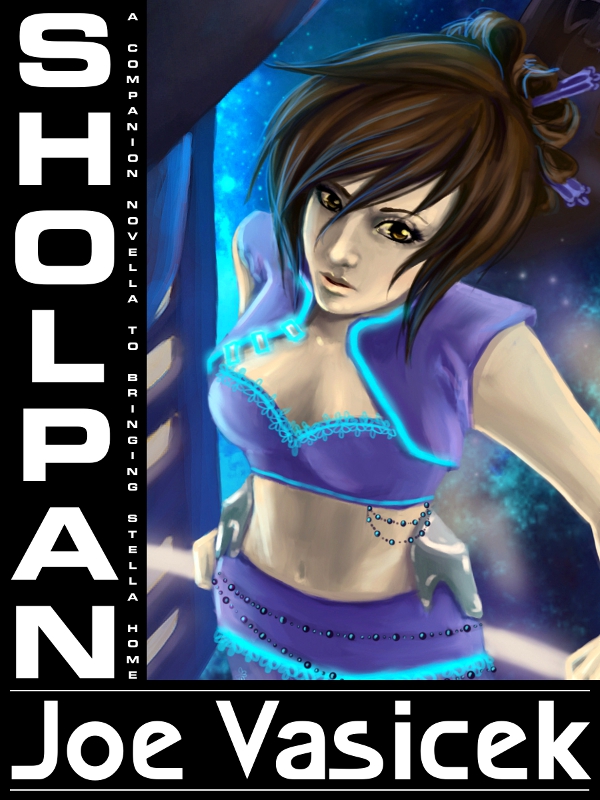
For those of you who are interested, here’s the cover:

And that’s about it.  I’m leaving the day after next for Worldcon, so I’ll do a post on that before I head out.  Probably won’t write much this week, but hopefully the con will help me make connections, pick up a few pointers, and get a good feel for the current zeitgeist in the science fiction and fantasy genres.  More on that to come.

New title and writing update

Just a quick update before I go to bed.

After much deliberation, I decided to go with Desert Stars as a title.  Thanks, Megan, for suggesting it.  It’s a little short, and doesn’t exactly wow me, but I’ll try it out and see if I grow into it.  The most important thing anyway is what the readers think.

The last couple of days have been going slow, mostly because of stupid writerly avoidance things.  It’s a lot easier for me to revise than it is to write new material, and the last couple of chapters have required a lot of new material.  But I think I’m through most of it, and will hopefully make some good progress tomorrow.

Genesis Earth has been selling a lot better than I thought it would…which doesn’t say much, but at least it says something.  For promotion, all I’ve done is the blog tour, a couple links on facebook, and general participation on the Kindle Boards.  In any case, I’m betting that writing is more important than promotion, so that’s where I’m focusing my energy.

The temp job I’m working is pretty good.  I listen to stories, writing podcasts, and lectures all day while doing data entry.  One of the most interesting ones is this presentation from Gencon, all about story structure and the hero’s journey.  Good stuff; it’s helped me figure out a lot of things with my current WIP (Desert Stars).

I’ve also been listening to a lot of trance music, especially Armin Van Buuren.  I know my Dad will think it’s crap, but hey I like it!  I think I’ll leave you with this track, where Armin teams up with the guy behind Owl City.  I’d tell you how many times I’ve listened to it, but that would be embarrassing.  So anyways…good night!

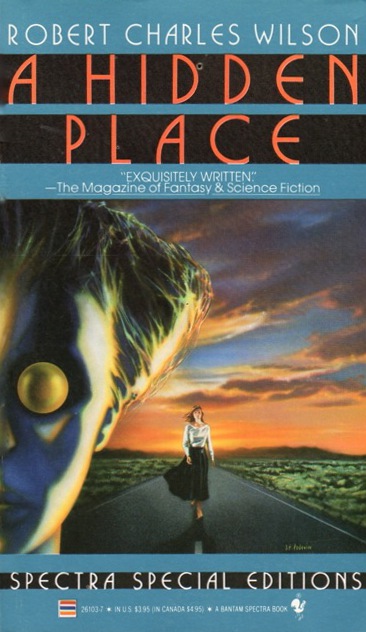
A Hidden Place by Robert Charles Wilson

Travis Fisher is an outsider in most places, but nowhere more than the small midwestern town of Haute Montagne.  But when his mother dies, leaving him parentless and jobless in the midst of the Great Depression, his stern aunt and uncle are the only ones who will take him in.

When Travis falls in love with Nancy Wilcox, the rebellious daughter of the Baptist Ladies Association president, things become worse.  With murderous transients roaming the countryside, Haute Montagne closes ranks, casting them out.

In this moment of distress, a mysterious yet hauntingly beautiful woman reaches out to them with a cry for help.  Stranded in the small midwestern town, she is a being from another world, and she is dying.  Only the two young lovers can help her, but to do so, they must find her dark, masculine half–and in so doing, confront the demons that threaten to tear them apart.

This is one of Robert Charles Wilson’s earlier novels, and I enjoyed it quite a bit.  It’s very short, yet well crafted and beautifully written.  Wilson’s prose is extremely evocative, and his descriptions of Haute Montagne brought back childhood memories from when I lived in the Midwest.  The story was also done well, and had a very satisfying ending.

While this is a good book, though, I wouldn’t say that it’s Wilson’s best.  His characters were interesting, but not nearly as compelling as those in Spin. The baptists were a little too villainous, though Travis’s aunt and uncle were individually more complex.

In spite of all this, however, the story was structured so well that the poignance of it largely overcame these flaws.  As a writer, that’s what I found most interesting about this book–how the masterful way the story was constructed made the whole greater than the sum of the parts.  Call it the monomyth, the hero’s journey, or whatever else, but something about this story made it reverberate in a powerful way.

I suppose that this is what all great stories do: echo some greater, universal story that is in all of us.  It’s the same echo that I felt when I read Spin, or Ender’s Game, or The Neverending Story, albeit a little softer.  It’s something that I hope my own stories evoke, this sense of clarity and wholeness, of returning to some great truth that we lost somewhere between birth and adulthood.

I don’t know if I’m making any sense, but those are my thoughts.  It’s a short read, and I enjoyed it quite a lot.  If you can find it, it’s a good one to pick up.