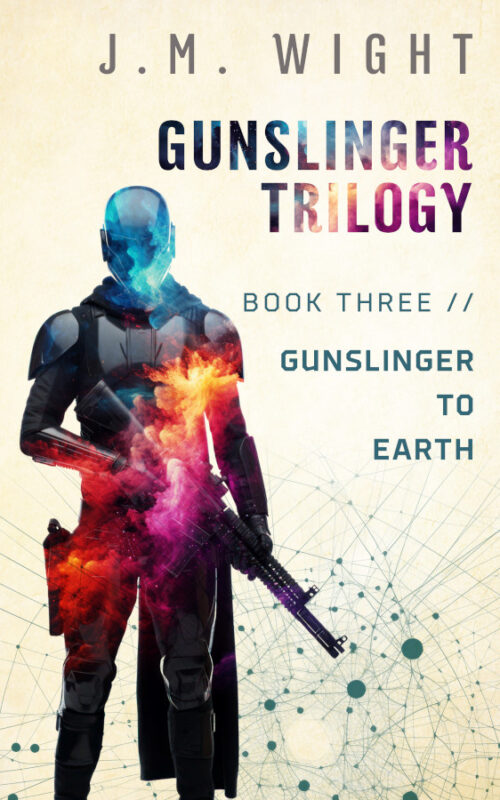
The Choice to Believe in Gunslinger to Earth

At its core, Gunslinger to Earth, the space-opera finale of the Gunslinger Trilogy, asks a simple but lifelong question: What do you choose to believe when the universe refuses to give you certainty? When Earth vanishes into an impossible anomaly—and later reappears transformed—no one can prove exactly what happened. The characters must decide for themselves what is true, what is worth fighting for, and who they will become in the face of the miraculous.

Where the Idea Came From

The theme grew out of a major turning point in my own life. I started this book just after I began dating the woman who would become my wife and while I was reinventing my writing process to tell better stories. It was a season of uncertainty, hope, and change, full of questions I didn’t know how to answer. That personal crossroads naturally shaped the theme of the story into one about faith, conviction, and choosing a future even when you can’t see what comes next.

How the Choice to Believe Shapes the Story

Throughout Gunslinger to Earth, every major character is confronted with a moment where proof is impossible, but a choice is required. Rex must decide whether to trust Charlotte, whether to follow Sam and Jane, whether to cross the wormhole, and ultimately whether to stay in paradise or return to a mortal life with someone he loves. No one can make these choices for him—not Sam, not Jane, not Charlotte—because the heart of his journey is learning to choose his own truth instead of waiting for certainty that will never come.

On a cosmic scale, the entire plot turns on the same dilemma—an end-times science fiction mystery wrapped in the language of prophecy. The anomaly that swallowed Earth may be the fulfillment of ancient prophecies, or it may be an alien event we don’t yet understand. Mahijah may be exactly who he claims to be, or something else entirely. No lab test or political briefing can answer those questions. Sam, Jane, Rex, the empaths, and the remnants of Earthfleet all have to decide for themselves what they believe—and those choices lead them to the endings they earn. The story isn’t about proving the miracle; it’s about how people respond when the miraculous breaks into their livesthe heart of the choice to believe.

What the Choice to Believe Says About Us

We all live in a world where certainty is rare, where conflicting stories demand our loyalty, and where the most important truths—love, faith, family, hope—are things you commit to long before you can prove them. Gunslinger to Earth reflects that deeply human reality in a character-driven science fiction way. It suggests that belief isn’t about having perfect evidence; it’s about having the courage to choose who you’re going to be and what kind of future you want to build. At the end of the day, the world is shaped not just by what happens to us, but by what we decide to believe about ourselves, about others, and about the meaning of our lives.

Why This Theme Matters to Me

When I wrote Gunslinger to Earth, the closing volume of the Gunslinger Trilogy, I was learning to make those kinds of choices in my own life—about faith, about love, and about the kind of writer and person I wanted to become. It was a moment when I had to step forward without seeing the whole path. That experience shaped the story in ways I couldn’t fully articulate at the time, but I can see clearly now. This book matters to me because it’s ultimately about hope: the hope that even in chaos, even in uncertainty, we can choose what we believe—and those choices can lead us somewhere good.

Where to Get the Book

Related Posts and Pages

Explore the series index for the Gunslinger Trilogy.

Return to the book page for Gunslinger to Earth.
Is Gunslinger to Earth for you?

See all of my books in series order.

Is Gunslinger to Earth for You?

Gunslinger to Earth is a character-driven space opera adventure about crossing a cosmic no-man’s-land to discover what happened to the home you thought was lost forever. It blends gunslinger-style starship action, found-family dynamics, political revolution, and end-times mystery as Rex Carter, Sam Kletchka, and Jane Kletchka risk everything to follow Earth into an impossible anomaly. It’s a fast, hopeful, and surprisingly tender finale that wraps up the Gunslinger Trilogy with both high stakes and a genuine sense of homecoming.

What Kind of Reader Will Love This Book?

If you love…

  • Space opera that feels like Firefly meets end-times science fiction, with a gunslinger pilot, a loyal found family, and a war-torn galaxy trying to pull them apart
  • Stories where faith, prophecy, and cosmic mystery actually matter to the plot, not just as window dressing
  • Coming-of-age under fire, as Rex Carter tries to decide who he is and where he belongs while revolutions, wormholes, and vanished planets rearrange the map of human history
  • Character-focused military SF with moral clarity, loyalty, and hope, rather than grimdark cynicism

…then Gunslinger to Earth is probably your kind of story.

What You’ll Find Inside

Gunslinger to Earth is a story rooted in space opera adventure, end-times science fiction, and prophecy-driven mystery. The hero of this third book in the trilogy is Rex Carter, a cadet still reeling from the day Earth and Luna vanished into an impossible anomaly. Torn between his patriot girlfriend Charlotte, his loyalty to Sam and Jane, and his fear for his family back home, Rex has to grow up fast as he’s swept into a mission to follow Earth across the “world-bridge” and find out what really happened.

The mood balances tense, boots-on-the-deck action (derelict ghost ships in the anomaly, desperate battles near wormholes, claustrophobic escapes from Luna) with a deep, almost awe-struck sense of wonder as the crew finally confronts a transformed Earth and the fulfillment of ancient prophecies. The style is fast-paced, voice-driven, and accessible—more “frontier adventure with big ideas” than hard-science textbook—with a strong throughline of family, faith, and the search for home.

What Makes It Different

Fans of classic space opera and military SF—think Firefly, The Expanse, or David Weber—will recognize the starship battles, political tensions, and ragtag crews, but Gunslinger to Earth takes those ideas in a very different direction. Instead of treating religion and prophecy as background flavor, this book leans straight into them: the disappearance of Earth isn’t just a physics problem, it’s tied to the City of Enoch, the fulfillment of Latter-day Saint-style millennial prophecies, and a literal “new Earth” where history has turned a corner.

Where many space war stories focus on winning the next battle or installing the next regime, this one asks what happens when the war is suddenly dwarfed by something much bigger—when the homeworld itself is renewed and taken off the game board. It’s less about toppling empires and more about how ordinary, stubbornly decent people respond when God, history, and politics all collide at once. And because it’s the capstone of the Gunslinger Trilogy, it doesn’t just raise the stakes; it actually lands them with a clear, hopeful ending.

Readers who enjoy the moral backbone of Lois McMaster Bujold, the frontier grit of Firefly, and the cosmic mystery of The Expanse will find familiar elements here—but woven together in a way that feels genuinely new.

What You Won’t Find

You won’t find grimdark nihilism, graphic sex, or wall-to-wall gore here. The story has violence, war, and real loss—this is a revolution and an end-times crisis, after all—but it’s written at about a PG-13 level, with the camera panning away from anything needlessly explicit. You also won’t find a sneering, anti-religious tone; faith and prophecy are treated respectfully and sincerely, even when characters struggle to believe them. This is a cleaner-but-still-intense sci-fi adventure that focuses more on meaning, loyalty, and wonder than shock value.

Why I Think You Might Love It

I wrote Gunslinger to Earth during a major turning point in my own life—just after I started dating the woman who would become my wife, at a time when I was reinventing my writing process so I could tell better stories more consistently. In a lot of ways, this book is about that same kind of turning point on a galactic scale: the moment when old patterns break, a long-promised future finally arrives, and you have to decide who you’re going to be on the other side of it. My hope is that if you care about loyalty, about home, about the possibility that history is going somewhere meaningful, then this story will leave you with the same feeling it gave me while I was writing it: that even in the middle of chaos, there’s a way through—and it leads somewhere worth fighting for.

Where to Get the Book

Related Posts and Pages

Explore the series index for the Gunslinger Trilogy.

Return to the book page for Gunslinger to Earth.
The Choice to Believe in Gunslinger to Earth.

See all of my books in series order.

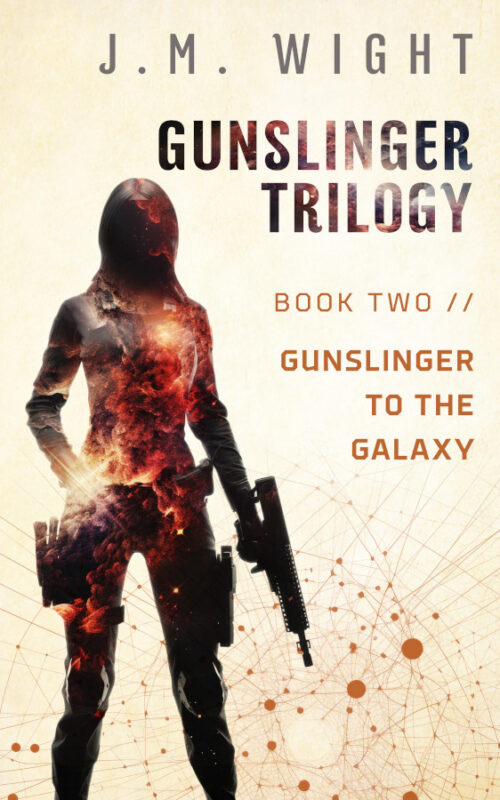
Being Equally Yoked in Gunslinger to the Galaxy

At its core, Gunslinger to the Galaxy is a space-opera story built around a deceptively simple question: what does it mean to be equally yoked when the universe is coming apart at the seams? Jane Kletchka isn’t just trying to save Earth; she’s trying to build a marriage, a family, and a vocation that all matter in an honest, eternal way. The story keeps circling back to this tension: how do you stay true to your gifts, your faith, and your partner when war, politics, and Immortal-sized crises keep demanding more?

Where the Idea Came From

When I wrote Gunslinger to the Galaxy, I was working part-time at a warehouse in Iowa and later grinding through a 40+ hour per week construction job in Utah. I wasn’t married yet, but it was something I definitely wanted in my life, and I poured that into my writing, forcing myself to write a few hundred words a day even when I was exhausted and everything around me felt like a dump.

That experience of trying to build something meaningful in the middle of chaos is baked into Jane and Sam’s story. At its heart, Gunslinger to the Galaxy is about two people trying to be a force for good while the universe keeps trying to knock them flat. I kept that theme close even through the difficult circumstances surrounding its writing—and, fittingly, around the time I finished the book, I also met the woman who would become my wife.

How Being Equally Yoked Shapes the Story

“Equally yoked” isn’t just a passing phrase in this book; it’s the backbone of Jane’s entire arc. From the early garden conversation with her mother—where Mom worries that Jane will end up standing in Sam’s shadow instead of using her own God-given talents as a xenolinguist—the story keeps pressing on a single pressure point: is this marriage helping both partners become what they’re meant to be, or is one being swallowed by the other’s path?

When the jumpgate network collapses and the Immortal civil war throws the galaxy into crisis, Jane has every excuse to curl up and let events happen to her. Instead, the story turns when she realizes she can’t just be “the gunslinger’s wife.” Drawing on Sam’s blunt insight about control and trauma, she chooses to use her training, her languages, and her brain to actually shape events—digging into logs, mapping networks, and turning her grief and fear into concrete action that can save lives and maybe bring Sam home. Being equally yoked here means more than just sharing a last name; it means each partner brings their full self to the fight, and the marriage becomes a shared mission instead of a sacrifice of one person’s calling to the other’s.

By the end, when Jane and Sam are sealed in the temple and begin building a family, the book circles back to that original fear: will motherhood and marriage erase Jane’s larger purpose? The answer is no—but not because the galaxy gets easier. Instead, the story shows her finding ways to balance remote work for the Andromedans and the Intergalactic Council with raising John Moses, weaving vocation, faith, and family into a single, hard-won whole. The adventure isn’t over; it’s just moved into a new phase where “equally yoked” means building a life that can withstand both warp drives and diapers.

What Being Equally Yoked Says About Us

In science fiction, we often see lone-wolf heroes or solitary saviors, but Gunslinger to the Galaxy takes a different path by centering a married-couple partnership in a space-opera setting. Under all the jumpgates and Immortals, this is a story about something very human: the fear that love will cost us our calling—or that our calling will cost us love. Most of us aren’t piloting starships, but we know what it feels like to worry that marriage, family, career, or faith will pull us in different directions until something breaks. Gunslinger to the Galaxy suggests a different model: the people we love most should help us become more ourselves, not less. Being equally yoked doesn’t mean never struggling or never disagreeing; it means pulling the same direction when the load gets heavy, and trusting that God can turn two flawed people into a team that does more good together than either could alone.

Why Being Equally Yoked Matters to Me

I wasn’t married when I wrote Gunslinger to the Galaxy, but it was definitely something I was looking forward to. I wrote it during a season of my life that was chaotic, exhausting, and frankly not very glamorous, but I pushed forward anyway, trusting that the kind of woman I hoped to marry someday would value that dedication. And sure enough, when I finally met her, one of the things that drew her to me was my hard work and dedication to my writing—a dedication that I have also channeled into our marriage and family life.

For me, Gunslinger to the Galaxy is a story about faith, marriage, and the stubborn belief that ordinary people can still choose to do the right thing together, even when it hurts. If this book resonates with you, I hope it’s because you see a bit of your own struggle to be “equally yoked” in a world that always seems on the brink—and you feel a little more hope that it’s worth the fight.

Where to Get the Book

Related Posts and Pages

Explore the series index for the Gunslinger Trilogy.

Return to the book page for Gunslinger to the Galaxy.

Is Gunslinger to the Galaxy for you?

See all of my books in series order.

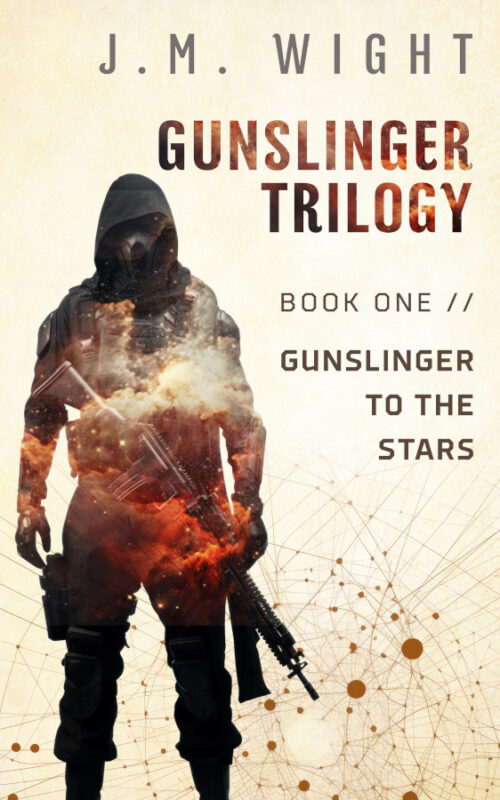
Moral Courage in Gunslinger to the Stars

What does it mean to do the right thing when the galaxy around you is chaotic, corrupt, or outright absurd? Gunslinger to the Stars takes that question and drops it squarely in the lap of Sam Kletchka—a mercenary gunslinger navigating a dangerous galactic frontier who keeps choosing responsibility even when no one is watching, rewarding, or deserving. At its heart, this space-western adventure is about moral courage: the stubborn, unfashionable insistence on doing the right thing in a universe that rarely makes it easy.

Where the Idea Came From

This theme grew out of a mashup of influences—long conversations with writer friends, a subplot from Schlock Mercenary, and the realization that a “rogue Immortal” character needed a counterweight with a strong personal code. Around the same time, I was watching Breaking Bad, fascinated by characters like Mike Ehrmantraut—tough, pragmatic men who do terrible things for complicated reasons. To push back against such a villainous force, I imagined Sam Kletchka: a gunslinger in a messy, morally gray universe who lives by a code and keeps choosing the harder path simply because it’s right, even when the galaxy doesn’t care.

How Moral Courage Shapes the Story

At every major turning point in Gunslinger to the Stars, Sam Kletchka’s choices are defined by moral courage—the instinct to protect others even when it’s dangerous, inconvenient, or unwinnable. He charges after kidnapped empaths when walking away would be safer; he shields Jane’s diplomatic idealism with his hard-won pragmatism; he survives abandonment in the desert through sheer stubborn responsibility; and he repeatedly throws himself into battles around war rigs, jumpgates, and alien war parties because no one else can or will. His personal code drives the story’s conflicts, shapes the character dynamics, and pushes this space-opera adventure toward a climax where courage isn’t about glory but about doing the right thing in a lawless, unpredictable, morally gray galaxy.

What Moral Courage Says About Us

Sam’s story reflects something deeply human: we don’t get to choose the worlds we’re born into, but we do get to choose what kind of people we become. In a galaxy run by Immortals, riddled with slavers, warlords, and manipulative telepaths, Sam’s personal code becomes his anchor—the thing that keeps him from becoming the very wolf he warns Jane about. His courage isn’t flashy heroism; it’s the uncomfortable, everyday kind that demands sacrifice, loyalty, and integrity when it would be easier to look away. In that sense, the book becomes a mirror for readers who love character-driven science fiction that asks what we stand for when the world pushes back.

Why This Theme Matters to Me

I wrote this book at a very different time in my life—years after Genesis Earth, when my own view of the world had shifted. I still believed in cultural understanding and bridging divides, but I’d also seen enough to know that evil doesn’t always yield to good intentions. Like Sam, I firmly believe in the right to defend oneself and others, and I’ve had long debates about the responsibilities that come with that. I wanted to write a character who lives at the intersection of those values—someone who understands violence, hates it, but won’t walk away when others depend on him. That tension, that conviction, is why moral courage felt like the beating heart of Gunslinger to the Stars.

Where to Get the Book

Related Posts and Pages

Explore the series index for the Gunslinger Trilogy.

Return to the book page for Gunslinger to the Stars.

Discover if Gunslinger to the Stars is for you.

See all of my books in series order.

Is Gunslinger to the Stars for You?

Gunslinger to the Stars is a character-driven space opera novel that blends Western adventure, first-contact science fiction, and pulpy action. It’s fast-paced, voice-driven, and built around a loyal, reluctant hero navigating a dangerous galactic frontier. It’s told in the unmistakable voice of Sam Kletchka—half gunslinger, half star-hopping troubleshooter, and 100% fun.

What Kind of Reader Will Love This Book?

If you like…

  • Classic space adventure with modern voice and humor, where the hero solves problems with grit, guts, and an outrageous arsenal of lovingly described guns
  • Found-family dynamics between a rough-around-the-edges gunslinger, a principled xenolinguist, a telepathic outcast, and a trio of shapeshifting empaths
  • Galaxy-spanning mysteries, alien politics, and first-contact stakes that push characters to their limits
  • The feel of a Western gunslinger dropped straight into a richly imagined galactic frontier

…then Gunslinger to the Stars is absolutely your kind of story.

What You’ll Find Inside

Gunslinger to the Stars (Book 1 of the Gunslinger Trilogy) follows Sam Kletchka, a New Texas gunslinger stranded in the Gorinal Cluster just as the local jumpgate—the only way out—mysteriously goes dark. What starts as a simple job escalates into a battle for survival involving hidden alien races, shape-shifting empaths, worldships, and a rising threat the Immortals never wanted anyone to discover. The tone blends wry humor with escalating danger, and the style is fast-paced, voice-driven, and cinematic—equal parts action romp and big-idea sci-fi. The result is a story that feels both classic and fresh: a pulpy, heartfelt adventure that’s as much about loyalty and moral clarity as it is about space battles and exotic technology.

What Makes It Different

Fans of Firefly and Schlock Mercenary will recognize the snappy banter, the found-crew dynamic, and the blend of humor with high-stakes action. But Gunslinger to the Stars pushes those familiar ingredients in new directions: the gunslinger-as-space-ranger angle gives the book a distinctive American-frontier voice, while the empath culture, the Immortals’ centuries-deep manipulations, and the emergence of the Draxxians create a myth-arc that feels simultaneously expansive and personal. Where many space operas lean on military hierarchy or techno-fetishism, this one leans into character, moral philosophy, and the uneasy tensions between peacekeeping and necessary force—all told through Sam’s dry, self-aware perspective.

This story blends classic space western tropes — the reluctant hero, the ragtag crew, and the dangerous frontier — with a deeper mystery about ancient alien powers. If you enjoy space western stories with a strong first-contact throughline, you’re going to enjoy this book.

What You Won’t Find

If you’re looking for grimdark bleakness, heavy technobabble, or a cynical antihero who never grows, this isn’t that. And if you want romance-heavy sci-fi or endless political intrigue, this book doesn’t go down those roads either. But if you want hopeful, character-focused adventure with humor, heart, and a hero who takes responsibility for his choices—sometimes reluctantly—you’ll feel right at home.

Why I Think You Might Love It

I wrote this story at a time when I needed to shake things up creatively, by writing something fun, energetic, and different from what I had been writing at the time. I was also going through a time when my worldview was changing, and I was questioning a lot of my old assumptions. This book grew out of a number of things: from my conversations with close friends, my love of classic pulp sci-fi, and from the idea of a lone wanderer who tries—however imperfectly—to do the right thing. The result, I believe, was a book with a lot of heart that captures that spark of wonder that made me first fall in love with science fiction. If that’s what you’re looking for, I think you’re going to love it!

Where to Get the Book

Related Posts and Pages

Explore the series index for the Gunslinger Trilogy.

Visit the book page for Gunslinger to the Stars for more details.

Read about moral courage in Gunslinger to the Stars.

See all of my books in series order.

Going for fun

They say that you should put as much of yourself as you can into what your right, and that’s true to some extent. But when you’re writing SF&F, there’s a much more important rule:

BE ENTERTAINING.

While I don’t think I’ve necessarily broken this rule, I haven’t always paid close attention to it. So for my current WIP, I’m pulling out the stops. I figure that the best way to entertain people in a book is to make it fun to read, and if it’s fun for me to write, I figure it will be fun for my readers as well. So my primary goal with this book is to have fun.

The working title is Gunslinger to the Stars, and if I had to give you the Hollywood pitch it would be this: Monster Hunter International meets Guardians of the Galaxy on the set of Firefly.

The main character is a freelance starship pilot named Sam Kletchka, who travels the galaxy taking various mercenary jobs. He was born and raised in the Gliese colonies, on a planet called New Texas, but although he was a gifted student, he dropped out of Earthfleet Academy his freshman year because he didn’t get stuck on a refitted Cold-War era submarine protecting colony ships in Earth-space (the galactics gave us cheap ground-to-orbit, which means that we used what we had when building our first fleet of starships).

The book starts when he gets stranded in the armpit of the galaxy, natch. The only other human who’s stranded there with him is an attractive twenty-something xenolinguist named Jane Carter, with whom he has a history. Let’s just say that she isn’t all that enthusiastic to see him.

At one point, he describes his guns:

MERCY is a supressed Ruger 22 Charger™ Rimfire Pistol. She’s fairly small and doesn’t pack much of a punch, but she’s as silent and stealthy as a Zan cloakship in deep space. Besides being perfect for cloak-and-dagger type stuff, Mercy is also good for hunting small game, on the few occasions where I’ve been stranded planetside without supplies.

The next two guns are really different components of the same gun, an AR-15 with two uppers that I can swap out depending on my needs. FAITHFULNESS is a suppressed 300 Blackout with a 9” barrel, perfect for boarding action. I use a homemade subsonic round with the ballistics tuned down just a notch, to allow for onboard fire that won’t accidentally puncture the ship’s hull. The suppressor is excellent for firing in confined spaces, and the standard 30 round magazine gives you plenty of firing capacity to stay in the fight.

RIGHTEOUSNESS is a .50 Beowulf upper that I can swap out for Faithfulness. This massive gun packs an enormous punch, enough to blow through a bulkhead and vent some atmo. I mix an oxidizer in the cartridges to allow it to fire in a vaccuum, making it an excellent weapon for extravehicular assaults. You just have to be careful to lock your magnetic boots firmly onto the ship’s hull, otherwise Newton’s third law will send you flying.

JUDGMENT is an M203 grenade launcher that attaches quite nicely onto Faithfulness and Righteousness. She makes the rifle a little heavier, but in zero gravity, that doesn’t really matter much. With the proper munitions, Judgment can light up a firefight like Christmas.

PRESERVATION is an 18” Mossberg 590A1™. She’s a tough little girl that can pack a serious punch. I keep her on the wall of my cabin within easy reach for home defense purposes. She has a capacity of 8+1, but I usually don’t load her with slugs unless I’m doing a breach and entry. The best thing about shotguns, though, is that the ammunition is super easy to fabricate. If I were going away for a while and could only take one gun with me, it would be Preservation.

LOVE is my father’s trusty old 1911. She’s been in the family for quite a while, and when I left the Gliese colonies for the stars, he wanted me to take her with me. She’s chambered in 9mm and has a capacity of 17+1. In spite of the .45’s stopping power, I prefer a good 9mm handgun simply for the increased accuracy and carrying capacity. Besides being stupidly rugged, the 1911 is also quite easy to maintenance or to fabricate replacement parts. For that reason, it’s the handgun of choice for most offworld colonists.

KINDNESS is the Gliese Arms 2011 .45 ACP that you’ve already met. The 2011 is a lot like the 1911, but the 140mm double stack magazine allows for a capacity of 14+1. As you already saw from the gunfight at the Oasis, Kindness has gotten me out of a lot of tough spots.

TRUST is a Himalayan Imports Chainpuri 15” Kukri: not a gun, but an excellent combat knife. The Nepalese Gurkhas were some of the most badass warriors of Earth, and the kukri is their signature weapon. I acquired Trust at the Earthfleet Academy on Luna, after winning a game of poker with my fellow cadets. She’s such a beauty, I wouldn’t dream of ever gambling her away.

Thing is, he’s as good with guns as he is horrible with women. As you can probably guess, hilarity ensues.

The book was actually inspired by the most recent Schlock Mercenary storyline, where one of the subplots involves rescuscitating Vog, the twelve million year-old member of an alien race that is functionally immortal. When the mercenaries revive him, he’s lost ten million years of his memories and thinks he’s an elite warrior from when his race was in its prime. Little does he know, his civilization has collapsed, and the mortal junior races have gotten a little uppity.

Thinking about the implications of immortality on intergalactic politics made me come up with a fantastic idea for a near-future space opera universe. When CERN does a new sub-atomic particle experiment, it alerts the galactics to our presence, much like Zefram Cochrane’s first flight with the warp drive alerts the Vulcans in Star Trek. The galactic junior races have all been patronized by the Immortals, who have built a massive jumpgate network that unites the galaxy together. The Immortals don’t interact with the junior races directly however: they use mediator races as proxies. And the Immortals aren’t interested in ruling the junior races so much as… I won’t spoil it for you.

In any case, that’s the story I’m writing right now, and even by chapter three it has been loads of fun so far. Lots of shooting, lots of action, lots of intergalactic secrets and intrigue. With luck, Gunslinger to the Stars should be out sometime early next year.

W is for Wagon Train to the Stars

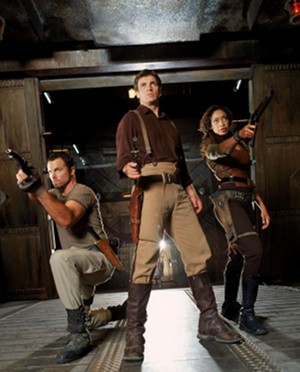
big_damn_heroes_moment_smallWhen Gene Roddenberry pitched the original Star Trek series back in the 60s, Westerns were all the rage.  Consequently, he pitched his show as a “wagon train to the stars,” where a bunch of quirky characters on an awesome starship travel from adventure town to interstellar adventure town, exploring and pioneering the final frontier.

Sound familiar?  Yeah, I thought so.  The concept proved so catchy that it’s been redone time and again, from Battlestar Galactica to Firefly to Doctor Who.  Even though Westerns aren’t nearly as popular as they used to be, many of its tropes are so well suited to Science Fiction that they drive the genre even today.

For example, adventure planets.  In a typical Western, the characters travel from town to town, with a different adventure in each one.  Well, in Science Fiction, the characters do the same thing, except that they’re traveling from planet to planet.  And really, if you’ve got the ability to travel to other worlds, how can you not have an adventure in each one?

A large reason for the Western / Science Fiction crossover is the whole concept of space as the final frontier, which we explored earlier in this series with I is for Interstellar.  There’s a very real sense of manifest destiny in the space exploration community, not because of humano-ethnocentrism (heck, we don’t even know we’re not alone in our local stellar neighborhood), but to ensure humanity’s long-term survival.  The parallels between that and the westward movement in 19th century America aren’t perfect, but they do exist.

Similarly, as we explored in R is for Rebel, the notion of space as the final frontier has a special resonance with the American audience.  The days of the old frontier may be over, but its spirit lives on in our culture, from guns to road trips to our glorification of the rugged, self-made individual.  Today’s Science Fiction, especially the space-focused SF of Space Opera, grew out of the adventure fiction of the pulps, which thrived on that frontier American ethos.

In fiction, the frontier can still be found in two major genres: the Western, which is historical and therefore more backward-looking, and Science fiction, which is futuristic and therefore more forward-looking.  Because Science Fiction isn’t burdened with all of the historical baggage of the traditional Western, it’s a much more flexible medium for story, readily adaptable to contemporary issues and concerns.

For example, where Star Trek echoes the large-scale nation to nation conflicts of the Cold War (Federation vs. Klingons and Romulans), the new Battlestar Galactica series echoes the much more asymmetrical conflicts of the post-9/11 world (Cylon agents who are indistinguishable from humans and may not even know that they are cylons).  At the same time, the wholesale co-opting of Western tropes enables a latent sense of nostalgia, evident in the look and feel of Firefly, or the famous opening lines from Star Wars: A long time ago in a galaxy far, far away.

My first real experience with a wagon train to the stars type of story was probably Star Trek: Voyager, which I watched religiously with my dad every Wednesday night until maybe 9th or 10th grade.  The Western-borrowed tropes are somewhat more muted in that series, but they exist, especially the planetville / adventure towns stuff.  However, it wasn’t until Firefly and Serenity that I really experienced the awesomeness of a true Space Western.  There were a lot of things in Firefly that I really loved, especially the character interactions, the gun-toting action scenes, and especially the starship Serenity.  There were some things I didn’t like so much, like the fact that every planet is basically Wyoming, but overall I really enjoyed the show.

It wasn’t until I started getting more acquainted with straight-up Westerns that I saw the real potential for crossover between the genres.  Stories about mountain men like Jeremiah Johnson really captured my imagination–what would this look like if it were set in space?  In that sense, I came to the Space Western more from the classic Science Fiction side first, rather than the pulp adventure stuff.  But once I discovered the crossover connection, it naturally found a way into my own work.

That’s basically how the story idea for Star Wanderers first came to me.  I was lying on my bed, daydreaming about having my own starship like the Serenity, when I wondered what it would be like for a starship pilot to get roped into an accidental marriage like in the movie Jeremiah Johnson?  The collision between the two ideas was like a supernova exploding in my brain.  I rolled out of bed and started writing, coming up with chapter one of Outworlder almost exactly like it’s written today.  And the more invested I became in those characters and that world, the more the story grew.  I’m writing Part VII right now (Reproach, from Noemi and Mariya’s POV), and so long as people read them I’ll keep writing more.

Genre mash-ups and crossovers are a great way to keep things fresh and come up with some really interesting stories.  Some genres aren’t very well suited for each other (Erotica and Middle Grade, for example), but others come together so well that they seem almost complementary.  That certainly seems to be the case with Westerns and Science Fiction, at least here in the United States where the spirit of the frontier still echoes through the popular culture.