LTUE 2013

Man, LTUE 2013 was this weekend, and it was AWESOME.  One of the best conventions I’ve ever attended.  I spoke on my first panel, attended my first book signing event as an author, and got to meet up with some old friends, as well as some amazing new people.

Since I live tweeted most of the panels I attended, I thought it might be interesting to repost a few of those here, with some additional thoughts.  So…here goes!

THURSDAY

I believe this was Scott Parkin from the “What Do You Write?” panel. Good advice. Megan Whalen Turner also had some very interesting things to say on the subject of genre, which I have since forgotten. But I recorded it, and the recording will eventually be made publicly available in the LTUE conference archives, or so I’ve been told.

This one was from the “What Is ‘Punk’ Literature and Its Many Genres?” panel. David Butler and Larry Correia were HILARIOUS. Nearly got into a wrestling match right in front of us.

And when the esteemed Mr. Butler began to describe his book, I swear, a choir of steampunk angel Moronis somewhere began to sing a heavenly chorus. I mean, he had me with Edgar Allen Poe faking his death to become a secret agent, but Orson Pratt’s phlogiston guns? Eliza R. Snow as chief counterintelligence officer for the Kingdom of Deseret? I will definitely be checking out this book, City of the Saints (which is apparently a finalist for the 2013 Whitney Award).

David Butler is also a way cool guy. I hung out with him a bit in the dealer’s room, chatting about Mormon history, Lyman Wight (“shoot and be damned!”), Sir Richard Francis Burton’s expedition to Salt Lake City, and all sorts of other crazy zany stuff. And the whole time, he was playing a guitar. So yeah, definitely a way cool guy.

This discovery CHANGED MY LIFE. Also, it helped me to save immensely on lunch money, as well as join in on some way cool conversations with other panelists as they desperately tried to escape their fans. Okay, not really, but the green room was AWESOME.

Howard Taylor’s presentation on teasers was tremendously insightful. In a nutshell, he said that a teaser (aka book description on Amazon / back cover) should have or at least point to the following things:

  1. The inciting incident
  2. Character action
  3. Conflict
  4. Hook

We then went over a few examples, including some good ones that broke these rules, and finished up by doctoring a couple of teasers volunteered from the audience. Howard Taylor admitted to me later that he wasn’t entirely satisfied with the way he presented it, but I get the impression that he’s never entirely satisfied with anything less than perfection. It was a great workshop.

From “Engaging the Reader.” Great panel. Lisa Mangum described the planning / drafting / revising process for each of her first three novels, and they were all wildly different. With seven novels under my belt so far, I can definitely relate. Some, like Genesis Earth and Stars of Blood and Glory, practically write themselves. Others are like having a c-section with a hacksaw. And others…yeah, I’m not going to go there.

FRIDAY

Okay, maybe I said one useful thing: when there’s a language barrier, little things become big obstacles. One of the other panelists, Anna Del C. Dye, also had a bunch of stories about adapting to a foreign language and culture (in her case, the United States).

Overall, the panel was really, really fun! I also had some cards out for Star Wanderers: Outworlder, and a bunch of people came up afterward to get them. Guess I must have said something interesting. I hope you guys enjoy the book!


From “Current Trends in SF.” Great panel–it totally wasn’t just another over-hyped discussion about what’s hot right now. I asked how the panelists think the trend cycle will change in the age of self-published ebooks, and they had some very interesting things to say. They all agreed that speed to market, while it may give some advantages, isn’t a make-or-break game changer, or even really a good strategy (unless you really love the trend you’re writing to). Some things change, others remain the same. It will be interesting to give this one a re-listen.


From “Creators in the Community.” Probably one of the best panels of the entire convention. Tracy Hickman is really on top of the changes in the publishing world, and had a lot of interesting things to say about it in all of his panels. As for the subject of writerly communities, much wisdom and insight was shared by all of the panelists. Definitely look for this one.

Man, I’d forgotten how cool the guys at Dungeon Crawlers Radio are! They interviewed me back in 2011, when I was just getting ready to publish Genesis Earth. This time, we talked about space opera, sci-fi romance, language barriers in marriage and all the crazy things I have to look forward to, and a bunch of other stuff. I also shared some of my thoughts and opinions on self-publishing myths, especially regarding the “tsunami of crap.” We coined a new word, “nerdaissance,” to describe all the awesome new stuff that’s coming out now, thanks to the ease of self-publishing.

So yeah, it was a great interview! I’ll definitely be cross-linking once it goes live.

From “Effective Book Covers.” Great panel with some very good artists and cover designers, including Isaac Stewart who does all the maps for Brandon Sanderson. Although some parts were geared toward illustrators, most of the advice was for writers (especially self-pubbing writers) who are looking to design their own covers. Lots of great and insightful perspectives from the visual arts side of things.

FRIDAY NIGHT BOOK SIGNING

Okay, I’ve got to be honest: when I went into the mass signing with my cardboard box of CreateSpace POD novels, I didn’t expect to sell anything. I figured that was just my ticket to get a seat at a table and hand out cards for Star Wanderers: Outworlder to some of the casual book browsers.

Well, I was pleasantly surprised! An uncle of one of my old mission companions was impressed enough to buy a couple of copies. I think he’s one of these guys who likes to buy things from new authors to help encourage them. It’s great to see people like that. He told me to keep writing, and I told him I definitely would!

Lots of people snagged the card for Outworlder, and I came up with a pretty decent pitch: “it’s about a starship pilot who accidentally marries a girl who doesn’t speak his language.” That raised a lot of eyebrows! A lot of people were really happy to see a science fiction story, especially a space adventure. I get the impression that there’s a craving for this kind of stuff in the market that isn’t currently being satisfied. So yeah, that was very encouraging!

After things wound down a bit, I wandered around the signing checking out some of the other books. Saw a couple that I recognized from the Kindle Boards, which was interesting. Chatted with them, as well as a bunch of geeky guys about chain mail, Halo, Frank Herbert, and all sorts of awesome stuff. Man, the best part about sci-fi/fantasy conventions is the chance to just talk with people! So much interesting stuff. It was great.

SATURDAY


From “Write For the Market or Write What You Know?” Another great panel. Definitely will be re-listening to that one.

From the main address with Megan Whalen Turner. She talked about book censorship and the need to teach children how to make their own reading choices, rather than keeping them sheltered and making the choice for them. She pointed out how every time a New York Times article comes out bemoaning some YA book for inappropriate content, it’s kind of hypocritical because there are so many other books they miss. The Golden Compass, for example, didn’t even pop up on their radar until the movie came out. Kids don’t magically become mature, well-adjusted adults when they turn 18–we have to teach them to make these choices (and mistakes) for themselves.

From “How Does Your Story Mean?” Great discussion on the writing process. Saw a lot of other good live-tweets during this one.

Okay, I take back what I said about the best panel of the convention. THIS was definitely the best. “The Engines of Exploration,” with Howard Taylor, Megan Whalen Turner, Roger White, James Owen, Kevin Evans, and Charles Stanford–the panel was packed. It basically turned into a round-robin discussion of which commodities are most essential to modern civilization, which ones will be the most valuable in the event of a societal collapse, and which ones will take us to the stars. The eventual consensus on each of these eventually came down to goats. Seriously. GOATS!


From “Writing Romance Without Erotica.” Lots of delicious awkwardness, as well as some really interesting thoughts and perspectives on the subject of romance. One of the panelists talked about the importance of “character penetration” without realizing about halfway through the panel how hilarious that phrase sounded in this context. But yeah, there was also a lot of wisdom in there as well. There are a lot of strong opinions about sex and romance floating around in this part of the world, so it was a very spirited and interesting panel.


The last panel of the convention (technically, symposium, but whatever) was “eBook Publishing” with some highly successful indies like Michaelbrent Collings. As you can tell from the tweets, it was a bit controversial, but very, very interesting. Questions were flying all over the place, on subjects ranging from formatting to building an audience. The biggest shock to me was that none of the panelists (none of them!) are on Smashwords. It’s a wild, wild west out here in indie-land. Makes me wonder, maybe I should publish to iTunes through another venue? Hmmmm…

So yeah, that was pretty much the whole convention/symposium. I finished it out by playing Alhambra with a bunch of friends from Kindal Debenham’s writing group who came down from Seattle and Idaho. Good, good times–it was actually kind of sad to say goodbye. Definitely worth coming 11 time zones to attend.

All I can say is that I am STOKED for Conduit!
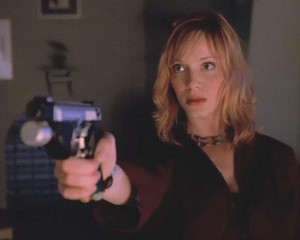
Trope Tuesday: The Vamp

Also known as the temptress or the seductress, the vamp is one of the more dangerous characters the hero meets on his journey.  A devastating beauty who is as evil as she is sexy, she uses her feminine wiles to exploit men’s flaws to her own advantage.  If the hero falls for her, he will be destroyed.

Unlike the femme fatale, her more neutral counterpart, she is completely evil and cannot be redeemed.  This is because her role in the story demands it.  She generally makes her first appearance in the initiation phase of the hero’s journey, after the hero sets out on the adventure but before he masters the unfamiliar world.  In many cases, she represents a leave your quest test or a secret test of character.

Joseph Campbell thought this character was so important that he dedicated an entire phase of the monomyth to her:

When it suddenly dawns on us…that everything we think or do is necessarily tainted with the odor of the flesh, then, not uncommonly, there is experienced a moment of revulsion: life, the acts of life, the organs of life, woman in particular as the great symbol of life, become intolerable to the pure, the pure, pure soul. The seeker of the life beyond life must press beyond (the woman), surpass the temptations of her call, and soar to the immaculate ether beyond.

As such, the vamp represents the more carnal elements of the hero’s nature, which he must reject or overcome in order to be transformed.  Confronting her is an important part of the story because it gives him an opportunity to recognize his flaws and master them.  It isn’t easy, though–the vamp is an extremely deceptive character, and often plays tricks like the wounded gazelle gambit to confuse the hero and gain his sympathy.

While often a female character, there are a few male examples of this character.  Mr. Wickham from Pride and Prejudice is one of the more obvious ones.  Basically, the vamp can be of any gender, so long as s/he is someone the main character finds sexually enticing.  Because of the traditionally male-centric nature of the hero’s journey, however, she’s almost always female.

Also, I think it’s important to add that it’s not just the vamp’s sexiness that makes her evil, it’s the way that she uses it to manipulate and undermine the hero.  If she starts out evil but has a heel-face turn later in the story, she doesn’t fulfill this trope.  Likewise, if falling for her wouldn’t make the hero fail, then she doesn’t fulfill the trope either.

I’ve played with this trope a little bit in my own work, but not in a big way yet.  Heloise from Star Wanderers: Fidelity (Part II) probably fits this trope the best, though her appearance is fairly brief.  Tamu from Bringing Stella Home might appear superficially to be one, but she’s actually more of a fair weather mentor for Stella (and has good reasons for choosing the life of a Hameji consort).  And of course, Mira from Desert Stars doesn’t fit this trope at all, seeing how much she changes by the end.

Trope Tuesday: A Man is Not a Virgin

I’m back from vacation, but I’m going to take a break from the Hero’s Journey trope posts to talk about something that I really feel passionate about.  I hope you’ll forgive me if this turns into a rant, but I think this is an important issue that has some very dangerous implications that need to be explored.

In modern fiction, there’s a very prominent trope that a man is not a virgin.  The basic idea is this: if the protagonist is an adult male and he hasn’t yet had sex with a woman, there’s something fundamentally wrong with him.  Of course, because of his adventurous lifestyle, he can’t be tied down in a committed relationship–that would spoil the story.  But he can’t be holding himself back, either, lest his manhood come into question.  And most of the time, he doesn’t really want to, anyway.

This trope has a whole host of unfortunate implications, though, all of which serve to reinforce constrictive gender roles, disempower both men and women, drive a gulf of misunderstanding between the sexes, and emasculate true manhood and its role in our society.

To demonstrate this, let’s take this trope to the logical conclusions that our society seems to have come to.

If a man is not a virgin, then sex is a rite of passage, and it isn’t rape if it’s female on male.

In fiction, the sex as rite of passage trope is often seen in stories about angsty teenagers trying desperately to get laid. These are not typically stories about love–they are stories about peer pressure, objectification, and power.  By equating sex as a rite of passage in this way, it actually divorces sex from any concept of love or commitment, and turns any form of physical intimacy into a caricature of itself.

It doesn’t stop there, though.  If sex is a rite of passage, then it’s only reasonable that the young novice should have an older mentor to help him through the initiation process.  Thus we get the professional sex-ed trope, where the boy’s mentors or guardians help guide him through his first sexual encounter.  The implications for pedophilia and underage sex are more than a little disturbing.

We can see this trope in action in the way we treat female sex offenders.  If a 30-something male teacher has sex with one of his female students, he gets a lengthy prison sentence and spends the rest of his life stigmatized as a predator.  If a 30-something female teacher has sex with one of her male students, she gets a slap on the wrist and TV spot.  She’s not a sexual predator–she’s just having a personal crisis.

Needless to say, this double standard is extremely destructive for the victims of such abuse.

If a man is not a virginthen men cannot help themselves.  Therefore, all men are perverts.

If a true man is not a virgin, then a true man doesn’t say no to sex.  Even if he can say no, he won’t because that’s just not what men do.  Therefore, being a man is functionally synonymous with being a pervert.

The danger here is that it reduces men to their basic animal urges.  If being a man means finding a warm, inviting place for your penis each night, then you might as well go out to the pasture and eat grass.  Whatever happened to self control and delayed gratification?  Do you think anything meaningful would ever have come out of our civilization if we couldn’t keep our pants on?

And yet, both men and women seem perfectly willing to believe that it’s not only unmanly for a man to control his animal urges, it’s impossible.  On the Kindle Boards forum about a month ago, there was a thread on erotica and marriage and one of the members posted this:

I used to work as a forums admin on a large women’s forum (over 100,000 members) and the relationships forum had a lot of heated discussions on this topic. I won’t of course refer to any specific threads, but the discussions went a lot like this:

One woman concerned that her husband was spending too much time watching porn
A massive amount of women telling her that it’s ok, that ‘all men watch porn’
A small amount of women saying either they don’t agree with it or that their men don’t view it
A percentage of women saying their men are addicted to porn and would rather watch it than go to bed with a willing wife
A percentage of women saying it’s not the porn itself that concerns them, but the type of porn their husbands watch
Another group of women saying they either watch it themselves, or watch it with their husbands
Yet another small group of women who either were or are prostitutes/strippers/involved in amateur porn (who are either for or against based on their experiences)
A very vocal percentage of women saying that if your man says he doesn’t watch it, he’s a liar
A heated discussion ensuing….

How does it possibly empower men to tell them that they cannot control their own sexual impulses?  It’s a self-fulfilling prophecy, which harms not only men but women as well.  If all men are perverts, then women can’t afford to wait for a decent man and should settle instead for a deadbeat porn addict.

But that’s not even the worst of it:

…and if all men are perverts and all women are prudes, then men and women are two entirely different species that are completely incapable of understanding one another.

This one really gets to me.  I hear it everywhere, even from people who don’t consciously buy into the logic behind it.  I used to buy into it myself.  It’s the idea that women are so complicated that they are impossible to understand, whereas men are as simple as an on/off switch.

In my experience, men and woman are both human.  Both of them are equally complex and equally emotional.  Yes, they are different, but in such a way that it’s equally difficult (or equally easy) for the one to understand the other.  Generally, women tend to externalize their complexity, whereas men tend to internalize it.  At least,  that’s what I’ve found.

Our society takes this to the next level, however, and teaches men that they should just swallow their emotions.  If they don’t, they risk being seen as weak or effeminate (never mind that equating weakness with femininity is a whole other can of worms in itself).  And after a lifetime of living this way, it can be hard not to believe that that’s just the way men are.

But this is perhaps the most insidious danger of all.  It’s the falsehood that real men don’t cry, or show emotion, or have any capacity for compassion or tenderness.  It’s the fallacy of equating strength with violence.  It’s the destructive belief that men will never rise above the lowest common denominator of their hormones, and should never even try.  And because men are so obviously different from women in this regard, any attempt to understand them would be futile.

But how can you have a committed relationship with someone you can’t understand?  How can you possibly hope to make the necessary sacrifices for each other to make the thing work out?  And if you can’t reach the understanding necessary for a committed, loving relationship, how can you ever hope to raise a family together?

So yeah, sorry for the rant, but this trope REALLY gets under my skin.  It doesn’t help that one of my favorite authors, David Gemmell, is a big fan of it.  I tried to get into his Rigante series, but this trope was so strong that I couldn’t finish the first book.

I should also clarify that the thing that irks me isn’t just the trope, but how much our society has bought into it.  By themselves, tropes are neither good nor bad, but when something like this becomes so prevalent that it defines the entire operating system on which our society is based, that’s when someone needs to speak out.

And for the record, I am a 28 year old single male who is not ashamed to say that he is still saving himself for marriage.  Am I gay?  No.  Has it been difficult?  Yes.  Am I anything less than a man because of it?  Hell, no.  In fact, I would argue that the wait has made me more of a man than I otherwise would have been, and I’m sure that my future wife will agree.

Real men aren’t defined by their hormones or their sexual history.  They’re defined by the way they treat the people around them, especially the ones who are most important in their lives.

მოტაცება, or how to bag a wife–literally

მოტაცება (pronounced mot’atseba) is the Georgian word for bride kidnapping, as opposed to regular kidnapping, which takes a different word.  It’s an ancient practice in the Caucasus region that doesn’t happen as much as it used to, but still happens, especially in the rural areas.  Today, most Georgians condemn it, but there’s still a whole slew of lingering cultural subtexts that can be very difficult for a Westerner (like me) to understand and navigate.

The video clip at the top is from a Georgian comedy program (named,  aptly enough, “Comedy შაუ”), and does a pretty good job illustrating how mot’atseba works.  Of course, the genders have been reversed–50% of Georgian humor is cross-dressing, and the other 50% is cross-dressing with slapstick–but everything else is pretty accurate.  Like I said in a previous post, it’s like a weird game of capture-the-flag involving sex and arranged marriage, where the flag is the girl.

This is how it works: boy meets girl.  Boy decides to marry girl.  Boy gets his friends together and kidnaps the girl (with or without her consent), holding her captive overnight.  The next morning, boy contacts girl’s parents to ask for girl’s hand in marriage.

Since the girl has been held overnight, the implication is that she’s been raped (which may or may not be true).  Therefore, to avoid a scandal which could tarnish the family’s reputation, the parents will usually marry their daughter off as quickly as possible.  However, if the girl can escape, or the girl’s brothers can rescue her before nightfall, the crisis can be averted.

I first heard about mot’atseba from this post on Georgia On My Mind, back when I was looking into TLG about a year ago.  It disturbed me a little, but not enough to dissuade me from coming to Georgia.  A couple of weeks ago, however, I learned that that was how my host parents got married.

Here’s the thing, though: they both seem to remember it kind of fondly.  In fact, when my host mom saw the clip from Comedy შაუ, she couldn’t stop laughing.  Her mom lives with them now, and from time to time they go out to visit his family in the village, so it looks like everyone’s on pretty good terms.

So what the heck happened?

Here’s the story, as best as I can piece it together.  They were introduced by his sister, who was her coworker at the hospital.  After a month, he got together with some friends and took her without violence to his family’s house out in the village.  She was surprised and upset at first, of course, but her parents gave their consent, and so they were married the next day by a magistrate.  Now, they’ve got four kids–a huge family, by Georgian standards–and seem to be pretty happy together.

As a Westerner, it blows my mind that a strong, healthy family can come out of something as violent as an act of kidnapping.  Indeed, I have yet to be convinced that that’s a normal outcome. However, after asking around and doing some research, I’ve come to realize that mot’atseba isn’t a black and white issue: there are all sorts of cultural subtexts that make the issue much more complicated.

The key to understanding how all this works is the following proverb, which underscores the entire Georgian concept of gender roles and the differences between men and women:

If a woman says no, she means maybe.  If she says maybe, she means yes.  If she says yes, she is not a woman.

From this, two things follow:

1: Women are fickle, therefore men should be assertive.

As a man, I see this all the time.  All three of my co-teachers are women, and all of them constantly defer to me, even though they have far more professional experience than I do.  When I had some pretty serious differences over teaching methodologies with one of them, she suggested that I take over the next lesson and teach it without her interference, so that she could get a better idea that way.  This isn’t the case with the female volunteers–many of them complain about how hard it is to get anyone to take their suggestions seriously.

2: A woman can never say no.

If “no” is constantly interpreted as “maybe,” then it follows that no one (or at least, no man) is going to believe that a woman is even capable of saying “no.” This turns the whole concept of rape into a nebulous gray area, unlike the United States, where women have a lot more power at least in terms of the law.

This is not to say that in Georgian culture, women are doormats or property (even though that’s what some TLGers claim).  Women have a number of support networks, such as family, friends, and other women, and can use these networks to ward off unwanted attention.  When I asked my host sister if she’s worried that a mot’atseba would ever happen to her, she said no, because if it did, her three brothers would kick some serious ass.

On top of all this, Georgians have no real concept of casual dating.  If a girl and a guy are seeing each other, they’re either married or about to be married.  This shows up in the way they use Facebook and other social networks: instead of listing themselves as “in a relationship,” the girl will give her password to the guy she’s dating.  And they don’t just do it because the guy demands it–when my host sister was seeing someone, he asked her if she wanted to give her password to him, as if that was the natural next-step in their relationship.  From the way she told me, she seemed to be worried that she’d made a mistake by telling him no.  Of course, I told her she’d made the right decision!

Combine all of these together, and you should start to get a clearer picture of some of the subtext surrounding mot’atseba.

When I asked my first co-teacher about it, she said it was only an ancient practice and absolutely didn’t happen anymore.  When I brought up rape and asked if that was also a part of it, she was horrified and didn’t want to talk about it.  However, when I asked if it’s possible for a happy marriage to come of it, she kind of smiled a little and said that if the woman likes it, then why not?

My second co-teacher was much more straight with me.  Yes, it happens occasionally, though it was a lot more “fashionable” about twenty or thirty years ago.  No, it’s not romantic.  Yes, a lot of the marriages aren’t very happy, which is why so many of them end in divorce.  She told me that one of her friends from college was married through mot’atseba, and that she knows of at least one case in our school where an 8th grader was kidnapped and married.  However, under President Sakashvili, mot’atseba is now a serious crime, so it’s not as common as it used to be.

My third co-teacher’s answer was a lot sketchier.  The first time I asked about it was in passing, as she walked in on the conversation I was having with my first co-teacher.  When I asked her about rape, she laughed and said “well yes, of course it happens!” as if that wasn’t a big deal.  Later, however, she sat me down and said quite seriously that mot’atseba is a horrible thing, that it’s a criminal act, that it doesn’t happen anymore, etc etc.

However–and this was perhaps the most illuminating thing–she said that sometimes, when a guy and a girl are in love, but she’s being wishy-washy and non-committal, he’ll sweep her off her feet and carry her off.  In fact, that was what happened with her: her boyfriend wanted to marry her, but she kept putting it off, so one day he tricked her into getting in the car and told her “all right, enough is enough–we’re getting married this weekend.” And they did.

When I asked her if that was mot’atseba, she said no, but I think the subtext was similar.  A real man knows how to assert himself and take what he wants.  Since a real woman will never say yes, sometimes you just have to man up and tell her how it’s going to be.  And don’t worry if she says no at first–she only says that because she doesn’t really know what she wants yet.  She’ll come around eventually.

It sounds pretty horrible, but that seems to be how it works.  And really, there are gradations of it. Most Georgians will agree that it’s wrong for a guy to kidnap a girl he doesn’t know so that he can rape her and force her to marry him.  But if the guy and the girl know each other, and are already pretty serious (ie seeing each other at all), and he wants to speed things up–or, alternately, if she knows her parents would never say yes otherwise–that’s when everyone speaks of it with a wink and a nod.

And really, can we say that our culture’s problems are any less abhorrent?  What about teenage pregnancy?  Secret abortions?  Date rape?  At least with mot’atseba, the guy is trying to marry the girl, not just sleep with her and walk away.  If it’s just sex that the guy is after, there are a lot more easier ways to get it than risking a prison sentence.

So is it “wrong”?  I don’t know if it’s possible to say yes or no, except on a case by case basis.  My host sister knows a girl who was kidnapped at age 12 and had a baby the year after.  I’m pretty sure that’s wrong.  But when I told her what would happen to that guy in the states–that he would go on the registered sex offender list and spend the rest of his life ostracized and unable to find work–she thought that that was wrong too.  And as for my host parents, well, it seemed to work out well for them.

I don’t know.  But either way, it’s definitely an interesting anthropological experience.

Trope Tuesday: Abduction is Love

In real life, abduction is an awful, violent thing that we hope would never happen to us or anyone we know.  But in fiction, the Rule of Romantic can make abduction the basis of a wonderful, heartwarming love storyat least for some of us.

This is actually a more common trope than you might think.  It’s the underlying premise for Beauty and the Beast, though Disney rewrote that part out of it.  It’s a major plot element in Watership Down, as well as The Courtship of Princess Leia.  More recently, Twilight featured a few variations on this trope, though considering the source, that probably isn’t surprising.

In G and PG rated versions, this often leads to And Now You Must Marry Me.  In PG-13 and R rated versions, leads to Rape Is Love, with many unfortunate implications.  Due to the violent nature of the story, it often involves a lot of Slap-Slap-Kiss.  Stockholm Syndrome, the psychological phenomenon whereby victims of abduction develop an emotional connection with their captors, is the overarching theme, making any abduction love story a match made in Stockholm.

In the West, this trope tends to be a lot less prominent than it used to be.  However, if you look at the trappings of our marriage customs, you start to notice some disturbing trends that point to a time when abduction-as-romance was much more common.  For example, what was the original function of the best man at a wedding?  Quite possibly, it was to keep the bride from escaping (or being rescued).  And why does the groom whisk the bride away to a remote, isolated place to consummate the marriage?  To evade the bride’s angry family, of course.

Here in Georgia, this trope is alive and well, not just in fiction but in real life–seriously.  It’s called motatseba, and is often discussed with a wink and a nod.  In the family that’s hosting me, the mother married her husband after he abducted her, then bore him four children.  Now, they both seem to remember it rather fondly.

This is such a bizarre tradition that I’m going to dedicate an entire post to it…after I figure out just what the hell is going on.  Seriously, I can barely make sense of the practice–it’s like a twisted game of tag involving sex and arranged marriage.  How it can possibly lead to love…that’s what I’m trying to figure out.

However, I’m sure it involves some interesting variation of this trope.

Trope Tuesday: Celibate Hero vs. The Fettered

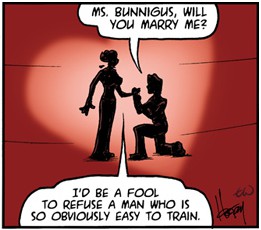
Yes, there are still good men out there...and they tend to know who's boss.

I’m mashing up two tropes this week because I’m not satisfied with the one.  There are a bazillion tropes about characters who are sexually active, but very few about sexually chaste characters that don’t portray them as weak, clueless, or socially inept.

According to tvtropes, a celibate hero is a main character who “doesn’t do the romance thing.” Unlike the chaste hero, who is just clueless, the celibate hero has made a conscious decision not to engage in sexual relations or get tied down in a relationship.  There may be any number of reasons for this, but it usually comes down to some combination of Love is a Weakness, Love Hurts, and It’s Not You, It’s My Enemies.

(As a hilarious example of this: TESLA!!!)

But what about the character who isn’t necessarily opposed to romance, but feels that they should wait until marriage to have sex?  Unfortunately, this trope is pretty rare nowadays.  I can only think of two mainstream examples: Edward from Twilight and Reverend Theo from Schlock Mercenary.

Theo in particular is a great example of this, because he’s not clueless, he’s not weak, and he not only gets the girl, he gets the girl that everyone wants.  The only reason he holds out is because his religious order forbids sex before marriage.  It does permit priests to marry, however, so Theo does manage to balance the two.

So why are characters like this so rare?  Unfortunately, I think it comes down to the widespread notion that a true man isn’t a virgin, and that sex makes people cool.  If we accept these tropes as true, then that means that men who exercise self-restraint are actually weak and pitiful, and couples who choose to wait are pathetic losers.

It’s worth pointing out that both Edward and Reverent Theo were created by writers who are practicing Mormons–people who belong to a religious community where it’s still the norm to wait until marriage.  If literature is the way that the culture speaks to itself, then this goes to show just how unrestrained the rest of Western society has become.

This is why I think that the better trope for this kind of character is The Fettered.  Unlike the celibate hero, who usually gives up sex for some kind of external reason, the fettered gives it up as a matter of principle.  Living by his ideals isn’t easy, and he’s constantly tempted to give in and break his moral code.  However, by resisting these temptations, the fettered gains great strength, and can stand like a beacon of light in an otherwise disillusioned world.

This is actually something that I tried to do with my latest novel, Desert Stars.  The main character, Jalil, is a man who believes in honor, and follows a code of abstinence before marriage.  However, to manipulate him into staying at the camp, his father charges Mira, the female protagonist, to seduce him.  Since the fettered’s strength is also his greatest weakness, if Mira can get Jalil to sully her honor, then out of shame he will return and marry her.

The catch?  She actually has feelings for him, and doesn’t want to manipulate him in this way.  In this way, merely persuading him to have sex isn’t a win condition–in fact, if done in the wrong way, it could be a very serious “game over.”

Whether or not I actually pulled it off well is up to the readers to judge.  But one thing I was definitely shooting for was to write a character who fulfills this trope in an unconventional yet powerful way.  And if you’ll permit me to step onto my soapbox for a little bit, I think our culture desperately needs more heroes like this–heroes who show that real men are capable of self-restraint, and that following a moral code is still cool, even if it means waiting to consummate a relationship.

Trope Tuesday: The Bechdel Test

The Bechdel Test is a way to measure how prominently women figure in a story.  It mostly comes up in discussions of TV and film, but can also be applied to works of literature.  To pass the test, the story must have

  1. at least two named female characters
  2. who talk to each other
  3. about something other than men.

The surprising thing, as you can see in this discussion of the trope, is that so few stories actually pass this test. Even in literature, works like The Odyssey, Romeo & Juliet, and even War & Peace fail to pass or only barely pass this test.

Closely related to the Bechdel Test is the Smurfette Principle, where only one of the major characters is female–the token chick.  Stories that fail to pass the first part of the test fall into this category.

So why does this happen?  It may be because most writers are male, but that isn’t necessarily true of books and literature.  Novel writing, after all, was originally considered a womanly pursuit, and the English major was created in the so that women could have something to study while they were in college.  Not surprisingly, 19th century works by female writers like the Bronte sisters tend to pass…

…or do they?  It’s been a while since I read Jane Eyre or Pride and Prejudice, but the impression I got was that the women in those books spend only really talk with each other about men.  And when you look to contemporary writers like Dickens and Tolstoy, the trend holds.  After all, how many female characters are there in A Christmas Carol?  Do any of them ever even talk to each other?

This isn’t necessarily a measure of how good or bad a story is, or even of how feminist it is (Aliens, after all, technically passes), but it is a measure of how independent and well rounded the female characters really are.  If the story doesn’t pass, it’s a sign that the women only play a role in relation to the men, or that the male characters are the ones who advance the plot.

I don’t usually like to bring up my own stories in relation to these tropes, but I thought it would be useful to apply this test to my own books and see how they shape up.  As a writer, I think it’s a good idea to do this periodically, to make sure my work isn’t slipping into a rut.  So here we go:

Genesis Earth

Point 1: Yes, there are two named female characters: Terra and Stella.

Points 2 & 3: No, they never talk.  However, when you apply the reverse Bechdel test (two men who talk to each other about something other than women), Genesis Earth only barely passes.  Michael talks with Tom in the first chapter, mostly about Terra, and for the rest of the book he and Terra are alone.

Bringing Stella Home

Point 1: Yes, it passes.  Named female characters include: Stella McCoy, Danica Nova, Anya Sikorsky, Tamu, Lady Borta, Lady Zeline, Sergeant Maria.

Point 2: Yes; in most of Stella’s scenes, she’s talking with Tamu or Borta or one of the other Hameji women.  Also, since Danica is the captain of the Tajji Flame and Anya is the chief pilot, they interact quite a bit.

Point 3: Yes, but just barely.  In most of their scenes together, Stella and Tamu are talking about Qasar or the harem or sex.  There are a couple where they talk about each other and their past, but it all relates back to their captivity under the Hameji.  At one point later in the book, Anya goes AWOL and Danica has to talk her down, which is probably the scene that makes the book pass, but a hardcore feminist might argue that that conversation is indirectly about a man.  Still, I’m counting it.

Desert Stars

Point 1: Yes, there are plenty of women.  In fact, as you can see from this list of non-minor characters, there are almost as many women as there are men:

Female Male
Mira Jalil
Shira Sathi
Zayne Hamza
Tiera Rumiya
Lena Gregor
Surayya Kariym
Amina Ashraf
Rina Ibrahim
Sarah Lars
Michelle Nash
Mark
Will

Point 2: Yes, plenty of these women talk to each other.  Surayya and Amina are practically joined at the hip, Tiera, Shira, and Lena all have private conversations with Mira, and the only time Rina even talks is when she and Mira are alone.

Point 3: While most of the conversations between the female characters revolve around men and marriage, Tiera talks with Mira about honor, and Rina talks with Mira about leaving home.  Without spoiling too much, there are other conversations that have nothing to do with men, though they happen off-stage and only get reported second-hand.  Either way, I’d say this book passes.

None of this is to say that a good story must pass the Bechdel test.  Lawrence of Arabia, for example, doesn’t have a single female actress–not one single actress!–and it’s an amazing film.  As a counterpoint, I’m sure there are plenty of good stories out there (most of them probably anime or manga) that do not pass the reverse Bechdel test.

However, it is a good measure of female presence and how much the story is driven by men.  And as a lens through which to view the wider culture, it offers a surprising and somewhat disturbing perspective on male-domination in fiction.

Trope Tuesday: Scarpia Ultimatum

How far would you go to save the one you love?  Would you sacrifice your life?  Suffer an irreparable blow to your reputation?  Or would you sleep with your lover’s would-be killer?

Scarpia Ultimatum is when the villain threatens to kill the hero (or, alternately, a basket full of kittens) unless the romantic interest gives him some sort of  sexual favor or gratification.  It doesn’t have to explicitly involve the physical act, though if it does, it tends to take the story in a very dark direction.  G-rated examples of this trope tend to revolve around marriage or some sort of emotional commitment instead.

The standoff can end in one of the following ways:

  • The romantic interest submits to the villain’s demands.  Since the ultimatum involves a fundamental betrayal of fidelity, this rarely ends well.
  • The romantic interest decides she’s not all that interested in the hero after all.  Alternately, she does the villain’s job for him.
  • One of the side characters offers to go in the romantic interest’s place, and the villain consents.  IIRC, something like this happened in Enchanted.
  • The romantic interest submits to the villains demands, but the hero escapes and rescues her at the last minute.  Can be difficult to pull off, since it basically consists of having your cake and eating it too.
  • The romantic interest comes up with a third option that saves the hero without forcing her to give herself up to the villain.  By far, this is the most common solution.

At the heart of this standoff is the fact that both choices involve a betrayal.  If the romantic interest refuses, she lets the hero die.  If she submits, she becomes unfaithful.  Even if the standoff is over a basket full of kittens, it almost always involves a choice between two morally reprehensible options.

My favorite example of this trope is from Phantom of the Opera, where the Phantom forces Christine to choose between her freedom and Raoul’s llife.  She takes the third option and kisses the Phantom, making him have compassion on her because no one else had ever shown him such affection.  What makes this a crowning moment of awesome, for me at least, is the way that it empowers Christine without doing anything to diminish Raoul.  He shows himself willing to make a truly heroic sacrifice, while she proves that love is more powerful than violence.

As a way to add a moral dilemma to your story, this trope is highly effective.  The stakes are high, the options are limited, and the moral choices are far from black and white.  If your characters do take a third option, however, it should probably make some sort of commentary on the ethical questions raised–otherwise, it’ll probably come across as an ***-pull.

“Who would have thought…”

I would like to address this post to my fellow Mormon readers.

A couple of days ago, I got a discouraging message from some old mission friends of mine.  It said, more or less: “who would have thought that the missionary that taught us the gospel would write such a lurid book?” They were referring to my latest release, Sholpan.

To be honest, it’s been very difficult for me to publish it, because I knew that this sort of thing would happen.  I worry that my friends and family will think that I’ve done something inappropriate, or violated some moral standard, or made myself unworthy in some way.  It’s very difficult to put your writing out there under normal circumstances, much less with complications like these.

However, I would like you to know that I have prayed about this, and that the answer I’ve received is that this is a story worth telling.

Sholpan is about a girl who lives essentially LDS moral standards and falls into what may be the worst situation any of us could imagine for such a girl: slavery in the harem of a powerful warlord who has the power not only to rape her, but to kill her.  By refusing to compromise her values–and risking death to do so–she makes friends in unexpected places and gains a whole lot more power than she ever would have if she’d taken the easy path and compromised.

In other words, it’s a little bit like the story of Esther.  Yes, there are sexual themes, but they aren’t there to be gratuitous or titillating; they’re there to show that even in the face of such horrible immorality, you don’t have to compromise your values.

I know this kind of story isn’t for everyone, which is why I’ve put up warnings in the book descriptions and made it abundantly clear that this book has adult content.  And if you decide you don’t want to read it, I won’t be offended at all.  But please, don’t assume that I’ve gone off the deep end or betrayed my faith, because that’s not the case at all.

It’s a difficult position to be in; I’m sure that Stephanie Meyer’s and Orson Scott Card’s bishops get a lot of mail from fellow Latter-day Saints who feel that they ought to be excommunicated.  But these are the kinds of stories that I feel driven to write: stories that address difficult moral issues and don’t shy away from portraying evil for what it really is.

I appreciate your concern on my behalf, but my faith and spirituality are still quite strong.  You may or may not believe that after reading my books, but please don’t feel like you have to save me.  The best thing you can do is continue to be a positive influence, and let me be a positive influence for you.

Wow, this is fun

I spent almost the whole day Saturday with family, but when I finally got around to working on Sholpan, I breezed through almost 10k words in only a couple hours.  Granted, it was mostly light revision and the material was fairly well polished to begin with, but still…it was just fun.

The best part of writing this novella has been rediscovering Stella’s story from Bringing Stella Home.  At first, I was a little worried that it might be a bit too shocking (and for some of my friends, it probably is), but there’s a lot of depth to the story, and the content, while definitely mature, is never gratuitous.

The story is basically about an innocent, sexually inexperienced young woman who struggles to keep her virtue and self-respect intact within the harem of the brutal space barbarians who have enslaved her.  While she starts from a position of almost total powerlessness, she finds ways to leverage herself without completely compromising her values.

I haven’t figure out the blurb yet, but that’s a pretty accurate description of the story.  It’s basically all of the scenes in Bringing Stella Home from Stella’s viewpoint, up through the first and second acts of the book.  In the third act, everything comes to a head, and…well, I won’t ruin it for you. 😉

I’ll probably finish Sholpan sometime later today.  My copy editor for Bringing Stella Home should be sending back the manuscript with his edits tonight, and I’ll spend the rest of the week going through and getting it ready for publication.  By Monday, it should be up!

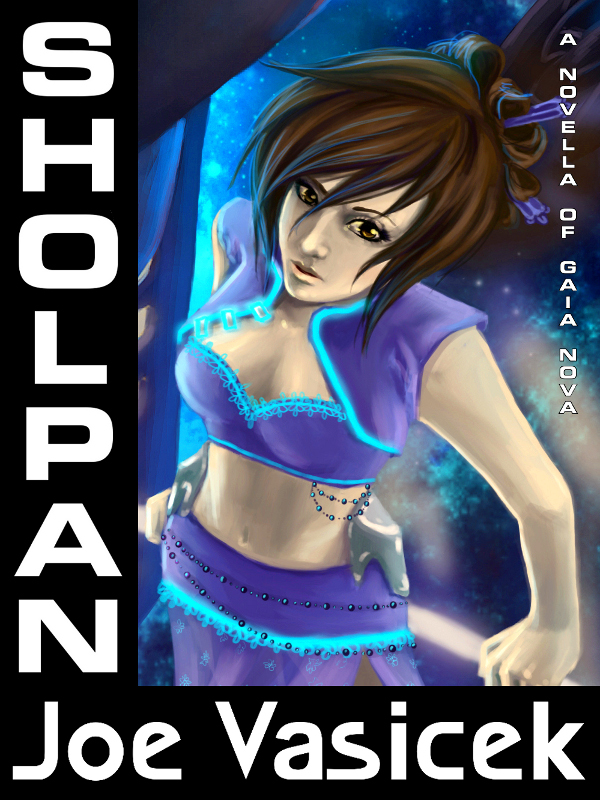
In the meantime, check this out: I was playing with the cover art yesterday afternoon, and came up with a cover for Sholpan.  What do you think?

The thumbnail:

…and the full sized image:

Man, this is so much fun!