Fantasy from A to Z: E is for Epic

What is the ideal length of a fantasy novel? Of a fantasy series?

Fantasy, as a genre, is known for being big. Big stakes, big emotions, big battles—and big books. It isn’t unusual for a single fantasy novel to run well over 200,000 words. Authors like Brandon Sanderson regularly turn in doorstoppers, with Words of Radiance clocking in at over 400,000 words, longer than the entire Lord of the Rings trilogy combined. And of course, there’s J.R.R. Tolkien himself, whose influence looms large over the genre. The Lord of the Rings helped establish the idea that a fantasy story needs room to breathe—and to expand.

Series length is no different. Some of the most beloved and influential fantasy series are also some of the longest. Steven Erikson’s Malazan Book of the Fallen spans ten main volumes and several more side novels. Robert Jordan’s Wheel of Time ran for fourteen massive books (fifteen, if you count the prequel). These stories require commitment, but for many readers, that’s part of the appeal. Once they find a world they love, they want to spend as much time there as possible.

But not all fantasy needs to be long.

Robert E. Howard, one of the foundational voices in the genre, wrote mostly short stories. His Conan tales, often published in pulp magazines like Weird Tales, rarely ran longer than a few thousand words. Yet they endure. David G. Hartwell, in “The Making of the American Fantasy Genre,” points out that Howard and Tolkien were arguably the two most successful fantasy authors of the twentieth century. Before The Lord of the Rings took off in the 1970s, most fantasy readers thought of the short story as the natural format for the genre. That pulp tradition carried strong into the mid-century, where fantasy shared shelf space with science fiction in magazines and anthologies.

That clearly isn’t the case anymore. In today’s market, a 90,000-word fantasy novel is often considered short. Readers are more than happy to put up with a bit of filler or extra padding if it means they get to linger in the world a little longer. And to be fair, there is something immersive about a book that takes its time. When done well, it can feel less like reading a story and more like living inside another world.

That said, I still believe in the value of economy of words. Economy of words doesn’t mean writing short—it means writing lean. It means using only as many words as the story needs. Louis L’Amour is a great example of this. His prose is tight, clear, and evocative. Most of his novels are quick reads, but they pack a punch. He could sketch a character in half a page and make you care about them. That’s not to say all of his books were short—The Walking Drum is a long and sprawling novel—but even there, his style is efficient. Every scene does something. Every word earns its place.

So why does epic fantasy run so long? Does it always have to be padded with extra filler? Not when it’s done well. One of the defining features of epic fantasy is that the world itself becomes a character. Tolkien mastered this. Middle-earth isn’t just a setting; it has a history, a culture, and an arc. The long travelogues, the deep lore, the songs and genealogies—they help build a sense of depth that makes the final conflict in The Return of the King resonate on a mythic level. You’re not just watching Frodo destroy a ring; you’re watching the curtain fall on an entire age.

And when the world has that kind of weight—when it grows, transforms, and carries the burden of history—it’s no surprise that a single book often isn’t enough. That’s one of the reasons epic fantasy so often stretches into multi-volume series. If the world is a character, it needs space for its own arc to unfold. A hero might only need three acts to complete their journey, but a world? That can take a bit longer.

Still, there’s more than one way to structure a series. Take Louis L’Amour again. He wrote mostly short standalone novels, but many of them followed the same families—like the Sacketts or the Chantrys—so that readers who wanted more could get it. You didn’t have to read them in order. You could pick up whichever one you found first and still get a complete story. That’s a far cry from most modern fantasy series, where the series itself is a single, complete work that must be read in order. After all, try starting The Wheel of Time at book five or A Song of Ice and Fire at book three, and you’ll be utterly lost.

My copy of The Lord of the Rings is a single-volume edition, the way Tolkien originally intended it. The main reason it was split into multiple books was to save on printing costs (Tolkien himself split the book into six parts, but the publisher turned it into a trilogy). Frankly, I think it works better that way. When a series beings to sprawl, the middle books often sag, and readers can definitely feel that. Just look at Crossroads of Twilight (Book 10 of The Wheel of Time) and how much the fans hate that book. I also remember when A Dance with Dragons first came out, with a 2.9-star average on Amazon that held for several years. (That rating has since improved, but I suspect that a large part of it is due to review farming by the publisher.)

Another risk inherent in writing a long, sprawling series is that the author will never finish it. George R.R. Martin is the most infamous example here—fans have been waiting for The Winds of Winter for over a decade, with no firm release date in sight. Patrick Rothfuss has faced similar criticism, with readers growing increasingly frustrated over the long delay between The Wise Man’s Fear and the long-promised third book in the Kingkiller Chronicle. And Orson Scott Card has yet to finish his Alvin Maker series. Seventh Son was published when I was just four years old, and though I enjoyed the first two books in that series, I refuse to read the rest of it until Card finishes the damned series.

I’m not alone. Many readers, burned one too many times, now refuse to even begin a new fantasy series until it’s complete. I can’t blame readers for feeling this way, but it does create a real challenge for new and midlist authors trying to break into the genre. Without the benefit of an established readership, it’s hard to convince readers to invest in book one of a planned trilogy or longer series. And if readers don’t start the first book, the rest may never see publication.

Right now, I’m writing an epic fantasy series based loosely on the life of King David. According to my outline, it’s a seven book series, but I’ve decided instead to split it into two trilogies (each with a complete arc) and a bridge novel (kind of like what Frank Herbert intended for the Dune books, though he died before he could finish the final book of the second trilogy). My plan is to wait until the first trilogy is totally written, publish the first three books within a month of each other, and promote that trilogy while I write the bridge novel and sequel trilogy.

In the meantime, I’ve been having a blast writing short fantasy novels in the Sea Mage Cycle, in-between drafts of my larger books. With The Sea Mage Cycle, I’m following a series structure that’s much closer to what Louis L’Amour did with his Chantry and Sackett books. Each book is a standalone, and the books can be read in any order, but they all tie together with recurring characters/families. As with all epic fantasy, the world itself is something of a character, but each book is more like a single thread in the tapestry of that wider story.

Not every epic needs to be long. Not every story benefits from being part of a massive, sprawling series. But when done well—when every word pulls its weight, when the world itself becomes a living character, when the structure supports the arc instead of smothering it—epic fantasy becomes something truly special.

It becomes epic, in every sense of the word.
Thoughts on series and perma-free

For the last five years, the conventional wisdom among most indie writers has been to write short books in sequential series and make the first book permanently free. It’s a strategy that works, to a certain extent. It’s what got me from making pizza money on my book sales to making a humble living at this gig. However, I’m starting to question that wisdom.

I have two books available for free this month: Genesis Earth and Star Wanderers: Outworlder (Part I). Genesis Earth was my first indie published novel, a “standalone with series potential” (specifically, a trilogy) written according to the conventional wisdom for breaking into traditional publishing. Outworlder is a very different book: the first in an eight-book novella series, strong enough to stand alone but short enough to leave the reader wanting more. And for several years, it was perma-free.

Outworlder was the first of my books to make it big. It’s gotten tens of thousands of free downloads and driven thousands of sales (I don’t have the exact numbers because I haven’t yet collated all of my sales reports from the past five years, but that’s something I plan to do). It was largely on the success of Outworlder and the Star Wanderers series that I built my early career.

But over time, downloads of Outworlder slowed to a bare trickle, and sales did as well. I could give it a short-term boost by running a few strategically placed ads, but it would always fall back down to a baseline that was simply unacceptable.

Also, when you have a book that’s permanently free, it tends to accumulate a lot of negative reviews. It’s strange, but some people seem to feel more entitled to XYZ when they get it for free, as opposed to paying for it. Or maybe these are the people who try to go through life without actually paying for anything? Who hoard everything, even the stuff that they hate, so long as they can get it for free? I don’t know.

Certainly, that’s not true of everyone who reads free books. But when you have a perma-free book, it tends to accumulate more of the barely-coherent “dis buk sux” kinds of reviews from people who probably weren’t in the target audience to begin with. And over time, that tends to weigh the book’s overall rating down, which unfortunately can be a turn-off for people who are in the book’s audience.

Contrast that with Genesis Earth. I launched it at full price with a blog tour (which I put together myself, among writer friends whom I knew personally and who had readers who would probably enjoy the book). It sold about a hundred copies in the first ninety days, then slowed to a very low trickle—maybe one or two sales each month, if that. Things continued like this for several years.

Then, back in December, I made it free for one month. Downloads immediately shot up, and continued strong throughout the entire month. Even without any advertising, I was still getting maybe 50 downloads per day on Amazon, plus a constant trickle on the other platforms. For the next couple of months, sales of all my other books grew as well

For April, I decided to make it free again, just to see if I could duplicate that kind of success. I haven’t done any paid advertising for it, but I have submitted it to various sites and newsletters that will promote free books. The result? Thousands of downloads, with a baseline rate of more than a hundred downloads per day.

Genesis Earth has never been perma-free, but every time I set it free for a limited time, it’s like I’ve released the pent-up flood waters. In contrast, Outworlder struggles to get any downloads at all, even when it’s free for only a limited time.

Part of this may have to do with the reviews. Genesis Earth has a much better overall book rating, simply because most of the people who read it over the years were the ones willing to pay full price. This also means that the book has grown into its own niche organically, since the people who have bought Genesis Earth also tend to buy other books similar to it. Retailers like Amazon take note of this, and tend to associate these books with each other in things like also-bought recommendations.

This is all just speculation, but when all of this comes together, it seems to result not only in a higher download rate when the book is free, but more downloads from people who are in the book’s targeted audience.

The mos fascinating result of this is that when the book goes back to full price, sales get a small but long-lasting boost. I’ve seen this with Bringing Stella Home, which was free in March. It’s not a huge boost—maybe only five or six books a month—but it boosts all of the other books in the series as well, and lasts for a couple of months. It’s not just Amazon where this is happening, either—in fact, it may be boosting sales on the non-Amazon platforms even more.

Bringing Stella Home is different, though, because it’s a full-length novel (about 110k words, or +300 pages) in a series that can be read out of order just fine. In other words, more of the “stand-alone with series potential” that was the convential wisdom in the old tradpub world. Like Genesis Earth, it has never been perma-free.

So what’s the takeaway?

That maybe the convential wisdom among indies is all wrong. That perma-free actually taints books and makes it harder for them to stick in the rankings, or to grow into their natural audience. That longer stand-alone books with recurring characters set in the same universe may be better for gaining long-term traction than shorter, more episodic books. Also, that the more books you give away for free—not just first in series—the better that all of your books will sell.

My experience is purely anecdotal, and there’s a lot more analysis I need to do before I can say anything for sure. From what I can tell, though, it seems that the best strategy is to write longer, fuller books that satisfy more than they entice, and to use free as a marketing strategy for only a limited time.

In other words, the collective wisdom of KBoards is completely off the mark, and Kris Rusch (who regularly gets vilified on KBoards) actually knows what she’s talking about most of the time.

Like I said, this is all anecdotal and more analysis is required. But I’m very curious now to make some of my non- first-in-series books free for a month, just to see if it has a similar boost. With Bringing Stella Home, for example, a lot of readers seem to be jumping over books 2 and 3 to read Heart of the Nebula, the direct sequel (but book 4 in the Gaia Nova series order). It would be very interesting to see if Desert Stars has an awesome free run as well, resulting in more sales after it reverts back to full price.

Lots of interesting stuff to consider. It’s definitely going to inform my writing and marketing efforts in the future.

Looking ahead

Sorry not to post anything new in a while. This past week has been rather busy/disorganized for me, which isn’t helped by the fact that I had my last wisdom tooth pulled today. I’ve swallowed so much blood that my mouth tastes like I’ve been sucking on an anvil, and I can also feel a piece of exposed bone with my tongue. Awesome.

So I’m in the middle of Strangers in Flight (Sons of the Starfarers: Book III), and it looks like I’ll have to do a fairly substantial revision. That’s going to throw off the publication schedule a bit, but hopefully not more than a couple of weeks. Comrades in Hope (Sons of the Starfarers: Book II) will be out by the end of June, and Strangers in Flight will be out sometime in August. After that, I’ll take a break to work on some other projects and write the next three Sons of the Starfarers books.

I really enjoy writing in series of novella-length books. I know that a lot of readers complain when writers chop their stories into parts rather than packing them all into one full-length novel, but novellas come a lot more natural to me than novels. I probably won’t go any shorter than Star Wanderers: Outworlder (Part I), which technically is a novelette–novelettes lean more toward short stories in terms of structure, whereas novellas have a lot more room to play with (but not so much that you get lost in it).

What I’m thinking about doing from now on is writing novellas to start off with, and if a series does well (like Star Wanderers), to write a couple of full-length novels with the same characters. I can put out novellas a lot faster than I can put out novels, and putting them in series is a great way to build traction across a whole lot of books. And if the series is successful enough, then I know that a novel with the same characters will do fairly well too.

It’s kind of like Star Trek, in a way: it started as a TV series, then spun off a bunch of movies with the same characters. Which makes me wonder, why didn’t Voyager ever get a movie? Voyager was my favorite Star Trek series, and I totally think it deserved a movie or two.

In any case, I definitely want to write a Star Wanderers novel bringing back some of the main characters from that series. I’ll probably work on that after finishing Strangers in Flight, though with how long it takes me to write a novel, it may be a year before it’s ready for public consumption. It’s definitely on the list of books to write, though.

In the meantime, Sons of the Starfarers is going to consume all of my attention for the next month or so. I’d better get some sleep so I can work on it tomorrow. So much to do, so much to write … but I think you guys are really going to like it when it’s done!

The next few months are going to be CRAZY

I knew that back in March, but with Brothers in Exile about to be published, I’m right in the thick of it! Fortunately, it looks like everything is proceeding more or less according to schedule, which is good for my readers because it means a steady stream of books all summer.

First of all, I’m just about ready to publish Brothers in Exile–in fact, if all goes well, I should be able to hit “publish” tomorrow (it still takes about 24 hours for the book to actually go up for sale, but yeah). Yesterday I got the cover art, today I went through all the edits, and tomorrow I’ll write up the author’s note, format the thing and put it up on Amazon, Smashwords, Kobo, and Barnes & Noble.

The second book, Comrades in Hope, is coming along quite well and should be ready in six weeks at the latest. I’ve gotten enough feedback from my first readers to do a quick revision draft, probably in about a week or so, before getting the publishing gears ready to grind. My first readers ate this book up–many of them said they finished it in one sitting. It’s short, but not super short–about the length of a 60s sci-fi novel–so that tells me it’s just about ready to go.

The third book, Strangers in Flight, is going to be a bit more tricky, but I should be able to get it out six weeks after Comrades in Hope. I’m still writing the first draft, and am maybe 1/4 to 1/3 of the way through it, but the story is coming along well and shouldn’t hit any major snags <crosses fingers>. I know exactly how it’s going to end, and I predict a lot of you are going to squeal at the cliffhanger, but don’t worry–I’ll try to throw in at least some resolution, since it might be a few months before book IV.

Right now, I foresee at least nine books in the Sons of the Starfarers series, perhaps as many as twelve. Like Paul Atreides, I can only catch a few fragmentary glimpses of what will happen in the next few books, but the overall direction is very clear. These books are going to be a lot of fun to write–if you guys enjoy reading them as much as I’ve enjoyed writing them, you’re in for a real treat.

The books are fairly short–not as short as the Star Wanderers books, but not too much longer. They straddle the line between novellas and short novels, kind of like the long-form science fiction from the golden and silver ages. Unlike those books, though, these are more character-driven than idea-driven, with the overarching galactic conflict tying all the characters together, rather than the other way around.

Once I’ve finished writing Strangers in Flight, I’ll take a short break to work on some other projects. I’ll come back to Sons of the Starfarers sometime in the fall, though, with the same grueling schedule for the next three books. It’s hectic but fun–I’m definitely not complaining.

So that’s what the next few months are going to look like. With luck, tomorrow will be the day I upload Brothers in Exile–I can hardly wait to get it out to you guys! Definitely look out for it in the next couple of days or so!

D is for Discoverability

If there’s one thing that indie writers like to talk about when they talk shop, it’s “discoverability”–how to make their books stand out so that readers can discover them. You don’t have to spend much time on author blogs or writing forums to find some pretty intense discussions about this topic. For those of us trying to make a living at this gig, it’s something we constantly obsess about.

So what’s the best way to boost your discoverability? What works, and what doesn’t? If I had the answers to those questions, I could probably make a lot more money writing “how-to” books! However, here are a couple of books I’ve found that do an excellent job answering this question.

The Secrets to Ebook Publishing Success is an excellent resource for ebook marketing ideas that won’t cost you an arm and a leg. The book won’t cost you, either–it’s available on Smashwords for free. The author, Mark Coker, is the founder and CEO of Smashwords, and he wrote this book to help Smashwords authors succeed. Definitely worth giving a read.

Let’s Get Visible is the other book on discoverability that I’d recommend. For this book, David Gaughran collaborated with a number of other indie writers from KBoards to figure out the best ways to work with Amazon’s algorithms. It’s an excellent book that explains some of the best practices for free giveaways, price pulsing, and choosing keywords and categories.

Those are the two books I’d recommend. There are other good ones I’m sure, but there are also a lot of scammy marketing books that are just out there to take your money. These ones aren’t scam books at all. Without getting any benefit from the authors of these books for saying it, I can vouch from experience that their advice is pretty solid.

So what’s worked for me personally? I can point to a few things:

  • Writing in a series. If your books are grouped together by series, then readers who enjoy one of those books are more likely to try out another. They’re less likely to read one book and forget about it because all of the books are connected. In this way, each of your books helps readers to discover the others.
  • Give some books away. Readers love free books. They’re a lot more likely to try out a book by an unknown writer if it’s free than if it costs any money at all–even as little as $.99. I know a lot of writers don’t like giving away their books for free, but if you’ve got ten other books that readers go on to buy after reading the first one, it’s worth a lot more than having eleven full-price books that no one ever buys.
  • Make the first book in a series permanently free. That’s what I did for Star Wanderers, and the strategy has worked extremely well. Before that, I had a couple of short stories and non-series books that were perma-free, but none of them gave my other books much traction. But with Star Wanderers, it’s easy to see that the first book leads to the second book, the second book leads to the third book, etc.
  • Don’t let your price become an obstacle to new readers. The principle behind perma-free + series that makes it work is the sales funnel, where you try to spread some of your books as widely as you can in order to funnel people to your other books. But if your first book is free and all the other books are priced so high that price becomes an obstacle, readers are bound to get irked and drop out. I’ll say more about this in P is for Pricing, but one thing I’ve learned is that it really helps if you’ve got a lot of low-priced books that readers can move on to after picking up your free stuff and before moving on to the higher priced stuff.
  • Write and publish lots of books. It wasn’t until I had maybe fifteen books out that I started to notice that my entire catalog was working together. When my Star Wanderers books sold well, I saw more sales of my other books too. When you have enough books out, they work together to sell each other. I wouldn’t be surprised to find that on average, one person with fifteen books out sells more than fifteen people with one book each.
  • Book blurb, cover, metadata. That’s the trifecta–if you don’t hit all three of those, nothing else you do may ultimately matter.

And of course, there’s the most important thing of all: write a damn good book. If your book sucks, all the discoverability in the world isn’t going to save it.

When you’re an indie writer, it often feels as if publishing a book is like tossing a message in a bottle out into a churning sea. You have no idea where your book is going to end up, and the marketplace is as wide and as menacing as a stormy ocean. Lots of books sink to the bottom of that ocean, where no one ever finds them. But plenty of other books stay afloat, selling a copy here or a copy there–just enough to stay up at the surface. And eventually, the winds of the marketplace cast it up on a distant shore, where it’s discovered by a fan.

But here, the analogy breaks down. Because unlike a beachcomber who finds a message in a bottle, a fan doesn’t have to wait for your next book to come to them–they can go out and find them directly. So the more books you have out there, the greater the likelihood that they’ll eventually be discovered. And if they’re out in the marketplace for long enough–out where the potential fans can discover them–then eventually they will grow into their natural audience.

That’s been my experience, at least. There are a lot of other things that I’m experimenting with now, but these are the things that I know work for sure–at least for me.

What I’ve been up to lately (besides short stories)

It’s been a while since I did an update post, so I figure I should do one of those to let you guys know what projects I’m working on. There are quite a few of them, and I’m happy to say that the writing is going quite well! If I don’t post on this blog very much, it’s probably because I’m busy writing.

Anyhow, here’s what I’m working on (and what you can expect to see in the coming months):

Sons of the Starfarers
Book II: Comrades in Hope

This is the project that’s been taking most of my attention. What started out as a novella has grown and morphed into a short novel–I expect it will top out at just under 40k words. I’m just past the 2/3rds mark now, where it’s still a slog but I can just about see the end. I was hoping to finish it this week, but now it looks like I’ll be pushing it back into April.

That’s okay, though, because my second big project is:

Sons of the Starfarers
Book III: Strangers in Flight

I’ve been itching to start this one for a while, and last night I finally opened up and started it. In the first book, Brothers in Exile, the two starfaring brothers Aaron and Isaac find a beautiful girl covered in henna tattoos and frozen in a cryotank on a derelict space station. In this, the third book, the girl finally wakes up and we get to see things from her point of view.

With the way I’m writing Sons of the Starfarers, it’s going to be structured in a series of three book arcs. Since I want to release the books in each arc fairly close to each other, I don’t want to publish Brothers in Exile until Comrades in Hope and Strangers in Flight are both complete. So even if I end up taking a break from Comrades in Hope for a little while, if I’m working on Strangers in Flight, it’s not putting things off since I’d have to write that one first anyway.

I am really, really excited about these books, and when you read them, I think you will be to. I’m trying to think of ways that I can share them, since it’s hard to talk about something if it’s not actually out there for you to read. Maybe if I posted a series of short excerpts from the first book, no longer than 400-500 words each? I generally skip over blog posts where authors sample their own books, but maybe if they were shorter excerpts, that wouldn’t be as much of a problem. What do you guys think?

So that’s what I’m working on writing-wise. Here’s what I’m working on publishing-wise.

New Star Wanderers covers (and print editions)

So the cover designer I’ve been working with for Star Wanderers told me this week that he’s overextended himself by taking on more work than he can handle and that unfortunately he has to drop some clients. That’s unfortunate but understandable–we all have limitations, and things come up in life that we can’t always plan for. We’ve parted amicably, and he’s promised to get me the files I need to pick up on the cover work where he left off.

I’m really anxious to get the new covers done, though, and would like to find a good cover designer as soon as I can. If you guys have any recommendations, please let me know. Ideally, I’d like to find someone who I could work with long-term, since there definitely won’t be a shortage of work anytime soon!

Because of this, though, I’ll probably keep the original space art covers for the POD books at least for the foreseeable future. The omnibus editions will feature the new art, though, and I’ve just bartered with a friend of mine to do the typesetting for those. I’m not sure when they’ll be out, but it will probably be sometime in the late spring / early summer.

As for the print edition of Star Wanderers: Deliverance (Part VIII), that should be out approximately whenever I get around to it, which would be sooner except that I’m so busy writing Sons of the Starfarers. I’m not sure how many of you are waiting on that one–the print versions for the individual novellas have been selling better than I’d expected, though still at a trickle, so that’s not quite at the top of my priorities right now.

Blogging A to Z Book

Last year, I did the Blogging from A to Z challenge and had a lot of fun with it! The topic I blogged on was science fiction, with a new post each day in April starting with “A is for …” “B is for …” etc. Well, I’d like to do that again this year, but first I’d like to put together last year’s posts into an ebook. It shouldn’t take too long–probably no more than a week at the longest–so I’ll probably take care of that next week or so.

For this year’s challenge, I’m going to blog about publishing. I already have the first few posts planned out: “A is for Amazon,” “B is for Big 6 (now 5),” “C is for Contracts,” etc. These posts aren’t meant to be advice, more just sharing my perspective and experience, since hey I’ve been indie published for 3+ years now, which might as well be 3+ decades what with the way the industry is changing. So even though there’s a lot I’m still learning, I do have a few things to share.

That’s just about it. Better grab some lunch now and head out to write. See you!

Experimenting with prices

So now that the last Star Wanderers novella is out and I’m hard at work on the next book, I’m thinking very seriously about experimenting with my prices. I haven’t done a lot of price experimentation, especially since writing became my main source of income about six months ago. I just recently landed a job to save up some money, though, so that gives me a little more space to try things out.

Right now, I’ve basically got three pricing tiers for ebooks: novels and omnibuses at $4.95, novellas at $2.99 (especially Star Wanderers), and short stories at $.99. My best sellers by far have been the Star Wanderers novellas. Now that Part VIII is out, though, I’ve noticed that fewer people who start the series are going through and finishing the whole thing. I’ve also got a fair amount of pushback in the reviews, saying that the $2.99 price for the novellas is too high.

The tricky thing is that at any lower price point, my royalties take a huge hit. At $2.99, I get a 70% royalty from Amazon and a 65% royalty from pretty much everywhere else. At anything less, I get a 35% royalty. That means that at $1.99, I have to sell three times as many books to make the same as I would from one $2.99 sale. At $.99, I have to sell six times as much.

But wait, it gets trickier. The general consensus (inasmuch as there is a consensus about any aspect of epublishing) is that $1.99 is a dead price point. In other words, a book priced at $1.99 will sell so many fewer copies than a book priced at $.99 that they earn less revenue. A $2.99 book may also sell less than a $.99 book, but the increased royalty rate makes up for the shortfall.

Up until this point, my pricing strategy has been to maximize revenue, so that I can have more time to write. That worked fairly well: I put out one novel and four novellas in 2013, finished up the Star Wanderers series, and started a number of other projects that will hopefully bear fruit in 2014. But now that Star Wanderers is complete, I think it might be time for a change in strategy.

What I’ve learned in the past month is that readers will drop out of a series early if 1) the series is long, and 2) the individual parts in the series are priced relatively high. A lot of readers either drop out after Part II or pick up the omnibus, but the ratio of sales between Part II + Omnibus I-IV and Part VIII frankly isn’t that great. From Part V to Part VIII, it’s almost 1:1, but a lot of readers are dropping out right at the beginning–a lot more than when there were only four parts.

Part of this may be that the story just isn’t engaging that many people, but another part may be that the price has become something of an obstacle, especially as readers look ahead at all the other books in the series. Length probably also plays a role–my Star Wanderers books are fairly short, leaning more toward the low-end of the novella spectrum. Combined with the fact that many full-length sci-fi novels are now priced at $2.99, that probably only makes readers balk all the more.

I want to see what will happen if I drop the price low enough that it ceases to be an obstacle. Will fewer readers drop out after the first couple of books? Will more of those readers move on to my other books? Exactly how much of a hit will my revenue take?

For all of these reasons, I’m going to drop the price of my individual Star Wanderers novellas to $.99 for a month to see what happens. To keep the omnibus price competitive, I’ll drop it to $3.79 and release the second omnibus at $3.79 as well. I will raise the list price of the print editions, though (mostly to shoot for extended bookstore distribution), and probably raise the price of my novels from $4.95 to $5.99.

I have no idea how this is going to turn out, which makes me kind of nervous. Since I want to move on to other projects, though, including a spinoff series that I hope to launch later this year, I think it’s more important to encourage readers to read through Star Wanderers as a whole without putting any potential obstacles in their way.

So yeah, that’s the plan. We’ll see how it goes. I’m open to any feedback or ideas, so if you have any thoughts to share either as a reader or as a writer, please don’t hesitate.

Thoughts on sequels and the Desolation of Smaug

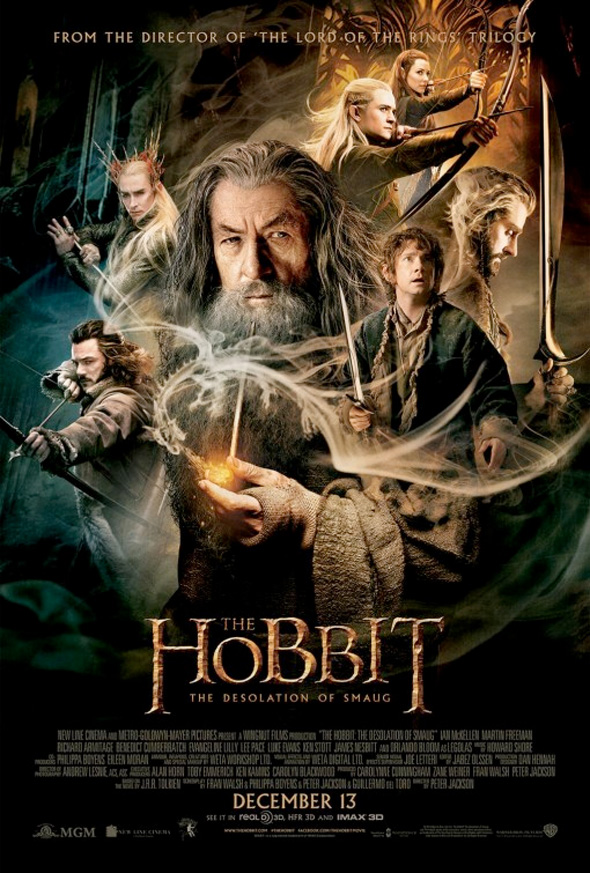
hobbit2-finalposter-fullSo last week I saw the new Hobbit movie, The Desolation of Smaug, and I really, really liked it … right up to the ending.  Why?

BECAUSE IT RESOLVED NOTHING!!!

Okay, sorry for the spoiler (though you probably should have guessed there would be spoilers in a post like this).  There’s going to be more in this post, so if you haven’t seen the movie yet, read on at your own risk.

Overall, I thought the movie was pretty good.  The action was fun, the fantasy elements were very well executed, and Benedict Cumberbatch was excellent as the voice of Smaug.  My only real hangups (beside the ending) are relatively minor, such as the impossible physics of Thorin’s luge run down the river of molten metal, or the fact that all of the gold ever mined in the history of the Earth would not fill a tenth of the stockpile in Erebor (seriously, all of the world’s gold would only fill a cube about 20 meters to a side … so maybe half of that big statue they melted at the end?).  Oh, and I thought the politics of Laketown were simplified to the point of caricature.  That was actually a fairly big issue for me, though I suspect the third movie will either make it or break it.

But all of those are dwarfed (no pun intended … okay, maybe a little) by the movie’s biggest flaw, which is that IT HAS NO RESOLUTION.

Seriously, none of the half-dozen subplots resolve in any meaningful way.  The one that comes closest is that love affair between the elf woman and the dwarf, since I guess she kind of saves him from his orc wound.  But he doesn’t even regain consciousness, which means that they aren’t even really reunited by the end.  And as for the other storylines … well, Smaug is still alive and about to burn Laketown, Gandalf is a prisoner of Sauron, Bard is a prisoner of that fat guy who wasn’t ever in the book and the dwarves still haven’t taken Erebor.

I understand that the middle installment in a series can’t resolve everything, but I still think it should resolve something.  Take The Empire Strikes Back, for example.  It ends on something of a cliffhanger, but there’s still enough of a resolution that it stands very well on its own.  Han Solo is frozen in carbonite, but Leia, Chewie, and the droids have escaped to safety.  Luke hasn’t defeated Vader, but he has learned something that completely changes the relationship between them both.  The Rebel Alliance hasn’t won yet, but they have gotten away from Hoth without being completely decimated by the Empire.

The Empire Strikes Back is not just part I of The Return of the Jedi–it stands on its own as a complete story.  It bridges A New Hope and Jedi by showing the tragic failure of Luke Skywalker to defeat Vader, rescue his friends, and become a Jedi.  By the end of the movie, he’s a very different person than he was at the beginning.  Could the same be said of Thorin, Bilbo, and the Desolation of Smaug?  Not really.

I suppose I have to be a bit cautious here, since there are those who would say that I’m guilty of this myself.  I’ll freely admit that I’ve written a few cliffhanger endings, most recently in some of the Star Wanderers stories.  However, I always try to resolve something, so that each book can stand at least partly on its own.

In Fidelity, for example, Jeremiah and Noemi haven’t found a home yet, but they do have one to work toward.  It starts with their arrival at Oriana Station and it ends with their departure–everything that they need to do there has been done.  In Sacrifice, the language barrier, cultural misunderstandings, and Jeremiah’s own personal shortcomings converge until he’s more or less forced to leave Noemi, at least temporarily.  It’s not a feel-good ending, but it is a resolution of sorts.  And in Reproach, Mariya comes to the horrifying realization that she’s destroyed everything that she was hoping to build.

I guess the key to bridging a series in such a way that the sequels stand on their own is to keep the individual conflicts and subplots distinct, especially the internal and external ones.  For example, I thought that The Unexpected Journey had a much better ending, not because the overall plot was resolved, but because Bilbo had transformed from a homebody to an adventurer.  The internal conflict had a satisfying resolution, and the growth arc had more or less come full swing.  The Desolation of Smaug could have done that with Thorin, and in some ways it seemed to be trying, but by the end it just fell short.

So am I going to see the third movie?  Well, yeah, so from a Hollywood perspective, I suppose the movie was a success.  But I’m not as excited for it as I was for Return of the Jedi.  And the lesson I’m taking from this is that cliffhangers are good, but you’ve got to deliver at least some satisfaction–you’ve got to resolve something.  Otherwise, people are going to feel cheated.

Novella woes and farmers markets

Today I wrote about 2.6 words in my current WIP (Sons of the Starfarers), which didn’t really feel like it because I was constantly getting distracted.  Still, 2.6 words is pretty solid–it’s about mid-range for me.  If I can hit that every day from here on out (which is doubtful, but hey), the rough draft should be finished before the end of the month.

The crazy thing is that I just hit the inciting incident at the end of today’s writing session, after passing the 6k word mark.  For a mid-sized novella, that’s pretty late.  In the classic three act structure, the inciting incident usually hits between the 12%-15% mark, but this one is well past 20% for a 30k word novella–and just barely at 16% for a 40k.

So in layman’s terms, how long is this book going to be?  Probably longer than any of the Star Wanderers stories, but not quite as long as Genesis Earth.  It probably won’t turn into a full-fledged novel, since there’s only one viewpoint character, but I can already tell that it’s going to flirt with the line between novella and novel.

We’ll see how it turns out.  I’m still really excited about this story, and even though I don’t have a clear idea how to write the ending, I do know exactly how it’s going to end, if that makes any sense.  I’ve got a clear idea of the series arc that this book is going to set up, but I don’t yet have a clear idea of the book’s self-contained arc.  Once I figure that out, maybe I’ll be able to trim it down to a 30k novella after all.

============================================================

I visited the Stadium Farmer’s Market in Provo for the first time today.  It was pretty neat–lots of great produce, a nice community atmosphere, and a few quirky things like Jalapeno Jelly and tie died baby jumpers that you can’t really find in a mainstream grocery store.  I came away with some excellent peaches and a hankering to come back next week for more.

Anyhow, the trip got me thinking how indie publishing is kind of like a farmer’s market.  You’ve got everything from the guys who sell their produce out of unmarked paint buckets (writers who toss their books up to amazon with hardly a thought) to the local farm operations with pretty banners, pretty baskets, and laminated fact sheets drilling down on every possible difference between Elberta and Briscoe peaches (writers who go to great lengths to organize their own small presses and become Facebook/Twitter/Blogging personalities).

Almost everyone gives away free samples, which actually does a lot to drive sales.  In a similar way, most indie writers either have a couple of perma-free titles or free-pulse their books.  Everyone at the farmer’s market tries to be friendly and reach out to the customers (kind of like authors on Facebook and Twitter), but for me personally this kind of drives me away.  A good entertaining sales pitch, though, can be quite interesting.  I listened to the guy selling honey for almost twenty minutes, going on and on about his wares.  It’s clear he’s in a business that he loves.

Even though the fruit in the farmer’s market tends to have more blemishes than the stuff you find in the mainstream store, it is WAAAY more fresh and delicious.  Similarly, the stuff from the mainstream presses might be a lot more edited and polished, but the true innovation and formula-breaking stuff is happening in the world of self-publishing.  Publishers want things to be more predictable and formulaic so that they can have a better idea how something is going to sell, but indies are free to try almost anything.

Those aren’t the only parallels, either.  The more I think about it, the more it seems that being a self-published indie writer (or “author-publisher,” a newer term that I think I actually prefer) is a lot like being a local small farmer.  I’m sure there are differences, but the similarities are quite striking.

And now I’m really wishing I’d bought some of that honey.

Things I’ve learned from STAR WANDERERS

Star Wanderers I (thumb)Star Wanderers II (thumb)Star Wanderers III (thumb)Star Wanderers IV (thumb)SW-V Dreamweaver (thumb)SW-VI (thumb)SW-VII Reproach (thumb)

When I published the first couple installments of Star Wanderers, it represented both an experiment with a new publishing format and a departure from the more long-form styles that I was used to.  Now, a little over a year later, I can say it’s been a success.  The series isn’t finished, and I’m still learning as I go, but here are some of the big lessons that I’ve picked up:

Novellas are surprisingly well-suited to series. They read fairly quickly, contain enough focus to sustain an episode of a larger story, and yet at the same time contain enough space to develop a wider arc.  Plus, they are a lot quicker to write than novels and generally don’t require as much editing, since it’s easier to get the story right on the first pass.  This means that you can put out novellas faster and more regularly than long-form novels, maintaining good momentum for the series as a whole.

It’s hard to write anything shorter than a novella without leaving readers unsatisfied.  By far the biggest criticism I’ve received for Outworlder (which is really more of a novelette than a novella) is that the story feels too short.  If the novella (17,500 to 40,000 words, or 80 to 150 pages) has all the benefits of the novel and the short story, then it seems that the novelette (7,500 to 17,500 words, or 30 to 80 pages) has all of the drawbacks.  Then again, it could just be that I have yet to master the form.

The satisfying element in a series is at least as important as the returnable element.  Every successful episodic story has some sort of returnable element–something about the story that makes the audience ravenous for more.  Often, this takes the form of a cliffhanger, leaving something unresolved.  However, it’s not enough just to string readers along, holding back whatever your story has promised them.  In every installment, you have to deliver.

It’s a delicate balance, to be sure, but the advantage of erring on the side of satisfaction is that the satisfaction can actually become a major hook in itself.  If readers know that they’re going to be satisfied whenever they pick up one of your books, you don’t have to ratchet up the tension to eleven in order to keep them coming back.  Several Star Wanderers reviews mention that it’s more relaxing and not as fast paced as other space opera, but sales of parts III through VI are almost 1:1.

Readers love to revisit a good story from another character’s point of view.  Some of the most glowing reviews I’ve received for this series are for Dreamweaver, which is basically a parallel novella to Outworlder but from Noemi’s point of view.  In Outworlder’s Amazon also-boughts, it sometimes even appears ahead of Homeworld, which actually comes before it in the series order.  This tells me that readers love to revisit a story, or to hear the same story again but from a different point of view.  Head-hopping from episode to episode can be a great way to add variety and depth.

Plenty of readers are willing to pay $2.99 per book for a series they enjoy.  When I published the omnibus for Star Wanderers I-IV, I wondered if sales of the individual novellas would taper off since I priced the omnibus much lower than their sum.  To my surprise, sales for both the omnibus and the individual installments have actually remained about even.  Since the omnibus clearly shows up on Amazon’s recommendations, this tells me that $2.99 is not too high of a price, even for a novella.

Perma-free works; however, free and $.99 attract some bad apples.  Do not underestimate the power of free, especially perma-free for the first book in a series.  I credit that strategy for at least 90% of the Star Wanderers sales, since the series itself has boosted my total sales numbers by more than an order of magnitude.  However, there are people out there who never fail to find something to complain about.  These are usually the same people who don’t like to pay for anything, and when they realize that the rest of my series is not free, they tend to leave unhelpful and/or incomprehensible reviews.

I priced Fidelity at $.99 to try to give readers more of a hook from part I to part II, but the sales ratio between part II (Fidelity) and part III is about 2.5:1–in other words, pretty bad.  Judging from some of the reviews, it seems that a fair number of the people who are dropping out are the bad apples.  I haven’t decided whether to raise the price, but if things keep going the way they have been, I probably will.

Series don’t usually take off until the third or fourth installment.  Do you know how many sales Outworlder had in the month when I first published it?  About 10–and that was actually a surprise.  When I published Fidelity, I had even fewer, and Sacrifice hardly sold anything until Outworlder went perma-free.  When it did, sales of the other two novellas picked up, but it wasn’t until after I’d published Dreamweaver that the sales of Fidelity started hitting triple digits.  The lesson to me is clear: it takes time for a series to pick up steam, so don’t be like Fox.  Give it a chance to grow.

Nothing sells a book like writing and publishing more books.  This is probably the main driving factor behind the last point.  I’ve done almost no promotion for Star Wanderers, other than putting out new books on a fairly consistent basis.  Amazon’s algorithms have probably done their part (sales on other outlets haven’t been growing nearly as much), but at the end of the day, there is no substitute to writing more and better books.  Any sort of promotional or marketing activity that takes away from my writing time is just not worth it–not when I’ve got stories to tell.

Right now, I’m getting ready to start a new spin-off series, which hopefully will be even more successful.  I’ll to try out a few new things (mostly along the lines of better covers and meatier novellas), but mostly, I’m going to try to replicate the success I’ve achieved with Star Wanderers by keeping these lessons in mind.  I have no idea how this new series is going to go, but I figure I know enough about the publishing side now that I can focus my attention on writing an awesome story, which is the most important thing after all.