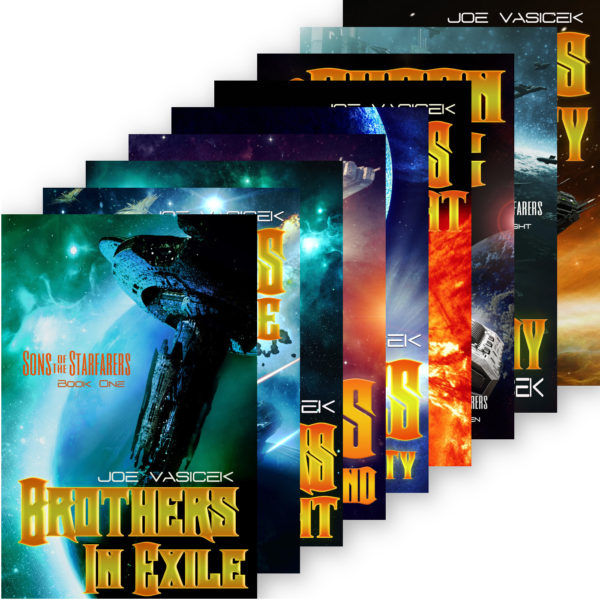
I’m currently running a sale for my Sons of the Starfarers series bundle, available only on my online author bookstore. From now to the end of December, you can get all nine books in my flagship series for just $9.99.
Merry Christmas!
I’m currently running a sale for my Sons of the Starfarers series bundle, available only on my online author bookstore. From now to the end of December, you can get all nine books in my flagship series for just $9.99.
Merry Christmas!

From now until Saturday, March 9th, all of my books are 50% off on Smashwords for the annual Read an Ebook Week sale! Simply head over to my Smashwords author page, select the books you want, and apply the coupon code at checkout!
A couple of weeks ago, I got a new (to me) car. It’s a 2005 Ford Focus / Saleen: a two-door hatchback that drives like a racing car and gets about thirty miles per gallon (WA-A-AY better than the gas guzzler I was driving before). It’s also a manual transmission, which is perhaps the biggest difference between this and my previous car.
This is my first time driving stick shift, and I have to say, it is a lot of fun! When you drive a stick, each hand and each foot is doing something different. There’s a lot more to keep track of, and if you do things in the wrong order (like braking without engaging the clutch, or starting without giving it some gas), you run the risk of making the car stall or doing nasty things to your transmission. On the other hand, driving a manual gives you a much better feel for the engine and what it’s capable of. You can feel when you’re putting too much stress on it–or alternately, when you can push it a little further.
I usually like to walk everywhere, but ever since I got this car, I just want to drive it! It’s way more fun than driving an automatic, even with (or indeed, because of) the extra challenge. So today, while I was walking to BYU campus (alas, the parking situation there makes driving a major pain), I got to thinking about it, and I realized that driving a manual is a lot like being an indie author.
When you’re an indie, you have a lot more things to juggle, just like driving a manual. This gives you much greater control of your career, but it also makes it easier to stall or screw up. At the same time, because of that extra control, you’ve got a much better feel for the market, and probably a better connection with your readers. And for me at least, the extra challenge doesn’t make it less enjoyable, it actually makes me enjoy it more!
This week, I had the first day where I sold 100+ books in a 24 hour period. That was pretty awesome! I’ve been running a $.99 sale for Star Wanderers: The Jeremiah Chronicles (Omnibus I-IV), and it got picked up by a couple of ebook sites that really pushed it in the right way. Now that I know how to run a sale like that, I hope to do it again, perhaps for Black Friday. And if you haven’t picked up this one yet, it’s on sale for $.99 through Friday.
Marketing and promotion is one of the harder parts about going indie for me, kind of like how finding the clutch point and starting without stalling is hard when you first drive a manual. The more that I practice, though, the better that I get at it, and the more I enjoy it.
Another area where I think I’ve more or less stalled is in my covers. When I put out the first few Gaia Nova novels, I spent a fair amount of money hiring out artists to do the illustrations, but I did the typography myself. On those earlier covers, it definitely shows. For my later books, I worked with a bunch of cover designers, and seeing their work made me realize that there’s definitely room for improvement on those earlier ones, especially for the print editions.
I’ve decided to redo the covers for those three novels (Bringing Stella Home, Desert Stars, and Stars of Blood and Glory), keeping the illustrations but changing the typography. I tried to find a cover designer to do it, but I wasn’t able to find one that did satisfactory work, and after playing around with them for a bit I think I can actually do them myself. I’ve got a lot more experience with covers and cover design now than I did when I was starting out, and I’ve learned a few photoshop tricks as well.
In any case, here is what I came up with for Bringing Stella Home:
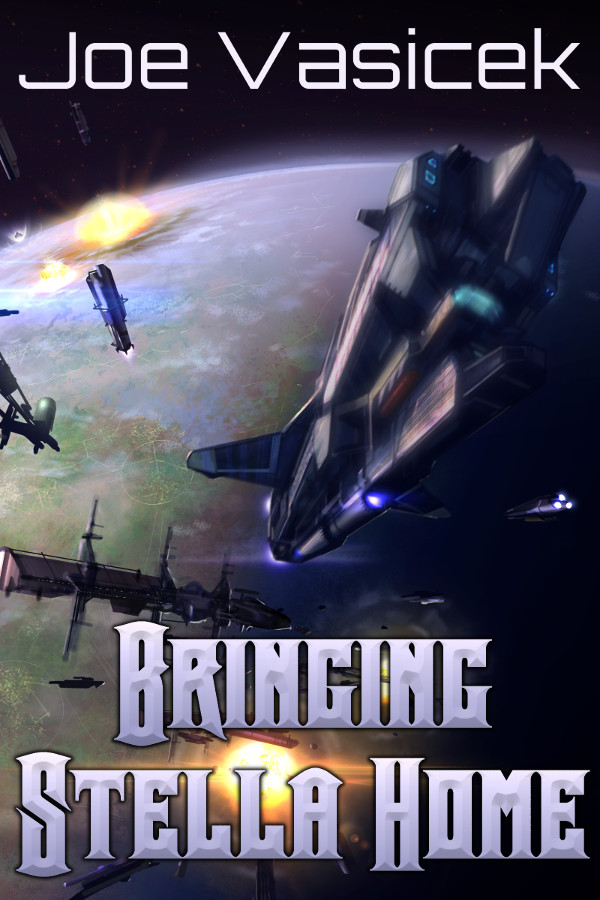 How do you like it? I rather like how it turned out, though I’ll admit I’m still learning. I did the new design just this morning, so I figure I ought to wait a couple of days and maybe seek out some feedback from professional designers before I go through with it.
I hope to have the new edition out before the end of the month. The content and story will all be the same, but the cover and metadata will be updated, and some minor errors such as typos will be fixed. I also hope to do the same thing with Desert Stars and Stars of Blood and Glory. Once the new editions are out, I’ll probably run some sales and giveaways with them, so definitely stay tuned!
As for my other projects, the next book in the Sons of the Starfarers series is out with my first readers, so it’s on track for a January release. My next WIP is The Sword Keeper, a fantasy novel I think I’ve mentioned before, and I hope to get that one knocked out in about a month or so. It’s already halfway finished, so the hard part is just ahead. There are also a couple of Gaia Nova novels that I’ve been meaning to get around to, and probably will before the end of the year.
That just about does it. Look out for more covers soon! I’m definitely having fun with the new ones. 😀
According to conventional bookselling wisdom, summer is the slowest time out of the year for book sales. But is that really the case? I’ve heard David Gaughran and Ed Robertson argue that that’s just a myth perpetuated by New York publishers who are completely out of touch with their readers. Sales don’t fluctuate with the season so much as with promotions and new releases, so the argument goes.
Well, it’s been three years since I started self-publishing, and I still have no idea whether there’s a slump or not. June was my best month ever, but sales have fallen off sharply since then and it looks like August is going to be the worst month of the year. I wish I could blame that on the summer slump, but last year, June was also my best month, and sales after that held more or less steady.
It’s a hard thing to watch your main source of income fall more than 50% over the course of seven or eight weeks. More than anything else, it’s reinforced to me that I cannot afford to rely on just one income stream. Most of my sales come through Amazon, but I need to figure out ways to promote and market my books on the other venues. Relying almost exclusively on Amazon is like putting all your officers in the same shuttlecraft.
How much of the decline has to do with the launch of Kindle Unlimited last month? I don’t know, but it’s making me nervous. None of my books are available through KU because Amazon requires exclusivity in order to be enrolled in the program. That’s not something I’m willing to give them, at least with my already published books. But I may enroll one of my future books in the program, just to see what it’s about.
Honestly, though, I think the slump has more to do with my own lack of promotion and the fact that I haven’t had a new release for two months. When Strangers in Flight (Sons of the Starfarers: Book 3) comes out next month, I hope that will change things around.
I think it’s also good to remember that books don’t spoil. In a certain sense, it doesn’t matter when a book comes out–when a reader discovers a book for the first time, to them, it’s something new. My Star Wanderers series has been out for a while, but there are still a lot of people who have never heard of it and would probably enjoy it. I’ve got to find ways to get at least the first book into those people’s hands.
I really, really suck at marketing though, as you can probably tell from the fact that I’m blogging about writerly business stuff that isn’t all that interesting to the average fan. 😛 Until now, I’ve been relying mainly on the strength of my writing to sell itself, but that probably isn’t the best strategy.
And that’s one of the other problems with the idea of the summer slump–it lulls you into thinking that things will pick up on their own once the summer is over. Well, that’s one rude awakening that I’d rather avoid if I can help it. In this case, the path of least regret is to assume that the slump is a myth and get back to work, dammit. Because even if it isn’t, it’s not like the extra marketing is going to hurt you.
Enough with the boring business stuff. Here’s Grant Thompson doing the ALS ice bucket challenge with dry ice. Enjoy!







When I published the first couple installments of Star Wanderers, it represented both an experiment with a new publishing format and a departure from the more long-form styles that I was used to. Now, a little over a year later, I can say it’s been a success. The series isn’t finished, and I’m still learning as I go, but here are some of the big lessons that I’ve picked up:
Novellas are surprisingly well-suited to series. They read fairly quickly, contain enough focus to sustain an episode of a larger story, and yet at the same time contain enough space to develop a wider arc. Plus, they are a lot quicker to write than novels and generally don’t require as much editing, since it’s easier to get the story right on the first pass. This means that you can put out novellas faster and more regularly than long-form novels, maintaining good momentum for the series as a whole.
It’s hard to write anything shorter than a novella without leaving readers unsatisfied. By far the biggest criticism I’ve received for Outworlder (which is really more of a novelette than a novella) is that the story feels too short. If the novella (17,500 to 40,000 words, or 80 to 150 pages) has all the benefits of the novel and the short story, then it seems that the novelette (7,500 to 17,500 words, or 30 to 80 pages) has all of the drawbacks. Then again, it could just be that I have yet to master the form.
The satisfying element in a series is at least as important as the returnable element. Every successful episodic story has some sort of returnable element–something about the story that makes the audience ravenous for more. Often, this takes the form of a cliffhanger, leaving something unresolved. However, it’s not enough just to string readers along, holding back whatever your story has promised them. In every installment, you have to deliver.
It’s a delicate balance, to be sure, but the advantage of erring on the side of satisfaction is that the satisfaction can actually become a major hook in itself. If readers know that they’re going to be satisfied whenever they pick up one of your books, you don’t have to ratchet up the tension to eleven in order to keep them coming back. Several Star Wanderers reviews mention that it’s more relaxing and not as fast paced as other space opera, but sales of parts III through VI are almost 1:1.
Readers love to revisit a good story from another character’s point of view. Some of the most glowing reviews I’ve received for this series are for Dreamweaver, which is basically a parallel novella to Outworlder but from Noemi’s point of view. In Outworlder’s Amazon also-boughts, it sometimes even appears ahead of Homeworld, which actually comes before it in the series order. This tells me that readers love to revisit a story, or to hear the same story again but from a different point of view. Head-hopping from episode to episode can be a great way to add variety and depth.
Plenty of readers are willing to pay $2.99 per book for a series they enjoy. When I published the omnibus for Star Wanderers I-IV, I wondered if sales of the individual novellas would taper off since I priced the omnibus much lower than their sum. To my surprise, sales for both the omnibus and the individual installments have actually remained about even. Since the omnibus clearly shows up on Amazon’s recommendations, this tells me that $2.99 is not too high of a price, even for a novella.
Perma-free works; however, free and $.99 attract some bad apples. Do not underestimate the power of free, especially perma-free for the first book in a series. I credit that strategy for at least 90% of the Star Wanderers sales, since the series itself has boosted my total sales numbers by more than an order of magnitude. However, there are people out there who never fail to find something to complain about. These are usually the same people who don’t like to pay for anything, and when they realize that the rest of my series is not free, they tend to leave unhelpful and/or incomprehensible reviews.
I priced Fidelity at $.99 to try to give readers more of a hook from part I to part II, but the sales ratio between part II (Fidelity) and part III is about 2.5:1–in other words, pretty bad. Judging from some of the reviews, it seems that a fair number of the people who are dropping out are the bad apples. I haven’t decided whether to raise the price, but if things keep going the way they have been, I probably will.
Series don’t usually take off until the third or fourth installment. Do you know how many sales Outworlder had in the month when I first published it? About 10–and that was actually a surprise. When I published Fidelity, I had even fewer, and Sacrifice hardly sold anything until Outworlder went perma-free. When it did, sales of the other two novellas picked up, but it wasn’t until after I’d published Dreamweaver that the sales of Fidelity started hitting triple digits. The lesson to me is clear: it takes time for a series to pick up steam, so don’t be like Fox. Give it a chance to grow.
Nothing sells a book like writing and publishing more books. This is probably the main driving factor behind the last point. I’ve done almost no promotion for Star Wanderers, other than putting out new books on a fairly consistent basis. Amazon’s algorithms have probably done their part (sales on other outlets haven’t been growing nearly as much), but at the end of the day, there is no substitute to writing more and better books. Any sort of promotional or marketing activity that takes away from my writing time is just not worth it–not when I’ve got stories to tell.
Right now, I’m getting ready to start a new spin-off series, which hopefully will be even more successful. I’ll to try out a few new things (mostly along the lines of better covers and meatier novellas), but mostly, I’m going to try to replicate the success I’ve achieved with Star Wanderers by keeping these lessons in mind. I have no idea how this new series is going to go, but I figure I know enough about the publishing side now that I can focus my attention on writing an awesome story, which is the most important thing after all.
 Today’s issue of Dave’s Daily Kick was titled “Hooking Credibility,” and I’m not sure what I think of it. At the end, Dave’s brother Tailspin Jim had the following to say:
What I’m about to add is so basic that [Dave] would never think to include it, but you may be like the vast majority of Kick readers who just don’t have his depth of background on this subject or who would be benefited from taking a look at it.
Each hook or marketing ploy is like firing a bullet at your reader. You probably won’t kill their resistance with the very first shot. You want to fire bullet after bullet until they collapse and make the decision to buy.
Not only does this statement smack of everything I hate about sales and salespeople, but it seems to fundamentally clash with the new reality of publishing.
With social networking and the internet, writers can now connect directly with their readers. For those going the indie route, this is absolutely essential. The key element to success, from what I can see, is developing an ongoing relationship with your fans–one in which they take the role of patron, not merely consumer.
There’s a huge difference between thinking of readers as patrons and thinking of them as consumers. If they’re just consumers, then the end goal is to get them to buy your product, and there’s nothing wrong with spamming them or shamelessly plugging yourself if that’s what works.
But if they’re patrons, the end goal is to develop that relationship–to connect with your readers on a meaningful level, both before and after they buy your work. And in this brave new world of publishing, that seems like the best coarse to take. Consumers have to be sold on each individual book; patrons are sold on you, so they’ll read everything you put out.
And as a reader, that’s how I buy. Whenever I find an Ende or a Wilson or a Le Guin in the bookstore, I rush to grab it, because those are the writers who speak to me. I’ve bought just about every Sanderson in hardcover because I love his work and want to support him.
That’s why this comparison of bookselling to “a series of bullets being fired from an automatic rifle at the prospective buyer” rubs me in all the wrong ways. I’m not just peddling widgets; I’m creating art and sending it out into the world, waiting patiently for it to return back a hundredfold. And if I work hard to create the best possible art and treat my readers (aka you guys) as my patrons, I sincerely believe that it will.
So to all of you who have read my books, regardless of whether you bought them or downloaded them from Smashwords for free, I just want to say thank you! The greatest honor any writer can have is to be read, period.
I also want you to know that I’m never going to “shoot” you with a bunch of cheap sales tricks or “hooks” that get in the way of the story. I’m just going to write damn good books and put them out where you can find them, trusting you to rate, review, like, and share them if you feel they truly deserve it.
I will never, ever, EVER put a gun to your head to get you to buy my work. I’d much rather you jump at the chance to read a Vasicek, because that’s what speaks to you.