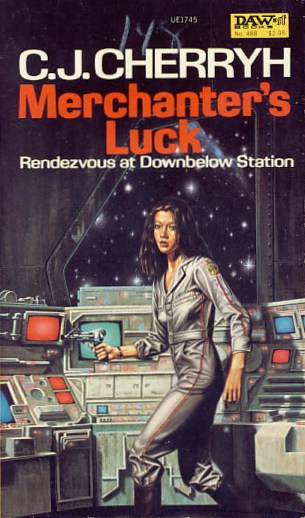
Merchanter’s Luck by C. J. Cherryh

He was a down and out merchanter, the captain, crew, and sole proprietor of a run-down bucket of bolts spacecraft.  She was a daughter of one of the finest starfaring clans, with seven hundred cousins standing between her and the one thing she wanted more than anything else: command of a starship.

They met at Pell during the height of the Company War–the key strategic point on the border between Union and Earth.  Their fateful meeting would affect not only the outcome of the war, but the course of their own lives–for the starship Lucy of Wyatt’s Combine was not at all what she seemed to be.

Before I review this book, I need to issue a disclaimer: you probably aren’t going to enjoy it very much unless you’ve already read Downbelow Station.  Cherryh isn’t the best at easing her readers into her worlds, and without the background on Union, Alliance, and the Company War, you’ll probably be hopelessly lost.

That said, I absolutely loved this book.

The premise is so awesome.  Space adventure hardcore, with a beautiful love story set amidst an epic interstellar war, where alliances are constantly broken and no one can be trusted…oh man, I LOVED this book!

While the premise seems pretty standard, C. J. Cherryh transcends the well-worn tropes and cliches of her genre by intimately developing her characters and working their motivations into the story until they are the ones driving the plot, and not the other way around.

Every character is unique, and though they act in ways that may seem strange to our modern sensibilities, there are always reasons for everything they do, cultural or otherwise.  As windows into their far-future spacefaring culture, they give the reader a wonderful view of Cherryh’s unique and marvelously constructed universe.

The thing that surprised me the most, however, was the sharp contrast between this book and Downbelow Station. While Downbelow Station traces the epic arc of the Company War through the viewpoints of a large cast of characters, much like Tolkien or Dune, Merchanter’s Luck focuses more on the characters themselves, in much the same way as David Gemmell or Ursula K. Le Guin.  In other words, while Downbelow Station is comparable to “high” or epic fantasy, Merchanter’s Luck would fall closer to “low” fantasy or sword & sorcery.

The interesting self-realization I took from the book was that I’m much more interested in the intimately personal stories than the sweeping epic tale of the Rise and Fall of cultures and civilizations.  I suppose that’s why I’m more of a David Gemmell nut than a Tolkien fanatic, and perhaps why I’m more into space opera and military sf than epic fantasy.  In all of my novels, the focus is always on the individual characters and their personal conflicts, and whenever I get sidetracked and focus too much on the overworld story, it always falls apart. 

Merchanter’s Luck definitely doesn’t get sidetracked, and that’s why I loved it so much.  I fell in love with the characters almost from the very first page–from the blurb on the back cover, even.  And most of all, I fell hopelessly in love with the starship Lucy:

You know you’re doing science fiction right when your readers bemoan the fact that they weren’t born in the 26th century, when they could command their own spaceship.  C. J. Cherryh is an amazing writer, and if I had the chance, I would teleport into her Union-Alliance universe in a heartbeat.

If you love well-crafted far-future worlds and stories about the people that live in them, check out Downbelow Station (or really, just the first chapter–that’s all you need for a solid grounding) and read this book!
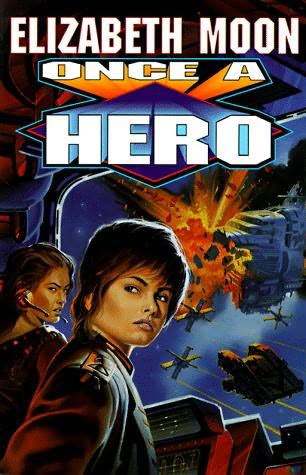
Once a Hero by Elizabeth Moon

Esmay Suiza never asked to be a hero.  All she wanted was to leave her dysfunctional home and join the navy.  But after surviving a mutiny and leading her spaceship to a most unlikely victory, everyone seems to be showering her with unwanted attention–or worse, examining her files for signs of command potential.

No, all she wants is to disappear–and now that her family has offered her a generous inheritance on her home world of Altiplano, she finds herself tempted to leave the stars behind and settle down for a while.

Little does she know, her family has hidden secrets from her–secrets from her past, which have the power to undo and destroy her.  Unfortunately, being a hero has a price–and the trauma of combat has already unearthed things from her subconscious than she cannot keep buried any longer.

This was my first time reading Elizabeth Moon, and I enjoyed it quite a bit.  Moon is extremely good at portraying a complex, believable military culture; she was a Lieutenant in the Marines, and definitely knows how to do military SF right.

My favorite part of the book was the descriptions of Altiplano, and Esmay’s experience returning to her homeworld of Altiplano.  Elizabeth Moon does an excellent job of creating a captivating world and transporting the reader there.  I fell in love with Altiplano almost instantly–not only with the planet itself, but the culture and the people, the whole society.  Excellent job.

Elizabeth Moon also does an excellent job developing her characters and giving them believable internal conflicts.  The way she portrays Esmay’s PTSD is quite striking, and very interesting.  Her struggles feel very real, and important too.  I think this novel helped me to better understand those who suffer from similar traumatic experiences, and that was very meaningful.

Storywise, however, I had a few minor issues, most of them having to do with the plot.  Things dragged a bit in the middle; when Esmay left her homeworld, I lost a sense of progression and felt that she was just wandering around.

When the antagonists came in–basically, a hostile army trying to capture her ship–I felt that Esmay solved her problems too easily, without any real try-fail cycles.  It gave me the sense that Esmay was some kind of superhero girl–not quite a Mary Sue, but toeing the line.

And Esmay’s love interest…I didn’t really get into him at all.  He seemed like a stereotypical damsel in distress, except with the sexes reversed.  I heard once that in good romance stories, the girl readers want to be the female protagonist, and the guy readers want to be the male protagonist.  Yeah…call me a chauvinist, but I never really wanted to be that guy.

I hate to be too critical, though, because Elizabeth Moon’s writing is quite good.  She has an excellent grasp of character, and her ability to transport her readers to another time and place more than makes up for her shortcomings with plot and story structure.  Also, I get the sense that this isn’t her best work.

In any case, if you’re a fan of military SF, you’ll probably enjoy this book.  I enjoyed it, and I will certainly be reading more Elizabeth Moon in the future.

New projects and other stuff

So I started the sequel to Mercenary Savior today; I figure I can take a couple months off to finish the rough draft, then leave it in the trunk until the first one sells.

The working title of this one is Into the Nebulous Deep, which captures the main premise quite nicely (though let me know if it doesn’t jive with you).  It takes place five years after the events of Mercenary Savior. James is a lieutenant in the Colony’s civil defense forces, and has made a name for himself as an ace gunboat commander.

The basic premise is that the Colony is falling into economic ruin and must therefore make a mass exodus in order to survive.  Their only real option is to flee into the Good Hope Nebula, where FTL drives don’t work and the Hameji can’t follow them.
Deep in the nebula are newly born stars with planets and proto-planets, and they hope to re-establish themselves there.  Of course, nothing happens quite that smoothly, and James is going to find himself putting out fires most of the time.

While all that is going on, however, I hope to put him in the middle of a love triangle.  I have the ending of it planned out, and it can ONLY happen this way in a science fiction novel.  Oh man, the twist is going to be way interesting–and incredibly hard to pull off well.  I’m up for a challenge, though, and I can already tell this one is going to be fun.

For some reason, things worked out so that I started this novel on November 1st.  Because of that, I suppose I’m doing it for a nanowrimo–since hey, the rough draft is probably going to be between 120k to 140k words long, and I want to finish it before January.  Sounds tough, but I’ve got the money saved up to take off a few weeks and work on my writing, so that’s what I plan to do.

In loosely related news, I hope to start running soon.  My brother in law ran a marathon this year, and he’s going to help me get set up.  Basically, I need to get in shape for the wilderness job I hope to train for in January, and also because hey, I need to take better care of my body.  Besides, I’ve found that exercising boosts my writing tremendously, which is something I definitely need.  Exercise = win/win/win.

The most pressing thing on my mind now, however, is the article I need to write about the history of “the class that wouldn’t die.” I’m working on a very tight deadline, and absolutely must produce.  I wish I hadn’t been so flaky with the previous deadlines, but it is a volunteer magazine and I have had other pressing things taking up my time.  Not any more–I’ll get it done right away.

In the meantime, I’m tired and must get some sleep.  I wish I could function like one of Stephanie Myer’s vampires, but reality is a harsh and unforgiving mistress.  One of these days, though, I’ll be free of her–just you wait!

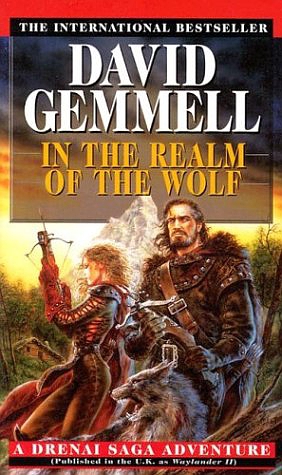
In the Realm of the Wolf by David Gemmell

Never leave home without a weapon, Dakyras taught his adopted daughter Miriel.  Though they live a quiet life alone in the mountains, death is never far from the man known as Waylander.

When the Assassin’s Guild puts out a high price on Waylander’s head, both Waylander and Miriel find themselves on the run.  With them come two ill-fated gladiators from Drenai: the loyal and steady Angel, and the arrogant and reckless Senta.  Both men vie for Miriel’s hand–and both are honor bound to kill each other.

But in the face of the evil hunting Waylander, Angel and Senta must lay aside their vendetta and take up arms against the Gothir army hunting the Wolf clan, tribe of the prophesied chieftain that will one day unite the Nadir.  For deep in the realm of the Wolf lies a castle more ancient than the three empires–a castle whose dark secrets threaten to upset the global order forever.

This book was awesome.  I loved every moment of it.  With each page, the story just got better and better, right up to the climactic finish.  If you’re looking for a rousing adventure, you can’t go wrong with David Gemmell.

One of the things I loved the most about this story was the love triangle between Miriel, Angel, and Senta.  At first, I thought I knew who was good, who was bad, and which one she’d end up with, but then things changed and I wasn’t too sure.  Even though I hated Senta at first, I spent most of the book vacillating with my feelings on him.  And the way things ended–I wasn’t disappointed.  Not one bit.

Even though the overall story conflict was much, much larger than life, Gemmell’s characters always felt very real.  Perhaps it has to do with the way their true nature always seems to come out in battle–and Gemmell gives them plenty of opportunity to show their true nature.

It also has to do with the things they’re fighting for, though–the stakes are always clear for each character, and when they’re confused what they’re fighting for, that’s made clear too.  Though the conflict itself is larger than life, the stakes for each individual character never are.

The ending really took the cake for me, though.  When I finished the book, I couldn’t help but smile.  Gemmell is a master at writing endings that make you want to stand up and cheer.

As awesome as this book was, though, the last book in the trilogy, Hero in the Shadows, is so much better.  The last scene of that book stands out so much more to me, now that I know everything about Waylander’s past.  So.  Freaking.  Epic.

But do yourself a favor: don’t read the last book first, like I did.  Start with Waylander, which is a good book–not great, but good–and read through the trilogy.  If you love stories about true heroes and epic adventures, you won’t be disappointed.

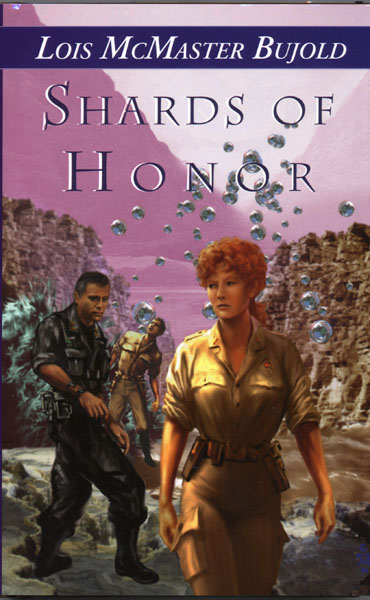
Shards of Honor by Lois McMaster Bujold

Cordelia Naismith never thought she would find the love of her life on a scientific survey to an unexplored border world, let alone that he would be a Barrayan, one of the enemy.  But Aral Vorkosigan is not just any other officer in the Barrayan Military.  He is courteous, fair-minded, thoughtful–and above all else, driven by an innate sense of honor.  To her surprise, Cordelia soon finds that she has more in common with the man than she thought possible.

But the rumors of war between Escobar, Beta Colony, and Barrayar soon conspire to drive them apart.  Though Cordelia sees Vorkosigan for the good man he is, the rest of the galaxy only knows him as the “Butcher of Komarr”–an unfortunate title which Vorkosigan does not entirely deserve.

As Barrayar goes to war and Cordelia finds herself rising through the ranks of the Betan Military, she is forced to choose between loyalty to her country and loyalty to the man she loves.  When the two are mutually exclusive, how does one preserve one’s honor while securing a degree of happiness?

I loved this book.  Unlike some romances, where the male protagonist is a complete douchbag, Aral Vorkosigan is the kind of guy I’d like to be like.  Bujold strikes an excellent balance between strong and sensitive that enhances, rather than taints, his manliness.  Besides that, Vorkosigan is extremely fascinating, with a complicated backstory and motivations that are both believable and interesting.

Though it’s technically a romance, the book reads very much like military science fiction, with deliciously tongue-in-cheek phrases like “the cadet was too young to believe in death after life” and rigorous attention to the details of military life, such as rank and chain of command.  The book definitely has enough explosions, space battles, and political intrigue to appeal to boys as well as the romance audience, but Bujold melds the space adventure elements seamlessly with the romantic elements, so that readers of either genre don’t feel left out or patronized.

There was only one thing that bothered me, and since it contains spoilers I’ll put it in black so that you don’t inadvertently see it.  To read it, highlight the text:

After Cordelia ran away from home and married Vorkosigan, why did she never think about her homeland again? You would think that as a career military officer who had dedicated her life to her country, she would at least have some lingering doubts that she’d done the right thing by running away–especially when her husband became the new Lord Regent of Barrayar! To me, this seems in-congruent with her character.

All things considered, though, this was an excellent, well-written science fiction adventure/romance. I thoroughly enjoyed it and will definitely be reading more of Lois McMaster Bujold’s work again.

If it kills me

I will finish this novel if it kills me. At the rate things are going, it just might.

Things are kind of tough for me right now.  I desperately need a new job–the one I’ve got is slowly sucking away my soul without even paying enough to get by–and job rejections are way worse than rejections from publishers (I’ve been getting a lot of both, by the way.  Not that I’m looking for pity, but yeah.).

As if that weren’t bad enough, my current novel, Worlds Away from Home, is turning out to be a train wreck.  There are all sorts of problems with character motivations, improper foreshadowing and plot set up, etc etc.  That makes it REALLY hard to get motivated to write each day.  Yesterday, I wrote only 245 words (youch).  Today, I did about 2.2k, but that’s still way less than I need to be doing.

The thing that worries me the most is the thought that the audience for this particular story may be slim to nonexistent.  It’s solid space opera, but with a romantic element that challenges a lot of the mores of our modern, sex-saturated society, as well as many of the conventions of romance within science fiction.

The main female protagonist is something of a pushover–but she has to be, in order for her growth arc to have any umph.  The main male protagonist is an orphan on a quest to discover his own origins, kind of like a cross between Mogli and Pip.  His quest, combined with her parents’ manipulative attempts to get them physically intimate too soon, are the main things keeping them apart.

But in a genre where physical intimacy usually marks the romantic climax, how do you make it out to be the obstacle against that climax?  Will science fiction readers go for that, or will they hurl my book across the room because of it?

Well, if they hurled my current draft, I wouldn’t blame them one single bit.  So many plot holes and awkwardly written scenes–ugh.  I’ve got to seriously rethink so much about this story.  But a later draft?  I don’t know–maybe it would work.  It would probably need other hooks to keep them engaged, such as cool world building elements, but I think I could make those work.

Anyway, I suppose it’s nothing unusual.  For every book I’ve written, I’ve come to a point in the rough draft where I thought the story was completely unworkable and should be scrapped.  It’s a tortuous, masochistic process, but I suppose it’s normal.  That’s some comfort, at least.

My goal is to finish this abomination by August 15th, then move on to polish Mercenary Savior and make it really shine.

Another goal is to get a decently paying job (at least $8/hr at +25 hours per week) in order to afford to go to DragonCon in September.  Another goal is to reteach myself algebra and calculus through the math books my dad (who is a geometry teacher) is letting me borrow.  Another goal is to actually get a social life.  BLARG.

Thoughts on the convolutions of discovery writing

It’s been forever since I posted, so I figured I’d put something up and let you guys know what I’ve been up to.

I’m happy to say that Worlds Away From Home is going well; I wrote just under 20k this week, which is more than I’ve written in a long time.  I hope to keep a steady 15k to 20k for the next three weeks as I finish this draft.

I think I’m through the roughest parts (famous last words, right?), and I’ve got a fairly clear idea where I want to take this.  That is, I have a target ending that’s both specific enough to give me direction and vague enough to give me some flexibility.  If I’m doing things right, I expect these characters will surprise me before the end.

When I first started this novel almost two years ago, I hit a bad rough patch right around my current spot and had to put it on hold for a while.  At the time, I thought it was because of a particularly difficult scene (which I just rewrote), but now I see that the problem was much bigger.

I thought that I was telling a story about a guy who nearly falls for the wrong girl and ends up with the right one in the end, when really the first girl was the right one.  Once again, I found myself telling a very different story than the one I set out to tell.

Interestingly, in order to see what I needed to do to fix the problem, I had to write a completely unrelated novel in the same world about the same overarching world events.  My problem, I think, was that I spent so much time world building that I stopped paying attention to what the characters were doing.

With the current draft, I’ve discovered that this story is very solidly a science fiction romance.  There’s plenty of sf action, but it’s the romance that drives the plot.

While this discovery comes as a pleasant surprise, it also worries me because the potential audience may be very small.  Traditionally, science fiction has been anathema to romance, and while that may be changing (as evidenced by this interesting post at tor.com), I wonder how well this book will sell, especially because it’s not your typical romance.  In some ways, it’s actually a critique of our typical ideas of romance.

Oh well.  I suppose there isn’t anything I can do about it except finish the damn thing and worry about selling it later.  These types of thoughts tend to be counterproductive to the creative process, especially when you’re more thank 50k into the draft.

Overall, though, I’m optimistic.  I like this story that I’m telling, and while I may cringe at the mistakes I make as I go along, I know that I need to resist the urge to fix them until the rough draft is complete.

Writing for me is like wandering around blindfolded with a Polaroid camera and taking a picture of something that sounds cool.  When I take off the blindfold and check the picture, it takes a while before I can see the coherent whole.  Usually, though I have some idea what to expect, the end result surprises me.

I love it, though.  That element of surprise and spontaneity is well worth the lack of control, because usually (if I handle things right) it helps to give the story depth, meaning, and honesty that my conscious mind simply could not give it.

I’m very optimistic about this novel.  Now that the world is solidly built, I can focus everything on the characters, and that’s where the true story lies.  I’m currently having a lot of fun torturing them, but I know where their headed with their growth arcs and how all of this ties together (well, most of it, anyway).  If I can pull it off, it should be quite satisfying.  In the meantime, I’m excited to seeing where it takes me.

When taking a break is not enough

So these past few days, I’ve been taking an unofficial break from writing.  After I finished Mercenary Savior 3.0, I didn’t feel that the time was quite right to start my next project.  Plus, I figured that after working so hard, I kind of deserved a break.
It’s been kind of weird, though.  In some ways, it’s kind of relaxing not to be writing every day, but in other ways, it’s unsettling.  I don’t feel like I’m recharging the well–I just feel like I’m being lazy. Writing is hard work, but it’s satisfying work, and I miss that sense of satisfaction.

I hope to get it back soon, though.  I’ve got a rough outline and a ton of ideas for my next project, and I kind of know where I want to start.  The trouble is, I still feel that something is missing, and I’m not sure what it is.  Maybe the best way to overcome that is to blog about my ideas and see what happens.

So for this next project, I want to recycle the story and characters from Hero in Exile, which I left unfinished back in winter of 2009 (right around the time when I finished Genesis Earth).  It takes place on Gaia Nova, a planet that is half desert/wilderness, half densely settled urban arcologies.  The main character is a boy named Jalil who became separated from his parents when their ship was destroyed in orbit; they threw him into an escape pod with his mother’s ID pendant, and he crashed into the desert.  A local tribe of Bedouin-type nomads took him in and raised him, but he’s always wanted to get back to his biological family and find out who he really is.

Things get complicated, though, because the sheikh of the tribe has no sons, and therefore wants to marry Jalil off to one of his daughters in order to keep the tribal holdings in the family.  He’s so desperate that he orders one of his daughters, Mira, to seduce Jalil by any means necessary.  Since chastity and virginity are highly valued within the tribal society, Mira feels very uncomfortable about doing this.  She has feelings for Jalil and would like to marry him, but not in that way.  At the same time, however, she doesn’t want to disobey her father.

The story starts right around the time when Jalil sets out in quest to find his biological family and learn of his true origins.  He decides that the best way to do this is to go on a pilgrimage to the Temple of a Thousand Suns, deep in the urban arcology side of the planet.  The sheikh of the tribe sends Mira with him, under the pretense that she’s making the pilgrimage.  The real reason she’s going, however, is to catch him in a moment of weakness and seduce him, thus forcing him through the stain on her honor to marry her and return to the tribe.

Jalil, however, is completely oblivious of all this.  He is totally naive to the ways of the world, and believes very strongly in honor, virtue, and other high moral ideals.  As he and Mira leave the desert and descend into the morally corrupt world of the arcologies, however, Jalil finds himself becoming more and more disillusioned.  He and Mira become closer and closer physically, yet further apart in the ways that really matter because of the poison of deception and manipulation that has come into their relationship.  Eventually, they both find themselves forced to make some defining decisions, just as everything they’ve known and believed is shattered and destroyed.

That’s the general idea, at least.  I suppose you could call it a romance where the main obstacle to them getting together is the intense pressure on them to have sex. It’s probably been done before, but hopefully my sci fi take on the idea will make things interesting.

I still feel like I have a lot of prewriting work to do, though.  I want to make Mira and Jalil both viewpoint characters, and to do that I need to have their backstories and motivations worked out very well.  With Jalil, I think I’m ready to start, but I’m not so sure about Mira.

Anyways, that’s where things stand.  Do you like the idea?  Don’t like it?  See something interesting that I haven’t seen?  Let me know–please let me know.

Oh, and I need a new title.  Hero in Exile is way too cheesy.

Falling in love: does it actually happen?

I like to tell people that I don’t believe in the concept of “falling in love”–that true love isn’t something you fall into, it’s something you grow into.  The thing you fall into is called “infatuation,” which by itself doesn’t last long.  It’s happened to me many times, and look at how single I am.

However, I was listening to this week’s episode of This American Life, and the first story got me to think about the concept of “falling in love.” The story was about an American exchange student in China who went back a year later in order to chase down this girl he’d met over there.  Miraculously, he found her, and in a short period of time, they married each other.

The story doesn’t end there, though, nor does it gloss over or ignore their struggles since getting married.  In fact, they’re both surprisingly candid.  Even though they could have broken up, though, they said that the incredible story of how they got together kept them going until they worked through the crisis.  The narrator finished:

..Eric and Yuen-Yuen had to make that same transition that all couples do, from the crazy, in-love stage to the other thing—the hard part of love. And it’s when you’re in that struggle that you most need the story of how you’re meant to be, because the alternative–that the person you’re with could be one any one of hundreds or thousands of other people–well, if that’s true, then why even try?

This got me to wondering–is there something besides sentimental hogwash to the notion of falling in love? Is it a necessary myth? Or is it more than a myth? Growth is generally something you control, but if all you can say is that you and your significant other “grew” into where you are today, is that enough to keep you going?

Snarkiness aside, I suppose it’s different for everybody. Some people have to believe they were fated to be together, while others abhor anything but the idea that love is something that grew slowly and steadily, without crazy flashes in the pan.

The important thing, I suppose, is that when it comes to love, we all have to have a story that we tell ourselves. Without a story to help us make sense why we’re with our significant other, it’s possible to think about leaving them.

By definition, every story has a beginning, a middle, and an end. In a love story, I suppose that “falling in love” happens in the beginning, while “growing in love” has to do with the middle, while the end is this hopeful, optimistic future, full of wonderful possibility. No one part makes any sense without the two others, but together they must give a comforting sense of direction, of destiny.

So maybe there is something to the idea of “falling in love.” I don’t think for one second that the initial “falling in love” is the most important part of any functional romance, but I’ll grant that it has its place in the story.