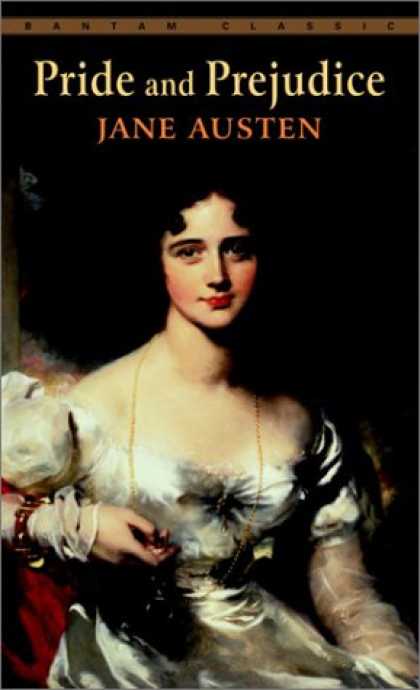
Pride and Prejudice by Jane Austen

I think the first line of this novel sums it up better than I ever could:

It is a truth universally acknowledged, that a single man in possession of a good fortune, must be in want of a wife.

I’ve been familiar with the story of Pride and Prejudice for a long time, but this was the first time I’d read the original.  Even though I don’t usually go for Regency romances, I have to say that I enjoyed this book very much!

Jane Austen has a genius for character.  She knows exactly what little mannerism to show or what description to give to make her characters come alive.  At several points in the book, I paused and said “holy cow, that’s just like so and so,” or “haha, I know exactly what this person is like.” At no point did I feel hit over the head or dragged through a long info dump explaining this or that character’s background.  Of all the possible details she could share, Austen always chooses the exact ones you need to get a clear, distinct picture–no more, no less.

Austen drives her story with some snappy, entertaining dialogue.  Far from being sappy or sentimental, her main character, Elizabeth, is snarky and spirited, and she clashes with a lot of people in ways that are much more interesting (and mature) than typical girl drama.  Be that as it may, I found it entertaining to compare Elizabeth’s dating/relationship experiences with my own.  As different as things were back then, in some very interesting ways they are still the same.

I did feel that the novel slowed down a bit in the middle, probably because that was when Elizabeth went on the tour of Derbyshire with her relatives and left behind most of the other characters that interested me.  Also (since I am a straight guy), Mr. Darcy didn’t really turn me on much, so Elizabeth’s gradual change of mind as she toured his house wasn’t as engaging to me.

One thing that confuses me, having read this book, is why women all over the place set up Mr. Darcy as the ideal male.  What exactly is his appeal?  He’s a little rough around the edges, has an independent streak, speaks his mind even when doing so would be rude, and is constantly aloof from everyone else.  Is this what women find so appealing about him?  I can see how the “Beauty and the Beast” syndrome can also be a turn-on–Elizabeth essentially wins him over by taming him–but that has less to do with who he is than how Elizabeth changes him.  Do women go for a guy who they have the power to change?  Is that what it is?  I’m still a bit confused.

One thing made me a little mad, and it had nothing to do with the book at all; it had to do with the blurb on the back.  It reads:

One of the most universally loved and admired English novels, Pride and Prejudice, was penned as a popular entertainment.  But the consummate artistry of Jane Austen (1775-1817) transformed this effervescent tale of rural romance into a witty, shrewdly observed satire of English country life that is now regarded as one of the principal treasures of English literature.

Austen’s “consummate artistry” transformed this novel from “popular entertainment” to “one of the principal treasures of English literature”?  Come on.  That statement is as pompous as it is illogical.  Once her book came out in print, Austen “transformed” nothing–the only thing that changed was the way people looked at it.  It started out as a popular genre novel, like anything by Rowling or Steele or Grisham or King, and when the literati decided to claim it, they rebranded it as something else.

What irks me is this idea that “popular entertainment” is somehow inherently devoid of literary worth.  Come on, people–virtually all the “great authors” before 1920 were well-read and well-loved in their day, among the masses as much as the literary elite.  It’s not a sin to make money writing books.

Overall, I enjoyed this book very much.  Just as Lord of the Rings is the quintessential fantasy novel, Pride and Prejudice is probably the lodestar of the romance genre.  I was pleased to find that it’s not a book that only women can enjoy!

Spin by Robert Charles Wilson

What would you do if you knew that the world was going to end in the next thirty years? That one day, before the end of your natural lifespan, the oceans will boil and the forests burst into flames, and life on this planet will come to an end? That you, your children, and even humanity itself have no future–that everything will end with you?
When the mysterious beings known as the Hypotheticals encase Earth in a temporal warp field that causes years to pass outside for every second on Earth, that is the uncomfortable question that all of mankind must confront. In five billion years–less than forty years on Earth–the sun will burn up its hydrogen and expand into a red giant star. When that happens, the sun will swallow the Earth and every living thing will die.

Some people turn to religion for answers.  Some turn to Science.  Some put off the question, living their lives as if the end will not come.  But as the years pass and the unavoidable apocalypse looms nearer, humanity begins to spiral out of control, and civilization itself looms on the verge of collapse.

The year the stars fell from the sky, thirteen year old Tyler Dupree discovers that he is in love with his best friend (Jason Lawton)’s sister, Diane.  The dynamics of the friendship between the three, however, make it impossible for Tyler to express his true feelings–and, in any case, Diane doesn’t seem interested in being anything more than a friend.

When the Spin hits, all three of them find themselves on radically different and sometimes conflicting paths.  Diane turns to evangelical Christianity and the frenzied religious outporing the Spin inspires.  Through his father, Jason rises to become one of the most influential scientists and directors in the Perihelion Foundation, the premier aerospace agency and Spin-related policy forming body in the US.  

Tyler, however, pursues the same middle class life he probably would have followed anyway–medical school, followed by a career as a doctor.  Still, his undiminished feelings for Diane and his frienship with Jason draw him into the center of the Spin hysteria and behind the scenes in the circuitous Spin-era politics.

Diane, now married to a fervent believer in a free love fundamentalist cult, comes to rely on Tyler as her only link to the outside world.  Meanwhile, Jason Lawton pursues perhaps the most grandiose and ambitious project mankind has ever attempted; the terraformation of Mars. 

With the temporal distortion of the Spin, millions of years of evolution turn Mars into a verdant green world in only one Earth year.  When Jason launches the first manned mission to the planet, barely a week passes before the the first Martian-born human returns to mankinds ancestral home–a descendant of a civilization millenia older than our own.  This small, dark-skinned, wrinkled man comes with a tantalizing message that may prove the key to finally understanding the Hypotheticals and the Spin itself.

But all of this may be too late, because the Spin membrane is finally beginning to show distressing signs of failure, and the sun has already grown hot enough to boil the oceans and scorch the planet.

I loved this book.  Honestly, I have to say it is one of the best science fiction books I have ever read.  Better even than Ender’s Game, better even than Foundation or any of the other classics.  No other book that I’ve read has done everything that I believe a good science fiction book should do.  I would highly recommend this book to anyone and everyone.

Like Clarke and a lot of the older classics in the science fiction tradition, Spin addresses some of the grand questions with which science and humanity have always wrestled.  What is the ultimate end of mankind?  The ultimate end of evolution?  Are we unique in this universe?  What is our place in the cosmos?  What is transcendence, and can we as a mortal species achieve it?

Unlike much of the older works, however, Spin addresses these questions through solid, developed, rich characters and a human drama that is as engaging as anything in any other genre.  When I read this book, I felt connected with these characters.  I genuinely cared about them.  They were real, distinct people who changed and grew based on their choices and experiences.  Furthermore, their struggles and conflicts echoed my own.  It felt true.  Tyler’s unrequited love was not only utterly believable, it kept me just as engaged as the grand ideas and the science fiction elements.

As science fiction, the ideas in this book were some of the most original and eye-popping ideas I’ve ever seen.  There was definitely a sense of wonder, as thick and beautiful as Clarke or Heinlein or Asimov.  The thing that made these ideas so great, however, was the eminent believability that accompanied them.  Robert Charles Wilson thought out the implications of everything, and showed them through concrete, human details.  His Martian landscapes were as real and believable as his picture of the New England countryside.  I not only felt that I was there, I felt that I was in this world, where the end-of-everything panic had set in, causing all sorts of bizarre, almost post-apocalyptic (pre-apocalyptic?) social changes.  It was truly fascinating.

But it wasn’t just the storytelling that engaged me: Robert Charles Wilson’s prose is among some of the best that I’ve ever read.  Reading this book really was like eating cheesecake.  The writing not only flowed, it shined, yet in a way that illuminated the meaning behind the words rather than drawing attention to the words themselves.  Wilson’s metaphors were not only rich and beautiful, they expressed the meaning behind the text so clearly that in each case, I don’t think he could have gotten across that particular impression, that feeling, in any other way.  Everything was calculated, and I would read pages and pages of text without even realizing how far I’d come.  Incredible.

I did have one issue with my first readthrough, back in July of last year: the Martian civilization, while grand, didn’t feel grand enough.  I mean, in 0nly four thousand years of history, look how far we’ve come here on Earth–all of our religions, all of our science, all of our discoveries and everything else.  We can hardly even remember what it was like, four thousand years ago–yet in Spin, the Martians know all about the reasons why Earth spawned their civilization, all of the questions that the Earthers have been asking about the Hypotheticals, etc.  I almost think that the Martians would have a more mystical view of Earth; that their understanding of us would be steeped in legend, and that they would have forgotten who we really are.

In my second readthrough, however, this was less of an issue to me.  Wilson really does make the Martians seem alien, a separate, distinct culture with a long, rich tradition.  His Martian citizen is very distinct from any of the Earthers, and notices some very small things that we always take for granted.  So, even though there could be more of a feeling of grandeur, Wilson already paints a very believable, very grand view of the Martian civilization he invents.

I am not exaggerating one bit when I say that this is probably the best science fiction book I have ever read.  I would recommend it above and beyond anything else I’ve reviewed here on this website.  If you haven’t already, pick up this book and read it.

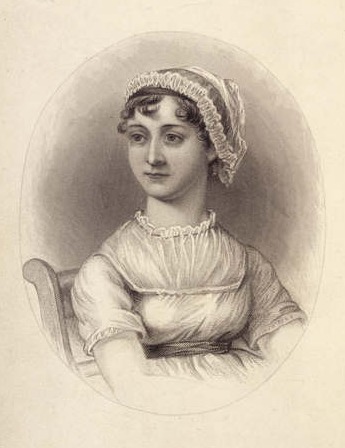
Was Jane Austen a man?

Okay, okay, don’t worry, I know the answer to this question.  But in five hundred or a thousand years, will people be so certain?  

We question the true authorship of Shakespeare’s works.  Some of us even question whether Jesus Christ was a real human being, or just a fiction that some religious group invented.  Five hundred years from now, what’s not to say that people will be questioning whether Jane Austen really wrote her own books–or whether she even existed at all?

I had this idea while I was doing a copy edit with The Leading Edge (apparently, if you help them with their slushpile consistently enough, you get roped into the higher level stuff like copy edits, substantive edits, and even get a position with some authority–eventually).  We were taking a quick break and I was chatting with some of the other editors about story ideas, and somehow out of the conversation this idea spawned.  Good heavens.

I think it’s an awesome idea, but I know for sure that I don’t have the chops to pull it off.  I haven’t read enough Austen to really develop a taste or a love for her work,  or even really an understanding of it.  If someone else with much more knowledge and love of Austen could pull it off, I’d definitely like to see it.  If you think that’s you, feel free to “steal” my idea and run with it.

If I personally were going to write it, I’d extrapolate a crazy middle-far future world that basically resembles our own, with a few key cultural and economic shifts, and focus on the question of her gender.  I’d think of some awesome reason why these futuristic people specifically question whether it was a man who wrote her books and pattern the debate off of the kinds of debates we have about the authorship of Shakespeare’s works.  The characters in the story would probably be literary elites who are WAY WAY worked up over this question–the kind of people who go to war over this stuff.  From there, I would make it a comedy of the sexes, and use the story as a way to examine, in a humorous, upbeat way, some of the timeless differences between men and women.

But that’s just how I’d do it.  Maybe you have a better idea.  If you do write something like this (or know of something similar), please let me know, because I want to read it!

Slow but steady

Okay, quick post before I go to bed.

Things are progressing in this novel, slowly but surely, as you can see from the wordcount.  Unlike past weeks, I’m not pushing myself too hard, mostly because I’ve got a lot of schoolwork right now and if I were to spend much more time on this novel, I would neglect a lot of the more important stuff.  Even though my course load is relatively light this semester, I’m a senior and I’m really not as motivated to do this stuff as I used to be.  I get done what needs to get done, but just barely.

I have been successfully getting up early, however.  And I’ve discovered something very interesting: I’m more productive when I have less free time.  Thursday, I didn’t have class until noon, so when I got on the computer at about 6:30 to write, I opened up the email, opened up facebook…and, by the time I had to leave for class, I had only written about 430 words.  Disgusting.  But today, when I had class at 9:00 am and still had my Arabic homework to do, I got in about 700 words in half an hour.

I still have a lot of self discipline to learn, I guess. 😛  The scary thing is that my idea, up to this point, has been to keep my time open in the summer so that I’ll be able to write.  Err…yeah.  We’ll see how that goes.

I’ve been getting a lot of comments back from my alpha readers on Genesis Earth, and it’s been REALLY fun!  Even the criticism–as long as it’s helpful criticism, I really appreciate it.  This one girl in my ward asked me if she could be an alpha reader, then read the whole thing in only a couple of days.  She had a LOT of positive comments–in fact, almost all of her comments were positive–and she said she really loved it!  So much so, in fact, that she said she was having withdrawals, so I sent her The Phoenix of Nova Terra v1.2.  Hopefully, getting her comments back will give me motivation to pick up that old thing and rework it…goodness knows it needs it.  Needs it bad.

My first two novels, The Phoenix of Nova Terra and Genesis Earth are completely different in some ways, but very similar in others.

<spoiler alert>

They both have an important romantic element, and they both have generally positive endings.  The book I’m writing now is something of a tragedy, at least at it’s core, and there is a completely different dynamic there.  No love stories, no happy resolutions–lots of pain, lots of violence, lots of grappling with difficult issues.

</spoiler alert>

I suppose it’s good to try out a lot of different things early on in your writing career.  That’s what I’m doing.  At the same time, though…I get feedback on the one novel, and I kind of want to work on it instead of the one right in front of me!  And when I think about what I did right in the one I finished, I look at the one I’m currently writing and I think “man, this is crap.” Of course, I keep working on it because I recognize that I ALWAYS think “man, this is crap” at some point before I’m done.  Knowing that doesn’t make it easier, however.

Jason from the FLSR writing group said something interesting about that, however.  He said that writing a draft of a novel is like climbing a mountain: you do it three times.

The first time, you climb it in your mind as you plan it out.  You’re excited and motivated, and busy with all the preparations.

The second time, you actually physically do the work of climbing.  It is long, hard, and frustrating, you get lost a few times, the summit is anticlimactic, and the return is boring.  You can’t wait until you’ve finished and it’s all over.

The third time is when you look back on the experience after you’re safely back down.  No matter how excruciating the climb was, you look back on it fondly and remember all the best parts.  You thrive on the memories and wish that you were back up there, standing on the summit, enjoying the experience.

Right now, I’m on my third climb for Genesis Earth and my second climb for Bringing Estella Home. I can remember how miserable I was when I was still in the middle of Genesis Earth–for a while I seriously thought about throwing the whole thing out and doing something else.  However, now that I’ve been letting it sit for a while, I’m getting really, really excited about it!  I can hardly wait before I can get back and write the second draft.

But that’s not going to happen until I finish Bringing Estella Home.  And, no matter how difficult it gets, I swear I WILL finish this book!  I’m a chapter away from act III, and that’s too deep into the thing to quit and start something else!  This book WILL be finished–if not by April, then by sometime in May!