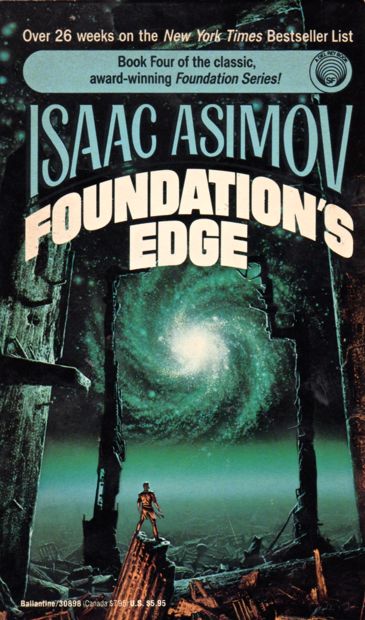
I haven’t read all of Asimov’s Foundation novels yet, but I’ve loved all of the ones that I’ve read, including Foundation’s Edge. Really fun. Lots of interesting ideas. Classic sci-fi. A must-read for sure.
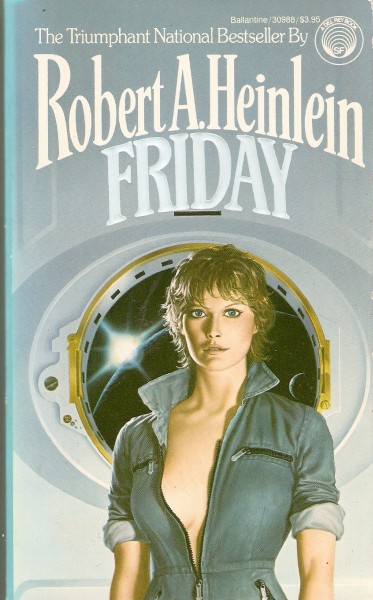
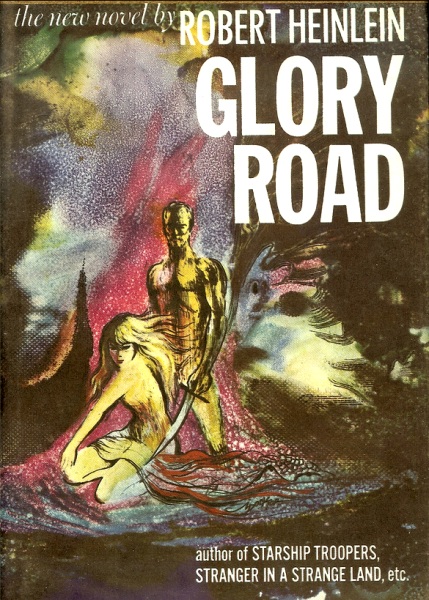
I’ve written before about my love-hate relationship with Heinlein. The long and short of it is that I’ve learned to avoid any of his books where he explores his free love ideas about sex and women. I’ve really enjoyed his juveniles, and books like Farnham’s Freehold and Starship Troopers. But if it’s got a partially (or fully) unclothed woman on the cover, it’s probably not for me.
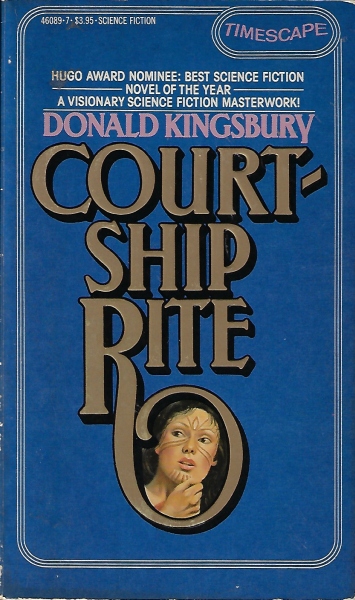
Courtship Rite was an easy skip, based on ChatGPT’s preview of the book. Here is what it said:
Courtship Rite by Donald Kingsbury is one of the most morally challenging and controversial works in classic science fiction. The most immediate concern is the sexual content: Kingsbury depicts a harsh, survival-driven society on the planet Geta where sexual practices are ritualized, non-monogamous, and culturally compulsory. Several scenes contain explicit adult sexual behavior—never pornographic in tone, but described in enough detail to be unmistakably explicit. These sexual rites are integral to the worldbuilding and cannot be skipped without losing the thread of the story.
Violence is also central to the novel, particularly the culture’s reliance on cannibalism as both a sacrament and a pragmatic necessity in a resource-scarce ecosystem. Cannibalism is discussed repeatedly and explicitly, sometimes in unsettling biological detail, and ritual combat, ordeal, poisoning, and execution also appear. Although the novel does not dwell on scenes of graphic torture or sadistic harm, the society it portrays practices ritual child sacrifice and cannibalism, and this is presented as a normalized element of Getan culture.
From the book description: Jo Walton remarked that Courtship Rite “is about a distant generation of colonists on a planet with no usable animals. This is the book with everything, where everything includes cannibalism, polyamory, evolution and getting tattoos so your skin will make more interesting leather when you’re dead.”
There are too many good books in the world for me to waste any of my life reading that.
I know a lot of people love Gene Wolfe’s Book of the New Sun series, but I tried the first book and just couldn’t get into it. The fantasy world was just too macabre for me, and the story never hooked me. I’ve also heard that his writing is an acquired taste, so maybe I should give it another chance. But if I were to cast my ballot now, I wouldn’t vote for it.
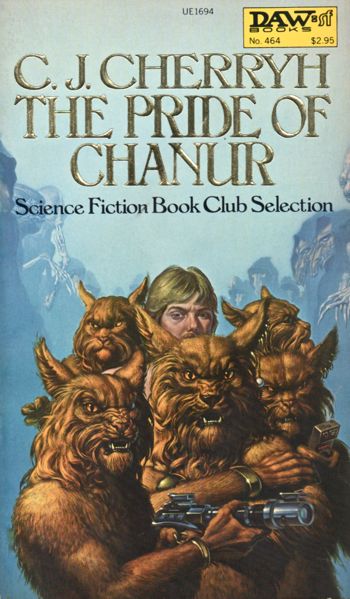
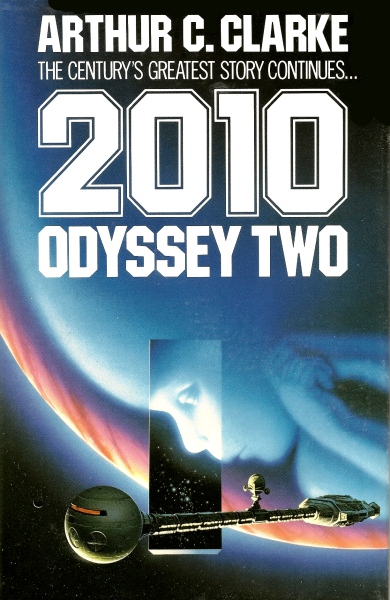
As for 2010: Odyssey Two and The Pride of Chanur, I DNFed both of those for basically the same reason: I got bored. The story and characters didn’t really hook me, the world building was interesting but not enough to keep me reading, and over time I just lost interest and gave up. They weren’t terrible books, just not particularly interesting or compelling. I might enjoy them in audio, though, so maybe I’ll give that a try.
If that seems a little harsh, I’d like to point out that No Award doesn’t appear anywhere on this ballot. For the Hugo Awards, that’s saying something. In general, the 80s was a pretty good decade for the Hugo Awards, so even though this particular year wasn’t a bullseye for me, I’d still rather read any of these books (even Courtship Rite) over most of the woke crap that gets nominated these days.
This was a pretty decent year, though I didn’t enjoy all of the novels. Still, I thought they were all good, even if not all of them were to my particular taste.
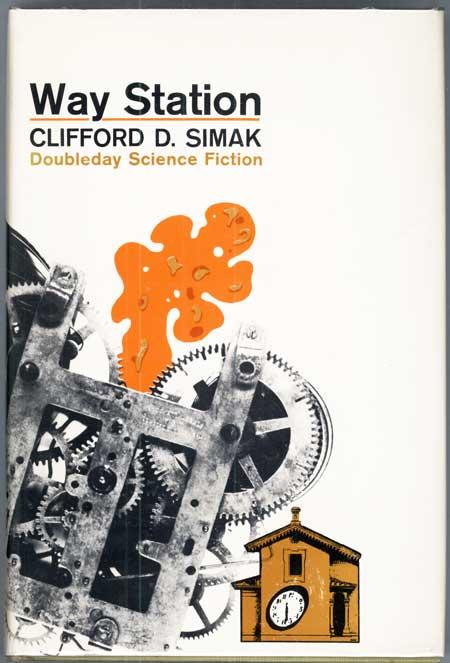
I really enjoyed Way Station by Clifford Simak. It’s about a civil war soldier who has quietly been living in the back country for the last hundred years, right up to the 60s, when someone in the government begins to notice how weird it is that this guy is still around, and still going daily to his mailbox on the country lane, carrying his old musket. When we learn what’s actually going on with the guy, and how he’s connected with the aliens who are deliberately keeping their existence secret from most of humanity, things get really interesting.
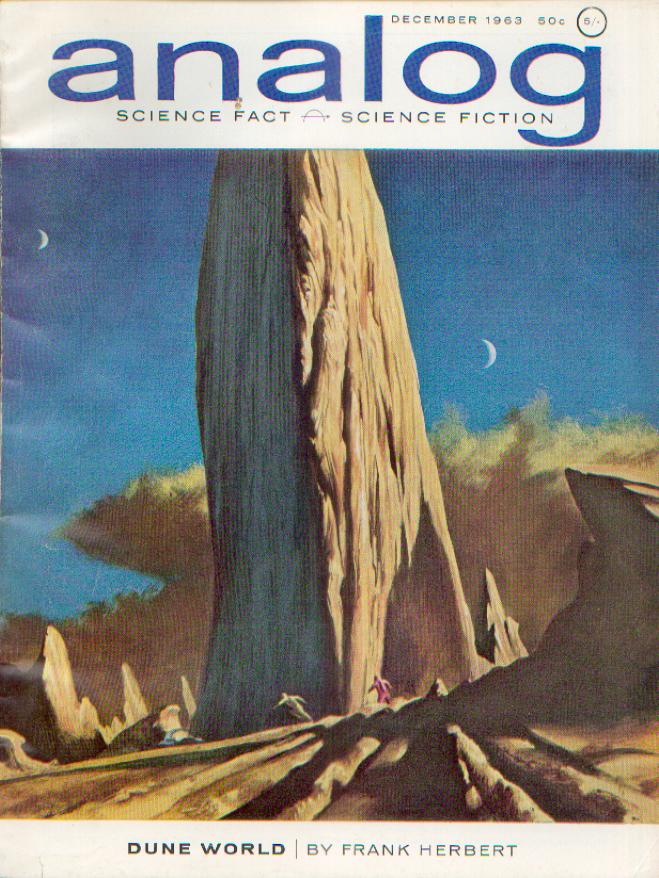
The ending could have been stronger, but the novel has a lot of heart, and I really enjoyed reading it. With that said, however, I would still put the serialized early draft of Dune higher, just because Dune is such a well-deserved classic, and the ending to Way Station did feel a little weak. But the ideas in the novel were absolutely fantastic, and very well explored.
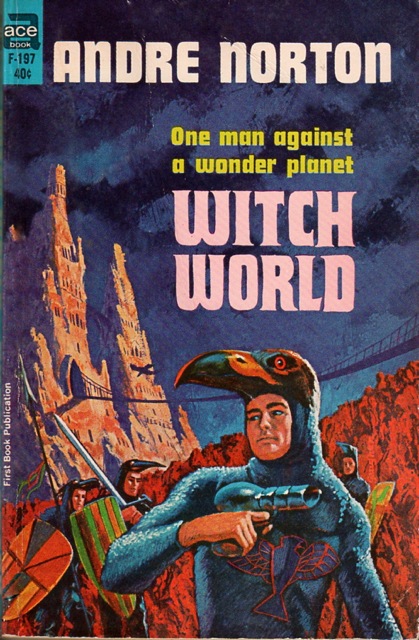
I also enjoyed Witch World, though I don’t think I’ll follow up with the rest of the series. It was an interesting portal fantasy / adventure tale, though the fantasy world itself never really held my interest. Maybe it was the weird blend of science fiction with fantasy, or maybe it was Norton’s particular writing style, which almost rose to Shakespearean diction at points. I did like the characters enough to read to the end of the story, but not enough to follow them into the next book.
As for Glory Road and Cat’s Cradle, I DNFed both of them. Cat’s Cradle was just too stylistically dense for me to enjoy—it’s much more of a literary novel, and that’s not really my thing. Glory Road was alright, but it very quickly got explicity with the nudity and sexuality, and I have learned from personal experience that whenever Heinlein goes off about sex, the book is not for me.
Immortality, Inc. is the first book I’ve read by Robert Sheckley, and while it’s definitely dated, I enjoyed it quite a bit. The premise was fun and interesting, and the writing was fast-paced with a healthy dose of suspense. As for the stuff that felt dated, I actually think that added to the book’s charm, making it feel like a throwback to an earlier (if not quite innocent) time. I’ve often felt like if I’d had a choice in the time in which I’d been born, I would have chosen to be born about a hundred years ago, so I do occasionally like a good throwback to golden age sci fi. I’m definitely interested in reading more Robert Sheckley.
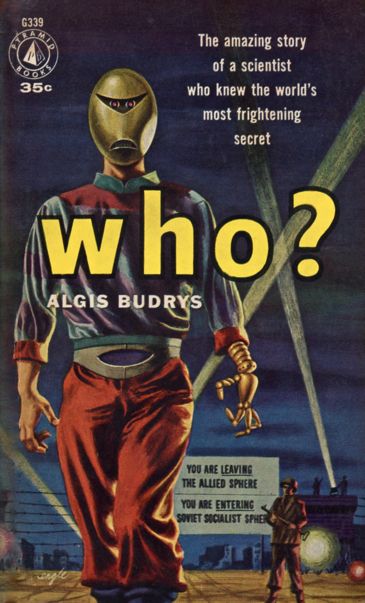
While I’ve enjoyed Algis Budrys in the past, I found it difficult to get into Who? though not due to any fault of the book or the author. The basic premise of the book is that a spy has returned from enemy custody, but he’s recieved so many prosthetics (including a prosthetic head and brain) that he’s practically a machine now, to the point where his handlers can’t tell if he’s the actual spy or someone trying to impersonate him. Back in the 1950s, the premise made sense, but that was before we knew about DNA, which renders the whole thing obsolete since a small blood sample and a DNA test would resolve the main conflict right away. I just couldn’t get over that, and the story itself didn’t really hook me, so I gave up midway through. Perhaps I should try it again, though.
The Enemy Stars was another Poul Anderson book that I just couldn’t get into. The characters weren’t quite as flat as in some of his other books, but they all still tended to blend together, and by about page 50 I still couldn’t tell what the main conflict of the story was. I love sprawling space operas just as much as the next sci fi reader, but the book has to have a plot, too. Less worldbuilding and more actual story, please.
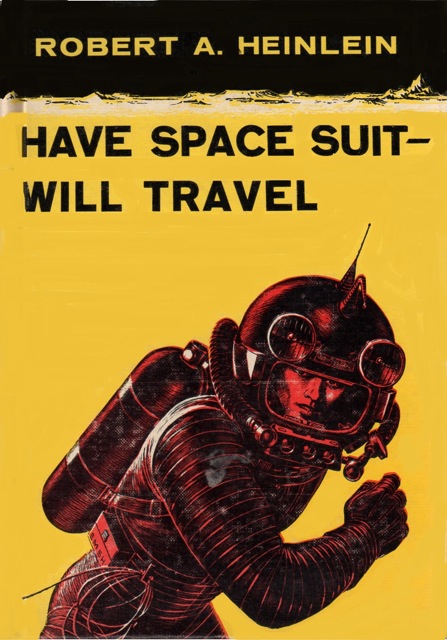
Have Space Suit Will Travel was okay, but I didn’t really love it, and if I hadn’t picked up the audiobook, I probably would have DNFed it. It’s a book for young readers that feels like a book for young readers—in other words, a book that seems to talk down to the reader more than was necessary. It did have a lot of golden-age, 50’s era charm, and I enjoyed the world and the characters. Heinlein can definitely write a fun story. But with all that said, I don’t think this is one of his best—in fact, I wouldn’t even say it’s one of his best juveniles.
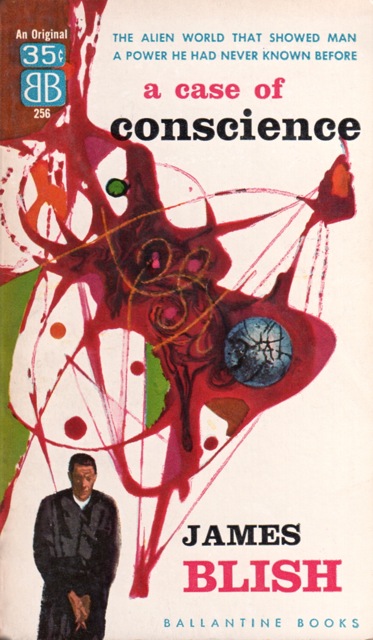
It’s been a while since I read A Case of Conscience, but I think the main reason I DNFed it had to do with its Malthusian premise and treatment of religion. Basically, it’s about a Catholic priest who is also an interstellar explorer, and how he wrestles with the question of whether a certain race of intelligent alien beings has souls. One of the aliens comes back to Earth and is instrumental in the complete collapse of society, which somehow ties into the philosophical questions, but that part wasn’t very clear to me. The story was very dry and cerebral, and I was never really sold on the central premise. Also, the religious character felt like he was obviously written by someone who isn’t religious (though I suppose I could be wrong about that—after all, I’m not a Catholic). But perhaps that was just me.
In short, while I wouldn’t say this was one of the best years for the Hugo, it had some good books, and none of the ones that made the ballot were particularly objectionable. With that said, though, I don’t think any of them stand the test of time.
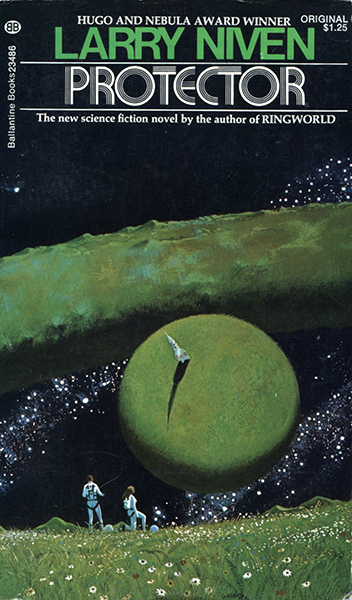
I really enjoyed Protector. It was a great sci-fi space opera novel, with interesting characters, fun worldbuilding, an intriguing premise, a deep sense of wonder, lots of suspense, and some really unexpected twists and turns. It was also a very good hard SF novel, where the rigorous scientific accuracy actually drove the story and made it even stronger. That can be a very difficult thing to pull off, since in the hands of an unskilled author, the harder the science fiction elements become, the more dry and cerebral the story tends to become as well, but Larry Niven is a very skilled author and he pulled it off quite well in this one. In particular, the long-distance space battle that covered the last hundred pages or so had me thrilled right through to the end.
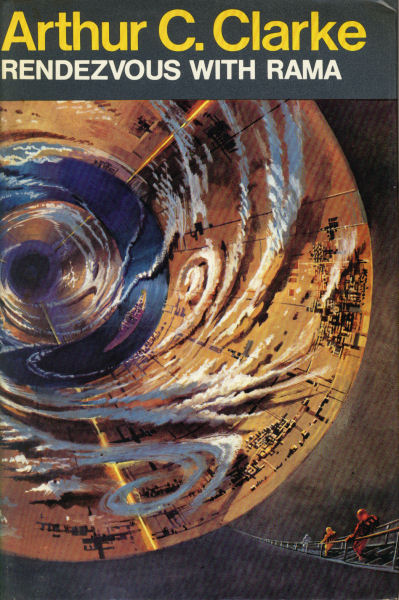
In contrast, Rendezvous with Rama was the kind of hard SF that tends to bore me. There was nothing wrong or objectionable about the story, but it was kind of slow, and didn’t build up very much suspense, aside from the central premise, which was basically “ooh, an abandoned alien starship—and we get to go inside!” I should probably try to read it again, though, because Arthur C. Clarke is definitely not an unskilled author, and Rama is one of the classics.
Poul Anderson, though… I don’t know what it is, but reading his books is like trying to walk through a brick wall. The parts that I have the most questions about, he doesn’t explain at all, and the aspects of his stories that I care about the last (particularly the worldbuilding elements) he explains in soporific detail. His characters all feel like wooden marionettes, and whenever they move, they seem off or contorted in some way, doing and saying things in ways that I would least expect.
Maybe it’s just me, but I’m beginning to think that Poul Anderson just isn’t a very good writer, and his success was mostly due to the good fortune he had to be writing in a time when any book with a rocketship on the cover was guaranteed to be snapped up by hungry science fiction fans. I’ll try a couple more times to read him, but at this point I’m just about ready to give up on this author.
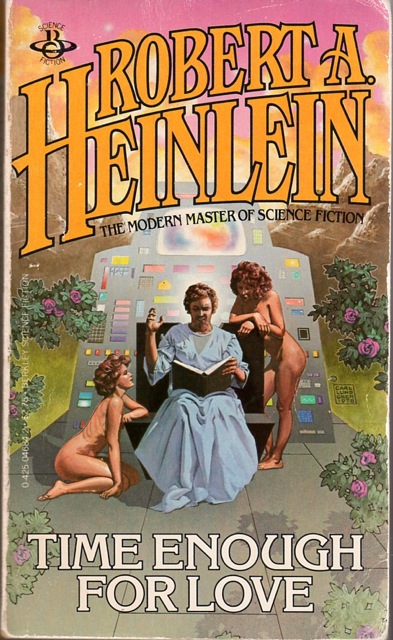
I did not even try to read Time Enough for Love. I’ve been burned enough by Heinlein to know that anything of his that 1) is longer than his juveniles, or 2) has a half-naked (or in this case, fully naked) woman on the cover is guaranteed to turn me off. Time Enough for Love fails both of those counts, so it got a hard skip.
I know that a lot of people love Heinlein, especially the kind of science fiction reader who otherwise aligns with my own reading tastes. But my own experience with Heinlein is all over the map: some of his books, like Farnham’s Freehold and Citizen of the Galaxy, I absolutely loved, and even count as major influences on my own writing. Others, however, like Stranger in a Strange Land and The Moon is a Harsh Mistress, I just couldn’t stand at all. With some, like Double Star, I was glued to the page all the way through, while others, like Have Space Suit, Will Travel, never really hooked me at all (if I weren’t listening to that one on audio, I don’t think I ever would have finished it). So at this point, I’ve more or less decided to limit my reading of Heinlein to his juveniles, unless it comes with a strong recommendation.
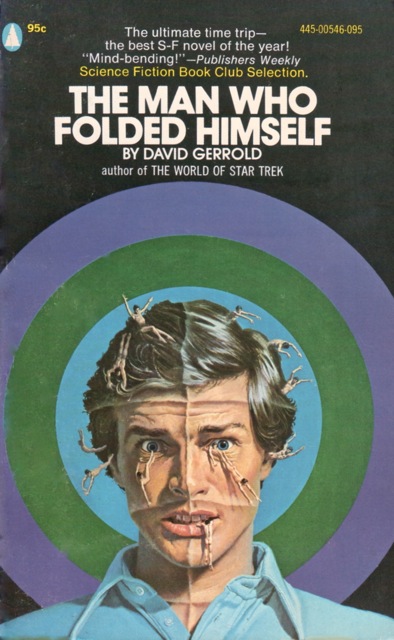
Which brings me to The Man Who Folded Himself, which is one of the most disgusting Hugo-nominated books I have ever DNFed, and the main reason why I put No Award on the ballot for this year. A better title would be The Man Who Fucked Himself, since that is both more memorable and more accurate to the story. It starts out as a delightful little time travel novel, but soon turns into a homo- / mono-erotic sexual fantasy. I quit just before the money shot, but I am 100% convinced that Gerrold is a pederast, if not an outright pedophile. Disgusting!
In fact, I had such a horrible experience with The Man Who F***ed Himself that I have started a ChatGPT thread specifically for the purpose of screening these Hugo-nominated books for woke and explicit content. If ChatGPT gives me a synopsis that doesn’t pass my smell test, I’m going to pre-emptively skip it, since I don’t want to expose myself to anything like The Man Who F***ed Himself again. Any book that I skip in this way will get ranked below No Award, and I’ll include ChatGPT’s synopsis in the review.
On the plus side, that probably means I’ll get through this How I Would Vote Now blog series a lot faster.
I’ve read every one of these books from start to finish, and I love them all. Even the lesser ones I’d put up above most of the Hugo-nominated books from the last couple of decades. And the best—well, let’s go there.
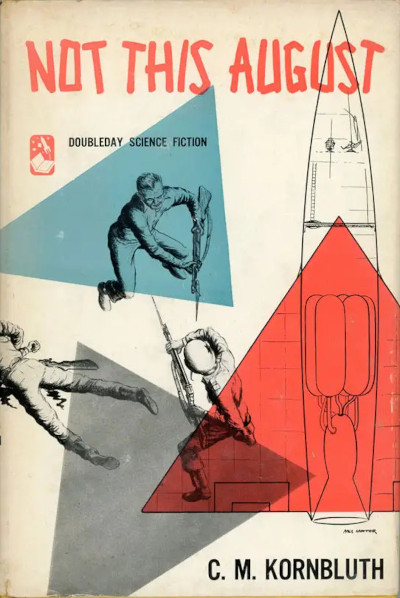
First, Not This August. This was really more of an early Cold War political thriller, with frightening near-future space technology since, at the time this was written, Sputnik was freaking everyone out in a major way. The technology itself is moderately science fictional, but if a book like this were written today, it would probably be shelved as a technothriller—which makes me wonder if the conservative science fiction writers of the 60s and 70s didn’t just migrate to the thriller genre as science fiction was increasingly taken over by the left. But that’s a subject for another blog post.
In any case, Not This August is very much a cautionary tale, kind of like 1984, but set only a decade or two after WWII. Basically, China and the USSR launch a joint invasion of the US that succeeds, but an underground resistance movements works to finish this American superweapon: an orbital military base armed with nuclear weapons that is undetectable by the surface and can bomb anywhere on the planet.
Since it was written in the early part of the 50s, it plays very much on fears that the world wars would shortly resume, and that the US would never recover economically from the wars. Such fears later proved to be unfounded, but at the time, there were very good reasons to think we were caught in a vicious cycle—and in some ways (such as with Eisenhower’s warnings of the Military-Industrial complex), perhaps we were.
In some ways, it was a difficult read, not because of the writing itself, but because of how dark it was. However, like any good thriller, it built up the suspense quite nicely, and I finished the last hundred pages at a sprint. With that said, it hasn’t aged nearly as well as 1984, and reading it from the perspective of the 2020s it seems much more like an historical curiousity than a true cautionary tale. But I enjoyed it.
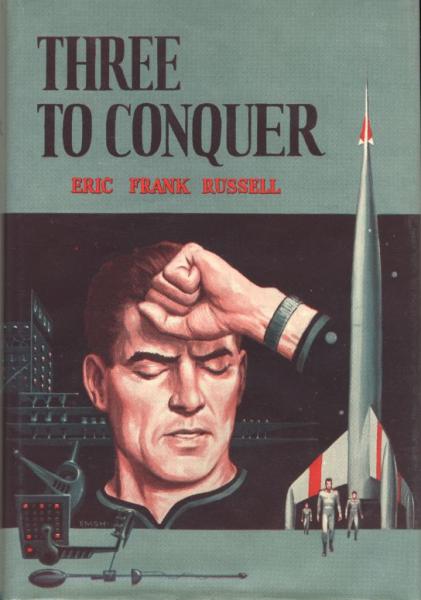
Three to Conquer was much lighter, and a fun, quick read. It’s about a man who is secretly a telepath, who stops on the side of the road to help a stranded motorist and discovers that some hostile alien body-snatchers have come to Earth after infecting three returning astronauts, and are now trying to takeover all of humanity before we realize that they’re even here. It’s a race against time to find and kill all of the zombified humans before they infect everyone else, with a cute little love story thrown in for good measure, between the main character and his secretary. A fun if somewhat forgettable read. I did really like how the main character had a sharp mind and was quick on his feet.
Now, to the really good ones.
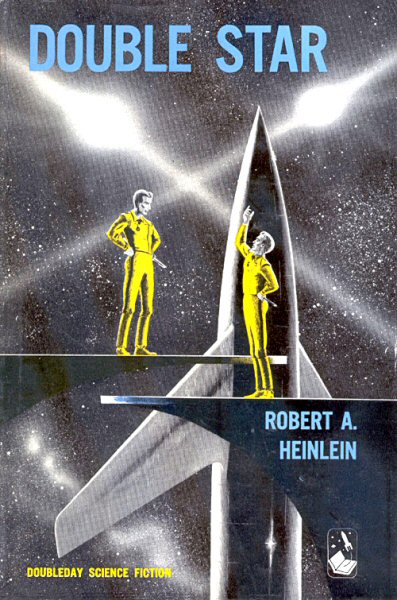
Double Star is a fantastic book, and just because I’ve put it at third place on my ballot, you should not think that means that I thought it was mediocre at all. In fact, I’d put it above probably 60% or 70% of the novels that have won the Hugo. It’s quite good, showcasing Heinlein at some of his best (though I do think Farnham’s Freehold is better). It was a really compelling story about a man who overcomes his prejudices and shortcomings to grow into the role that has (quite literally) been cast for him. It also makes me very, very glad that I’m not an actor. Highly recommended.
The End of Eternity is one of the best time travel novels I’ve ever read. It’s about this bureaucratic organization called Eternity, which exists to shepherd humanity safely through 75,000 centuries of history. Basically, the technicians of Eternity calculate all the best ways to tweak the timeline with “reality changes” in order to avoid all of the worst catastrophes, like pandemics, global wars, etc. But after the 75,000th century, there’s a long period of “hidden centuries” that are somehow inaccessible to them, followed by a world where humanity is extinct. The main character is a technician who falls into forbidden love with a woman in Time, whose existence is going to be wiped out by a reality change. He conspires to save her by bringing her into Eternity, and sets off a series of events that threaten to wipe out Eternity itself.
I really enjoyed this book. Toward the end, I wondered if this book would have a happy ending, since I couldn’t think of any way to pull that off without making it kind of sappy and cliche. Then the twist happened, and everything changed… but we still got the happy ending, which fit in perfectly with the world-changing twist. Just a really brilliant book by an all-time science fiction master. Classics like this are the reason why Isaac Asimov hasn’t been canceled yet, and hopefully never will be.
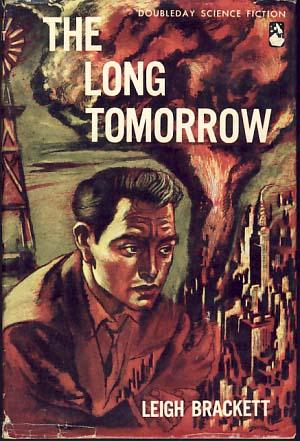
As I said above, I genuinely enjoyed all of these books. But as good as they all were, none of them blew me away nearly as much as Leigh Brackett’s The Long Tomorrow.
The Long Tomorrow is a post-apocalyptic story about a future America, after the atomic wars, where cities are a thing of the past, the Constitution has been amended to restrict the size of towns (in order to prevent them from becoming potential targets for a nuclear weapon), and most of the population has reverted back to 19th century tech and an Amish or Amish-adjacent lifestyle. But there are legends about a secret city called Bartorstown, where the old technology hasn’t been lost, and people still live lives full of wonder and wealth, just like the old days.
The story follows two boys who run away from home in order to find Bartorstown, tracing their adventures and coming of age, until they finally learn the terrible truth about what Bartorstown actually is, and grapple with what that means for all of them. It’s a pretty basic plot, but what really blew me away was the depth of character and how brilliantly Brackett’s writing and storytelling drew me into their lives, making them come alive. Consequently, the story really came alive, raising all sorts of questions that left me thinking and wondering long after I’d put it down. There are some really heavy themes in this book, but like the best sci-fi, it doesn’t feel like “message” fiction at all.
It’s a little bit sad, though, because Brackett wrote this book just as the hydrogen bomb transformed foreign policy with the threat of mutually assured destruction, thus making her post-apocalyptic future into something totally implausible. The Long Tomorrow only works in a world where total nuclear war doesn’t result in the utter annihilation of humanity. From what I can tell, that’s the main reason this book never really took off. Also, I’m guessing that Brackett didn’t have as many fans as Heinlein or Asimov, and since the Hugos have always essentially been a popularity contest (these days, among an increasingly narrow and snobbish clique), that’s probably the main reason why The Long Tomorrow didn’t win the Hugo this year, even though I personally think it’s the most deserving book on the ballot.
But as I said above, 1955 (the publication date) was a really good year for science fiction, and all of these books are really good—some of the best, in fact. I highly recommend them all!
I’ve been going back and forth on this post for almost a year now, wondering how exactly to express my thoughts. Some of the positive reviews on my fiction have expressed that I write “libertarian fiction,” and in some ways, I think that’s accurate: certainly, I value liberty very strongly, and support those government policies that are designed to safeguard our liberties while opposing those that seek to destroy it. That has not changed. But my views of libertarianism more generally have, perhaps in some ways that might surprise my longtime readers.
First, a little bit of my personal history. I grew up in one of the most liberal parts of the country, Pioneer Valley, Massachusetts, and considered myself a conservative while I lived there. Then, after serving a two-year mission for my church in Silicon Valley, California—what is probably the most progressive, leftist part of the country—I went to college at Brigham Young University, in the most Republican county of the most Republican state in the United States. At that point, I considered myself to be a sort of left-leaning classical liberal. When Dick Cheney spoke at BYU’s commencement, I blogged about the protests and attended the alternate commencement where Ralph Nader spoke.
I graduated in 2010, in the middle of the Great Recession, and made the fateful decision not to go to grad school at that time. To this day, I count that as the single best decision I ever made in my life (right up there with deleting my Facebook and Twitter accounts). Not only did this force me to learn how to navigate the real world, but it also got me out of the indoctrination factory that the national university system has become, even to a degree at my alma mater, BYU.
About five years after I graduated, I got red-pilled and started listening to right-wing commentators like Glenn Beck, Ben Shapiro, and Dennis Prager. I also looked seriously into Ron Paul and the libertarian movement, and became something of a libertarian. As fractitious as libertarianism is as a political philosophy, it seemed like the most logically coherent and intellectually honest way of understanding the world, whereas leftism and conservatism were both riddled with internal contradictions.
But then I got married and started a family. That experience has changed me in a lot of ways, perhaps even more than all the rest of my life experiences combined. But politically, the biggest thing it has caused me to rethink is this question:
What is the fundamental unit of society?
I’d always played lip service to the belief that the family is the fundamental unit of society, but starting a family of my own has made that real for me—indeed, has made me realize—in a way that simple bumper-sticker slogans never could. Before, I was living for myself. Now, I live for my children. Before, I was the hero of my own story, and that story was a single volume. Now, my story is just a single volume in an ongoing saga, a link in the chain of the generations that came before and will go on after me.
Libertarians believe that they stand in opposition to authoritarians of all stripes, be they communists, fascists, socialists, etc. But both libertarians and authoritarians operate on the unspoken assumption that the individual, not the family, is the fundamental unit of society. Leftists want to destroy the family and put the state in charge of raising and educating children, in order to make them obedient to government authority. Libertarians, on the other hand, romanticize this idea of the atomized individual who follows his own path and eschews all forms of collectivism, including the family. Ayn Rand’s books are populated by ubermensch who seem like they’ve sprung forth from the head of Zeus, and the children in her novels are basically just adults in miniature.
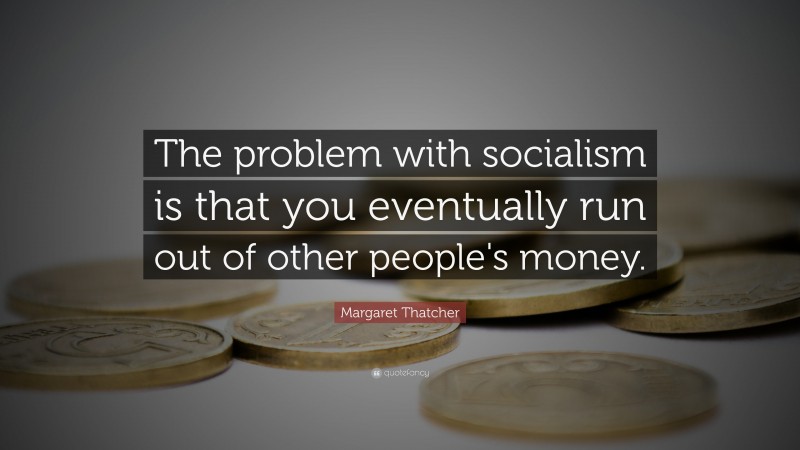
Allow me to put it this way: Margaret Thatcher had a brilliant quote about socialism that libertarians love to repeat. And from a purely economic standpoint, I believe that the libertarians are correct. But change that quote just a little, and you get this:
The problem with socialism libertarianism is that you eventually run out of other people’s money families.
Families don’t just happen. They take a lot of work to build and to maintain, and unless they are planted in a culture that nourishes them, they will wither and die. Libertarianism does not foster that kind of a culture, yet it depends on families in order to raise the kind of people who can make a libertarian society work. People from broken families often lack the mental and emotional maturity to take upon themselves the personal responsibilities that come with personal liberty—in other words, they lack the capacity for personal independence which libertarianism depends on. Growing up in a healthy family isn’t the only way to develop that sort of independence, but a society of broken families will invariably fail to produce such a people.
This is why libertarianism ultimately leads to authoritarianism. We aren’t all characters in an Ayn Rand novel: we aren’t all ubermensch all of the time, reshaping the world by the strength of our will. And when we inevitable fail, where can we turn to for help? If society is nothing more than a group of individuals, then ultimately the only place to turn to is the state. Perhaps there may be churches, companies, or other private civic organizations to which a person may turn, but any form of libertarianism that rejects altruism as a moral good will fail to foster these organizations as well. So, in the absense of anywhere else to turn, individuals will, over time, turn increasingly to the state, trading their libertarian freedoms for economic and social security. A society that exalts the individual at the expense of the family will always, in the end, devolve into a statist tyranny.
If you want to create a stable society that recognizes individual freedom, you have to recognize the family as the fundamental unit of that society, and you have to proactively enact policies that will foster a culture of strong families. Not only does this give you a social safety net that is totally apart from the state, but it also ensures that your society will be self-perpetuating, since one of the central purposes of the family is to create and raise children.
In fact, the family is perhaps the best antidote to government power creeping into every facet of society, which also makes it the best way to push back against woke leftism, ESG, and the Great Reset. Hence why everything about leftist progressivism is calculated to destroy the family. Parents concerned about CRT in their schools? Domestic terrorists. Kids who say that they’re transgender? Transition them without telling the parents, and take them away from their families if the parents object.
But it’s not just a partisan issue. If the family is the fundamental unit of society and needs to be strengthened, then there are things on both the left and the right that need to change. For example, poverty is a huge issue for families, since poor families are much more likely to break up due to the stress. But conservatives often ignore the issue of income inequality, mouthing platitudes about the free market while giving us socialism for the rich and capitalism for the poor. And the libertarians are little better, what with how they push for the legalization of drugs, prostitution, abortion, and pornography. Few things have done more to destroy the family than widespread substance abuse and the hypersexualization of our society.
This is why I’ve mostly given up on reading Heinlein anymore. He’s a brilliant writer with a fascinating take on some of science fiction’s most fundamental tropes, but whenever he writes about sex or sexuality, all I can think of is “the problem with libertarianism is that you eventually run out of other people’s families.” Heinlein and his boomer readership took the family for granted, neglected their own, and gave us a world of widespread sexual promiscuity, where society is falling apart.
So that’s why I don’t consider myself a libertarian anymore, even though there are many tenets of libertarianism that I still admire and believe, especially on the economic side. I suppose you say that I’m a conservative, but that isn’t really accurate either, because most strains of conservatism in 2024 really seem more about conserving the leftism of two or three generations ago. So I guess that means I’m politically homeless—just like most of my fellow Americans these days.
One of the things I’m going to start doing more of on this blog is recommend books and stories that I’ve enjoyed. I recently decided to start listening to all of the major SF&F short story podcasts again, and while they’re all batshit crazy woke, a good story will occasionally slip through. So I suppose if you’re looking for SF&F short stories that aren’t insufferably woke, these recommendations will be a good source for those.
Last month, Podcastle put out “A Thousand Echoes in One Voice” by Deborah L. Davitt. It’s an intriguing and atmospheric time travel story, where the main character discovers a mysterious and (seemingly) abandoned subway network that can take her to alternate times and dimensions, and the other travelers who came before her have left semi-coherent maps scrawled in graffiti on the walls. It has a really fund mind-screw that reminded me of Heinlein’s “All You Zombies.” Good stuff!
I’ll try to post these short story podcast recommendations as often as I find them, though I may end up skipping a few not because they’re terrible, but just because I have too much to listen to. And of course, if a story is terrible I won’t bother posting about it—not even if it’s spectacularly terrible. There’s enough outrage on the internet already that I really don’t feel a need to contribute to it.
Back a few years ago when indie publishing was a new thing, I remember there was a blog that would take the worst self-published covers and make fun of them. It was a popular site for a while, though a lot of the indies whose covers were shamed didn’t think it was all that fun.
Thing is, it’s not just self-published books that have horrible covers. In fact, some of the worst covers probably came out of traditional publishing, partially because tradpub has simply been around longer, and partially because in tradpub, cover design is often done by a committee, as opposed to just one guy. And while it’s true that some people have a unique talent for creating some truly hideous art, the IQ of a committe is the lowest common denominator of all of its members, and if one of them happens to have that talent, God bless the poor author who got stuck with that cover art.
If you go back 50-60 years, you can find some truly hideous covers, especially in science fiction. Such as:
Ah, Farnham’s Freehold. Such an awesome book—one of my all-time favorite Heinlein novels—but such a terrible, terrible cover. What is that? A giant egg with some Salvador Dali clocks, and Polynesian war chief holding court in the lobby of the hotel from The Shining? Also, why is everything a hideous tint of fuchsia? And of course, you’ve gotta have a random 60s chick in a summer dress (though to be fair, that might be one of the actual characters).
But the thing that really gets me is how dark everything is. Seriously, if you pick this book up in a used bookstore, it’s usually so faded and time-weathered that you can barely make out any of the details at all. That was certainly true of the copy that I read, back when I was working delivery for the BYU Bookstore and snatching a couple of pages here and there between drops. Good memories, seriously.
Believe it or not, this actually isn’t the worst cover of this book. I’m so glad I picked up a copy with this cover, because the cover of the Baen edition gives away the ending! It’s not even subtle about it, either! The Baen edition features the sign to the entrance of Farnham’s Freehold at the end, and it’s totally full of spoilers for the whole book. Seriously, what kind of an idiot thought that was a good idea? See my comment about the IQ of committees up above.
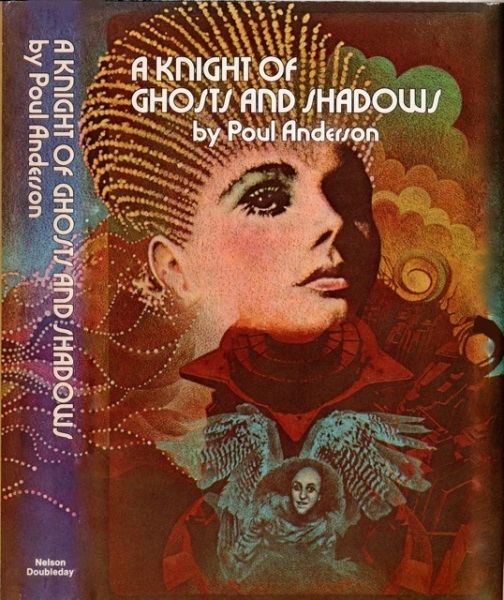
I recently picked up A Knight of Ghosts and Shadows by Poul Anderson from the library and DNFed it: too much opera, not enough space. But the cover… it takes the meaning of “hideous” to an entirely new level. In fact, this was the cover that gave me the idea of writing this blog post.
So what have we got here? There’s a psychadelic 70s chick with some hair that makes her look like Princess Leia’s grandmother, and a creepy little goblin dude in a spacesuit with random owl wings, who looks like he wants to peep on her. Also, some weird sci-fi cityscape in the background, I guess? It’s difficult to tell, because elsewhere the background looks like one of my Mom’s first-grade art projects. And of course, if that didn’t make it dated enough, you’ve got the funky 70s typography that died along with disco.
I picked up this book because 1. it was a Poul Anderson book that was at my local library, and 2. it made the Locus recommended reading list for 1975 without being nominated for the Hugo or the Nebula. Many of the other covers are surprisingly NSFW, because apparently Princess Leia’s grandmother is a futuristic sex slave—and yet, I found even the parts with her in it to be surprisingly dull. Like I said, too much opera, not enough space.
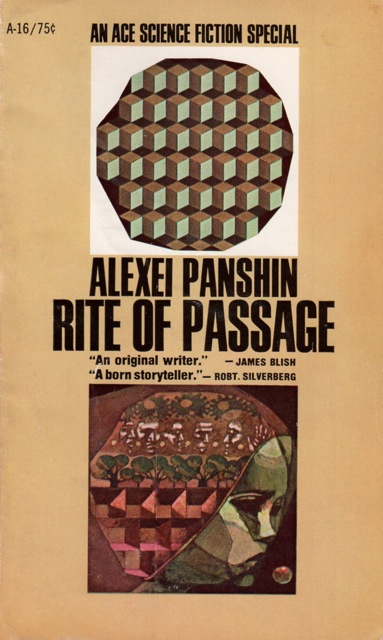
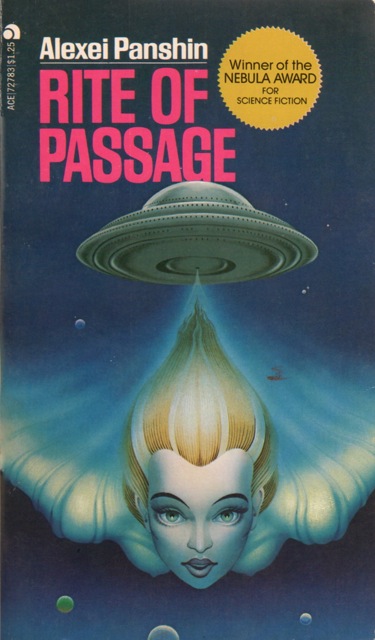
Speaking of mildly NSFW book covers that make reading in public super awkward, here is the cover of the copy of Rite of Passage by Alexei Panshin that was at the BYU Library, of all places. It’s not the cover above: I was going to post it, then thought better because it’s uncomfortably pornographic—especially when you consider that the main character is a minor. Yech. When my wife saw it, she said: “that’s a weird looking spaceship… oh wait, that’s not a spaceship!”
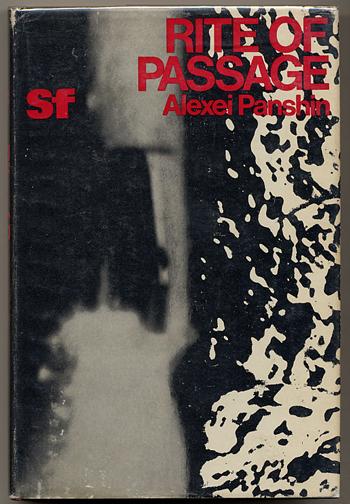
But even more hideous than that one (though perhaps not as terrible as this one), the cover above makes me think of nothing so much as the fact that communism ruins everything. Seriously, this cover has all the charm and aesthetic appeal of a Kruschev-era Soviet housing project in Eastern Ukraine, or maybe a ruined bus stop somewhere in the Kazakh steppes.
Seriously, when I lived in Georgia (the country, not the state), we would see old public art pieces from the communist era all over the place, in the soul-destroying style of socialist realism. This particular cover brings back a lot of memories of the Tbilisi subway. Which isn’t too surprising, because from reading this book, I’m pretty sure that Panshin was a socialist. In fact, it was right around this time that the entire science fiction genre swung super hard to the left, and with a few notable exceptions (David Weber, John Ringo, Larry Correia), it’s never really swung back.
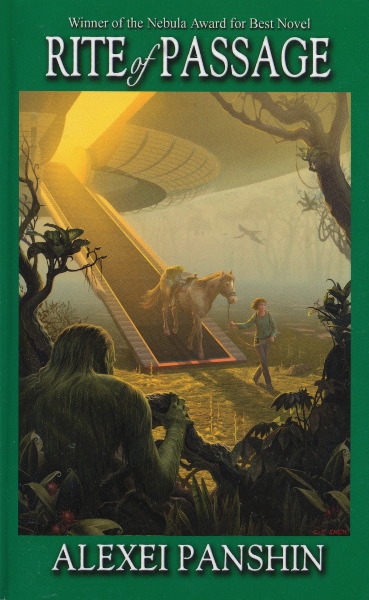
…and looking at Alexei Panshin’s Wikipedia entry, it appears that he passed away less than a month ago. RIP. Fortunately, he got at least one good cover for Rite of Passage before he died.
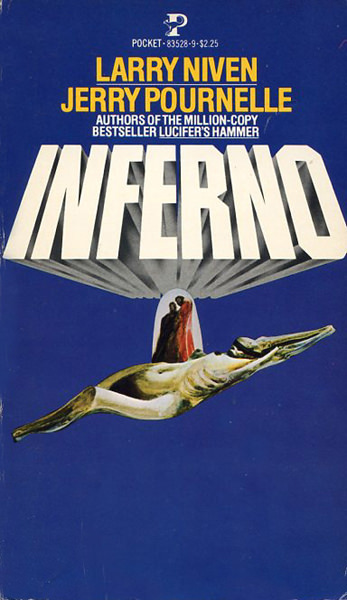
My wife recently read Inferno by Larry Niven and Jerry Pournelle, and she really enjoyed it. Based on her recommendation, I picked up a copy (not this one, thank goodness!) and I’m reading it now. It’s pretty good, but what the heck is going on with this cover? Seriously, it’s like someone puked up a mummy on the blue screen of death from Windows XP, except without any text. And what’s with the two monks standing on the mummy’s belly? Like, who saw the preliminary sketches of this cover art and thought “yup, that’s going to attract the right kind of reader and sell a bunch of books.” Thankfully, the book sold reall well in spite of this cover, not because of it.
So much for retro cover fails. What are some of your personal favorites that still stand out after all these years?
Half an hour after the show is over, a random viewer is staring into their refrigerator, vaguely bemused by the fact that their six-pack of beer has somehow become a two-pack of beer. Rather than work out how this might have happened, it occurs to them to wonder how in the hell Sydney Bristow went from Hungary to Melbourne, Australia, then to LA, all within 24 hours. Or maybe it occurs to them that they’ve never met anyone who actually named their dog Fido. It didn’t bother them during the show. It wasn’t until they discovered they were running short of beer that it became an issue.
When China Mike Glyer picked up my post a couple of days ago, I was skimming over the comments and saw one that said, in effect, “every book deserves to be read.” At the time, I thought “well, that’s obviously stupid” and moved on, but last evening I had a moment of fridge logic, almost exactly like TV Tropes describes (minus the beer, since I don’t drink).
Every book deserves to be read? Really? Prove it by reading the Bible cover to cover. And the Book of Mormon. And the Doctrine and Covenants / Pearl of Great Price. And the Complete Journal of Discourses. And every General Conference report going back for the last two centuries. Heck, even as a believing Latter-day Saint, I don’t think there’s anyone alive who’s read all of that.
Or how about Mein Kampf? Does that deserve to be read?
(I happen to believe that it does, but in a “he who knows himself and the enemy does not need to fear the outcome of a hundred battles” sort of way. And no, I haven’t read it yet.)
Seriously, though, how insane do you have to be to actually believe something like that? “All books deserve to be read.” That’s not the sort of thing that a person comes up with unless they’ve been programmed to think a certain way. Like, “all women deserve to be believed” (except for Tara Reade, of course).
Now, I don’t believe that there’s a nefarious conspiracy to deliberately program people like this commenter to read crappy books. But there is a lot of propaganda out there that follows the formula “all _____ deserve to be ______.” Case in point, believe all women. What probably happened was this commenter, who has already been programmed by this sort of propaganda, tried to reformulate it in a way that would make me look bad. As in, “Vasicek is such a heartless monster to DNF so many books. All books deserve to be read.”
Here’s the thing, though: books are inanimate objects. They don’t have feelings. They don’t care if you read them or not. But readers do care if a book wastes their time. Time is a scarce resource for all of us, and there are more books in the world than can be read in a thousand lifetimes. So if you want to have any chance of finding and reading the best books, you need to be discerning—and that means acknowledging that some books just aren’t worth your time.
This is why I’m such a firm believer in DNFing books early and often. There’s nothing I hate about reading more than slogging through a book that isn’t working for me, only to find that I should have DNFed it a hundred pages ago. That’s why I was so frustrated with Stranger in a Strange Land. I love many of Heinlein’s other books, especially his juveniles, but some of them really misfire for me. So now, I assume that the author needs to prove themselves with every book.
But Joe, doesn’t it bother you as an author that people are DNFing your books? Not at all! Reading is an act of collaboration between the reader and the writer, which means that everyone’s “best books” list is going to be subjective. Some of the elements that make a book good can be measured objectively, but those elements are going to hit differently for different people—and that’s okay. Besides, even Jesus gets one-star, “did not finish” reviews. Who am I to think that I’m better than Him?
I used to worry that I was DNFing books to easily. But over the course of this last year, I’ve come to trust my own tastes. One of the things that I do test this is to skip to the last chapter of every book that I DNF, and read that. In 9/10 cases, I find that yes, there really is something objectionable about the book, and I made the right choice. And in the 1/10 books where that isn’t the case, something about it usually sticks with me, so that I end up coming back and reading it later. One of those books for me now is Deadhouse Gates, which I am thoroughly enjoying.
But you can’t learn to trust your own tastes if you adopt this insane idea that “every book deserves to be read.” In fact, if I still believed that I needed to finish every book that I started, I probably wouldn’t be much of a reader right now, just like most Americans.
So no, not every book deserves to be read. And at the end of the day, it isn’t about the books at all: it’s about the readers.
My 2022 reading resolution: Read or DNF every novel that has won a Hugo or a Nebula award, and acquire all the good ones.
In 2007, when I was a sophomore in college, I went up to Salt Lake City with some friends and was browsing the awesome (and fairly run down, even at the time) used bookstore near the Gallivan Plaza TRAX stop, which has since changed names and moved to another location. It was a really awesome used bookstore, and I determined to buy a SF novel while I was there, since I was really getting back into SF after my mission. I saw a massive 600+ page trade paperback edition of Cyteen by C.J. Cherryh, and since I was reading Downbelow Station at the time, I decided to get that one.
For the next fifteen years, I lugged that book everywhere, through more than a dozen moves (though for the biggest move, where I made the pioneer trek in the wrong direction and repented 8 months later, I boxed it up with my other books and left it in a friend’s basement). In all that time, I never actually read it—or even opened it up, really—but it was always there, somewhere in the middle of my dismally long TBR list.
It wasn’t that I didn’t want to read it: I just didn’t have (or make) the time. Downbelow Station had been an okay read, if not spectacular, but I had really enjoyed some of C.J. Cherryh’s shorter books, like Merchanter’s Luck and Voyager in Night. Also, space opera books about sprawling galactic empires were right up my wheelhouse, so it didn’t seem odd for me to own such a book that I hadn’t yet read. In fact, most of the books that I owned throughout this time were books that I wanted to read but hadn’t gotten around to yet. If I have a superpower, it’s an uncanny ability to acquire books no matter where I am. Unfortunately, I’m not as good at reading them.
Fast forward to 2022. I’ve gotten married, had a daughter, launched my own writing career, and become a homeowner—and I’m still lugging this massive 600+ page trade paperback book that I’ve never read. But I’ve just set a resolution to read (or DNF) every Hugo and Nebula award-winning novel, and Cyteen is on the list. So around the middle of March, I finally open it up and start reading it.
After about a month, I decided to DNF it.
It’s not that it was terrible. Perhaps you enjoyed it, and that’s fine. I just found it to be too drawn out and confusing. I think C.J. Cherryh does better when she’s focusing on just a few characters, rather than trying to give the grand sweep of galactic civilization or whatever. I didn’t finish Foreigner for similar reasons. Maybe someday I’ll return to that one and Cyteen, but for now, I’m counting it as a DNF.
But the thing is, I was hauling around this massive book for most of my adult life. When I bought it in 2007, I figured that since it had won a Hugo, it had to be good. Perhaps, if I’d read it back then, I would have been more patient with it and slogged through to the end. Perhaps I would have decided it was just as good as Downbelow Station. Or perhaps, if I read Downbelow Station today, I would end up DNFing it as well.
The point is, I wish I’d been a lot more discerning about my reading when I was younger, and not just acquired books that I hoped to read “someday”… because books (at least the paper ones) are heavy and take up a lot of space. And a lot of them really aren’t worth reading. Of course, you’ve got to read a few stinkers to figure out what you really like, so it isn’t always a waste… but libraries exist for a reason.
So what this experience really tells me is that Mrs. Vasicek and I are doing the right thing by taking our family to our local library once a week. Also, it tells me that the second part of my resolution—to actually acquire all of the books that I think were worth reading—is just as important as actually reading them. Because, if the ultimate goal is to “seek… out of the best books words of wisdom,” then it’s not enough to just make a list: you actually have to read the damned things, and keep your own personal library in order to revisit those words and share them with others. Because ultimately, you have to discover which books are the “best books” on your own, and your best books list isn’t going to be the same as anyone else’s best books list. Which means that you can’t rely on anyone else’s list. You can use it as a starting point to make your own list, but that’s all you should use it for.
So now I want to go through all of the books I’ve acquired over the years and figure out which ones I ought to get rid of, because Cyteen certainly wasn’t the only one. In fact, most of the books in our family library are books that I haven’t (yet) read. By my count, there are just under 150 of them, totalling about 55k words. Even at a rate of 100 words or two hours of reading each day, that’s still going to take almost two years… and that’s not counting all the library books that we’re sure to check out in the meantime.
Oh well. I suppose this is more of a process than anything else. Journey before destination, and all that. And I’m sure I’ll have fun in the process, since despite the fact that I DNF far more books than I actually read, I do genuinely enjoy reading.
In any case, here are all of the Hugo and Nebula award-winning books that I read (or DNFed) in the month of April:
Books that I read and plan to or have already acquired:
Rainbows End by Vernor Vinge (2007 Hugo)
Blackout by Connie Willis (2011 Hugo and Nebula) (audio)
Books that I read and do not plan to acquire:
Blackout by Connie Willis (2011 Hugo and Nebula) (print)
Books that I did not finish:
A Time of Changes by Robert Silverberg (1972 Nebula)
The Gods Themselves by Isaac Asimov (1973 Hugo and Nebula)
The Fountains of Paradise by Arthur C. Clarke (1980 Hugo and Nebula)
The Claw of the Conciliator by Gene Wolfe (1982 Nebula)
Cyteen by C.J. Cherryh (1989 Hugo)
Tehanu by Ursula K. Le Guin (1991 Nebula)
The Diamond Age by Neal Stephenson (1996 Hugo)
The Moon and the Sun by Vonda N. McIntyre (1998 Nebula)
Parable of the Talents by Octavia E. Butler (2000 Nebula)
2312 by Kim Stanley Robinson (2013 Nebula)
Beyond This Horizon by Robert A. Heinlein (1943 Retro Hugo, awarded in 2018)
The Nemesis from Terra by Leigh Brackett (1945 Retro Hugo, awarded in 2020)
Total books remaining: 26 out of 110 (currently reading 12 and listening to 3).