Fantasy from A to Z: W is for Worldbuilding

What is the biggest thing that sets fantasy apart from all other genres? Without a doubt, it has to be worldbuilding. In every other genre (even science fiction, to some extent), the writer can get away with a loose or surface-level understanding of the world. But in order to do fantasy right, you have to build the world from the ground up, and include such an immersive and visceral level of detail that the reader feels like it’s a real world that they can lose themselves in. That is the feeling that readers want when they pick up a fantasy book.

At the same time, I think that most writers put too much emphasis on worldbuilding. It’s become trendy in writerly circles to talk about worldbuilding, almost as if it’s something you do for its own sake. In the best books, though—even in the best fantasy books—the worldbuilding is always in service to the story, and not the other way around.

For many of us writers, the act of dreaming up a world is the thing that immerses us the most in it. Daydreaming about our fantasy worlds and working out all of the details about it—that’s often the fun part, and the thing that got us into writing fantasy in the first place. But it doesn’t translate very well to the page. The things that seemed so cool to us when we were dreaming them up often come across as dry and boring when we write them out in a huge info dump.

In order for a reader to feel immersed in the world, they need to have a character that they can follow through it. The character’s experience of the world becomes the reader’s experience. But the character needs to be in motion—they need to have some sort of goal or objective that they’re working toward, even if they don’t consciously realize it yet. And it needs to be a struggle for them, at least on some level. Even in cozy fantasy, where the stakes are typically pretty low, the characters still have to put some effort into getting the things they want.

That’s because characters show us who they really are through the trials and struggles that they face. Just like in real life, hard times make us see what people are made of. Without that, readers have a difficult time connecting with the characters through whose eyes we want to show them our fantasy worlds. It’s through a character’s struggle that we find that we can relate to them.

Another thing I’ve noticed, particularly in some recent big-name traditionally published fantasy, is that the viewpoint characters are often just terrible people. If I met them in real life, I often think that I would find them petty, narcissistic, and repulsive. At best, they are amoral, and at worst, they are little better than the villains who oppose them—and yet, from the way they’re written, it’s clear that we’re supposed to latch onto them simply because they are the main character.

As a reader, that doesn’t work for me. If I’m going to connect with a character deeply enough to get that immersive fantasy experience, I want them to either be the kind of person I can admire, or the kind of person I feel like I can hang out with. Preferably both. And if the character is going to do something morally repulsive early on in the book, I need to see them wrestle with the ethics of it first, and perhaps feel some remorse afterward. Otherwise, it’s going to throw me out of the book.

Anything that throws the reader out of the book is also going to kill that immersive experience, rendering all that worldbuilding utterly ineffectual. In some ways, the reader first has to feel immersed in the characters before they can feel immersed in the world.

This is why the characters in the best fantasy books often have more depth and nuance to them than the characters in any other genre. When the book is set in our own familiar world, the characters themselves are often larger than life. The heroes are billionaires or ex-Navy SEALs, the love interests are supermodels or billionaires, and the villains are criminal masterminds or rival billionaires. But in fantasy, the larger-than-life element is the world itself, so the characters (or at least the viewpoint characters) often feel much more like real people, so as to ground us in the story.

I’ve often heard people say that worldbuilding is a bit like an iceberg, in that only 10% or so should be visible. But I think it’s more precise to say that worldbuilding should be grounded in the character (or characters) through whose eyes we get to see it. Of course, those characters are grounded in the conflict or plot of the story, since that’s what shows us who they really are. And the plot itself is grounded in time and space, which brings us back full circle to setting and worldbuilding. So ultimately, it’s all a virtuous cycle.

I don’t think I’ve ever found an author who does character better than Ursula K. Le Guin. I haven’t read much of her fantasy, but I did read Powers, and I felt so totally immersed in that world because I felt like I knew the main character even better than I know myself. It was an incredible reading experience, just like the best of her science fiction, which I adore.

Brandon Sanderson also tends to buck the current trend of morally ambiguous main characters who never really earn our sympathy or admiration. In almost all of his books, his protagonists strike me as good people—the kind that I can admire and hang out with. That fact, combined with how his books tend to be much cleaner than most contemporary fantasy, go a long way toward explaining his tremendous success (though of course, Sanderson’s greatest strength is his ability to write killer endings).

Bottom line, the best worldbuilding in fantasy is only as good as the characters through whom we experience it. Worldbuilding should always serve the story, and not the other way around.
What readers want

I’ve been thinking a lot recently about what science fiction and fantasy readers want in the books they read. I’m in the middle of writing and publishing a series of novellas and short novels, so it’s definitely on my mind. After publishing twenty books and completing another novella series, I think I have a pretty good idea.

First and foremost, I think that readers want to have an experience. The exact nature of that experience depends on the genre, but for science fiction and fantasy readers, that experience needs to be out of this world. They want to be transported somewhere and feel that they’re immersed in the world of the story.

I think I’ve done a pretty decent job of this so far. I’ve gotten a lot of feedback from readers who say that they really enjoy the worlds that I’ve created. There’s always room for improvement, but so far, I think I’ve done a pretty good job transporting my readers to other worlds.

Second, readers want characters that they can connect with somehow. That usually means characters that they can relate to, though it can also include larger-than-life characters as long as they don’t feel fake. The characters are especially important for science fiction and fantasy, since they make everything else in the book feel real and authentic. Besides, when you’re visiting a new and unfamiliar place, it’s always good to have a friend.

I think that character is one of my strong points. I love getting into my characters’ heads and showing how they uniquely see the world around them. I also love showing how characters change and grow as they struggle to overcome their weaknesses. I’ve gotten a lot of positive feedback from readers on my characters, even in some of the more critical reviews, so that tells me I’m doing something right that so many readers can connect with them.

Third, readers (especially sf&f readers), want an adventure. They don’t just want an internal struggle as a character wrestles with difficult moral issues, or a transformative growth experience as a character faces a difficult challenge. Both of those can make a good story into a great story, and turn a reader into a fan, but more than that they want stuff to actually happen. They want the plot to move at an exciting pace–to get sucked into a story as they wonder what’s going to happen next.

With the series I’m writing now (Sons of the Starfarers), I’m trying to do just that. Star Wanderers (my other novella series) did pretty well, but I think the conflict was more personal and internal, or had more to do with the relationships between the characters than any sort of adventure that they were having together. There’s a place for that, but I think a lot of readers got bored midway through the series, or didn’t feel a compelling need to finish it. With Sons of the Starfarers, I’ve been careful to keep the action moving at a good clip with every book, and so far almost everyone who reads the second book goes on to the third book.

So those, I think, are the top three things that the majority of readers are looking for. But there’s something else that I don’t think I’ve been as good at, and it has to do with everything above.

I think that most readers, especially sf&f readers, are looking for longer books. They want everything above, but they want it in much bigger doses. The enjoyment they get out of a book doesn’t increase linearly with the page count, it increases exponentially. The longer the book, the deeper the immersion. The characters feel that much more real the longer they get to spend with them, and the adventure feels that much more thrilling.

As I’ve said before, I really enjoy writing novellas. But if my readers want something meatier, I’ll do what I can to satisfy them. I may love writing novellas, but I also love writing novels too. Since they generally take longer to write, with a lot more time between new releases, it’s more of a challenge to market them, but I have enough books out now that I can switch gears.

There are a couple of half-finished novel projects that I’ve had on the back burner for a while. I’ll keep working on Sons of the Starfarers until that series is complete, probably sometime next year, but I’ll also work on the novels in the meantime. Sons of the Starfarers will have nine books (three omnibus editions), and then it will be complete. After that, time to move on to longer books.

Midichlorians vs. the Philotic Web, or a new dimension to Brandon Sanderson’s first rule of magic

I got into an interesting discussion today with my brother-in-law about science fiction & fantasy, specifically about whether explaining something too much takes away from the sense of wonder that is so critical to those genres.  It started out with a discussion of Star Wars I: The Phantom Menace, which (surprisingly) he actually kind of likes, and eventually got on to Brandon Sanderson’s first law of magic.

I was trying to explain why The Phantom Menace was so broken, and after hemming and hawing over various things came to the midichlorians.  That, more than anything else, threw me out of the story.  By explaining the Force in such a banal, insipid way, it undid all the magic of the previous trilogy and completely sterilized it.  There was no sense of wonder after that point–explaining the Force completely killed it, just like over-explaining any magic system always kills that sense of wonder.

… or does it?  Because there are quite a few wonder-inducing magic systems that get explained in great detail.  Take the Philotic Web, for example.  In Xenocide, Orson Scott Card explains, in great detail, how the physics behind the ansible system works.  And yet, by doing so, he increases that sense of wonder to the point where Xenocide is one of my favorite of his books.  Why?  Because it introduces a bunch of implications that lead to even more questions, more mysteries.

With The Phantom Menace, of course, that isn’t the case–the midichlorian thing is basically a clumsy ass pull that fails in the magic department just as hard as Jar-Jar Binks does at comic relief.  But it doesn’t fail because it over-explains things, it fails because it explains the magic in a way that doesn’t allow room to explore the implications.  As much as I hate to admit it, Lucas could have pulled off the midichlorian thing if the implications had been relevant to more things in the story than just a simple plot point.

This is where Sanderson’s first law comes in.  Basically, Sanderson’s first law states that there’s an inverse relationship to how well the magic can induce wonder versus how well the magic can advance the plot.  In order to advance the plot through magic, you have to explain how the magic works to some degree, and that’s going to take away from the sense of wonder.

But as we’ve just shown, that isn’t always the case.  Sometimes the sense of wonder gets even stronger the more the magic gets explained.  This is especially true in science fiction that follows the one big lie approach, where one thing (wormholes, reactionless drives, time travel) is truly fantastic and everything else more or less follows the laws of physics as we understand them; in order to maintain the suspension of disbelief, the story is basically forced to explore all the implications of the magic, often to great detail.

In other words, explaining the magic isn’t always like building a wall–sometimes, it’s like building a door.  Yes, it lays down a boundary that closes off the imaginative spaciousness that a story really needs to convey that sense of wonder, but if the explanation leads to new questions–new mysteries–then that sense of wonder can be maintained.  Instead of walling the reader in, it throws the reader into a maze with countless secret chambers to explore.

The relationship between plot-based magic and wonder-based magic is not linear, as Brandon Sanderson’s first law implies.  Rather, there’s a second dimension that has very little to do with his law, and learning how to traverse that dimension is key to maintaining the sense of wonder in any story.

I haven’t figured out a pithy way to explain all this yet, but I’m going to, hopefully within the next few days.  If you guys have any thoughts on the subject, please feel free to share.  I’m definitely interested in hearing your perspectives on it.

Why I love writing novellas

Star Wanderers I (thumb)Star Wanderers II (thumb)Star Wanderers III (thumb)Star Wanderers IV (thumb)SW-V Dreamweaver (thumb)SW-VI Benefactor (thumb)thumb (Sholpan)

For the first half of this year, almost every project I’ve worked on (with the exception of an unfinished short novel) has been a novella.  It’s not a form I was familiar with when I first started writing, but I’ve come to enjoy it immensely, and look forward to writing much more in the future.

The technical definition of a novella is pretty simple, at least according to SFWA.  It mainly has to do with word length:

  • Novel — 40,000 words or more
  • Novella — 17,500–39,999 words
  • Novelette — 7,500–17,499 words
  • Short Story — 7,499 words or fewer

That one simple distinction leads to a host of other differences, though, since words and story length are so crucial to the different types of stories you can tell.

Short stories tend to be more situational.  A good short story writer (which I am not) can use the form to explore all sorts of other story elements, but there’s always something of a tradeoff.  A good short story will have strong characterization but a simplistic or nonexistent plot, or center around a compelling concept but not provide an immersive setting.  It’s a very minimalistic form–there’s always something of a sacrifice.

A good short story can pack a real punch, but it doesn’t really immerse you in another world.  It might resonate for a long time after you read it, but you finish it almost as soon as you start it.  It’s a form that I enjoy in audio form, but don’t actually read very much.  It’s great for the commute or a road trip, but not so great when I’m curled up in the lovesack looking to get lost in a book.

That’s just me, at least.  And as for writing them, I need a lot more practice before I have anything useful to say on that.

With novels, it’s exactly the opposite.  They are so expansive that they tend to have multiple viewpoints, subplots, character arcs, and setting elements all woven together in one sprawling whole.  There are differences, of course, between a 200k word fantasy epic and a short 60k word thriller, but complexity is an important part of the form.  It’s not enough to have an interesting situation, or a single mind-blowing idea–you have to have several, and they have to work together.

When done well, the effect can be tremendous.  A good novel is much more than just the sum of its parts, and the climactic moments when everything comes together can be truly spectacular.  They’re incredibly immersive, too–I’m pretty sure that some of my childhood memories are things that never happened except in the pages of a book.

But sometimes, it can be hard to get into a novel, either because it starts off slow or because from the very beginning it’s so complex.  Also, it requires much more of an investment, especially in time.  I can’t tell you how many novels I’ve checked out from the library, only to return a few weeks later with a hefty overdue fine on my account–not because I didn’t like them, but because I just couldn’t find the time to finish.

In terms of writing, all of that storytelling complexity can make the task positively gargantuan.  It depends on the length of the novel, of course, but the longer it gets, the harder it is to keep everything straight.  And when something is off and the story just doesn’t seem to be coming together, it can be incredibly difficult to figure out exactly what is broken.  Even if it’s small, or something that’s easy to fix, you can easily find yourself revising in circles.

The novella falls more or less in the “Goldilocks” zone of these other forms.  It’s long enough to give you the space you need to play with things on a novelistic scale, but short enough that you don’t have to worry about bringing all that complexity to the page.

Generally, I’ve found that there isn’t much of a difference between novellas and novelettes.  I’ve dabbled with both, and found that the difference has more to do with brevity and less to do with actual structure or form.  A well-written novelette can do all (or at least most) of the things a novella can do, just in a slightly more economical fashion.  And of course, the differences in all of these forms is subjective and fuzzy.  Your experience could very well be different.

But personally, I find novellas (and novelettes) much more fun to write because it allows me, sometimes even forces me, to get a lot more intimate with my characters and their individual points of view.  A situation or idea alone is not enough to carry the story for the required length, but exploring multiple viewpoints (or at least more than two) tends to push the story too far.  Consequently, I find myself really diving into my characters and trying to see things from their perspective.

It’s similar with novels, but without all the other subplots or character arcs, there are fewer distractions–and fewer ways to screw up.  I can stay in the character’s head without having to break out to fix something else.  Also, my first drafts tend to be a lot cleaner, with less need for massive substantial revisions.  And even if the draft is irredeemable, I can toss it out and rewrite from scratch with a lot less pain, since it’s only 30k or 40k words.

So yeah, I really love writing novellas, which is something that would have surprised me only three or four years ago.  There aren’t a whole lot of traditional markets to sell them to, but that doesn’t matter because they’re perfect for ebooks and self-publishing.  It’s also a lot easier to take a loss on a perma-free novella than it is on a full-length novel.

I’ve found that I can write a good first draft of a novella in anywhere between two and six weeks.  I wish I could do it quicker, but I’m not a very fast writer, so thirty days is a pretty good cap for a deadline.  And because they’re shorter, they tend to be quicker to revise, and easier to hand off to alpha readers who will give you a good turn-around time for feedback.

For those of you who prefer more long-form stories, don’t worry–I haven’t given up on writing novels.  In fact, I’ve got a half-finished epic fantasy novel that I’ll probably work on next, once Star Wanderers: Benefactor (Part VI) has gone through a major revision pass.  But if you enjoy reading novellas as much as I enjoy writing them, then you’ve got a treat, because I’ve got a bunch of Star Wanderers novellas that will be coming out in the next few months!

And after that?  Who knows …

Trope Tuesday: MacGuffin

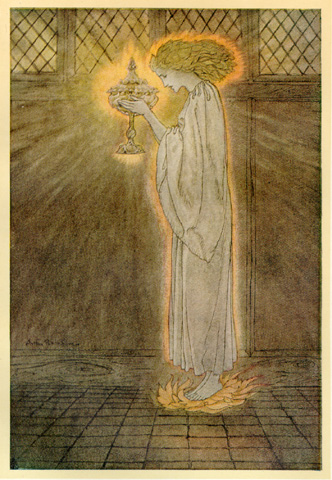
The Holy Grail of MacGuffins. Literally.

So the hero has crossed the threshold of adventure, thwarted the trickster, evaded the vamp, and met with the goddess.  He may have lost his mentor and descended into the deepest dungeon, but by calling on the supernatural aid he received at the beginning of the quest, he has passed the final test, found atonement with his father, and come back stronger than he ever was before.

So now that that’s all done, what’s left?  Just one thing, really–he has to receive the ultimate boon, or in other words, get the MacGuffin that he came out questing for in the first place.

A MacGuffin is an object whose main (sometimes only) purpose in a story is to motivate the plot.  It is usually something that everyone is chasing after, whether it be a ticking time bomb, a briefcase full of money, a priceless artifact, or some sort of superweapon.  Basically, it can be almost anything–that’s kind of the point.  If you can replace an object with something completely different that serves the exact same plot purpose–for example, a priceless stolen Picasso with a priceless stolen Dead Sea scroll–then it’s a MacGuffin.

Like it or not, MacGuffins are everywhere in fiction.  It’s such a prevalent trope, it even has its own Wikipedia page.  One of the most famous examples, at least in the Western literary tradition, is the Holy Grail.  Another example is the One Ring from Lord of the Rings–it could just as easily be a bracelet, or earring, or any other wearable artifact (though admittedly, if it were a necklace and Gollum had to bite off Frodo’s head, that would change the story quite a bit).  The MacGuffin page on tvtropes lists nearly 30 subtropes, from Egg MacGuffin to I’m Dying, Please Take My MacGuffin.

So what does this have to do with the hero’s journey?  The last phase of the initiation cycle (basically, all the stuff between the departure and return) is known as the Ultimate Boon.  It not only represents the achievement of the hero’s quest, it represents receiving something to bring to the people back home.  As Joseph Campbell pointed out:

The gods and goddesses then are to be understood as embodiments and custodians of the elixir of Imperishable Being, but not themselves the Ultimate in its primary state. What the hero seeks through his intercourse with them is therefore not finally themselves, but their grace, i.e., the power of their sustaining substance…This is the miraculous energy of the thunderbolts of Zeus, Yahweh, and the Supreme Buddha, the fertility of the rain of Viracocha, the virtue announced by the bell rung in the Mass at the consecration, and the light of the ultimate illumination of the saint and sage. Its guardians dare release it only to the duly proven.

According to Vogler, the hero has to return home with something to benefit himself or the community–otherwise, the whole journey has been a waste of time.  Before entering the return phase, then, the hero has to receive the object of his quest.

At this point, it’s worth pointing out that tropes are neither good nor bad.  Just because a story revolves around a MacGuffin doesn’t automatically make it cheap or formulaic.  Tropes themselves are value neutral–what matters is how you, as the author, use them.  Some of the greatest and most inspiring stories of all time make heavy use of MacGuffins.

Because the MacGuffin is a plot-centric trope, when you really understand how it works, you can do some interesting writerly things with it.  Michael Moorcock, for example, used this trope to formulate a method for writing a novel in just three days.  Would you like to be able to write a novel in three days?  Gosh, I’d like to.  And before you write that off as formulaic crap, remember, it wasn’t just anyone who came up with this method–it was Michael Moorcock.

In my own work, the best example of this trope would have to be Stella from Bringing Stella Home.  As you might have gathered from the title, Stella serves as a MacGuffin for her brother James (specifically, in The President’s Daughter flavor).  She does have her own character arc, of course, but as far as James’s storyline is concerned, she could just as well be his mother, or cousin, or <insert kidnapped loved one here>.  I did a similar thing in Stars of Blood and Glory, an as-yet-unpublished sequel to Bringing Stella Home, but it should be coming out in January or February of next year so you’ll have a chance to read it then.

plot vs. PLOT and an interesting serial publishing idea

Back in English 318 at BYU, Brandon Sanderson used to tell us that there was a big difference between “little-p plot” and “big-p Plot.” The first applies mostly to chapters and scenes, which he said he could teach us.  The second refers to the overall story structure, which he couldn’t teach in a classroom setting and said we’d have to discover on our own.

I’ve been thinking a lot about this recently, because it seems that my books are starting to fall into a recognizable pattern–and that pattern has some interesting potential for serials and other alternate forms of publication.  Each book is divided into 3-4 parts, each part is divided into 3-6 chapters (typically 5), and each chapter is divided into 3-5 scenes.  Here’s how it works:

Chapter 1: Setup for the basic story arc.  Introduction of the characters and setting, the prominent theme or premise, and a little foreshadowing of the coming conflict.
Chapter 2: The inciting incident, a discovery or event that starts the plot rolling and puts the characters in motion and conflict.
Chapter 3: Complications arise, the problem gets worse, the first attempt at a solution fails, generally leaving the characters at a loss.
Chapter 4: Setup for the resolution.  The characters discover or build something that will help them to settle the conflict.  They stop reacting and start to be more assertive.
Chapter 5: The resolution.  The characters either succeed or fail, but the arc comes to a close either way.  The story question is answered, the thematic elements come full circle, and the story either closes or moves on to the next part.

Basically, it’s the 3-act format divided into five chapters.  When I wrote Heart of the Nebula, all four parts fell into this pattern, and now that I’m writing Star Wanderers, I’m finding myself  falling into the exact same pattern again.  Stars of Blood and Glory is a little bit different; there are three parts instead of four, and each part is divided into six chapters instead of five.  But still, it’s all very structured.

In short, Brandon was right.  It took me a few books to really learn “big-p Plot,” but now that I’ve found a story structure that works for me, it’s starting to come quite naturally.

The cool thing about this particular structure is that it’s very conducive to serialization.  Each chapter is between maybe 3,000 to 5,000 words, so each complete sub-arc is between about 15,000 to 25,000.  That’s the length of a short novella, and it takes me only a month or two to write (sometimes three, depending on how much revision it needs).

The only reason I haven’t done more with serialization up to this point is because I’ve found that sharing my work while it’s still unfinished tends to throw a wrench in my creative process.  The idea of publishing a work in progress on a chapter-by-chapter basis scares me, because if one of the story arcs has a flawed beginning, I wouldn’t be able to fix it.

However, by following a five-chapter arc format (with bits and pieces here and there to hint at a larger overarching structure), I can see myself publishing a novel or epic in a serial format.  It would be something like the Perry Rhodan series, which follows an arc structure of 25 to 100 issues (each a small novella) per cycle.

So here’s how I’m thinking of doing it:

  1. Publish the first installment and price it at free while writing the second one.
  2. Publish the second installment and price it at free, raise the price of the first installment to $.99 and write the third one.
  3. Publish the third installment and price it at free, raise the price of the second installment to $.99 and write the fourth one.
  4. Publish the fourth installment for $.99, drop the price of the first installment to free and publish the completed novel for $2.99.

So what do you think?  Does it seem like a good way to publish a book?  It gives the reader a reason to keep coming back, and rewards those who got in early by charging them less for the completed work.  By selling the novel in shorter chunks, I would be able to put more work out and hopefully gain more visibility, especially by making a portion of it free at any given time.

I’m seriously thinking about publishing Star Wanderers this way, once I hear back from Writers of the Future.  I’ve already finished the rough draft for the second part; it probably needs a good revision or two before it’s ready, but since it’s shorter, it shouldn’t take more than a few weeks to get feedback from some first readers and finish the next draft.  And if the third part is already finished by then…

So many awesome possibilities! 🙂 What do you think?

Trope Tuesday: Big Damn Heroes

You know the drill.  The clock is ticking down to zero, the evil hordes are swarming through the gates, the virgins are about to be sacrificed and the damsel in distress is about to be lost forever–and then the  heroes show up in all their glory to save the day.

This happens all the freaking time, which means that if you want to make a living telling stories, this is not a trope that you should ignore.  And with good reason.  Not only does it give the writer ample opportunity to play with suspense and action, but it arguably lies at the very core of what makes a hero a hero:

David Gemmell, according to this interview with Ian Graham, defined a hero simply as “someone who does heroic things.” They might not always take the right side, or they might not even care about doing what is right, but when the universe conspires to bring them to a moment of decision, they make the choice that all of us would like to think that we would take and do something extraordinary.

I like this definition of a hero.  It strikes me as a lot more honest than the perpetual do-gooder whose only motivation is Truth, Justice and the American Way (though those characters can–and do–have Big Damn Hero moments of their own).  Also, it means that true heroism is not contingent upon actually winning.  History may be written by the victors, but that doesn’t cheapen the experience of those who actually lived it.

Of course, if the heroes don’t save the day, it’s pretty hard to pull off a crowning moment of awesome without bringing in the Bolivian Army.  Either the heroes find out that they’re too late, or they make things worse, or (as is so common with Othar Tryggvasson of Girl Genius) they just prove that their ego is too big for its own good.  When taken to the extreme, the heroes may even be in danger of turning to the dark side.

The biggest danger with this trope is turning it into a Deus Ex Machina.  The thing that makes Big Damn Heroes so incredibly satisfying is the sense of climax when they show up to save the day.  Thus, proper foreshadowing is key.  Yes, the rule of cool still applies, but if that’s all you rely on, you’re not going to be able to pull it off to maximum effect.

One of my favorite examples of this trope is Liam Neeson in Taken.  Plenty of action movies are more violent, but few are more satisfying.  It’s the perfect pick-me-up after a long crappy day at the office–not that I work in an office anymore.  I wonder why…

In any case, this is a great trope to look out for, and definitely one to master, especially if you’re writing any sort of action-adventure story.

Trope Tuesday: Xanatos Speed Chess

Well, I can’t say any of this mess was part of my original plan, but it’s all working out so beautifully that I can’t complain.

Tarvek, Girl Genius.

The Xanatos Gambit is when a character plans out a scheme such that all possible outcomes (including abject failure) ultimately benefit that character.  Named after David Xanatos from Gargoyles, it is most often used by villains who are very good at evading karma.

Xanatos Speed Chess, on the other hand, is when the character relies not on setting up an only-win scenario from the beginning, but on being able to adapt and change their plans quickly enough to pull off a victory even after their first few attempts inevitably fail.  For this character, the important thing is not to keep everything from falling apart, but to outsmart their opponent even after everything already has.

Both heroes and villains can play at this game, but the heroes generally tend to be better at it.  Part of the reason for this is that try-fail cycles are much more conducive to Xanatos speed chess than the Xanatos gambit.  The heroes might lose a pawn or two, or even the queen, but that doesn’t stop them from turning defeat into victory.  In fact, depending on the story, it may provide exactly the sort of dramatic tension that makes the ending so awesome.

A good example of this in recent cinema would probably be the new Mission: Impossible movie.  Over and over, the mission falls apart–and the characters respond either by changing the mission or by crafting a new one.  It’s one of the things that makes it such a great spy thriller: the tension is always high, because you never know how they’re going to pull it off.

The opposite of this trope is the Indy Ploy.  This is because Xanatos speed chess is still chess; even though the plans are dynamic, they are still plans, and involve a large degree of calculation and forethought.  With the Indy ploy, the character is just wingin’ it, jumping into the thick of things and making it up as they go along.

The main reason I’m interested in this trope is because my current project, Stars of Blood and Glory, has a strong military plot, and I want one of the characters to be a magnificent bastard.  Let’s just say that if Bringing Stella Home is the Mongol conquests in space, Stars of Blood and Glory is the Battle of Ayn Jalut.  It’s going to be challenging to pull it off, but that’s part of what makes writing so much fun…

Trope Tuesday: The Bechdel Test

The Bechdel Test is a way to measure how prominently women figure in a story.  It mostly comes up in discussions of TV and film, but can also be applied to works of literature.  To pass the test, the story must have

  1. at least two named female characters
  2. who talk to each other
  3. about something other than men.

The surprising thing, as you can see in this discussion of the trope, is that so few stories actually pass this test. Even in literature, works like The Odyssey, Romeo & Juliet, and even War & Peace fail to pass or only barely pass this test.

Closely related to the Bechdel Test is the Smurfette Principle, where only one of the major characters is female–the token chick.  Stories that fail to pass the first part of the test fall into this category.

So why does this happen?  It may be because most writers are male, but that isn’t necessarily true of books and literature.  Novel writing, after all, was originally considered a womanly pursuit, and the English major was created in the so that women could have something to study while they were in college.  Not surprisingly, 19th century works by female writers like the Bronte sisters tend to pass…

…or do they?  It’s been a while since I read Jane Eyre or Pride and Prejudice, but the impression I got was that the women in those books spend only really talk with each other about men.  And when you look to contemporary writers like Dickens and Tolstoy, the trend holds.  After all, how many female characters are there in A Christmas Carol?  Do any of them ever even talk to each other?

This isn’t necessarily a measure of how good or bad a story is, or even of how feminist it is (Aliens, after all, technically passes), but it is a measure of how independent and well rounded the female characters really are.  If the story doesn’t pass, it’s a sign that the women only play a role in relation to the men, or that the male characters are the ones who advance the plot.

I don’t usually like to bring up my own stories in relation to these tropes, but I thought it would be useful to apply this test to my own books and see how they shape up.  As a writer, I think it’s a good idea to do this periodically, to make sure my work isn’t slipping into a rut.  So here we go:

Genesis Earth

Point 1: Yes, there are two named female characters: Terra and Stella.

Points 2 & 3: No, they never talk.  However, when you apply the reverse Bechdel test (two men who talk to each other about something other than women), Genesis Earth only barely passes.  Michael talks with Tom in the first chapter, mostly about Terra, and for the rest of the book he and Terra are alone.

Bringing Stella Home

Point 1: Yes, it passes.  Named female characters include: Stella McCoy, Danica Nova, Anya Sikorsky, Tamu, Lady Borta, Lady Zeline, Sergeant Maria.

Point 2: Yes; in most of Stella’s scenes, she’s talking with Tamu or Borta or one of the other Hameji women.  Also, since Danica is the captain of the Tajji Flame and Anya is the chief pilot, they interact quite a bit.

Point 3: Yes, but just barely.  In most of their scenes together, Stella and Tamu are talking about Qasar or the harem or sex.  There are a couple where they talk about each other and their past, but it all relates back to their captivity under the Hameji.  At one point later in the book, Anya goes AWOL and Danica has to talk her down, which is probably the scene that makes the book pass, but a hardcore feminist might argue that that conversation is indirectly about a man.  Still, I’m counting it.

Desert Stars

Point 1: Yes, there are plenty of women.  In fact, as you can see from this list of non-minor characters, there are almost as many women as there are men:

Female Male
Mira Jalil
Shira Sathi
Zayne Hamza
Tiera Rumiya
Lena Gregor
Surayya Kariym
Amina Ashraf
Rina Ibrahim
Sarah Lars
Michelle Nash
Mark
Will

Point 2: Yes, plenty of these women talk to each other.  Surayya and Amina are practically joined at the hip, Tiera, Shira, and Lena all have private conversations with Mira, and the only time Rina even talks is when she and Mira are alone.

Point 3: While most of the conversations between the female characters revolve around men and marriage, Tiera talks with Mira about honor, and Rina talks with Mira about leaving home.  Without spoiling too much, there are other conversations that have nothing to do with men, though they happen off-stage and only get reported second-hand.  Either way, I’d say this book passes.

None of this is to say that a good story must pass the Bechdel test.  Lawrence of Arabia, for example, doesn’t have a single female actress–not one single actress!–and it’s an amazing film.  As a counterpoint, I’m sure there are plenty of good stories out there (most of them probably anime or manga) that do not pass the reverse Bechdel test.

However, it is a good measure of female presence and how much the story is driven by men.  And as a lens through which to view the wider culture, it offers a surprising and somewhat disturbing perspective on male-domination in fiction.

Struggling not to settle

I’m in the middle of my first revision pass through Heart of the Nebula, direct sequel to Bringing Stella Home, and…I don’t know exactly how to put this, but the story seems to be simultaneously smoother and more shallow.  Plot-wise, everything works great; character-wise, there just doesn’t seem to be as much depth as my other work.

I remember finishing the first draft in May, and being surprised at how well structured it was.  Each of the three major plot points happened after exactly five chapters, and each of the chapters was almost perfectly balanced–a far cry from my previous work.  I had a few stops and starts in the first part, but everything after the first hundred pages was smooth as gravy.  What’s more, I’m finding in this revision that not a whole lot needs to change; it works pretty well as-is.

And yet…I can help but feel as if something is missing.  The characters just aren’t coming alive the way they did in my previous works.  The story isn’t quite as engaging, the climaxes quite as gut-wrenching as I would like.  It feels like a good story, but not a great story.

Here’s the thing: my previous stories were all broken in this phase.  Desert Stars was so broken I had to write another novel to figure out how to finish it–and even then, the second half of the book went entirely in the wrong direction and had to be thrown out.  Bringing Stella Home had a solid storyline, but Stella’s character was completely broken and had to be rebuilt from the bottom up.  And Genesis Earth had half a dozen false starts, and at least as many chapters that had to be thrown out because they did nothing to advance the plot.

But Heart of the Nebula isn’t exactly broken, it’s just…not at the level I would like.  And I worry that because it isn’t broken, I won’t feel as compelled to make it better.  I worked hard on the others, and learned a lot of lessons which helped me to write this book, but even if I’ve hit my stride and this is the result, it feels too much like settling.  I can do better.

None of this probably makes any sense if you haven’t read the manuscript, but I hope it doesn’t sound too much like whining.  Even if these are problems, these are good problems and I’m happy to have them.  When I share this with my first readers, they will probably have all sorts of insights that will make me smack my forehead and make everything awesome again.

I guess my point is that I don’t want to settle, even though this draft will probably not be as good as I’d like it to be.  I’ll fix all the known problems, then send it out to my first readers and trust them to help me find the unknown problems.

In the meantime, I should probably start something new.  I have a ton of great ideas for the fantasy novel, and bouncing them off of friends has really helped me to figure out what else the story needs.  After I finish reading American Gods, I’ll stock up on some fantasy to get into the right mindset, starting with David Gemmell (incidently, at dinner group tonight, I literally squeed while talking about David Gemmell.  It was simultaneously embarrassing and really awesome).

Enough of this.  Time for sleep.