Content Ratings for Books

A couple of weeks ago, there was a discussion on The Passive Voice blog about trigger warnings and how they are destroying literature. The post spawned a discussion that went on for 240 comments before Passive Guy closed it (probably because we got too political), but it ended up being very insightful.

Laying aside any issues of politics social justice, the fact exists that there is simply not a standard content rating system for books. We have rating systems for movies (MPAA is the main one here in the US) and video games (ESRB), but the majority of books are published without any sort of rating at all.

Is this a bad thing? Personally, I don’t think so, but I know that it matters to others. Last year, there was a big kerfluffle in the book world over an app called Clean Reader that screened objectionable content based on a number of user-controlled filters. It seems that there is an unmet need for some sort of system to help readers avoid offensive content.

That was why the discussion on TPV was so fascinating to me. Between the cries of “censorship!” and “triggering!” there were some very interesting points brought up. Yes, there are politically-motivated people who use “trigger warnings” as a means of advancing the political correctness regime, but there are also sensative readers who appreciate that sort of thing. When I first published Bringing Stella Home, I put a warning on it that stated “if this were a movie, it would be rated PG-13,” and at least one reviewer really appreciated that.

It’s a little bit ridiculous to equate trigger warnings with censorship, though both may be found on the same slippery slope. Still, there are places that scan your metadata and block you from publishing based not on the actual content, but your description of the content. Erotica writers know far more about navigating this maze than I do, though I have experienced it with books like Sholpan. Ironically, adding a content warning to the book description can sometimes get your book blocked altogether, even though the content is far tamer than some of the books on the site from traditional publishers.

So what’s an indie author to do? The commenters at TPV mentioned a site called AO3, or Archive of Our Own, as a place to check out. It’s a massive repository of fanfiction with a very refined system of filters and tags, along with a rating system that seems to work really well.

Since I really don’t want to reinvent the square wheel, I decided to check it out and see if this was the sort of thing I could apply to my own original books. I’ve never been a big reader of fanfiction, but I know that many of my readers are, so adapting the AO3 system seemed like a good way to present them with a system that felt intuitive and familiar.

The AO3 content ratings system has four components: content ratings, pairings/orientations, content warnings, and finished/unfinished. Obviously, the last one really doesn’t apply, since anything I publish commercially is going to be a finished work. The pairings/orientations component also seems unnecessary, since in a book where romance is a major plot driver, the  reader should be able to gather from the book description whether it’s M/F, M/M, F/F, or whatever. Also, fanfic readers tend to read for that sort of thing, while general readers do not.

That means that the relevant part of the system is the content rating and the content warnings. I looked for a more detailed official explanation, but it really does seem like ultimate discretion is left to the writers.
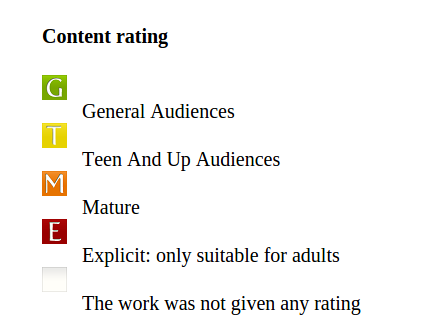
Screenshot from 2015-08-04 15:24:38There are four countent ratings: G, T, M, and E. If you’re more familiar with AO3 than I am, please correct me if I’m wrong, but it seems that the equivalent MPAA ratings are as follows:

  • G: General Audiences.
  • T: PG and PG-13.
  • M: Restricted.
  • E: NC-17.

Of course, it’s virtually impossible to avoid some degree of subjectivity with these sorts of things. What is the threshold between a T and an M? I’m not sure, but I think it lies somewhere between an implied sex scene and one that describes the actual act, or violence that advances thea plot versus violence that IS the plot. There’s also the threshold between an M and an E, but I’m less concerned about that because my books don’t tend to be that extreme.

The key part of the AO3 system, which also removes a great deal of ambiguity, is the content warnings:
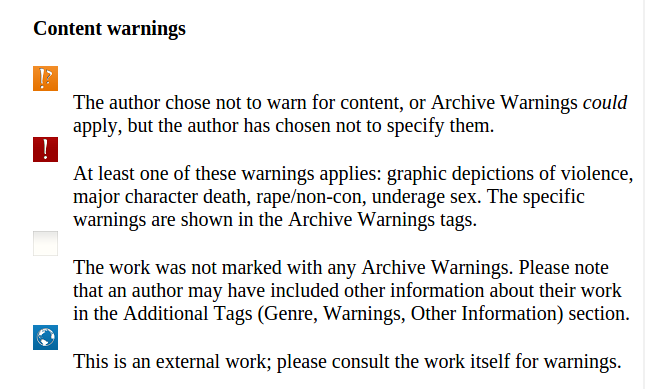
Screenshot from 2015-08-04 16:03:52The key part here is the ! tag, since the last two obviously don’t apply and the ?! tag is too purposefully ambiguous to be useful. The ! tag very clearly states that one of the following things will be true:

  • A major character will die, OR
  • The descriptions of violence will be graphic, OR
  • There will be rape or non-consensual sex, OR
  • The sex will involve minors.

In other words, the ! tag indicates a trigger warning. A book rated T, for example, may have some non-triggering crude or obscene language, but a book rated T! is going to have something that would trigger, say, a rape victim, or a victim of child abuse. Obviously, some readers won’t be triggered as much as others, but adding a warning tag makes it easier for readers to use their own discretion.

Again, correct me if I’m wrong, but I think that this is the best way to adapt the AO3 system. Towards that end, I’ve added a rating to all of my books, so that if you’re familiar with the AO3 content rating system, you should be able to tell pretty easily where each of my books rate. Unless something drastic changes, I expect to use this system to rate all my books in the future.
U is for Universal Translator

In science fiction, whenever two characters from different planets or different alien races have to interact with each other, they almost always speak the same language or have some sort of universal translator that magically makes them able to communicate with minimal misunderstandings.  This is especially common in Star Trek, though it happens in just about every franchise involving a far-future space opera setting of some kind.

I’ve got to be honest, I think this is a cheap plot device that almost always weakens the story.  As a writer, it’s tempting to have something like this so you don’t have to deal with any pesky language barriers, but when you do this, you remove a major potential source of conflict, thus violating the rule of drama.  Also, you make your fictional universe feel a little less grand, your aliens a little less alien.  After all, if everyone can perfectly understand each other, then there must not be a huge difference between Earth and the far side of the galaxy.

There are some times when having a universal translator allows you to broaden the story and focus on other conflicts.  For example, if some sort of interstellar legislation is under review in the grand galactic council, you can’t spend all your time focusing on basic communication difficulties.

However, if this is the case, then you can usually overcome the language barrier through other means–a galactic lingua franca, for example, or translation tools that may or may not misfire on occasion (much like Google Translate).  Of course, if you’re writing a comedy like Galaxy Quest (or parts of Star Control II), then falling back on a universal translator is forgivable.  But if you’re going for believability and a sense of wonder, this trope isn’t going to do you any favors.

While linguists and technologists have been working on translation programs for some time (and admittedly making some significant breakthroughs), I’m extremely skeptical that we will ever develop a perfect universal translator in real life.  If we do, I expect we will have to develop a sentient AI as a prerequisite, since the nuances of language are so inseparable from the things that make us human.

Here’s how translation services like Google Translate work:

  1. They amass an enormous database of language material by scanning websites, newspapers, and other documents.
  2. They analyze this database to look at word combinations and frequencies, observing the likelihood that any one word will appear in combination with any others.
  3. They compare these combinations and frequencies with those in other language databases to match words and phrases.

This data crunch method of translation works fairly well for simple words and phrases, but it falls apart in the more complex grammatical structures.  I see this any time I try to use Google Translate with an Arabic source.  Arabic is an extremely eloquent language, with all sorts of structures that simply don’t work in English.  One mistranslated word can completely change the meaning of the entire text, and even when it works, the technically correct English translation sounds as if it’s full of errors.

The methodology also falls apart for languages that are too small to have much of an electronic database.  The Georgian language is a good example of this.  It’s spoken by only about 4.5 million people worldwide, most of them in the country of Georgia, which is predominantly rural.  Internet access for most of the population is very limited, and most Georgians who do communicate online tend to use the Roman or Cyrillic alphabets more often than their own.  As a result, Google Translate for Georgian is utterly useless–seriously, you’re better off just sounding out the letters and guessing at the meaning.  There are some other sites like translate.ge that try to fill the gap, but they seem to rely on actual lexicons, not databases and algorithms.

All of this is between entirely human languages that developed in parallel on the same planet–indeed, languages between human cultures that have traded and shared linguistic influences for thousands of years.  What happens when we encounter an alien race whose biology makes it impossible for them to make human-sounding noises?  Or an alien race that communicates through smell or electromagnetic impulses instead of sound?  What happens when humanity is spread out across hundreds of star systems, each of which periodically becomes isolated from the others for hundreds or even thousands of years?  When our definition of human is stretched so thin that we would not even recognize our far-future descendents as anything but alien?

There is so much wasted potential whenever a science fiction story falls back on a universal translator.  Case in point, compare Halo I, II, and III with Halo: Reach.  In the first three games, the Master Chief’s universal translator enables him to hear exactly what the enemy Covenant troops are saying.  This is great fun when you’re chasing down panicked grunts, but it tends to get old after a while.  In Halo: Reach, however, the human forces haven’t yet developed a universal translator, so everything the Covenant say is in their original language.  All of a sudden, the game went from a hilarious joyride to a serious war against aliens that felt truly alien.  That one little change did wonders to the tone and feel of the entire game.

Needless to say, you won’t find a universal translator in any of my books.  In Star Wanderers, the language barrier is the heart and soul of the story–it’s a science fiction romance between two characters from radically different worlds who don’t speak the same language, and yet overcome that to develop a strong and healthy relationship.  In Sholpan and Bringing Stella Home, Stella knows a language that is fairly similar to the one spoken by the Hameji, but there are still words and phrases that elude her.  This detail is critical because it impedes her ability to understand and adapt to the Hameji culture, leading to some major conflicts later in the book.

As someone who’s lived for significant periods of time in Europe and Asia and learned languages very different from English, I can say that the language barrier is not something that we as writers should avoid, but something that we should embrace.  There are so many interesting stories that can be told when two characters don’t speak the same language.  Please, don’t be lazy and write that out of the story through a cheap plot device!  Let your aliens be truly alien, and your worlds and cultures so fantastic that we can’t help but feel hopelessly lost in them.

LTUE 2013

Man, LTUE 2013 was this weekend, and it was AWESOME.  One of the best conventions I’ve ever attended.  I spoke on my first panel, attended my first book signing event as an author, and got to meet up with some old friends, as well as some amazing new people.

Since I live tweeted most of the panels I attended, I thought it might be interesting to repost a few of those here, with some additional thoughts.  So…here goes!

THURSDAY

I believe this was Scott Parkin from the “What Do You Write?” panel. Good advice. Megan Whalen Turner also had some very interesting things to say on the subject of genre, which I have since forgotten. But I recorded it, and the recording will eventually be made publicly available in the LTUE conference archives, or so I’ve been told.

This one was from the “What Is ‘Punk’ Literature and Its Many Genres?” panel. David Butler and Larry Correia were HILARIOUS. Nearly got into a wrestling match right in front of us.

And when the esteemed Mr. Butler began to describe his book, I swear, a choir of steampunk angel Moronis somewhere began to sing a heavenly chorus. I mean, he had me with Edgar Allen Poe faking his death to become a secret agent, but Orson Pratt’s phlogiston guns? Eliza R. Snow as chief counterintelligence officer for the Kingdom of Deseret? I will definitely be checking out this book, City of the Saints (which is apparently a finalist for the 2013 Whitney Award).

David Butler is also a way cool guy. I hung out with him a bit in the dealer’s room, chatting about Mormon history, Lyman Wight (“shoot and be damned!”), Sir Richard Francis Burton’s expedition to Salt Lake City, and all sorts of other crazy zany stuff. And the whole time, he was playing a guitar. So yeah, definitely a way cool guy.

This discovery CHANGED MY LIFE. Also, it helped me to save immensely on lunch money, as well as join in on some way cool conversations with other panelists as they desperately tried to escape their fans. Okay, not really, but the green room was AWESOME.

Howard Taylor’s presentation on teasers was tremendously insightful. In a nutshell, he said that a teaser (aka book description on Amazon / back cover) should have or at least point to the following things:

  1. The inciting incident
  2. Character action
  3. Conflict
  4. Hook

We then went over a few examples, including some good ones that broke these rules, and finished up by doctoring a couple of teasers volunteered from the audience. Howard Taylor admitted to me later that he wasn’t entirely satisfied with the way he presented it, but I get the impression that he’s never entirely satisfied with anything less than perfection. It was a great workshop.

From “Engaging the Reader.” Great panel. Lisa Mangum described the planning / drafting / revising process for each of her first three novels, and they were all wildly different. With seven novels under my belt so far, I can definitely relate. Some, like Genesis Earth and Stars of Blood and Glory, practically write themselves. Others are like having a c-section with a hacksaw. And others…yeah, I’m not going to go there.

FRIDAY

Okay, maybe I said one useful thing: when there’s a language barrier, little things become big obstacles. One of the other panelists, Anna Del C. Dye, also had a bunch of stories about adapting to a foreign language and culture (in her case, the United States).

Overall, the panel was really, really fun! I also had some cards out for Star Wanderers: Outworlder, and a bunch of people came up afterward to get them. Guess I must have said something interesting. I hope you guys enjoy the book!


From “Current Trends in SF.” Great panel–it totally wasn’t just another over-hyped discussion about what’s hot right now. I asked how the panelists think the trend cycle will change in the age of self-published ebooks, and they had some very interesting things to say. They all agreed that speed to market, while it may give some advantages, isn’t a make-or-break game changer, or even really a good strategy (unless you really love the trend you’re writing to). Some things change, others remain the same. It will be interesting to give this one a re-listen.


From “Creators in the Community.” Probably one of the best panels of the entire convention. Tracy Hickman is really on top of the changes in the publishing world, and had a lot of interesting things to say about it in all of his panels. As for the subject of writerly communities, much wisdom and insight was shared by all of the panelists. Definitely look for this one.

Man, I’d forgotten how cool the guys at Dungeon Crawlers Radio are! They interviewed me back in 2011, when I was just getting ready to publish Genesis Earth. This time, we talked about space opera, sci-fi romance, language barriers in marriage and all the crazy things I have to look forward to, and a bunch of other stuff. I also shared some of my thoughts and opinions on self-publishing myths, especially regarding the “tsunami of crap.” We coined a new word, “nerdaissance,” to describe all the awesome new stuff that’s coming out now, thanks to the ease of self-publishing.

So yeah, it was a great interview! I’ll definitely be cross-linking once it goes live.

From “Effective Book Covers.” Great panel with some very good artists and cover designers, including Isaac Stewart who does all the maps for Brandon Sanderson. Although some parts were geared toward illustrators, most of the advice was for writers (especially self-pubbing writers) who are looking to design their own covers. Lots of great and insightful perspectives from the visual arts side of things.

FRIDAY NIGHT BOOK SIGNING

Okay, I’ve got to be honest: when I went into the mass signing with my cardboard box of CreateSpace POD novels, I didn’t expect to sell anything. I figured that was just my ticket to get a seat at a table and hand out cards for Star Wanderers: Outworlder to some of the casual book browsers.

Well, I was pleasantly surprised! An uncle of one of my old mission companions was impressed enough to buy a couple of copies. I think he’s one of these guys who likes to buy things from new authors to help encourage them. It’s great to see people like that. He told me to keep writing, and I told him I definitely would!

Lots of people snagged the card for Outworlder, and I came up with a pretty decent pitch: “it’s about a starship pilot who accidentally marries a girl who doesn’t speak his language.” That raised a lot of eyebrows! A lot of people were really happy to see a science fiction story, especially a space adventure. I get the impression that there’s a craving for this kind of stuff in the market that isn’t currently being satisfied. So yeah, that was very encouraging!

After things wound down a bit, I wandered around the signing checking out some of the other books. Saw a couple that I recognized from the Kindle Boards, which was interesting. Chatted with them, as well as a bunch of geeky guys about chain mail, Halo, Frank Herbert, and all sorts of awesome stuff. Man, the best part about sci-fi/fantasy conventions is the chance to just talk with people! So much interesting stuff. It was great.

SATURDAY


From “Write For the Market or Write What You Know?” Another great panel. Definitely will be re-listening to that one.

From the main address with Megan Whalen Turner. She talked about book censorship and the need to teach children how to make their own reading choices, rather than keeping them sheltered and making the choice for them. She pointed out how every time a New York Times article comes out bemoaning some YA book for inappropriate content, it’s kind of hypocritical because there are so many other books they miss. The Golden Compass, for example, didn’t even pop up on their radar until the movie came out. Kids don’t magically become mature, well-adjusted adults when they turn 18–we have to teach them to make these choices (and mistakes) for themselves.

From “How Does Your Story Mean?” Great discussion on the writing process. Saw a lot of other good live-tweets during this one.

Okay, I take back what I said about the best panel of the convention. THIS was definitely the best. “The Engines of Exploration,” with Howard Taylor, Megan Whalen Turner, Roger White, James Owen, Kevin Evans, and Charles Stanford–the panel was packed. It basically turned into a round-robin discussion of which commodities are most essential to modern civilization, which ones will be the most valuable in the event of a societal collapse, and which ones will take us to the stars. The eventual consensus on each of these eventually came down to goats. Seriously. GOATS!


From “Writing Romance Without Erotica.” Lots of delicious awkwardness, as well as some really interesting thoughts and perspectives on the subject of romance. One of the panelists talked about the importance of “character penetration” without realizing about halfway through the panel how hilarious that phrase sounded in this context. But yeah, there was also a lot of wisdom in there as well. There are a lot of strong opinions about sex and romance floating around in this part of the world, so it was a very spirited and interesting panel.


The last panel of the convention (technically, symposium, but whatever) was “eBook Publishing” with some highly successful indies like Michaelbrent Collings. As you can tell from the tweets, it was a bit controversial, but very, very interesting. Questions were flying all over the place, on subjects ranging from formatting to building an audience. The biggest shock to me was that none of the panelists (none of them!) are on Smashwords. It’s a wild, wild west out here in indie-land. Makes me wonder, maybe I should publish to iTunes through another venue? Hmmmm…

So yeah, that was pretty much the whole convention/symposium. I finished it out by playing Alhambra with a bunch of friends from Kindal Debenham’s writing group who came down from Seattle and Idaho. Good, good times–it was actually kind of sad to say goodbye. Definitely worth coming 11 time zones to attend.

All I can say is that I am STOKED for Conduit!

New publication and first con panel!

Sorry, no Trope Tuesday this week.  This day ended up being a lot more packed than I thought it was going to be.  Not too productive from a writing point of view, but Stars of Blood and Glory is coming along and should be out on schedule.

I do have a couple of quick announcements, though.

LE63

First, issue 63 of Leading Edge is now out, and I’ve got a publication in it!  For this issue, they ran a first novel chapter contest, and Stars of Blood and Glory was one of the stories that placed.  If you want to pick up a copy, you can do so here.  Print copies are $7.95, PDF copies are $3.00.

ltue

Second, the schedule for this year’s LTUE symposium is out, and I’m on one of the panels!  It’s Friday morning at 9:00, and the theme is “Raising the Language Barrier.”

This will be my first convention panel EVER.  I’m kind of nervous about it, but I do have some authority on the subject after living overseas for a year, so it should be a good experience.  The other panelists include Dene Low, one of my English professors from back in college.  That should be interesting. 🙂

That’s just about it for now.  Back to writing!

Trope Tuesday: Language of Love

Oh look!  While traveling in distant lands, the hero met a girl–probably the chief’s daughter–and fell (or rather, stumbled) in love.  The catch?  Neither of them speak the same language.

That’s okay, though: through the power of love, the two of them will somehow find a way to understand each other.  Whether through touch, music, math, or a montage filled with magical sparkles, they come to discover that love itself is a language, one which they know fluently.

To be honest, I was a little disappointed in the page for this trope.  It’s pretty dang sparse, though it does make a couple of good points.  The main one is that this type of story almost always has the male character speak the language of  the audience, with the female character being the foreign or exotic one.  That might be because the seductress is such a powerful character archetype…but then again, it might just be because everything sounds sexier in French.

My favorite example of this trope is in the film Jeremiah Johnson, where the hero unwittingly stumbles into a marriage with–you guessed it–the chief’s daughter.  What starts out as an awkward pairing, to say the least, turns into a wonderfully endearing love story, as Jeremiah builds a cabin for the two of them (and the mute boy he picked up earlier…long story) and together they become a family.

Because this is a major driving element in Star Wanderers, the novel I’m currently writing, I’m especially conscious of this trope right now.  However, I can’t think of many good examples where this trope came into play.  Do you have any ideas that you can share?  Favorite stories where love overcame a major language barrier?  If so, I would love to hear about it.  Because in spite of my tongue-in-cheek comment about the sparkles, I think this trope has some really awesome potential.

Image by Kevin Jackson.  Taken from here.

In Tbilisi!

My first view of Georgia from the airplane.

So, I’m in Georgia now, writing this blog post from the hotel in Tbilisi where we’re having our orientation!  The flight from New York went well, all my stuff made it alright, and I’m having a blast making new friends and playing the role of clueless foreigner!

There’s about twenty to twenty five of us here, most from the US, but a few from Australia, Canada, and one girl from Egypt.  I met a whole bunch of them in the airport at JFK, including my roommate, who is from Alaska.  Most everyone has had some travel/expat experience, though most of us are fresh out of college.  A couple of us know Russian, but that’s about it–no one really knows Georgian.

The people here seem friendly enough, at least the ones we’ve attempted to speak with.  I knew it was going to be disorienting not being able to speak the language, but…wow.  There’s nothing quite like being the clueless foreigner.  All I really know is that the word for “hello” sounds a lot like “gom jabbar.” The only thing for it is to abandon all shame and do your best to get out there and communicate, which my Alaskan roommate is really great at.  I think we’re going to get along quite well.

That’s about all I can say for now.  I hear that Georgia is in the American news now, with Iran trying to attack the Israeli embassy–yeah, that’s just what my parents needed to hear. :/ Don’t worry about me, though; I’m doing fine, and I’ll be sure to keep my eyes open and stay out of danger.

I’d write more, but I don’t want to plug in my computer until I have a surge protector, and I’ll need to conserve my battery if I want to write at all later today.  I haven’t been writing hardly at all in the last few days, but of course I’ve been busy getting adjusted to all the new changes.  I’ll try to do about 500 words a day minimum, but I’m not going to be too strict on it–I’ve got a lot of other things going on, after all.

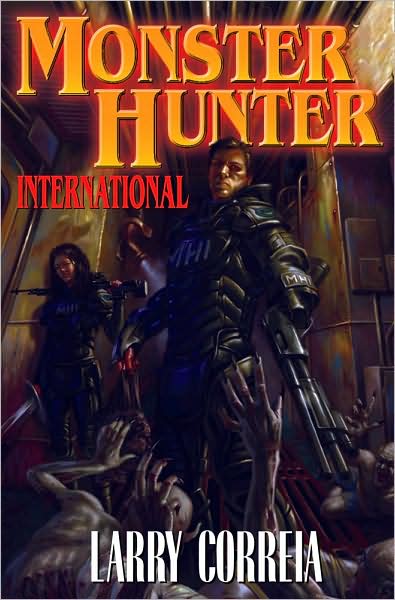
Monster Hunter International by Larry Correia

Owen Zastava Pitt wants nothing more than to be a mild-mannered accountant with a comfortable, boring life.  Unfortunately, fate has other plans.  His father–a retired green beret–brought him up to be a killing machine, with or without a firearm.  To pay for college, Owen worked alternately as a bouncer and a highly illegal cage fighter.  But all that’s behind him now; he has a respectable job–one where he isn’t required to kill things for a living.

When his boss turns out to be a werewolf, however, and Owen single-handedly kills him, all of that changes.  A guy shows up at the hospital with a business card for a company called “Monster Hunter International,” and promises to help him make a lot of money killing things for a living.  It turns out that vampires, wights, werewolves, and evil tentacled monsters are real, and the business of monster hunting is quite lucrative.

At first, Owen is hesitant.  But when an old Jewish man starts showing up in his dreams, telling him about an ancient, evil plot to subjugate the world,  he realizes that he has little choice in the matter.  Fate has given him a calling–or, as the old man likes to say, the “short end of stick.”

If  you’re a gun fanatic or a B-movie connoisseur, you’ll love this book.  It’s basically Men in Black meets Van Helsing, with enough firearms and weapons to make Rambo look tame.  Hundreds of mindless zombie wights?  Bring out your automatic 12 gauge shotgun.  Giant flying gargoyles the size of semi-trucks?  Hope you brought enough RPGs and grenade launchers to go around.  Hordes of undead swarming across Alabama?  Better arm the 5-kiloton tactical nukes.

The story was quite entertaining, with enough comedic and romantic subplots to keep things interesting.  The battle between good and evil was pretty clear cut and unambiguous, with evil being measured by how many tentacles a thing has, but some of the monsters (such as the vampires) were much more complex.  When you have to decapitate your buddies after they die, to make sure they don’t come back as something that will kill you, that makes things interesting.

I felt that the second half of the novel lagged a little, especially with the number of false endings.  However, the ending itself was quite satisfying, with an interesting twist that caught me a little by surprise.  The quality of Correia’s writing was a little weak in places, but the story was more about killing the bad guys than crafting beautiful prose.  In any case, I don’t think his intended audience will mind.

Overall, it was an entertaining, surprisingly fast read.  It’s not the type of thing I usually read, but I enjoyed it.  If you’re looking for deep, meaningful literature that changes the way you view the world, or a clean, wholesome read that’s free of excessive language or violence (Gamila, I’m talking to you), this book probably isn’t for you, but if you’re looking for an entertaining story about undead monsters where the good guys aren’t pussy-footing idiots, you’ll probably enjoy this book.  If you own more than one firearm, it’s a must-read.

Trapped in a parking garage and other late night story ideas

I had a weird idea for a story yesterday.  I went to the library and parked in the underground parking lot of the JFSB, and when the library closed at midnight, I came back and found the garage completely empty.  I was on the bottom floor, but forgot that the exit is only on the second floor, so I drove to where the exit should have been and found myself looking at a sign that said “NO EXIT.”

This made me wonder…what if you were trapped in an underground parking garage that, for some inexplicable reason, had no exits?  That the more you tried to find one, the more lost you’d become.  And it was completely empty?  And it was night?

Also, today at work I had an interesting idea–how to turn telepathy into a reality.  First, design a computer interface that connects directly to the human brain, without the need for a keyboard or a mouse or anything else.  Next, surgically implant these computers into people, and connect the computers to the internet.  You could open an IM box and chat with people directly, mind to mind.

Of course, you would still have to use words and language, since your mind has to translate your thoughts into words, which the computer can process into data, which the other computer can interpret as words, which the other person can then understand.  Still, it would be interesting, wouldn’t it?  Imagine the ability to IM anyone at any time, directly through your brain…

…holy cow, I would never get anything done!

Anyways, it’s WAY past my bedtime (my self-imposed bedtime, I’ll have you know, which unfortunately I have not been imposing nearly enough on myself.  That will have to change in the near future).