Squirrel!

So a couple of months ago, I set aside the first draft for Friends in Command (Sons of the Starfarers: Book IV) in order to let the story percolate a little in my mind. I do this from time to time, especially between deep revisions, in order to step back approach the story with a fresh mind. I’ve found that doing so tends to improve the quality of the story immensely.

I was fully intending to get back to Friends in Command this month (and still intend to do so eventually), but just as I was finishing up the 4.0 draft for Heart of the Nebula, I had this crazy awesome story idea pop into my head and I couldn’t not write it. It actually came to me right before I got to the last chapter, which led to this exasperated tweet:

So anyways, the working title for the squirrel! project is Queen of the Falconstar. It’s a sci-fi action & adventure standalone (for now, heh) that takes place in the same universe as Sons of the Starfarers, but a few hundred years into the future. The Outworld frontier has been more or less tamed, and the Hameji are beginning to establish themselves on the outer reaches of human space. It’s a brutal and dangerous universe outside of the major stellar empires—which of course is where this story takes place.

It’s the main character, Zlata, that I’m really excited about. She’s crafty, pragmatic, resourceful, and slightly pessimistic, a little like Mara from Sons of the Starfarers but without all the trauma and daddy issues. She’s ruthless when she needs to be, but can be quite altruistic whenever it’s practical. Above all else, she’s a realist, accepting things as they are and preparing herself to deal with them accordingly.

The story starts when pirates capture her home station and carry her and her best friend off as slaves. It turns out, though, that these aren’t ordinary pirates—they’re Hameji tribesmen from the Outer Reaches. The captain, Lord Khasan Valdamar, is a young Hameji commander trying to establish himself and build a war fleet to his name. He doesn’t have much to work with, though, and in the brutal world of intertribal Hameji politics, a single miscalculation could lead to the annihilation of his small clan.

Through a daring combination of intrigue and romance, Zlata convinces him to take both her and her friend as wives, thus raising their status and securing their future. But this sets off a tribal war, which she soon discovers is far more of an adventure than she ever bargained for.

That’s the basic story idea that I’m working with, at least. Like I said, I’m way excited about it! I don’t have any idea how long it’s going to be or what it’s going to turn into, but this is basically how Star Wanderers got started and that turned out rather well.

So I’ll probably dive into this rabbit hole for the next month or so to see what’s down there. But don’t worry, I fully intend to write Friends in Command as well. At the very latest, that one should be out sometime in the summer, though it will probably be ready much sooner. And when Queen of the Falconstar is finished, I think you’re really going to like this one as well!
Trope Tuesday: Eagle Squadron

pdrm8846cYou’ve got your standard mercenaries: hired guns who fight for money.  Then you’ve got your fighting for a homeland types: mercenaries (usually) who used to have a cause to fight for, but now all they’ve got is each other, and maybe the hope that someday they’ll find a new homeland to replace the one they’ve lost.  Invert that, and you’ve got an eagle squadron: a ragtag bunch of volunteers who leave their homeland to fight for someone else’s cause, usually a sympathetic rebel faction or band of underdog freedom fighters.

It isn’t really fair to group these guys with mercenaries, since they aren’t fighting for money or fortune.  Far from it.  They believe so totally in the cause they’re fighting for that they’re willing to give up their lives for it, even though they could easily go home and live out their lives peaceably.  At least, that’s how it is on the idealist side of the sliding scale.  On the more cynical side, eagle squadron is really just a Legion of Lost Souls full of thugs and criminals who are hoping to clear their names.  Or, even further down the scale, perhaps they just love killing.

Even on the idealist side, there’s always the possibility that your terrorists are our freedom fighters.  After all, where did Al Qaeda come from?  The Mujahideen, volunteers from all over the Muslim world who joined with the Afghan freedom fighters against the Soviet invasion of the 80s.  When they won, it galvanized their Islamist cause and inspired them to take the fight to their homelands, many of which were ruled by dictators.  Since the United States props up many of these dictatorships, it was only a matter of time before they turned on us as well.

The name from this trope comes from three volunteer squadrons of US fighter pilots in World War II, who joined the RAF in the fight against the Nazis back when the United States was still neutral.  Since the Nazis have pretty much become the standard of all that is evil in the eyes of our modern society, the eagle squadrons are now heroes by default.  War is of course more complicated than that, though there is still room for heroism even in a world of moral ambiguity.

When the eagle squadron makes the ultimate sacrifice, you can count on them being remembered as heroes for all time.  That’s basically what happened with the Alamo: a bunch of frontier Americans sympathetic to the cause of Texan Independence went to join the fight against Santa Anna and made a bloody last stand when the war went out of their favor.  Of course, since history tends to be written by the victors, it’s arguable that this only happens if the survivors go on to win the war.  After all, plenty of expatriates volunteered to fight for the Nazis, but we don’t remember them in quite the same way.

Wow, this post turned out to be way more cynical than I’d intended.  The basic drive behind this trope is the yearning for an ideal, a cause to fight for.  We root for the eagle squadron because we want to believe that all it takes to defeat evil is for good men from across the world to take up arms against it.  If Eagle Squadron is led by the Incorruptible, then that might actually be the case, though it’s difficult to make that kind of a story anything other than black and white, one-dimensional, and utterly inauthentic.

I haven’t played with this trope too much yet, though I’ve been meaning to write a prequel book in the Gaia Nova series that tells the origin story for Danica and her band of Tajji mercenaries.  Her father was an admiral in the Tajji rebellion, and when the star system fell to the Imperials, they killed her entire family.  She escaped, though, and was taken in by an eagle squadron commander that fought alongside her father against the Imperial oppression.  After getting back on her feet, she leaves the Eagle Squadron to start her own military band, intent on getting revenge for the loss of her homeworld.  I’m not sure yet how the eagle squadron will play into that, but I see the commander as trying to dissuade her from this path.

In any case, it’s definitely a trope I want to play with.  I had a lot of fun with fighting for a homeland in Stars of Blood and Glory, so this would be a way to revisit some of the dynamics that made that story interesting.  You can definitely expect to see more of this from me in the future.

Nanowrimo anyone?

November is coming up, and with it, nanowrimo.  I’ve always wanted to participate, but every time it rolls around, it seems like I’ve got another project going on that’s more important.

This year is no exception, but I think I have a way around that.  The goal for nanowrimo is just to write something–it doesn’t have to be any good.  I’ve got a bunch of projects I’m currently working on, including Star Wanderers: Deliverance (Part VIII) which I hope to publish by Thanksgiving, but I think I can still do a just-for-fun sort of thing on the side, with the understanding that it doesn’t have to be serious.

What I think I’ll do is write a story where all of the characters from all of my previous books get caught up in some sort of a weird time-space dimensional warping thing, so that they end up in books where they don’t belong and universes where they never existed.  It should be a fun way to revisit some of them, especially the ones from the Gaia Nova books, which I haven’t really done much with in a while.

It’s probably not going to make much sense to anyone who hasn’t read my books, but who cares?  That’s not the point.  I may or may not put it up somewhere for people to read, but it may have some stuff from projects that are either unfinished or unpublished, so it might be a little obtuse even for the fans.  However, it seems like a really fun project, one that I can really run with, and that’s all that really matters for nanowrimo.

As far as my other projects go, right now I’m working on a heroic fantasy novel that’s a prequel of sorts to The Sword Bearer.  I have no idea where it’s going to go, but I’m taking a page from my favorite writer of all time (David Gemmell), with lots of violence, lots of blood, and lots of true grit and heroism.

At the same time, I’m still working on Sons of the Starfarers off and on, though I may end up putting that one on hold for a while as I figure things out with this heroic fantasy story.  It will get done, though–it’s definitely a story I’m itching to tell.  In a couple of reviews and emails, readers have asked whether I’ll ever write an origin story for the Hameji.  Well, that’s what Sons of the Starfarers is going to be, though the connection might not happen until well into the series.

There’s a couple of other Gaia Nova books I’ve been meaning to write for a long, long time, but I don’t know if I’ll be able to get to them anytime soon.  This nanowrimo project might spark something, though, since I’ll be revisiting a lot of those old characters.  And even if the nanowrimo novel itself is pretty bad, if it gets those projects on the back burner simmering again, then that will definitely be something.

Dang, I really want to get started with nanowrimo now!  So many wacky ideas … it’s like writing fanfiction for one of your own books!  In any case, I’d better get back to writing before I get too excited.  Don’t want to spend so much time thinking about writing that it becomes hard when I actually sit down to do it.

Later!

Trope Tuesday: Forbidden Zone

For the next few Trope Tuesday posts, I’m going to pick apart some of the tropes I’m playing with in my latest WIP, Sons of the Starfarers.  One of the things I love to do when brainstorming a new story is to use tvtropes like a menu, finding the tropes that best fit my story ideas and combining them with other tropes to get even more ideas.

It’s not often hard to spot the forbidden zone in a fantastical world.  Perhaps it has an ominous name (bonus points if it has the word “doom” in it), or perhaps there’s some sort of sign saying “do not enter.” Either way, this is definitely a place where no one goes, and no one is supposed to go.

Of course, you can pretty much guarantee that the main characters are going to go there.  It’s like the forbidden fruit: the very fact that it’s off limits makes it more alluring.  If genre blindness is in effect, someone will probably make the mistake of saying “what could possibly go wrong?

There are many reasons why the zone may be forbidden.  Perhaps it’s a death world, where the characters will soon find themselves running for their lives.  Perhaps it’s not quite so dangerous, but once you go, you can never come back.  Or perhaps all the warnings were lies, and the so-called forbidden zone is actually the place that the characters needed to get to all along.  If that’s the case, then the mentor was probably a broken pedestal or the Svengali.

In any case, the forbidden zone definitely lies in the realm of adventure.  Depending on how soon or how late in the story the characters go there, it may lie just on the other side of the threshold, at the bottom of the belly of the whale, or at the very heart of the character’s nadir.

The Mines of Moria, the Toxic Jungle, Area 51, the Elephant Graveyard, and the Fire Swamp are all classic examples.  In C.S. Lewis’s Space Trilogy, Earth itself is a forbidden zone to all the other inhabitants of the solar system, which is why it’s called the silent planet.

In real life, there are plenty of these as well.  Just look at the DMZ on the Korean Peninsula, or the fallout zone around Chernobyl.  When I was living in Georgia, Abkhazia was off limits to the TLG volunteers, meaning that if you went there (and the Ministry of Education found out about it) it was grounds for immediate firing.  Of course, that only encouraged some of my TLG friends to go there even more–remember the forbidden fruit?  Others waited until their contracts were over and practically made a tour of the many forbidden zones of the Caucasus, including Nagorny Karabakh, which one friend described as safer than Philadelphia.

I’ve toyed with this trope in my own work, but never too explicitly.  The best example is probably the alien ghost ship from Genesis Earth.  It’s not exactly forbidden, since there’s no one around to tell Mike not to go there, but Terra definitely doesn’t want him to go.  Earlier in the same book, she forbids him from entering her workspace in the observatory, which leads to some complications and a major reveal when he inevitably does.  In the Gaia Nova series, the Outer Reaches qualify as a forbidden zone, since the only people who live out there are murderous barbarians like the Hameji.

In my new series, Sons of the Starfarers, the first book starts out with a forbidden zone–a derelict space colony, where everyone has died of an unknown cause.  Since the nearest settlement is light-years away (and because Aaron is perhaps too curious for his own good), that’s where Isaac and Aaron go.  What they find there propels the rest of the book–and quite possibly the rest of the series.

Check back next week for more!

X is for Xenocide

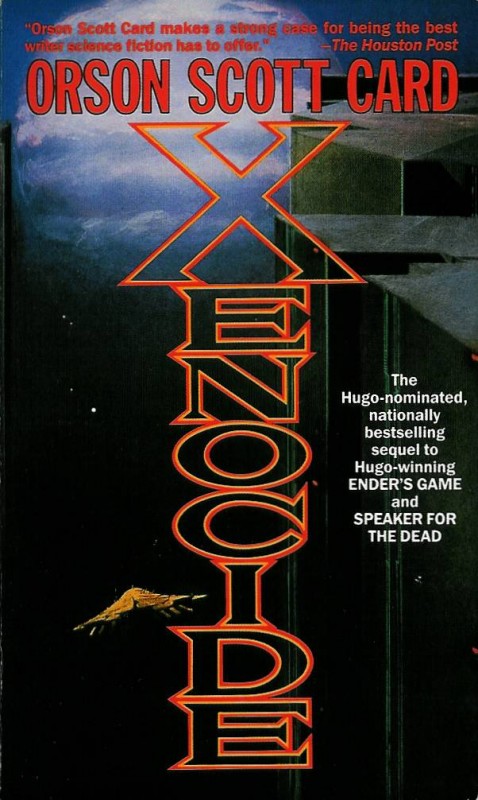
xenocideThis post isn’t just about the third book in the Ender’s Game series–it’s about the genocide of an entire alien race, which is actually a fairly important trope in science fiction.

Of all the evils of our modern era, perhaps the most heinous is the systematic extermination of an entire race or ethnicity.  These acts of genocide not only cross the moral event horizon, they create specters and villains that live on from generation to generation.  Just look at how the Nazis are portrayed in popular culture–even today, they are practically mascots of the ultimate evil.

And for good reason.  There really is something evil about the total annihilation of a foreign culture.  It’s one of the reasons why terms like “genocide” and “ethnic cleansing” are so controversial, especially in conflicts that are still ongoing–and there are so many unresolved conflicts where the systematic and purposeful annihilation of a race or culture is still happening.

Is wholesale genocide a phenomenon unique to our modern age?  Probably not, but modern science has enabled it on a scale that was previously impossible.  This became all too clear to us after World War II.  Only a generation before, great numbers of people believed that we were on a path of progress that would eventually culminate in world peace.  If there was any of that sentiment left, it was shattered with the liberation of Auschwitz and the bombings of Hiroshima and Nagasaki.  Suddenly, we realized that systematic mass destruction and genocide were not only possible, they were a modern reality.

It should come as no surprise, then, that science fiction immediately began to explore this issue.  From Frankenstein to 1984, science fiction has been full of cautionary tales of science gone wrong, issuing a critical voice of warning.  But after 1945, it went much further, exploring the issue in ways that can only be done in a science fictional setting.

Is genocide ever morally justifiable?  In our current world, probably not, but what if an alien race was bent on our destruction?  If their primary objective was the utter annihilation the human race, and negotiation was impossible?  Wouldn’t it be justifiable–perhaps imperative even–to stop such a race by annihilating them first?

This is what is meant by the term “xenocide.” A portmanteau of “xenos,” the Greek word for stranger, and “genocide,” it denotes the complete extermination of an alien race.

Xenocide forms the core conflict of Orson Scott Card’s Ender’s Game series (hence the title of the third book) and features in The Forever War by Joe Haldeman.  Battlestar Galactica presents an interesting twist, where the cylons debate the ethical questions surrounding the complete annihilation of the humans.  And then, of course, there’s all the time travel stories involving Hitler–let’s not even go there.

The interesting thing about xenocide stories is that even though they describe a dilemma that does not currently exist in our modern world, they inevitably come down to issues of Otherness that lie at the very core of the evils of genocide.  In order for xenocide to be morally justifiable, you have to know your enemy well enough to know that there’s no possibility of forging any sort of peace with them.  And to know them that well, they cease to be quite so alien.  It’s one of the major themes in Orson Scott Card’s work–that to defeat an enemy, you have to know them so well that you can’t help but love them.

In our modern world, genocide is only possible when an ethnic group is relegated to the position of Other–when they are made out to be so different and unlike us that we can never possibly relate to or mix with them.  They become “sticks” (Germany), “cockroaches” (Rwanda), “animals” and “barbarians” (Israel).  That is precisely why it makes us uncomfortable in stories about xenocide–because it turns the well-intentioned saviors of humanity into knights templar, or possibly the very monsters they are trying to destroy.

By positing a situation in which genocide might actually be justifiable, science fiction helps us to understand exactly why it is so reprehensible–and that’s only one of the ways in which the genre can uniquely explore these issues.  That’s one of the things I love so much about science fiction: its ability to take things to their extreme logical conclusions, and thus help us to see our own real-world issues in ways that would otherwise be impossible.

Since most of my characters are human, xenocide as such isn’t a major theme in my books, but genocide certainly is.  In the Gaia Nova series, the starfaring Hameji look down on the Planetborn as inferior beings and think nothing of enslaving them and slagging entire worlds.  That’s how Prince Abaqa from Stars of Blood and Glory sees the universe at first, but by the end of the novel he’s not quite so sure.  Stella from Sholpan and Bringing Stella Home also deals with these issues as she comes to realize how it’s possible for the Hameji to hold to such a belief system.

If genocide is one of the ugly skeletons in the closet of this screwed up modern world, then xenocide is science fiction’s way of taking those skeletons out and dignifying them with a proper burial.  By wrestling with these issues in stories set on other worlds, we are better able to humanize the Other and prevent these horrors from happening again on our own.  In this way and so many others, science fiction helps us to build a better world.

V is for Vast

Pale_Blue_Dot

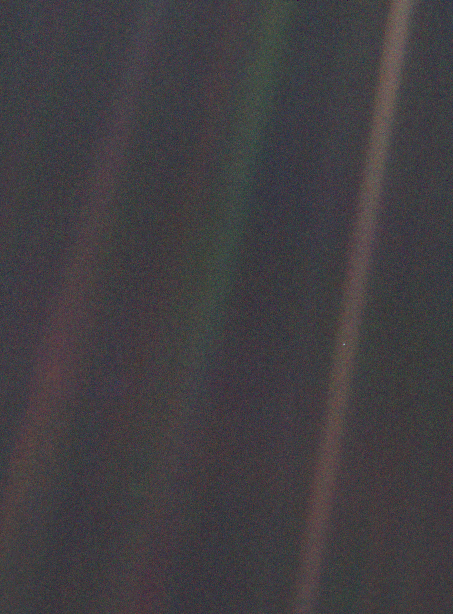
If you don’t know anything else about the universe, you should know this: it’s big.  Really, really, REALLY big.

How big, you ask?  Well, for starters, take a look at Earth in the picture above.  Can you see it?  It’s the pale blue dot in the beam of starlight on the right side of the picture.  As Carl Sagan so famously put it:

From this distant vantage point, the Earth might not seem of any particular interest. But for us, it’s different. Consider again that dot. That’s here. That’s home. That’s us. On it everyone you love, everyone you know, everyone you ever heard of, every human being who ever was, lived out their lives. The aggregate of our joy and suffering, thousands of confident religions, ideologies, and economic doctrines, every hunter and forager, every hero and coward, every creator and destroyer of civilization, every king and peasant, every young couple in love, every mother and father, hopeful child, inventor and explorer, every teacher of morals, every corrupt politician, every “superstar,” every “supreme leader,” every saint and sinner in the history of our species lived there – on a mote of dust suspended in a sunbeam.

The picture was taken by the Voyager 1 spacecraft more than a decade ago.  At the time, the spacecraft was about 6,000,000,000 kilometers from Earth, or 5.56 light-hours.  A light-hour is the distance a particle of light can travel in one hour (assuming it’s traveling through a vacuum).  To give you some sense of scale, in one light-second, a particle of light can travel around the circumference of the Earth seven and a half times.

And lest you think that’s actually a distance of any cosmic significance, consider this: the nearest star, Proxima Centauri, is about 4.24 light-years away.  That’s more than 6,500 times the distance in the photograph above–and that’s just the closest star!

Our galaxy, the Milky Way, is between 100,000 to 120,000 light-years across.  If you were on the other side of the galaxy and had a telescope powerful enough to get a good view of Earth, you would see a gigantic ice sheet over both of the poles with no visible sign of humanity whatosever.  The light from all our cities, from our prehistoric ancestors’ campfires, has not yet traveled more than a fraction of the distance across this galactic island universe we call home.

Seriously, the universe is huge.  If you don’t believe me, download Celestia and take yourself for a spin.  In case you haven’t heard of it, Celestia is basically like Google Earth, except for the universe.  Everything is to scale, and there are all sorts of plugins and mods for exoplanets, nebulae, space probes, and other fascinating celestial objects.

I remember what it was like when I first tried out Celestia back in 2010.  I was at the Barlow Center for the BYU Washington Seminar program, in the little library just below the dorms.  I think it was twilight or something, and I hadn’t yet turned on the lights.  The building had a bit of that Northeast feel to it, like something old and rickety (though not as old as some of the buildings up here in New England).  I turned off the ambient light option to make it look more realistic, and began to zoom out.

Let me tell you, the chills I got as the Milky Way disappeared to blackness were like nothing I’ve felt ever since.  So much space, so much emptiness.  It’s insane.  The vastness between stars is just mind boggling–absolutely mind-boggling.

I got my first introduction to science fiction when I saw Star Wars IV: A New Hope as a seven year old boy.  In the next few years, I think I checked out every single Star Wars novel in our local library’s collection.  It wasn’t enough.  Whenever I was on an errand with my mom, I tried to pick up a new one.  I think they even left some copies of the Young Jedi Knight series under my pillow when I lost my last few baby teeth.

One of those summers, we drove down to Texas for a family vacation.  I picked up the second Star Wars book in the Corellian trilogy, written by Roger Allen McBride.  It was completely unlike any of the other Star Wars books I’d ever read.  In it, Han Solo’s brother leads a terrorist organization in the heart of their home system of Corellia.  They hijack an ancient alien artifact and use it to set up a force field that makes it impossible for anyone to enter hyperspace within a couple of light hours from the system sun.  The part that blew my mind was that without FTL tech, it would take the good guys years to get to the station with the terrorists.

All of a sudden, the Star Wars universe didn’t seem so small anymore.  And it only got crazier.  Roger Allen McBride did an excellent job getting across the true vastness of space.  At one point, Admiral Ackbar mused on just how puny their wars must seem to the stars, which measure their lifespans in the billions of years. For the ten year old me, it was truly mind boggling.

That was my first taste of science fiction that went one step beyond the typical melodrama of most space opera.  And once I had that taste, I couldn’t really stop.  As much as I love a good space adventure, real-life astronomy offers just as much of a sense of wonder.  When a good author combines the classic tropes of science fiction in a space-based setting that captures the true vastness of this universe we live in, it’s as delicious as chocolate cake–more so, even.

I try to capture a bit of that in my own fiction, though I’m not always sure how much I succeed.  In Star Wanderers, the vastness of space is especially significant for the characters because their FTL tech is so rudimentary that it still takes months to travel between stars.  All of that time out in the void can really make you feel lonely–or, if you have someone to share it with, it can bring you closer together than almost anything else.  It’s the same in Genesis Earth, which is also about a boy and a girl who venture into the vastness alone.  The Gaia Nova books lean closer to the action/adventure side of space opera, but the same sensibility is still there.

The best science fiction, in my opinion, both deepens and broadens our relationship with this marvelous place we call the universe.  It’s not just a fantastic setting for the sake of a fantastic setting–it’s the universe that we actually live in, or at least a plausible version of it set in a parallel or future reality.  The universe is an amazing, beautiful place, and my appreciation for it only grows the more science fiction I read.  If I can get that across in my own books, then I know that I’ve done something right.

T is for Terraforming

[NOTE: this post is a reprint of an earlier post from the Trope Tuesday series, which you can find here.]

The fantasy isn’t that Mars could actually look like this, but that NASA might actually get the funding.

One of the problems with interplanetary colonization is that Earth-like worlds are fairly rare (though possibly not as rare as we once thought). In our own solar system, the only other world that comes anywhere close (Mars) is a radiation-blasted desert with only the barest hint of an atmosphere and a surface temperature colder than Antarctica. To get around this problem, you can do one of two things: build an artificial enclosed environment to house the colony, or change the world itself to make it more Earthlike–in other words, terraform it.

The actual science of terraforming is way over my head far too complex to do it justice in this post. Instead, I’ll just point you to the Terraforming Wikipedia page as a starting point and focus on how the concept is used as a story trope.

According to tvtropes and Wikipedia, the term came from a 1942 novella by Jack Williamson titled “Collision Orbit.” The concept of changing the environment of an entire planet actually goes back much further, with H.G. Wells subverting the trope in War of the Worlds (instead of humans terraforming other worlds, the hostile Martians try to xenoform Earth to make it habitable for them). Before the U.S. and U.S.S.R. put probes on the surface of Mars and Venus, it was fairly common for writers to speculate that those planets were able to support human life, at least on a basic, rudimentary level. Once the science showed that that isn’t actually the case, terraforming as a story trope really began to take off.

Today, this trope occurs commonly across all ranges of the Mohs scale. Soft sci-fi stories (such as Firefly) use it as an excuse to have planets that look and feel like Earth. Hard sci-fi stories (such as Red Mars, Green Mars, and Blue Mars) use it as a fundamental premise, or to pose questions like “what is the ultimate destiny of human evolution?” or “how important is it to our species’ survival that we spread out beyond Earth?” Although it’s not something that we as a species have (yet) done, our present science seems to place it well within the range of the plausible, and that means that makes it fair game for any kind of science fiction.

In order to be believable, however, any significant terraforming project requires two things: resources and time. LOTS of time. We’re talking on the order of centuries and millenia here. Because of that, stories that use this trope generally fall into the following categories:

  • The terraforming happened a long time ago and is part of the world’s ancient (or near ancient) history.
  • The terraforming is on-going and directly impacts almost every element of the world’s culture and setting.
  • The terraforming has failed in some way, which may (or may not) make it a key element in the story conflict.

As with generation ships, the scope of this trope spans more than just the interests of a single character–it deals with the ultimate destiny of entire cultures and civilizations. In hard sci-fi stories, the planet that’s being terraformed may actually become more of a character in itself than the individual people who are terraforming it. Unless they have some form of immortality, they have little hope of ever seeing the ultimate end of it.

Of course, that almost makes the project more of a religion to the colonists than a science, with all sorts of interesting philosophical and story implications.

Why is this trope so widespread in science fiction? I can think of a few potential reasons. First, it hits on some of the key issues that lie at the very heart of the genre, such as the ultimate destiny of humanity and the ethical issues surrounding our ability to play God through the wonders of science. Also, it captures the imagination in a way that few other tropes can equal. Because the scope of any terraforming project is so vast, the implications touch on almost every key element of the story, including setting, character, and conflict.

But on an even more fundamental level, it hits on one of the key elements of any fantasy magic system: limitations. We can’t live on an alien world because the conditions are too hostile, but we can’t just wave our hands to make it Earth-like either. We have to undergo a painstaking, laborious process that could unravel at any point and throw everything we’ve worked for into chaos. We have to dedicate our whole lives to the project for dozens of generations before it will ever pay off. There are no shortcuts–none that won’t strain our readers’ suspension of disbelief, anyway. But if it all works out, then we will have created a new Earth–and how is that not magic?

Needless to say, I’m a big fan of this trope. I’ve used it in just about every science fiction story I’ve written, though I probably play with it the most in Star Wanderers. The main character of that story comes from a world where a terraformation project failed, having severe religious implications that drive the whole series. Sacrifice is largely set in orbit around a world that is midway through the terraforming process. Elswhere in the Gaia Nova universe, people build domes just as often to keep humanity from screwing over a terraformed world as they do to provide room to live on one that isn’t. After all this, though, I feel like I’ve only begun to scratch the surface of this trope. You can definitely expect to see it in my work in the future.

K is for Klingon

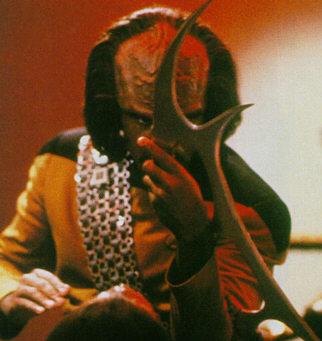
worfAh, the proud warrior race.  Where would science fiction be without it?  From Klingons to Ur-Quans, Wookies to Sangheilis, Mri to Green Martians to Vor Lords, warrior races have been a staple of space opera and space-centered science fiction pretty much since the genre was invented.

The concept behind this trope is the same as the one behind blood knight: honor is more valuable than life, and the best way to win or defend honor is through combat.  It’s not necessarily death that these guys live for, so much as glory and a chance to prove their prowess.  Unlike the always chaotic evil races, these guys usually follow a strict code of honor, sometimes to the point of absurdity.

When taken too far, of course, you get a planet of hats, where everyone has exactly the same values without any kind of depth or diversityFridge logic leads to Klingon Scientists Get No Respect.  After all, how did the Klingons build starships and discover space travel if they’re all constantly fighting each other?

Fortunately, we have plenty of real-world examples for how this sort of thing works.  Lots of human cultures have placed a high value on warrior qualities, including the Spartans, the Samurai, the Vikings, and the Mongols, just to name a few.  Of course, relying on stereotypes may lead to some unfortunate implications, so it’s not a good idea not to have too narrow or ethnocentric a reading of history.  Still, there’s a lot from history that we can glean.

In fact, you could make a valid argument that humans are the quintessential warrior race.  After all, we developed the technology to annihilate our own species before we put a man in space.  Even today, the amount of resources we spend on war and security far outstrips the amount of resources we dedicate to just about any other pursuit.  From the earliest ages, we engage in competitive physical sporting activities that mimic warfare and video games that outright simulate actual combat.  Our everyday language is full of violent terms like “on target,” “wiped out,” and “having a blast,” to the point where most of them are invisible.  Indeed, if we ever make contact with an alien race, we may very well find that we are the Klingons.

In that respect, this trope is just another way that science fiction acts as a mirror through which we can better see ourselves.  The proud warrior race fascinates us because we have so much in common with them.  Klingons are not just faceless orcs for the good guys to slay by the dozen–in many sci-fi universes, they (or individual members) actually become good guys.  Just think of Worf from Star Trek, or The Arbiter from Halo, or Aral Vorkosigan from Louis McMaster Bujold’s Vorkosigan Saga.  While on the surface, these guys seem absolutely crazy, when you start to explore them you frequently find a lot of depth.

I am fascinated by the concept of a warrior race.  I’ve played with it quite a bit in my own work, especially with the Hameji in Bringing Stella Home, Sholpan, and Stars of Blood and Glory.  The Hameji are an entirely spacefaring society that lives on the outer fringes of space, beyond any terraformed planets.  Because they live entirely on spaceships, they must capture and repurpose new spaceships just to have enough living space to expand their families.  Since their battleships also house their families, they make no distinction between military and civilian, and live by an extremely rigid social hierarchy with the patriarchal captain at the top and everyone else under his command.  Life is a privilege, not a right, and disobedience is strictly punished since it has the potential to put everyone’s life at risk.

As a result of all this, the Hameji are extremely vicious and warlike, living by a moral/ethical code that runs completely counter to our modern sensibilities but makes perfect sense to them.  They think nothing of slagging entire worlds and killing billions of people because to them, a world is a giant starship, and all those billions of people are so many enemy warriors.  They look down at the planetborn as weak because of their lack of discipline and obedience, and think nothing of enslaving them due to their strict social hierarchy.  In fact, because resources are limited and life is a privilege granted by the ship’s captain, the Hameji prefer to space their prisoners rather than keep them alive.

Man, those books were fun to write. 😀 Brutal, but fun.  Because the weird thing is, as much as you abhor a culture whose values contradict your own, when you really understand them, you can’t help but feel something of a connection.  You might not love them, but you respect them, and in a strange sort of way sympathize with them.  I’m not sure if that’s the experience with the Hameji that my readers have had, but that’s definitely been my experience in writing them.

So yeah, I’m definitely a big fan of the proud warrior race.  Expect to see me play with it many more times in the future.

F is for Faster Than Light

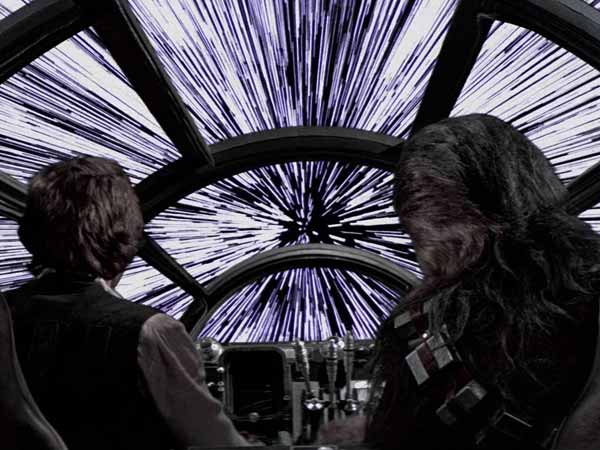
falcon_startrailsRemember that moment in Star Wars when the Millennium Falcon went into hyperspace?  When Harrison Ford shouted “go strap yourselves in, I’m going to make the jump to light speed,” and the sky lit up as the stars streaked by?  That was my first introduction to faster-than-light (FTL) travel, and I haven’t looked back since.

FTL is a major recurring trope in space opera, and not just because of how cool it is.  If you’re going to have a galactic empire, you need some way to get around that empire–or at least some way to transmit information without too much difficulty.  The distance between star systems is measured not in miles or kilometers, but light years–that is, the distance that a particle of light can travel in one year.  Considering how the nearest star to Earth, Proxima Centauri, is ~4.24 ly away, you can see the need for some sort of magical technology to bridge the distance.

FTL travel comes in four basic flavors:

  • Warp Drives — The ship breaks the speed of light as easily as our modern fighter jets break the speed of sound.  Impossible to justify, except through hand-waving.  The most prominent example of this is Star Trek.
  • Jump Drives — The ship disappears from its current position and reappears somewhere else.  Also requires hand-waving, but is at least a little easier to justify.  Battlestar Galactica is a good example of this, as is Schlock Mercenary.
  • Hyperspace Drives — The ship enters an alternate dimension which allows it to travel faster through our own.  The alternate dimension is called ____space, usually “hyper” but also “quasi,” “x,” etc.  Star Wars is the classic example, though Star Control II took things a step further by having a hyperspace dimension within hyperspace.
  • Wormgate Network — The ship (or maybe just the passengers) enters a portal which transports it to a portal somewhere else.  A network of these portals allows travel throughout the galaxy.  Stargate and Babylon 5 use this method.

An alternate way to do it is to make FTL travel impossible, but hold the galactic empire together through FTL communication.  This technology, known as the ansible, features prominently in Ursula K. Le Guin’s books and the Ender’s Game universe.  It has some really interesting implications: for example, even though planets can communicate instantaneously with each other, it takes almost 40 or 50 years to go from one to another, but at near-light speeds, it feels as if only a few months have gone by.  Thus, if you’re going to travel to another world, you have to leave everything behind, including your family and loved ones.  By traveling from world to world, you can skip entire generations, spreading your natural lifespan across thousands of years of normal time.

In writing FTL, one thing you have to be really careful about is to keep in mind ways in which the system can be abused.  For example, if jump drive technology makes it possible to instantaneously transport anything anywhere in the universe, then you can bet that someone is going to send a bomb into the White House (or whatever the equivalent is in your fictional universe).  Thus, the invention of unrestricted jump drive technology will lead to a very short and brutal war.

This actually happened in Schlock Mercenary, and the solution was Terraport Area Denial (TAD) zones, or broad areas of space where a force field prevents anyone from either jumping in or out.  Thus, anyone who wants to visit a planet in a TAD zone has to jump to the edge of the field and travel the rest of the way at sublight speeds.

FTL isn’t always appropriate for a science fiction story.  If the story is supposed to lean more toward hard sf, then it’s probably better to stick with our current understanding of the rules of physics, which state that nothing can travel faster than the speed of light.  Still, with things like quantum entanglement and other recent discoveries, if you know the science well enough, even the speed of light might not be an upper limit.  But for the rest of us mortals, FTL is basically just magic–a sufficiently explained magic, perhaps, but magic nonetheless.

Personally, I’m a fan of the jump drive form of FTL.  That’s the one I use the most in my own books.  The cost is that the further distance you try to jump, the harder it is to pinpoint exactly where you’ll end up.  To overcome this, you can use jump beacons to draw out anyone trying to jump into your particular sector and have them exit jumpspace next to the beacon.  This comes in handy in combat, when the enemy tries to jump a nuke onto your ship.

In the later Gaia Nova books, FTL is facilitated by jump stations spread out in a line across space, with reactors powerful enough to jump ships rapidly to the next point along the line.  In the earlier Star Wanderers books, that technology hasn’t been invented yet, so there’s still an Outworld frontier.

It gets kind of complicated, but it’s lots and lots of fun to world build.  For example, how does a particular change in the FTL tech alter the galactic balance of power?  When settlers try to colonize a new system, what do they establish first–starlanes, jump beacons, Lagrange outposts, or what? As with any magic, changing one thing affects everything else, which also affects everything else, which … yeah, you get the picture.

E is for Empire

terran_empireAlmost every far future science fiction story has a galactic empire of some kind.  From Dune to Foundation, from Star Wars to Firefly, there’s always someone trying to rule the galaxy, often in a way that makes life difficult for the protagonists.

Why?  Rule of drama, of course, but also because it gives the story a truly epic scope.  Just as the classics such as Homer’s Iliad and Tolstoy’s War and Peace are as much about entire civilizations as they are about the people characters within them, so it is with science fiction, especially space opera.  Combine that with science fiction’s forward-thinking nature, and you have the potential for some truly amazing stories about humanity’s destiny among the stars.

But why empire?  Because even if we make it out to the stars, we’ll probably still take with us all of the baggage that makes us human.  Science fiction may be forward looking, but history repeats itself, and you can’t have a clear view of the future without understanding and acknowledging the past.

Not all galactic empires are evil, but most of them are.  We shouldn’t have to look further than the real-world history of Imperialism to see why.  Oppression, exploitation, slavery, genocide–all of these have been done in the name of Empire, and many more evils besides.  Even benevolent hegemonic powers (such as, I would argue, the United States of America) often end up doing great harm, either through action or inaction.

Of course, all of this makes for some really great stories.  When Asimov wrote his Foundation series, he quite literally based it on The History of the Decline and Fall of the Roman Empire by Edward Gibbon.  When Frank Herbert wrote Dune, he drew extensively from his background as an orientalist and based the overworld story on the Muslim conquests of the 7th and 8th centuries.  Star Wars is based loosely on the collapse of the Roman Republic, and Firefly echoes many of the old Western tales of former Confederate soldiers heading west after the US Civil War.

It’s worth pointing out that the Galactic Empire is by no means the only form of political organization in space opera.  There are actually several, including:

  • The FederationA loose organization of stars and planets that usually exists to foster cooperation and mutual peace between galactic civilizations.  Rarely evil, but can be crippled by red tape.
  • The RepublicA more centralized version of the Federation, typically.  Exercises more control over its citizens, but not in an oppressive way.  Usually features some form of representative government.
  • The AllianceA team of political underdogs united to overthrow the Empire and establish a more just form of government in its place.  If they win, they usually become the Republic or the Federation.
  • The KingdomA smaller government within the larger political system, often struggling for survival against more powerful forces. Not always democratic, but is often good, at least to its own citizens.
  • The Hegemonic EmpireLike the Empire, but rules primarily through soft power, ie co-opting their enemies rather than crushing them.  May overlap with the Republic or the Federation.
  • The People’s Republic of TyrannyThe Empire pretending to be the Federation.
  • The Vestigial EmpireWhat the Empire becomes when it’s been defeated but not yet destroyed.  Still oppressive and evil, but rules a smaller territory and struggles for relevance and survival.
  • The RemnantAn element from the Alliance that’s gone rogue.  The war may be over, but these guys are still fighting it, even if they’ve lost sight of what they’re fighting for.
  • The HordeA highly aggressive and expansionist warlord state.  By far the most violent and brutal of any political organization, it seeks to conquer and subjugate the entire galaxy.

As a political science major, all these forms of government really fascinate me.  I’ve played with quite a few of them, especially the Horde (Bringing Stella Home), the Empire (Desert Stars), the Hegemonic Empire (Star Wanderers), the Kingdom (Stars of Blood and Glory), and the Remnant (also Stars of Blood and Glory).  You can definitely expect to see me play with them again in the future.