Is Gunslinger to the Stars for You?

Gunslinger to the Stars is a character-driven space opera novel that blends Western adventure, first-contact science fiction, and pulpy action. It’s fast-paced, voice-driven, and built around a loyal, reluctant hero navigating a dangerous galactic frontier. It’s told in the unmistakable voice of Sam Kletchka—half gunslinger, half star-hopping troubleshooter, and 100% fun.

What Kind of Reader Will Love This Book?

If you like…

  • Classic space adventure with modern voice and humor, where the hero solves problems with grit, guts, and an outrageous arsenal of lovingly described guns
  • Found-family dynamics between a rough-around-the-edges gunslinger, a principled xenolinguist, a telepathic outcast, and a trio of shapeshifting empaths
  • Galaxy-spanning mysteries, alien politics, and first-contact stakes that push characters to their limits
  • The feel of a Western gunslinger dropped straight into a richly imagined galactic frontier

…then Gunslinger to the Stars is absolutely your kind of story.

What You’ll Find Inside

Gunslinger to the Stars (Book 1 of the Gunslinger Trilogy) follows Sam Kletchka, a New Texas gunslinger stranded in the Gorinal Cluster just as the local jumpgate—the only way out—mysteriously goes dark. What starts as a simple job escalates into a battle for survival involving hidden alien races, shape-shifting empaths, worldships, and a rising threat the Immortals never wanted anyone to discover. The tone blends wry humor with escalating danger, and the style is fast-paced, voice-driven, and cinematic—equal parts action romp and big-idea sci-fi. The result is a story that feels both classic and fresh: a pulpy, heartfelt adventure that’s as much about loyalty and moral clarity as it is about space battles and exotic technology.

What Makes It Different

Fans of Firefly and Schlock Mercenary will recognize the snappy banter, the found-crew dynamic, and the blend of humor with high-stakes action. But Gunslinger to the Stars pushes those familiar ingredients in new directions: the gunslinger-as-space-ranger angle gives the book a distinctive American-frontier voice, while the empath culture, the Immortals’ centuries-deep manipulations, and the emergence of the Draxxians create a myth-arc that feels simultaneously expansive and personal. Where many space operas lean on military hierarchy or techno-fetishism, this one leans into character, moral philosophy, and the uneasy tensions between peacekeeping and necessary force—all told through Sam’s dry, self-aware perspective.

This story blends classic space western tropes — the reluctant hero, the ragtag crew, and the dangerous frontier — with a deeper mystery about ancient alien powers. If you enjoy space western stories with a strong first-contact throughline, you’re going to enjoy this book.

What You Won’t Find

If you’re looking for grimdark bleakness, heavy technobabble, or a cynical antihero who never grows, this isn’t that. And if you want romance-heavy sci-fi or endless political intrigue, this book doesn’t go down those roads either. But if you want hopeful, character-focused adventure with humor, heart, and a hero who takes responsibility for his choices—sometimes reluctantly—you’ll feel right at home.

Why I Think You Might Love It

I wrote this story at a time when I needed to shake things up creatively, by writing something fun, energetic, and different from what I had been writing at the time. I was also going through a time when my worldview was changing, and I was questioning a lot of my old assumptions. This book grew out of a number of things: from my conversations with close friends, my love of classic pulp sci-fi, and from the idea of a lone wanderer who tries—however imperfectly—to do the right thing. The result, I believe, was a book with a lot of heart that captures that spark of wonder that made me first fall in love with science fiction. If that’s what you’re looking for, I think you’re going to love it!

Where to Get the Book

Related Posts and Pages

Explore the series index for the Gunslinger Trilogy.

Visit the book page for Gunslinger to the Stars for more details.

Read about moral courage in Gunslinger to the Stars.

See all of my books in series order.

Author’s Note for THE JEREMIAH CHRONICLES

SW-TJC (thumb)Here’s the author’s note at the end of Star Wanderers: The Jeremiah Chronicles.  It’s the only content in the omnibus that isn’t available anywhere else, and I don’t want my readers to feel like they have to buy something they’ve already read in order to get it.  And if you do want to buy it, there’s a link in the sidebar over there. ———–>

I put an author’s note at the end of every ebook I publish.  It adds a little bit to the progress bar, which can be annoying for readers who expect “the end” to come at 100%, but I think it’s good to briefly tell the story behind the story.  It’s certainly something that I would enjoy reading at the end of some of my favorite books (especially the ones by David Gemmell!).  Whether you read them or whether you skip over them, it’s a feature I plan to keep in every ebook I release.

So, here it is!

==================================================

One of the questions writers get asked the most is ‘where do you come up with your ideas?’ Honestly, that’s probably the hardest question to answer. Orson Scott Card said that everyone runs across at least a thousand story ideas each day, and a good writer will see maybe three. To that, I would add that it might take years before you realize that you’ve seen them.

The idea that eventually grew into Star Wanderers probably came to me the first time I saw Serenity. At the beginning of the movie, there’s this long continuous shot that shows the space ship from the hangar bay doors to the cockpit. I don’t even remember what the characters were talking about, I was just mesmerized by that shot. For weeks, I dreamed about having my own starship like the Serenity, where I could escape the stresses of college and lead an adventurous life out among the stars. I still daydream about it to this day. Having my own starship and piloting it to places where I can be free and independent is one of my greatest recurring fantasies.

Another major catalyst for the idea that became this story was the Lombardo translation of Homer’s Odyssey. The Odyssey is perhaps the most famous epic work of all time, but the Lombardo translation struck a particular chord with me because of how down-to-earth and accessible it is. Instead of some stodgy 19th century translation that passes for cruel and unusual punishment in some high schools, this one made the story come alive. I was first introduced to it in a Western Civ class in college, but enjoyed it so immensely that I picked up a copy over the summer of 2009 and read the whole thing.

As I read it, I couldn’t help but notice the potential for a science fiction crossover. What if the sailing ships were starships, and the oceans the vastness of space? The islands would be like planets, with their strange and exotic cultures, and travel from world to world would be as arduous and difficult as it was for Odysseus to return to Ithaca. A new form of paganism would emerge, one that worshiped the stars and planets just as the Greeks worshiped the rivers and trees. The starfaring people would be as hardy and self-reliant as the ancient Greeks, and as antagonistic toward the more civilized Coreward peoples as the Aegeans to the Trojans. Most importantly, though, the starfarers would feel a sense of powerlessness as they faced the unforgiving vastness of space, just like Odysseus as he braved the wine-dark sea.

I actually started writing that novel in 2010, and got about a hundred pages into it before moving on to the revisions for Bringing Stella Home. Later, I trunked it, but the basic world-building stayed with me as I continued to expand the Gaia Nova universe with Desert Stars and Heart of the Nebula.

The final catalyst for Star Wanderers was the love story from one of my favorite Westerns, Jeremiah Johnson. My college roommates introduced me to that movie my sophomore year, and just like Serenity, I spent the next several days daydreaming what it would be like to be a mountain man. I went to college in Utah, so the frontier landscape where the film was shot is very familiar to me (in fact, I’m writing this author’s note from Slide Canyon just outside of Provo). But the love story—that was the best part. An accidental marriage from a cultural misunderstanding that blossoms into something touching and wonderful, in spite of the language barrier—by far, that was my favorite part of the whole movie.

All of these ideas were bouncing around somewhere in the back of my mind for years, but it wasn’t until 2011 that they all came together. I had graduated about a year and a half before, and was working a number of low-skilled temp jobs, trying to make ends meet as I grew my writing career. I was between projects, trying to work on Edenfall (sequel to Genesis Earth), but nothing was coming together and I just felt very frustrated.

One day, as I was lying on my bed daydreaming for the umptieth time about escaping this planet on my own starship, the thought “what would Jeremiah Johnson look like if it were set in space?” came to me. It was like a supernova exploding in my mind, illuminating my imagination with the power of an exploding star. For the next half hour, I worked through all the details in my head—the famine backstory of Megiddo Station, the Oddysey-like far-future space setting, the wandering lifestyle of the mountain man turned starship pilot. And then, once I’d replayed it half a dozen times in my head and worked myself up to a fever pitch, I rolled out of bed and wrote the first chapter of Outworlder almost exactly as it now stands. The rest of that novelette came just as readily, and in a couple of weeks I had a finished draft.

As a young single guy in my early twenties, I tend to think about love and relationships a lot. I think it’s a myth that women are somehow more interested in romance than men—we just express that interest in different ways. At Worldcon 2011 in Reno, Louis McMaster Bujold said that women tend to write about love and life, whereas men tend to write about love and death, and I’ve found that to hold very true, at least in my own writing. Perhaps that’s why it was so easy and natural to come up with the backstory that put Noemi on Jeremiah’s starship. The rest, with the pregnancy, the polygamy issues, and the baby at the end, all came naturally as I wrote things out. I was originally going to have Noemi miscarry about halfway through Fidelity, but realized almost immediately that that wasn’t going to fly. Once I realized that the natural ending of the story arc would be the birth of their son, everything else just came together.

My goal from the beginning was to write something that I could submit to the Writers of the Future contest. For that reason, I kept Outworlder fairly short. However, when I got to the end, I realized that there was still a lot of story left unwritten, so I decided to follow it out. I’m more of a novel writer than a short story writer, so it was natural to structure the overall story arc in that way. At the same time, I really enjoyed the intimacy of that first novelette, and the way that the shorter structure allowed me to focus on one or two characters and their relationships with each other. Those were all considerations that pushed me into following the novella format, as well as the chance to experiment with publishing a series of shorter works.

Fidelity and Sacrifice were a lot more challenging to write, in particular Sacrifice. Part of this was because I was still trying to figure out where the overall story arc was going, and part of it was because some of the subject matter (such as polygamy) seemed pretty unconventional for a science fiction story. But after taking a couple of short breaks to work on other projects, I managed to push through it, eventually getting to Homeworld which came much more easily. I’ve always been better at endings than at middles, and I went into Homeworld knowing that it would conclude Jeremiah’s main story arc.

As I was working on the later parts to the Star Wanderers series, I moved to the Republic of Georgia to teach English for a year. That had a tremendous impact on how I wrote the language barrier between Jeremiah and Noemi, mostly because my experience was quite similar. I didn’t accidentally marry a Georgian girl (though there are one or two who I still miss sometimes), but when I showed up in the airport in Tbilisi, I didn’t speak a word of Georgian and knew almost nothing about the people or the country. Needless to say, it was quite an adventure. The stresses of living in a foreign culture did slow down my writing a bit, but I managed to get it back by the end and finished Homeworld before coming back to the States for the summer.

When I first started publishing the Star Wanderers series, I saw it as a sort of side project that I would do before getting back to other projects. However, this series has proven to be more popular than any of my other books, so I’ve decided quite happily to expand it. The Jeremiah Chronicles contains the full story arc for Jeremiah, but there are a lot of other characters who I want to explore, and the novella format is perfect for that. If you have any in particular that you’d like to revisit, feel free to shot me an email at joseph [dot] vasicek [at] gmail [dot] com and let me know. I love getting fan mail and do my best to respond to it, so any comments would definitely be appreciated.

If you’ve just discovered Star Wanderers and would like to keep up with the newest books in the series, you can get them for free by signing up for my mailing list. Whenever I release a new Star Wanderers story, I put out a two-week coupon code to get it for free on Smashwords and send the coupon code out to my subscribers via my email newsletter. That way, you don’t have to feel like you’re spending too much once I have fifteen or twenty ebooks out. I figure that if you enjoy these stories enough to sign up for the mailing list, you’ll probably tell a friend or post a favorable review, so I’m happy to make my new Star Wanderers releases available for free.

I hope you enjoyed this omnibus! If you did, please consider posting a review or sharing it with a friend. Every little bit helps, and the more people discover and read this series, the more stories I’ll be able to write. My goal from the beginning has been to make a living telling stories that I love, and it looks like Star Wanderers might actually make that possible.

In the meantime, don’t be a stranger—you can find me on Twitter (@onelowerlight), Goodreads, or Facebook (Joe Vasicek), but the best way to keep up is to follow my blog, One Thousand and One Parsecs. I’ve been blogging since 2007 and plan to keep it up for the foreseeable future. You can also find links to all my books there, on all the major sites where they’re published. And of course, if you want to sign up for my mailing list, you can find the sign-up form on the sidebar.

That’s just about it. Thanks for reading! It’s readers, not writers, who really make a story come alive, and at the end of the day the greatest honor is simply to be read. So thanks for taking a chance on this one, and until next time, I hope to see you around!

W is for Wagon Train to the Stars

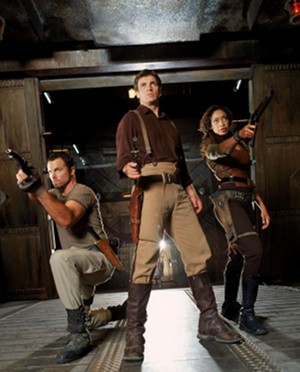
big_damn_heroes_moment_smallWhen Gene Roddenberry pitched the original Star Trek series back in the 60s, Westerns were all the rage.  Consequently, he pitched his show as a “wagon train to the stars,” where a bunch of quirky characters on an awesome starship travel from adventure town to interstellar adventure town, exploring and pioneering the final frontier.

Sound familiar?  Yeah, I thought so.  The concept proved so catchy that it’s been redone time and again, from Battlestar Galactica to Firefly to Doctor Who.  Even though Westerns aren’t nearly as popular as they used to be, many of its tropes are so well suited to Science Fiction that they drive the genre even today.

For example, adventure planets.  In a typical Western, the characters travel from town to town, with a different adventure in each one.  Well, in Science Fiction, the characters do the same thing, except that they’re traveling from planet to planet.  And really, if you’ve got the ability to travel to other worlds, how can you not have an adventure in each one?

A large reason for the Western / Science Fiction crossover is the whole concept of space as the final frontier, which we explored earlier in this series with I is for Interstellar.  There’s a very real sense of manifest destiny in the space exploration community, not because of humano-ethnocentrism (heck, we don’t even know we’re not alone in our local stellar neighborhood), but to ensure humanity’s long-term survival.  The parallels between that and the westward movement in 19th century America aren’t perfect, but they do exist.

Similarly, as we explored in R is for Rebel, the notion of space as the final frontier has a special resonance with the American audience.  The days of the old frontier may be over, but its spirit lives on in our culture, from guns to road trips to our glorification of the rugged, self-made individual.  Today’s Science Fiction, especially the space-focused SF of Space Opera, grew out of the adventure fiction of the pulps, which thrived on that frontier American ethos.

In fiction, the frontier can still be found in two major genres: the Western, which is historical and therefore more backward-looking, and Science fiction, which is futuristic and therefore more forward-looking.  Because Science Fiction isn’t burdened with all of the historical baggage of the traditional Western, it’s a much more flexible medium for story, readily adaptable to contemporary issues and concerns.

For example, where Star Trek echoes the large-scale nation to nation conflicts of the Cold War (Federation vs. Klingons and Romulans), the new Battlestar Galactica series echoes the much more asymmetrical conflicts of the post-9/11 world (Cylon agents who are indistinguishable from humans and may not even know that they are cylons).  At the same time, the wholesale co-opting of Western tropes enables a latent sense of nostalgia, evident in the look and feel of Firefly, or the famous opening lines from Star Wars: A long time ago in a galaxy far, far away.

My first real experience with a wagon train to the stars type of story was probably Star Trek: Voyager, which I watched religiously with my dad every Wednesday night until maybe 9th or 10th grade.  The Western-borrowed tropes are somewhat more muted in that series, but they exist, especially the planetville / adventure towns stuff.  However, it wasn’t until Firefly and Serenity that I really experienced the awesomeness of a true Space Western.  There were a lot of things in Firefly that I really loved, especially the character interactions, the gun-toting action scenes, and especially the starship Serenity.  There were some things I didn’t like so much, like the fact that every planet is basically Wyoming, but overall I really enjoyed the show.

It wasn’t until I started getting more acquainted with straight-up Westerns that I saw the real potential for crossover between the genres.  Stories about mountain men like Jeremiah Johnson really captured my imagination–what would this look like if it were set in space?  In that sense, I came to the Space Western more from the classic Science Fiction side first, rather than the pulp adventure stuff.  But once I discovered the crossover connection, it naturally found a way into my own work.

That’s basically how the story idea for Star Wanderers first came to me.  I was lying on my bed, daydreaming about having my own starship like the Serenity, when I wondered what it would be like for a starship pilot to get roped into an accidental marriage like in the movie Jeremiah Johnson?  The collision between the two ideas was like a supernova exploding in my brain.  I rolled out of bed and started writing, coming up with chapter one of Outworlder almost exactly like it’s written today.  And the more invested I became in those characters and that world, the more the story grew.  I’m writing Part VII right now (Reproach, from Noemi and Mariya’s POV), and so long as people read them I’ll keep writing more.

Genre mash-ups and crossovers are a great way to keep things fresh and come up with some really interesting stories.  Some genres aren’t very well suited for each other (Erotica and Middle Grade, for example), but others come together so well that they seem almost complementary.  That certainly seems to be the case with Westerns and Science Fiction, at least here in the United States where the spirit of the frontier still echoes through the popular culture.

R is for Rebel

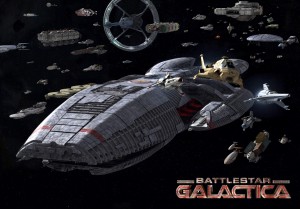
rebel_allianceJust as sprawling interstellar empires are a staple of space opera, so are the plucky rebels that fight against them.  From Star Wars to Battlestar Galactica, Firefly to FTL, there’s no shortage of characters in science fiction trying to stick it to the man.

I’m not sure how it is in other cultures, but in America, it seems like science fiction upholds a host of values closely related to rebel tropes, such as self-reliance, individualism, freedom and independence, frontier justice, enterprising self-made men, etc.  A lot of this probably grew out of the genre’s early ties with pulp-era adventure fiction, which often featured former Confederate soldiers leaving the civilized world for the realms of adventure following the US Civil War.  That’s certainly the case with John Carter in A Princess of Mars, and echoed to some extent with the Browncoats from Firefly.

It may go even further, though, to the revolutionary origins of the United States itself.  The frontier has always loomed large in our culture, shaping our values in the early days of settlement and, now that the age of the frontier is largely over, standing for an idealized nostalgic past.  Americans have always favored the self-made individual who stands up to injustice and corruption in high places, and we’ve always had an aversion to the centralization of power and authority.

Back in the days of the Cold War space race, when writers like Heinlein and shows like Star Trek really started to popularize the genre, there seems to have been a real push to promote American identity and values.  The science fiction of that day certainly got caught up in all that, which is weird because as pro-Americanism became the establishment, a genuinely rebellious counterculture began to push back.  To its credit, though, there was plenty of science fiction that embraced the counterculture, especially in the New Wave movement that followed the Golden Age.

So why are we so enamored with rebels?  Probably for the same reason that we all love a good rogue.  Since space is the final frontier, it’s naturally the kind of place that would attract a more rugged, individualistic type.  At the same time, rogues and rebels are much more likely to have exciting adventures than the more mild-mannered folk who are apt to stay at home and conform.  Let’s not forget that most people who read science fiction are adolescent boys (of all ages), hungry for adventure and often a little rebellious themselves.

Though the rebels are often the good guys, that’s not always the case.  It all depends on who they’re fighting against, and how black and white the story is trying to be.  If they’re fighting against the Empire, then they’re almost always courageous freedom fighters standing up for truth and justice and all that, but if they’re fighting against the Federation, things can be a lot more gray.  In FTL, for example, the rebels are the outright antagonists, and you have to save the galaxy by defeating them.

The rebels don’t always win, either.  In stories like Star Wars that skew towards idealism, then in the end they usually do, but in darker, grittier tales (such as most cyberpunk), they may or may not.  And even in some happy-go-lucky adventure stories, the rebels are apt to be martyrs for a lost cause–again, think of the Browncoats from Firefly.

The wide variety in the role of rebels in science fiction is a good indication of a healthy, vibrant back-and-forth in the genre that’s been going on for some time.  It also means that there’s plenty of room for a new writer to take these old, worn tropes and shake them up in a new and exciting way.  As much as we love Luke Skywalker, we love Han Solo just as much, and if you combine him with John Carter to get Mal, then you’ve got a rebellious character that a whole new generation can come to know and love.

I love playing around with these tropes, and do so quite often in my own fiction.  In Bringing Stella Home, James McCoy is very much a rebel, though it’s not the Hameji that he’s fighting against so much as everything standing between him and his brother and sister.  In that sense, he’s kind of a martyr without a cause, a determinator who shakes his fist at the universe even when the more sensible thing is to learn how to cope.  Similarly, Danica and her band of Tajji mercenaries all fought in a failed revolution and have been wandering the stars ever since.  Their backstory features much more prominently in Stars of Blood and Glory, in which things come around full circle.  And then, of course, there’s Terra from Genesis Earth, who isn’t about standing up to the man so much as giving him the finger and running off somewhere where none of that even matters–the frontier ethic taken to its furthest extreme.

So yeah, I’m a fan of this trope, and have been ever since I saw Star Wars and fell in love with the genre.  You can definitely expect to find lots of rebellious characters throughout my books in the future.

P is for Planets


Gliese 581 by ~arisechicken117 on deviantART

One of the best things about a good science fiction story is that it can take you to another world–literally!  Well, not in the sense of actually physically taking you there, but if you want to experience the thrills of an alien world from the safety of your favorite chair, the best way to do it is to immerse yourself in a good space adventure story.

Planets are to science fiction what islands and continents are to fantasy.  It’s possible to tell a story where no one ever sets foot on one, but then you’ve basically got a sea story (since space is an ocean, at least in most space opera).  Even then, your characters are probably going to put into port from time to time, if for nothing else than a change of scenery to make things interesting.  And if there’s anything science fiction interesting, it’s the wide variety of possible planet types.

For example, what would a planet be like if it were covered completely by water?  If the world-ocean was so deep that there was no visible land?  Assuming that the planet orbits within its sun’s habitable zone, where the temperature ranges allow water to exist as a liquid, then you would have a pretty interesting place.  What would the hurricanes be like?  A lot more intense than the ones here on Earth, that’s for sure.

Then again, suppose that the planet was a bit closer to its sun, and most of that water existed in the atmosphere as a gas.  You’d have some pretty intense atmospheric pressures on the surface, but the density of the atmosphere would make it much easier to keep airships and flying castles aloft.  In fact, that might be the most practical way to settle that kind of a world.

In our own solar system, there is an incredible amount of variety.  On Mars, for example, glaciers of dry ice cover the southern pole, while the sun sets blue in a normally dirty brown sky.  The tallest mountain actually summits above the atmosphere, and every few years, dust storms cover the whole world.  And believe it or not, Mars is a lot more similar to Earth than anything else in our solar system.

On Titan, rivers of liquid methane flow down mountains of water ice, while black carbon dunes drift across a desert shrouded in orange haze.  While the sun rises and sets with predictable regularity, the planet Saturn is suspended at the same point on the horizon and dominates a large portion of the sky.  Don’t expect to see any rings, though–Titan orbits along Saturn’s ring plane, so the rings are mostly invisible.

Europa, one of the four Galilean moons of Jupiter, is also dominated by its host planet.  Water ice covers the surface, but deep, deep below, there’s a massive liquid ocean that has never seen the light of the sun.  What sort of monsters lurk in those depths–an ocean buried beneath a world?

Jupiter itself is pretty intense.  A gas giant world with swirling bands of planet-sized clouds, it hosts a monstrous hurricane large enough to swallow at least two Earths.  This vortex has been churning across the planet for over 150 years, and possibly as much as 350.  I still remember the chills I got when I read 2001: A Space Odyssey, and the scientists’ probe dropped through the haze to a cloud deck as massive as one of our continents here on Earth.

Gas giant planets can be really interesting.  They aren’t human habitable, since the gravity and pressure are so intense that anything man-made would be crushed before it could hit the surface, but those same forces can lead to some other interesting things.  For example, at the lower levels, you may find storms that rain diamonds.  Go further still, and you find an intense magnetic core that’s just on the verge of being able to sustain nuclear fusion.  Detonate enough nuclear material down there, like they did in a short story from the Halo universe, and you can turn the planet into a star.

And that’s just our solar system.  What about the hundreds of exoplanets that astronomers are now discovering?  The first one to be confirmed, believe it or not, was orbiting of all things a pulsar!  Imagine that–instead of the life-giving rays of a sun, the planet is bathed in highly lethal X-rays and gamma rays.

Of course, there are plenty of planets orbiting stars like our sun, but most of the ones discovered so far are hot Jupiters–gas giant worlds that orbit so close to their sun that the years are measured in hours.  Some of these planets are so close that the sun is actually blasting the atmosphere away.  We haven’t discovered the rocky core of a gas giant world that’s been destroyed in this manner, but theoretically it could exist.

Or what about the planets with highly elliptical orbits that traverse the habitable zone of their stars?  Imagine: a world where the winters are so cold that the oceans freeze solid.  After several of our Earth years, the spring brings a massive thaw.  For a few short months the weather is actually quite balmy.  Then, as spring turns to summer, the heat grows more and more intense, until the oceans begin to boil!  When the summer reaches its zenith, the planet is nothing but a scorched desert wasteland.  Soon, though, the autumn cool brings back the rains, with storms so intense that they refill the oceans in just a matter of months!  Then, the deep freeze of winter begins, and the world returns to its long icy tomb.

One of my favorites, though, is the ribbon world that Asimov predicted in some of his stories.  Worlds like this occur most commonly at class M red dwarf stars, which are so cool compared to our sun that planets within the habitable zone are tidally locked.  This means that the sun neither rises nor sets, but remains stationary in the sky.  The day side is burning hot, with either a barren desert wasteland or a giant hurricane large enough to cover most of the hemisphere.  The night side, on the other hand, is so cold that all the water is completely frozen.  The only habitable parts of the planet exist in a ribbon-like swath where the sun is just on the other side of the horizon, casting the land in perpetual twilight.

Believe it or not, we’ve actually discovered a planet like this in the Gliese system.  Gliese 581g, or “Zarmina’s World” as the lead astronomer dubbed it, was discovered back in 2010.  I was so excited by the discovery that I dedicated a blog post to it.  Since then, the findings have not yet been confirmed, so it isn’t safe to call it a planet for sure, but if/when it ever is confirmed, it may be one of the first truly Earth-like planets to be discovered (at least, as Earth-like as a ribbon world can be).

In much of science fiction, there’s a tendency to make planets single biome only.  Thus, you have your desert planets (Arrakis, Tatooine, Gunsmoke), your ice planets (Hoth, Gethen), your ocean planets (Calamari, Aqua), your jungle/forest planets (Dagobah, Lusitania, Kashyyyk), and even planets that are nothing but giant cities (Trantor, Coruscant).  Some of the more recent series like Halo try to avert this, but even today it’s still fairly common.

If there’s anything that modern astronomy is showing us, though, it’s that the variety of planets and worlds out there is beyond anything we could possibly imagine.  This is why I get a bit irked when an otherwise excellent series like Firefly makes out every planet to be like Wyoming.  What about Gliese 581gKepler 22bGJ 1214bKepler 16b?

As more exoplanets are discovered, I can’t help but believe that science fiction is going to experience a paradigm shift.  What was once purely the realm of imagination is now being confirmed as reality.  Alien worlds exist–alien Earths, even.  And just as our conception of Mars changed from the Sword & Planet tales of Edgar Rice Burroughs’ Princess of Mars to the hard sf epics of Kim Stanley Robinson’s Red Mars, Green Mars, Blue Mars, so will our conception of other alien worlds.

I’ve got a lot of different planets in my own books, some borrowing a lot from the recent exoplanet discoveries, others leaning closer to the single biome worlds of classic space opera.  In Desert Stars, Gaia Nova is kind of a cross between Arrakis and Trantor, with giant domed arcologies covering half the planet’s surface while the rest is mostly desert and wasteland.  In Bringing Stella Home, Kardunash IV is (or rather, was) an Earth-like world, with forests, mountains, and oceans.  In Stars of Blood and Glory, New Rigel is a straight up ocean world, while Ebitha from Star Wanderers is an ocean world tidally locked to its dwarf M class sun.  I haven’t yet played with the elliptical planet, but I probably will someday.

One of the things I love most about a good science fiction story is that it takes me out of this world.  With all the incredible new discoveries that astronomers are making, that aspect of the genre is only bound to get better.  They’ve certainly enriched my own work, and will doubtless continue to do so in the future.

E is for Empire

terran_empireAlmost every far future science fiction story has a galactic empire of some kind.  From Dune to Foundation, from Star Wars to Firefly, there’s always someone trying to rule the galaxy, often in a way that makes life difficult for the protagonists.

Why?  Rule of drama, of course, but also because it gives the story a truly epic scope.  Just as the classics such as Homer’s Iliad and Tolstoy’s War and Peace are as much about entire civilizations as they are about the people characters within them, so it is with science fiction, especially space opera.  Combine that with science fiction’s forward-thinking nature, and you have the potential for some truly amazing stories about humanity’s destiny among the stars.

But why empire?  Because even if we make it out to the stars, we’ll probably still take with us all of the baggage that makes us human.  Science fiction may be forward looking, but history repeats itself, and you can’t have a clear view of the future without understanding and acknowledging the past.

Not all galactic empires are evil, but most of them are.  We shouldn’t have to look further than the real-world history of Imperialism to see why.  Oppression, exploitation, slavery, genocide–all of these have been done in the name of Empire, and many more evils besides.  Even benevolent hegemonic powers (such as, I would argue, the United States of America) often end up doing great harm, either through action or inaction.

Of course, all of this makes for some really great stories.  When Asimov wrote his Foundation series, he quite literally based it on The History of the Decline and Fall of the Roman Empire by Edward Gibbon.  When Frank Herbert wrote Dune, he drew extensively from his background as an orientalist and based the overworld story on the Muslim conquests of the 7th and 8th centuries.  Star Wars is based loosely on the collapse of the Roman Republic, and Firefly echoes many of the old Western tales of former Confederate soldiers heading west after the US Civil War.

It’s worth pointing out that the Galactic Empire is by no means the only form of political organization in space opera.  There are actually several, including:

  • The FederationA loose organization of stars and planets that usually exists to foster cooperation and mutual peace between galactic civilizations.  Rarely evil, but can be crippled by red tape.
  • The RepublicA more centralized version of the Federation, typically.  Exercises more control over its citizens, but not in an oppressive way.  Usually features some form of representative government.
  • The AllianceA team of political underdogs united to overthrow the Empire and establish a more just form of government in its place.  If they win, they usually become the Republic or the Federation.
  • The KingdomA smaller government within the larger political system, often struggling for survival against more powerful forces. Not always democratic, but is often good, at least to its own citizens.
  • The Hegemonic EmpireLike the Empire, but rules primarily through soft power, ie co-opting their enemies rather than crushing them.  May overlap with the Republic or the Federation.
  • The People’s Republic of TyrannyThe Empire pretending to be the Federation.
  • The Vestigial EmpireWhat the Empire becomes when it’s been defeated but not yet destroyed.  Still oppressive and evil, but rules a smaller territory and struggles for relevance and survival.
  • The RemnantAn element from the Alliance that’s gone rogue.  The war may be over, but these guys are still fighting it, even if they’ve lost sight of what they’re fighting for.
  • The HordeA highly aggressive and expansionist warlord state.  By far the most violent and brutal of any political organization, it seeks to conquer and subjugate the entire galaxy.

As a political science major, all these forms of government really fascinate me.  I’ve played with quite a few of them, especially the Horde (Bringing Stella Home), the Empire (Desert Stars), the Hegemonic Empire (Star Wanderers), the Kingdom (Stars of Blood and Glory), and the Remnant (also Stars of Blood and Glory).  You can definitely expect to see me play with them again in the future.

Trope Tuesday: Space Cossacks

I’m going to take a break from the hero’s journey trope posts for a while, until I have the time to do them justice.  In the meantime, let’s have a little fun.

Some of my favorite science fiction stories are the ones about a culture of nomadic starfaring people wandering the universe in search of a new homeworld.  Earth is usually a half-forgotten legend, and their starships have probably seen better days.  On tvtropes, the page for these stories is Space Cossacks, named after a real world culture in historic Russia that basically experienced the same thing, albeit on a terrestrial scale.

The description of this trope on the tvtropes page is so good, I’m just going to repost it here.  Seriously, every one of those cross links is worthy of your click.

There is no hope and You Can’t Go Home AgainThe Empire is spreading out. Even The Federation has too many Obstructive Bureaucrats. There is no way for free men to get out of the reaches of The Government and even mounting La Résistance will be of no avail.

So what do you do? You become Space Cossacks.

You flee to the border and live in a tough area where you all have to be sharp. You set up as Space Pirates or as Hired Guns or as Intrepid Merchants. Or all of these at once.

With you are various dissidents like people who feared being Made a Slave. There might be a Noble Fugitive or two, perhaps even a Defector from Decadence. You and your brave band of Fire-Forged Friends will struggle on to survive and maintain your freedom and heed no laws but your own.

One of the things that I think should qualify a story for this trope is that the society of space cossacks is just that: a community of people who share at least a few cultural bonds.  Battlestar Galactica definitely qualifies, but I’m a little on the fence as to Firefly, since that story is more or less about a ragtag band of failed revolutionaries.  Are the Browncoats all from the same culture, like the Kurds or the Circassians or the Ossetians, or are they just a pologlot group of frontiersmen from all over the settled worlds?  Does it even matter?

In the end, I suppose it doesn’t.  The spirit of this trope is a lot like that of Fighting for a Homeland: a bunch of displaced underdogs on the fringes of civilization trying to make their way in the universe.  The nature of the conflict is such that by the end, they can’t help but form their own distinct subculture.

I don’t know why I love this trope so much.  Maybe it has to do with the way it blends elements from the Western genre in a classic Science Fictional setting.  Maybe it’s because I was born in the wrong century and naturally dream of settling the frontier.  Maybe it’s because this is one of the best ways to get awesome space battles.

Whatever the reason, I can’t get enough of it, as you can probably guess from reading my books.  In Bringing Stella Home, Danica and her band of Tajji mercenaries fit this trope to a T.  Stars of Blood and Glory delves quite a bit deeper into their background, with Roman as a major viewpoint character.  In Heart of the Nebula, the people of the Colony basically become Space Cossacks over the course of the novel.  Both of those novels are currently unpublished, but I hope to put them up in the next year.

On the subject of roving bands of displaced Eastern Europeans, I listened to this Circassian folk song maybe a dozen times while writing this post:

Awesome stuff–I’m totally putting it in the soundtrack for my next Gaia Nova novel.  Also, I’ll have to name a moon or a planet in the Tajjur system after Mount Elrus or something.  Space Cossacks indeed!

Trope Tuesday: Accidental Marriage

When it comes to weddings, most of us like to plan things out in advance.  It’s not uncommon for couples to spend years figuring each other out before they finally tie the knot.  So what happens when you wake up one morning and find yourself married by accident to a complete and total stranger?

This trope generally comes in two forms:

  1. Situational: Two people from the same culture end up in a comedic situation where, quite unintentionally, they end up marrying each other.  Often takes place in Las Vegas and/or involves some form of intoxication.  Usually, neither of them has a clue what they’re getting into until it’s too late.
  2. Cross-Cultural: While traveling in a foreign land, the hero unwittingly marries the chieftain’s daughter through a hilarious cultural misunderstanding.  Typically, the guy is the oblivious one, while the girl knows exactly what’s she’s doing, though the gender roles do occasionally get reversed.

The characters are never the kind of people who would just up and leave their spouse, though–that would ruin the story.  For that reason, they’re usually both decent, likable people, at least at first.  But even if they decide to stick together, they usually have to work through a ton of (often hilarious) challenges first.

When part of the main storyline, this trope is often used as the setup for a romantic comedy (since the alternative is, well, kind of a downer).  When done well, it combines the awkwardness of a blind date with all of the angst and anticipation that comes along with wedding and marriage.  There’s a variety of ways that the situation can be resolved, and the longer things drag out, the more reasons the couple finds for sticking things out.

That’s not always the case, of course.  In the “Our Mrs. Reynolds” episode of Firefly, what starts out as an accidental marriage between Mal and Saffron turns into…well, something else.

Within science fiction & fantasy, this is probably the most prominent example of this trope.  The first half of the episode plays it straight, with Mal participating in a ceremony that seems innocent enough, but later turns out to be a marriage.  At first, he tries to get out of it, but one thing leads to another, and…well, go rewatch the episode!

Another good example of this is found in the movie Jeremiah Johnson.  The titular character, a former confederate soldier turned mountain man, finds himself a guest of the Flathead Indians.  The chief asks about a number of horses and scalps he acquired, and Jeremiah, who never wanted them in the first place, gives them to the chief as a gift.  Moments later, he realizes his mistake: the Flatheads have a custom of exchanging gifts of equal or greater value, and if they cannot reciprocate, they consider it an insult worthy of death.  Fortunately for Jeremiah, the chief finds a solution: he gives him his daughter.

Both of these examples involve variations of the cross-cultural type.  A good example of a purely situational version of this trope is the webcome Marry Me.  It starts with a philanthropist pop-star who’s suffering from burnout and on the verge of having a mental breakdown.  While putting on a concert, she sees a guy in the front with a sign that says “marry me” and decides, on a whim, to bring him onstage and do just that.

The thing is, he was only holding the sign for a friend, who was taking a bathroom break at the time.  He’s not even a fan of her music.  As you might expect, hilarity ensues.

Finally, this trope plays a major role in my latest title, Star Wanderers.  It starts off with a young single starfarer, who makes his living running the trade routes between stars.  Without realizing it, he visits a station where the food production systems have just recently broken down, condemning everyone to die.

The station master pulls Jeremiah into his private quarters and makes him choose one of his daughters, presumably to save her.  Jeremiah can’t really say no, so he chooses one, only to find himself holding hands with her while her father says a quick prayer.  Moments later, they’re whisked away to his starship, where they have a long voyage alone together to look forward to.

As you might have guessed, I’m a big fan of this trope.  When things work out, it can really make for a heartwarming story.  But whether or not it does, the romantic tension is just delicious.

PS: Be sure to check out the “playing with” page for this trope–there’s a lot of interesting variations on the main theme!  My favorite is the logical extreme, with the fertility dolls and the pie.  Interesting stuff…maybe I’ll use that in a story of my own someday. 😉

Trope Tuesday: Character Alignment

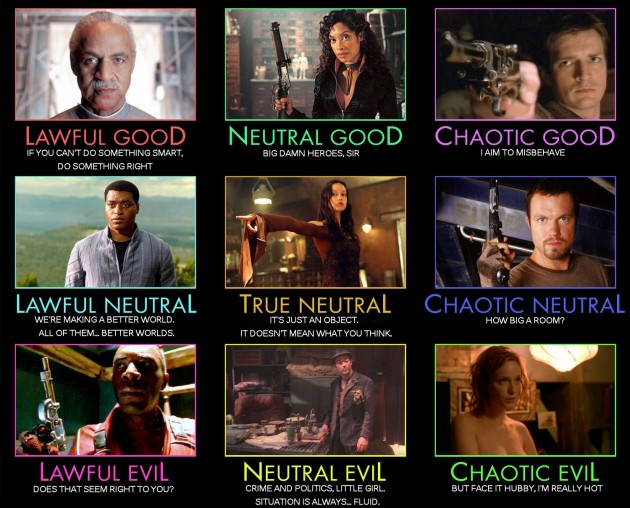
Alternate versions put 20th Century Fox in the Lawful Evil slot.

I love personality tests.  There’s something immensely satisfying about putting yourself on a grid that tells you something new and insightful about yourself and the people around you.  My personal favorite is the Meyers-Briggs test (I’m an ENTP), but I like playing around with others as well.

Character alignment is what you get when you combine fictional characters with the role they’re supposed to play in the story.  It’s a way to categorize the different ways they react to problems and ethical dilemmas, and to see which are inclined to be enemies and  which are inclined to be allies.

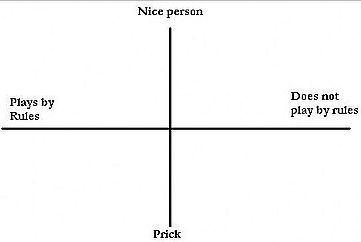
These systems initially arose out of RPG systems like Dungeons and Dragons, which use numbers, charts, and statistics to turn a story into a playable game.  There are many different kinds of alignments, but the most well-known is probably the one used by D&D, which charts characters along a good-evil axis and a lawful-chaotic axis.  In practice, the result looks a little like this:

Of course, that’s a very simplified version.  The tvtropes page goes into much greater depth, but I’ve personally found that this page right here does a much better job explaining the concepts behind the chart.

The horizontal axis, law vs. chaos, describes how much the character values order and authority vs. their own independence and freedom.  Lawful characters value honor and obedience, while chaotic characters value innovation and rebelliousness.  Characters who are neutral with regards to law and chaos generally respect authority, but put their own interests first and go against the established norms when that’s the best way to further their own ends.

The vertical axis, good vs. evil, describes how well (or poorly) characters tend to treat other people.  Good characters are altruistic and make sacrifices to protect the defenseless, whereas evil characters will kill, rob, or torture the innocent simply for the evulz.  Characters who are neutral with regards to good and evil don’t like to hurt others, but are not above pursuing questionable means to achieve their own goals.

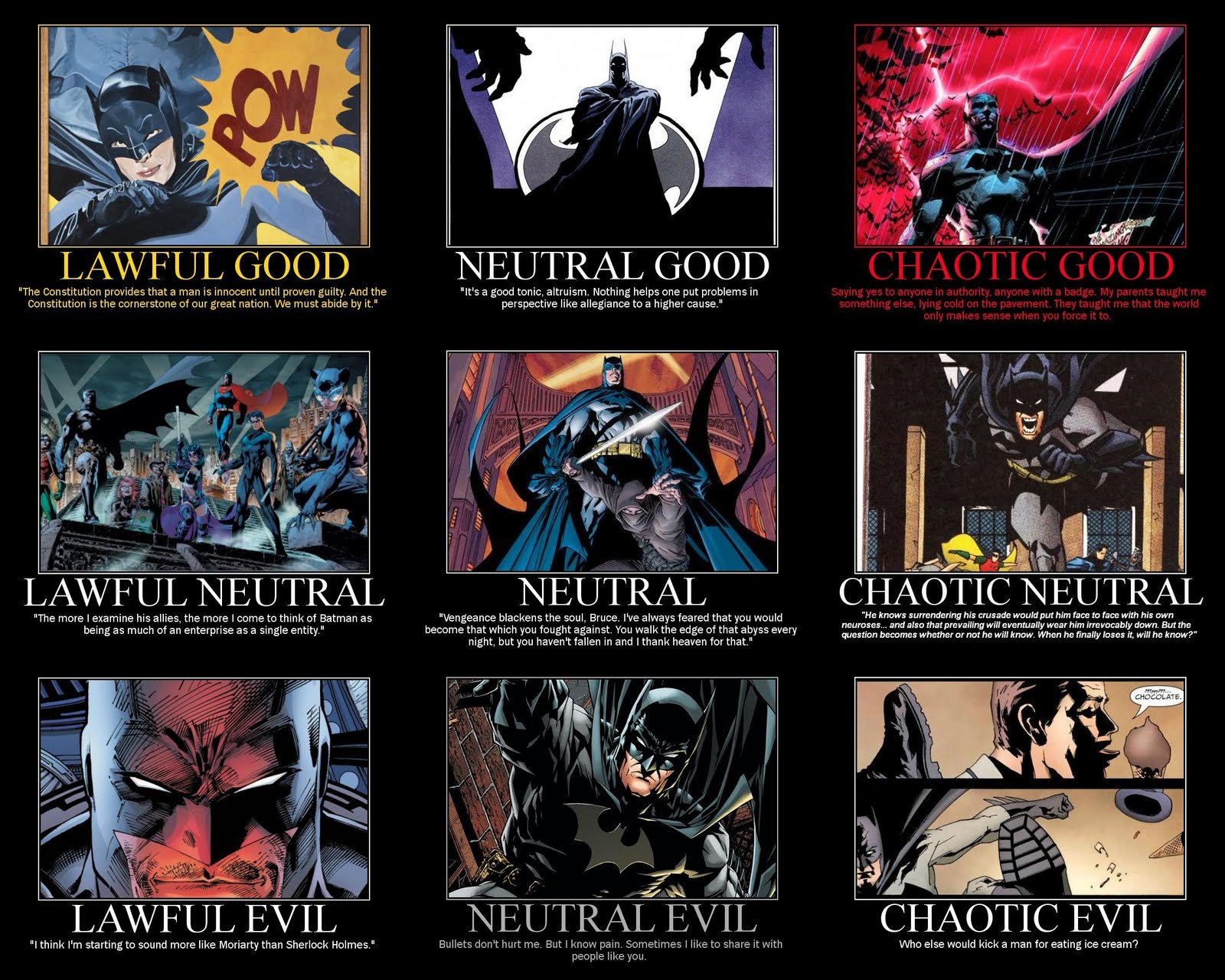
Put together, the alignments create a 9-square chart, like the one at the top of the post.  While it’s certainly not obligatory to fill every slot, doing so can add a greater degree of depth to your story, as it certainly did with Firefly.

As with any formula, however, there is danger in holding too closely to the chart and becoming inflexible.  In real life, people switch alignments all the time, just as personalities can change and evolve (in high school, for example, I was an INTP).  Not only that, but some characters even fulfill all the possible roles, depending on the incarnation and the story.

Because I'm BATMAN!

The point is, character alignment is just a tool, not a hard-and-fast rule that needs to be used with every story.  If it’s a helpful way to think about your characters and set them up with interesting conflicts, great.  If not, don’t sweat it; Homer and Shakespeare were telling great stories long before this chart.

I’m going to be going overseas soon, so I expect my internet access is going to be spotty for the next couple of months.  Because of that, I’m going to write up a bunch of Trope Tuesday posts on each of the nine alignments and schedule them to post automatically.  So stay tuned for more!