Fantasy from A to Z: E is for Epic

What is the ideal length of a fantasy novel? Of a fantasy series?

Fantasy, as a genre, is known for being big. Big stakes, big emotions, big battles—and big books. It isn’t unusual for a single fantasy novel to run well over 200,000 words. Authors like Brandon Sanderson regularly turn in doorstoppers, with Words of Radiance clocking in at over 400,000 words, longer than the entire Lord of the Rings trilogy combined. And of course, there’s J.R.R. Tolkien himself, whose influence looms large over the genre. The Lord of the Rings helped establish the idea that a fantasy story needs room to breathe—and to expand.

Series length is no different. Some of the most beloved and influential fantasy series are also some of the longest. Steven Erikson’s Malazan Book of the Fallen spans ten main volumes and several more side novels. Robert Jordan’s Wheel of Time ran for fourteen massive books (fifteen, if you count the prequel). These stories require commitment, but for many readers, that’s part of the appeal. Once they find a world they love, they want to spend as much time there as possible.

But not all fantasy needs to be long.

Robert E. Howard, one of the foundational voices in the genre, wrote mostly short stories. His Conan tales, often published in pulp magazines like Weird Tales, rarely ran longer than a few thousand words. Yet they endure. David G. Hartwell, in “The Making of the American Fantasy Genre,” points out that Howard and Tolkien were arguably the two most successful fantasy authors of the twentieth century. Before The Lord of the Rings took off in the 1970s, most fantasy readers thought of the short story as the natural format for the genre. That pulp tradition carried strong into the mid-century, where fantasy shared shelf space with science fiction in magazines and anthologies.

That clearly isn’t the case anymore. In today’s market, a 90,000-word fantasy novel is often considered short. Readers are more than happy to put up with a bit of filler or extra padding if it means they get to linger in the world a little longer. And to be fair, there is something immersive about a book that takes its time. When done well, it can feel less like reading a story and more like living inside another world.

That said, I still believe in the value of economy of words. Economy of words doesn’t mean writing short—it means writing lean. It means using only as many words as the story needs. Louis L’Amour is a great example of this. His prose is tight, clear, and evocative. Most of his novels are quick reads, but they pack a punch. He could sketch a character in half a page and make you care about them. That’s not to say all of his books were short—The Walking Drum is a long and sprawling novel—but even there, his style is efficient. Every scene does something. Every word earns its place.

So why does epic fantasy run so long? Does it always have to be padded with extra filler? Not when it’s done well. One of the defining features of epic fantasy is that the world itself becomes a character. Tolkien mastered this. Middle-earth isn’t just a setting; it has a history, a culture, and an arc. The long travelogues, the deep lore, the songs and genealogies—they help build a sense of depth that makes the final conflict in The Return of the King resonate on a mythic level. You’re not just watching Frodo destroy a ring; you’re watching the curtain fall on an entire age.

And when the world has that kind of weight—when it grows, transforms, and carries the burden of history—it’s no surprise that a single book often isn’t enough. That’s one of the reasons epic fantasy so often stretches into multi-volume series. If the world is a character, it needs space for its own arc to unfold. A hero might only need three acts to complete their journey, but a world? That can take a bit longer.

Still, there’s more than one way to structure a series. Take Louis L’Amour again. He wrote mostly short standalone novels, but many of them followed the same families—like the Sacketts or the Chantrys—so that readers who wanted more could get it. You didn’t have to read them in order. You could pick up whichever one you found first and still get a complete story. That’s a far cry from most modern fantasy series, where the series itself is a single, complete work that must be read in order. After all, try starting The Wheel of Time at book five or A Song of Ice and Fire at book three, and you’ll be utterly lost.

My copy of The Lord of the Rings is a single-volume edition, the way Tolkien originally intended it. The main reason it was split into multiple books was to save on printing costs (Tolkien himself split the book into six parts, but the publisher turned it into a trilogy). Frankly, I think it works better that way. When a series beings to sprawl, the middle books often sag, and readers can definitely feel that. Just look at Crossroads of Twilight (Book 10 of The Wheel of Time) and how much the fans hate that book. I also remember when A Dance with Dragons first came out, with a 2.9-star average on Amazon that held for several years. (That rating has since improved, but I suspect that a large part of it is due to review farming by the publisher.)

Another risk inherent in writing a long, sprawling series is that the author will never finish it. George R.R. Martin is the most infamous example here—fans have been waiting for The Winds of Winter for over a decade, with no firm release date in sight. Patrick Rothfuss has faced similar criticism, with readers growing increasingly frustrated over the long delay between The Wise Man’s Fear and the long-promised third book in the Kingkiller Chronicle. And Orson Scott Card has yet to finish his Alvin Maker series. Seventh Son was published when I was just four years old, and though I enjoyed the first two books in that series, I refuse to read the rest of it until Card finishes the damned series.

I’m not alone. Many readers, burned one too many times, now refuse to even begin a new fantasy series until it’s complete. I can’t blame readers for feeling this way, but it does create a real challenge for new and midlist authors trying to break into the genre. Without the benefit of an established readership, it’s hard to convince readers to invest in book one of a planned trilogy or longer series. And if readers don’t start the first book, the rest may never see publication.

Right now, I’m writing an epic fantasy series based loosely on the life of King David. According to my outline, it’s a seven book series, but I’ve decided instead to split it into two trilogies (each with a complete arc) and a bridge novel (kind of like what Frank Herbert intended for the Dune books, though he died before he could finish the final book of the second trilogy). My plan is to wait until the first trilogy is totally written, publish the first three books within a month of each other, and promote that trilogy while I write the bridge novel and sequel trilogy.

In the meantime, I’ve been having a blast writing short fantasy novels in the Sea Mage Cycle, in-between drafts of my larger books. With The Sea Mage Cycle, I’m following a series structure that’s much closer to what Louis L’Amour did with his Chantry and Sackett books. Each book is a standalone, and the books can be read in any order, but they all tie together with recurring characters/families. As with all epic fantasy, the world itself is something of a character, but each book is more like a single thread in the tapestry of that wider story.

Not every epic needs to be long. Not every story benefits from being part of a massive, sprawling series. But when done well—when every word pulls its weight, when the world itself becomes a living character, when the structure supports the arc instead of smothering it—epic fantasy becomes something truly special.

It becomes epic, in every sense of the word.
IT IS DONE

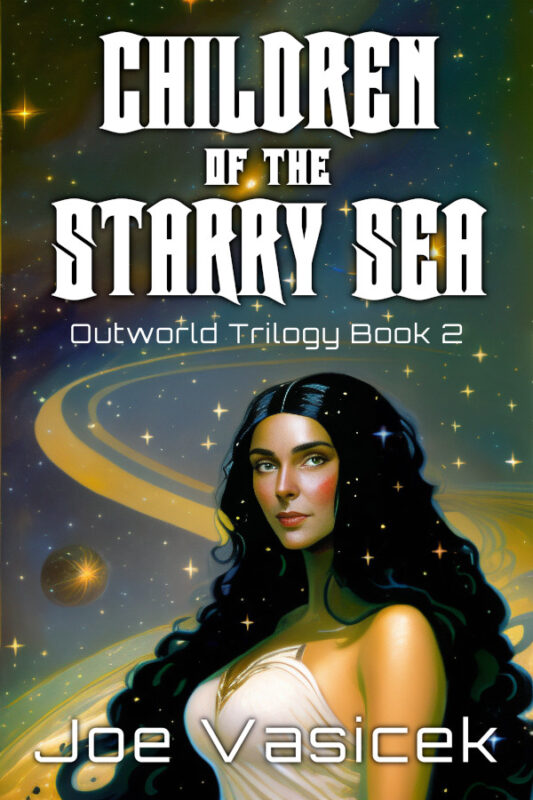
At long last, after more than a year, the rough draft of Children of the Starry Sea is now complete! It clocked in at just over 149k words, which makes it the longest book I have written since I started publishing (the first novel I ever finished was a 168k word train wreck that will never see the light of day. I wrote Genesis Earth next, and that was my first published novel).

I will probably pare it down to around 130k words, which will still make it my longest book when I publish it. Since I’ve been cycling through the revision drafts as I write, I will hopefully finish all the revisions within the next month and put it up for preorder shortly after that.

I am super excited, not only about this novel, but at the recent changes in my writing process that enabled me to finish it so quickly, and will hopefully help me to write a lot more books moving forward. Because of those changes, I’m confident that I can finish the third book in the trilogy (Return of the Starborn Son) before the end of the year, perhaps even before the end of the summer. It will be really fantastic to have this trilogy complete.

And after that? I’m not entirely sure. I currently have two other unfinished trilogies, and I hope to finish those soon, but I may also want to start a new one. If I can write at least three novels a year, I can finish a trilogy and start a new one every year going forward.

Anyway, I’m really excited that book two is done. Looking forward to writing the next one!

Another one done!

The Sword Keeper
Phase:3.0 Draft
100%

It’s done! Draft 2.0 of The Sword Keeper is finished. Still need to run it by some test readers, but it’s looking very good for a release this year.

In other news, the power cable for my laptop decided to die. I’ll replace it eventually, but in the meantime, I’m going to try turning my phone into a writing device. Just got a K480 bluetooth keyboard and I’m excited to try it out. My phone is a device I’ve always got with me, so adapting it for writing could be really great.

I’m also going to try a new writing technique that should hopefully lead to cleaner (perhaps even publishable) first drafts. If it works, this could significantly increase my writing output. It involves cycling through yesterday’s words before writing any new ones, getting into the flow and making any changes as necessary. This is actually very close to how I used to write back in high school, before all those college English classes. I also get the sense that this is how Dean Wesley Smith writes.

All sorts of experimental new things going on with my next WIP, which is Edenfall. Yes, it’s time to complete the trilogy. But before I jump into it, I’m going to take some time to do some serious prewriting, in the hopes (again) of writing a clean first draft. Which, if it works, means that the book will be published that much sooner.

In the meantime, Gunslinger to the Stars is almost ready for publication. My editor is working on it now, the cover art is just about finished, and besides that all that’s really left is crafting the book description and metadata. If all goes well, it should be up for pre-order on iBooks, Kobo, Smashwords, and Nook before the end of the month.

Also, new short story!

Nothing Found

Not a bad start

So January’s almost over, and I have to say it’s not a bad start to the year. Things are going quite well, both on the writing and publishing end, and on the personal end as well.

Gunslinger to the Stars
Phase:3.0 Draft
100%

First off, I finished draft 3.0 of Gunslinger to the Stars last week. The final draft came in at just under 52k words, which means that I managed to cut a healthy 27% of unnecessary wordage compared to the rough draft. That’s like upgrading from chuck roast to top sirloin, or 80/20 lean ground beef to 93/7 (except I actually prefer 85/15, but you get the point).

The Sci-Fi StoryBundle is doing quite well, enough that it may be a small windfall! That’s always encouraging, especially in today’s publishing climate. I should have some guest posts lined up soon from my fellow authors, which should be fun, so look out for that in the next few days. The bundle is only available for the next ten days, so if you haven’t picked it up yet, now is the time!

With Gunslinger to the Stars 3.0 finished, it’s time to move on to another WIP. The next one lined up is The Sword Keeper 2.0, which should be a lot of fun. This is my first epic fantasy novel, and there’s a bit that still has to be cleaned up, but I can legitimately say that this is one of the best things I’ve written so far. Really excited to get it out, hopfully later this year.

I also wrote a short story last week, and I’m not quite sure what to do with it. It’s so insanely political that it will probably get me blacklisted at half the magazines I submit it to. It’s also insanely short. I’ll probably clean it up a bit, see if I can add anything, and then go straight to self-publishing. Thank goodness that’s an option!

Lots more stuff happening this week. New free books, new release, new WIP, another short story in the works… 2017 is definitely off to a good start! And on that note, I’ll leave you with this awesome Pogo mix:

Gunslinger to the Stars Progress Update

The 2.0 draft of Gunslinger to the Stars is now complete—and right on deadline, too!

Gunslinger to the Stars
Phase:2.0 Draft
Due:9 years ago
100%

This draft ended at about 62k words, 13% less than the first draft. Leaner, tighter writing, with a lot less exposition and a lot more character voice.

Before I publish it, I do want to get some more feedback and do another editing pass. In particular, I want to make sure there aren’t any plot holes or other major problems. But it is at a point where I can write up the book description and commission cover art, so that should be coming in the next few weeks.

In the meantime, I’m gong to celebrate with a half-gallon of ice cream. Take care!

The Sword Keeper 1.0 is finished!

It’s been roughly four and a half years since I wrote the first word in The Sword Keeper, and now the first draft is finally complete! I finished it on Monday and promptly came down with the flu, which is why I’m only writing about it now.

This is my first complete fantasy novel, which is kind of a weird thing to realize. I started writing fantasy back in high school, but I never actually finished anything until college, and by then I was writing science fiction almost exclusively. Of course, the line between fantasy and science fiction is pretty fuzzy, especially the science fiction I tend to write, but still it’s a different set of tropes and a different kind of story.

In terms of other fantasy books, this one is pretty light. It’s just under 100k words, which makes it about 1/3 to 1/4 the size of a Brandon Sanderson novel. There’s magic, and it does drive the story, but the magic system itself isn’t the main driving factor of the plot. No elves, no dwarves, no dragons.

Instead, there’s an ancient order of magic sword bearers, a secret brotherhood of dark mages, a prophecy about saving the world, and a tavern girl (not a farmboy) who turns out to be the chosen one. About half of the fighting happens in the Void between the mortal and immortal realms. Oh, and the cost of magic is death.

There’s no question that this book needs a lot of work before it’ll be ready to publish. That said, I’m really excited about it. If all goes well, I expect it to be out sometime next year.

SSF-V: Captives in Obscurity 2.0 is complete!

Yesterday I finished the second draft of Captives in Obscurity (Sons of the Starfarers: Book V). I’m extremely pleased with how it turned out, and I think you guys are really going to enjoy it!

Unfortunately, writing the book is only the first step. Publishing is going to take resources that I don’t currently have, so it’s going to be a few months before I can get it out. Right now, it looks like Captives in Obscurity will go up for pre-order sometime in April/May, for a release date in July.

In the meantime, I plan to start working on Book VI: Patriots in Retreat right away, in order to release it soon after. With luck, there should be three Sons of the Starfarers books published next year, with only two left to complete the series.

I’ve got so many awesome ideas for stuff to fit into the next few books. Captives in Obscurity and Patriots in Retreat fall squarely into the midpoint of the series, where the characters hit rock bottom right before the plot twist. In other words, this is where I really get to twist the knife, and if you’ve read my other books you know that that’s the part I like best!

So yeah, it’s going to be a while before these books come out, but they are really going to be awesome when they do. In the meantime, I’ve got some short stories coming off of submission in the next couple of months, including a Sad Puppies inspired piece that I want to have up before the Hugos are in the news again. So even if it takes some time for Captives in Obscurity to get out there, I’m definitely not going away!

It’s done!

Yesterday I finally finished the second draft of Friends in Command (Sons of the Starfarers: Book IV)! I know I’d said I was working on other projects, but those were intermittent—this was the main one I was focusing on. I still need to run it by my first readers, but I’m pretty sure this is the version that I’ll publish. If all goes well, you can expect to see this go up on pre-order before the end of March.

While working on the revisions for Friends in Command, I more or less plotted out the rest of the Sons of the Starfarers series in my head. There are going to be nine books total, most of them around 40,000 to 50,000 words (or 150 to 200 pages). It will probably take me between two and four months to write each of them, including sending them off to first readers and implementing their feedback. If my first readers come back with problems, though, it might take more like five or six months.

While I’m definitely committed to finishing up this series, I’m probably not going to work exclusively on Sons of the Starfarers. As much as I would like to wrap up this series and get it all out there, there are a lot of other projects calling out to me—projects that I’ve been putting off for far too long. Here are just a few of them:

STAR WANDERERS: CHILDREN OF THE STARRY SEA

Yes, I have another story in the Star Wanderers series to tell. This one is a full-length novel, though, and it takes place about sixteen years after the events of The Jeremiah Chronicles. It’ll be fun to bring back all the old characters, but this story is mostly about their children (hence the title). This WIP is still in the early outlining stages, but I have lots of ideas with where to take it. I’ll probably write it sometime over the summer, unless there’s enough demand for me to write it sooner.

THE SWORD KEEPER

This is my epic fantasy novel that I’ve been writing on and off for the past two and a half years. I put it on the back burner last summer after I got blocked, but just last month I figured out what I needed to change to get the story flowing again. I could probably finish this one in a month if I focused on it. Hopefully, this is the year that I’ll finally get this one finished and publish it.

QUEEN OF THE FALCONSTAR

This is the passion project that distracted me while I was working on Friends in Command. I wrote about three chapters, put it on the back burner, and then daydreamed the whole rest of the book. Needless to say, I’m eager to get back to this one. I think it has a lot of potential—Star Wanderers was an unplanned passion project just like this one.

KING WASHINGTON

This is a new project that I haven’t blogged about yet. I’m collaborating on it with a friend (the story was actually his idea), and we’ve spent the last two or three weeks plotting out the entire series. All that is done now, so all we have to do is figure out our collaboration style and write the thing. We’re doing it in season/episode format, with five seasons of 12 episodes each. The episodes are each going to run about 20k to 30k words, so once we have our workflow down we should be able to pump out an episode every four to six weeks.

Lots and lots of stuff to work on—that’s partially why I haven’t been blogging much in the last few weeks. I hope to change that soon, though. And even if I’m not quite so active online as I have been, don’t worry—I’m still writing!

Back to novels again

So yesterday I finished the rough draft of Sons of the Starfarers: Brothers in Exile.  It needs work, but at least I’ve got something to work with.  Of course, before I can do that, I need to take a break and work on something else.

For my next project, I’m going to do a massive revision of a novel I wrote almost three years ago.  Heart of the Nebula is a direct sequel to Bringing Stella Home, and features James McCoy as the main character.  He’s older and (somewhat) wiser, with a lot more responsibility resting on his shoulders as an officer in the Civil Defense Corps of the Colony.  With the Hameji occupation driving them into famine and poverty, the stakes are a lot higher than the first book, and the dangers and intrigue a lot more complex.  Not only are there pirates and criminals to deal with, but the Patrician is playing his own game, and James soon gets caught up in it.

Currently, this book is a real mess.  I’ve attempted numerous revisions of it before, but finished none of them.  The first part of the book is probably pretty close to where it needs to be, but then there are a bunch of broken subplots, characters who were excised from certain sections and left in others, scenes and chapters out of order, and relationships that develop either way too fast or hardly at all.

Before I dive in, I’m reading through the whole draft and making notes on a scene by scene basis.  I’ve got a map set up for where all the scenes need to go, and I’m putting together a checklist of all the changes I have to make.  I did the same thing when I wrote Bringing Stella Home and Genesis Earth (come to think of it, Desert Stars as well).  Hopefully, this will help the revision to go quickly and to fix all the broken elements without watering down or polishing out the good stuff.

Probably the most important thing about revision notes is that they help me to separate my critical mind from my creative mind.  When I’m looking at the book in my critical mind, I want to throw out the stuff that isn’t perfect and make lots of changes to the story.  However, that can be a lot more destructive than constructive, since it’s the creative mind that really makes the good stuff.  By writing a set of notes before diving into revisions, I can keep my critical mind from making too many changes to the actual story, and identify the problems so that when I go back to make the changes, I can switch the critical mind off and keep the creative mind on.  And often, instead of making the changes I told myself to make (or rather, the changes my critical mind told me to make), my creative mind comes up with something else that puts the story on a much better path.

That’s the theory, anyway.  We’ll see how it goes.  The revision notes are going pretty quickly now, and even though things are going to get more complicated deeper into the book, I don’t think it will take me more than three or four days to finish them (unless I get called in to a job somewhere). Once that’s done, I’ll dive right into the book, probably tossing half of it and rewriting from scratch.

Thing is, it’s been a long time since I’ve worked on a novel this way.  All last year, I’ve been writing novellas, and while some of them have required overhauls, it’s never been too complicated.  With novels, though, it can be a mess.  I’m sure I can do it, but I’m not sure how long it will take me.  Hopefully no longer than a month, but I’m not going to stress it.  The important thing is to do it right, and to really immerse myself back into this world.

So that’s what I’m working on now.  I hope these updates on my writing projects aren’t too boring.  They’re really helpful in writing the Author’s Notes at the end of each book, because I can go back to my blog, drill down the categories by book title, and see what I was working on at various different times when other stuff was happening in my life.  For a book like Heart of the Nebula, that’s going to be important, because it’s been almost three years in the making.  For most of that time, it was just sitting on the back burner (or, more accurately, the fridge), but it’s out again now and I’m focusing on it again.  We’ll see how it goes.

It’s finished! Now onto the next thing.

Well, over the weekend, I finished the first draft of Star Wanderers: Reproach (Part VII).  Technically, I finished it at 4:30 am on Saturday, but I’m counting that for the Friday May 31st deadline that I set when I started the project.  I was determined to finish the thing before I went to bed, and nearly pulled an all-nighter.  Still recovering.

Star Wanderers: Benefactor (Part VI) needs some work before I feel it’s ready to be published, but I’m not sure if that’s what I want to move on to next.  From a business standpoint, that would appear to be the most prudent decision, since my Star Wanderers books are selling fairly well and expanding the series while the momentum is still good is probably the surest way to capitalize on that.  However, from a creative standpoint, I think it might be better to give this draft some more time to mull around in the back of my head, like I did for Genesis Earth, Bringing Stella Home, and Desert Stars.

Also, I really want to finish the first draft of Lifewalker.  All of my friends and family who have read bits and pieces of it are raving for me to finish it–literally, every time I talk with my Dad, he asks me when it’s going to be done.  I really do enjoy the voice of the main character in that one, and I stopped it only to finish Reproach, not because it was giving me any troubles.  If I go ahead with that now, I can probably finish it by the end of the month, with time to start work on another project (possibly Benefactor).

It’s difficult for me to talk meaningfully about a project that only I and a couple of other people have seen, so here are the first few paragraphs from the current draft, just to give you a taste of it:

My given name is Isaac Jameson, but most people know me as the Lifewalker. It is a fitting title. I am a stranger and a wanderer; death has cheated me not once, but thrice. For more than three generations, I have wandered the Earth, watching men and women spring up as wheat, bear seed, and pass away with the autumn frost. Yet with each passing generation, I alone remain—with each new crop of humanity, death refuses to harvest me. Some would see this as a blessing, but it is not. It is a curse worse than the fever that steals an infant from its mother, or the blight that takes the mother from her newborn child. It is hard enough to say goodbye to those you have known and loved—those who have shared everything in their lives with you, holding nothing back. But to say goodbye to everyone you have ever known—to find yourself a stranger in your own homeland, a man washed up on the shores of time while the world spins wildly beneath you—yes, that is a fate that can make death seem like a mercy. But I digress.

I suppose I should start this volume with a brief description of the land of my birth. Far to the west, beyond the lakes of the north and the great river of the plains, a series of great, craggy mountain ranges cross the land. In the heart of these mountains, almost a year’s journey by wagon from the eastern coast, lies a great salty sea. It is a desolate and lifeless place, and so far as I can tell, always has been. I only visited it once, but saw no signs of habitation along its briny beaches, ancient or otherwise. However, only a few short miles to the east, the ruins of a once-great city still stands. Its rusting skyscrapers are not as tall or as numerous as those in Boss-town or Old Neyark, but there are enough to show that it was once a place of some importance, before the years of the Blight.

South of these ruins, and beyond the numerous villages and communes that thrive in its shadows, lies a wide mountain valley with a freshwater lake at its center. The lake is extremely shallow, and the reeds grow thick along its southern coasts. It is a good place for catfish and mussels, as well as heron and other waterfowl. The mountains rise sharply all around it, but more especially to the east, though none of them are quite high enough to boast a peak that is snow-capped year round. A monument to the letter Y can still been seen on the face of one of the nearer foothills, though the coloring has long since faded. The northeast border of the valley is guarded by a mountain that looks like a young maiden, sleeping on her back with a hand on her pregnant belly. Some say that the child she carries is the hope of the new world. A narrow river runs just south of this mountain to the lake, through the heart of the land of Provorem.

Just for fun, I posted a longer version on the minecraft server where I currently play.  It’s possible to make books inside of the game, and fill them with a couple thousand words of text.  I’ll probably do a couple more minecraft books with bits and pieces of Lifewalker, and possibly a couple of other projects as well.

At the same time, I’ve got an idea for another project, one that has the potential to turn into a series of heroic fantasy novellas, along the lines of Star Wanderers.  I talked it over with my brother-in-law over the weekend, and while the world and the characters still need fleshing out, I think the core idea is pretty solid.  Part of me wants to drop everything and work on that right now, but the other part feels like a deer in the headlights with a semi full of story ideas bearing down on me…

All good problems to have.  But don’t worry–if I don’t have anything new published before the end of this month, I’ll definitely have something by the end of July.  That’s my unofficial goal now: at least one new published something every two months.

Gotta write.  Later!