Trope Tuesday: Our Dwarves Are All the Same

Yes, you saw that right: Trope Tuesday is back, at least for the next few weeks.  I dropped out for a number of reasons, most of them having to do with my own interminable disorganization.  I really love writing these posts, though, and you guys seem to love reading them, so I’ll do my best to keep the series alive.  Here goes!

Say the word “troll,” and you could mean one (or more) of a thousand different fantasy creatures.  The things same goes with gods, demons, vampires, fairies, goblins, and to some extent, elves.  But say the word “dwarf” and we all instantly know what you’re talking about.  As tvtropes puts it:

You know them. Gruff, gold-loving, industrious, blunt-speaking, Scottish-accented, practical, Viking-helmed, booze-swilling, Elf-hating, ax-swinging, stout, long-bearded, stolid and unimaginative, boastful of their battle prowess and their vast echoing underground halls and mainly just the fact that they are Dwarves … An entire race of miners and blacksmiths, with names like Dwarfaxe Dwarfbeard and Grimli Stonesack, who are overly sensitive about any perceived slight, always spoiling for a fight, unable to speak two sentences in a row without calling someone “lad” or “lass,” and possessed of a love of gold and jewels that drives them to live in Underground Cities where they dig deep and greedily, (often with catastrophic results).

The defining characteristics of this fantasy race basically include:

  • Short.  Should be self-evident from the name of the race.
  • Expert in smithing, forging, metalworking, and crafting priceless artifacts.
  • Prefer to live underground, mining for ore and precious metals.
  • Bearded to the extreme.  Even their women often have facial hair.
  • Fond of alcohol, and often rowdy or violent when drunk.
  • Weapon of choice is a battle axe (or perhaps a war hammer).

In other words, Tolkien set the standard and everyone since has followed it with little, if any, variation.  Tolkien himself got it from Norse mythology, which had a few key differences (for example, Norse dwarves would turn to stone if they were exposed to sunlight), but once Lord of the Rings hit the bookshelves, all dwarves would ever after be the same.

Why is this?  Well, as fantasy races go, dwarves tend to be more like supporting characters than members of the main cast.  Sure, there are plenty of series that focus on dwarves and dwarven culture, but the cultures that shape world history the most are usually human or elvish.  Dwarves are often content to stay in their dwarven halls and do their own thing, far beneath the surface of the earth.

Brandon Sanderson has an interesting take on this question, which he explains in his famous essay “How Tolkien Ruined Fantasy” (which has since been renamed).  Basically, he argues that the fantasy before Tolkien was all “low” fantasy, or fantasy that loosely uses our own world as a template.  This sort of fantasy may have wizards, or magic, or monsters, but the setting itself looks a lot like something out of the pages of a history book.  Tolkien was the first to really write “high” fantasy, where everything about the world is built from the ground up, and he did such a good job of it that we’ve all been copying him since.  Rather than writing high fantasy in an original vein, most authors have switched out the real world for Tolkien’s and have been writing low fantasy in a Tolkienesque world (at least until the last decade or so).

It’s an interesting argument, but I’m not quite so sure how valid it is.  The process that Sanderson describes basically happens in every genre: someone writes an extremely popular book, and for the next several decades (centuries, in the case of Treasure Island) everyone tries to go back to it in some way.  And yet, how many different kinds of vampires are there?  How many different kinds of cops, or detectives, or spies?

Perhaps Lord of the Rings had a much more overshadowing impact than Dracula or Frankenstein ever did, but consider some of the other fantasy races he basically invented.  Ents never really took off anywhere outside of Tolkien, and trolls never universally became the big, dumb, evil, brutish creatures that they are in The Hobbit.  Elves, which really were popularized in a huge way by Tolkien, have taken on a life of their own, differing fairly significantly from the immortal angel-analogues in Lord of the Rings and The Silmarillion.  Orcs, too, are becoming more like “green klingons” in games like World of Warcraft, with an extensive honor system and intelligence on par with humans and elves.

Is there something about the Tolkienesque dwarf that fulfills a deeper storytelling need, transforming the stereotype into an archetype? Or am I wrong, and dwarves just haven’t had the same makeover as elves and orcs?  I don’t know.  But I like dwarves, and I’m a political nerd, so I’ll leave you with a fascinating Marxist analysis of Dwarf Fortress, and an interesting picture of a female dwarf.

Tarin Portrait by =RachelleFryatt on deviantART

Parents: talk to your kids about Dwarf Fortress

DFSo if you’ve been wondering why I seem to have gone missing from the world of the living lately, it’s because I recently started playing Dwarf Fortress.  Those of you who know what Dwarf Fortress is are probably shaking your heads already, but for the rest of you, I’ll endeavor to explain.

Dwarf Fortress is easily the most detailed and immersive fantasy RPG ever created.  In it, you command a group of dwarves as they seek a new life in an unclaimed territory, designing their new home, seeking all sorts of precious metals, and defending their dwarven hordes from all manner of evil monsters. The graphics (what little there are) are basically ASCII, so you do all this by scrolling through an endless array of text-based menus, which sounds rather tedious but is actually what makes the game so awesome.

For every dwarf in your fortress, there is a detailed list with their personal history, their relationships, their likes/dislikes, their strengths/weaknesses, skills–even their thoughts!  And when there’s combat, the game generates a blow-by-blow where you can read exactly what happened to whom, who got injured, and what those injuries exactly were.  This extends to every part of the game, so that when you’re in overworld mode you can actually look up the histories of every person in every civilization.

What really makes it insane, though, are the crazy, crazy ways in which your fortress can die.  Kobolds, Goblins, vampires, were-creatures, tantrum spirals, catsplosions–the possibilities are endless.  If your dwarves are unhappy, one of them might throw a tantrum that sets everyone off so that they all kill each other.  If they don’t have socks, apparently they’ll riot over that as well.  And heaven help you if a forgotten beast gets loose in your dwarven hall.

The learning curve for this game is ridiculously steep, which is why I haven’t gotten into it before now.  I actually tinkered with it a couple of years ago, but could never get into it because I had no idea what was going on.  Some youtube tutorials and the lazy newb pack helped remedy that, and now, sixty some-odd hours later, I feel like I might have an idea of how it maybe works.

The things that make the game appealing are largely the same things that make fantasy appealing: the chance to build and live in a world full of crazy-awesome fantasy stuff.  The graphics might be horrible, but the level of detail is so incredible that with a bit of imagination, you can really immerse yourself in it.

… which is why I probably went a bit overboard.  That tends to happen with me and games–I tend to binge a lot when I first get started, then go cold turkey for a while, then come back for more before gradually easing into a more healthy level of play.  Right now, I’m just getting over that first binge; I’ll probably go cold turkey for a while, taking care of all the things I’ve neglected before easing back in.

But wow, this game has given me a TON of story ideas.  I really want to write about a band of dwarves now, or reread Lord of the Rings, or get back into classic high fantasy in some way.  It’s too early to say whether it’s just a phase or a genuine shift, but I’m happy to follow it out and see where it leads.

In the meantime, I’ve got a bajillion other things to do, and writing currently tops that list.  Later!

Beware the catsplosion.

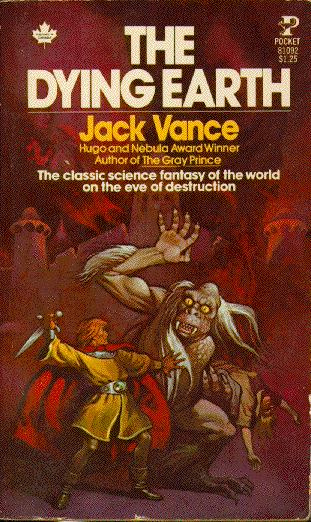
The Dying Earth by Jack Vance

the_dying_earthDo you remember those creepy-weird montages from those old 60s and 70s era Disney movies?  The ones like Dumbo, or The Three Caballeros–or heck, the entire thing of Fantasia–where all these weird kaleidoscopic shapes and psychedelic colors just move in and out of each other in twisted, convulsing ways?  Well, guess what?  Jack Vance’s The Dying Earth is like one of those montages in written form, and I loved it.
I picked up this book in order to familiarize myself a little better with the Sword & Planet subgenre, which I’d like to write in (as you may remember … my WIP is currently on hold, but I’d like to pick it up again soon).  This one is a lot different from the Princess of Mars series, with an eerie apocalyptic feel, arcane magic and forbidden knowledge, weird, monstrous creatures, and above all else, a decidedly un-Disney fairy-tale feel that pervades the book with doom and danger.

If you’re looking for straight-up Science Fiction, you’re better off looking elsewhere.  This book is even more fantastic than Ray Bradbury’s stuff, and while there’s a little bit of a sci-fi dressing thrown in, there really is no scientific justification for anything.  The basic premise is that the Earth is dying, meaning that the sun is growing dimmer and dimmer and will soon go completely out.  The last few people eking out an existence on this planet are mostly wizards and witches, each one intent on building their own little empire and cheating or stealing from everyone else.  There are a few pure-hearted souls, but the world is completely lawless, and the only way to survive is through magic or brute force.

The chapters are really more like interconnected short stories, where each one stands on its own, and yet may feature a recurring character, or be set in the same place as another.  There were only six chapters in the version I read (the 1977 Pocket Book edition), which makes me wonder if I missed any.  If I did, I would definitely like to read them, because the stories were absolutely mesmerizing!

Because I read this book to get a feel for the sub-genre, I’m going to list some of the things I really enjoyed about it.  Here they are:

  • The fairy-tale story structure.  None of the chapters started out with “there once was a …” but it certainly felt like they did.  Each character started off with a quest or dilemma, and then went on a journey of some sort where they faced trials, made friends, and defeated enemies in order to attain some sort of boon at the end.
  • Lots and lots of world-breaking magic.  Seriously.  One of the guys sets out on his journey with a spell that basically keeps him from any danger whatsoever, so long as he stays on “the path.” Since he really has no idea where he’s going, “the path” is basically any path he chooses to travel.  Since all the rest of the magic is just as world-breaking, you have no idea what could happen next.  There’s always a sense that anything could happen.
  • An elevated sense of diction.  The characters don’t speak like we do, they speak like people from the 18th or 19th centuries, with words like “thus,” “whence,” “wherefore,” and grammatical structures like “I know not,” and “half yet remains.” It’s not just the characters, either–the whole book is like that.  It really adds to the fantastic, otherworldly feel.
  • Lots of contrasting extremes.  The demons are truly perverse and sadistic, with death and brutality on every other page.  At the same time, though, the moments of beauty and love are just as great.  My favorite line from the whole book, which practically made me cry, is “My brain is whole! I see–I see the world!” If I explained it any more, it would be a spoiler.
  • High adventure.  LOTS and LOTS of high adventure.  There isn’t a viewpoint character in the book who doesn’t leave home to go on some sort of quest through all sorts of wild and creepy dangers.  Every character is seeking something, and not in a “meh” kind of way–they are so wholly focused on what they’re seeking that they put their very lives in peril just to obtain it.  Almost all the romance is rescue-romance, of the pulpiest possible kind.  It’s awesome.

There are more, but those are the big things.  Overall, I’d say that this book is about 50% Fantasy, 30% Horror, and 20% Science Fiction, with none of the more modern conventions of any of those genres.  It was first published in 1950, but it feels a lot closer to Robert E. Howard and Jules Verne than J.R.R. Tolkien and Arthur C. Clarke.  If you’re looking for a good spec-fic throwback with lots of magic and adventure, this is a great one to check out.

Trope Tuesday: Curiosity is a Crapshoot

curiosity
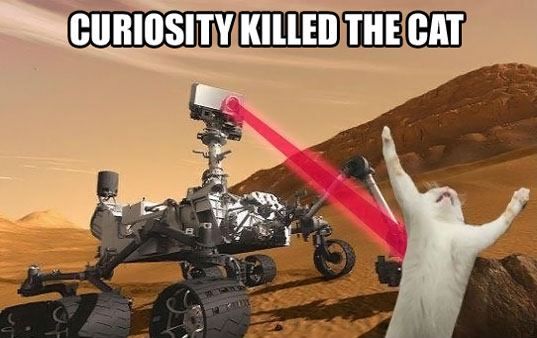
Is there life on Mars? NOT ANYMORE!

Is curiosity a bad thing?  Well, it depends how genre savvy you are.  It seemed to work out pretty well for Alice, but not quite so well for Pandora (or the rest of the ancient Greek world, for that matter).  Curious monkeys seem to come out all right, and their constantly curious counterparts also seem to do okay in the end, but anytime you run into schmuck bait you know that things aren’t going to turn out well.

The truth is, for just about every stock Aesop warning about the perils of being overly nosy, you can find another one exalting it as a virtue.  In fact, you could say that curiosity is a crapshoot.

But what is curiosity exactly?  The Merriam-Webster dictionary defines it as “desire to know,” and “interest leading to inquiry.” As you can imagine, there are situations where this could be good or bad.  Thus, what a story says about curiosity often changes depending on its genre.

For example, in most horror stories, curiosity and nosiness are usually bad, leading the protagonists to go places where they shouldn’t and uncover things that should never have been uncovered.  At the same time, a lack of curiosity can also be fatal … in fact, a lot of things can be fatal in a horror story.

In mythology and folklore, curiosity is often even worse.  From Pandora to Eve, Psyche to the proverbial cat, curiosity leads to Very Bad Things.  Perhaps this is because these kinds of stories are mostly tales of warning, passed on from generation to generation as a way to preserve our collective knowledge about the dangers of the world, rather than inspire us to go out and face them.

(As a side note, there are a few exceptions in the realm of folklore.  In the Bluebeard myth, curiosity killed off all of Bluebeard’s previous wives, but combined with cleverness, faith, and friendship, it saved the last one’s life.)

In fantasy, curiosity is often a mixed box bag.  For example, take the hobbits: most of them are perfectly content to live out their lives in the shire, but the few who are inquisitive enough to venture outside end up saving the world in a way that the elves, dwarves, and humans never could.  At the same time, it puts them through a great deal of pain, even after the world is saved–neither Bilbo nor Frodo are ever able to be content in the shire again.

Curiosity, in other words, is complicated.  It’s not just a quirk or a character flaw–it’s an underlying quality of the hero’s journey.  Without curiosity, either of the world around him or the internal struggles within, the hero would be content to live out an unremarkable life.  Certainly he wouldn’t have the capacity for the cleverness, guile, wisdom, and sensitivity that he needs in order to descend into the darkest dungeon, face his own nadir, and return with the elixir of life.  Curiosity may lead to sorrow, pain, or even death, but it also leads to adventure.

As a subgenre of fantasy, many of these issues carry over into the realm of science fiction.  And yet, as a genre unto itself, science fiction has a distinctly positive view of curiosity compared to other genres.  Science is nothing if not the primary process of human inquiry, where curiosity is not only a virtue but the virtue, one of the most important aspects of humanity.  Consider these words from Adam Steltzner, one of the leading engineers of the NASA Mars Curiosity mission:

Likewise, curiosity is a staple of science fiction.  In Star Trek, it’s the basis of the entire mission: “to explore strange new worlds, to seek out new life and new civilizations, to boldly go where no one has gone before.” In Doctor Who, it’s how the Doctor finds his companions.  In Babylon 5, it’s Delenn’s curiosity about the humans that ultimately saves all the alien races.  And in 2001: A Space Odyssey, it’s the gift from the black monolith that helps monkeys to turn bones into space stations (well, not literally, but you get the idea).

Curiosity isn’t a central theme in most of my books, but it is a major part of Genesis Earth.  If anything, that book is about the importance of balancing curiosity about our universe with curiosity about ourselves and what it means to be human.  In Star Wanderers, Noemi’s curiosity is a huge part of her story, helping her to turn around a horrible (not to mention awkward) situation.  In Desert Stars, curiosity is complicated; it leads Jalil far away from home and puts a schism between him and the girl who loves him, but it also leads him to discover the truth about who he is, giving him the strength to return.

In general, I suppose it all comes down not only to genre, but to the underlying worldview of the author of the story.  Since I have a very positive and enthusiastic view of curiosity, it usually works out for the best in the stories that I write. Then again, perhaps that’s why I’m drawn to science fiction … how about you?

Why I don’t like George R.R. Martin

I was thinking today about George R.R. Martin’s A Game of Thrones and the fact that I’ve more or less given up on the series after reading the first book.  A lot of my friends are rabid-at-the-mouth crazy about it, both the books and the TV miniseries, but I’m just not all that into it.

Don’t get me wrong—I can see why other people like it so much.  The story is engaging, the political intrigue is deliciously complex, the world building is wonderful and immersive, and the fantasy tropes are played quite well.  I enjoyed a lot of things about the first book, and intended to read the rest of the series after finishing it.  After all, it’s one of the most important works of epic fantasy to come out in the last few decades, with people calling George R.R. Martin an American Tolkien.

But the truth is, I just wasn’t all that into it.  And the more I think about it now, the more I’ve realized that this isn’t the kind of series I would enjoy at all.

The strange thing is, I’m a HUGE fan of David Gemmell, who writes almost the exact same sort of thing.  Immersive fantasy worlds, dark and gritty characters, shades of gray, lots of fighting, lots of sex, lots of brutality, the realization that anyone can die off at any time … the list goes on and on.  And yet, there’s something about David Gemmell’s books that turns me rabid-at-the-mouth and has me squeeing like an otaku fangirl, whereas with George R.R. Martin, all I can manage is “meh.”

I think the reason for this is that Martin’s characters basically fall into one or both of two camps: victim or victimizer.  There isn’t any middle ground—at least, none that anyone can stand on for long without dying in some horrific and brutal way.  The story requires the characters to all become monsters, and anyone who isn’t willing to do that meets a horrible, tragic end.

There were only two characters in A Game of Thrones that I really cared about: Arya and Ned Stark.  Ned was the only character who really tried to stand for something, and Arya was just a spunky little girl who resisted all the stupid girly stuff in favor of more practical stuff like street smarts.

<spoilers ahoy>

The trouble was that Ned was a complete idiot, trusting in the honor of a guy who explicitly said “do not trust me” and making stupid decisions that ended up getting half of House Stark killed or captured.  It’s almost as if Martin purposefully set him up to be a straw man character—that he wanted this one character to represent all the goody-goodies of the world, and knocked him off in the most brutal way possible.  It’s like Martin killed him off to make a point, and had the story drive the character rather than the character drive his own story.

And Arya … I forget exactly what happened to her, but she basically became a victim in such a horrible, twisted way that I could tell she’d be scarred for the rest of the series.  If she didn’t die off herself, she’d probably become a dirty street rat—the slit-your-throat-for-a-copper kind, not the Disney version.  So yeah, I pretty much gave up on her.

Jon Snow was okay, but he was so far removed from everything else in the story that I just got bored with him.  Tyrion was funny, but he was also a pervert, and all the reasons to sympathize with him basically revolved around “I’m a dwarf, everyone mistreats me”—again, the victim vs. victimizer thing.  Lady Catelyn was pretty cool, but I always saw her as more of a supporting character, and while I found myself rooting for Daenerys at the end, it was only out of frustration with all of the other douchebags in Westeros—I just wanted her to come over the sea and claim the throne so that everyone else would die.

It was a pretty good book, I’ll admit—other than the fact that I didn’t really like any of the characters, everything else was quite enjoyable.  It certainly held my attention long enough to finish the thing.  But I didn’t really feel compelled to read the next one because I frankly didn’t care what happened to any of the characters.  You could give me a list of all of the ones who die off, and I would just shrug and say “oh well.”

In contrast, with every David Gemmell book I’ve read, I fall in love with the characters after reading just a paragraph or two in their viewpoint.  Drenai or Nadir, civilized or barbarian, I not only like the characters, I fall deeply in love with them.  I care about them right from the outset, even the ones with a dark past, like Skilgannon or Waylander.  In fact, Waylander is probably my favorite of them all.

The fact that I know that some of these guys are going to die only makes me more invested, because even though Gemmell kills of most of his characters in any given book, the main characters’ deaths almost always mean something.  Maybe they have some awful secret that they finally are able to give up, or maybe they’ve been running from a fate that they finally gather the courage to face.  Or maybe they just happen to be in a circumstance that requires them to give up their lives, and they rise to meet the occasion.  Not every death is cathartic, but Gemmell never kills off a character merely for the sake of killing off a character, whereas with Martin, I get the sense that that’s sometimes the only reason.

But the biggest difference between the two is that with Gemmell, the victim vs. victimizer paradigm just doesn’t exist.  Gemmell’s books are all about unlikely heroism—characters in situations that require them to be something more, or do something beyond looking out for just themselves.  Anyone can be a hero, because a hero is nothing more than someone who does something heroic.  No matter your past, no matter your fears, no matter your weaknesses, when the chips are down, we’re not all that different.

The counter argument I’ve heard is that all of this heroism stuff is superfluous, and Martin is trying to get beyond it, kind of like the 19th and 20th century philosophers who were trying to get beyond morality.  The thing is, if that’s the case, then Martin has to have the darkest and most depressing view of human nature of almost any fantasy writer alive.  If his point is that there’s nothing intrinsically heroic about anyone, that being a hero is just a matter of rising to a role and becoming a figure in one of the stories that people tell to make sense of the world—if his point is to show that every hero is really just a douchebag, there’s something about the world that he’s really missing.

In Gemmell’s books, there are douchebags who rise to the heroic roles required of them—but in the act of filling that role, something about them changes, and you see that they’re really not as evil as you thought they were.  Because in Gemmell’s view, people are essentially good and everyone is redeemable, even the rapists and murderers.  One of his darkest characters, Skilgannon the Damned, learns at the end of his story that the difference between salvation and damnation is allowing yourself to receive the light—that the only thing damning you is yourself.  Whether or not you agree with that, you have to admit that’s a pretty optimistic way of seeing the world.

In the end, that’s why I love David Gemmell’s books so much—not just because anyone can die, but because anyone can be redeemed too, sometimes at the very same time.  From what I’ve read of George R.R. Martin, it seems that he redeems no one—that to the extent I’m rooting for any one character, it’s only because I can’t wait for them to kill or brutalize all the other horrible monsters in the book.  And frankly, I find that pointless and tiresome.

There are moments in almost every David Gemmell book I’ve read that stand out to me with great clarity, so that sometimes while I’m standing in line at the grocery store, or walking down the street to the library, they pop into my head completely unbidden.  With George R.R. Martin, that has never happened to me, even for the books of his that I’ve enjoyed.

I dunno.  Everyone is different.  Maybe George R.R. Martin really strikes a chord in you, so that you feel for him like I do for David Gemmell.  Maybe you actually like some of the characters whom I’ve dismissed as douchebags.  Or maybe you don’t read fantasy for the same things I do.  This post isn’t to knock you for that, it’s just to point out and analyze why I don’t like George R.R. Martin’s stuff as much as most other fantasy fans seem to.  And if you do feel about this the same way that I do, then my point is to declare that that’s all right.  You can still be a fantasy geek and not like A Sword of Ice and Fire or anything else by George R.R. Martin, no matter how much it’s hyped.  That’s perfectly okay.

I’m writing an epic fantasy right now, and it’s not going to be anything like A Sword of Ice and Fire.  It’s probably not going to be much like any of David Gemmell’s books either, but Gemmell is certainly a bigger influence on me than Martin.  We’ll have to see how it turns out.

Y is for Yesteryear

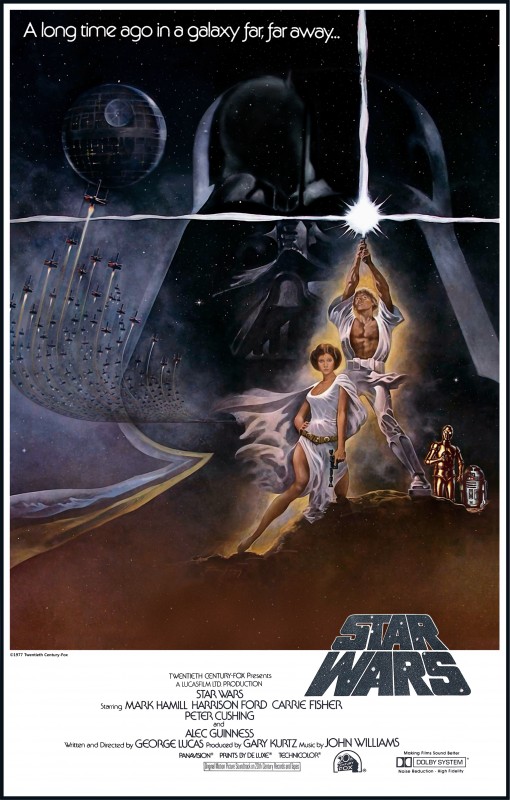
Star_wars_oldThey say that the golden age of science fiction is about twelve years old.  That’s definitely true for me.

My first exposure to the genre was Star Wars: A New Hope.  I saw it when I was seven, right around the height of my dinosaur phase.  Everything about the movie completely blew me away, from the Jawas and Sand People of Tatooine to the stormtrooper gunfights and lightsaber duels.  After watching Luke blow up the Death Star, I spent the next few hours running around the yard pretending to fly my own starfighter.

In a lot of ways, I’ve never really stopped.

My parents made me wait until I was nine to watch The Empire Strikes back, because it was rated PG.  Without any exaggeration, I can say that those were the longest two years of my life.  I was literally counting down days by the end, and to pass the time without going crazy, I read up on all the books about space that I could possibly find.

My father bought the original X-wing flight simulator game somewhere around then, and I soon became totally engrossed in it.  Since the 386 was our only entertainment system (no Super Nintendo–I had to visit a friend’s house for that), X-wing became the defining game of my childhood.  I spent hours and hours on that game, to the point where I knew exactly which simulated missions the characters from the books were flying and how to complete them faster and easier.

I thought The Empire Strikes Back was a little slow the first time I saw it, but it’s since grown on me, to the point where now it’s my favorite film in the whole series.  Thankfully, my parents let me watch Return of the Jedi the next day, and for the next few months my life felt utterly complete.

Around this time I discovered the Star Wars novels and soon immersed myself in them.  The Courtship of Princess Leia by Dave Wolverton soon became one of my favorites, as well as the Heir to the Empire trilogy by Timothy Zahn and the X-wing series by Michael A. Stackpole.

But it was Roger Allen McBride who first introduced me to a different flavor of science fiction with his Corellia trilogy.  As I mentioned in V is for Vast, those books had just enough of a touch of hard science to intrigue me about the other possibilities of the genre.  That was the last Star Wars series that I read before branching out into other works of science fiction.

The Tripod trilogy by John Christopher was my first introduction to the dystopian / post-apocalyptic genre, depicting an enslaved humanity after an alien invasion.  Those books really captured my imagination for a while.  The Giver was also quite interesting and thought provoking, though since it didn’t involve spaceships or aliens it wasn’t nearly as compelling.

I read a lot of fantasy in my early high school years, including Tracy Hickman, Lloyd Alexander, and (of course) J.R.R. Tolkien.  While I enjoyed those books and immersed myself in them for a while, my true love was still science fiction.  For almost a year, I watched Star Trek: Voyager religiously with my dad.  And every now and again, I’d pick out a science fiction book from the local town library and give it a try.  That’s how I discovered Frank Herbert’s Dune.

In eleventh grade, my English teacher had us choose an author and focus our term papers solely on their books for the entire year.  She suggested I choose Orson Scott Card, but I chose Cormac McCarthy instead.  I’m not sure if that was the worst decision of my high school career, or the best decision, since assigned high school reading tends to make any book feel like it sucks.  I discovered Ender’s Game the following summer, and finished it in a delirious rush at 3am the morning after checking it out from the local library.

More than any other book, Ender’s Game cemented my love for the genre, and showed me just how powerful and moving the genre could be.  It opened so many insights into the world and human nature, reading that book made me feel like I’d opened a pair of eyes that I didn’t even know I’d had.  Looking back, that was probably the moment when I knew I would be a science fiction writer.  I’d known I was going to be a writer ever since I read A Wrinkle in Time at age eight, but to be a science fiction writer specifically, that goal was probably cemented by reading Orson Scott Card.

After high school, I served a two year mission for my church, during which I didn’t read any novels or watch any TV or movies.  When I came back, though, Orson Scott Card and Madeline L’Engle helped me to ease through the awkwardness of adjusting back to normal civilian life.  When I left for college, I expanded my horizons even further, starting with Isaac Asimov’s Foundation series and Edgar Rice Burrough’s Princess of Mars.

When I discovered Pioneer Books in downtown Provo, I knew I’d found my favorite bookstore in Utah Valley.  I have so many fond memories sitting cross-legged on the floor in the science fiction section, browsing through the musty used books for hours at a time.  That’s where I discovered C.J. Cherryh, Arthur C. Clarke, Robert A. Heinlein, Ursula K. Le Guin, and numerous other authors who are among my favorites today.

When I discovered Spin, Robert Charles Wilson soon became one of my favorites.  I picked up that novel as a free PDF from Tor, and read it over the summer while studying abroad in Jordan.  Once again, that same hard sf sensibility I’d gotten from Roger Allen McBride touched me in an unforgettable way.  But it was the human element of that book that really moved me–in fact, it’s always been about the human element.  The world building in Downbelow Station was great and all, but the romance of Merchanter’s Luck had a much more lasting impact.  Starship Troopers had some good ideas, but it was Mandella’s personal journey in The Forever War that moved me almost to tears.  The intrigue of the Ender’s Shadow series was quite entertaining, but it was Ender’s Game and Speaker for the Dead that really taught me what it means to be human.

I finished my first novel, Genesis Earth, shortly after returning from that study abroad, and tried to capture the same sensibility from Spin as well as the intimately human element.  Since then, I’ve written several more sci-fi novels, some of them tragic, some triumphant, but in all of them I’ve tried to get as close as I can to the personal lives of the characters.  I don’t know if I’ll ever write a character portrait so intimate as Shevek’s in Ursula K. Le Guin’s The Dispossessed, but I certainly hope to someday.

For me, science fiction started out as a wonderfully exciting entertainment and turned into something much more meaningful.  If there’s anything the genre has taught me, though, it’s that the two aren’t mutually exclusive–that you can have your adventure and learn what it means to be human as well.  Indeed, the more imaginative the adventure, the greater the truths I’ve taken from it.

Because of that, even though I’m almost in my thirties now, I can’t possibly foresee a time when science fiction isn’t a major part of my life.  It’s a love affair that’s grown just as much as I have, and continues to grow with each new author I discover and each new book I write.  When I’m old and grizzled and pushing eighty, I’m sure there will still be a part of that twelve year old boy in me, still running around the yard flying his starship.

L is for Lost Colony

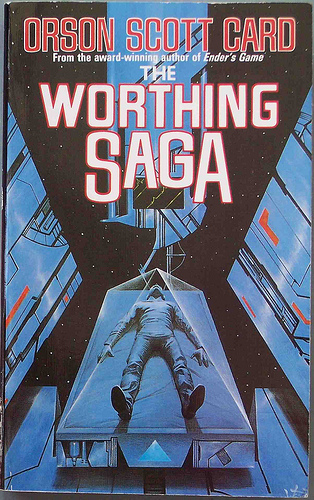
worthingsagaAs we discussed in I is for Interstellar, space colonization is a major theme of science fiction, especially space opera.  Of course, things don’t always go smoothly.  Space is a really, really, really big place, and sometimes, due to war or famine or simple bureaucratic mismanagement, colonies get cut off from the rest of galactic civilization.  They become lost colonies.

Some of my favorite stories are about lost colonies: either how they became cut off, or how they reintegrate after so many thousands of years.  In many of these stories, the technology of these colonies has regressed, sometimes to the point where the descendents may not even know that their ancestors came from the stars.  When contact is finally made, the envoys from the galactic federation may seem like gods or wizards.

Because of this technological disconnect, stories about lost colonies often straddle the line between science fiction and fantasy.  After all, Clarke’s third law states:

Any sufficiently advanced technology is indistinguishable from magic.

Of course, the line between science fiction and fantasy has always been a fuzzy one.  Hundreds of attempts have been made to define it, but they all fall short.  In the end, it often breaks down to certain recurring tropes, like dragons and wizards versus ray guns and rockets, but even that doesn’t always work.

For example, Anne McCaffrey’s Dragonriders of Pern is technically about a lost colony far into the future, but it’s got dragons and castles and other tropes that belong squarely in fantasy.  Then again, the dragonriders have to fight alien worms who invade every few dozen years from a planet with a highly elliptical orbit, so there’s still a strong science fiction basis undergirding the whole thing.

And that’s just Dragonriders of Pern.  What about Marion Zimmer Bradley’s Darkover series, or C.S. Lewis’s Space Trilogy?  Trigun is more western than fantasy, but it’s also full of sci-fi tropes like giant sand-crawling monster ships and a weird post-apocalyptic backstory.  And then there’s all the Japanese RPGs that combine magic with mechas, with Xenogears as one of the best examples.  For a distinct Middle Eastern flavor, look no further than Stargate.

It’s no coincidence that all of these stories feature a lost colony of one kind or another.  When the characters don’t know that they’re living in a science fictional universe, it’s very easy to throw in tropes from other genres.  By no means is it required–Battlestar Galactica and Dune are evidence enough of that–but they certainly present the opportunity to do so.  After all, lost colony stories basically present a hiccup in humanity’s march of progress, breaking the essential science fiction narrative for all sorts of interesting side stories and tangents.

One perennial favorite of science fiction writers is to suggest that Earth itself is a lost colony from some other galactic civilization.  That forms the entire premise behind Battlestar Galactica: the original twelve colonies have been destroyed in the human-cylon wars, and the last few survivors are searching for the legendary thirteenth colony of Earth, hoping to find some sort of refuge.  Apparently, Ursula K. Le Guin’s Hainish cycle also plays with this trope, though she’s never very explicit with her world building.  It can be a bit tricky to twist the lost colony trope in this manner, but if pulled off right it can really make you sit back and go “whoa.”

My personal favorite is probably Orson Scott Card’s The Worthing Saga, about a colony of telepaths that breaks off from a collapsing galactic empire and actually becomes more advanced than the rest of humanity.  When Jason Worthing and Justice re-establish contact, the descendents of the galactics are basically pre-industrial subsistence farmers who view them as gods–which, in a certain sense, they almost are.

It’s a great story that really entranced me, not just for the science fictional elements but also for the distinct fantasy flavor.  Orson Scott Card’s handling of viewpoint in that book is truly masterful, so that I felt as if I were viewing everything through the eyes of his characters.  Since the farmers don’t know anything about their spacefaring ancestors, all the parts from their point of view feel like a completely different story.  It was really great.

My first novel was actually a lost colony story, combined with a first contact.  I trunked it a long time ago, but many of the earliest posts on this blog are all about my experience writing it.  As for my other books, Desert Stars contains elements of this, though the lost colony in question is actually a nomadic desert society that lives on the capital planet of the galactic empire, just outside of the domes where all the more civilized folk live.  Heart of the Nebula is basically about a society that puts itself in exile in order to escape the privations of the Hameji.  And in… no, I’d better not spoil it. 😉

The lost colony isn’t one of the flashier or more prominent tropes of science fiction, but it’s definitely one of my favorites.  It’s a great way to add depth and intrigue, as well as bend genres.  For that reason, I think this trope does a lot to keep science fiction fresh.

Trope Tuesday: Wicked Cultured

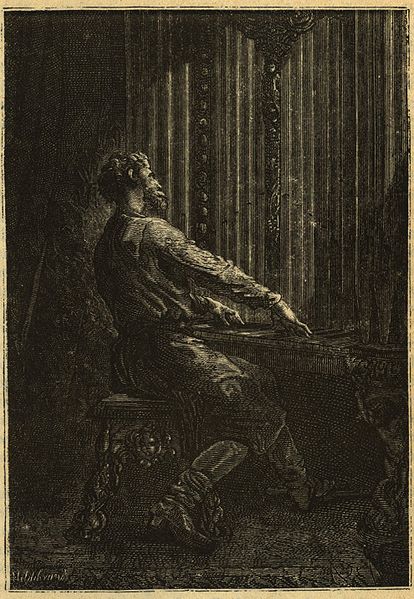
What Captain Nemo does in his spare time, when he isn’t terrorizing the world of maritime shipping.

This week’s Trope Tuesday series post is by request from a reader.

Evil villains aren’t always grotesque, brutish, foaming-at-the-mouth barbarians.  Quite often, they are wealthy and aristocratic, with exquisitely refined tastes and an extraordinary degree of eloquence.  It isn’t just that evil is cool (though it may overlap with this), or that the barbarians have finally developed a fashion sense–it’s that the more refined and cultured a character is, the more evil they are as well.

This happens a lot more often than you might think.  Magneto (X-men), Lucius Malfoy (Harry Potter), Hannibal Lector (Silence of the Lambs), Ganondorf (Zelda), Captain Nemo (20,000 Leagues Under the Sea), the Godfather (the Godfather), Kane (Command & Conquer), President Shinra (Final Fantasy VII), the Merovingian (The Matrix Reloaded), Grand Admiral Thrawn (Star Wars: Heir to the Empire and The Thrawn Trilogy), Khan (Star Trek II: The Wrath of Khan), Vetinari (Discworld), Captain Hook (Peter Pan), the Phantom (Phantom of the Opera) and every James Bond villain ever all fall squarely into this trope.

So why does this happen?  I can think of a few reasons, though I’m sure there are others.

First, it hearkens back to the age-old romanticism vs. enlightenment debate.  This is especially true of the fantasy genre, which tends to hearken back to a medieval golden age before the modern, industrial world, when life was simpler and people tended to live in picturesque rural villages instead of dense urban cities.  If your hero is a farmboy in a world of knights and wizards, or a barbarian hero who strikes first and asks questions never, chances are that anyone with a sense of refinement or culture is going to find themselves on the wrong side of the story.

Second, it hearkens back to the mad scientist and the cautionary tale of science gone horribly wrong.  As you might expect, this is much more common in science fiction, especially the classic dystopian stuff. The more scientific and enlightened a character, the more cultured they tend to be as well.  In stories where science is bad, then, it should come as no surprise that these characters are also evil.

Another good reason to use this trope is to indicate that the villains are members of the Empire.  Culture tends to happen when people of diverse talents and backgrounds are brought together, and the best way to bring them together is through conquest.  Just look at the Romans.  Almost every empire throughout history, no matter how brutal, has always produced an increase in some degree of culture.  Even the Mongols gave way to Kublai Khan and the Silk Road.  So in stories where the Evil Empire comes into play, having your villains be cultured can be a good way to show that.

The biggest reason for this trope, though, is that it makes the villains more complex and interesting.  If being evil always meant living in a cave and eating raw meat, then every story would read like a badly written RPG, where the heroes keep grinding until all their stats are at 9999 or higher.  And honestly, you have to admit that there’s something a little bit eerie about that guy who gets totally absorbed when playing the organ.

I haven’t played with this trope in a major way yet, but it does come into play a bit in Desert Stars, though only in a minor way.  In Bringing Stella Home and Heart of the Nebula (forthcoming), Lars is pretty much the opposite of this (the Gentleman and a Scholar trope, though he did drop out of college).  Probably the best example would be Heloise from Star Wanderers: Fidelity (Part II).  She’s wealthy, fashionable, and decorates her apartment with wallscreen monitors that cycle through artistic photographs of deep space nebulae.  She’s also one of the more dangerous female characters I think I’ve written.  Who knows–maybe she’ll show up in another story before too long.

Trope Tuesday: Dreaming of Things to Come

When a character in a story has a dream, there’s almost certainly a reason for it.  If it’s not thrown in just to show how scarred or tortured he is (or alternately, how repressed he is), chances are good he’s dreaming of things to come.

I’m a huge fan of this trope, as you may be able to tell if you’ve read any of my books.  It’s a special form of foreshadowing that lends a mystical, otherworldly flavor.  It’s also something that we can relate to: how often have you had a dream that was so powerful, so moving, that it just had to mean something?

When played straight, this trope often implies some sort of all-seeing being who sent the dream on purpose.  However, this doesn’t have to be the case.  I often find it much more satisfying when we don’t know where the dream came from.  It’s very easy to shatter the sense of wonder by over-explaining things, especially when it comes to the dream world.

Of course, the character doesn’t just have to dream of things to come to capture that sense of wonder.  They can also dream of times gone by, discovering something previously unknown about the past, or dream of the truth, working through a previously unsolvable problem in their sleep.  The mystical, otherworldly flavor still holds true for all of them.

As you might expect, this is a fairly common trope in fantasy.  Some prominent examples include:

  • Lord of the Rings
  • The Silmarillion
  • A Game of Thrones
  • The Black Cauldron
  • American Gods
  • Most of the Redwall books
  • Dragonsflight
  • Watership down

Why is so popular?  Even though dreaming is such a common, universal experience, it’s still shrouded in mystery.  It resonates deeply with us because we can all relate to it, and at the same time it opens all sorts of windows into the fantastic because there is so little we understand.

Like I said before, this is sort of a pet trope for me.  Consciously or not, I tend to throw in at least one dream sequence in every book I write.  It seems to have worked pretty well so far, so I don’t think I’ll be changing that anytime soon.

Trope Tuesday: Chess Motifs

Chess is quite possibly the oldest, deepest, most well known and widely played board game in the world.  It should come as no surprise, then, that it’s often used as a motif in works of fiction.

The interesting thing is how well the pieces fit some of the classic character archetypes:

  • The King is like the Hero: the most indispensable character around whom the story revolves.
  • The Queen is like the Chick (or perhaps the Heart): less appreciated than the Hero but a powerful character who holds the team together (and whose loss often makes the team fall apart).
  • The Rook is like the Big Guy: the stoic, straightforward heavy-lifter who might not be quick (rooks are often the last pieces to be developed) but pulls a lot of weight, especially in the endgame.
  • The Bishop is like the Smart Guy: quick and versatile, mystical and unpredictable, striking from a long distance and often performing two or three jobs at once, but lacking the power by himself to achieve victory.
  • The Knight is like the Lancer: likely to go over the others’ heads and the one most likely to sacrifice himself for the cause (knights before bishops, after all).
  • The Pawns are like the Red Shirts: expendable minor characters who may, if they push forward bravely and stay faithful to the end, eventually become queens.

And that’s not all.  The major chess strategies also correlate loosely to major story tropes.  For example, at the beginning of the game, it’s important to move the king to safety, while in the endgame, the king becomes a much more important offensive piece.  Likewise, the hero often spends the first half of the story running away from the bad guys, while in the second half, he starts to take real action.

And the list goes on.  The more I learn about chess, the more parallels I see.  It’s gotten to the point where I want to try diagramming a novel, or perhaps a series, according to a chess game, with that fact being part of the big reveal.  Or perhaps to have one of the major characters have a long-standing chess rivalry with another character who ends up being a major bad guy.

Or something.  I’m just starting a new novel, so everything looks fresh and exciting.  The story will probably change and evolve considerably over the course of writing it, but since it’s a fantasy novel, I think that some chess motifs may be especially appropriate.  Fantasy, after all, is about taking the reader back to a golden age of magic lost in the pages of history, and chess is perhaps the oldest popular game in the world.

In the meantime, is anyone up for a game of chess?

Image (cc) from wikimedia commons.