The next big dream

When I graduated from college, my goal for my writing career was this: to make a living telling stories that I love. It seemed, at the time, like an impossible dream–something so far out of my reach that I couldn’t possibly achieve it without years and years of constantly frustrated effort.

Well, guess what? For the past six months or so, I’ve more or less been doing it. I live below the poverty line in a basement with two other guys, and I have to donate plasma to cover the difference in my expenses each month, but writing is my main gig and I’m making enough to pay all my bills with it. Barely.

There’s more to life than making a living, though, even doing something that you love. My current month-to-month lifestyle isn’t particularly well suited for anything except, well, living month-to-month. So I need to make some changes, and to do that, I first need to dream a little bigger:

A really good dream should be–or at least seem to be–a little bit impossible. That way, you don’t have to worry about achieving it too soon. At the same time, it shouldn’t be too impossible. If you can’t see myself ever achieving it, then what’s the point?

For example, one of my bucket list goals is to look down on this planet from space. With the awesome advances in spaceflight that companies like SpaceX and Virgin Galactic are making right now, I can totally see that happening in my lifetime. But setting foot on an alien world? Nah, I don’t think that’s in the cards for me.

(Then again, if we figure out how to live forever, maybe it could actually happen. Even just adding another 50 or 100 years to my life would probably let me live to see a permanent base on the Moon or Mars. So maybe impossible is actually better–I don’t know.)

A friend of mine is building a business that he hopes will one day make him a cool seven figures. His mom makes six figures, but her name is also on six mortgages, so she’s pretty much tied to her job. One of his big dreams is to pay off all those mortgages for her so that she can retire.

When that happens, he’s going to celebrate by getting a bunch of friends together on a road trip to Texas. We’ll take a big refrigerated meat truck down there and go wild boar hunting until it’s packed full of pork. Then we’ll come back to Utah and have the mother of all barbecues. 😀

That’s the kind of dream I need to shoot for: something specific and personal that sounds kind of crazy but is still just barely within reach. In other words, it should be something that’ll make a good story when I finally achieve it. Or maybe I won’t achieve it–maybe the dream itself be so awesome that just the act of striving for it will make all the difference. As David Gemmell once wrote:

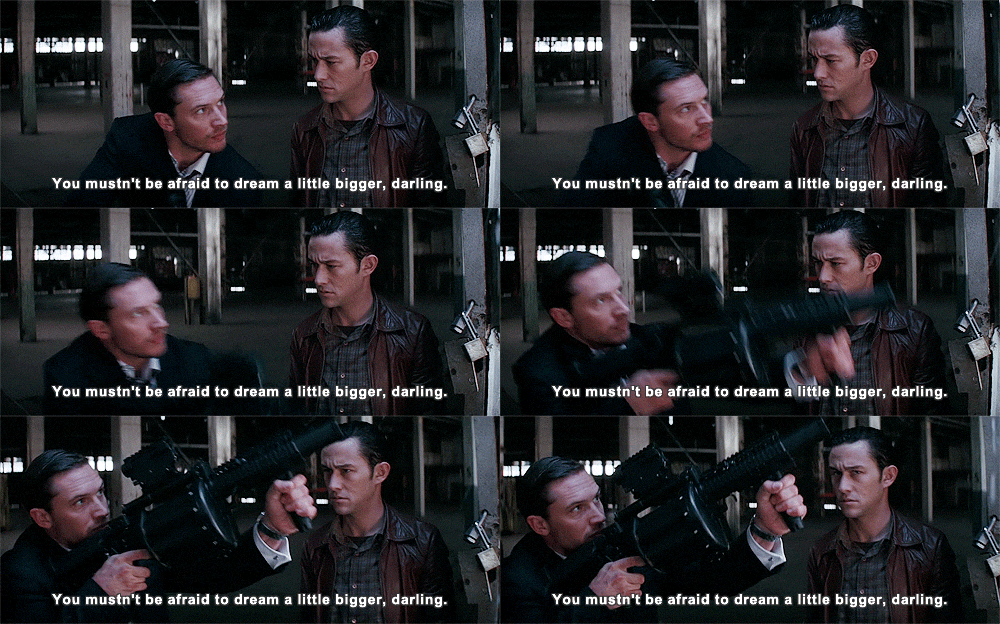
May all your dreams come true save one, for what is life without a dream?

It’s going to take more than one blog post to figure this whole dream thing out, so I’ll just leave that here for now. It’s definitely going to be on my mind for the next little while. If you have any impossible dreams of your own, please do share!

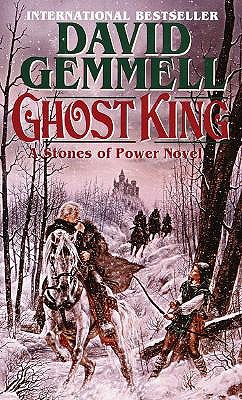
Ghost King by David Gemmell

Ghost KingAnother review of a David Gemmell book?  Yes, because I’m just that much of a fanboy.

With the Drenai series finished, I decided to sink my teeth into the Stones of Power series.  This series confuses me, because I’ve read The Jerusalem Man, which was retroactively put in as book three, but that’s a post-apocalyptic tale of the gunslinger Jon Shannow, but the series actually starts in Arthurian England.  As soon as I got a couple chapters into the first book, though, I began to see the connection.

Ghost King is an alternate history tale of King Arthur (Uther, in the book), and how he rises to become the Blood King of Britannia.  His grandfather, Culain, takes him into the mountains after the Brigantes assassinate his father, and there trains him to become a leader and a warrior.

Culain, of course, is one of the immortal Atlantians, just like his friend Maedhlyn (Merlin).  After the fall of Atlantis, they have wandered the Earth as gods, using the powers of the Sipstrassi stones to accomplish wonders.  Worshipped in turn by the Greeks, the Romans, the Hittites, and the Babylonians, Culain has tired of immortality and now wants to live out a mortal life.  But his jilted lover, the Ghost Queen, wants revenge on him for leaving her.  She was the one who killed Uther’s grandmother and mother, and who now wants to kill him and rule all of Brittania.  But her son Gilgamesh has corrupted her, so that in a parallel universe she must kill twenty pregnant woman every month just to replenish the magic of her Sipstrassi …

Okay, I might as well give up trying to explain the plot, because it only gets crazier.  Somewhere in this parallel dimension, a lost Roman legion has been wandering for hundreds of years, consigned to the void by Culain.  Also, Gain Avur (Guenevere) is in there too, as well as the Lance Lord (Lancelot), though he doesn’t come in until the epilogue.  There are also demons and vampyres, all sorts of battles, and lots of other crazy stuff.  It’s pretty freaking dang awesome.

I really enjoyed Uther’s transformation from the weak, bookish boy to the warrior king, as well as the budding of his relationship with Gain Avur (what can I say, I’m a sucker for romance).  My favorite character, though, was Prasamaccus, a crippled Brigante peasant who becomes one of Uther’s close advisors.  He’s basically a regular guy who gets sucked up into the whole adventure, but he’s level-headed and practical enough that he manages pretty well.  He’s also just a good person, which was quite refreshing in a world full of death and drama.

At one point, after rescuing Uther, he’s a guest in Uther’s chief general’s villa.  The general gives him a servant girl for the night, since in this world most men think nothing of bedding a slave.  Prasamaccus is a peasant, though, and he’s kind of shy.  The girl was actually captured in a raid in Germany, where she was raped, and this is her first time bedding someone since those traumati not the monster she’s afraid that he’ll be–they actually share a really tender moment of intimacy that heals much of her trauma and introduces him to the love of his life.c events.  She’s absolutely terrified, but so is Prasamaccus–he’s a cripple, and assumes that women just don’t want him.  He spends the night with the girl but doesn’t force her to sleep with him, and when she realizes how gentle he is–that she holds the power, and that he’s not the monster she’s afraid that he’ll be–they actually share a really tender moment of intimacy that heals much of her trauma and introduces him to the love of his life.

It’s poignant, story-rich moments like that that make me such a David Gemmell fanboy.  Usually they happen in the midst of war, between battle-hardened friends who are forced by circumstance to do something heroic, but they also happen in the quiet moments between characters who carry other scars.  That whole thing in the previous paragraph only happened in three pages or so, but it was still so incredibly powerful and moving.  Every moment of a David Gemmell book is like that, sometimes from the very first paragraph.  It’s awesome.

As far as David Gemmell books go, I’d put this one in about the middle of the pack.  It’s not quite as powerful as Legend or Wolf in Shadow, but it doesn’t meander as much as White Wolf or have such an anti-climactic ending as Ironhand’s Daughter (which was probably split by the publisher–more on that when I review The Hawk Eternal).  The characters aren’t quite as memorable as Druss, Skilgannon, or Waylander, but they are pretty awesome nonetheless.  I’d rate this book a 3 compared to Gemmell’s other books, but a 4.5 out of fantasy overall.  Definitely worth a read.

Nanowrimo anyone?

November is coming up, and with it, nanowrimo.  I’ve always wanted to participate, but every time it rolls around, it seems like I’ve got another project going on that’s more important.

This year is no exception, but I think I have a way around that.  The goal for nanowrimo is just to write something–it doesn’t have to be any good.  I’ve got a bunch of projects I’m currently working on, including Star Wanderers: Deliverance (Part VIII) which I hope to publish by Thanksgiving, but I think I can still do a just-for-fun sort of thing on the side, with the understanding that it doesn’t have to be serious.

What I think I’ll do is write a story where all of the characters from all of my previous books get caught up in some sort of a weird time-space dimensional warping thing, so that they end up in books where they don’t belong and universes where they never existed.  It should be a fun way to revisit some of them, especially the ones from the Gaia Nova books, which I haven’t really done much with in a while.

It’s probably not going to make much sense to anyone who hasn’t read my books, but who cares?  That’s not the point.  I may or may not put it up somewhere for people to read, but it may have some stuff from projects that are either unfinished or unpublished, so it might be a little obtuse even for the fans.  However, it seems like a really fun project, one that I can really run with, and that’s all that really matters for nanowrimo.

As far as my other projects go, right now I’m working on a heroic fantasy novel that’s a prequel of sorts to The Sword Bearer.  I have no idea where it’s going to go, but I’m taking a page from my favorite writer of all time (David Gemmell), with lots of violence, lots of blood, and lots of true grit and heroism.

At the same time, I’m still working on Sons of the Starfarers off and on, though I may end up putting that one on hold for a while as I figure things out with this heroic fantasy story.  It will get done, though–it’s definitely a story I’m itching to tell.  In a couple of reviews and emails, readers have asked whether I’ll ever write an origin story for the Hameji.  Well, that’s what Sons of the Starfarers is going to be, though the connection might not happen until well into the series.

There’s a couple of other Gaia Nova books I’ve been meaning to write for a long, long time, but I don’t know if I’ll be able to get to them anytime soon.  This nanowrimo project might spark something, though, since I’ll be revisiting a lot of those old characters.  And even if the nanowrimo novel itself is pretty bad, if it gets those projects on the back burner simmering again, then that will definitely be something.

Dang, I really want to get started with nanowrimo now!  So many wacky ideas … it’s like writing fanfiction for one of your own books!  In any case, I’d better get back to writing before I get too excited.  Don’t want to spend so much time thinking about writing that it becomes hard when I actually sit down to do it.

Later!

Why I don’t like George R.R. Martin

I was thinking today about George R.R. Martin’s A Game of Thrones and the fact that I’ve more or less given up on the series after reading the first book.  A lot of my friends are rabid-at-the-mouth crazy about it, both the books and the TV miniseries, but I’m just not all that into it.

Don’t get me wrong—I can see why other people like it so much.  The story is engaging, the political intrigue is deliciously complex, the world building is wonderful and immersive, and the fantasy tropes are played quite well.  I enjoyed a lot of things about the first book, and intended to read the rest of the series after finishing it.  After all, it’s one of the most important works of epic fantasy to come out in the last few decades, with people calling George R.R. Martin an American Tolkien.

But the truth is, I just wasn’t all that into it.  And the more I think about it now, the more I’ve realized that this isn’t the kind of series I would enjoy at all.

The strange thing is, I’m a HUGE fan of David Gemmell, who writes almost the exact same sort of thing.  Immersive fantasy worlds, dark and gritty characters, shades of gray, lots of fighting, lots of sex, lots of brutality, the realization that anyone can die off at any time … the list goes on and on.  And yet, there’s something about David Gemmell’s books that turns me rabid-at-the-mouth and has me squeeing like an otaku fangirl, whereas with George R.R. Martin, all I can manage is “meh.”

I think the reason for this is that Martin’s characters basically fall into one or both of two camps: victim or victimizer.  There isn’t any middle ground—at least, none that anyone can stand on for long without dying in some horrific and brutal way.  The story requires the characters to all become monsters, and anyone who isn’t willing to do that meets a horrible, tragic end.

There were only two characters in A Game of Thrones that I really cared about: Arya and Ned Stark.  Ned was the only character who really tried to stand for something, and Arya was just a spunky little girl who resisted all the stupid girly stuff in favor of more practical stuff like street smarts.

<spoilers ahoy>

The trouble was that Ned was a complete idiot, trusting in the honor of a guy who explicitly said “do not trust me” and making stupid decisions that ended up getting half of House Stark killed or captured.  It’s almost as if Martin purposefully set him up to be a straw man character—that he wanted this one character to represent all the goody-goodies of the world, and knocked him off in the most brutal way possible.  It’s like Martin killed him off to make a point, and had the story drive the character rather than the character drive his own story.

And Arya … I forget exactly what happened to her, but she basically became a victim in such a horrible, twisted way that I could tell she’d be scarred for the rest of the series.  If she didn’t die off herself, she’d probably become a dirty street rat—the slit-your-throat-for-a-copper kind, not the Disney version.  So yeah, I pretty much gave up on her.

Jon Snow was okay, but he was so far removed from everything else in the story that I just got bored with him.  Tyrion was funny, but he was also a pervert, and all the reasons to sympathize with him basically revolved around “I’m a dwarf, everyone mistreats me”—again, the victim vs. victimizer thing.  Lady Catelyn was pretty cool, but I always saw her as more of a supporting character, and while I found myself rooting for Daenerys at the end, it was only out of frustration with all of the other douchebags in Westeros—I just wanted her to come over the sea and claim the throne so that everyone else would die.

It was a pretty good book, I’ll admit—other than the fact that I didn’t really like any of the characters, everything else was quite enjoyable.  It certainly held my attention long enough to finish the thing.  But I didn’t really feel compelled to read the next one because I frankly didn’t care what happened to any of the characters.  You could give me a list of all of the ones who die off, and I would just shrug and say “oh well.”

In contrast, with every David Gemmell book I’ve read, I fall in love with the characters after reading just a paragraph or two in their viewpoint.  Drenai or Nadir, civilized or barbarian, I not only like the characters, I fall deeply in love with them.  I care about them right from the outset, even the ones with a dark past, like Skilgannon or Waylander.  In fact, Waylander is probably my favorite of them all.

The fact that I know that some of these guys are going to die only makes me more invested, because even though Gemmell kills of most of his characters in any given book, the main characters’ deaths almost always mean something.  Maybe they have some awful secret that they finally are able to give up, or maybe they’ve been running from a fate that they finally gather the courage to face.  Or maybe they just happen to be in a circumstance that requires them to give up their lives, and they rise to meet the occasion.  Not every death is cathartic, but Gemmell never kills off a character merely for the sake of killing off a character, whereas with Martin, I get the sense that that’s sometimes the only reason.

But the biggest difference between the two is that with Gemmell, the victim vs. victimizer paradigm just doesn’t exist.  Gemmell’s books are all about unlikely heroism—characters in situations that require them to be something more, or do something beyond looking out for just themselves.  Anyone can be a hero, because a hero is nothing more than someone who does something heroic.  No matter your past, no matter your fears, no matter your weaknesses, when the chips are down, we’re not all that different.

The counter argument I’ve heard is that all of this heroism stuff is superfluous, and Martin is trying to get beyond it, kind of like the 19th and 20th century philosophers who were trying to get beyond morality.  The thing is, if that’s the case, then Martin has to have the darkest and most depressing view of human nature of almost any fantasy writer alive.  If his point is that there’s nothing intrinsically heroic about anyone, that being a hero is just a matter of rising to a role and becoming a figure in one of the stories that people tell to make sense of the world—if his point is to show that every hero is really just a douchebag, there’s something about the world that he’s really missing.

In Gemmell’s books, there are douchebags who rise to the heroic roles required of them—but in the act of filling that role, something about them changes, and you see that they’re really not as evil as you thought they were.  Because in Gemmell’s view, people are essentially good and everyone is redeemable, even the rapists and murderers.  One of his darkest characters, Skilgannon the Damned, learns at the end of his story that the difference between salvation and damnation is allowing yourself to receive the light—that the only thing damning you is yourself.  Whether or not you agree with that, you have to admit that’s a pretty optimistic way of seeing the world.

In the end, that’s why I love David Gemmell’s books so much—not just because anyone can die, but because anyone can be redeemed too, sometimes at the very same time.  From what I’ve read of George R.R. Martin, it seems that he redeems no one—that to the extent I’m rooting for any one character, it’s only because I can’t wait for them to kill or brutalize all the other horrible monsters in the book.  And frankly, I find that pointless and tiresome.

There are moments in almost every David Gemmell book I’ve read that stand out to me with great clarity, so that sometimes while I’m standing in line at the grocery store, or walking down the street to the library, they pop into my head completely unbidden.  With George R.R. Martin, that has never happened to me, even for the books of his that I’ve enjoyed.

I dunno.  Everyone is different.  Maybe George R.R. Martin really strikes a chord in you, so that you feel for him like I do for David Gemmell.  Maybe you actually like some of the characters whom I’ve dismissed as douchebags.  Or maybe you don’t read fantasy for the same things I do.  This post isn’t to knock you for that, it’s just to point out and analyze why I don’t like George R.R. Martin’s stuff as much as most other fantasy fans seem to.  And if you do feel about this the same way that I do, then my point is to declare that that’s all right.  You can still be a fantasy geek and not like A Sword of Ice and Fire or anything else by George R.R. Martin, no matter how much it’s hyped.  That’s perfectly okay.

I’m writing an epic fantasy right now, and it’s not going to be anything like A Sword of Ice and Fire.  It’s probably not going to be much like any of David Gemmell’s books either, but Gemmell is certainly a bigger influence on me than Martin.  We’ll have to see how it turns out.
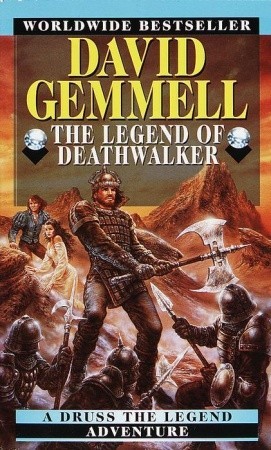
The Legend of Deathwalker by David Gemmell

legend_of_deathwalkerI’m not even going to try to write a synopsis of this story.  It’s just like all the other books in the Drenai series, which is why I love it so much.  Basically, this one gives the story behind the rise of Ulric, khan of the Nadir, and the origin of the Nadir people.  Interestingly enough, Druss the Legend plays a major role.
This was the last book in the Drenai Saga that I hadn’t read, so reading it was a very bittersweet experience.  On the one hand, this one is just as good as all the other books in the series, and made me want to revisit Legend and some of the others.  On the other hand, I knew that once I’d finished it, there wouldn’t be any more Drenai books left.  So I took it slow for the first half, but naturally I finished it at a breathless late-night sprint a day or two later.

I’ve been thinking a lot lately about why I love David Gemmell’s books so much.  There are many reasons, but I think the main reason is that his writing is honest.  He strips away all the incidental stuff and gets right at the heart of the stuff that matters.  He doesn’t pussyfoot around, either–if his characters do something despicable, he doesn’t make any excuses for them.  He tells it like it is.  This can make for a very brutal story, but it also makes for a very cathartic one.

The other reason I love his books so much is because he does such a good job depicting raw, unrepressed manhood–not the stupid stuff like driving big cars and eating meat, but manning up and facing your greatest fears.  It’s about friendship, and honor, and fighting with all of your strength for something you believe in.  It’s about all that raw, pent-up energy we all have, that animal urge that drives us to competitive sports and first person shooters, and channeling it for a heroic cause.

The craziest thing is that the fight itself is actually more important than whatever side the characters are fighting on.  In this book, Druss is actually fighting to help bring about the rise of the Nadir khan who later invades his homeland and kills him on the walls of Dros Delnoch.  None of that matters, though, because Druss doesn’t fight with malice.  For him, it’s all about fighting for something, not against something, and the battle itself is just as important as the victory.  I don’t think I can put it better than this:

“Can we win here?” Sieben asked, as the shaman’s image began to fade.

“Winning and losing are entirely dependent on what you are fighting for,” answered Shaoshad. “All men here could die, yet you could still win. Or all men could live and you could lose. Fare you well, poet.”

The best thing about David Gemmell’s books is the fact that none of the characters–not even the bad guys–are defined by their own evil.  The Nadir are supposed to be the evil chaotic race of the Drenai universe, but when you come to understand what they’re fighting for, their hopes and dreams for a better future, you can really see what’s good in them.  Likewise, the more civilized Gothir are kind of like the evil white men who want to put down the savages and keep them in their place, but there are good and honorable men among them too.

And yet, even though the two sides clash, and good men die on both sides, it somehow isn’t tragic.  That’s the crazy part.  It’s almost like you can feel the characters salute each other as they die in a good cause, the way Ulric gave Druss a proper funeral in Legend, even though the two were blood-sworn enemies.  In David Gemmell’s world, honor and courage are more important than life or money.  Everyone dies; dying well is more important than living without honor.

This book is incredible.  As I was reading it, I decided it was the best David Gemmell book I’ve ever read–which is something I do every time I read one of his books.  I feel like I’m a better man for having read them.  If he had written a hundred books in this series, I would happily read them all.  The fact that there are no more new ones deeply saddens me, but I know I’ll revisit these stories again in the future.

Trope Tuesday: Fridge Logic, Fridge Horror, and Fridge Brilliance

It's amazing how many existential story questions arise from this view.
It’s amazing how many stories suddenly stop making sense from this point of view.

You know that moment after the end of the show, when the credits are rolling and the glory of that crowning moment of awesome is just beginning to fade?  When you go to the fridge to get something to eat, and all of a sudden that gaping plot hole or internal consistency problem with the story hits you?  Yeah, that’s fridge logic.

The key, though, is that it’s not something you normally question while you’re reading the book or watching the show.  While you’re in the story itself, the narrative is so compelling that you just don’t question it–that, or rule of cool is in play.  It’s only after the story is over that those questions start to arise.

It doesn’t have to come from bad writing.  Sometimes, it’s a result of values dissonance, especially for stories written in a different time or culture (although by no means is this phenomenon immune to bad writing).  Sometimes, it’s a result of a tomato surprise, where a reveal of something the characters have known all along completely changes the audience’s understanding of the story (though certainly, this isn’t immune to bad writing either).

Not all fridge logic is bad.  Fridge horror happens when a story becomes even more terrifying the more you think about it.  Some of the scariest horror stories have done this to me, as well as some that weren’t really intended to finish on downer endings but kinda sorta did.  Cracked.com did an interesting article on six movies that went that way.

But the best is when a story turns around and gives you fridge brilliance–that moment when you realize that that thing that bothered you actually changes the nature of the story in a way that suddenly makes it your favorite.

My favorite novel of all time, The Neverending Story, totally did this to me.  When I first read it in fourth grade, there were so many things that made the story awesome: the Temple of a Thousand Doors, the test of the three gates, the old man who is the exact opposite of the Childlike Empress in every way, and of course the signature phrase “but that is another story and shall be told another time.” But when I reread it in college, I realized that the real story–the underlying story that brings everything together–isn’t about a loser kid having all sorts of adventures in a fantastic world, but about the power of storytelling itself, and how it can fill the world with love.

Another moment of fridge brilliance came to me when I learned the story behind the writing of Legend, my favorite novel by David Gemmell, my favorite fantasy writer.  The book is about a hopeless battle that everyone knows cannot be won, and the people who decide to go and fight it anyway.  That’s all well and good, except that David Gemmell wrote it immediately after he was diagnosed with terminal cancer.  The story of the battle itself was a metaphor for his own life, and his struggle with his own impending death.  Lucky for all of us, after he finished writing it the doctor came back and told him that the first test was a false positive–that he was going to live after all.  He then went on to write almost thirty more books, all of them off-the-charts awesome.

So yeah, there you have it.  These are more reader tropes than writer tropes, but as a writer it’s good to keep them in mind.  Don’t be lazy, otherwise your fans will pick your stories apart (or if you have to leave a hole, be sure to hang a lampshade on it).  And if you find yourself smacking your forehead over something you’ve already written and published, see if you can’t revisit it in later books in the series and turn it into fridge brilliance.

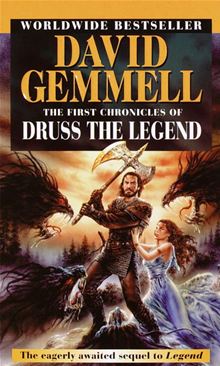
The First Chronicles of Druss the Legend by David Gemmell

druss_chroniclesBefore Dros Delnoch, before Skeln Pass, before the Legend there was a seventeen year old woodsman and his young bride Rowena.  They lived a happy, simple life until slavers attacked their village and carried her away.
But Druss would stop at nothing to save her.  With the demon-cursed blade Snaga, he crossed oceans and continents, fighting corsairs, brigands, armies, empires, even chaos beasts to find her.  And with each battle, the legend grew.

But the greatest challenge Druss would face was not a warrior or a monster, but an old family curse from beyond the land of the living.

Oh man, it’s been far, far too long since I’ve read a David Gemmell book.  Far too long.  And this one was perfect.  It had everything you could possibly ask for in a book by David Gemmell: honor, glory, blood, war, mystics and evil sorcerers, monsters from beyond the grave, great empires and epic sieges, and even a good deal of romance.  And Druss himself is such an awesome character, an unassuming, simple hero who may be brash and may have a temper, but is never completely corrupted by evil.

That said, this is a brutal, brutal book.  The pithiest way I can describe it is Taken meets Lord of the Rings.  People get killed.  Women get raped.  In fact, I think most of the women in the book get raped.  Certainly, more than 50% of the characters die, most of them in a grisly, violent way.  And not everyone is redeemed.  In fact, some of the noblest characters fall.

But man, this is a good book.  Where other fantasy books start off with the lore of the world, painting an exquisitely detailed picture of the world and the magic and the history, Gemmell just throws you right in and grabs you with the story.  Things happen, and they happen quickly.  From the beginning, he snags his hooks in you.

But more than anything, the story means something.  Not in the sense that there’s some kind of underlying moral, or the characters are all black and white.  They aren’t.  People do good things for the wrong reasons, and bad things for the right reasons.  Some of the most despicable characters rise up to do heroic things, while some of the noblest and most honorable characters end up fighting for evil through no fault of their own.  But through it all, there’s so much truth, so much insight, that you can’t help but come away feeling like you’ve been through life and death, and seen the best that both have to offer.

I’m gushing, I know.  This book is INCREDIBLE.  Definitely on par with Gemmell’s best.  I wish he could have written a hundred novels just like it.  I would have read them all.

This is the second to last book in the Drenai series that I’ve read.  The only one that I haven’t gotten to yet is The Legend of Deathwalker, and I plan to get to that one right away.  After that, I’ll probably move on to the John Shannow novels, and then the Rigante series.  In three years, I wouldn’t be surprised if I’ve read every book that David Gemmell has ever written.  He’s just that kind of an author to me.  And if he were still alive, you can bet I’d be ravenously devouring every new book that comes out…

Sadly, the number of David Gemmell books in the world is finite.  But still, there’s quite a few left before I read them all.  And one day, somewhere in the far-off future, I hope to write books as incredible as his.  To one day surpass him would be an impossible dream…but as the Ventrians say, may all your dreams come true save one, for what is life without a dream?

Awesome, awesome book.  If you’re a fantasy reader and brutal stuff like rape doesn’t trigger you, you definitely need to give the Drenai Series a try.  Start with Legend, but get to this one shortly thereafter.  It’s an amazing, incredible read.

Slow, but still making progress

Sorry for neglecting the blog this week.  I took a temp job to earn some cash, and that’s been sucking up most of my time lately.  Fortunately, it should be over sometime next week.

In the meantime, I found a place to live for the next few months.  I’m in the basement of an old house, rooming with a former classmate from Brandon Sanderson’s English 318 class.  So far, it’s actually been pretty awesome.  The rent is dirt cheap and you get what you pay for, but there aren’t any rats and the heater works fine.  It should be a good place to spend the winter.

Progress on Stars of Blood and Glory has slowed down somewhat, mostly due to the temp work, but it’s still coming along steadily.  If all goes well, I’ll have it polished and sent out to my editor by the end of next week, which leaves only the cover art to figure out.  I’m going all out for this one, just like I did with Desert Stars and Bringing Stella Home.

Also, I just (re)started Lifewalker, a post-apocalyptic novel previously titled The Chronicles of Lifewalker.  I know, I should be putting more time into getting Stars of Blood and Glory ready for publication, but this project has been begging to be written since 2011.  I wrote a first chapter two years ago, but the narrative voice wasn’t working too well.  Basically, I was trying too hard to imitate 19th century prose without having read enough to know how to do it well.  Instead, I decided to toss all that stuff out and write the dang story without being overly restrictive.  I think it’s going to turn out well.

Blah blah blah oh did I mention that I checked out a couple of David Gemmell books from the Provo Library?  Well, I did.  They are the last two books in the Drenai series that I haven’t read, and I am soooo excited to sink my teeth into them.  Just started The First Chronicles of Druss the Legend last night, and it is AMAZING.  Expect to see a review here soon.

Speaking of which, I should probably reread Wool and review it sometime.  Hugh Howey really took the publishing world by storm last year, and he’s doing some truly amazing things for indie writers.  His books are great, too–definitely worth picking one up.

That’s just about all right now.  I’ll probably put in another hour of writing/revising, then turn in for the night.  Later!

Trope Tuesday: A Man is Not a Virgin

I’m back from vacation, but I’m going to take a break from the Hero’s Journey trope posts to talk about something that I really feel passionate about.  I hope you’ll forgive me if this turns into a rant, but I think this is an important issue that has some very dangerous implications that need to be explored.

In modern fiction, there’s a very prominent trope that a man is not a virgin.  The basic idea is this: if the protagonist is an adult male and he hasn’t yet had sex with a woman, there’s something fundamentally wrong with him.  Of course, because of his adventurous lifestyle, he can’t be tied down in a committed relationship–that would spoil the story.  But he can’t be holding himself back, either, lest his manhood come into question.  And most of the time, he doesn’t really want to, anyway.

This trope has a whole host of unfortunate implications, though, all of which serve to reinforce constrictive gender roles, disempower both men and women, drive a gulf of misunderstanding between the sexes, and emasculate true manhood and its role in our society.

To demonstrate this, let’s take this trope to the logical conclusions that our society seems to have come to.

If a man is not a virgin, then sex is a rite of passage, and it isn’t rape if it’s female on male.

In fiction, the sex as rite of passage trope is often seen in stories about angsty teenagers trying desperately to get laid. These are not typically stories about love–they are stories about peer pressure, objectification, and power.  By equating sex as a rite of passage in this way, it actually divorces sex from any concept of love or commitment, and turns any form of physical intimacy into a caricature of itself.

It doesn’t stop there, though.  If sex is a rite of passage, then it’s only reasonable that the young novice should have an older mentor to help him through the initiation process.  Thus we get the professional sex-ed trope, where the boy’s mentors or guardians help guide him through his first sexual encounter.  The implications for pedophilia and underage sex are more than a little disturbing.

We can see this trope in action in the way we treat female sex offenders.  If a 30-something male teacher has sex with one of his female students, he gets a lengthy prison sentence and spends the rest of his life stigmatized as a predator.  If a 30-something female teacher has sex with one of her male students, she gets a slap on the wrist and TV spot.  She’s not a sexual predator–she’s just having a personal crisis.

Needless to say, this double standard is extremely destructive for the victims of such abuse.

If a man is not a virginthen men cannot help themselves.  Therefore, all men are perverts.

If a true man is not a virgin, then a true man doesn’t say no to sex.  Even if he can say no, he won’t because that’s just not what men do.  Therefore, being a man is functionally synonymous with being a pervert.

The danger here is that it reduces men to their basic animal urges.  If being a man means finding a warm, inviting place for your penis each night, then you might as well go out to the pasture and eat grass.  Whatever happened to self control and delayed gratification?  Do you think anything meaningful would ever have come out of our civilization if we couldn’t keep our pants on?

And yet, both men and women seem perfectly willing to believe that it’s not only unmanly for a man to control his animal urges, it’s impossible.  On the Kindle Boards forum about a month ago, there was a thread on erotica and marriage and one of the members posted this:

I used to work as a forums admin on a large women’s forum (over 100,000 members) and the relationships forum had a lot of heated discussions on this topic. I won’t of course refer to any specific threads, but the discussions went a lot like this:

One woman concerned that her husband was spending too much time watching porn
A massive amount of women telling her that it’s ok, that ‘all men watch porn’
A small amount of women saying either they don’t agree with it or that their men don’t view it
A percentage of women saying their men are addicted to porn and would rather watch it than go to bed with a willing wife
A percentage of women saying it’s not the porn itself that concerns them, but the type of porn their husbands watch
Another group of women saying they either watch it themselves, or watch it with their husbands
Yet another small group of women who either were or are prostitutes/strippers/involved in amateur porn (who are either for or against based on their experiences)
A very vocal percentage of women saying that if your man says he doesn’t watch it, he’s a liar
A heated discussion ensuing….

How does it possibly empower men to tell them that they cannot control their own sexual impulses?  It’s a self-fulfilling prophecy, which harms not only men but women as well.  If all men are perverts, then women can’t afford to wait for a decent man and should settle instead for a deadbeat porn addict.

But that’s not even the worst of it:

…and if all men are perverts and all women are prudes, then men and women are two entirely different species that are completely incapable of understanding one another.

This one really gets to me.  I hear it everywhere, even from people who don’t consciously buy into the logic behind it.  I used to buy into it myself.  It’s the idea that women are so complicated that they are impossible to understand, whereas men are as simple as an on/off switch.

In my experience, men and woman are both human.  Both of them are equally complex and equally emotional.  Yes, they are different, but in such a way that it’s equally difficult (or equally easy) for the one to understand the other.  Generally, women tend to externalize their complexity, whereas men tend to internalize it.  At least,  that’s what I’ve found.

Our society takes this to the next level, however, and teaches men that they should just swallow their emotions.  If they don’t, they risk being seen as weak or effeminate (never mind that equating weakness with femininity is a whole other can of worms in itself).  And after a lifetime of living this way, it can be hard not to believe that that’s just the way men are.

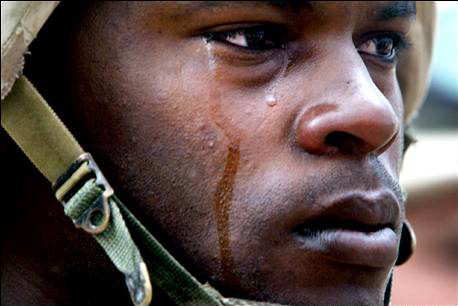
But this is perhaps the most insidious danger of all.  It’s the falsehood that real men don’t cry, or show emotion, or have any capacity for compassion or tenderness.  It’s the fallacy of equating strength with violence.  It’s the destructive belief that men will never rise above the lowest common denominator of their hormones, and should never even try.  And because men are so obviously different from women in this regard, any attempt to understand them would be futile.

But how can you have a committed relationship with someone you can’t understand?  How can you possibly hope to make the necessary sacrifices for each other to make the thing work out?  And if you can’t reach the understanding necessary for a committed, loving relationship, how can you ever hope to raise a family together?

So yeah, sorry for the rant, but this trope REALLY gets under my skin.  It doesn’t help that one of my favorite authors, David Gemmell, is a big fan of it.  I tried to get into his Rigante series, but this trope was so strong that I couldn’t finish the first book.

I should also clarify that the thing that irks me isn’t just the trope, but how much our society has bought into it.  By themselves, tropes are neither good nor bad, but when something like this becomes so prevalent that it defines the entire operating system on which our society is based, that’s when someone needs to speak out.

And for the record, I am a 28 year old single male who is not ashamed to say that he is still saving himself for marriage.  Am I gay?  No.  Has it been difficult?  Yes.  Am I anything less than a man because of it?  Hell, no.  In fact, I would argue that the wait has made me more of a man than I otherwise would have been, and I’m sure that my future wife will agree.

Real men aren’t defined by their hormones or their sexual history.  They’re defined by the way they treat the people around them, especially the ones who are most important in their lives.

When men cry, or in defense of damaged characters

I recently read an amazing blog post by Shannon Hale titled “Why boys don’t read girls (sometimes).” In it, she makes a number of excellent points about how our society stigmatizes boys who read “girlie books,” and why that’s harmful.

Perhaps the most moving part of the post was at the end, where she described an experience at one of her book signings where she saw a boy hanging back and asked him if he would like her to sign one of his books.  The boy’s mother jumped in and said “yeah, Isaac, would you like her to put your name in a girl book?” The boy’s sisters all laughed at him, shaming him for reading anything that ran against their strictly defined gender roles.

In direct contrast to Shannon Hale, Dave Farland released a “daily kick” newsletter a couple of days ago where he advises writers to never let their characters cry.  In it,  he states:

Whatever problem [the character has]—whether terminal disease or sociopathic neighbor or anything else—the problem must be faced with courage. This means that your character can’t cry about it, no matter what the source of pain…Any time that a character breaks down, we as an audience may cast judgment upon that character.

Now, I have nothing but respect for Dave Farland.  I’ve been following his “daily kick” emails for years, attended dozens of his convention panels, and even interviewed him once for an online magazine.  He’s been a very influential writer to me personally, and his advice has had a huge impact on my writing.

But on this issue, I think he’s dead wrong.

Even if you don’t have any problem with the idea that men should never cry–a disturbing belief that harms men by forcing them to hide their true feelings, and harms women by teaching men that compassion and empathy are signs of weakness–even if you’re comfortable living in a culture that accepts this belief, there are still instances where having a man cry in your story can be both moving and poignant.

Cross his woman, and he’ll blow your brains out–quoting scripture while he does it.

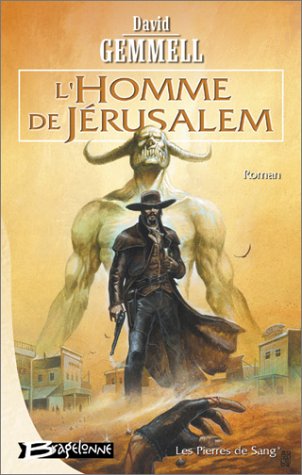
The best example of this that I can think of comes from David Gemmell’s The Jerusalem Man.  No one–and I mean no one–writes manlier heroes than David Gemmell.  And among his characters, Jon Shannow ranks as one of the manliest.

In The Jerusalem Man, Jon Shannow is a lone gunman roving the post-apocalyptic wastelands of Earth on a spiritual quest for the city of Jerusalem.  Near the beginning of the book, he comes across a frontier woman under attack from bandits.  He stops to defend her homestead, and she shows her gratitude by inviting him into her bed.

Jon Shannow is a middle aged man, but because of the post-apocalyptic setting, this is his first sexual experience, and it moves him to tears.  For me, that was one of the most poignant moments of the book.  It didn’t take away anything from his masculinity throughout the rest of the story–indeed, it added significantly to it when the woman got kidnapped and he determined to rescue her.

I’m sure there are other examples that you can think of.  Certainly in real life, this notion that men should never show their feelings is both harmful and outdated.  To say that in fiction, no characters should ever cry–female characters as well as male characters–that’s just so wrong it’s infuriating.  If crying is so taboo that it’s even forbidden in the pages of a book, then something is wrong with the culture, not the story.

In 2008, I attended a fascinating panel at LTUE in which Tracy Hickman and a number of romance and fantasy writers discussed how to write romance in science fiction and fantasy.  Tracy explained that in all the novels he writes with Margaret Weis, she does the fight scenes and he does the romantic ones.

He then went on to talk about how there’s a whole side of life that our culture has shut men off from–a feminine side which is present in all of us, men as well as women.  The way he explained it, romance is not just the “kissy bits,” but a vital and enriching way to see the world–a paradigm that infuses everything with feeling and passion.

It makes me think of The Princess Bride, where even the action scenes with Inigo Montoya have a certain romantic flair to them.  In the old days, the term “romance” described not only love stories, but action & adventure stories as well.  In modern times, we seem to have forgotten all the old qualities like honor, love, sacrifice, loyalty, heroism, and compassion–even though they still make for the best stories.

Of course, our characters need to have courage.  But courage is not the absence of fear–it’s pressing on in spite of it.  And crying is not always a sign of weakness–it can actually be a sign of great emotional strength.  And if it’s true that the best literature helps us to see our world in a new light, giving us a greater understanding and appreciation for the human condition, how is it “courage” for anyone to hide their true feelings?

So do the characters in my stories cry?  Hell, yeah!  I don’t have them hide their feelings just because some readers might look askance.  Some of them cry more than others, and many of them don’t hardly cry at all, but those who do cry do so because the story demands it.

Even though I write science fiction, I do my best to infuse my stories with romance–not just the “kissy bits,” but that depth of feeling and passion for life that made me fall in love with books and reading in the first place.  Star Wanderers is a great example of that, and so is Desert Stars.

And yes, in case you’re wondering, I’ve read a lot of “girlie books.” They’re some of my all-time favorites.