What do you guys think?

Looking for some feedback here.

I was hoping to do something big and awesome for the cover, but the artist I wanted to do it was too booked, and I’ve been having a hard time finding anyone else who quite fits the bill. And then I realized that since this is the first book in a series, it might be better to do a low-budget cover and upgrade later if the book takes off.

Anyways, what do you think? Like it? Love it? Hate it? Feel it needs work? I’m really hoping to get this book up for pre-order in the next couple of weeks, and to do that I need a cover.

Playing with cover art

So last week, I was dinking around with some images, making a cover mock-up for a Star Wanderers short story that’s currently on submission to Orson Scott Card’s Intergalactic Medicine Show. This is what I came up with:

Starchild (cover)The model is Devon Jade, photographed by Aaron Tyree on Deviantart (CC BY 2.5). The background image is variable star RS Puppis, photographed by NASA (public domain).

The story itself is set in the same universe as Star Wanderers, around the same timeline. It’s very short, only 15 pages, and follows the coming of age and loss of innocence of a girl on an isolated space station in the Far Outworlds. It’s on submission to the major SF&F markets right now, but in a few months I anticipate that it will be available to self-publish. I think I blogged about it when I wrote the story last year.

So far, I’ve sent it out to Clarkesworld, Asimov’s, F&SF, Strange Horizons, IGMS, and Escape Pod. All of them except for IGMS have rejected it so far, which isn’t too unusual for short stories (you tend to accrue a LOT of rejections before anything gets published). After I hear back from IGMS, I’ll probably send it out to a couple more pro markets and a handful of semi-pro markets before I publish it myself.

I’ve got to be honest, I’m really really tempted just to put it out right now. But I want to give the magazines a try first. I can always self-publish it after I’ve exhausted all the markets, but once it’s self-published, none of the magazines will take it. Better to be patient and keep it on submission for now.

You can probably expect to see this story sometime early next year, either in a sci-fi magazine (fingers crossed), or on Amazon. When I do publish it, I’ll make it free for my email list subscribers.

Things I learned in 2014 (Part 1)

Last week, Kris Rusch wrote an interesting blog post reflecting on 2014 and things she observed that indie writers learned, so I thought I’d do something similar and reflect on some of the things that I learned last year about the business and the craft. Here goes!

Readers of SF&F want longer books.

I did a lengthy blog post about this earlier, but the basic gist of it is that readers in my genre want longer, more immersive books. There’s a place for the short stuff, especially for high concept sci-fi, but most readers of speculative fiction want worlds they can get lost in with characters that become their best friends. It’s practically impossible to do that in a story that takes less than an hour to read, so to satisfy those readers, you’ve got to write long.

You can’t have a healthy career with only one income stream.

Between 80% to 90% of my income in 2014 came from Amazon. Times were good in the spring and summer, but then Amazon launched their ebook subscription service (Kindle Unlimited). None of my books were enrolled in KU, but because of the way that Amazon skews the rankings to favor KU books, my Amazon royalties took a huge hit.

I knew back in 2011 when I started that I needed to cultivate multiple income streams if I wanted to have a steady career, but I’d gotten complacent. Since my Amazon earnings were paying all the bills, I figured I was doing all right. But you can’t measure the healthiness of a career in just the revenue it’s bringing in right now; you’ve got to look at contingencies for the future, including the worst case scenario.When most of your revenue comes from a single client, that makes your career far too brittle.

So looking to the future, I can’t say that I have a healthy, steady career until I’m earning at least as much from all my other income streams as I am from Amazon.

I’ve been relying far too much on Amazon’s algorithms.

Related to the last point, I learned that I’ve been relying far too much on Amazon to sell my books. In fact, I can say that the Amazon algorithms were the linchpin of my marketing strategy (inasmuch as I actually had one, heh).

Amazon has the best book recommendation engine in the industry by far. It’s done a lot for my career, connecting my books with many readers who have gone on to become fans. But what the algos give, the algos can take away. To build a career with staying power, you have to constantly work to find new readers in a variety of different ways.

I’ve always believed that cream rises to the top. That said, if you’re starting at the bottom of the ocean, you’ve got a long, long way to rise. Up until now, I’ve been operating under the belief that readers will find me without me making much of an effort to find them. I learned this year that you’ve got to meet in the middle. You don’t have to hand sell every book (thank goodness!), but you do have to make an effort to make your books visible somehow.

A well-articulated negative review does more to sell books than a blasé positive one.

This one surprised me. When I published Brothers in Exile (Sons of the Starfarers: Book I), it garnered a fairly painful two-star review on Amazon about a week or two after launch. The review had some positive things in it, but it also had some negative things that were pretty spot on. Being the angsty writer that I am, I thought my chances had tanked. Instead, sales of the book immediately shot up, and stayed fairly high for about a month.

Readers aren’t stupid. They understand that not everyone has the same tastes in books, and parse their reviews accordingly. A negative review that is articulate and well-reasoned will lend a lot more credibility and cultivate a lot more interest than a string of positive reviews that lack any real substance. It sounds counterproductive, but it’s often the negative reviews that sell the book.

Sometimes you actually can get the best results by doing it yourself.

When I redid the covers for the first three Gaia Nova novels, I decided at first to hire a cover designer. For various reasons, though, that didn’t work out, so I decided to do them myself. I’d done the typography myself on the old ones, and let’s just say they left something to be desired.

The reason I wanted to hire the work out was because I didn’t think I’d get the best work if I did it myself. I figured that if I hired someone who was an expert in it, it would turn out so much better. Instead, when I did it myself, I discovered that my own skills had improved to the point where I could produce really good work myself.

It is possible, especially in self-publishing, to become so skilled at every aspect of the production process that you can do it all yourself and still produce a quality book. The learning curve is so sheer that it’s practically a cliff, but you can do it. And even if the work that you produced at the start of your career wasn’t all that good, you can improve to the point where your work is on par with that of professional designers.

The trouble is, it takes so much time and effort to get to that point that you may be better off hiring the work out. It takes a certain type of personality to DIY everything and produce a quality product without feeling overstretched. I’m pretty sure that’s my personality type, though of course I still have a lot to learn. But just because it’s DIY doesn’t necessarily mean it’s going to be of an inferior quality.

There are other things I learned in 2014 about the craft and business of writing, but this post is starting to get long so I think I’ll table it for the next post. Take care!

Two new cover reveals!

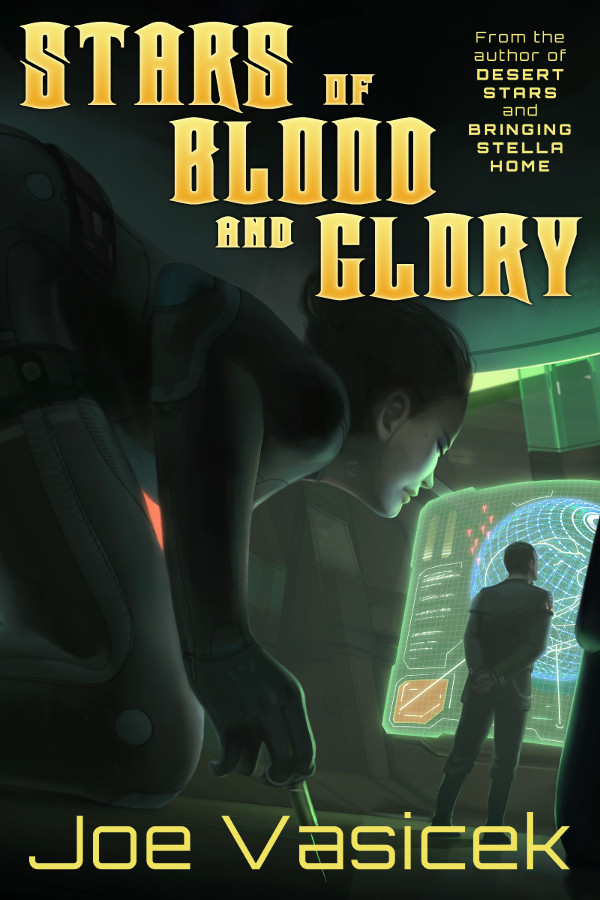
In between writing and revising, I’ve managed to redo the covers for Desert Stars and Stars of Blood and Glory. Check them out!

SBG (cover)DS (cover)I’m really excited to get the new editions out, especially the print editions! Expect to see those soon, like maybe in a week or two.

If you’ve already bought the books, don’t worry; the stories are still exactly the same. The new editions will just have the new covers and some updated metadata. I’m not sure if Amazon automatically updates them if you’ve already bought them, but if it’s an issue, just shoot me an email and we’ll work it out.

Man, designing covers is fun! 😀 I should do it more often!

Cover reveal for BROTHERS IN EXILE!

I just got the cover art for Brothers in Exile (Sons of the Starfarers, Book 1) and it looks pretty sweet–check it out!

SSF-I (cover)The cover designer is Kalen O’Donnell–he’s going to be doing the covers for the rest of the series. The scene here is from the first chapter, where Isaac and Aaron arrive at the derelict station in the Nova Alnilam system.

The book is coming along quite well–I should be ready to publish it before the end of the week! Just have to go through the edits, make a couple of small changes, and format it for publication (but that part doesn’t take too long). With luck, it should be up in time for Memorial Day.

I’m going to try something a little different with this book and launch it at $.99 for the first week, then raise the price up to $2.99 afterwards. That way, I can give my fans a good deal, and hopefully move it up on some of the lists to gain some visibility. That means it will only be available on Amazon, Smashwords, Kobo, and Barnes & Noble for the first week, though, since it’s harder to make price changes on the other sites, and Amazon will send you a nasty take-down notice if the book is selling for less on any other site.

That’s just about it. Back to work now–I’ve got a book to publish!

New STAR WANDERERS covers!

Let’s take a quick break from the Brothers in Exile excerpts to show you the awesome new cover art for the Star Wanderers books! These ones are for Dreamweaver, Benefactor, Reproach, and Deliverance, and I think they turned out quite well.

SW-V (cover)SW-VI (cover)SW-VII (cover)SW-VIII (cover)

The cover designer here is Libbie Hawker, who also did the other covers (except for Outworlder and Tales of the Far Outworlds. She’s also got a lot of great books of her own, so be sure to check her out!

In just a few days, I should have some art for Brothers in Exile to show you guys. I think you’re going to like it!

New STAR WANDERERS cover art!

A couple of weeks ago, I mentioned that I was getting some new cover art for the Star Wanderers books. Well, the art for the first half of the series is in–check it out!

SW-II (cover)SW-III (cover)SW-IV (cover)SW I-IV (cover)

A big thanks to Libbie Hawker, who did the cover art. I’m really pleased with how they’ve come out so far. We’ve been working on the proofs for the next four books, and they’re going to be really awesome as well!

I’ll reformat the ebooks and upload them to Amazon and the other retailers tomorrow. It’s probably going to take all day, but they should be up soon.

In other news, I finished the first draft of Comrades in Hope! The final word count clocked in at a little over 41,000, pushing it from novella-length into short novel territory. I’m fairly pleased with how it turned out, though it probably needs some work before it’s ready to go out. If all goes well, I’ll be publishing it before the end of June–a tight schedule, to be sure, but not an impossible one to keep. I’m totally immersed in the Sons of the Starfarers series right now, so it’s going to be really awesome when the first three books launch!

That’s just about it. A big thanks to everyone who picked up a copy of Star Wanderers: Outworlder on Amazon today! The book hit #203 in the Free Kindle Store, due in large part to an ad on Kindle Books and Tips. Needless to say, I am really shocked.

Take care, and thanks for reading!

C is for Cover Art

They say not to judge a book by its cover, but the truth is we all do. In fact, the cover probably sells a book more than the book blurb does. Whether in print or in digital format, it’s the first part of the book that readers see, and often makes the difference between “meh” and “hmm, what is this? I want to find out more!”

So how do you do cover art when you’re an indie? Is it better to make your own, or hire a designer? If you do hire a designer, how much can you expect to pay?

Honestly, when I started out, I think I invested a little too much into my covers. The first novel I published was Genesis Earth:

thumb (Genesis Earth)The cover art is gorgeous, and from an artistic view I’m very, very happy with it, but it took a long time for the book to earn that money back–far longer than the expense really justified. I would love it if all of my books could have awesome covers like this, but when you’re first starting, not every project justifies that sort of expense.

The thing to keep in mind when you do covers as an indie is that you can always change them. When you first start out and you don’t know how well a book is going to do, there’s nothing wrong with doing it on a shoestring budget and reinvesting those earnings later. There is a bit of a feedback loop, where a bad cover will hold a book back, but it’s not that hard to make a cover that’s not great, but acceptable.

Case in point, check out the first cover I did for Star Wanderers: Outworlder (Part I):

Star Wanderers I (thumb)The cost for this art was $0. I made it myself, using freeware fonts and public domain space art from NASA. It’s not nearly as gorgeous as the cover for Genesis Earth, but it says “space!” in a sci-fi sort of way, and that’s what I was going for. And even with a mediocre cover, this was the book that really started to take off.

Of course, as soon as those books were earning enough, I made plans to reinvest that money in proper cover art. Here is the new cover for Outworlder:

SW-I alt (thumb)I’m working with a cover designer right now to redo all the other ones in the series along a similar vein. In the next couple of weeks, expect to see some cover reveals!

In general, I’ve found that there are three approaches to cover art: doing it completely yourself, hiring a cover designer to make an cover from stock art, and hiring an illustrator to paint an original illustration. The last is probably the most expensive, though it does depend on the illustrator–you can find good illustrators on sites like Deviantart whose rates are quite reasonable. But the quality varies a lot.

Besides the art itself, a key part of the cover is the typography. One thing I’ve learned from working with cover designers is that they can do amazing things just with the fonts and font effects for your title. That’s probably the biggest benefit of going with a cover designer as opposed to an illustrator.

In fact, if you can afford to commission an original illustration, you can probably find a cover designer who will give you a deal on the typography. It is something you can learn yourself, but the difference between you and a cover designer is often the difference between acceptable and awesome.

Like anything with self-publishing, cover design is something you can learn–perhaps something you can excel at–but you probably can’t excel at that and everything else at the same time. What I’ve found is that I’m okay at doing my own cover art, but not awesome. From here on out, I expect I’ll be hiring cover designers.

At the same time, my books are earning enough that I can justify that expense. If I were first starting out, I’d probably DIY it or barter with other writers who do their own covers. A cover isn’t static–you can always change it later.

Case in point, check out the covers for Bringing Stella Home:

thumb (Bringing Stella Home)thumb 2 (Bringing Stella Home)

I got a good deal on the illustration for the first cover, but frankly, it’s not that great. The second cover was more expensive, but I’m much happier with it. What I’m probably going to do next is find a cover designer who can redo the title/author typography, since I did that myself and it kind of shows.

So that’s been my experience with cover art. It’s important to get it right, but you do have to work to find the best solution that works for your budget. Fortunately, when you’re an indie, your cover is something you can always upgrade.