A chilling solution to the Fermi Paradox

The Fermi Paradox is a classic problem in both science and science fiction. Put briefly, the paradox is this: if the natural conditions that led to the development of our human civilization are not unique, and it is reasonable to assume that alien civilizations more advanced than our own have developed elsewhere, then why haven’t they tried to contact us? In other words, if we aren’t alone in this universe, than where have all the aliens gone?

A number of possible solutions to this paradox have been proposed. Perhaps the aliens just don’t find us interesting enough to reach out. Perhaps we just don’t have the technology to contact them. Or perhaps there’s some sort of “great filter” that prevents alien civilizations from becoming spacefaring, or from becoming more advanced than our own. For example, perhaps when alien civilizations discover nuclear weapons, they destroy themselves in a spectacularly suicidal war.

All of these are interesting… but they’re also very naive. They assume that if aliens did try to contact us, everyone on Earth would know about it. But is that really the case?

If an alien civilization made contact with our own, who would be the first humans to learn about it, and who would be the last? Or in other words, if aliens made limited contact with a few humans, how likely would those humans be to share that information with the rest of us, and how likely would we believe them?

If aliens did make contact with us, it would almost certainly be limited in scope. To illustrate this, let’s break down their contact strategy based on hostile vs. peaceful intent, and whether or not they want to stay hidden:

Hostile IntentPeaceful Intent
Stay HiddenInfiltration mission: choose human targets selectivelyObservation mission: gather data from distance
Come OutInvasion mission: reduce human ability to organize and resistDiplomatic mission: prioritize contact with human leadership

In each of these strategies, the aliens gain nothing by doing a massive flyby and showing themselves to all of us at once. Even in the case of an invasion mission, they’d probably only want to do that if 1) they had overwhelming force, and 2) they decided to run some sort of shock-and-awe campaign, like Independence Day. But what exactly would they gain from that? Even if they did have overwhelming force, why would they want to present a clear target when they already have the element of surprise?

Point is, in most of these scenarios, the aliens would either want to limit their activities to the fringes of human society, or to establish contact with the human leadership first. Therefore, the first humans to learn about these aliens are either going to be the kind of people the rest of us can easily dismiss, or our leaders, who have every incentive to keep the knowledge of these aliens hidden, as the disruption it would cause would threaten their own power.

Put simply, the solution to the Fermi Paradox may have less to do with the aliens and more to do with us. After all, if aliens really had made contact with humanity, what makes you think you would know?

Is Gunslinger to the Stars for You?

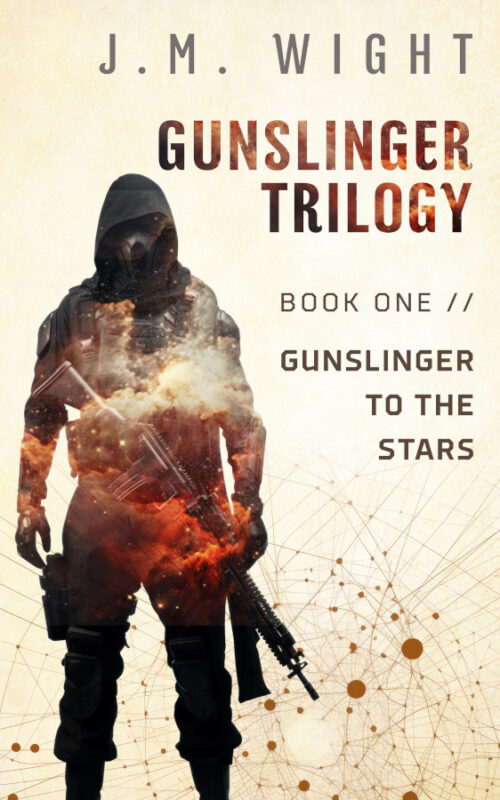
Gunslinger to the Stars is a character-driven space opera novel that blends Western adventure, first-contact science fiction, and pulpy action. It’s fast-paced, voice-driven, and built around a loyal, reluctant hero navigating a dangerous galactic frontier. It’s told in the unmistakable voice of Sam Kletchka—half gunslinger, half star-hopping troubleshooter, and 100% fun.

What Kind of Reader Will Love This Book?

If you like…

  • Classic space adventure with modern voice and humor, where the hero solves problems with grit, guts, and an outrageous arsenal of lovingly described guns
  • Found-family dynamics between a rough-around-the-edges gunslinger, a principled xenolinguist, a telepathic outcast, and a trio of shapeshifting empaths
  • Galaxy-spanning mysteries, alien politics, and first-contact stakes that push characters to their limits
  • The feel of a Western gunslinger dropped straight into a richly imagined galactic frontier

…then Gunslinger to the Stars is absolutely your kind of story.

What You’ll Find Inside

Gunslinger to the Stars (Book 1 of the Gunslinger Trilogy) follows Sam Kletchka, a New Texas gunslinger stranded in the Gorinal Cluster just as the local jumpgate—the only way out—mysteriously goes dark. What starts as a simple job escalates into a battle for survival involving hidden alien races, shape-shifting empaths, worldships, and a rising threat the Immortals never wanted anyone to discover. The tone blends wry humor with escalating danger, and the style is fast-paced, voice-driven, and cinematic—equal parts action romp and big-idea sci-fi. The result is a story that feels both classic and fresh: a pulpy, heartfelt adventure that’s as much about loyalty and moral clarity as it is about space battles and exotic technology.

What Makes It Different

Fans of Firefly and Schlock Mercenary will recognize the snappy banter, the found-crew dynamic, and the blend of humor with high-stakes action. But Gunslinger to the Stars pushes those familiar ingredients in new directions: the gunslinger-as-space-ranger angle gives the book a distinctive American-frontier voice, while the empath culture, the Immortals’ centuries-deep manipulations, and the emergence of the Draxxians create a myth-arc that feels simultaneously expansive and personal. Where many space operas lean on military hierarchy or techno-fetishism, this one leans into character, moral philosophy, and the uneasy tensions between peacekeeping and necessary force—all told through Sam’s dry, self-aware perspective.

This story blends classic space western tropes — the reluctant hero, the ragtag crew, and the dangerous frontier — with a deeper mystery about ancient alien powers. If you enjoy space western stories with a strong first-contact throughline, you’re going to enjoy this book.

What You Won’t Find

If you’re looking for grimdark bleakness, heavy technobabble, or a cynical antihero who never grows, this isn’t that. And if you want romance-heavy sci-fi or endless political intrigue, this book doesn’t go down those roads either. But if you want hopeful, character-focused adventure with humor, heart, and a hero who takes responsibility for his choices—sometimes reluctantly—you’ll feel right at home.

Why I Think You Might Love It

I wrote this story at a time when I needed to shake things up creatively, by writing something fun, energetic, and different from what I had been writing at the time. I was also going through a time when my worldview was changing, and I was questioning a lot of my old assumptions. This book grew out of a number of things: from my conversations with close friends, my love of classic pulp sci-fi, and from the idea of a lone wanderer who tries—however imperfectly—to do the right thing. The result, I believe, was a book with a lot of heart that captures that spark of wonder that made me first fall in love with science fiction. If that’s what you’re looking for, I think you’re going to love it!

Where to Get the Book

Related Posts and Pages

Explore the series index for the Gunslinger Trilogy.

Visit the book page for Gunslinger to the Stars for more details.

Read about moral courage in Gunslinger to the Stars.

See all of my books in series order.

U is for Universal Translator

In science fiction, whenever two characters from different planets or different alien races have to interact with each other, they almost always speak the same language or have some sort of universal translator that magically makes them able to communicate with minimal misunderstandings.  This is especially common in Star Trek, though it happens in just about every franchise involving a far-future space opera setting of some kind.

I’ve got to be honest, I think this is a cheap plot device that almost always weakens the story.  As a writer, it’s tempting to have something like this so you don’t have to deal with any pesky language barriers, but when you do this, you remove a major potential source of conflict, thus violating the rule of drama.  Also, you make your fictional universe feel a little less grand, your aliens a little less alien.  After all, if everyone can perfectly understand each other, then there must not be a huge difference between Earth and the far side of the galaxy.

There are some times when having a universal translator allows you to broaden the story and focus on other conflicts.  For example, if some sort of interstellar legislation is under review in the grand galactic council, you can’t spend all your time focusing on basic communication difficulties.

However, if this is the case, then you can usually overcome the language barrier through other means–a galactic lingua franca, for example, or translation tools that may or may not misfire on occasion (much like Google Translate).  Of course, if you’re writing a comedy like Galaxy Quest (or parts of Star Control II), then falling back on a universal translator is forgivable.  But if you’re going for believability and a sense of wonder, this trope isn’t going to do you any favors.

While linguists and technologists have been working on translation programs for some time (and admittedly making some significant breakthroughs), I’m extremely skeptical that we will ever develop a perfect universal translator in real life.  If we do, I expect we will have to develop a sentient AI as a prerequisite, since the nuances of language are so inseparable from the things that make us human.

Here’s how translation services like Google Translate work:

  1. They amass an enormous database of language material by scanning websites, newspapers, and other documents.
  2. They analyze this database to look at word combinations and frequencies, observing the likelihood that any one word will appear in combination with any others.
  3. They compare these combinations and frequencies with those in other language databases to match words and phrases.

This data crunch method of translation works fairly well for simple words and phrases, but it falls apart in the more complex grammatical structures.  I see this any time I try to use Google Translate with an Arabic source.  Arabic is an extremely eloquent language, with all sorts of structures that simply don’t work in English.  One mistranslated word can completely change the meaning of the entire text, and even when it works, the technically correct English translation sounds as if it’s full of errors.

The methodology also falls apart for languages that are too small to have much of an electronic database.  The Georgian language is a good example of this.  It’s spoken by only about 4.5 million people worldwide, most of them in the country of Georgia, which is predominantly rural.  Internet access for most of the population is very limited, and most Georgians who do communicate online tend to use the Roman or Cyrillic alphabets more often than their own.  As a result, Google Translate for Georgian is utterly useless–seriously, you’re better off just sounding out the letters and guessing at the meaning.  There are some other sites like translate.ge that try to fill the gap, but they seem to rely on actual lexicons, not databases and algorithms.

All of this is between entirely human languages that developed in parallel on the same planet–indeed, languages between human cultures that have traded and shared linguistic influences for thousands of years.  What happens when we encounter an alien race whose biology makes it impossible for them to make human-sounding noises?  Or an alien race that communicates through smell or electromagnetic impulses instead of sound?  What happens when humanity is spread out across hundreds of star systems, each of which periodically becomes isolated from the others for hundreds or even thousands of years?  When our definition of human is stretched so thin that we would not even recognize our far-future descendents as anything but alien?

There is so much wasted potential whenever a science fiction story falls back on a universal translator.  Case in point, compare Halo I, II, and III with Halo: Reach.  In the first three games, the Master Chief’s universal translator enables him to hear exactly what the enemy Covenant troops are saying.  This is great fun when you’re chasing down panicked grunts, but it tends to get old after a while.  In Halo: Reach, however, the human forces haven’t yet developed a universal translator, so everything the Covenant say is in their original language.  All of a sudden, the game went from a hilarious joyride to a serious war against aliens that felt truly alien.  That one little change did wonders to the tone and feel of the entire game.

Needless to say, you won’t find a universal translator in any of my books.  In Star Wanderers, the language barrier is the heart and soul of the story–it’s a science fiction romance between two characters from radically different worlds who don’t speak the same language, and yet overcome that to develop a strong and healthy relationship.  In Sholpan and Bringing Stella Home, Stella knows a language that is fairly similar to the one spoken by the Hameji, but there are still words and phrases that elude her.  This detail is critical because it impedes her ability to understand and adapt to the Hameji culture, leading to some major conflicts later in the book.

As someone who’s lived for significant periods of time in Europe and Asia and learned languages very different from English, I can say that the language barrier is not something that we as writers should avoid, but something that we should embrace.  There are so many interesting stories that can be told when two characters don’t speak the same language.  Please, don’t be lazy and write that out of the story through a cheap plot device!  Let your aliens be truly alien, and your worlds and cultures so fantastic that we can’t help but feel hopelessly lost in them.

A is for Aliens

cantinaAlien races–what would science fiction be without them?  They’re as fundamental to the genre as elves and dwarves are to fantasy.  If you’re reading a book and an alien being from another planet shows up on the page, that in itself is usually enough to make the story science fiction.

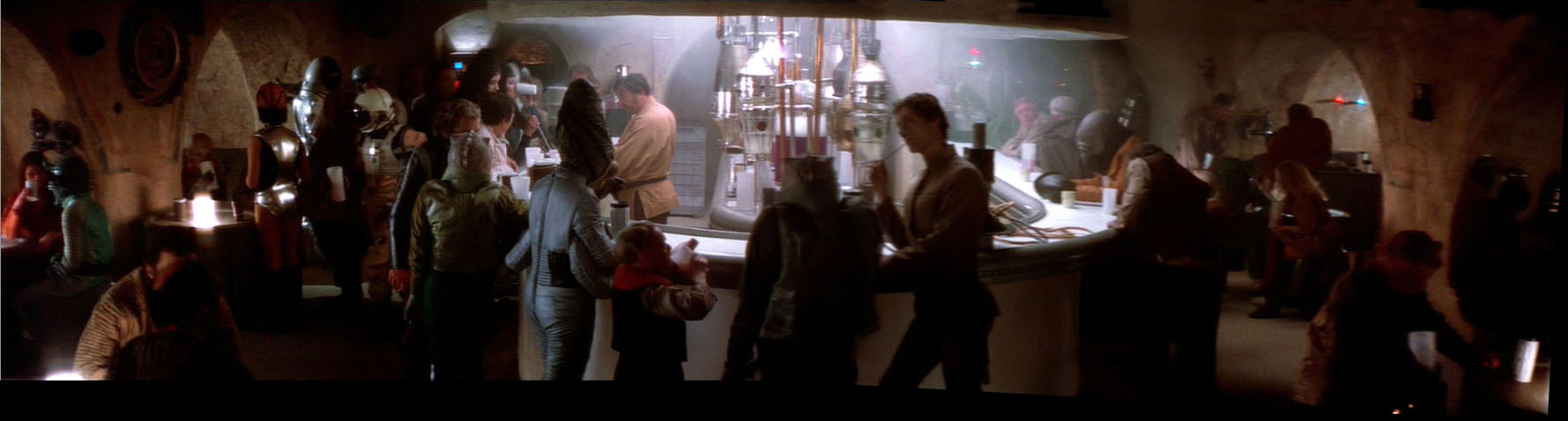
My first exposure to aliens came from Star Wars IV: A New Hope, which I saw as a kid sometime back in the early nineties.  The cantina scene with the weird, catchy music and all the frighteningly creatures both scared and fascinated me.  Here were a bunch of humans, mingling with these things that looked like monsters as if nothing were strange or unusual.  In fact, it soon became clear that these weren’t monsters at all, but regular people–that is, as regular as you can be without being human.

I think the main reason for including aliens in a space opera story is that it makes the setting feel more exotic and otherworldly.  It can also add all sorts of interesting possibilities for plot and character, depending on the different capabilities of the various alien races and the way their culture shapes them.  Babylon 5 is a great example of this, with the characters from each alien race interacting with each other in ways unique to their various cultures.

One way to think of science fictional aliens is to put them on a spectrum with two extremes.  On the one side, you have the more familiar aliens–the races from Star Trek, for example, which are basically human-like except with weird skin or bone ridges to physically distinguish them.  On the other side, you have the truly bizarre–the kinds of aliens that are so different from us, we cannot possibly conceive their thoughts or the way they see the world.

The main advantage of the more familiar alien types is that they’re easy to understand and relate to.  Yeah, they may look weird, but they don’t think or act much differently than the Russians, or the Arabs, or whatever human culture they roughly parallel.  In fact, it’s not uncommon in fiction of this type for the aliens to be less “alien” than the Japanese (at least, in Western fiction–obviously, it’s different in manga and anime).  This, in turn, is the main weakness with aliens of this type: they are so readily understandable that it’s easy to lose that sense of otherness.

The main advantage of the more extreme kind of alien is that it can make a much stronger impact, which makes for a more compelling and thought-provoking story.  For example, the Hypotheticals in Robert Charles Wilson’s Spin trilogy are so fascinating because we know so little about them.  They have the power to shape entire worlds, manipulating space and time itself, and yet none of the reasons behind what they’re doing make sense–if indeed there’s any reason behind it at all.  Or in Octavia Butler’s Xenogensis trilogy, it’s not too hard to figure out what the aliens are trying to do, but the way in which they do it, impregnating the main character through their tri-sexual biological capabilities makes for a profoundly disturbing story.

The disadvantage, of course, is that aliens of this kind are much more difficult for readers to relate to.  If the aliens are so advanced that their thoughts transcend our own, or if their sensory organs are so different that we cannot possibly conceive of how they see the world, then it’s very difficult for us to get inside of their heads.  For this reason, aliens of this kind tend to become more of a force of nature than actual characters–or characters in the aggregate, in the way that humanity is the main character of most of Arthur C. Clarke’s books.

Personally, I’m more of a fan of the extreme alien type.  The universe is so vast, and our understanding of it is so lacking, that it rings a lot truer to me.  The odds that we are alone in the universe are so infinitesimally small that refusing to believe in the existence of aliens would be akin to believing in 1492 that the Earth is flat, and yet if/when we ever make contact, I can’t help but wonder how different from us they’ll be.  So much of what we take for granted is just a fluke of our particular circumstances here on this planet–the chance combination of so many variables that changing any one of them would completely rewrite the story of how our species evolved, much less our civilization.

There is a place for the more familiar aliens of space opera, though. They make for some very entertaining stories, provide a fun escape from this world when that’s what we need.  They also give us a chance to look at ourselves through a lens that strips away our stereotypes and prejudices.  We might have some very strong opinions about immigrants, for example, or people of a different race or color, but none of us are prejudiced against Sand People, or Klingons, or Androsynth.  In space opera, most alien races are loosely based on real-world cultures, so it’s possible to draw parallels without all the cultural and historical baggage.

In a sense, all fiction is just the culture speaking to itself, so when we read about aliens we are really reading about ourselves.  Encountering the Other in a non-threatening fictional world enables us to face the real-world Other with understanding and compassion.

I haven’t written very many alien stories yet, but I have a couple cooking in the back of my mind.  Genesis Earth has an alien encounter with a bit of a twist to it, but the characters in my Star Wanderers and Gaia Nova series are all human (well, mostly).  If/when I do introduce an alien race, I plan to do it right, which will almost certainly involve a first contact story.  But that’s for Saturday’s blog post, not today’s.

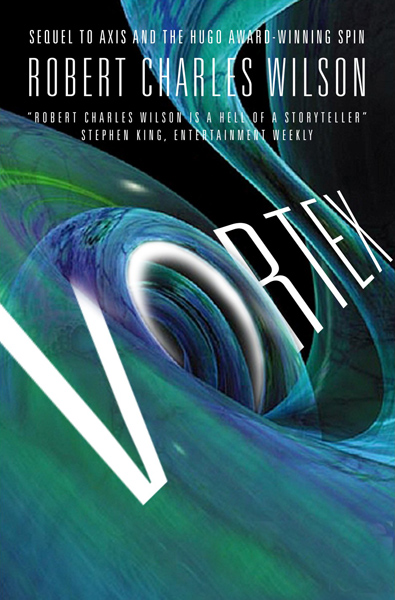
Vortex by Robert Charles Wilson

Almost seventy years ago, the mysterious alien beings known as the Hypotheticals encased Earth in a force field and built a network of giant arches facilitating overland travel to other habitable planets.  With access to the fossil fuel resources of half a dozen worlds, humanity is slowly killing its homeworld, even as it expands to other stars.

All of this matters little to Sandra Cole, however.  A psychologist at the State Care facility in Texas, it’s all she can do to endure another day.  But all of that starts to change when a police officer brings in a mysterious boy–a boy with a message from the future.

This is the third and final book in Robert Charles Wilson’s Spin trilogy, and it brings the series to a thoroughly satisfying conclusion.  The first book introduced the Hypotheticals and hinted at some greater scheme that they were involved in, the second book further explored the universe while raising more questions about the Hypotheticals, and the last book follows the Hypotheticals to the end of time, answering these questions while taking nothing from the truly alien grandeur of it all.

However, like the other books, the story itself is not about the aliens, but the people who make contact with them.  The high-concept science fiction goodness is all in there, but it’s framed by characters who are both human and relatable.  I wasn’t as invested in these characters as the ones in Spin, but I was still very interested in seeing what happened with them.

The structure of the book is a lot like Ursula K. Le Guin’s The Dispossessed, with alternating chapters telling two stories that don’t connect until the very end.  I finished the last half of it in practically one sitting, and the last chapter in a breathless sprint–much like Spin and Axis.  The way everything came together, not only for this book but the entire series, was awesome.

I was really happy to see this series finish well, because the first book was a major influence for me in writing Genesis Earth.  As I said in an earlier post, I don’t think anymore that this is the kind of science fiction I’ll write very often, but I sure love reading it.  I wouldn’t recommend starting with this book, but if you like science fiction that makes you stand back and blink at the sheer magnificence of the universe, this is a series you should definitely check out.

What have you learned from reading science fiction?

While trolling around the new Facebook questions app, I came across this interesting question.  Unable to resist, I spent the next hour crafting my answer.

This is what I wrote:

Gosh, what HAVEN’T I learned from science fiction?

Because of science fiction, I do not fear the alien. I do not feel threatened by people of different places or cultures, but take great interest in learning from them. I look at them and love them, because I can see myself in them.

Because of science fiction, I can look out at the vast expanse of the universe and not despair because of my insignificance. I know my place within it, and can appreciate the wonders and endless possibilities all around me.

Because of science fiction, I can look at the world and know which questions to ask. I can see through the lies that society constantly feeds me, and know how to fight against them.

Because of science fiction, I can look to the future with hope. Having seen the best and the worst of all possible worlds, I know which paths to avoid and which paths to follow. With this knowledge I can inspire my fellow men, because I know that nothing is inevitable.

Because of science fiction, I have a deep and endearing love for the world in which I live. I know better what it means to be human, and knowing this helps me to take no human life for granted. I have a greater capacity to love those around me, and that is the most important thing of all.

Science fiction has enriched my life beyond measure. By constantly stretching the bounds of my imagination, science fiction has led me to more truth than any other literary genre–and not only led me to that truth, but helped me to incorporate it into all that I do. So long as I live, I will always be a reader and a writer of science fiction.

Answering this question reminded me of my interview with Shayne Bell a couple weeks ago.  In it, he talked about how rich and vibrant science fiction is as a literary genre, and how it deeply impacted his own life.  Listening to him speak, I couldn’t help but feel that I was in the presence of a great man.

I don’t think he’d be comfortable with me posting the full audio of that interview, but many of his comments will appear in the article I’m putting together for the December issue of Mormon Artist.  Between working full time and trying to finish the fourth draft of Mercenary Savior in time for World Fantasy, I haven’t had much time to work on it, but it’s going to be awesome.

What have YOU learned from science fiction?  How has it enriched your life?

The Madness Season by C. S. Friedman

In the 21st century, Earth was conquered by an alien collective consciousness known as the Tyr.  Now, five hundred years later, humankind has been scattered across the Tyr-occupied worlds as slaves.  It is a dark and uncertain existence, under the rule of masters who do not care whether their charges live or die.

For the last five hundred years, Daetrin has been a survivor.  An anomaly among humans–a man with the power to live indefinitely–Daetrin is used to keeping his true nature hidden.  But when the Tyr learn of his strange abilities and take him away for further study, he finds himself on the run, out in the open.

In order to survive, however, he must face his greatest fear–the fear that he isn’t entirely human.

This book was interesting.  C. S. Friedman’s prose is quite good, and her main character has a very unique and engaging voice.  For some reason, she wrote all of Daetrin’s stuff in first person, while the other characters in third person.  I think that the main reason for this was to preserve the sense of surprise and horror when he made certain discoveries while at the same time revealing certain critical aspects of her world that the reader absolutely needed to know in order for the story to make sense.  It didn’t bother me–in fact, I think she did it quite well–but it might not work for you.

In terms of story, this book was interesting but a little confusing.  It lagged at times, especially towards the beginning, and towards the end so many things came together at once that it was difficult for me to keep track of them.  I’m not entirely sure why that was, but I think it’s related to the fact that I never felt a very clear sense of progression.  Plotwise, things happened, but I didn’t see how one led necessarily to the next, or where things were going overall.

That said, the ending was satisfying, and I enjoyed reading this book.  You don’t realize it until the end, but the whole book is basically Friedman’s sf take on a certain type of well known, very popular mythical monster.  I won’t spoil the book by telling you which one, but when I saw it, it made me smile.

In terms of science fiction, there are a lot of old tropes with very few new ideas, except for the shapeshifting alien species known as the Marra.  Their culture was interesting, and I thought Friedman did a very good job conveying both the familiarity and the alien-ness of that species.  The Tyr weren’t quite as interesting, because they were basically just the Borg with scales and spikes, but the Hraas and the Tekk (who are a type of human) were also well done.

This is definitely the kind of book you’d want to sit down and read, rather than take everywhere with you and read whenever you get a spare moment.  Without sitting down and dedicating some time to it, it’s very difficult to really get into the story or feel immersed in the world.  I made that mistake, and it took me nearly a month to finish it.  That said, it was a good book; I’ll definitely be reading some Friedman again.

Take me to Arabia

Recently, I’ve found myself nearly overwhelmed by the sudden urge to run away to the Middle East and go totally and irrevocably native.  It may pass, but I still want to go back there–really bad.

So I looked up BYU’s TESOL certification program, and figured I could apply in January, start fall of ’11, and be on my way to an Arabian adventure in ’12.

Or…I could bypass the whole certification thing altogether, but I’d probably get a crappier job.  Besides, the certification could lead to other things, like perhaps an actual stable day job.  Who knows?

Regardless, I should probably find some way to actually use my Arabic degree.  After all, why did I get it in the first place?  Better put it to use!

So why am I tripping out on Middle East stuff?  Interestingly enough, I think it has a lot to do with the current novel I’m writing, Worlds Away from Home. I started it in fall ’08, just after getting back from BYU’s 2008 Jordan study abroad program, and the influence is definitely very visible.

Sometimes it makes me cringe a little, though; the fictional culture is patterned after my understanding of and experiences with Arab culture, but…it’s very pseudo Arab, if that make sense.  Kind of like it looks Arab, but it feels more Western.  I don’t know–I guess what I’m saying is that it’s bad (or maybe I just think that because I’m in the middle of the rough draft, when everything I write is utter and absolute crap.  Blegh).

But the thing is, if I try to make the culture truly foreign, I’m worried it will be more of a barrier to the reader than a gateway.  In other words, it’s the classic science fiction problem of aliens: the more you succeed in making your aliens truly alien, the harder it is for the reader to understand or sympathize with them.

But then again, isn’t that why we read?  To be transported to different times and places, experience other people and cultures, and be exposed to new ideas?  To expand our minds and enrich our understanding?  If that’s the case, there’s got to be something good and healthy about immersing the reader in a totally foreign culture.

Unfortunately, that doesn’t make it any easier.

Oh well.  I’m up for the challenge.  In the meantime, I’ll keep reading T. E. Lawrence’s The Seven Pillars of Wisdom and continuously loop all my Arab pop.  Not familiar with Arabic music?  Here’s a really good one:

Track 5

(ps: I’d tell you who wrote/performs the song, but frankly I have no idea.  Unfortunately, copyright doesn’t really exist in the Middle East.  Oh well.  Enjoy!)

Old story notebook, part 2

Alright, here is the second part of my oldest story notebook, the one that I just found a couple days ago.  These ideas date from 2007 when I started pursuing writing as more than a hobby, up to the summer of 2008 when I went to Jordan on the BYU study abroad program.

The Singularity: it will lead more to a social change and conflict than a transformation of humanity–increasing disparity between techies and non-techies, and a tech/class conflict. What will the perspective be of those who look at us and our advances after the new dark ages? Or are we in the dark ages?

Interesting–if you believe in the technological singularity, that is. I’m not quite so sure I do anymore; that’s kind of what Genesis Earth

was all about.

An alien race of beings that have no sensory organs, but instead perceive the thoughts of beings with sensory organs, and thus do all their perceiving through others.

There is so much cool stuff you can do with aliens–stuff that nobody seems to be doing, because they always stick with the tropes. Or maybe I’m just not well-read enough.

The more advanced our society becomes, the more our education specializes so that it becomes harder to know the minimum necessary to understand everything. This leads to class/tech divisions, and to the potential for society to fall apart.

Have you ever wondered about this? I mean, it’s kind of crazy how complicated we’ve made life and living. And all this we call “civilization.”

When relativistic space travel becomes more widespread, society will develop new rituals and ways to mourn and deal with the separation that comes with people going forward out into space.

I think I had this thought while reading Speaker for the Dead or another of Orson Scott Card’s Ender’s Game books. That series totally blew my mind.

If we lived in a telepathic society, we would learn to separate our deep thoughts from our shallow thoughts to put up a facade in public–but how would the relationship between deep and shallow change the way society works? If we had to hide even our thoughts?

Heck, what would a telepathic society even look like?

Aliens who shed their skin each year (or something else) and have derived a culture that treats each person as having a different identity each year.

Kind of like in Tahiti, where people change their names at different stages of their lives (childhood, adulthood, etc). I hear it makes family history work insanely frustrating.

We make contact with aliens who need a human companion with whom they merge telepathically, and the story is from the human translator’s point of view.

This would make a really cool anime.

First contact was made in the 12th century with the Abassids, and the explorer ship returned with Arab emissaries to the alien homeworld. Now those emissaries are returning to establish regular connections via ansible, and they are shocked to find the world in its current state.

Okay, I think this idea has some really cool potential. I’m not sure I’d be the one to write it, but it sounds like it could be really awesome, if it were done right.

An alien species incapable of lying.

It would probably turn first contact into an unmitigated disaster. After all, lying is the essence of diplomacy.

When we first go into space, colonies will be governed by multi-national corporations, not stats. Profit will come before the welfare of the colonists themselves, and the wars will be over trade routes and tariffs.

Sounds like something straight out of C. J. Cherryh.

An alien species* that considers it okay to show uncovered reproductive organs but obscene to show the eating organs. *Or, a human society

It sure would be weird, especially if it were a human society that did that.

An alien spaceship comes to Earth and it’s full of colonists.

Definitely been done already. Probably multiple times.

Dolphins are a post-alien species that came to Earth millions of years ago.

Has this been done before? I seriously doubt it. I’d write it, but any story set on Earth tends to bore me.

EDIT: Alright, yeah, it’s been done–quite a bit, actually. Looks like I need to get out from under my rock and read some more.

Aliens have colonies under the ocean.

Hey, if they have them anywhere, they’re probably down there.

Is a necessary element of our free agency our ignorance of ourselves, on the deepest level?

Perhaps.

A 19th century Mormon gets stuck in a time warp and ends up in 21st century Utah.

Oh, the horror!

I’d better stop here, since general conference is about to start. I’ll finish this list in the next couple of days, probably. Blogging keeps me sane. In the meantime, have a wonderful Easter!

Why I love Robert Charles Wilson

From Mysterium, which I plan to review here soon:

“Do you ever wonder, Howard, about the questions we can’t ask?
“Can’t answer, you mean?
“No. Can’t ask.
“I don’t understand.”
Stern leaned back in his deck chair and folded his hands over his gaunt, ascetic frame. His glasses were opaque in the porch light. The crickets seemed suddenly loud.
“Think about a dog,” he said. “Think about your dog–what’s his name?”
“Albert.”
“Yes. Think about Albert. He’s a healthy dog, is he not?”
“Yes.”
“Intelligent?”
“Sure.”
“He functions in every way normally, then, within the parameters of dogness. He’s an exemplar of his species. And he has the ability to learn, yes? He can do tricks? Learn from his experience? And he’s awarer of his surroundings; he can distinguish between you and your mother, for instance? H’es not unconscious or impaired?”
“Right.”
“But despite all that, there’s a limit on his understanding. Obviously so. If we talk about gravitons or Fourier transforms, he can’t follow the conversation. We’re speaking a language he doesn’t know and cannot know. The concepts can’t be translated; his mental universe simply won’t contain them.”
“Granted,” Howard said. “Am I missing the point?”
“We’re sitting here,” Stern said, “asking spectacular questions, you and I. About the universe and how it began. About everything that exists. And if we can ask a question, probably, sooner or later, we can answer it. So we assume there’s no limit to knowledge. But maybe your dog makes the same mistake! He doesn’t know what lies beyond the neighborhood, but if he found himself in a strange place he would approach it with the tools of comprehension available to him, and soon he would understand it–dog-fashion, by sight and smell and so on. There are no limits to his comprehensions, Howard, except the limits he does not and cannot ever experience.
“So how different are we? We’re mammals within the same broad compass of evolution, after all. Our forebrains are bigger, but the difference amounts to a few ounces. We can ask many, many more questions than your dog. And we can answer them. But if there are real limits on our comprehension, they would be as invisible to us as they are to Albert. So: Is there anything in the universe we simply cannot know? Is there a question we can’t ask? And would we ever encounter some hint of it, some intimation of the mystery? Or is it permanently beyond our grasp?”

This is the kind of science fiction that I love: the kind that brings me right up to the limits of human knowledge and makes me feel naked in the face of the unknown. The kind where the aliens truly feel alien, not like an unusually bizarre race of human beings. I want the aliens to surprise me–I want to feel that there’s something about them that is completely beyond my comprehension. Something sublime, something romantic.

In all of his books that I’ve read, Robert Charles Wilson captures this feeling spectacularly. So does Arthur C. Clarke, C. J. Cherryh, and Orson Scott Card. Larry Niven, Jerry Pournelle, John Scalzi and Alastair Reynolds are excellent writers, and I’ve genuinely enjoyed their books, but their aliens are too…understandable. Too clear cut, too defined. After a while, you don’t feel that there’s anything left to surprise you, anything that is so alien it’s beyond your grasp.

In some ways, I think this boils down to the author’s worldview. Those with a more positivist worldview believe that the world is fundamentally understandable, and that every phenomenon can be modeled and predicted, provided that we have a sophisticated enough understanding of natural law. The interpretivist worldview, on the other hand, posits that while truth may exist, there are limits to our understanding–that some things are inherently unpredictable and impossible to model.

I used to think that I was a positivist. Then I took Poli Sci 310 with Goodliffe, and it turned my world upside down. Genesis Earth is, in some ways, a product of that personal worldview shift. I don’t think I’m anywhere near on par with my aliens as Wilson, Clarke, and Card are with theirs, but I hope I’m on my way.