Some new writing resolutions

So I’ve been following Dean Wesley Smith’s blog pretty closely over the last few days, as he posts about his creative process for a novel he’s ghost writing.  It’s more than a little mind-boggling–he started literally with nothing, not even a working title, and yet he’s averaging between 5k-7k per day.  If he hasn’t already, he’ll probably finish it tonight.

I’m learning a lot from these posts, especially about the importance of switching off your internal critic and trusting your creative instincts.  Over the last couple of days, I’ve tried to do just that with the sword & planet novel I mentioned last week, and I can say that it really works!  By doing all I can to put words on the page and ignoring everything else, I’m averaging about a thousand words per day and the story is unfolding wonderfully.  It’s like a trust fall with my muse, where instead of failing miserably I’ve found she’s there to catch me.

All of this has made me think that I need to reorder my writing routine and make some resolutions in order to keep this momentum going.  If I can overcome some of my bad habits and replace them with good ones, I can be a lot more productive, and writing will be that much more fun.

So here’s what I’m going to do this week:

  • Start every day with writing.  Even if it’s only fifteen or twenty minutes, as soon as I get out of bed I’m going to sit down at the writing computer and pound out a few hundred words.
  • Write in lots of little chunks, rather than one or two large chunks.  In other words, don’t put off writing until the chores are done–put off the chores!
  • Shoot for 1000 words per hour or better.  If the pace starts to flag, switch projects if necessary, even if the other project is fanfic.
  • Go for at least one walk at some point in the day.  Walks do more to re-energize my creative energy than just about anything else.

Basically, I’m going to treat my work-in-progress as something fun, rather than work or a chore.  I’ll use a stopwatch to keep track of how many hours I write each day, but I won’t give myself a quota.

My writing process isn’t the same as Dean’s, and I’m not going to try to imitate his process, but I am going to pick out what I like about it and see what works.  Also, I’m going to focus a lot more on quantity than quality, with the understanding that treating everything as practice will likely improve both.

As for the A to Z blogging challenge, I’ve got two posts left, Y and Z.  I haven’t written them yet, but I’ve got a great idea for both of them.  Since writing takes precedence, though, I may not get to them until later in the day.  It also depends on whether the temp agency calls me up in the morning with a job–they’ve been doing that a lot recently.  Last week I was at a factory making toothbrushes for dogs (true story).  This week, I could be doing anything–or nothing, as the case may be.  I’d like a couple of days of nothing, just for a good chance to write.

X is for Xenocide

xenocideThis post isn’t just about the third book in the Ender’s Game series–it’s about the genocide of an entire alien race, which is actually a fairly important trope in science fiction.

Of all the evils of our modern era, perhaps the most heinous is the systematic extermination of an entire race or ethnicity.  These acts of genocide not only cross the moral event horizon, they create specters and villains that live on from generation to generation.  Just look at how the Nazis are portrayed in popular culture–even today, they are practically mascots of the ultimate evil.

And for good reason.  There really is something evil about the total annihilation of a foreign culture.  It’s one of the reasons why terms like “genocide” and “ethnic cleansing” are so controversial, especially in conflicts that are still ongoing–and there are so many unresolved conflicts where the systematic and purposeful annihilation of a race or culture is still happening.

Is wholesale genocide a phenomenon unique to our modern age?  Probably not, but modern science has enabled it on a scale that was previously impossible.  This became all too clear to us after World War II.  Only a generation before, great numbers of people believed that we were on a path of progress that would eventually culminate in world peace.  If there was any of that sentiment left, it was shattered with the liberation of Auschwitz and the bombings of Hiroshima and Nagasaki.  Suddenly, we realized that systematic mass destruction and genocide were not only possible, they were a modern reality.

It should come as no surprise, then, that science fiction immediately began to explore this issue.  From Frankenstein to 1984, science fiction has been full of cautionary tales of science gone wrong, issuing a critical voice of warning.  But after 1945, it went much further, exploring the issue in ways that can only be done in a science fictional setting.

Is genocide ever morally justifiable?  In our current world, probably not, but what if an alien race was bent on our destruction?  If their primary objective was the utter annihilation the human race, and negotiation was impossible?  Wouldn’t it be justifiable–perhaps imperative even–to stop such a race by annihilating them first?

This is what is meant by the term “xenocide.” A portmanteau of “xenos,” the Greek word for stranger, and “genocide,” it denotes the complete extermination of an alien race.

Xenocide forms the core conflict of Orson Scott Card’s Ender’s Game series (hence the title of the third book) and features in The Forever War by Joe Haldeman.  Battlestar Galactica presents an interesting twist, where the cylons debate the ethical questions surrounding the complete annihilation of the humans.  And then, of course, there’s all the time travel stories involving Hitler–let’s not even go there.

The interesting thing about xenocide stories is that even though they describe a dilemma that does not currently exist in our modern world, they inevitably come down to issues of Otherness that lie at the very core of the evils of genocide.  In order for xenocide to be morally justifiable, you have to know your enemy well enough to know that there’s no possibility of forging any sort of peace with them.  And to know them that well, they cease to be quite so alien.  It’s one of the major themes in Orson Scott Card’s work–that to defeat an enemy, you have to know them so well that you can’t help but love them.

In our modern world, genocide is only possible when an ethnic group is relegated to the position of Other–when they are made out to be so different and unlike us that we can never possibly relate to or mix with them.  They become “sticks” (Germany), “cockroaches” (Rwanda), “animals” and “barbarians” (Israel).  That is precisely why it makes us uncomfortable in stories about xenocide–because it turns the well-intentioned saviors of humanity into knights templar, or possibly the very monsters they are trying to destroy.

By positing a situation in which genocide might actually be justifiable, science fiction helps us to understand exactly why it is so reprehensible–and that’s only one of the ways in which the genre can uniquely explore these issues.  That’s one of the things I love so much about science fiction: its ability to take things to their extreme logical conclusions, and thus help us to see our own real-world issues in ways that would otherwise be impossible.

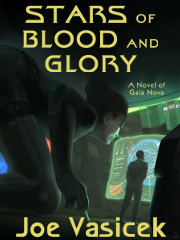
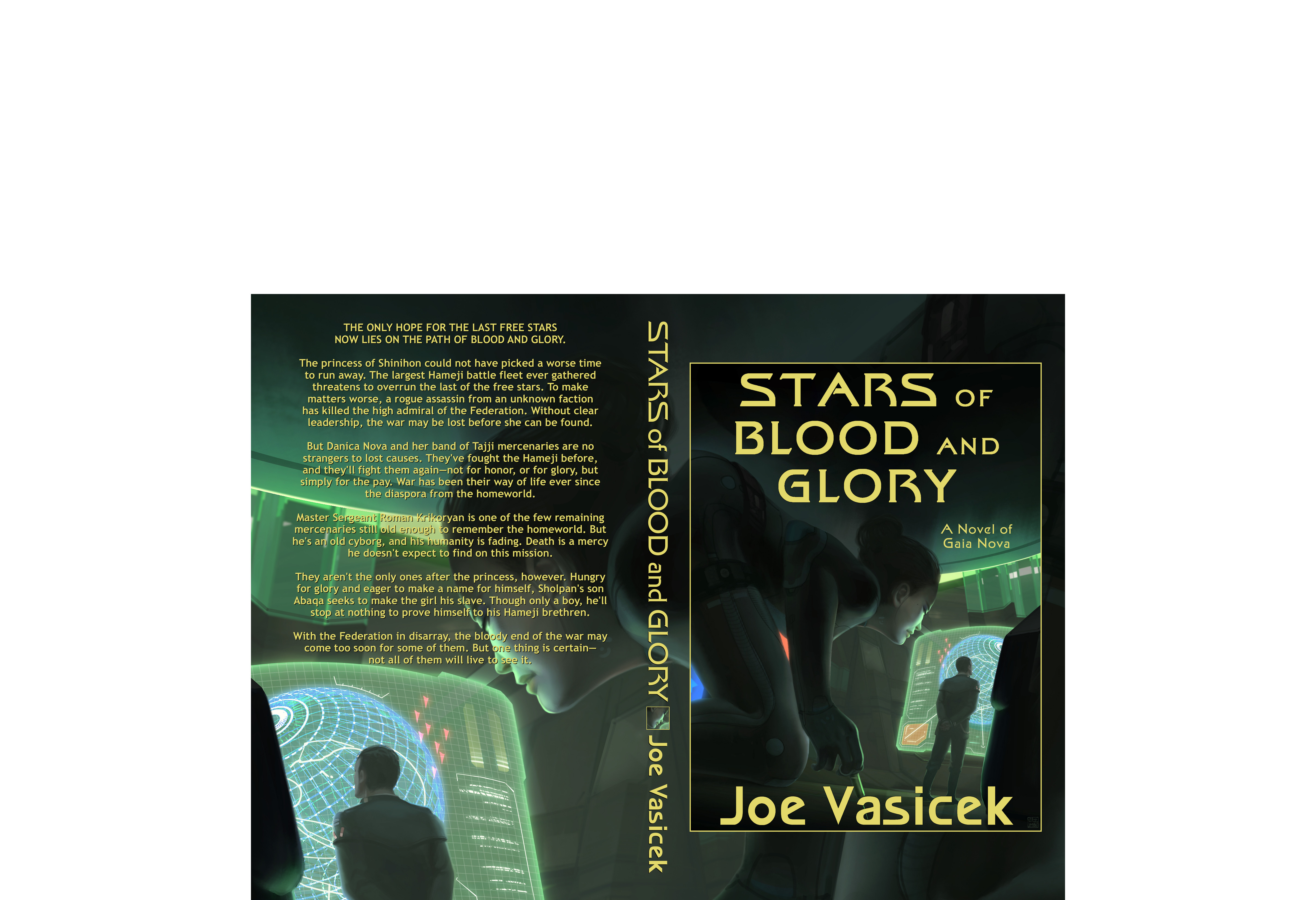
Since most of my characters are human, xenocide as such isn’t a major theme in my books, but genocide certainly is.  In the Gaia Nova series, the starfaring Hameji look down on the Planetborn as inferior beings and think nothing of enslaving them and slagging entire worlds.  That’s how Prince Abaqa from Stars of Blood and Glory sees the universe at first, but by the end of the novel he’s not quite so sure.  Stella from Sholpan and Bringing Stella Home also deals with these issues as she comes to realize how it’s possible for the Hameji to hold to such a belief system.

If genocide is one of the ugly skeletons in the closet of this screwed up modern world, then xenocide is science fiction’s way of taking those skeletons out and dignifying them with a proper burial.  By wrestling with these issues in stories set on other worlds, we are better able to humanize the Other and prevent these horrors from happening again on our own.  In this way and so many others, science fiction helps us to build a better world.

W is for Wagon Train to the Stars

big_damn_heroes_moment_smallWhen Gene Roddenberry pitched the original Star Trek series back in the 60s, Westerns were all the rage.  Consequently, he pitched his show as a “wagon train to the stars,” where a bunch of quirky characters on an awesome starship travel from adventure town to interstellar adventure town, exploring and pioneering the final frontier.

Sound familiar?  Yeah, I thought so.  The concept proved so catchy that it’s been redone time and again, from Battlestar Galactica to Firefly to Doctor Who.  Even though Westerns aren’t nearly as popular as they used to be, many of its tropes are so well suited to Science Fiction that they drive the genre even today.

For example, adventure planets.  In a typical Western, the characters travel from town to town, with a different adventure in each one.  Well, in Science Fiction, the characters do the same thing, except that they’re traveling from planet to planet.  And really, if you’ve got the ability to travel to other worlds, how can you not have an adventure in each one?

A large reason for the Western / Science Fiction crossover is the whole concept of space as the final frontier, which we explored earlier in this series with I is for Interstellar.  There’s a very real sense of manifest destiny in the space exploration community, not because of humano-ethnocentrism (heck, we don’t even know we’re not alone in our local stellar neighborhood), but to ensure humanity’s long-term survival.  The parallels between that and the westward movement in 19th century America aren’t perfect, but they do exist.

Similarly, as we explored in R is for Rebel, the notion of space as the final frontier has a special resonance with the American audience.  The days of the old frontier may be over, but its spirit lives on in our culture, from guns to road trips to our glorification of the rugged, self-made individual.  Today’s Science Fiction, especially the space-focused SF of Space Opera, grew out of the adventure fiction of the pulps, which thrived on that frontier American ethos.

In fiction, the frontier can still be found in two major genres: the Western, which is historical and therefore more backward-looking, and Science fiction, which is futuristic and therefore more forward-looking.  Because Science Fiction isn’t burdened with all of the historical baggage of the traditional Western, it’s a much more flexible medium for story, readily adaptable to contemporary issues and concerns.

For example, where Star Trek echoes the large-scale nation to nation conflicts of the Cold War (Federation vs. Klingons and Romulans), the new Battlestar Galactica series echoes the much more asymmetrical conflicts of the post-9/11 world (Cylon agents who are indistinguishable from humans and may not even know that they are cylons).  At the same time, the wholesale co-opting of Western tropes enables a latent sense of nostalgia, evident in the look and feel of Firefly, or the famous opening lines from Star Wars: A long time ago in a galaxy far, far away.

My first real experience with a wagon train to the stars type of story was probably Star Trek: Voyager, which I watched religiously with my dad every Wednesday night until maybe 9th or 10th grade.  The Western-borrowed tropes are somewhat more muted in that series, but they exist, especially the planetville / adventure towns stuff.  However, it wasn’t until Firefly and Serenity that I really experienced the awesomeness of a true Space Western.  There were a lot of things in Firefly that I really loved, especially the character interactions, the gun-toting action scenes, and especially the starship Serenity.  There were some things I didn’t like so much, like the fact that every planet is basically Wyoming, but overall I really enjoyed the show.

It wasn’t until I started getting more acquainted with straight-up Westerns that I saw the real potential for crossover between the genres.  Stories about mountain men like Jeremiah Johnson really captured my imagination–what would this look like if it were set in space?  In that sense, I came to the Space Western more from the classic Science Fiction side first, rather than the pulp adventure stuff.  But once I discovered the crossover connection, it naturally found a way into my own work.

That’s basically how the story idea for Star Wanderers first came to me.  I was lying on my bed, daydreaming about having my own starship like the Serenity, when I wondered what it would be like for a starship pilot to get roped into an accidental marriage like in the movie Jeremiah Johnson?  The collision between the two ideas was like a supernova exploding in my brain.  I rolled out of bed and started writing, coming up with chapter one of Outworlder almost exactly like it’s written today.  And the more invested I became in those characters and that world, the more the story grew.  I’m writing Part VII right now (Reproach, from Noemi and Mariya’s POV), and so long as people read them I’ll keep writing more.

Genre mash-ups and crossovers are a great way to keep things fresh and come up with some really interesting stories.  Some genres aren’t very well suited for each other (Erotica and Middle Grade, for example), but others come together so well that they seem almost complementary.  That certainly seems to be the case with Westerns and Science Fiction, at least here in the United States where the spirit of the frontier still echoes through the popular culture.

V is for Vast

Pale_Blue_Dot

If you don’t know anything else about the universe, you should know this: it’s big.  Really, really, REALLY big.

How big, you ask?  Well, for starters, take a look at Earth in the picture above.  Can you see it?  It’s the pale blue dot in the beam of starlight on the right side of the picture.  As Carl Sagan so famously put it:

From this distant vantage point, the Earth might not seem of any particular interest. But for us, it’s different. Consider again that dot. That’s here. That’s home. That’s us. On it everyone you love, everyone you know, everyone you ever heard of, every human being who ever was, lived out their lives. The aggregate of our joy and suffering, thousands of confident religions, ideologies, and economic doctrines, every hunter and forager, every hero and coward, every creator and destroyer of civilization, every king and peasant, every young couple in love, every mother and father, hopeful child, inventor and explorer, every teacher of morals, every corrupt politician, every “superstar,” every “supreme leader,” every saint and sinner in the history of our species lived there – on a mote of dust suspended in a sunbeam.

The picture was taken by the Voyager 1 spacecraft more than a decade ago.  At the time, the spacecraft was about 6,000,000,000 kilometers from Earth, or 5.56 light-hours.  A light-hour is the distance a particle of light can travel in one hour (assuming it’s traveling through a vacuum).  To give you some sense of scale, in one light-second, a particle of light can travel around the circumference of the Earth seven and a half times.

And lest you think that’s actually a distance of any cosmic significance, consider this: the nearest star, Proxima Centauri, is about 4.24 light-years away.  That’s more than 6,500 times the distance in the photograph above–and that’s just the closest star!

Our galaxy, the Milky Way, is between 100,000 to 120,000 light-years across.  If you were on the other side of the galaxy and had a telescope powerful enough to get a good view of Earth, you would see a gigantic ice sheet over both of the poles with no visible sign of humanity whatosever.  The light from all our cities, from our prehistoric ancestors’ campfires, has not yet traveled more than a fraction of the distance across this galactic island universe we call home.

Seriously, the universe is huge.  If you don’t believe me, download Celestia and take yourself for a spin.  In case you haven’t heard of it, Celestia is basically like Google Earth, except for the universe.  Everything is to scale, and there are all sorts of plugins and mods for exoplanets, nebulae, space probes, and other fascinating celestial objects.

I remember what it was like when I first tried out Celestia back in 2010.  I was at the Barlow Center for the BYU Washington Seminar program, in the little library just below the dorms.  I think it was twilight or something, and I hadn’t yet turned on the lights.  The building had a bit of that Northeast feel to it, like something old and rickety (though not as old as some of the buildings up here in New England).  I turned off the ambient light option to make it look more realistic, and began to zoom out.

Let me tell you, the chills I got as the Milky Way disappeared to blackness were like nothing I’ve felt ever since.  So much space, so much emptiness.  It’s insane.  The vastness between stars is just mind boggling–absolutely mind-boggling.

I got my first introduction to science fiction when I saw Star Wars IV: A New Hope as a seven year old boy.  In the next few years, I think I checked out every single Star Wars novel in our local library’s collection.  It wasn’t enough.  Whenever I was on an errand with my mom, I tried to pick up a new one.  I think they even left some copies of the Young Jedi Knight series under my pillow when I lost my last few baby teeth.

One of those summers, we drove down to Texas for a family vacation.  I picked up the second Star Wars book in the Corellian trilogy, written by Roger Allen McBride.  It was completely unlike any of the other Star Wars books I’d ever read.  In it, Han Solo’s brother leads a terrorist organization in the heart of their home system of Corellia.  They hijack an ancient alien artifact and use it to set up a force field that makes it impossible for anyone to enter hyperspace within a couple of light hours from the system sun.  The part that blew my mind was that without FTL tech, it would take the good guys years to get to the station with the terrorists.

All of a sudden, the Star Wars universe didn’t seem so small anymore.  And it only got crazier.  Roger Allen McBride did an excellent job getting across the true vastness of space.  At one point, Admiral Ackbar mused on just how puny their wars must seem to the stars, which measure their lifespans in the billions of years. For the ten year old me, it was truly mind boggling.

That was my first taste of science fiction that went one step beyond the typical melodrama of most space opera.  And once I had that taste, I couldn’t really stop.  As much as I love a good space adventure, real-life astronomy offers just as much of a sense of wonder.  When a good author combines the classic tropes of science fiction in a space-based setting that captures the true vastness of this universe we live in, it’s as delicious as chocolate cake–more so, even.

I try to capture a bit of that in my own fiction, though I’m not always sure how much I succeed.  In Star Wanderers, the vastness of space is especially significant for the characters because their FTL tech is so rudimentary that it still takes months to travel between stars.  All of that time out in the void can really make you feel lonely–or, if you have someone to share it with, it can bring you closer together than almost anything else.  It’s the same in Genesis Earth, which is also about a boy and a girl who venture into the vastness alone.  The Gaia Nova books lean closer to the action/adventure side of space opera, but the same sensibility is still there.

The best science fiction, in my opinion, both deepens and broadens our relationship with this marvelous place we call the universe.  It’s not just a fantastic setting for the sake of a fantastic setting–it’s the universe that we actually live in, or at least a plausible version of it set in a parallel or future reality.  The universe is an amazing, beautiful place, and my appreciation for it only grows the more science fiction I read.  If I can get that across in my own books, then I know that I’ve done something right.

U is for Universal Translator

In science fiction, whenever two characters from different planets or different alien races have to interact with each other, they almost always speak the same language or have some sort of universal translator that magically makes them able to communicate with minimal misunderstandings.  This is especially common in Star Trek, though it happens in just about every franchise involving a far-future space opera setting of some kind.

I’ve got to be honest, I think this is a cheap plot device that almost always weakens the story.  As a writer, it’s tempting to have something like this so you don’t have to deal with any pesky language barriers, but when you do this, you remove a major potential source of conflict, thus violating the rule of drama.  Also, you make your fictional universe feel a little less grand, your aliens a little less alien.  After all, if everyone can perfectly understand each other, then there must not be a huge difference between Earth and the far side of the galaxy.

There are some times when having a universal translator allows you to broaden the story and focus on other conflicts.  For example, if some sort of interstellar legislation is under review in the grand galactic council, you can’t spend all your time focusing on basic communication difficulties.

However, if this is the case, then you can usually overcome the language barrier through other means–a galactic lingua franca, for example, or translation tools that may or may not misfire on occasion (much like Google Translate).  Of course, if you’re writing a comedy like Galaxy Quest (or parts of Star Control II), then falling back on a universal translator is forgivable.  But if you’re going for believability and a sense of wonder, this trope isn’t going to do you any favors.

While linguists and technologists have been working on translation programs for some time (and admittedly making some significant breakthroughs), I’m extremely skeptical that we will ever develop a perfect universal translator in real life.  If we do, I expect we will have to develop a sentient AI as a prerequisite, since the nuances of language are so inseparable from the things that make us human.

Here’s how translation services like Google Translate work:

  1. They amass an enormous database of language material by scanning websites, newspapers, and other documents.
  2. They analyze this database to look at word combinations and frequencies, observing the likelihood that any one word will appear in combination with any others.
  3. They compare these combinations and frequencies with those in other language databases to match words and phrases.

This data crunch method of translation works fairly well for simple words and phrases, but it falls apart in the more complex grammatical structures.  I see this any time I try to use Google Translate with an Arabic source.  Arabic is an extremely eloquent language, with all sorts of structures that simply don’t work in English.  One mistranslated word can completely change the meaning of the entire text, and even when it works, the technically correct English translation sounds as if it’s full of errors.

The methodology also falls apart for languages that are too small to have much of an electronic database.  The Georgian language is a good example of this.  It’s spoken by only about 4.5 million people worldwide, most of them in the country of Georgia, which is predominantly rural.  Internet access for most of the population is very limited, and most Georgians who do communicate online tend to use the Roman or Cyrillic alphabets more often than their own.  As a result, Google Translate for Georgian is utterly useless–seriously, you’re better off just sounding out the letters and guessing at the meaning.  There are some other sites like translate.ge that try to fill the gap, but they seem to rely on actual lexicons, not databases and algorithms.

All of this is between entirely human languages that developed in parallel on the same planet–indeed, languages between human cultures that have traded and shared linguistic influences for thousands of years.  What happens when we encounter an alien race whose biology makes it impossible for them to make human-sounding noises?  Or an alien race that communicates through smell or electromagnetic impulses instead of sound?  What happens when humanity is spread out across hundreds of star systems, each of which periodically becomes isolated from the others for hundreds or even thousands of years?  When our definition of human is stretched so thin that we would not even recognize our far-future descendents as anything but alien?

There is so much wasted potential whenever a science fiction story falls back on a universal translator.  Case in point, compare Halo I, II, and III with Halo: Reach.  In the first three games, the Master Chief’s universal translator enables him to hear exactly what the enemy Covenant troops are saying.  This is great fun when you’re chasing down panicked grunts, but it tends to get old after a while.  In Halo: Reach, however, the human forces haven’t yet developed a universal translator, so everything the Covenant say is in their original language.  All of a sudden, the game went from a hilarious joyride to a serious war against aliens that felt truly alien.  That one little change did wonders to the tone and feel of the entire game.

Needless to say, you won’t find a universal translator in any of my books.  In Star Wanderers, the language barrier is the heart and soul of the story–it’s a science fiction romance between two characters from radically different worlds who don’t speak the same language, and yet overcome that to develop a strong and healthy relationship.  In Sholpan and Bringing Stella Home, Stella knows a language that is fairly similar to the one spoken by the Hameji, but there are still words and phrases that elude her.  This detail is critical because it impedes her ability to understand and adapt to the Hameji culture, leading to some major conflicts later in the book.

As someone who’s lived for significant periods of time in Europe and Asia and learned languages very different from English, I can say that the language barrier is not something that we as writers should avoid, but something that we should embrace.  There are so many interesting stories that can be told when two characters don’t speak the same language.  Please, don’t be lazy and write that out of the story through a cheap plot device!  Let your aliens be truly alien, and your worlds and cultures so fantastic that we can’t help but feel hopelessly lost in them.

T is for Terraforming

[NOTE: this post is a reprint of an earlier post from the Trope Tuesday series, which you can find here.]

The fantasy isn’t that Mars could actually look like this, but that NASA might actually get the funding.

One of the problems with interplanetary colonization is that Earth-like worlds are fairly rare (though possibly not as rare as we once thought). In our own solar system, the only other world that comes anywhere close (Mars) is a radiation-blasted desert with only the barest hint of an atmosphere and a surface temperature colder than Antarctica. To get around this problem, you can do one of two things: build an artificial enclosed environment to house the colony, or change the world itself to make it more Earthlike–in other words, terraform it.

The actual science of terraforming is way over my head far too complex to do it justice in this post. Instead, I’ll just point you to the Terraforming Wikipedia page as a starting point and focus on how the concept is used as a story trope.

According to tvtropes and Wikipedia, the term came from a 1942 novella by Jack Williamson titled “Collision Orbit.” The concept of changing the environment of an entire planet actually goes back much further, with H.G. Wells subverting the trope in War of the Worlds (instead of humans terraforming other worlds, the hostile Martians try to xenoform Earth to make it habitable for them). Before the U.S. and U.S.S.R. put probes on the surface of Mars and Venus, it was fairly common for writers to speculate that those planets were able to support human life, at least on a basic, rudimentary level. Once the science showed that that isn’t actually the case, terraforming as a story trope really began to take off.

Today, this trope occurs commonly across all ranges of the Mohs scale. Soft sci-fi stories (such as Firefly) use it as an excuse to have planets that look and feel like Earth. Hard sci-fi stories (such as Red Mars, Green Mars, and Blue Mars) use it as a fundamental premise, or to pose questions like “what is the ultimate destiny of human evolution?” or “how important is it to our species’ survival that we spread out beyond Earth?” Although it’s not something that we as a species have (yet) done, our present science seems to place it well within the range of the plausible, and that means that makes it fair game for any kind of science fiction.

In order to be believable, however, any significant terraforming project requires two things: resources and time. LOTS of time. We’re talking on the order of centuries and millenia here. Because of that, stories that use this trope generally fall into the following categories:

  • The terraforming happened a long time ago and is part of the world’s ancient (or near ancient) history.
  • The terraforming is on-going and directly impacts almost every element of the world’s culture and setting.
  • The terraforming has failed in some way, which may (or may not) make it a key element in the story conflict.

As with generation ships, the scope of this trope spans more than just the interests of a single character–it deals with the ultimate destiny of entire cultures and civilizations. In hard sci-fi stories, the planet that’s being terraformed may actually become more of a character in itself than the individual people who are terraforming it. Unless they have some form of immortality, they have little hope of ever seeing the ultimate end of it.

Of course, that almost makes the project more of a religion to the colonists than a science, with all sorts of interesting philosophical and story implications.

Why is this trope so widespread in science fiction? I can think of a few potential reasons. First, it hits on some of the key issues that lie at the very heart of the genre, such as the ultimate destiny of humanity and the ethical issues surrounding our ability to play God through the wonders of science. Also, it captures the imagination in a way that few other tropes can equal. Because the scope of any terraforming project is so vast, the implications touch on almost every key element of the story, including setting, character, and conflict.

But on an even more fundamental level, it hits on one of the key elements of any fantasy magic system: limitations. We can’t live on an alien world because the conditions are too hostile, but we can’t just wave our hands to make it Earth-like either. We have to undergo a painstaking, laborious process that could unravel at any point and throw everything we’ve worked for into chaos. We have to dedicate our whole lives to the project for dozens of generations before it will ever pay off. There are no shortcuts–none that won’t strain our readers’ suspension of disbelief, anyway. But if it all works out, then we will have created a new Earth–and how is that not magic?

Needless to say, I’m a big fan of this trope. I’ve used it in just about every science fiction story I’ve written, though I probably play with it the most in Star Wanderers. The main character of that story comes from a world where a terraformation project failed, having severe religious implications that drive the whole series. Sacrifice is largely set in orbit around a world that is midway through the terraforming process. Elswhere in the Gaia Nova universe, people build domes just as often to keep humanity from screwing over a terraformed world as they do to provide room to live on one that isn’t. After all this, though, I feel like I’ve only begun to scratch the surface of this trope. You can definitely expect to see it in my work in the future.

I have a confession…

…I’ve started writing a Sword & Planet story.

In case you’re wondering what the heck is Sword & Planet, think Conan the Barbarian in space.  With giant lizards and man-eating plants.  And half-naked princesses getting kidnapped by evil technomancers with giant four-armed bodyguards that wield laser-bladed swords.  Basically, science fiction in the style of the classic 20s pulp adventure novels.

In other words, this:

I’ve read a lot more Heroic Fantasy and Sword & Sorcery than straight Sword & Planet, but I figure there’s a good deal of overlap.  I read A Princess of Mars way back in college and really enjoyed it, and of course I’m a huge fan of Star Wars and other series that were heavily influenced by the genre.  Basically, I want to try my hand at a classic science fiction adventure style, without the scientific rigor of Hard SF or the sprawling world building of Space Opera.  It’s all about the adventure, with liberal helpings of awesome sprinkled with omigoshomigoshomigosh.

The tentative title for this book is The Last Warrior Princess, though it’s about a twenty-something college grad working a wilderness job in southern Utah who accidentally finds a portal to another world while wandering around Arches National Monument.  The princess comes later, though not too much later.  I don’t know much about her yet.

In fact, I don’t know much about the story at all.  I’m discovery writing everything, and I do mean everything.  This is a fly-by-your-pants ready-set-go kind of book, with no restrictions and no limits–just me and the muse, not caring what anyone else thinks.  My internal editor is bound and gagged in the cellar with the spiders, and if he breaks out somehow I’ll hamstring him and toss him back down.  This project might never get another mention beyond this post, but I’m okay with that because it’s going to be a whole lot of fun.

For those of you waiting for the next Star Wanderers story, don’t worry, I’m still writing those too.  This is more of a side project at this point, so I won’t put up a progress bar for it until I get fairly close to the end and know it’s something I want to keep.  Which might never happen.

So basically, it’s just a personal pet project for now.  It’s interesting, though, because when you’ve got nothing to fall back on but your own creative impulses, the words start to flow in remarkable ways.  Take this passage, for example:

I drove up just as the sun was setting. The crescent moon hung like a razor in the yellow-orange sky, with Venus a twinkling point on its edge. Blood-red Mars was not far off, while Jupiter loomed ascendant.

I have no idea where that came from, but in the white-hot creative heat of the moment, it just spewed out onto the page that way.  The only word that I changed was “loomed,” which I had originally written as “hung” (maybe I should change it back? Nah, who cares).  In a little over an hour, I committed about 1,500 words, all just like this.

So yeah, if nothing else, this project will help to shake up my creative process and get the juices flowing for other projects.  I could really use that right now, what with a couple of recent life roles (my grandmother passed away last week, which wasn’t unexpected but it did throw a kink in my already rocky routine).  And who knows?  If it turns out well, you might see me put it out as a novel in a few months.  Or maybe the first part of a new series … nah, better not get carried away.  Better just write it first.

Besides the A to Z challenge (which I may also turn into a book at some point) and Star Wanderers: Reproach, that’s what I’ve been up to recently.  I’ve got a Star Wanderers omnibus in the publishing queue, but there’s nothing firm I can say about that yet, other than it will probably be for Parts I-IV and feature a professional cover (though I plan to keep the space images for the individual installments).  I could say more, but I want to go for a walk.  Later.

S is for Space Station

downbelow_stationPlanets are not the only setting for science fiction stories–space stations are common as well.  From the Death Star (“that’s no moon…”) to Downbelow Station, the Venus Equilateral to ISPV 7 to the Battle School in Ender’s Game, space stations are a major staple of any space-centered science fiction.

The reasons for this should be fairly obvious.  Before we can go to the planets and the stars, we need to have a permanent presence outside of this massive gravity well we call Earth.  The easiest and most logical place to expand first is to orbit, where supplies can be ferried up without too much difficulty and astronauts can escape in case of an emergency.  Indeed, with the International Space Station, that’s exactly what we’re doing right now.

In science fiction, of course, space stations go much further than they do in real life.  They’re often giant orbital cities, with thousands of people living and working there permanently.  Often, they feature some sort of rotating toroidal structure in order to simulate gravity.  If there are settlements on the planet below, the station often serves as a major hub for commerce, serving as a waypoint for interstellar merchants and wholesalers who ferry their wares up to orbit.  And if the planet is still being colonized, then the space station often serves as an important umbilical to the outside universe.

They can also have strategic value in the event of a war.  Battleships need to be serviced too, after all, and a station’s position in orbit can provide an excellent platform from which to bombard or lay siege to the planet.  Alternately, outposts at more distant locations like the Lagrange points can serve as a staging ground for future attacks–a sort of astronomical “high ground,” if you will.  If nothing else, abandoned stations may contain supply caches that can aid a fleeing starship, or provide shelter behind enemy lines, as was the case with the first Halo game.

Stations can come in all sorts of different flavors, from the puny to the magnificent.  The most eye-popping station of all is probably the Ringworld from Larry Niven’s series of the same name.  As the name would imply, the station is a giant ring–so huge, its circumference is the orbit of a habitable planet, with the sun at its center!  Gravity is provided by rotation, and night and day by giant orbiting panels that block out the sun at regular intervals.

My favorite stations, though, are the more realistic ones–the ones that I can imagine myself living on someday.  That was one of the things I enjoyed about Downbelow Station by C.J. Cherryh–her depiction of human expansion into space is eminently believable, and her stations are a natural extension of that.  I also really enjoyed her focus on the social dynamics of living on a giant station, and what it would be like to live in such a society.

The Battle School from Ender’s Game is another huge favorite of mine.  One of the advantages of building a structure in space is that gravity becomes malleable, so that some parts of the structure can simulate Earth-surface gravity while others leave people completely weightless.  The Battle School uses that to its advantage, with the main training room a zero-g laser tag battle arena, where the students have to learn how to stop thinking in terms of the planar dimensions, where “up” and “down” have any meaning.  It’s really quite fascinating.

It should come as no surprise that space stations pepper my own works.  They’re especially common in the Star Wanderers series, where few worlds have been terraformed and orbital platforms make up the majority of human living space (at least in the Outworlds).  In Sholpan and Bringing Stella Home, James, Ben, and Stella are all from a space station–a distinction that is especially useful for Stella, since her Hameji captors despise the “planetborn.” Genesis Earth takes that a step further, as spaceborn Michael and Terra have never been to the surface of a planet before until midway through the novel.  Just as going into space is paradigm shifting for us, the experience of walking on a planet proves just as transformative for them.

R is for Rebel

rebel_allianceJust as sprawling interstellar empires are a staple of space opera, so are the plucky rebels that fight against them.  From Star Wars to Battlestar Galactica, Firefly to FTL, there’s no shortage of characters in science fiction trying to stick it to the man.

I’m not sure how it is in other cultures, but in America, it seems like science fiction upholds a host of values closely related to rebel tropes, such as self-reliance, individualism, freedom and independence, frontier justice, enterprising self-made men, etc.  A lot of this probably grew out of the genre’s early ties with pulp-era adventure fiction, which often featured former Confederate soldiers leaving the civilized world for the realms of adventure following the US Civil War.  That’s certainly the case with John Carter in A Princess of Mars, and echoed to some extent with the Browncoats from Firefly.

It may go even further, though, to the revolutionary origins of the United States itself.  The frontier has always loomed large in our culture, shaping our values in the early days of settlement and, now that the age of the frontier is largely over, standing for an idealized nostalgic past.  Americans have always favored the self-made individual who stands up to injustice and corruption in high places, and we’ve always had an aversion to the centralization of power and authority.

Back in the days of the Cold War space race, when writers like Heinlein and shows like Star Trek really started to popularize the genre, there seems to have been a real push to promote American identity and values.  The science fiction of that day certainly got caught up in all that, which is weird because as pro-Americanism became the establishment, a genuinely rebellious counterculture began to push back.  To its credit, though, there was plenty of science fiction that embraced the counterculture, especially in the New Wave movement that followed the Golden Age.

So why are we so enamored with rebels?  Probably for the same reason that we all love a good rogue.  Since space is the final frontier, it’s naturally the kind of place that would attract a more rugged, individualistic type.  At the same time, rogues and rebels are much more likely to have exciting adventures than the more mild-mannered folk who are apt to stay at home and conform.  Let’s not forget that most people who read science fiction are adolescent boys (of all ages), hungry for adventure and often a little rebellious themselves.

Though the rebels are often the good guys, that’s not always the case.  It all depends on who they’re fighting against, and how black and white the story is trying to be.  If they’re fighting against the Empire, then they’re almost always courageous freedom fighters standing up for truth and justice and all that, but if they’re fighting against the Federation, things can be a lot more gray.  In FTL, for example, the rebels are the outright antagonists, and you have to save the galaxy by defeating them.

The rebels don’t always win, either.  In stories like Star Wars that skew towards idealism, then in the end they usually do, but in darker, grittier tales (such as most cyberpunk), they may or may not.  And even in some happy-go-lucky adventure stories, the rebels are apt to be martyrs for a lost cause–again, think of the Browncoats from Firefly.

The wide variety in the role of rebels in science fiction is a good indication of a healthy, vibrant back-and-forth in the genre that’s been going on for some time.  It also means that there’s plenty of room for a new writer to take these old, worn tropes and shake them up in a new and exciting way.  As much as we love Luke Skywalker, we love Han Solo just as much, and if you combine him with John Carter to get Mal, then you’ve got a rebellious character that a whole new generation can come to know and love.

I love playing around with these tropes, and do so quite often in my own fiction.  In Bringing Stella Home, James McCoy is very much a rebel, though it’s not the Hameji that he’s fighting against so much as everything standing between him and his brother and sister.  In that sense, he’s kind of a martyr without a cause, a determinator who shakes his fist at the universe even when the more sensible thing is to learn how to cope.  Similarly, Danica and her band of Tajji mercenaries all fought in a failed revolution and have been wandering the stars ever since.  Their backstory features much more prominently in Stars of Blood and Glory, in which things come around full circle.  And then, of course, there’s Terra from Genesis Earth, who isn’t about standing up to the man so much as giving him the finger and running off somewhere where none of that even matters–the frontier ethic taken to its furthest extreme.

So yeah, I’m a fan of this trope, and have been ever since I saw Star Wars and fell in love with the genre.  You can definitely expect to find lots of rebellious characters throughout my books in the future.

Q is for Quark

Quark_Mascot_by_OrphneIf it takes a village to raise a child, does it take a group of like-minded creative souls to raise a writer? I don’t know, but in my case, having a writing community around me really helped.  That community was Quark, BYU’s Science Fiction & Fantasy club.

I joined Quark my second semester of college.  I’d heard about the writing group, and on a whim I decided to check it out.  This was when Ben Hardin was the writing group leader, back before the current iteration of the club was really well-organized.  Aneeka Richins had basically built the writing group from scratch only a year or two before, and Kindal Debenham and Annaliese Lemmon had each spent a year as president shortly after that.  They were all still around, workshopping their stories and adding to the community.

We met on the second floor of the Harold B. Lee library, in one of the study rooms way in the back near what is now the classical music area (2520 was the room number, I think).  Looking back, it seemed like a weird place to meet, since we were always so LOUD.  However, back in those early days Quark didn’t get a lot of respect from the BYU student administration (BYUSA, known more familiarly as BYUSSR), so we kind of organized under the radar.

The spring semester of 2007 was a lot of fun!  I fit in very well with the group, and made a lot of friends.  It wasn’t until they made me the writing group president that I started attending regularly, though.  In retrospect, accepting that post was probably the best extracurricular decision I could have made.  I lead the writing group for two years, from fall of 2007 to spring of 2009, and that’s when I really became a writer.

When I first started back in 2007, I had a couple of hobby projects kicking around here and there, but the main thing I wanted to write was a Final Fantasy VI fanfic.  At the same time, I had a great idea for an original novel, but I’d never written a complete novel before, so I wasn’t sure what to do.  Aneeka convinced me to go with my own project, and that became The Lost Colony, also known as Ashes of the Starry Sea.

Around that time, I also started this blog, mostly so my writing friends could keep me honest.  I finished the first draft in 2008–a whopping 168k word manuscript that barely held together.  After coming back to the US from a study abroad program in the Middle East, I started revising it, but soon decided to trunk it in order to work on other projects.  Shortly thereafter, I finished the first draft of Genesis Earth, and the rest is history.

I later wrote up a detailed post on the origins of Quark, one that was published in a short-lived magazine called Mormon ArtistYou can find that article here.  Orson Scott Card himself commented on it, which really made my inner fanboy squee. 😀 For me, though, Quark was all about surrounding myself with like-minded friends who could foster my natural sense of creativity.  I probably would have become a writer anyway even without them, but it would have happened a lot later, and the road would have been much more rocky.

And now that we’ve all graduated and moved on, I’m happy to say we still keep in touch!  Kindal is a self-published indie writer much like me, with some excellent books out there.  He’s organized an online writing group that is mostly made up of us old-time Quarkies.  Aneeka’s got her webcomic, which seems to be fairly successful, and the others who chose to go a more traditional path are having success there as well.  But mostly, it’s just great to keep in touch.

After my time as president, Quark really exploded in popularity and became officially sanctioned by the BYUSA.  It’s really thriving right now, with a book club, a board/video gaming group, a film forum, and a bunch of other stuff.  Most of that was there when I was in the writing group, but it was floundering, and the writing group was much more autonomous.  But the guys who have carried on the torch seem to have done a great job making things even better, and that’s encouraging.