So, I’m in Georgia now, writing this blog post from the hotel in Tbilisi where we’re having our orientation! The flight from New York went well, all my stuff made it alright, and I’m having a blast making new friends and playing the role of clueless foreigner!
There’s about twenty to twenty five of us here, most from the US, but a few from Australia, Canada, and one girl from Egypt. I met a whole bunch of them in the airport at JFK, including my roommate, who is from Alaska. Most everyone has had some travel/expat experience, though most of us are fresh out of college. A couple of us know Russian, but that’s about it–no one really knows Georgian.
The people here seem friendly enough, at least the ones we’ve attempted to speak with. I knew it was going to be disorienting not being able to speak the language, but…wow. There’s nothing quite like being the clueless foreigner. All I really know is that the word for “hello” sounds a lot like “gom jabbar.” The only thing for it is to abandon all shame and do your best to get out there and communicate, which my Alaskan roommate is really great at. I think we’re going to get along quite well.
That’s about all I can say for now. I hear that Georgia is in the American news now, with Iran trying to attack the Israeli embassy–yeah, that’s just what my parents needed to hear. :/ Don’t worry about me, though; I’m doing fine, and I’ll be sure to keep my eyes open and stay out of danger.
I’d write more, but I don’t want to plug in my computer until I have a surge protector, and I’ll need to conserve my battery if I want to write at all later today. I haven’t been writing hardly at all in the last few days, but of course I’ve been busy getting adjusted to all the new changes. I’ll try to do about 500 words a day minimum, but I’m not going to be too strict on it–I’ve got a lot of other things going on, after all.
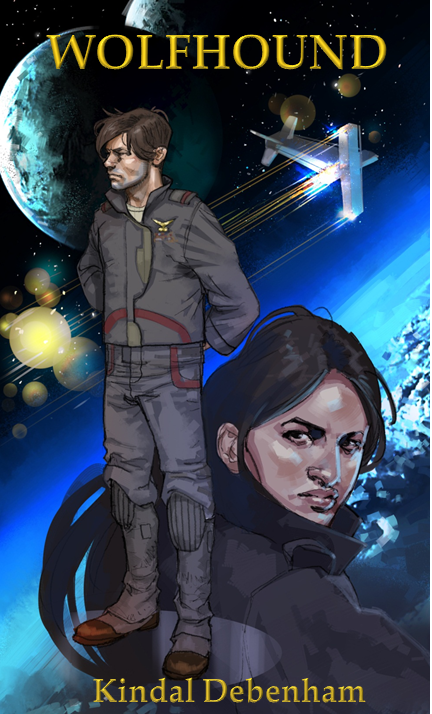
Jacob Hull may be just a spacer’s son, but he’s not afraid to dream big. As an ensign in the Celostian Navy, his biggest dream is to pilot a destroyer like the Wolfhound, the brand new ship on which he receives his first assignment. But when pirates attack on their training exercises and drive them far from the rest of the Celostian fleet, Hull realizes that his dream might be more than he asked for…
Full disclosure: Kindal Debenham is actually a good friend of mine–we were both members of Quark in college and still keep in touch as alpha readers for each others’ books. That’s not why I’m saying that I loved this book, though. I’ll admit, I had a few doubts when I first started it. The descriptions are a little wordy, the formatting isn’t perfectly clean–but none of that really matters, because the story is AWESOME.
Why is it so awesome? Because it’s full of characters you want to root for, facing one impossible conflict after the other, each one bigger and more daunting than the one before. The story gets off to a decent start, but it really starts to take off after the first third or so, and just keeps getting better and better right up to the end.
Seriously, this is the kind of book I used to hunt for in the library as a kid. It reminds me a little of the old Star Wars novels by Timothy Zahn, Kevin J. Anderson and Michael A. Stackpole. Forget dark, dystopian futures and boring, high-concept stuff–this is some rip-roaring space opera, with stations you wish you could visit and starships you wish you could fly.
So yeah, I loved this book. Great read; once I got into the second half, I couldn’t put it down. If you’re a fan of space adventure stories, you should definitely check out this book. It’s available from both Amazon and Smashwords as an indie published ebook, and it’s actually holding it’s own quite well on the Amazon bestseller lists. It definitely deserves the spot! Oh, and if you want to check out Kindal’s blog, you can find him here.
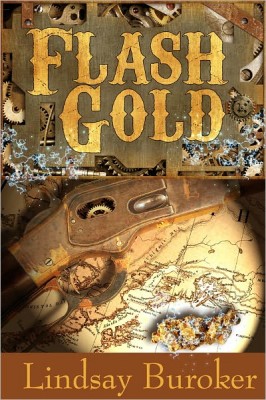
All Kali McAlister wants is to leave Moose Hollow far, far behind–and with her dogless sled, the $1,000 prize for the sled race is just her ticket. But with pirates, gangsters, and thugs in the Yukon after her late father’s alchemical secrets, she’ll be lucky to make it to the finish line alive. And then there’s that striking man by the mysterious name of Cedar–why is he helping her?
This was a fun steampunk adventure story. It was fast-paced, well-written, and quite enjoyable; Buroker knows how to hook a reader with interesting characters and conflicts. I’m looking forward to reading more books set in this universe.
That said, I did have a few issues with this book. At some parts, the dialog came across as wooden because the characters’ words and reactions didn’t match the intensity of the scene. For example, Kali and Cedar got caught up in a couple of friendly discussions during gunfights, one about her automatic reloading rifle (which was somewhat excusable) and one about the status of their relationship (which felt a little contrived). Also, the climax of the story revolves around a late third act info dump, which is a pet peeve of mine. It didn’t bring the story to a screeching halt, but it did feel a little clumsy.
None of those kept me from enjoying the story, but they were definitely things I noticed. My biggest issue was probably a lack of real dept or thoughtfulness; what I like to call a “stuff happens, the end” kind of story. The main character had good internal motivations, but no real internal conflict. For example, she had this whole history with a previous lover betraying her trust, but she didn’t really struggle much with learning to trust again; all that old baggage was just a part of her background.
Overall, though, this was a fun action-adventure romp. The steampunk setting was great, one that I’d like to come back and revisit. And in spite of my critiques, I didn’t feel cheated by this story at all; it really was an enjoyable read. For $.99, what do you have to lose?
You can find Flash Gold at the author’s site here, or at Smashwords and Barnes & Noble (for some reason, the Amazon link appears to be broken).
That’s right–my travel journals from the 2008 study abroad to Jordan are now up on Amazon, Barnes & Noble, and almost everywhere else! Here’s a complete list:
Kobo, Xinxii, and Sony should be coming in the next couple of weeks.
I initially set the price for the illustrated version at $4.95, but the transaction fees are a lot less than I thought they would be, so I’ve decided to drop it down to $2.99 with the unillustrated version. The changes should be reflected on Amazon and Barnes & Noble in a few hours.
I had an amazing, life-changing experience in Jordan, and after coming home, I had big dreams of turning my travel journals into a book. Because of ebooks and indie publishing, that dream is now a reality. From the description:
In 2008, Brigham Young University partnered with the University of Jordan to organize a summer study abroad program for its Arabic students. Scattered across West Amman in home-stays coordinated with Amideast, these students spent the summer living, studying, playing, and adventuring in the Middle East.
This is the travel journal of one of those students, and gives a detailed and intensely personal account of his time there. Besides the cultural experience of living with a Palestinian family in an Arab country, it tells the story of a critical juncture in his life, and how traveling across the Middle East helped to shape his personal growth, his spirituality, and his love for a people far from his American home.
Kind of cheesy, but yeah. 🙂 I hope you like it–please share it if you do!
I’m about to embark on another adventure, so this probably won’t be the last travel journal I do. Who knows–maybe a year or two from now, I’ll be doing a book like this on my experiences in Georgia. Or better yet, I’ll make it back to the Middle East and do a before-and-after. Whatever I do, I’ll be sure to keep you guys updated frequently–so definitely stay in touch!
A chaotic good character acts as his conscience directs him with little regard for what others expect of him. He makes his own way, but he’s kind and benevolent. He believes in goodness and right but has little use for laws and regulations. He hates it when people try to intimidate others and tell them what to do. He follows his own moral compass, which, although good, may not agree with that of society.
Interestingly, once the evil bad guys are gone, the balance between Good and Chaotic is even more difficult to keep than the line between Good and Lawful. For that reason, Chaotic Goods often make extremely poor rulers after the war is over. When they win, they usually do one of the following:
Accept the new responsibilities and give up the life of adventure to finally settle down. They shift away from Chaotic Good and become something else.
Of all the character alignments, this one is my favorite. It fits my own sensibilities almost perfectly. Whenever a character of this type has to give up their old life to accept their new responsibilities, I can’t help but feel a little wistful and sad (maybe that’s why I haven’t settled down and married yet…hmm…).
This trope is extremely prevalent in manga and anime, with Edward Elric from Fullmetal Alchemist my personal favorite. Agatha and Gil from Girl Genius are also really awesome–it’s going to be interesting to see how Gil shifts now that his father is out of the picture. In science fiction, Captain Kirk is probably the most beloved character of this type, though almost all of Heinlein’s protagonists also fit the bill.
In my own work, Tiera Al-Najmi from Desert Stars is probably the best example of this trope. She stands alone against the restrictive norms and hypocrisy of her society, urging Mira to do what’s right instead of what’s expected. In Bringing Stella Home, James McCoy fits this trope too, though you could also make an argument that he’s more of a Neutral Good. In Heart of the Nebula, however, he’s definitely Chaotic Good, which puts him squarely at odds with Lars, a Lawful Good who appears in all of the Gaia Nova novels thus far.
Alright, it’s time to go through another story notebook. This one covers the spring and summer of 2010, right after I graduated. It was a weird transitional period in my life, when I didn’t really know what I was doing or where I was going, but I was determined to keep on writing anyway.
I filled three pocket notebooks with story ideas in 2010, and last time I mistakenly thought I’d covered one that went from graduation through the end of the year. While putting my records in order before going abroad, I found that this one actually came a little earlier.
Lots and lots of story ideas…2010 was definitely a good year for that. So anyhow, here we go:
A planet settled by people with aircars: there will be no asphalt roads, only packed earth.
An interesting consequence of futuristic technology; too often, stories come up with something flashy without really thinking through all of the implications. Can you imagine a world without asphalt? If you can, then please take me there!
A task-oriented woman who thinks men are fickle because they’re always trying to come across as macho, trying to save face, etc.
This makes me think of something I heard somewhere about gender roles and politicians. If I remember it correctly, most men go into politics for the fame, power, and glory, while most women go into politics because something in their community is broken and they feel it’s their duty to fix it. Not sure if that’s true or not, but this story idea made me think of that for some reason.
Humanity has been domesticated by a super-intelligent alien race and bred into several different breeds with wildly varying physical characteristics.
In other words, a post-human universe where humans have been bred as pets, like dogs. Can you imagine a world where the physical differences between humans of different races are as great as this:
Can these two even physically reproduce?
A fantasy where the traveling hero is actually the bad guy.
I think Girl Genius already beat me to that, though Othar is more of an annoyance than a genuine villain.
An interstellar Sir Richard Burton.
Now that would be an interesting series. Sir Richard Burton was a British adventurer who went to the Middle East before doing that was cool. He made the first English translation of the 1001 Arabian Nights (as well as the Kama Sutra, apparently), and was one of the first European explorer to sneak into Mecca–certainly the first non-Muslim explorer. I hear he was quite a character.
A planet on a highly eccentric orbit where habitability is sustained by large glowstones that absorb high amounts of energy and emit heat slowly.
Ooh, I’d forgotten about this one. I’ll have to use it sometime–maybe in a science fiction / fantasy mashup. You know, with dragons and stuff.
A werewolf who is tame around just one person.
I’m pretty sure this one has been done, and I’m also pretty sure I’m not interested in reading it. Sorry, Twilight fans–or maybe you’re welcome?
A landscape more vertical than horizontal, where the architecture reflects this (like the old Knight building).
The Knight building was a multi-split-level administration building at BYU where Leading Edge used to meet. Lots of stairs, entrances on just about every level–it was a weird building (but not quite as weird as the JKB). But yeah, a vertical landscape would be cool–though I guess that’s pretty common in cyberpunk, with all those cities.
An alien species that communicates only by touch.
“What the–augh! Get it off of me!” Thus begins humanity’s first interstellar war.
Purgatory for fictional characters, where all the plot hole stories go.
I’m pretty sure that was a South Park episode.
A religious order that believes that developing math skills is the key to self and enlightenment, becuase math is the only science that is completely a priori.
Heh, I’ll bet my Dad would like that story. It might be the first one of mine that he actually buys.
A man frames himself to go to prison so that he can go to law school / have time to write.
When you’re unemployed and struggling to make ends meet, some otherwise unsavory options begin to look pretty attractive…
What if humanity had a blight like the American Chestnut, where everyone over the age of 20 dies of a horrible disease?
I actually started writing that one. Finished the first chapter, kind of in a pseudo-Victorian first person style, like Robinson Crusoe. I have no idea when I’ll finish it, but the universe is really, really fascinating.
A world where novelists / storytellers convey their tales telepathically without translation into words.
And then SOPA gets passed, and all of us creative types are screwed.
What if the mountains were sentient? What would they think of the human race?
“Dang it! Not another cavity!”
Land of the sleeping rainbows
I think this is actually a real place in southern Utah; I just thought it would make a cool story prompt.
What if the Amish really are 18th century people, guarding a natural time portal in central Pennsylvania?
That would be a fun one to research. “Hello, I’m writing a time travel novel…can I join your village for a year?”
Marital therapy that involves swapping bodies.
I’m pretty sure Disney did something like that in the 60s. With the way the country has changed, I’m sure it would be much different if someone did it again today.
And that just about does it for this notebook. As always, feel free to use any of these ideas in your own work. It isn’t “stealing” if it hasn’t actually been written yet (unless congress passes a revamped version of SOPA that…hmm, that gives me an idea…).
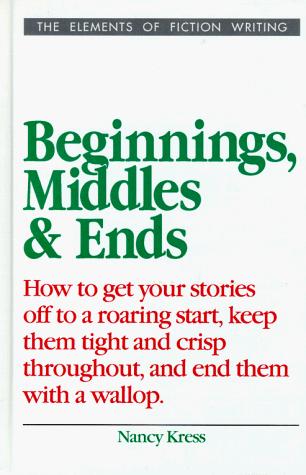
I finished last week’s book a couple of days late, but I’m still going to count it. It’s a book on writing by Hug0-award winning science fiction author Nancy Kress, and for anyone interested in writing stories in any genre, I’d highly recommend it.
Kress wrote this book back in the early 90s, after publishing six novels and a handful of short stories. She also taught creative writing, and from the calibre of her writing advice, that’s abundantly clear throughout the book. She tackles just about every aspect of story creation in a straightforward, methodical way, with a calm, almost motherly tone that is reassuring without being too heavy-handed. She picks apart just about every element that is essential to a good story, and explains how it all works in a way that is clear and makes sense.
Because this was written back in the 90s, there are some artifacts of traditional publishing that make the book feel dated. For example, the first few chapters focus on how to construct a beginning that will sell to an over-stressed, over-worked editor, with less of an emphasis on how to hook general readers. Aside from that, however, much of her advice is still quite applicable to today’s indie writers. The book’s main focus is on story, and good storytelling is important no matter which market you’re writing for.
The section on beginnings was a bit overwhelming, with so much “you must do this, you must not do this” kind of advice that it would probably kill my creativity if I were reading it as I was just starting a new book. However, the sections on middles and ends were quite insightful, and sparked a ton of great new ideas for my current project. Either way, her advice is spot on.
If you’re a new writer, I would recommend picking this book up after you’ve written a practice novel, or after you’ve finished a couple of short stories. If you’re already an experienced writer, I would still recommend it, because even if most of the advice isn’t new, it will help you see much more clearly how a good story comes together. It’s a short, easy read, but it’s so packed with good information that I’ll definitely reread it. Highly recommended.
Originally published as a blog, I always wanted to make it available as a book someday. I spent the last couple of months running through it, putting together all the old posts as well as a few private ones.
I’ve edited them to bring the quality of my writing up to date, but did my best to retain the original sense of enthusiasm and discovery. I’ve also added a foreword and afterword to give it a little more context, especially in light of the past few years.
This is the unillustrated version; I’m not exactly sure how to format ebooks with pictures, so the illustrated version with the photographs will have to wait. I can’t promise I’ll get it up before I head out to Georgia (I’m just waiting to get the call–I could be leaving as soon as next week), but I’ll do what I can.
This version will be exactly the same as the other except for the photos, however, so if that’s not important to you, the unillustrated version is cheaper and much less unwieldy (only 895 KB). Also, until Smashwords allows for direct epub uploads in a little less than a year, the only version available from Smashwords will be this version.
It was a lot of fun putting this one together, and I’m excited to see it up! As with all my books, thanks for taking the time to read it, and I hope you enjoy!
Alternate versions put 20th Century Fox in the Lawful Evil slot.
I love personality tests. There’s something immensely satisfying about putting yourself on a grid that tells you something new and insightful about yourself and the people around you. My personal favorite is the Meyers-Briggs test (I’m an ENTP), but I like playing around with others as well.
Character alignment is what you get when you combine fictional characters with the role they’re supposed to play in the story. It’s a way to categorize the different ways they react to problems and ethical dilemmas, and to see which are inclined to be enemies and which are inclined to be allies.
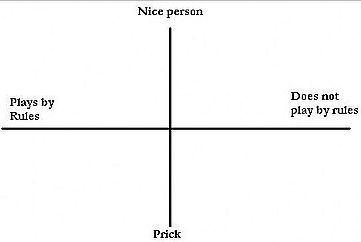
These systems initially arose out of RPG systems like Dungeons and Dragons, which use numbers, charts, and statistics to turn a story into a playable game. There are many different kinds of alignments, but the most well-known is probably the one used by D&D, which charts characters along a good-evil axis and a lawful-chaotic axis. In practice, the result looks a little like this:
Of course, that’s a very simplified version. The tvtropes page goes into much greater depth, but I’ve personally found that this page right here does a much better job explaining the concepts behind the chart.
The horizontal axis, law vs. chaos, describes how much the character values order and authority vs. their own independence and freedom. Lawful characters value honor and obedience, while chaotic characters value innovation and rebelliousness. Characters who are neutral with regards to law and chaos generally respect authority, but put their own interests first and go against the established norms when that’s the best way to further their own ends.
The vertical axis, good vs. evil, describes how well (or poorly) characters tend to treat other people. Good characters are altruistic and make sacrifices to protect the defenseless, whereas evil characters will kill, rob, or torture the innocent simply for the evulz. Characters who are neutral with regards to good and evil don’t like to hurt others, but are not above pursuing questionable means to achieve their own goals.
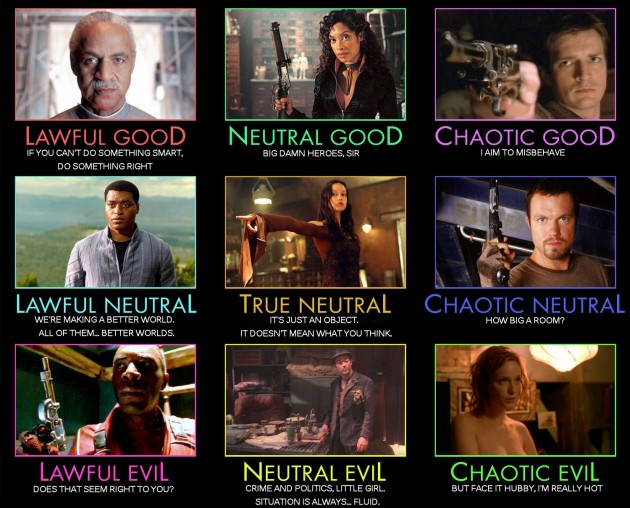
Put together, the alignments create a 9-square chart, like the one at the top of the post. While it’s certainly not obligatory to fill every slot, doing so can add a greater degree of depth to your story, as it certainly did with Firefly.
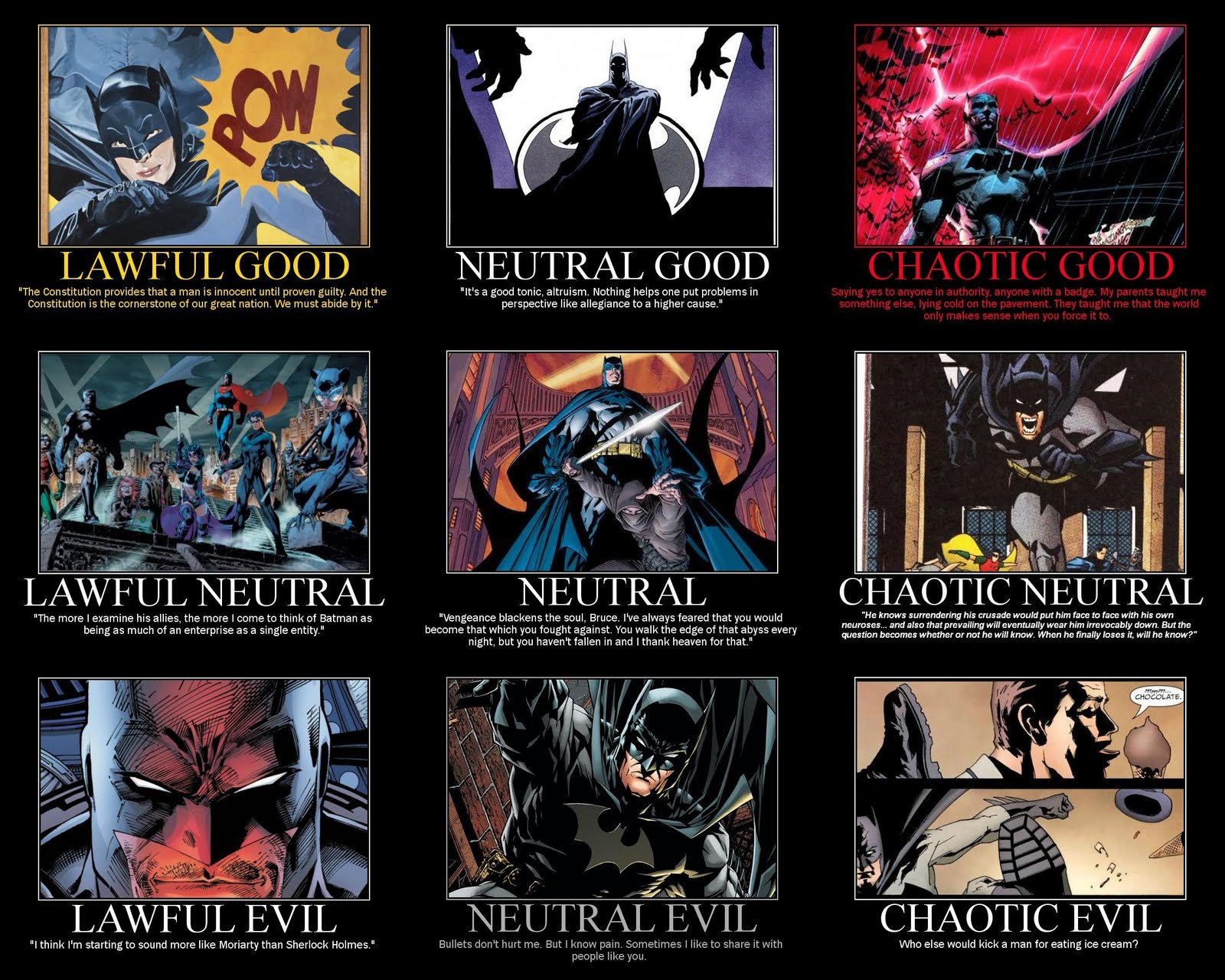
As with any formula, however, there is danger in holding too closely to the chart and becoming inflexible. In real life, people switch alignments all the time, just as personalities can change and evolve (in high school, for example, I was an INTP). Not only that, but some characters even fulfill all the possible roles, depending on the incarnation and the story.
Because I'm BATMAN!
The point is, character alignment is just a tool, not a hard-and-fast rule that needs to be used with every story. If it’s a helpful way to think about your characters and set them up with interesting conflicts, great. If not, don’t sweat it; Homer and Shakespeare were telling great stories long before this chart.
I’m going to be going overseas soon, so I expect my internet access is going to be spotty for the next couple of months. Because of that, I’m going to write up a bunch of Trope Tuesday posts on each of the nine alignments and schedule them to post automatically. So stay tuned for more!
This happens all the freaking time, which means that if you want to make a living telling stories, this is not a trope that you should ignore. And with good reason. Not only does it give the writer ample opportunity to play with suspense and action, but it arguably lies at the very core of what makes a hero a hero:
David Gemmell, according to this interview with Ian Graham, defined a hero simply as “someone who does heroic things.” They might not always take the right side, or they might not even care about doing what is right, but when the universe conspires to bring them to a moment of decision, they make the choice that all of us would like to think that we would take and do something extraordinary.
I like this definition of a hero. It strikes me as a lot more honest than the perpetual do-gooder whose only motivation is Truth, Justice and the American Way (though those characters can–and do–have Big Damn Hero moments of their own). Also, it means that true heroism is not contingent upon actually winning. History may be written by the victors, but that doesn’t cheapen the experience of those who actually lived it.
The biggest danger with this trope is turning it into a Deus Ex Machina. The thing that makes Big Damn Heroes so incredibly satisfying is the sense of climax when they show up to save the day. Thus, proper foreshadowing is key. Yes, the rule of cool still applies, but if that’s all you rely on, you’re not going to be able to pull it off to maximum effect.
One of my favorite examples of this trope is Liam Neeson in Taken. Plenty of action movies are more violent, but few are more satisfying. It’s the perfect pick-me-up after a long crappy day at the office–not that I work in an office anymore. I wonder why…
In any case, this is a great trope to look out for, and definitely one to master, especially if you’re writing any sort of action-adventure story.