Idea for a new blog series

So a little background information: about a month ago, I tripped over my brand new laptop’s power cord and broke the DC port, making it impossible to recharge my battery. After sending it in to a local shop to get it worked on, I discovered that the motherboard itself was broken and that the computer was now useless except for parts. Fortunately, I was able to find the exact same model for less than $300. It should arrive on Tuesday.

This whole debacle made me realize how much better I write when I’m somewhere other than where I live. Whenever I sit in front of my desktop machine, it’s like I have this uncanny aversion to doing anything writing related. It’s stupid, and I probably need to get over it, but I am definitely looking forward to having a laptop again so that I can get out and write.

Which made me think: why don’t I do a blog series on interesting places to write? There’s quite a few around here in Provo that I frequent: the city library, the HBLL, Pioneer Book (their new location), the Wash Hut, Slide Canyon. Branching out a bit, there’s Amtrak and the Frontrunner, two places where I’ve done a lot of good writing. Beyond that, I’m sure there are a ton of other places that I’ve never been to, but would be fun to explore and try out.

Besides giving each place a standard 1-5 star rating, I could review it based on how many distractions it has, how comfortable it is, whether it has wi-fi (not always a good thing!), ambient noise, people-watching opportunities, etc. It would be fun to break things down and see what makes a place good for writing, and what makes it not so good.

What do you guys think? If I did this, what sort of criteria would you like me to look at? Are there any places around Provo or Salt Lake that you think I should try out? This new computer cannot come soon enough!

Stray by Andrea K. Höst

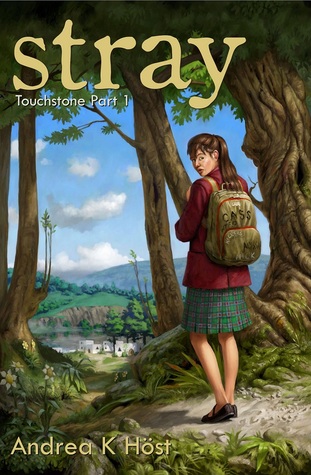
Stray (Adrea K Host)So I picked up this book on the Kindle Store shortly before boarding the California Zephyr for a cross-country train trip. For those of you not familiar with Amtrak, the California Zephyr runs from Emeryville to Chicago and is one of the most picturesque train routes in the United States, with some of the best views of the Colorado Rockies that you will ever see.

Well, I wasn’t paying much attention to the scenery this time, since I was way too engrossed in this book! I was more than halfway through by the time we got to Chicago, and finished it somewhere in the northeast corridor. It was an awesome, amazing read, one that I could hardly tear myself away from!

It starts out kind of like Hatchet, with a teenage Australian schoolgirl named Cassandra who suddenly and inexplicably finds herself in an uninhabited wilderness. It’s written in first person as a personal diary, so the first few chapters are all about the things she does to survive, such as finding food, water, and shelter, dealing with the wildlife, and trying to figure out just where she is exactly and how she can get herself rescued.

Eventually, she figures out that she’s on an alien planet. After a long trek in search of civilization, she finds a bunch of white stone ruins inhabited by cats. Then some weird things happen, which she doesn’t really understand (or oddly enough, doesn’t seem to be too bothered about), and shortly after that, she gets rescued–though not by people from our world.

It turns out that there are people living on another planet who have access to these naturally occurring inter-dimensional portals or gates, and use them to travel between real-space and near-space. This enables them to jump between worlds. Their civilization is about a hundred years more advanced than ours, with computers integrated directly into the human brain and other cool stuff like nanotech suits. They also have psychic abilities, like levitation, telekinesis, elemental manipulation of fire, water, lightning, etc, and supernatural sight.

Here’s the thing, though: they’re fighting a war against an infestation of trans-dimensional creatures called Ionoth, which originate in near-space and are creeping more and more into real-space. Some of them are relatively harmless, others are dangerous but unintelligent, and still others–the Cruzatch–are intelligent, highly dangerous, and very, very hostile. A special forces group called the Setari has been organized to fight them off, but the infestation is getting worse, and new gates are opening faster than anyone can close them. If nothing changes, humanity will be overrun in just a few short years.

It doesn’t take long for Cassandra to learn that she has psychic abilities of her own. The strange thing is that her abilities aren’t like any of the others. The people who rescued her soon enlist her into the Setari, where she may prove to be the key to turning the tide of the Ionoth war. But if the people of this dimension need her, how will she ever get back to Earth? Or will she even want to?

What starts off as a simple survival story soon turns into a complicated tale full of lost civilizations, trans-dimensional beings, psychic magic, high-tech, and political intrigue. At the center of it, though, is a very well-developed character who feels both real and authentic. Cassandra isn’t your typical YA heroine or “strong female character”–she doesn’t kick ass, she isn’t particularly attractive or popular, and she doesn’t get involved in any sort of sappy love triangle. But she is intelligent and resourceful, holds together under pressure, and is open and emotionally honest with her friends. She’s a great example of a female character who doesn’t have to be masculine or violent to be strong.

The world of this book is awesome. I was already sold on the ancient ruins and the alien planet wilderness, but the trans-dimensional stuff just takes it to a whole other level. The Taren civilization with their mind computers and neural network is pretty cool, and Andrea Höst very deftly works out the social and cultural implications of that technology. I’m not sure I’d want the government to have access to everything I can see, but this is definitely a world I’d like to explore. Fortunately, Stray is the first book in a trilogy, so it looks like I’ll be able to do just that!

The book ends almost exactly like you’d expect an old stock-bound composition notebook to end–on the last page, with a short entry that reads “sorry, ran out of room, will continue in the next volume.” The first book doesn’t have a clear ending that ties everything together, which is okay, because it fits very well with the overall tone and voice–it’s supposed to be a personal journal, after all. I wasn’t really bothered by it.

In fact, I can’t say that there was anything about this book that really bugged me. It’s a solid, awesome story. It does get a bit complicated by the end, but it’s not hard to follow, and the complications make it all the more engrossing. Reading this review, you probably think I’ve given away the plot of the whole book. Well, let me tell you, this quick synopsis barely scratches the surface! But I’m not a fan of spoilers, so I’ll end it here.

If you’re a fan of speculative fiction in any form–fantasy, science fiction, whatever–you’re probably going to love this book. You’ll especially love it if you’re sick and tired of the stereotypes that usually revolve around YA heroines and “strong female characters.” And if you just want to get lost in an alien world, this is one you won’t find your way out of easily!

Update on 2014 Resolutions

So since it’s February now, I figure it’s worth checking back on my January resolutions to see how horribly I’ve failed how well I’m doing. Here goes!

1. Publish something every 6 weeks.

I’m actually still on track with this one. The next 6 week deadline is February 15, and if all goes well I should be able to publish Star Wanderers: Tales of the Far Outworlds (Omnibus V-VIII) by then. Derek Murphy is working on the cover, and all I have to write for it is the author’s note which shouldn’t take more than a day or two. After that, it’s just a matter of compiling and formatting the thing–shouldn’t take more than two or three hours–then upload it to all the retailers.

So yeah, still on track with this one!

2. Write at least two short stories per month and submit them to traditional markets.

For this one, I’m not doing so well. I did write one story, “The Open Source Time Machine,” and sent it out to Writers of the Future, but that’s about it. I am working on a second story, but I haven’t finished it yet, which is annoying because the whole thing is in my head but not yet on the page. Better get on that. Also, there’s another story that got rejected in January that I still need to send out to the next market.

Well, one out of two isn’t so bad. If I take off the weekends to work on these stories, I can probably get back on track before the end of the month.

3. Read a book every week.

Yeah, about that … I was doing so well the first two weeks, but then things got disorganized and this goal kind of fell through the cracks. It probably didn’t help that I spent upwards of 50 hours on Steam in the last two weeks of January. What can I say–XCOM is an amazing game!

I’ve got a huge TBR pile and the book I’m reading now is really awesome, but I just haven’t been good about making the time to read. That’s gotta change. Evenings are the perfect time to read, when I’m too tired to do much writing but too awake to go to bed. Instead, I usually end up browsing the internet or playing on Steam, neither of which are as fulfilling as reading a book.

So yeah, this is one I’m going to have to work on. Fortunately, it shouldn’t be hard to adjust my habits.

4. Keep a detailed weekly personal journal.

This is one resolution that I have been keeping extremely well. I’ve completely redone the format for my personal journal keeping, and now it’s one of my main Sunday activities. The last month wasn’t very eventful for me, so it wasn’t too hard to keep up, but I’ve solidly gotten back into the habit of journal writing and I’m still quite motivated to keep doing it.

If I only keep one resolution this year, it’s going to be this one. Fortunately, I’m still on top of it 100%. Now that’s satisfying!

5. Get to the point where I can run a mile every day.

AHAHAHAHA!!!! Oh dear. The last time I went running was probably three weeks ago. For a while, I was going on some long daily walks, but then the Google Fiber job landed in my lap and all of that kind of got put to the side.

Fortunately, the job is starting to fall into something of a routine. It’s an on-call thing, which means that if I go running I need to keep my phone on me and a change of clothes in the car, but I can still probably do it. The track at BYU’s Smith Field House is open until 10pm, and the parking lots open up around 6pm or 7pm. I prefer to run in the mornings, but the evenings can work too.

So yeah, this one is definitely a fail, at least for January. But with a bit of work, I can get back on track again soon.

6. Finish hiking the seven peaks.

Because it’s winter, hiking any of the higher mountains around these parts is pretty much impossible (at least without professional equipment). But there’s still a lot I can do to prepare for the spring.

For one thing, I need to get new shoes. My hiking shoes from last year are pretty torn up and definitely not in shape for a big climb. With the Google Fiber job, I now have enough of a discretionary income to spend on things like that. And since I’m going to need new shoes for my next overseas adventure anyway, I don’t feel so bad about taking out from the money I’d be saving for that.

I need to get in shape for hiking, though. That’s probably the biggest thing. Not much I can do with snow on all the peaks, but I can hike the Y, and maybe Squaw Peak as well. One thing I’d like to do this season is go snowshoeing, maybe for a date or something. Definitely need to look into that.

Other than that, all I guess I can really do is make plans and wait for the snow to thaw. When it does, you can bet I’ll be doing some serious hiking!

Conclusion

So out of six resolutions, I’m doing really well at two, doing marginally well at two others, and failing at the last two. Not too bad. It isn’t perfect, but it’s not like it’s fallen apart yet either.

Most of the time, it seems that people drop their resolutions around February/March after failing to keep them perfectly. That’s just silly, though. If you break a resolution one month, why not pick it up again the next? So what if you don’t keep it the whole year? If it takes you until July or August or even October to master it, that’s still a lot more months that you’d be keeping it than if you dropped it in March.

So this year, I’m going to try to revisit my resolutions at the beginning of each month and start over with them as if each month were January. That’s kind of what you’ve got to do when you lead a freelancer’s life–plans always change, routines always fall apart, but if your goals are clearly defined and you keep your eyes on them, you can get back up just as quickly as you get knocked down.
 

Experimenting with prices

So now that the last Star Wanderers novella is out and I’m hard at work on the next book, I’m thinking very seriously about experimenting with my prices. I haven’t done a lot of price experimentation, especially since writing became my main source of income about six months ago. I just recently landed a job to save up some money, though, so that gives me a little more space to try things out.

Right now, I’ve basically got three pricing tiers for ebooks: novels and omnibuses at $4.95, novellas at $2.99 (especially Star Wanderers), and short stories at $.99. My best sellers by far have been the Star Wanderers novellas. Now that Part VIII is out, though, I’ve noticed that fewer people who start the series are going through and finishing the whole thing. I’ve also got a fair amount of pushback in the reviews, saying that the $2.99 price for the novellas is too high.

The tricky thing is that at any lower price point, my royalties take a huge hit. At $2.99, I get a 70% royalty from Amazon and a 65% royalty from pretty much everywhere else. At anything less, I get a 35% royalty. That means that at $1.99, I have to sell three times as many books to make the same as I would from one $2.99 sale. At $.99, I have to sell six times as much.

But wait, it gets trickier. The general consensus (inasmuch as there is a consensus about any aspect of epublishing) is that $1.99 is a dead price point. In other words, a book priced at $1.99 will sell so many fewer copies than a book priced at $.99 that they earn less revenue. A $2.99 book may also sell less than a $.99 book, but the increased royalty rate makes up for the shortfall.

Up until this point, my pricing strategy has been to maximize revenue, so that I can have more time to write. That worked fairly well: I put out one novel and four novellas in 2013, finished up the Star Wanderers series, and started a number of other projects that will hopefully bear fruit in 2014. But now that Star Wanderers is complete, I think it might be time for a change in strategy.

What I’ve learned in the past month is that readers will drop out of a series early if 1) the series is long, and 2) the individual parts in the series are priced relatively high. A lot of readers either drop out after Part II or pick up the omnibus, but the ratio of sales between Part II + Omnibus I-IV and Part VIII frankly isn’t that great. From Part V to Part VIII, it’s almost 1:1, but a lot of readers are dropping out right at the beginning–a lot more than when there were only four parts.

Part of this may be that the story just isn’t engaging that many people, but another part may be that the price has become something of an obstacle, especially as readers look ahead at all the other books in the series. Length probably also plays a role–my Star Wanderers books are fairly short, leaning more toward the low-end of the novella spectrum. Combined with the fact that many full-length sci-fi novels are now priced at $2.99, that probably only makes readers balk all the more.

I want to see what will happen if I drop the price low enough that it ceases to be an obstacle. Will fewer readers drop out after the first couple of books? Will more of those readers move on to my other books? Exactly how much of a hit will my revenue take?

For all of these reasons, I’m going to drop the price of my individual Star Wanderers novellas to $.99 for a month to see what happens. To keep the omnibus price competitive, I’ll drop it to $3.79 and release the second omnibus at $3.79 as well. I will raise the list price of the print editions, though (mostly to shoot for extended bookstore distribution), and probably raise the price of my novels from $4.95 to $5.99.

I have no idea how this is going to turn out, which makes me kind of nervous. Since I want to move on to other projects, though, including a spinoff series that I hope to launch later this year, I think it’s more important to encourage readers to read through Star Wanderers as a whole without putting any potential obstacles in their way.

So yeah, that’s the plan. We’ll see how it goes. I’m open to any feedback or ideas, so if you have any thoughts to share either as a reader or as a writer, please don’t hesitate.

Looking for a new title

So I’m about a quarter of the way through the revisions for the next Gaia Nova book, currently titled Heart of the Nebula. The thing is, the story is changing a lot in the revision, to the point where that title doesn’t really make sense any more.

This tends to happen with most of my longer books. The original working title for Genesis Earth was THE WORMHOLE PARADIGM. Desert Stars started out as HERO IN EXILE, switched to WORLDS AWAY FROM HOME, then simplified briefly to WORLDS AWAY before finally settling on its current tile. Bringing Stella Home is actually the original working title for that book, but it briefly changed to MERCENARY SAVIOR before switching back again. The only novel of mine that hasn’t had two or three different titles is Stars of Blood and Glory, but that book was unusual in a number of ways.

In fact, Heart of the Nebula has already gone through one title change. It started out as “Into the Nebulous Deep,” not the most inspiring title but definitely accurate (perhaps even mildly spoilerific). I thought about changing it to “Into the Heart of the Nebula” before shortening that to the title it has now.

Anyway. For reasons I don’t really care to get into, I need a new title for this one. Here are some of the ones I’ve come up with so far:

  • STAR WOLF
  • THE LONE WOLF OF THE NEBULA
  • HOPE OF THE FREEDOM STAR
  • LEGEND OF THE FREEDOM STAR
  • EXODUS OF THE FREEDOM STAR
  • LONE WOLF OF THE FREEDOM STAR

I really like the words “wolf,” “legend,” “exodus,” and “freedom star,” but I’m not sure how to combine them in the best way. I’m kind of partial to STAR WOLF, just because it’s shortest, but LONE WOLF OF THE FREEDOM STAR has a ring to it that comes closest to what I’m shooting for.

Those are my thoughts for the moment, anyway. What do you guys think?

Another overseas adventure?

About a year ago, I blogged about how I need to get out of Provo before I went stir-crazy. Well, it’s been a year, and I haven’t gone anywhere yet. My love/hate relationship with Provo has mellowed out a bit–I’m not as anxious to get out as I used to be–but still, it would be good to change things up and go on another adventure.

This time, I’m thinking quite seriously about going to the Czech Republic. My sister is working to become a certified genealogist, and she keeps a fairly intensive blog on Czech family history research. If I were to go over there, I’m sure she would have all sorts of fun places for me to check out–places where our ancestors used to live. She’s already contacted a fifth cousin of ours, descended from the side of the family that didn’t emigrate, and she has a lot of other contacts over there as well. It would be an amazing life experience to live and travel over there.

Until now, every time I’ve gone overseas I’ve been a part of some sort of program. Even in Georgia, where I didn’t speak the language, didn’t know anyone, and barely knew anything about the country at all, the TLG program still had a fair amount of support infrastructure for us to fall back on whenever we ran up against a wall. I suppose I could find a similar sort of program in the Czech Republic, but that’s not what I want to do. This time, if I do go over, I want to go over on my own.

I’m still kind of on the fence about this, because it is kind of a big leap from where I am right now. But I’m earning enough with my book royalties that I could probably support myself on that income alone. From what I’ve heard, living costs in Prague can run as low as 450-600 USD per month, though most expats spend more in the 800-1200 USD range. That’s certainly doable. If I don’t need to take a TEFL job to support myself, why should I? Better to spend that time writing and/or seeing the country.

Of course, without making any concrete plans, this is still just a crazy dream. So here’s what I would need to do to make it happen:

  • Save up for plane tickets and a reasonable cash reserve, at least 150% the cost of a ticket back to the states. It looks like tickets to and from JFK and Prague run about $1,500, so I’d probably have to save up at least $4,000 (not including what it would take to get to New York from Utah).
  • Look up the rules for getting a visa, housing contract, insurance, etc (my Slovakian friend tells me that health insurance in the Czech Republic is mandatory).
  • Connect with the expat community online and figure out what the support network would look like. This would include stuff like couchsurfers, Kate’s contacts, the local church community, etc.
  • Learn some basic Czech, starting with the alphabet.
  • If possible, figure out some sort of housing arrangement in advance. Better yet, find a travel buddy.

I think those are all the big ones. And honestly, they’re all fairly doable. The hardest one would be to save up the money, but if I can find a short-term job on top of my writing that pays fairly well, I could do it in a few months. Since I plan to attend LTUE and Westercon this year, I probably won’t go overseas until mid-July at the earliest.

So yeah, that’s what I’m thinking at this point. It’s definitely something to work toward, and I think it could be another awesome life changing adventure. What do you guys think? Is there anything glaringly obvious that I’m missing? Got any tips or advice? Please share–I’m definitely open to feedback and suggestions!

Midichlorians vs. the Philotic Web, or a new dimension to Brandon Sanderson’s first rule of magic

I got into an interesting discussion today with my brother-in-law about science fiction & fantasy, specifically about whether explaining something too much takes away from the sense of wonder that is so critical to those genres.  It started out with a discussion of Star Wars I: The Phantom Menace, which (surprisingly) he actually kind of likes, and eventually got on to Brandon Sanderson’s first law of magic.

I was trying to explain why The Phantom Menace was so broken, and after hemming and hawing over various things came to the midichlorians.  That, more than anything else, threw me out of the story.  By explaining the Force in such a banal, insipid way, it undid all the magic of the previous trilogy and completely sterilized it.  There was no sense of wonder after that point–explaining the Force completely killed it, just like over-explaining any magic system always kills that sense of wonder.

… or does it?  Because there are quite a few wonder-inducing magic systems that get explained in great detail.  Take the Philotic Web, for example.  In Xenocide, Orson Scott Card explains, in great detail, how the physics behind the ansible system works.  And yet, by doing so, he increases that sense of wonder to the point where Xenocide is one of my favorite of his books.  Why?  Because it introduces a bunch of implications that lead to even more questions, more mysteries.

With The Phantom Menace, of course, that isn’t the case–the midichlorian thing is basically a clumsy ass pull that fails in the magic department just as hard as Jar-Jar Binks does at comic relief.  But it doesn’t fail because it over-explains things, it fails because it explains the magic in a way that doesn’t allow room to explore the implications.  As much as I hate to admit it, Lucas could have pulled off the midichlorian thing if the implications had been relevant to more things in the story than just a simple plot point.

This is where Sanderson’s first law comes in.  Basically, Sanderson’s first law states that there’s an inverse relationship to how well the magic can induce wonder versus how well the magic can advance the plot.  In order to advance the plot through magic, you have to explain how the magic works to some degree, and that’s going to take away from the sense of wonder.

But as we’ve just shown, that isn’t always the case.  Sometimes the sense of wonder gets even stronger the more the magic gets explained.  This is especially true in science fiction that follows the one big lie approach, where one thing (wormholes, reactionless drives, time travel) is truly fantastic and everything else more or less follows the laws of physics as we understand them; in order to maintain the suspension of disbelief, the story is basically forced to explore all the implications of the magic, often to great detail.

In other words, explaining the magic isn’t always like building a wall–sometimes, it’s like building a door.  Yes, it lays down a boundary that closes off the imaginative spaciousness that a story really needs to convey that sense of wonder, but if the explanation leads to new questions–new mysteries–then that sense of wonder can be maintained.  Instead of walling the reader in, it throws the reader into a maze with countless secret chambers to explore.

The relationship between plot-based magic and wonder-based magic is not linear, as Brandon Sanderson’s first law implies.  Rather, there’s a second dimension that has very little to do with his law, and learning how to traverse that dimension is key to maintaining the sense of wonder in any story.

I haven’t figured out a pithy way to explain all this yet, but I’m going to, hopefully within the next few days.  If you guys have any thoughts on the subject, please feel free to share.  I’m definitely interested in hearing your perspectives on it.

Ghost King by David Gemmell

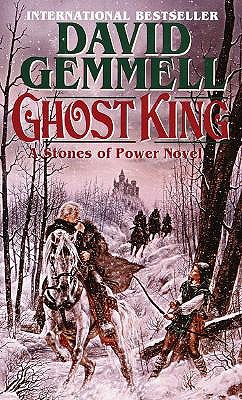
Ghost KingAnother review of a David Gemmell book?  Yes, because I’m just that much of a fanboy.

With the Drenai series finished, I decided to sink my teeth into the Stones of Power series.  This series confuses me, because I’ve read The Jerusalem Man, which was retroactively put in as book three, but that’s a post-apocalyptic tale of the gunslinger Jon Shannow, but the series actually starts in Arthurian England.  As soon as I got a couple chapters into the first book, though, I began to see the connection.

Ghost King is an alternate history tale of King Arthur (Uther, in the book), and how he rises to become the Blood King of Britannia.  His grandfather, Culain, takes him into the mountains after the Brigantes assassinate his father, and there trains him to become a leader and a warrior.

Culain, of course, is one of the immortal Atlantians, just like his friend Maedhlyn (Merlin).  After the fall of Atlantis, they have wandered the Earth as gods, using the powers of the Sipstrassi stones to accomplish wonders.  Worshipped in turn by the Greeks, the Romans, the Hittites, and the Babylonians, Culain has tired of immortality and now wants to live out a mortal life.  But his jilted lover, the Ghost Queen, wants revenge on him for leaving her.  She was the one who killed Uther’s grandmother and mother, and who now wants to kill him and rule all of Brittania.  But her son Gilgamesh has corrupted her, so that in a parallel universe she must kill twenty pregnant woman every month just to replenish the magic of her Sipstrassi …

Okay, I might as well give up trying to explain the plot, because it only gets crazier.  Somewhere in this parallel dimension, a lost Roman legion has been wandering for hundreds of years, consigned to the void by Culain.  Also, Gain Avur (Guenevere) is in there too, as well as the Lance Lord (Lancelot), though he doesn’t come in until the epilogue.  There are also demons and vampyres, all sorts of battles, and lots of other crazy stuff.  It’s pretty freaking dang awesome.

I really enjoyed Uther’s transformation from the weak, bookish boy to the warrior king, as well as the budding of his relationship with Gain Avur (what can I say, I’m a sucker for romance).  My favorite character, though, was Prasamaccus, a crippled Brigante peasant who becomes one of Uther’s close advisors.  He’s basically a regular guy who gets sucked up into the whole adventure, but he’s level-headed and practical enough that he manages pretty well.  He’s also just a good person, which was quite refreshing in a world full of death and drama.

At one point, after rescuing Uther, he’s a guest in Uther’s chief general’s villa.  The general gives him a servant girl for the night, since in this world most men think nothing of bedding a slave.  Prasamaccus is a peasant, though, and he’s kind of shy.  The girl was actually captured in a raid in Germany, where she was raped, and this is her first time bedding someone since those traumati not the monster she’s afraid that he’ll be–they actually share a really tender moment of intimacy that heals much of her trauma and introduces him to the love of his life.c events.  She’s absolutely terrified, but so is Prasamaccus–he’s a cripple, and assumes that women just don’t want him.  He spends the night with the girl but doesn’t force her to sleep with him, and when she realizes how gentle he is–that she holds the power, and that he’s not the monster she’s afraid that he’ll be–they actually share a really tender moment of intimacy that heals much of her trauma and introduces him to the love of his life.

It’s poignant, story-rich moments like that that make me such a David Gemmell fanboy.  Usually they happen in the midst of war, between battle-hardened friends who are forced by circumstance to do something heroic, but they also happen in the quiet moments between characters who carry other scars.  That whole thing in the previous paragraph only happened in three pages or so, but it was still so incredibly powerful and moving.  Every moment of a David Gemmell book is like that, sometimes from the very first paragraph.  It’s awesome.

As far as David Gemmell books go, I’d put this one in about the middle of the pack.  It’s not quite as powerful as Legend or Wolf in Shadow, but it doesn’t meander as much as White Wolf or have such an anti-climactic ending as Ironhand’s Daughter (which was probably split by the publisher–more on that when I review The Hawk Eternal).  The characters aren’t quite as memorable as Druss, Skilgannon, or Waylander, but they are pretty awesome nonetheless.  I’d rate this book a 3 compared to Gemmell’s other books, but a 4.5 out of fantasy overall.  Definitely worth a read.

Why boycotting Ender’s Game is stupid

First of all, let me just say that I don’t think there’s anything wrong with making a personal decision not to read a book or see a movie because you disagree with the views of the author.  We all should be free to consume (or not consume) the media we choose, and if a certain author offends for any reason, I think it’s perfectly fine to cut that author’s work out of your life–as a personal decision.

But with Orson Scott Card and Ender’s Game, there’s a group of people who are taking it a step further and organizing an all-out boycott.  They want the movie to fail, because Orson Scott Card holds some views about morality and homosexuality that they find offensive–views that have nothing to do with the movie at all.  The idea is that Orson Scott Card is a homophobe, and as such everything he creates should automatically be rejected out of hand.

There are a number of reasons why this idea is stupid, many of which have been discussed elsewhere.  There are those who agree with Card’s views and make their arguments on that basis.  I don’t care to go there, because he has been a controversial and divisive figure, and I do think there are legitimate reasons for disagreeing with his views.  There are views he holds that I disagree with very strongly.  However, I do think there is something to be said about the way his opponents have twisted his words.

Laying ideology aside, there are those who say the boycott is stupid because it will send the wrong message.  If the boycott is successful (which I doubt it will be), then all that filmmakers are going to take from it is that the public doesn’t want to see sci-fi movies of this type.  There’s nothing whatsoever in Ender’s Game that has anything to do with Card’s views on homosexuality, so boycotting it isn’t a very effective way to protest his views.

Those are all valid reasons, but none of them are the main reason why I think the idea of this boycott is flawed.  I’m not concerned with the impact this boycott will have on Orson Scott Card, but the impact it will have on the writers who follow after him.

Frankly, Ender’s Game is such a phenomenon, I doubt that this boycott is going to do any real harm, no matter how loudly some corners of the internet rage against him.  If anything, it’s just more publicity, and perhaps an opportunity for him to get back into the public arena to bring attention to some of his views. As of now, it seems he’s content to ignore the boycotters, which he can easily afford to do since he’s successful and well-established.

But the message it sends to budding writers is a lot more powerful, and much more dangerous.  For science fiction writers who are in the early stages of their careers, this boycott sends the message that there is an ideological orthodoxy in the science fiction community that will do everything it can to destroy you if you challenge the beliefs that they hold sacrosanct.  It sends the message that some beliefs should never be challenged, not even in a genre that is famous for challenging beliefs and ideas.  And finally, it sends the message that if you challenge the new orthodoxy, they will not engage your ideas in an intellectually honest debate, but do everything they can to marginalize and dismiss you.

I could understand this boycott if Orson Scott Card had actually done something illegal like committing hate speech–something that clearly crosses a line that we as a society have collectively agreed upon.  But he hasn’t.  He just holds some views that a lot of people, perhaps even a majority, find hateful and offensive.  But if that’s just a way of saying that he opposes the new status quo, how is it not regressive and reactionary to attack him for that?

If you disagree with Card’s views, engage him.  Make him eat his words.  Use the movie as an opportunity to bring up these old debates and point out just how wrong and offensive he was.  Don’t use something he said fifteen years ago to sabotage what is arguably the best sci-fi movie of the year, if not the decade.  And for the sake of all the books that are yet unwritten, don’t threaten the writers who dare to challenge the beliefs you hold sacrosanct.  Don’t replace one rigid orthodoxy with another.

There was a time when science fiction was known as the genre of ideas, where writers were free to question anything, even our most basic assumptions about humanity.  Let’s do what we can to bring those days back, not shut them off forever.

Trope Tuesday: Our Dwarves Are All the Same

Yes, you saw that right: Trope Tuesday is back, at least for the next few weeks.  I dropped out for a number of reasons, most of them having to do with my own interminable disorganization.  I really love writing these posts, though, and you guys seem to love reading them, so I’ll do my best to keep the series alive.  Here goes!

Say the word “troll,” and you could mean one (or more) of a thousand different fantasy creatures.  The things same goes with gods, demons, vampires, fairies, goblins, and to some extent, elves.  But say the word “dwarf” and we all instantly know what you’re talking about.  As tvtropes puts it:

You know them. Gruff, gold-loving, industrious, blunt-speaking, Scottish-accented, practical, Viking-helmed, booze-swilling, Elf-hating, ax-swinging, stout, long-bearded, stolid and unimaginative, boastful of their battle prowess and their vast echoing underground halls and mainly just the fact that they are Dwarves … An entire race of miners and blacksmiths, with names like Dwarfaxe Dwarfbeard and Grimli Stonesack, who are overly sensitive about any perceived slight, always spoiling for a fight, unable to speak two sentences in a row without calling someone “lad” or “lass,” and possessed of a love of gold and jewels that drives them to live in Underground Cities where they dig deep and greedily, (often with catastrophic results).

The defining characteristics of this fantasy race basically include:

  • Short.  Should be self-evident from the name of the race.
  • Expert in smithing, forging, metalworking, and crafting priceless artifacts.
  • Prefer to live underground, mining for ore and precious metals.
  • Bearded to the extreme.  Even their women often have facial hair.
  • Fond of alcohol, and often rowdy or violent when drunk.
  • Weapon of choice is a battle axe (or perhaps a war hammer).

In other words, Tolkien set the standard and everyone since has followed it with little, if any, variation.  Tolkien himself got it from Norse mythology, which had a few key differences (for example, Norse dwarves would turn to stone if they were exposed to sunlight), but once Lord of the Rings hit the bookshelves, all dwarves would ever after be the same.

Why is this?  Well, as fantasy races go, dwarves tend to be more like supporting characters than members of the main cast.  Sure, there are plenty of series that focus on dwarves and dwarven culture, but the cultures that shape world history the most are usually human or elvish.  Dwarves are often content to stay in their dwarven halls and do their own thing, far beneath the surface of the earth.

Brandon Sanderson has an interesting take on this question, which he explains in his famous essay “How Tolkien Ruined Fantasy” (which has since been renamed).  Basically, he argues that the fantasy before Tolkien was all “low” fantasy, or fantasy that loosely uses our own world as a template.  This sort of fantasy may have wizards, or magic, or monsters, but the setting itself looks a lot like something out of the pages of a history book.  Tolkien was the first to really write “high” fantasy, where everything about the world is built from the ground up, and he did such a good job of it that we’ve all been copying him since.  Rather than writing high fantasy in an original vein, most authors have switched out the real world for Tolkien’s and have been writing low fantasy in a Tolkienesque world (at least until the last decade or so).

It’s an interesting argument, but I’m not quite so sure how valid it is.  The process that Sanderson describes basically happens in every genre: someone writes an extremely popular book, and for the next several decades (centuries, in the case of Treasure Island) everyone tries to go back to it in some way.  And yet, how many different kinds of vampires are there?  How many different kinds of cops, or detectives, or spies?

Perhaps Lord of the Rings had a much more overshadowing impact than Dracula or Frankenstein ever did, but consider some of the other fantasy races he basically invented.  Ents never really took off anywhere outside of Tolkien, and trolls never universally became the big, dumb, evil, brutish creatures that they are in The Hobbit.  Elves, which really were popularized in a huge way by Tolkien, have taken on a life of their own, differing fairly significantly from the immortal angel-analogues in Lord of the Rings and The Silmarillion.  Orcs, too, are becoming more like “green klingons” in games like World of Warcraft, with an extensive honor system and intelligence on par with humans and elves.

Is there something about the Tolkienesque dwarf that fulfills a deeper storytelling need, transforming the stereotype into an archetype? Or am I wrong, and dwarves just haven’t had the same makeover as elves and orcs?  I don’t know.  But I like dwarves, and I’m a political nerd, so I’ll leave you with a fascinating Marxist analysis of Dwarf Fortress, and an interesting picture of a female dwarf.


Tarin Portrait by =RachelleFryatt on deviantART