If I were a character in Twilight…

I don’t know why I did this, but I saw it while wasting time on the internet and somehow suckered myself into it.

Twilight Quiz

Judging from all the advertising crap I had to go through just to get this result, I’m probably going to be spammed to high heaven for the next ten years. Fortunately, all of the personal information I provided is fake, except for the email (hehe, the guys at the Arabic house are probably going to get some pretty funny junk mail next year…).

It’s been a long time since I read Twilight, but I can vaguely remember liking this character. He probably was the one most like me.

I’m just glad I didn’t end up as Edward, because that kid is ridiculously abusive.

New About page

Traffic to this blog has been picking up a bit, and I decided it’s time to change my “about” page.  This was the old one:

In some ways, I live a double life. By day, I study Political Science and Arabic at Brigham Young University in Provo, Utah, but by night I’m an aspiring writer of science fiction and fantasy. And I have NO IDEA where all of this is going to take me.

A lot of people dream of writing and being a writer, but the motivations vary. Some people are just enamoured with vague ideas of the bohemian lifestyle. Other people are looking for fame and the joy of seeing their name on a book. It’s different for me, however. I write simply because I can’t NOT write. I wrote my first story in 5th grade and I haven’t been able to stop since. Stories just flow out of me–it’s a part of who I am. Most of them are fleeting and pretty crappy, but hopefully, somewhere in there is a story that can bring something meaningful to somebody.

And so I write, not with any illusions of the fame, fortunes, and friends it will bring me, but because it’s who I am. And yes, writing is not glamorous. It’s about hard work and consistency. It’s about rejection. It’s about realizing that the story you love so much reads like crap because you have a LONG way to go before your writing is any good. I know that. I’m experiencing it now. And I can tell you that it’s not without reward either.

So join me as I blog about my struggles, frustrations, adventures, and successes as an aspiring writer. Read about the agonizing and exhilarating process of writing a novel. Keep me honest in my writing goals. Check out my book reviews as I try to learn what I can from what’s come in the sci fi / fantasy genres before. Get caught up in my imagination as I share the story ideas that pop into my head. And please, if something strikes you, drop a comment and let me know what you think!

Goals:

  • Write and submit at least one novel per year.
  • Finish 1st draft of The Lost Colony by 25 April 2008. ACCOMPLISHED
  • Write three polished novel drafts before World Fantasy 2009 and attend the conference.

I don’t know if the new one is much better, but you can check it out.  Hopefully, it’s enough to give a good, honest impression of this site.

Also, I bit the bullet and finally signed up for twitter!  My username is onelowerlight; you can check me out here.

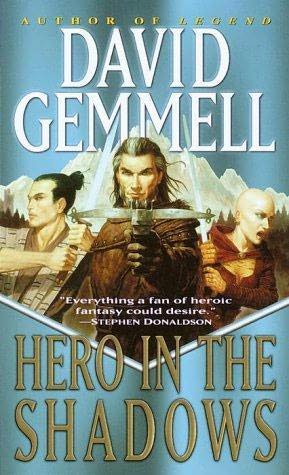
Hero in the Shadows by David Gemmell

Waylander gave up his dark life as an assassin years ago–or so he thought.  When an ancient magic gateway begins to break down and evil beings from another world set out to reconquer the lands of Kydor, Waylander finds himself caught up once again in the cycle of war and bloodshed.

Waylander joins forces with Kysumu, a rajnee warrior who has been training all his life to be the best swordsman, and Ustarte, an escaped  changeling experiment who has come from the demon world to organize a resistance.  But when the spirit of Qin Chong comes from the past to aid the fledgling resistance, he comes to the unlikeliest person of all–the ditch-digger Yu Yu Liang.  As Kysumu wrestles with envy over the spirit’s choice, he comes to understand what it truly means to be a hero.

This book was good. Way good.  Not only was it a thrilling action/adventure story, it was full of deep, wonderful insights into the nature of courage and cowardice, life and death, good  and evil, and true heroism.  David Gemmell’s books are full of wonderful insight, and deliciously complex in the way they deal with life’s most important and meaningful questions.

I read the last hundred pages at a breathless sprint.  So many of the characters died!  Yet even though the story was very violent, I didn’t feel that it was excessively so.  The violence always had a reason to be there, and added something to the story.

What really surprised me was how Gemmell redeemed even some of his most evil characters.  Just when you think one of the main antagonists is soulless and outright evil, he shows you another side of the character and makes you rethink him/her entirely.  Amazing.

Not only where the “good guy” characters imminently likeable, they were surprisingly relatable.  I felt like I understood exactly how Kysumu felt, having spent his whole life training to be the best warrior, only for the spirit of Qin Chong to choose a clumsy, shameless commoner.  As he struggled with his  jealousy, I felt I knew exactly what he was going through.  Interesting stuff.

Waylander, too, was very interesting.  Even though he was the best warrior out of anyone in the book, he was far from invulnerable or perfect.  He had a dark side that was very believable–not too gritty or over the top.  In fact, I think Waylander was originally an antagonist in the earlier books in the series.

When I read White Wolf, I had issues with the plot structure and excessive use of flashbacks.  Not so with this novel.  The plot progressed wonderfully, keeping me engaged and interested the whole time.  The twist ending was delicious!  Wonderfully satisfying.

Above all else, this is a book that means something, that actually says something.  I came away from this book satisfied, not only because of the excellent, entertaining story, but because of the way the story made me think.  Gemmell is an expert at creating depth to his characters and his stories, pulling you beneath the surface to glimpse at things that are really important and meaningful.

CSS magic

Dude!  Check out the new header for this blog!  Isn’t it the awesomest header image you’ve ever seen?

A few days ago, I got my hands on this cd full of cool arabesque patterns for graphic design.  I saved them to my flash drive, figuring I could use them to make a way cool blog header.  

Then, earlier tonight, I was chatting with my friend Danke from Quark–she’s the one who helped me with the other header (the font, btw, is from the game Alpha Centauri).  She’s a CS major and a whiz with css.

Two hours later…behold!

Danke’s official nickname is now The Sourceress.  I’m off to bed–all this magic is addictively tiring, especially at 2am.  Once you start down the dark path…

CONduit 2009 mp3s

I was fortunate enough to attend CONduit 2009 this weekend, up in Salt Lake.  It was a ton of fun, and very educational and inspiring as well;  I’ll sum up more of my thoughts and impressions from the con later.

I recorded most of the panels I attended, and I’ve linked to the full mp3s here.  I haven’t listened to any of them all the way through, so there might be some background noise (or hilarious snorting laughter from my friend Charlie).  I’ll put these out on a CC license so you can touch them up on your own time.

Friday, May 22nd

Clint Johnson’s writing workshop

Writing evil overlords

Culture building in SF&F

Main address: Howard Tayler

Structuring Creativity (Howard & Sandra Tayler)

Saturday, May 23rd

Dan Willis on writing

The stenchless chamberpot

Nuts and bolts of creativity (Howard & Sandra Tayler)

The Mike show

Main address: Dave Wolverton

Sunday, May 24th

Intellectual property

Aspiring writers Q&A

Creative Commons License
This work is licensed under a Creative Commons Attribution-Noncommercial-Share Alike 3.0 United States License.

Spin by Robert Charles Wilson

What would you do if you knew that the world was going to end in the next thirty years? That one day, before the end of your natural lifespan, the oceans will boil and the forests burst into flames, and life on this planet will come to an end? That you, your children, and even humanity itself have no future–that everything will end with you?


When the mysterious beings known as the Hypotheticals encase Earth in a temporal warp field that causes years to pass outside for every second on Earth, that is the uncomfortable question that all of mankind must confront. In five billion years–less than forty years on Earth–the sun will burn up its hydrogen and expand into a red giant star. When that happens, the sun will swallow the Earth and every living thing will die.

Some people turn to religion for answers.  Some turn to Science.  Some put off the question, living their lives as if the end will not come.  But as the years pass and the unavoidable apocalypse looms nearer, humanity begins to spiral out of control, and civilization itself looms on the verge of collapse.

The year the stars fell from the sky, thirteen year old Tyler Dupree discovers that he is in love with his best friend (Jason Lawton)’s sister, Diane.  The dynamics of the friendship between the three, however, make it impossible for Tyler to express his true feelings–and, in any case, Diane doesn’t seem interested in being anything more than a friend.

When the Spin hits, all three of them find themselves on radically different and sometimes conflicting paths.  Diane turns to evangelical Christianity and the frenzied religious outporing the Spin inspires.  Through his father, Jason rises to become one of the most influential scientists and directors in the Perihelion Foundation, the premier aerospace agency and Spin-related policy forming body in the US.  

Tyler, however, pursues the same middle class life he probably would have followed anyway–medical school, followed by a career as a doctor.  Still, his undiminished feelings for Diane and his frienship with Jason draw him into the center of the Spin hysteria and behind the scenes in the circuitous Spin-era politics.

Diane, now married to a fervent believer in a free love fundamentalist cult, comes to rely on Tyler as her only link to the outside world.  Meanwhile, Jason Lawton pursues perhaps the most grandiose and ambitious project mankind has ever attempted; the terraformation of Mars. 

With the temporal distortion of the Spin, millions of years of evolution turn Mars into a verdant green world in only one Earth year.  When Jason launches the first manned mission to the planet, barely a week passes before the the first Martian-born human returns to mankinds ancestral home–a descendant of a civilization millenia older than our own.  This small, dark-skinned, wrinkled man comes with a tantalizing message that may prove the key to finally understanding the Hypotheticals and the Spin itself.

But all of this may be too late, because the Spin membrane is finally beginning to show distressing signs of failure, and the sun has already grown hot enough to boil the oceans and scorch the planet.

I loved this book.  Honestly, I have to say it is one of the best science fiction books I have ever read.  Better even than Ender’s Game, better even than Foundation or any of the other classics.  No other book that I’ve read has done everything that I believe a good science fiction book should do.  I would highly recommend this book to anyone and everyone.

Like Clarke and a lot of the older classics in the science fiction tradition, Spin addresses some of the grand questions with which science and humanity have always wrestled.  What is the ultimate end of mankind?  The ultimate end of evolution?  Are we unique in this universe?  What is our place in the cosmos?  What is transcendence, and can we as a mortal species achieve it?

Unlike much of the older works, however, Spin addresses these questions through solid, developed, rich characters and a human drama that is as engaging as anything in any other genre.  When I read this book, I felt connected with these characters.  I genuinely cared about them.  They were real, distinct people who changed and grew based on their choices and experiences.  Furthermore, their struggles and conflicts echoed my own.  It felt true.  Tyler’s unrequited love was not only utterly believable, it kept me just as engaged as the grand ideas and the science fiction elements.

As science fiction, the ideas in this book were some of the most original and eye-popping ideas I’ve ever seen.  There was definitely a sense of wonder, as thick and beautiful as Clarke or Heinlein or Asimov.  The thing that made these ideas so great, however, was the eminent believability that accompanied them.  Robert Charles Wilson thought out the implications of everything, and showed them through concrete, human details.  His Martian landscapes were as real and believable as his picture of the New England countryside.  I not only felt that I was there, I felt that I was in this world, where the end-of-everything panic had set in, causing all sorts of bizarre, almost post-apocalyptic (pre-apocalyptic?) social changes.  It was truly fascinating.

But it wasn’t just the storytelling that engaged me: Robert Charles Wilson’s prose is among some of the best that I’ve ever read.  Reading this book really was like eating cheesecake.  The writing not only flowed, it shined, yet in a way that illuminated the meaning behind the words rather than drawing attention to the words themselves.  Wilson’s metaphors were not only rich and beautiful, they expressed the meaning behind the text so clearly that in each case, I don’t think he could have gotten across that particular impression, that feeling, in any other way.  Everything was calculated, and I would read pages and pages of text without even realizing how far I’d come.  Incredible.

I did have one issue with my first readthrough, back in July of last year: the Martian civilization, while grand, didn’t feel grand enough.  I mean, in 0nly four thousand years of history, look how far we’ve come here on Earth–all of our religions, all of our science, all of our discoveries and everything else.  We can hardly even remember what it was like, four thousand years ago–yet in Spin, the Martians know all about the reasons why Earth spawned their civilization, all of the questions that the Earthers have been asking about the Hypotheticals, etc.  I almost think that the Martians would have a more mystical view of Earth; that their understanding of us would be steeped in legend, and that they would have forgotten who we really are.

In my second readthrough, however, this was less of an issue to me.  Wilson really does make the Martians seem alien, a separate, distinct culture with a long, rich tradition.  His Martian citizen is very distinct from any of the Earthers, and notices some very small things that we always take for granted.  So, even though there could be more of a feeling of grandeur, Wilson already paints a very believable, very grand view of the Martian civilization he invents.

I am not exaggerating one bit when I say that this is probably the best science fiction book I have ever read.  I would recommend it above and beyond anything else I’ve reviewed here on this website.  If you haven’t already, pick up this book and read it.

Living in a state of limbo

Graduation was today.  I’ve got another year left, but a lot of my friends are moving on.  I took my last exam of the semester on Monday, and my contract at the FLSR ends Saturday morning at 10 am.

And I have no idea where I’ll be living for the summer.

There’s a chance I might be going to New York for an internship with Brandon Sanderson’s agent.  My friend Steve has been planning to move to New York in June, to try and break into writing for Saturday Night Live and 30 Rock, and I thought it would be really cool to live with him while working/interning/whatever in the publishing world there.  I asked Brandon if he knew of any openings with editors/agents for a summer intern, and he got back to me with the news that his agent was looking to take one on.

Well, I got in touch with the guys over at JABberwocky literary agency at the beginning of the month, sent them a resume, had a phone interview, and…haven’t heard back yet.  They told me they’d get back to me after the London book fair, which was this past weekend, so…I’m still waiting to find out what they say.  I think the interview went okay, though I heard from Brandon that they’ve got a lot of other people itching to get this internship.  College graduates.  With degrees in editing and publishing.

So…I don’t know what’s going to  happen.  It would be WAY awesome to go to New York City this summer, and really awesome to be an intern in the publishing world.  REALLY awesome.  I’ve been following the publishing world, especially the sf&f corner of the publishing world, for a couple of years now.  It would be great to get in there and see it up close, see how it works, see what kind of career opportunities exist there and meet the people who are involved in all that.

If it doesn’t work out, though, that’s still okay.  I’ve got a backup plan.  It’s not as awesome, but it still works.  If I don’t go to New York, I’ll probably spend spring here in Provo, taking a break from classes and working odd jobs here and there (private English tutor–my boss at the FHSS Writing Lab can set me up with that–Arabic tutor, freelance editing, temp campus jobs during some of the conferences out here, etc).  I’d also spend some serious time working on my writing, and attend some of the major local sf&f conventions, such as BYU Writers and Illustrators for Young Readers and CONduit.  I might even be able to go home over summer term and attend Worldcon in Montreal.

I’ve got two finished rough drafts right now and two others that are only halfway finished.  With a relatively free summer, I could almost certainly have three polished, finished drafts by the time school starts again.  Perhaps I could even have them all finished before Worldcon 2009 in August, or finish all four of them before World Fantasy 2009 in October.

It would also be a good chance to see whether I can handle the writing lifestyle.  I’ve been writing fairly steadily for the past two or three years, doing between 500 to 1,000 words a day, but it was never the primary thing I was doing.  If I have the summer off from all my other obligations, I’ll be able to explore a little bit what it’s like to write full time.  It doesn’t exactly translate into something nice and shiny on a resume (not like an internship, at least), but it would give me some valuable and useful personal experience.

Besides that, taking time off would help me to figure out what I want to do post-graduation.  I’m aiming to be a professional writer, but I’ll probably graduate from BYU long before I sign my first book deal, so it’s good to have other directions to go.  Trouble is, whenever I’m busy with school I never take the time to think existentially about what I’m doing and what I want to do.  I’m so focused on the day to day aspect of things that I find it hard to make any long term plans.

Of course, either way is going to help me figure that out.  Whether taking time off to work on my writing or working as an intern for a literary agency, I’m going to gain experience that will help me figure out what I want to do after graduation.  So I can expect that to happen no matter where I go, I hope.

So…until I get an email / phone call from the guys at JABberwocky, things are up in the air.  It’s a little bit nerve wracking, especially with all of the moving out / moving in going on around here.  I know I won’t have any trouble getting a spring/summer contract here at BYU, but New York…I have no idea.  I’ve got family up there that I can stay with for a few days until I get settled, and there’s the housing list for the New York stake, but man, it’s expensive over there.

I don’t know.  Maybe I’ll end up staying here in Provo after all.  We’ll see how it goes.

(Image courtesy David Iliff. Published under a CC attribution 3.0 unported license.)

Brief intermission

The last two weeks have been crazy.  And it’s not over.  Papers, finals, projects–it’s all coming due right now.  That’s why my writing (and blogging) has been sparse.

Fortunately, after Friday, almost all of my work is behind me.  Just two more days…

Downbelow Station by C. J. Cherryh

“The stars, like all man’s other ventures, were an obvious impracticality, as rash and improbable an ambition as the first venture of man onto Earth’s own great oceans, or into the air, or into space.” Thus begins Downbelow Station, an epic tale of man’s future beyond Earth.

The outer colonies of Earth have rebelled and are fighting a long, ferocious war against the Earth colony. Mazian’s fleet, the main battle fleet aligned with Earth, has been out of contact with their superiors for so long that Earth company no longer controls them. As they fight their losing war against the Union of outer stations, they leave wreckage and destruction in their wake, determined not to give Union forces anything that could be used against them. One by one, the stations that serve as stepping stones to the Beyond fall into destruction in this terrible, senseless war of attrition.

Pell is the last major station before Earth, the nexus point between the two warring sides. It is also the only station orbiting a marginally habitable world with sentient life–the peaceful and primitive Hisa, who worship the sun and dream of traveling one day to the stars. The Konstantin family is determined to do everything they can to maintain Pell’s neutrality, but with the war coming closer and floods of refugees bringing crime and disorder, that proves increasingly difficult. It is made even more difficult by power players within the station who, unbeknown to Mazian or the Konstantins, are seeking to strike a deal with Union.

This story won the 1982 Hugo award. Since I like to write science fiction, specifically epic space opera much like this, I was very interested in reading this book and seeing what Cherryh’s vision of the far future looked like.

Her worldbuilding in this book is really, really cool. In the first chapter, she outlines how human history takes mankind to the stars–through commercial means and business interests, not government expansion. Each station serves as a jumping off point for the next expedition to the next star system, with independent merchanters hauling the profits back to Earth and conducting trade between the stations. As humanity expands, however, communication between Earth and the Beyond becomes more and more difficult, and when the Earth company tries to impose taxes on the outer stations, they rebel and form the Union.

Stationers and merchanters have distinct cultures, with the stationers feeling much more rooted to one place, trusting more in bureaucracy, and feeling more of an allegiance with Earth and the company. Merchanters, on the other hand, are much more nomadic and independent, putting more credence to family names than port of origin, and tend to have single-parent families (to keep the population from becoming inbred, merchanter women remain single, obtaining their children through short-lived relationships whenever they come into port). Two of the main characters (Damon and Elene) are a stationer-merchanter couple, and the cultural differences really come out in the way they interact with each other.

At the same time, it’s a story of first contact and what happens after first contact. The Hisa are a distinct race of sentient beings, creatures who don’t understand the ways of the humans, especially war. Their presence adds a degree of tension, especially when you consider how disastrous the war could be on Human-Hisa relations. The Hisa, however, are very clever, and the humans come to realize that they have a lot to learn from this peaceful race of furry little creatures. One of the viewpoint characters is a Hisa, and it’s really interesting to look at the station, the world, and the humans from this alien perspective. Cherryh did a good job creating a believable, complex alien race.

Overall, this story is more about grand ideas and concepts than it is about individual characters, so while Cherryh did a fair job with her characterization, her point of view was always a bit distant and I never felt extremely close to any of her characters (except perhaps Mallory–more on that later). That made it a bit hard to read the story as I got deeper and deeper into the story. There was a lot of setup before the action really started to break, and because I wasn’t very close to the characters, I didn’t feel as engaged by the story.

The action, too, was very difficult to visualize. I never really understood how faster-than-light travel worked in this book, and because all of the space battles happened partially inside warpspace, I never knew what was going on. That was a little frustrating, and kept me from really understanding or getting the tension. The gunfights and hand to hand combat was good, but it was almost always chaotic mobs against lines of armed police and/or soldiers, and never really described all that concretely. Cherryh didn’t really describe what the soldiers were wearing, what they looked like, what their guns were like, what the mobs looked like, sounded like, etc. Distant viewpoint, more conceptual than immediate.

The political situation, however, was very interesting and complex. There were a lot of different players, each with their own distinct goals and interests. There is the Company, whose chief spokesman in the beyond is Ayres, a diplomat whose delegation essentially becomes prisoner to the Union; the Union, lead by Admiral Azov, a shrewd, effective military commander; there’s Pell, led by the Konstantin family (Damon, Emilio, Angelo); but then within these three main parties there are all sorts of other divisions, such as Mazian’s fleet (and within Mazian’s fleet there is another division, with Mallory and her ship as a sort of loose cannon), the merchanters, the Lucas company (Konstantin’s main rivals within Pell), the refugees of Pell (known as “Q,” for quarantine), etc etc.

With some of these groups, you know clearly who is good and who is evil. With others, however, you’re not so sure. Mallory was a fascinating character to me–fascinating because even though I hated what she was doing to everyone else, I really admired the way she ran her ship, the way she respected and took care of her troops, and the way she was always on top of things. She earned my respect, despite that I spent a good portion of the book hating her, and of all the characters, she was the one I felt closest to. She always did what needed to be done, even if it meant getting her hands bloody, and though she was a bit arrogant, she made up for it by being an excellent, top-rate leader. She was by far the most interesting character, the wild card, and Cherryh played her very well.

Cherryh’s writing is very dense and abstract; this book took me a lot longer than I thought it would. It’s not for everyone, and I wouldn’t be surprised if ended up quitting midway through. I almost did that, but I forced myself to read through it until the plot really took off. Cherryh’s vision of the future, however, is really fascinating, something complex, futuristic, and yet very believable, from the way she connects everything together. A fascinating world, and a vision that is, for all the war and horror, satisfyingly hopeful in the end.