Red Mars by Kim Stanley Robinson

For eons, sandstorms have swept the barren, desolate landscape of the red planet.  For centuries, Mars has beckoned to mankind to come and conquer its hostile climate.  Now, in the year 2026, a group of one hundred colonists is about to fulfill that destiny.

I first picked up this book two and a half years ago, when I was still trying to read a novel a week.  I’ve got to be honest; this was the book that made me break that new years resolution.  It is freaking huge, and some points are more interesting than others.

That said, this is an awesome piece of hard science fiction.  Lots of people have written about Mars, but very few have done it believably.  Kim Stanley Robinson does an job here–you can tell that he put in a ton of research, both into Martian geography (areology?) and feasible technology.

When I read science fiction, however, that’s not what I generally read for.  I’m more interested in characters, conflict, and thematic elements–in other words, the stuff that makes for a good story.  As far as that stuff goes, my opinion of Red Mars is somewhat mixed.

For example, the first chapter starts out with a murder, as seen from the point of view of the murderer.  Right away, I’ve got a reason not to sympathize with the main viewpoint character.  When we get into his mind and I see his motivations for killing the character, I like him even less–and he’s one of the main, driving characters.

Some of the characters are more sympathetic, and I enjoyed the sections in their point of view.  Others, however, were just plain boring–I neither loved them nor despised them.  Because of this, a lot of the character drama early in the novel didn’t engage me much; stuff was happening, but I didn’t really care.

When it comes to setting, Red Mars is also somewhat mixed.  Robinson goes to great depths to describe the Martian landscape, and several of his setting descriptions were quite interesting and wonderful.  At the same time, he explains everything in a very clinical, scientific way–his imagery is never as poetic and captivating as Ray Bradbury’s, or Ursula K. Le Guin’s, or George R. R. Martin’s.  I came away with a lot more knowledge about Mars, but not quite as much of a sense of wonder.

Things did get interesting once the political tensions started to come into play.  Robinson’s portrayal of the colonization of Mars raises a lot of interesting questions about the political relationship between Earth and Mars once those colonies start to become self-sufficient.  He follows things through right to the war for independence, and the implications of the conflict are quite interesting.  I finished the last hundred pages or so at a sprint.

All in all, I wouldn’t recommend this book unless you’re already a fan of hard science fiction.  Like most hard sf, character and conflict plays second string to scientific plausibility.  Within its sub-genre, however, Red Mars is awesome.  Let’s just put it this way: even though I got bored with it the first time, I knew I would one day pick it up and finish it.  I don’t regret that I did.

Dying of the Light by George R. R. Martin

Worlorn is a planet without a sun, wandering on the fringes of the galaxy where the skies are starless.  Though it came to life briefly as it passed the red giant Fat Satan, those days are over, and the world is slowly dying.

Dirk T’Larien never thought he would find himself on such a forsaken world. But when his onetime lover, Gwen Delvano, sends him a plea for help, he realizes that more than anything, he wants to have her back.

It will not be easy, however.  Gwen is betheyn to two men: Jaantony Vikary, whom she loves, and Garse Janacek, whom she hates.  Both are from Kavalar, a warlike planet where offworlders are considered subhuman.  And even though Worlorn is slowly dying, a colony of extremist Kavalars has taken root, planning to bring back the old ways when offworlders were hunted like beasts.

I picked up this book at Pioneer Books a couple weeks ago; I saw that it was by George R. R. Martin and decided to give it a try.  I was very much impressed.  For the last hundred pages, I couldn’t put it down, and the story haunted me for a couple days after I’d finished it.

The strongest element of the story was definitely the setting.  The story may be set in a grand galactic empire with spaceships and alien worlds, but make no mistake, this beautiful piece of space opera reads more like fantasy than science fiction.  There’s even a thirty page glossary of terms in the back, for ease of reference.

The effect of Martin’s grandiose worldbuilding is a haunting sense of wonder that keeps you, as the reader, hooked.  The more you read, the more you immerse yourself in the world; and the more you immerse yourself, the more you want to read.  After the story ends, you still find yourself thinking about the fantastic worlds, as if you’ve actually been there.  It’s awesome.

Another thing that kept me hooked was the basic premise of the plot.  The main character, Dirk T’Larien, is trying to win back the affection of an ex-girlfriend and get back together.  That’s something with which I can definitely relate–the ex even has the same name (roughly) as a girl I once chased after (quite unrequitedly, may I add).  Because of this, I was drawn into the story right away.

Martin is known for his plot twists, however, and though the story began as a basic love triangle, it very quickly became… something else.  I’m not entirely sure how to describe it without giving major spoilers, but I will say that I found it impossible to predict how this story would end.  I found that a lot more annoying than enjoyable, however–just when I thought things were headed in a certain direction, something happened to nullify everyone’s efforts and turn things completely around.

Despite this, however, the story…worked.  I don’t know quite how to describe it.  The basic markers were all there, even though they were jumbled in unpredictable patterns.  No death was meaningless, no success was insignificant; there was no excess baggage in the story that didn’t somehow belong.

All around, it was a very good book.  Kind of dark, but not nearly as edgy as I was expecting.  This is definitely the kind of science fiction that a fantasy reader would go for–and probably most science fiction readers as well.

Ender’s Game by Orson Scott Card

“I’ve watched through his eyes, I’ve listened through his ears, and I tell you he’s the one.  Or at least as close as we’re goign to get.

“That’s what you said about the brother.”

“The brother tested out impossible.  For other reasons.  Nothing to do with his ability.”

“Same with the sister.  And there are doubts about him.  He’s too malleable.  Too willing to submerge himself in someone else’s will.”

“Not if the other person is his enemy.”

“So what do we do?  Surround him with enemies all the time?”

“If we have to.”

“I thought you said you liked this kid.”

“If the buggers get him, they’ll make me look like his favorite uncle.”

“All right.  We’re saving the world, after all.  Take him.”

Thus begins one of the greatest SF classics of all time, Ender’s Game. With such a spectacular beginning, it only keeps getting better.

I decided to reread Ender’s Game because a friend of mine in Washington was reading it.  I read this book back in high school in only two sittings–the first twenty pages in the library, and the rest back home, where I finished it wide-eyed at three in the morning.  I didn’t regret a single moment of it, then or now.

One of the most fascinating things to me about this book is the way that Orson Scott Card breaks almost all of the rules of writing.  On every page, he “tells” much more than he “shows”–some of the battles he glosses over in only a couple of paragraphs.  He gives only minimal setting details, and very few of these are visceral or concrete–it’s very hard to “get into” the world of Ender’s Game the way you would with a fantasy novel.  Most of the characterization consists of “navel gazing”–Ender thinking to himself about how bad things are, rather than taking action.

Breaking these rules, however, is exactly the thing that makes this a good book.  The story isn’t in the setting, or in the nitty gritty of the battles–it’s in Ender’s mind, how he reacts to the forces around him, and how those forces change him. “Telling” rather than “showing” allows him to keep the pace at a breakneck, thrilling speed while cutting out unnecessary details, and the “navel gazing” allows us to get an intimate picture of Ender’s mind.

It goes to show that good writing isn’t just about knowing the rules, but knowing how to break them.  And when it comes to plot, character, pacing, foreshadowing, thematic elements, and the hero cycle, Orson Scott Card proves his masterful brilliance in this work beyond a doubt.

One of the most fascinating things about this book is that it hits all eight points of the Campbellian monomyth.  This excellent article (originally published in Leading Edge) explains how.  The most incredible thing to me is that the year after Ender’s Game came out, Orson Scott Card did it all again–wrote a blockbuster book hitting all eight points of the monomyth–with Speaker for the Dead, which I think is a superior book.

Ender’s Game is a true classic of the science fiction genre.  Not only is it a highly entertaining story, it is deeply meaningful and insightful as well.  It’s one of those books you can reread multiple times, and it only keeps getting better.  Whether or not you’re a fan of science fiction, this is a book you will deeply benefit from reading.

With the Lightnings by David Drake

Daniel Leary, Lieutenant in the Republic of Cinnabar Navy, dreams of commanding a military starship one day.  Unfortunately, as the estranged son of a corrupt senator, and with almost no money to his name, he has virtually no chance of ever seeing it happen.

While serving in an assignment on Kostrama, a neutral trade world between Cinnabar and her mortal enemies, the Alliance, he meets Adele Mundy, chief librarian of the Kostraman capitol.  The title is virtual meaningless, however, as the uncultured Kostramans would give the position to anyone–even a political exile from Cinnibar such as Adele.  Her whole family was assassinated by Leary’s father, and she has sworn to take revenge.

Little do they both know, the Alliance has other plans.

Ever since I met David Drake at World Fantasy 2009 in San Jose, I’ve been meaning to read one of his books.  I must say, I picked a good one.  With the Lightnings is the first book in his RCN Series, which is basically David Drake’s take on Patrick O’Brian’s Aubrey-Maturin novels.  Think Napoleon-era naval battles and political intrigue…in space.

Does it sound good already?  Yeah, I thought so.

I was a little surprised at first, because the first chapter started with a bunch of info dumps.  It took until about the halfway mark for the action to really start, but when it did, it was awesome. A bunch of navy guys marooned on a hostile planet behind enemy lines, trying to survive a planetwide coup and blowing all kinds of stuff up along the way–yeah, it was cool.

The thing I enjoyed most about this book, however, was the insight into the minds of the officers and the way the officers and soldiers interacted.  You can tell that David Drake has experience in the military–lots of experience.

It was evident in the little things the main character noticed–the colors and patterns of soldiers’ uniforms, competency among his own men and incompetency in men not under his command, leadership style and how he dealt with crises–stuff like that.  The language was colorful, but when the soldiers swore, their language had a bite to it that went beyond the actual words.  The people felt gritty, but very real.

At World Fantasy, I mentioned to David Drake that I’d read some of Joe Haldeman’s works, and knew they were both Vietnam vets.  He remarked that Haldeman’s works are very much different than his own: Haldeman’s characters are constantly stabbing each other in the back, whereas in Drake’s works, there is always a sense of teamwork and unity, even when the going gets messy.

I could definitely see that in With the Lightnings–it’s one of the things that made the book so fun to read.  Yes, things get pretty tough and a lot of people die, but there’s always a sense of loyalty within the platoon (or whatever the unit is called).

With the Lightnings is a great space opera action/adventure story.  After reading it, I really want to read more books in the RCN series.  If you want a good, fun military sf adventure story, this is a great one to pick up.

I’m published!

That’s right–my first published story just came out in issue 58 of The Leading Edge.  I am happy to say that after three years of formally pursuing my career as a writer, I am now a published author!

The story is titled Decision LZ1527, and it’s about a guy asking a girl out on a date–as told from the point of view of the little men inside his head piloting his body like a starship. I really like the tagline in the table of contents: “A man, a woman, and a whole crew of matchmakers.”

Full disclosure: I submitted this story after I joined the staff as a volunteer slushpile reader.  Most of the editors for this issue are pretty good friends of mine (including the Production Director, who’s one of my most trusted alpha readers).  I submitted it under a pseudonym, however, so most of the staff didn’t know it was mine until after they’d accepted it.

The Leading Edge is known for the excellent quality of its illustrations, and I’m happy to say that I lucked out with with the artist the editors picked for my story!  Josh McGill is a graphic designer and aspiring children’s book illustrator.  He’s done art for issues 53 and 55 of The Leading Edge. The picture on the right is the one he did for the front page of my story.  I must say, I’m impressed!

The Leading Edge is a semi-professional small press science fiction and fantasy magazine affiliated with BYU.  It’s been in publication since the early 80s, when Marion K. “Doc” Smith’s famous “class that wouldn’t die” got together and started it, along with Quark and LTUE.  If you would like to support the magazine (and read my story!) you can purchase a copy of issue 58 at the following link:

Issue 58: “Redemption Songs”

Lot’s of people dream about getting published, but it takes a lot of hard work and rejection to actually make it happen.  As writers, though, we tend to be harder on ourselves than we ought to be.  It took almost four years for Decision LZ1527 to find its way into print, but it did.  That’s enough to make the rest of the process worth it.

Let’s hope it’s the first of many!

“This is my culture; this is my community”

So back at World Fantasy in San Jose, I picked up a bookmark for a science  fiction club in the Washington DC area, WSFA.  I figured that since I was headed out there, I should check it out.  Last night, I went to my first meeting.

Getting there was quite an adventure.  The meeting was in Maryland, at a member’s house–I had to go to the end of the green line, then cross over the beltway and walk nearly three miles to get there.  The sidewalks were still covered in snow, so I had to keep to the street, which was a little unnerving on the overpass–but I made it.

I didn’t know anybody there and had no idea what to expect, but the people were friendly and I soon felt like I fit in.  It was a little bit like a cross between Quark and Bimbos of the Death Sun, which is a pretty awesome mix.  The meeting was called to order and people started discussing some pretty interesting projects, like publishing a special edition Jeff Vandermeer novella for Capclave in October and getting various things for the con squared away.

A couple of things about the club surprised me: one, the members were all middle aged and older; and two, how extremely liberal everyone was, politically.  I say I was surprised, but really, I could easily have seen this coming.  The east coast is very different from the inter-mountain west, so it stands to reason that there would be differences.  Not that I minded.

I’m not sure how many people in the club are writers, but like any good sf&f community, everyone seems to be an avid reader.  I was surprised that so few people had heard of World Fantasy, but when I told them I wanted to break into publishing, they all told me that I should come to Capclave, the DC area con that happens in October.  Will I be in the area for that?  Not sure yet.

Fortunately, I didn’t have to walk back to the metro; one of the regulars was heading to Arlington and gave me a ride.  We had an interesting conversation on the way back–he’s from Philly, drove a cab for a few years, and has quite a colorful vocabulary.

We were talking about fandom in general, though, and he made the comment “this is my culture; this is my community.” That’s exactly the sense that I got from the meeting–that these fans have built a community around science fiction and fantasy that transcends fandom and stretches into all other aspects of their life.  It’s similar in some ways to the sense of community that you feel in the LDS church–even when you move to a new place, you’re not a stranger.

Am I going to keep coming to WSFA meetings, or become a member?  I don’t know.  A lot of it depends on what I do in April.  I’ll probably come to a few more meetings, though–these are my people.

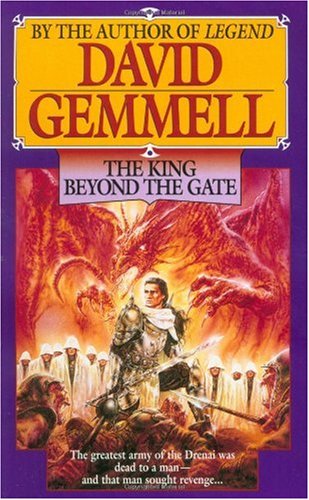
Quest for Lost Heroes by David Gemmell

It has been forever since I read this book.  Still, I really should review it.  Here goes.

At Bel-Azar, four friends held out against hopeless odds, only to be spared by the Nadir Khan.  Known by the Nadir as the “ghosts yet to be,” they enjoyed the fame of heroes for a time, but now live in obscurity in their own kingdom.

When a band of slavers raze a village and carry off the women, however, a young, reckless boy named Kiall calls upon the forgotten heroes to help him free his unrequited love.  And so the “ghosts yet to be” join together for one last quest, only to find that the stakes are much higher than any of them could have forseen…

David Gemmell writes awesome fantasy!  Some of the best I have ever read.  This one, while not quite as deep and meaningful as others like Legend, had its moments.  Let me just say, Gemmell knows how to kill off his characters.

The story started off very well, with some interesting introductions.  It felt a bit like a cowboy movie, where the heroes are all outcasts, unable to find their place in mainstream society.  I immediately took a liking to the main character, Chareos–Gemmell knows how to write heroic characters, even dark heroic characters.

The action began immediately, with blood and battle in every chapter.  As usual, Gemmell did an excellent job getting to the meaning (or lack thereof) of it all, but at times, it felt a little bit superficial.  Not very much, but sometimes, it seemed that he threw the action in just to keep the story interesting.  It didn’t pack quite the same punch as Legend, which was a much superior book.

It took me a few chapters to feel that the story was progressing–Gemmell isn’t always strong on plot–but once I did, it really took off.  I finished the last hundred or so pages at a sprint, and the ending, like all of Gemmell’s endings, did not disappoint.

Overall, I’d say this book is more fan action-adventure story than anything else–light reading, compared to Gemmell’s other work.  Still, it was definitely entertaining, and much deeper and well-written than your typical thriller.  If you like heroic adventure stories with lots of action, you’ll love this book.

FINISHED!

YES!  My last semester of classes at Brigham Young University is FINISHED!

And now I’ve got to grade a million tests and papers, mail my books home (the ones that I’m willing to pay to keep), clean out my car, sell it (I hope), pack all my junk in two >50 lb. bags and a carry-on…all before Monday.  Yikes!

It’s too late to be up.  I need to sleep.

But…school is finished!

The Dispossessed by Ursula K. Le Guin

Urras and Annares, a world and its moon, separated by the gulf of space and two hundred years of mutual contempt.  On Urras, capitalist and socialist nations vie for dominance over the world’s rich and abundant resources.  On  Annares, the anarchist exiles scrounge for a meager living, but live in peace–and in hope.

Shevek has never known any other world than the anarchist utopia of Annares.  His life’s work is to develop a unified theory of simultaneity–a tremendous feat that will rework the paradigm of space travel and communication.  When the people of Annares reject his theory, however, he voyages to Urras in the hopes that by offering his theory as a gift to all nations, he can bridge the gap between the worlds.

Hopelessly inexperienced in the cutthroat ways of the propertarians, Shevek has no idea what he is getting himself into.  In his gilded prison, with nations vying for control of his person, can he find allies who share his idealistic, utopian vision?  Or is he alone in a world of greed, lies, and murder?

This is, quite possibly, one of the most impressive and beautiful works of literary science fiction that I have read.  It may be the best novel I’ve read all year.  Le Guin’s characters are so deep, her ideas so compelling, her worlds so rich, her writing so poetic and beautiful that I hardly know where to start.

One of the many things that made this book so good was the depth of Le Guin’s character development.  The story had a plot, and Le Guin dropped just enough pieces of it here and there for you to know that there was one, but more than anything this book is a portrait of an incredibly interesting man, Shevek.

The book actually contains two stories that merge into one in the end.  One taking place in the present, after Shevek arrives at Urras, and the other is a series of flashbacks showing how he arrived at that point.  Le Guin alternates brilliantly between past and present to reveal insights into Shevek’s character that would otherwise remain unexplored.  By the end of this novel, I felt that I knew this man–and loved him–better than anyone in real life, including myself.  It blew me away.

Le Guin’s worldbuilding, too is incredible.  Before reading this book, I didn’t consider myself an anarchist, but after spending so much time in the utopian society of Anarres, I almost want to become one.  Le Guin meticulously extrapolates her world from her highly perceptive understanding of human nature, paying such attention to detail that her anarchist world is not only surprisingly plausible, but enviable as well.  This is the kind of world that I would like to visit, explore, and perhaps even settle down in and live.

Her ideas, like her world, are meticulously well thought out and incredibly compelling.  In the Hainish cycle, Shevek is the inventor of the ansible drive, the technology that eventually enables peaceable diplomatic missions to other worlds, such as the one chronicled in The Left Hand of Darkness. Shevek’s struggle is to find a way to let this technology bring peace and break down walls, rather than empower tyrants to conquer and destroy.  Time and again, Shevek’s egalitarian, anarchist values come to the surface, clashing not only with those of capitalist Urras, but with our own.

All of this would be enough to make this a compelling, memorable story–but Le Guin’s stunning, beautiful prose puts this book into a league of its own.  The rhythm and beauty in her words made every page a joy to read, with descriptions that kept me entranced and dialogue that made her characters leap off of the page.  Above all, her prose conveys with powerful and compelling clarity the many life-changing ideas and themes of this story.  The book’s last words still haunt me.

The Dispossed is, without a doubt, is one of the best works of Science Fiction that I have read.  I would even go so far as to claim that it is a superior book to Le Guin’s better known work, The Left Hand of Darkness. If I could read a book this insightful every month, I would be a much better man, and have a much deeper and imaginative understanding of the world than I presently have.  This book is a true masterpiece.