Short Story: The Body Tax

This was a fun one to write, even if it did go a little dark at first. The idea for it came from this article about a couple in San Francisco who received an outrageously huge warning fine ($1,500) for parking their car in their own driveway. In the comments to the article, I wrote:

This is why property taxes are evil. If the government can seize your house for non-payment of taxes, was it ever really yours to begin with?

But here’s the thing: every possible answer to that question is terrifying.

If you answer “no, I guess it wasn’t ever really my house,” you’re acknowledging that Mao was right and all power (and with it, ownership) flows from the barrel of a gun.

If you answer “yes, it’s still my own house,” then you have to answer the question: does the state have the right to issue property taxes?

Answer “yes, the state is within its rights,” then congratulations, you’ve just given the Maoist approach to property ownership a veneer of legitimacy and revealed yourself for a boot-licker and a coward.

Answer “no, the state is not within its rights,” then you’ve just acknowledged that you live under a tyrannical regime. It might be a relatively benign regime, but a petty tyrant is still a tyrant, as we saw during the covid lockdowns.

But you’ve still got one more question: do you pay the property taxes, or don’t you?

Answer no, and the state seizes your property and/or throws you in prison.

Answer yes, and you’ve just put yourself in the same position as the landlord who pays protection money to the mob. The only difference is that this mob wears uniforms and has a geographic monopoly on the use of deadly force.

This is why the Roman farmers welcomed the barbarians. Perhaps we should as well.

Later, as I thought on it, I wondered if perhaps I couldn’t write a short story that gets across everything I hate about the property tax. I came up with an idea where the thing that’s being taxed isn’t your property, but your time and your body—literally.

Once a quarter, you are required to voluntarily submit your body to the state, who uses a chip in your brain to turn you into a mindless zombie and exploit you for manual labor. If you have no record and a clean social credit score, it’s typically only for a couple of days. Otherwise, you’ll be a mindless zombie slave of the state for a couple of weeks, or maybe even a couple of months. If you’re a criminal, you may spend more of your life as a zombie slave than as a free man.

To make it even more outrageous and controversial, the story is about a young woman who wakes up from the body tax and finds that she’s pregnant. She was used as a sex worker, and the birth control failed. But the twist is that she’s pro-life, and wants to keep the child. Yay for controversy!

Like I said, it was a really fun story to write. And even though it goes to some pretty dark places, it actually has a happy ending, oddly enough. But the way I’ve currently written it, I think it’s a bit too sappy, so hopefully my writing group can help to smooth that out and make it end on the right note.

This will probably be my last short story for a while. I’ve decided to turn “Christopher Columbus, Wildcatter” into two stories: “Christopher Columbus, Wildcatter” (which I’ve already written) and “Christopher Columbus, Treasure Hunter.” That will probably turn into a wild and zany series of short stories. Also, based on the feedback from my writing group, I will probably turn “The Freedom of Second Chances” into two short stories (one of which will also be very pro-life, oddly enough).

But I may have to come back and write more short stories soon. “Blight of Empire” and “Christopher Columbus, Wildcatter” are both out on submission to the traditional markets, and both of them have received some surprisingly favorable responses from the editors. No contracts yet, but they are on hold for consideration. If they do get picked up, then I’ll have to write a couple more short stories (probably in the Christopher Columbus series) to fill out my publication schedule. Got to keep a solid buffer of short stories to publish.

In the meantime, I’ve resumed work on Children of the Starry Sea and hope to have it done by Thanksgiving. That should be enough time to finish the rough draft and cycle through all the necessary revisions, barring some unforeseen hangups like another major writing block or a difficult life event. But that’s the plan.

That’s all for now. I’ll leave off this post with an excerpt from “The Body Tax,” where Ellie (the protagonist) confronts the terrorist leader who has kidnapped her:

“If the state can throw you into prison—or worse, turn you into a robota—for failure to pay the body tax, was your body ever really yours to begin with? Be careful, because every possible answer to that question is terrifying.”

I sighed heavily. “All right. Suppose I say that you’re right, and it means that I don’t own my own body?”

Mav leaned forward, grinning manically from ear to ear. “Then you’ve just admitted that Mao Tsedong was right, and all power—as well as ownership—flow from the barrel of a gun. But consider the implications if your answer is no—that in spite of the body tax, you do still own your body. Then you have to ask yourself: does the state have the legitimate authority to levy such a tax, or does it not?”

“I don’t know,” I said, growing tired of these rhetorical games.

“If you answer that the state is acting within its authority to issue such a tax, then congratulations, you have just legitimized the Maoist philosophy of property and ownership. Might makes right, the strong always take what is theirs, and possession is the whole of the law. But if you answer contrarywise, that the state does not have legitimate authority to issue the body tax, then why do you pay it? Is it not simply because you fear what the state will do to you if you do not pay? In that case, your position is no different than the man who pays protection money to the mob—only this mob wears uniforms and calls itself the law. In which case, the state is simply the dominant criminal enterprise—or dare I say it, terrorist organization—in the area in which you live. Terrifying, yes?”

“Yes,” I agreed, more to get him to drop the subject than anything else. “It’s terrifying.”

Spring Shorts 2022 #4: The Freedom of Second Chances

I’m really happy with how this short story turned out. It pushes the edge in a lot of interesting ways, with the main character having to choose between duty and honor and doing what is right, and a forced abortion situation that puts the lie to the “women’s right to choose” insanity. It will probably get me blacklisted at a few more magazines, but at this point I really don’t care.

Once again, I used the Mythulu cards to come up with this story. Here are the ones I used:

  • CLONE: Many available forms, including: duplicate, twin, rebirth, alternative life path manifested, time traveler overlap, actor, understudy, etc. Can even mean a second chance or a relapse.
  • ABANDONED: Indicates a severe problem in the environment that prior ihabitants were unable to solve. Draw +1 Habitat.
    • COASTAL: Peaceful threshold where the ocean meets land. Known for caves, karsts, and dunes. Represents unsolvable relationship problems.
  • ERODED: Extensive, exponential deterioration of a foundation due to long-neglected defense.
  • MARRIAGE OF HONOR: A permanent relationship initiated to help someone else avoid shame or discredit.
  • TATTOO: Marked to identify, warn, or remember.
  • GUILTY: Responsible for the worst thing that has happened recently to everyone around them.
  • BODYGUARD: Primary purpose is to protect something else, at any cost.
  • VELVET: Labor-intensive weave of fabric that mimics the soft fur on a young buck’s antlers. Worn to inspire reverence or respect.
  • BLOOD: Represents the energy invested to keep something alive. The only element which affects the soul beyond mortality. Can taint or purify.
  • SLIPPERY: Wants freedom and is hard to hold onto. Often enjoys the chase.
  • BUREAUCRAT: Keeps others in bondage with words. Diverts enemies toward illusions to exhaust them into giving up.
  • CATALYST: Initiates or accelerates a chemical reaction without itself being affected. Gifted at getting things moving.
  • NECRO: Things that were once living, but no longer are. Draw again to decide what died. Draw +1 Habitat or Element.
    • PET: Healthy codependence with a clear heirarchy, usually between members of different species.
  • TORN: Forcibly separated parts, which often continue to exist separately. Indicates a lost privilege or reduction in status. Symbol of anger.
  • SIGIL: Symbols that have power to force or bind. Used in communities to rally groups together.

I’m going to keep going through until I’ve used all of the Mythulu cards in a story at least once. So far, they’ve proven to be an interesting way to not only generate story ideas, but to send my stories off in different and interesting directions. It usually takes me a little while (or sometimes a couple of different draws) to figure out how to fit everything into a coherent story, but I’m getting the hang of it, and the process is actually pretty fun.

As for the spring shorts challenge, it’s Memorial Day today, which means that the challenge is basically over. I only ended up writing four stories, which is a lot less than what I’d hoped to write, but I think these will turn out really well after I rework them a bit, so I’m counting it as a partial success.

For June, I plan to write two more short stories in order to fill up the buffer. My writing group meets once a month, so with two more stories to critique in June, that will give me a buffer of six months by the time July rolls around. I also plan to fix up all four of these spring shorts stories and put them on submission for the next few months, before I publish them as free singles.

I will try to do a new short story each month, in order to keep the buffer at six months, but I may do another short story nanowrimo this year if it turns out that I need more. As far as other WIPs are concerned, though, after I write these next two stories in June, I’m going to go back to novels. My plan right now is to write the first three chapters of The Sword Bearer and Captive of the Falconstar by the fourth of July, then decide whether to go on with one of those or to keep working on Children of the Starry Sea.

Refining my short story strategy

I’ve blogged several times about my short story strategy. To restate it briefly, I’ve found that it works best to self-publish all of my short story singles for free, and to take them down when I have enough of them (+40k words, usually about 10 stories) to bundle into a collection. I earn more this way than I do from selling the singles at 99¢, since all of the free stories help me to sell the collections. Also, I get better engagement from my fans and better discoverability with new readers, since when time is the only cost for reading a story, readers tend to prefer something short.

I’ve also found that with just a little bit of a marketing push, consisting mostly of my newsletter, reddit, free promotion sites, and group promotions such as Book Funnel and Story Origin, I can get my stories out to as many readers as most of the professional and semi-prozines. This was surprising to me, but when I compare my download numbers to the magazine circulation numbers published annually in Locus Magazine, there’s actually not much of a disparity. With a more aggressive marketing push, I can probably exceed those numbers.

Partly because of this, and partly because of how batshit crazy insane woke most of the traditional and award-winning SF&F short story markets have become, I no longer prioritize selling my short stories to the traditional markets, and am just fine self-publishing them first, even if that means forfeiting the couple hundred bucks they might have earned by selling them to a traditional market first. Many of my stories have languished on my hard drive for years while I was pursuing that path, and since time is money, I find it more worthwhile to publish them now. However, I do like to take at least a few months to submit them to the markets that aren’t insanely woke, and occasionally make a sale.

But still, I’ve been struggling lately with some of the finer details of this plan. How often should I publish my short story singles? How long should I keep them on submission before self-publishing them? Should I self-publish all of the stories that will eventually go in the next collection, or should I hold a few back so as to give my readers a reason to buy it? How long should each story be available as a free short story single?

From September 2021 through March 2022, I self-published at least two new titles every month. The purpose of the experiment was to see how this would impact overall sales. My sales did go up quite a bit by the end of this period, but that may have also been because of a few lucky BookBub Featured Deals that I got.

(It was a lot harder to get BBFDs back in 2021, largely because traditional publishing dumped all of the books that were in the production process when covid hit, so there was a lot more competition for spots. But now, it appears that there’s a bit of a drought of trad-published books, since all of the stuff coming out now was acquired during the time when they were still adjusting to all of the pandemic lockdown measures, and weren’t nearly as productive.)

However, the experiment was useful in demonstrating just how difficult it is to maintain such a rigorous self-publishing schedule for a lengthy period of time. I think that at least part of the reason I’m going through something of a creative slump right now is because of how much energy and mental space it took to publish 14 new titles in 7 consecutive months. Perhaps when I was still single, I could have kept up that pace indefinitely, but not with a wife and a baby daughter who deserve my attention. I can still occasionally publish more than one title per month, but not for multiple consecutive months without suffering some detrimental consequences.

At the same time, I do think there’s something to be said for consistency. For a long time in my early career, I would publish only intermittently, sometimes with several months going by before I put out another title. If instead, I’d spent the last ten years putting out a new free short story once a month, in the first week of the month, I’d probably not only have more fans right now, but more loyal fans.

So the plan from now on is to publish a new free short story each month, on the first Saturday of the month, and to publish it under my Joe Vasicek name (stories published under any of my pen names don’t count, even if they’re under an open pen name).

But at the same time, I don’t want to have more than six free short stories out at a time. Six, because 1. that’s how many stories appear at a time on the series carousel on Amazon, at least with a wide screen monitor, and 2. I don’t want to have more than half of the stories I plan to bundle together out at the same time. Since I’m never going to put less than ten stories in a collection, and one of the six free singles is always going to be “Paradox of Choice” (it’s published under a CC BY 4.0 license, so there’s no sense in ever unpublishing it), six is the magic number.

As for whether or not to hold some stories back, so long as no more than half of the stories in the next collection are available as free singles at the same time, I think it’s okay to put them all out there. My loyal fans will have already downloaded all of the stories when they were free, but they’re also my loyal fans, and that seems like a good way to reward their loyalty. Besides, some of them will probably go ahead and buy the collection anyway, both to support me and to get the author’s note.

What about putting stories on submission? How much of a buffer should I keep to ensure that each story gets sent out to all of the markets that I’m willing to sell it to?

I think a buffer of six months is enough. It might require doing some simultaneous submissions, but a lot more markets allow simultaneous submissions nowadays. And with a six month buffer, if I sell a couple of them, I won’t be scrambling to write new stories to fill up the next publishing slot—not unless all six of them sell within a few days of each other.

If a story sells to a traditional market, I’ll probably just put it straight in the next collection when the exclusivity period expires, rather than putting it on the schedule to publish as a free short story single. But it depends on what’s going on at the time, and whether it’s more important to get that collection out or to refill the buffer. I won’t put out the next collection until I have at least six other short stories to fill out the free singles.

So that’s the plan. Maybe it makes sense to you, maybe it’s clear as mud, but the important things are 1. I’m going to put out a new free short story each month on the first Saturday of the month, come hell or high water, and 2. I’m only going to have six free short stories available at a time. And all of the stories in my collections will appear first either as a free short story, or in one of the magazines/anthologies. Sometimes both.

Spring Shorts Story #3: Christopher Columbus, Wildcatter

Wow, has it really been almost three weeks since I finished another short story? I really need to get back into the game. Still, this was a fun one, and I’m really looking forward to turning it into something great.

As with the two previous stories, I used the Mythulu cards to come up with this one. Here’s what I drew:

  • STATISTIC: The face, pile, voice, or sacrifice that gives personal meaning to a problem previously encountered and ignored.
  • EXPLORER: Enchanted by novelty. Energized by challenge. Brave, joyful, and resilient. Worst thing that can happen is for life to become too predictable.
  • GHOST LIMB: When amputees receive nerve signals from non-existant limbs.
  • MINE: Gleaning useful or shiny resources from the earth. Runoff from mines causes ecologically devastating pollution.
  • DEBTOR: One who has received something they cannot yet repay. Leads to either accountability or slvaery. Not free to pursue their own heart until absolved.
  • WATER: Currency of life. Symbolizes connection. Breaks boundaries. Patient, responsive, nurturing.
  • VIBRATING: A gentle resonant sumble. Usually felt when some kind of energy is flowing freely, whether sound, electricity, or emotion.
  • RECOVERING: Half-healed from some kind of significant damage.
  • FUZZY: A soft, comforting layer associated with innocent living things.
  • ADORABLE: Too cute to be taken seriously. Cannot intimidate others, no matter how hard they try. Their boundaries are frequently ignored.
  • LOUD: Showy in a way that interrupts others. Uncomfortably irreverent, noisy, or insistent.
  • HUNGRY: Ravenous and/or so desperately poor that they cannot afford food.
  • TEMPLE: Home of the gods. Point of access where higher powers can be found and petitioned.
  • MONK: Offers total forgiveness. Able to see through deception, especially self-deception. Invites, but never forces.
  • THRESHOLD: A Doorway that leads to a new life. Once you cross a threshold, you cannot return the same.
  • WIND: Represents connection to the unknown. Responsible for storms, pollinations, erosion. Influences evolution, spread of disease, and pollution dispersal.

For most of these elements, I ignored the flavor text altogether. With “statistic,” for example, all I did was start the story off with a random statistic I heard somewhere. No idea if it’s actually true, but hey, it makes for a great story. And with “threshold,” I traded out the card I’d actually drawn with one that worked much better. Also, I’m not entirely sure how “wind” fits in with the rest of it, but it feels right.

I’m going to keep going through with these Mythulu-inspired stories until I’ve used all of the cards. That definitely won’t happen until after Memorial Day, which I’ve marked as the end of this Spring Shorts challenge, but I’ll keep track of which cards I’ve already used and continue to write short stories on the side. With luck, I’ll be able to write at least one more story here, and I may keep it up for a while in the summer just until I’ve filled up the buffer in my publishing schedule. But more about that in a later post.

Spring Shorts Story #2: Prison of Dreams

It’s been a little crazy over here, which is probably why I’ve found it so difficult to write lately. It’s not a function of time so much as brainspace, and I really need to find ways to refill the creative well. But I did manage to finish another story this week, and I think it has real potential. Next step: writing group.

This is another Mythulu-inspired story, and I ended up using more cards for this one than any other story I’ve written. Here are the cards I used:

  • DREAM: A space where anything is possible but nothing lasts. Often inspires discovery and change elsewhere.
  • SCAVENGER: Symbolizes poverty of mind. Lives on the leftovers of greatness because they are unable to create something new.
  • DATA: The element you draw next is the primary means for carrying data. (Draw +1 Element)
    • MACHINE: The messy, awkward, expensive try-fail attempts of those who elevate a race to god-like status.
  • HIBERNATES: Enters a standby state with low power usage to survive extreme conditions. Most animals cannot heal during hibernation.
  • AWAKE: Pulled from sleep, animated, enlightened. A higher state of consciousness.
  • ARTIST: Passionately engaged in a profession that doesn’t pay. Artists are soul-healers and their work transcends political sides.
  • CASTE: Systemized, religiously justified discrimination.
  • LOVER: The other self. True lovers always fill a hole. Stronger together than the sum of the parts.
  • METALLOID: A non-metal element that behaves like metal. Conductive, fusible, and/or ductile. Trouble being categorized or fitting in is usually connected to extraordinary abilities.
  • RUST: Deterioration caused by extended contact with water, air, or acid. Threatens functionality. Difficult to restore.
  • STOCKHOLM SYNDROME: A captive who has developed sympathy for their tormentor.

I was worried at first that this short story would expand into something longer, but I managed to keep the first draft under 5,600 words. If I can get it under 5,000, so much the better. I really do feel like it could benefit from another set of eyes looking at it, so I’m going to hold off on sending it anywhere.

Dean Wesley Smith likes to boast how in the early days of his writing career, he would submit his stories to the editors before he workshopped them in his writing group, and often the things that his writing group criticized were things that the editors loved. But he also says that writers should never revise their work, and that anyone who reads critically needs to “go get help. And I mean real help, professional help, because you have lost all ability to see a story and are trapped by the little black marks on the paper.” In fact, some of the worst writing and publishing advice I have ever heard has come from Dean Wesley Smith, so at this point I feel no compulsion to follow anything he says that doesn’t make sense on its face. But hey, he’s the guy who always tells us to turn off our critical minds, so that’s really just following his advice.

(The crazy thing is that some of the best writing and publishing advice I’ve ever heard has also come from Dean, which makes his bad advice—and it is truly bad—all the more puzzling. How can someone who knows so much also be so wrong? I’ve come to my own conclusions about that, but this is a public blog, so I’ll refrain from posting my thoughts on the subject here.)

In any case, I’ve been really happy with the feedback from my current writing group, so from now on I think I’m going to workshop all of my short stories through there before publishing or submitting them. And I look forward to getting their feedback on this one, because even though I think it turned out pretty good, it needs an extra something and I’m not sure what.

As for the next story, I will try to use just as many cards as I did with this one, since my goal for this writing challenge is to use all of the cards in the deck. But there are a lot of cards, so it’s entirely possible that I won’t end up doing that. Should be fun, though.

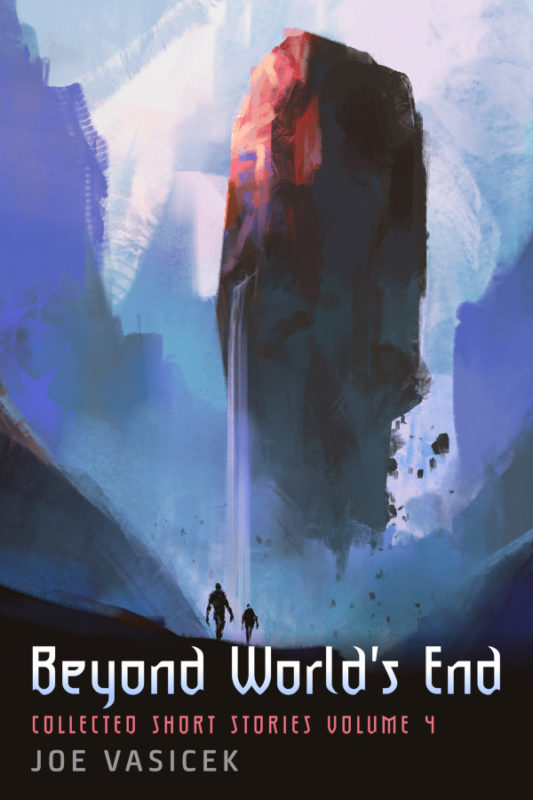
Now available for pre-order: Beyond World’s End (Collected Short Stories #4)

Beyond World’s End

Beyond World’s End

Eleven short stories and a poem that show us what comes after the end of all we know.

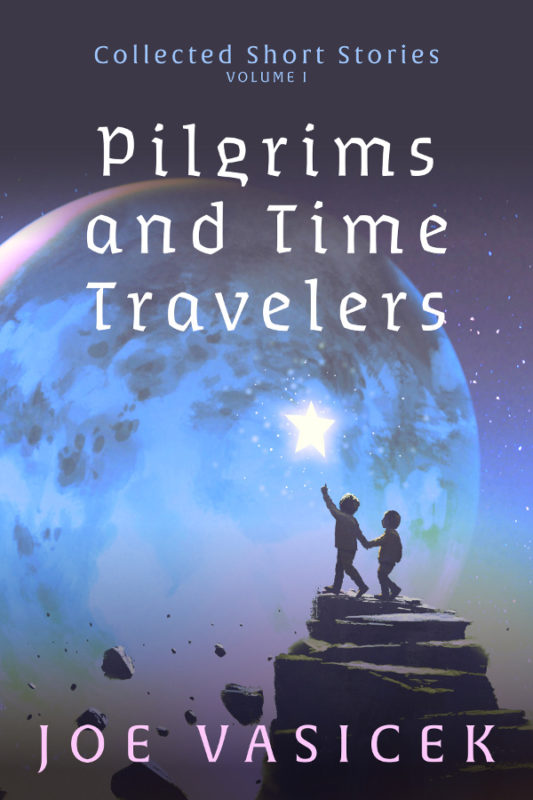
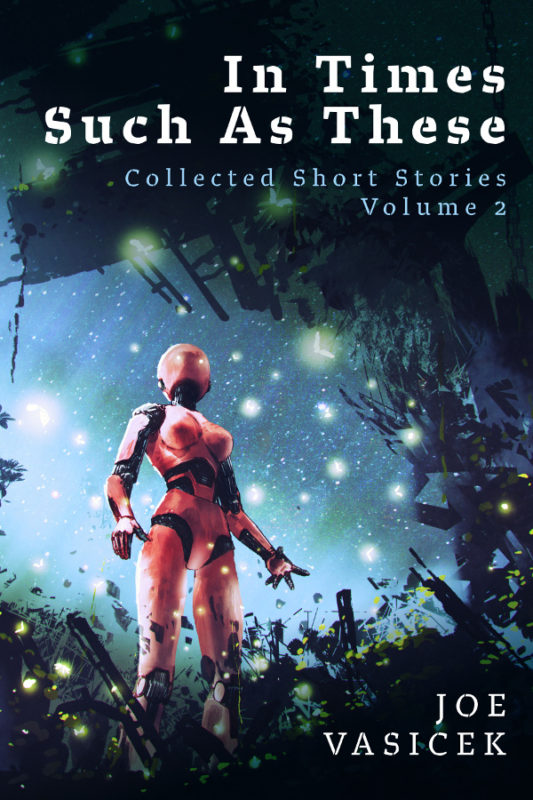
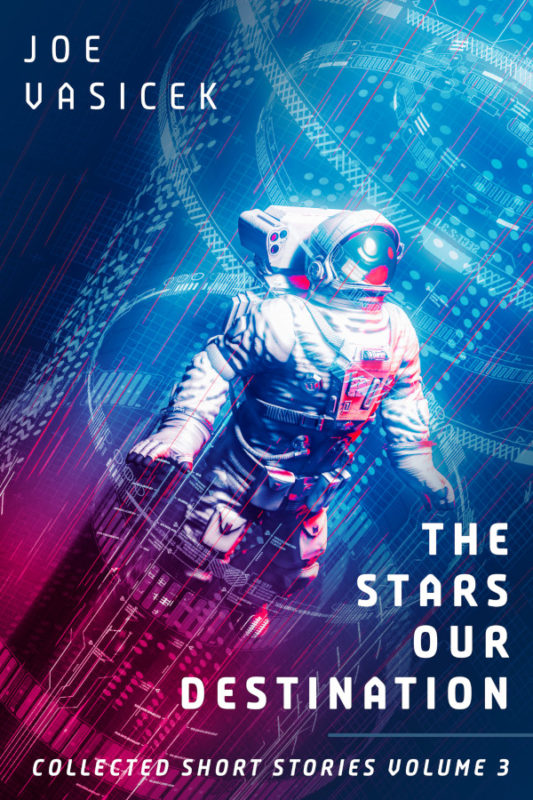
This is the fourth volume of the collected short stories of Joe Vasicek. It includes:

The Manchurian Paradox
A Fatal Rebirth
The Final Turning
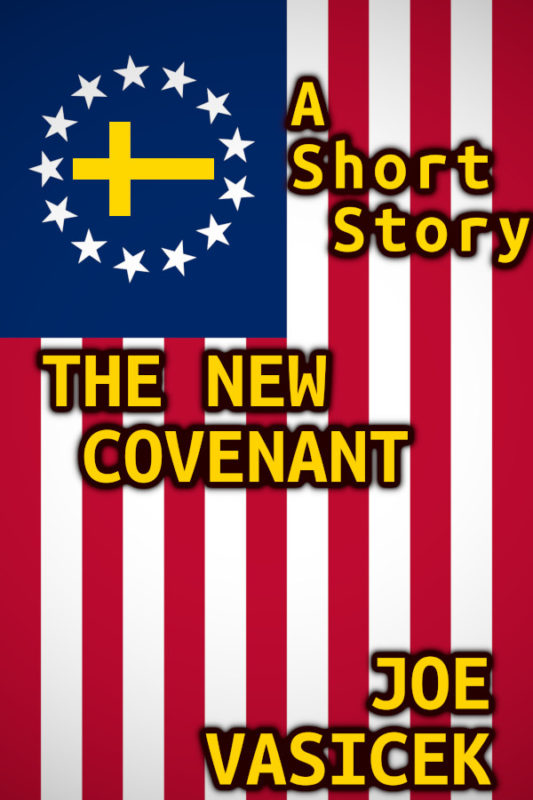
The New Covenant
Hearken and Behold (by J.M. Wight)
The End of Elysium
The Promise of King Washington
Lord of the Slaves
The Other Side of Reality
Schrödinger's Diaper
Two Hours Ago
Welcome to Our Crazy Family

Order Now!
About the Book
Eleven short stories and a poem that show us what comes after the end of all we know. This is the fourth volume of the collected short stories of Joe Vasicek. It includes: The Manchurian Paradox We have met our timeline’s enemy and he is us. A Fatal Rebirth Nothing in this world should live forever—not even civilization itself. The Final Turning This is how the world ends: not with a bang, but with a whimper—thanks to me. The New Covenant To restore a fallen America, an ancient and terrible covenant must be renewed. Hearken and Behold (by J.M. Wight) “Hearken, oh ye hypocrites, and behold the desolation that is already come upon you!” The End of Elysium For the promise of paradise, the last civilization will surrender to the apocalypse. The Promise of King Washington When the aliens came, it wasn’t a military invasion: it was an economic one. (Again, Hazardous Imaginings, December 2020) Lord of the Slaves “Everyone secretly wants to be a slave. Those who deny it simply haven’t found the right master.” The Other Side of Reality What if your future self came back to give you advice, and all it did was confuse you? Schrödinger’s Diaper “Stays clean and dry until you’re free to change it!” …except not quite. (Bards and Sages Quarterly, April 2022) Two Hours Ago A time machine without paradoxes, so long as it’s not abused. Welcome to Our Crazy Family Two genderqueer lesbians and a tranny have a rebellious daughter who does the unthinkable and decides to marry a Christian.
Details
Authors: Joe Vasicek, J.M. Wight
Series: Collected Short Stories, Book 4
Genres: Collections & Anthologies, Collections & Anthologies, Fantasy, FICTION, Political, Religious, Science Fiction, Short Stories (single author)
Tag: 2022 Release
Publisher: Joe Vasicek
Publication Year: May 2022
Length: Collection
eBook Price: $4.99
Joe Vasicek

Joe Vasicek fell in love with science fiction and fantasy when he read The Neverending Story as a child. He is the author of more than twenty books, including Genesis Earth, Gunslinger to the Stars, The Sword Keeper, and the Sons of the Starfarers series. As a young man, he studied Arabic at Brigham Young University and traveled across the Middle East and the Caucasus Mountains. He lives in Utah with his wife and two apple trees.

Some of the links in the page above are "affiliate links." This means if you click on the link and purchase the item, I will receive an affiliate commission. You will not receive any additional charge. As an Amazon Associate I earn from qualifying purchases.

Why I won’t be publishing “The New Covenant” as a free short story single

For short stories, I typically self-publish them first as free ebooks, until I have enough of them to bundle together in a collection. I’ve found that this is a great way to give new readers a taste of my writing and engage my already existing fans. It also helps to market the collections, which is great.

Last week, I was going to publish “The New Covenant,” a post-apocalyptic short story about a theocratic republic in the post-collapse United States that is holding a public execution of four abortionists. The main character is the bishop/mayor tasked with conducting the public execution. While the story doesn’t come down morally or politically on one side or another, he is a sympathetic character, and the execution does indeed take place.

As you can imagine, this is a very politically charged story, perhaps even more than “The Promise of King Washington” which starts out with vultures flying over hundreds of gallows lining the Capitol Mall in Washington DC. Politics has really become a minefield these days, and aside from the authors like Larry Correia who have picked a side and made that a major part of their author brand, it’s very difficult to write about politics or current events without turning everyone off.

Before the war in Ukraine, I used to be able to do that. During the 2020 election, I would share my thoughts in my newsletter, and get emails from fans that said “I totally agree with you, and that’s why I’m voting for Biden!” right alongside other emails that said “I’m so glad you get it! Trump-Pence 2020!” My basic approach was to engage in regular self-reflection, sincerely listen to opposing points of view, avoid outright partisanship, and assume that the person I was writing for was a good, honest person who disagreed with me. And until the war in Ukraine, that seemed to work.

But since the Russian invasion of Ukraine, something has really changed. About a month ago, I wrote an email with some of my then-current thoughts on the conflict, as well as some of my predictions for what will come next, and while I got a few friendly emails, I also noticed a lot of drive-by one-stars and upvotes for one-star reviews on Amazon. I suspect that that newsletter turned off some people, and a small fraction of them decided to take it out on me by one-starring a bunch of my books.

It may also have been something I mentioned on this blog. I haven’t publicly shared my reflections on the Ukraine war, but I have been pretty open about the fact that I’m reading through all of the Hugo and Nebula award-winning books this year, and have reflected rather candidly on that. Since this blog is public, it’s much more likely to attract attention from potential outrage mobs than my email newsletter, and ever since the Sad Puppies, fandom has been downright toxic with outrage mobs of every stripe. So the one-star bombers may have come from there.

Of course, it may also be that the quality of my stories is declining. But I don’t think it’s primarily that, because this is a new pattern of behavior that I haven’t seen before.

My general feeling is that the war in Ukraine has been pouring gasoline on every internet flame war, and that as bad as the partisan divide was in 2021, it’s getting much worse. Which means that it is rapidly becoming impossible to talk about politics or current events without taking a side, making the approach that I’ve taken up to this point untenable. A future historical narrative is being constructed before our eyes, and the stakes are nothing less than the fate of the world.

Of course, that also means that it’s never been more important to bridge the partisan divide. But that isn’t something I can do just by posting my musings and reflections. Every battle needs to be chosen deliberately and with care, and in most cases, the winning move is probably going to be not to play.

I am not ashamed of “The New Covenant.” I think it is one of the timelier and more thoughtful things I have written. But it’s also very political, and not a very good introduction to the rest of my books. I do still plan to publish it, but as part of my fourth short story collection, Beyond World’s End, and not as a free single. And moving forward, I’m going to be more careful about which short story singles I do publish. I’m not going to self-censor what I write, but I am going to be more careful about what I publish.

Spring Shorts 2022 Story #1: “Blight of Empire”

Finished the first short story of the writing challenge that I’m calling Spring Shorts 2022, which is to write 12 short stories before Memorial Day. This one is titled “Blight of Empire,” and it takes place in the distant future, where the galaxy is full of failed terraforming projects and a massive galactic empire rules almost everything. I used the Mythulu cards with this one, and here are the cards I drew:

  • AMPHIBIOUS: Adapted to live in two distinctly different environments. Likes to live on the threshold. (Draw +2 Habitat)
    • CAVE: Isolated biome that would survive even if the sun died. Represents impressive adaptability and unnecessary paranoia.
    • TERRAFORMED: Repurposed to support a specific, narrow spectrum of life. Can be forced, or part of natural biome evolution.
  • FESTERING: Open wound that has become infected and resists healing. Threatens the whole entity.
  • FIRE: Symbolizes passion. Has a dual nature. On one side, brings protection, healing, sanitation. On the other, destruction.
  • GODPARENT: Legally responsible for a child if parents die or are incapacitated. Named at birth and expected to participate in child’s life from the beginning.
  • INVENTOR: The one who pays the price to elevate their people. Graced with curiosity and unusual resilience to disappointment.
  • HUMID: Something is infused into the air and the levels fluctuate. Draw 1 Element to decide what’s floating around. (Draw +1 Element)
    • FUNGUS: More potent than plants, with all the same variations–edible, poisonous, medicine, entheogen. Overall, a tool for removing festering excess.

I had to draw the cards a couple of times before I came up with a good story idea. From now on, I’m going to go through each of the six decks, drawing the top three and choosing the one that seems most interesting. If I need to pick another card from that deck, it’ll be from the other two.

This story ended up going in a completely different direction than I thought it would, which was interesting. A lot of discovery writing with this one, which was a good change of pace. For the last month, I think I’ve been trying to write unsuccessfully through a general drought of creativity, but these short story exercises are helping to stimulate my creative mind again. Just need to make sure to keep filling the well.

Other than that, things have been kind of crazy around here. We have a long-term plumbing problem that just flared up again, and half the house’s plumbing is unusable. Unfortunately, that includes the washing machine, and our baby is in the middle of potty training. My wife has an uncle who works as a maintenance guy at BYU, and he’s been a huge help, but each day has been a different plumbing adventure. Later this week, we’re going to remove a section of cast iron pipe and run a snake up through it backwards, and maybe a shop vac too. I just hope the sewer pipe hasn’t been leaking under the foundation (knock on wood).

On the publishing front, I was planning to release a short story this week, but that got pushed back due to all this craziness. I do have my fourth short story collection up for preorder, though, so that’s something. Also ran a massive promo last week for Bringing Stella Home, which I recently relaunched with a new cover.

I think I’m going to keep using the Mythulu cards for this Spring Shorts 2022 writing challenge. In fact, I’m going to try to use all of the cards, just for the fun of it. That means that none of the cards I used for this story will show up again. I’ve already drawn a few base stories, and come up with some intriguing combinations. Very excited to write, if all this other life stuff will just calm down!

Slight Change of Direction

I’m currently a little over 54k words into the rough draft of Children of the Starry Sea, the sequel to Star Wanderers and second book in the Outworld Trilogy. Most of my novels fall somewhere between 40k and 80k words, so if this was a typical WIP, I would be pretty close to finishing it. However, I expect that this novel will turn out to be somewhere north of 140k in the final draft, and the rough draft is already shaping up to be at least 160k. So I’ve still got a long way to go before this one is finished.

I was hoping to release this book by the end of the year, but I also want to release book 2 and book 3 within two months of each other, with book 3 already set up for preorder by the time I release book 2. That seems to be the best way to launch the later books in a trilogy, especially in conjunction with a price promotion on the first book. Launching book 2 without book 3 anywhere in sight, it’s much more difficult to make a splash. So I don’t want to publish Children of the Starry Sea until at least the rough draft of book 3 (which doesn’t even have a title yet, let alone an outline) is done.

So with all of that in mind, I’m looking at my publishing schedule for the rest of the year, and without Children of the Starry Sea and the yet unnamed book 3, it looks pretty sparse. I’ve got my fourth short story collection coming out in May, another short story later this month, two short stories sometime in the summer, a J.M. Wight short story that I’m workshopping through my writing group this month, and two more J.M. Wight projects that I haven’t even written yet. And that’s it.

I would like to publish at least one new title every month, preferably two if they’re both short. Also, I would like to have enough short stories in production so that I can keep them on submission for a while, preferably at least six months.

At this point, it seems that the best solution to this problem is to take some time off from my WIP to write short stories, fill up the publishing schedule from now to the end of the year, and go back to writing Children of the Starry Sea and its untitled sequel. To do that, I need to write ten short stories in addition to the two unfinished J.M. Wight works. One of those is going to be a novella, so I’ll probably have to take an extra couple of weeks for that, but I should be able to write about two short stories per week.

So my new goal is to write a dozen stories between now and Memorial Day. That will be more than enough to fill up the publishing schedule through the end of the year, especially if I have enough stories to bundle into another short story collection (which I almost certainly will). It’ll also give me something to blog about, which should be fun.

I wish I were the kind of writer who could write five secret novels on top of everything else I’m doing. Heck, I wish I were the kind of writer who could write three or four novels a year, instead of just one or two. Perhaps in time I’ll get to that point, but for now all I can do is strive to make incremental improvements, and I do think that writing more short stories will help me to be a better writer. And I’m not putting Children of the Starry Sea completely aside, just on the back burner for now. Hopefully that helps me to finish it faster when I do make it my primary WIP again.