


Check me out on Wattpad!

So I signed up recently for a site called Wattpad, which is basically like Deviantart for writers.  Once you have a profile, you can post stories or chapters or excerpts, and other members can read your stuff, comment on it, or vote it up.  It’s designed especially for smartphones, so if you have one, that’s probably the best way to access it.

You can find my Wattpad profile here.  I’m still kind of a beginner at this, so it’s going to take me a while to figure out how it works.  It seems like the kind of thing I would have become obsessive about back in high school, kind of like how my sister was obsessive about AOL Instant Messaging.  I’m not a teenager anymore, but hopefully I’m not too old to still have fun with it!

The most interesting thing about the site is how it allows you to release a book serially, by chapter or scene.  Right now, I’m posting Star Wanderers: Outworlder (Part I), with updates on Mondays, Wednesdays, and Fridays.  If there’s interest, I may post a few more Star Wanderers stories as well.

My curiosity about Wattpad got started when I read this guest post on Lindsay Buroker’s blog.  The concept of serializing a book like a webcomic seemed kind of cool to me, and the idea of a reading community seemed pretty neat as well.  At first, I was a little leery because it would basically mean giving away my books for free, but then I thought about it and figured why not?  It’s worth giving it a try.  I’m pretty sure it won’t cost me sales, and if it gives me a chance to interact with people who love my books, awesome!

So yeah, if you’re on Wattpad, check me out!  And if you’re not, check the site out!  Like Deviantart, there’s a lot of fanfic and teen angst, but that’s to be expected–and actually, I think it’s kind of cool.  Anyone can post a story, and anything can take off.  It’s all a big community where there is no line between writers and readers, which seems like a really exciting concept.  So yeah, check it out!

Quick update and a funny thing

SW-VII Reproach (thumb)First, just a quick update on my latest writing projects.  I got the feedback from my second round of test readers for Star Wanderers: Reproach (Part VII), and while I think the story still needs work, it’s getting closer. I probably won’t be able to get it out by the end of September, but first or second week of October it should be ready.

It’s funny–I sent it to a guy and a girl, and while the guy thought it didn’t need any changes (and he’s studying to be an editor), the girl pointed out a few things that need a little more reinforcement and development.  It’s mostly just minor changes I think, getting more into Noemi’s viewpoint and figuring out exactly what she’s going through, and making that clear to the reader.  So yeah, it shouldn’t be too hard.

In some ways, writing this book has been like writing myself out of a corner.  The story in Reproach runs parallel with the events of Sacrifice, and some of the stuff that happens there is pretty complicated.  For example, it’s got a sixteen year old girl who feels like her only hope at happiness is to convince her best friend to share her husband, and the best friend actually kind of comes around to it by the end, though the whole ordeal is almost unbearable for her.

Writing about monogamous relationships is hard enough when you’ve always been single–it’s doubly hard when you’re writing about polygamy.  But I’m actually fairly pleased with the way it’s come out so far–even though it’s not quite ready to be published, everyone who’s read it has really gotten into it, even the readers who haven’t yet read the earlier books in the series.  It’s been a challenging book to write, but it’s been a gratifying one, and I think you guys are going to enjoy it.

Of course, all of this is yanking me away from Sons of the Starfarers, which is really kind of aggravating.  On an interview I listened to recently, Jim Butcher said that writers are either writing, thinking about what they’re writing, or thinking about what they’ve written.  The way my brain is wired, I can only really do one of those things at a time, and I’d much rather write or think about what I’m writing than think about what I’ve written.  But yeah, Reproach is more important, so after finishing the current chapter I’ll put Sons of the Starfarers on hold for a couple weeks.

Also, I’m working to get print editions out for all of my Star Wanderers books before Christmas.  Part of this is because of the new Matchbook program from Amazon, but mostly it’s just because … well, why not?  For those of you who want paperback versions of these novellas, that will soon be an option.  I’m having a little trouble figuring out the cover art (RBG vs. CMYK, getting the covers to print attractively instead of turning out way too dark, etc), but that shouldn’t take longer than a few weeks to iron out.  Expect to see parts I-IV out by November.

Finally, a funny thing happened to me at Leading Edge.  For those of you who don’t know, it’s a student-run science fiction & fantasy magazine where student volunteers read every story submission and write a critique for the author.  Well, while sitting in the slushpile, one of the editors came in and showed me a story that I’d critiqued … twice!  The first time, I’d given it a rejection.  The second time, I’d actually recommended that the editors buy it!

Well, I racked my brain a little bit to figure out what had happened, and as close as I can tell the only real difference was in how distracted I’d been when I’d read it.  The first time, it had been fairly noisy and there’d been a lot of distractions.  The story had some good parts to it, which I mentioned in the letter, but I didn’t really pick up on the character motivations well, so I rejected it based on that.  The second time, though, it had been quiet enough for me to really pay attention to the story, enough to really get what was going on.  I finished it, and the ending moved me so much that I knew I’d have to recommend that we publish it.

The editor wanted to keep the rejection sheet anyway, but I tossed it in the garbage since really it wasn’t all that helpful anyway.  And the moral, if there is one, is to pick up every story with the idea firmly in mind that you’ve got a potential gem in your hands.  Too often, I think we read stuff flippantly, as if we already know that it’s not worth our time and attention.  Well, don’t do that!  Who knows but what you’ve got your new favorite story of all time sitting right in front of you?  Give it a chance!

And on that note, I leave you with this:

See you guys around!

Trope Tuesday: Foolish sibling, responsible sibling

Whenever you’ve got two characters who interact with each other a lot, chances are that one is a foil of the other.  There are a lot of reasons for this, but the big reason is that it helps to highlight certain character traits by providing contrast.  Because the contrast is the important thing, the relationship between the characters can take a variety of possible forms.  It may be that one is the hero and the other the sidekick, or (if they’re villains) perhaps one is the Big Bad and the other is the Dragon.  If enemy mine or one of the other frenemy tropes is in play, they might be on opposing sides.

Foolish sibling, responsible sibling is what happens when the character foils are siblings.  It’s a subtrope of sibling yin-yang that contrasts the character traits of responsibility and recklessness, duty and prodigality, and how the two opposites somehow manage (or not) to live together and stand up for each other in spite of their differences.

It may be used to set up an aesop, usually along the lines of “be like the responsible sibling, not the foolish one,” but that’s not always the case.  It might be that the younger sibling is closer to earth and the uptight responsible one needs to learn how to loosen up.  Simon from Firefly kind of fits that mold, though he learns to loosen up not from his sister River so much as from the rest of Mal’s crew.

In a lot of stories, it’s not necessarily meant to send a message so much as set up an interesting dynamic between two equally sympathetic characters.  In the movie Gettysburg, for example, Lawrence Chamberlain is the commanding officer of the regiment, and thus has to lead the men, follow military protocol, etc, while his annoying younger brother Tom calls him by name and forgets to salute him, runs around chatting it up with union soldiers and rebel prisoners alike, and generally seems a lot more loose and carefree.

Usually, the responsible character is the older sibling, for reasons that should be fairly obvious to anyone who grew up with siblings.  As the oldest child in my own family, I can readily sympathize with the dutiful son, since I more or less was one.  That’s not always the case, though.  In sitcoms where the middle child is the main character, usually it falls on them to thanklessly pick up the slack (yeah, being the middle child pretty much sucks).  Bart and Lisa from The Simpsons are a good example of this.

I played with this a little in Desert Stars with some of the minor characters: as the second oldest, Surayya generally tries to do things by the book, whereas Amina tends to be more mischievous and conniving.  Michelle and Lars also fall into this trope, with Lars a carefree academy dropout and Michelle a hardworking (though also fun-loving) mechanic on her father’s ship.  Between Desert Stars and Bringing Stella Home, though, Lars completely turns around, so that by Heart of the Nebula (not yet published) he’s quite possibly one of the most responsible characters in the book (and I still have yet to give him a viewpoint … hmmm).

In Sons of the Starfarers, I’m playing with this character dynamic a lot.  Isaac is the oldest son, who always knew he would leave on his father’s starship to fulfill the Outworld traditions and seek his fortune as a star wanderer.  Aaron, on the other hand, kind of got roped into the whole thing unexpectedly (see Star Wanderers: Benefactor) and hasn’t yet matured.  The events of the story will no doubt give him a growth arc, but in the meantime, the dynamic between the two of them is a lot of fun to write.

There are a lot of other issues in that relationship to play with too, such as promotion to parent and always someone better, but I’ll save those for another Tuesday.

Addicted to typesetting

So I just realized it’s been a looong time since I posted anything besides Trope Tuesday posts on this blog.  A lot of things have happened, and I’ve got a lot of things I want to blog about, but really all my spare time has been spent happily typesetting for Stars of Blood and Glory and Star Wanderers: Outworlder (Part I).

I always tell people that if I wasn’t a writer, I’d be a typesetter because I enjoy it so much.  I’m not sure if that’s true, because it can get a little mind-numbing after a while, but as an indie writer who only has to do it every now and again, it’s really fun!  The best part, of course, is getting to that finished product, a book full of words and paragraphs and chapters that look so beautiful on the page, which you can flip through and say “wow, I wrote that!”

The whole process is great, though, even with the frustrations like computer crashes and formatting struggles.  Fortunately, those don’t happen quite as often since I’ve more or less figured out the tools.  I use LibreOffice almost exclusively for the interior (yes, I know In Design is awesome but LibreOffice works well too), and The Gimp for the cover art.

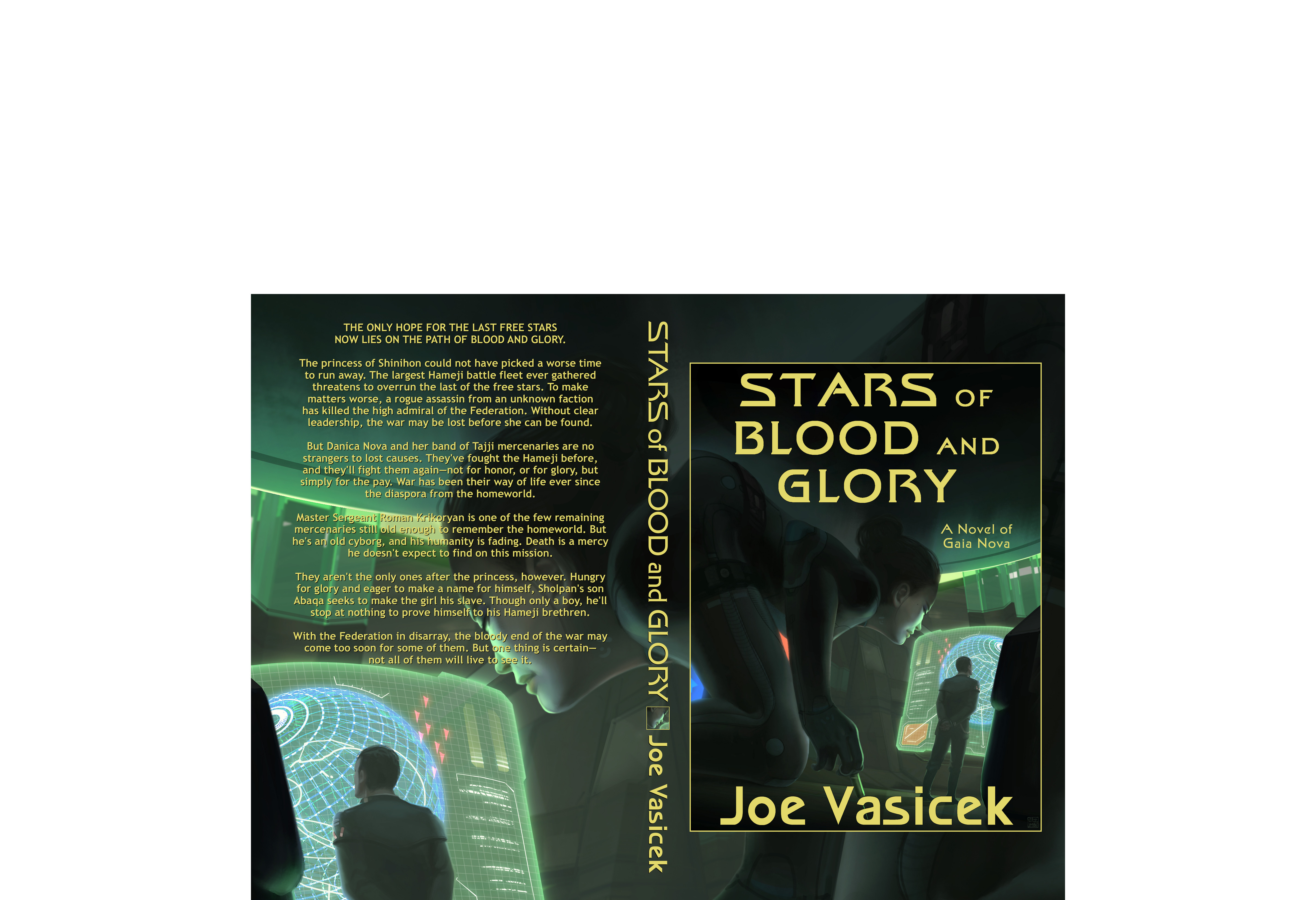
Yesterday, I started on the cover art for Stars of Blood and Glory, thinking it would take me a few days to finish it.  Well, one thing led to another, and a few hours later I had this:

POD cover (Stars of Blood and Glory)Not bad.  I think I was able to do it so quickly because I followed the same basic pattern as Bringing Stella Home and Desert Stars.  Once you know what you’re doing, it doesn’t take very long to do it.  It also helped to have such great art (shout-out to Hideyoshi)!

So yeah, the only thing I have to do now is order the proofs and approve them.  After that, the print edition of Stars of Blood and Glory should be up on Amazon in just a couple of days, so keep an eye out for that!

Also, I don’t think Amazon has announced this to the general public yet, but this Christmas they’re starting a program where you can get the ebook edition of a participating book bundled with the print edition of the book for an extra $2.99 or less.  It’s called Matchbook, and I’m happy to announce that all of my novels will be in the program!  They’ll be priced at either $1.99 or $.99, so if you’re looking for a Christmas gift, you can buy one of my print books and get the ebook for yourself for more than 50% of the price.  The Star Wanderers books, when I have the print versions up (and I’m working on that now), will bundle the ebooks for free!

So yeah, that’s what’s been taking away from my blogging time.  Salt Lake Comic Con was also pretty cool–it was my first Comic Con experience, so I should probably blog about that too.  Also, some book reviews, some stuff that exploded on the internet recently that I want to react to … yeah, I’ve fallen a bit behind.

But above and beyond all this blogging / typesetting / publishing stuff, writing is still my #1 priority.  I started the first Sons of the Starfarers novella just last week, and have been working on it a little every day since.  I’m way excited about this next project–it’s going to be amazing!  Like a spinoff of Star Wanderers, but sooo much more.  But I’ll wait until tuesday to talk about that.

In the meantime, keep an eye out for the print edition of Stars of Blood and Glory!  It should be out in the next week or so.  And as for Star Wanderers, the print editions should be coming out this month or next, depending on how effectively (or not) I can manage this typesetting addiction.

Later!

Things I’ve learned from STAR WANDERERS

Star Wanderers I (thumb)Star Wanderers II (thumb)Star Wanderers III (thumb)Star Wanderers IV (thumb)SW-V Dreamweaver (thumb)SW-VI (thumb)SW-VII Reproach (thumb)

When I published the first couple installments of Star Wanderers, it represented both an experiment with a new publishing format and a departure from the more long-form styles that I was used to.  Now, a little over a year later, I can say it’s been a success.  The series isn’t finished, and I’m still learning as I go, but here are some of the big lessons that I’ve picked up:

Novellas are surprisingly well-suited to series. They read fairly quickly, contain enough focus to sustain an episode of a larger story, and yet at the same time contain enough space to develop a wider arc.  Plus, they are a lot quicker to write than novels and generally don’t require as much editing, since it’s easier to get the story right on the first pass.  This means that you can put out novellas faster and more regularly than long-form novels, maintaining good momentum for the series as a whole.

It’s hard to write anything shorter than a novella without leaving readers unsatisfied.  By far the biggest criticism I’ve received for Outworlder (which is really more of a novelette than a novella) is that the story feels too short.  If the novella (17,500 to 40,000 words, or 80 to 150 pages) has all the benefits of the novel and the short story, then it seems that the novelette (7,500 to 17,500 words, or 30 to 80 pages) has all of the drawbacks.  Then again, it could just be that I have yet to master the form.

The satisfying element in a series is at least as important as the returnable element.  Every successful episodic story has some sort of returnable element–something about the story that makes the audience ravenous for more.  Often, this takes the form of a cliffhanger, leaving something unresolved.  However, it’s not enough just to string readers along, holding back whatever your story has promised them.  In every installment, you have to deliver.

It’s a delicate balance, to be sure, but the advantage of erring on the side of satisfaction is that the satisfaction can actually become a major hook in itself.  If readers know that they’re going to be satisfied whenever they pick up one of your books, you don’t have to ratchet up the tension to eleven in order to keep them coming back.  Several Star Wanderers reviews mention that it’s more relaxing and not as fast paced as other space opera, but sales of parts III through VI are almost 1:1.

Readers love to revisit a good story from another character’s point of view.  Some of the most glowing reviews I’ve received for this series are for Dreamweaver, which is basically a parallel novella to Outworlder but from Noemi’s point of view.  In Outworlder’s Amazon also-boughts, it sometimes even appears ahead of Homeworld, which actually comes before it in the series order.  This tells me that readers love to revisit a story, or to hear the same story again but from a different point of view.  Head-hopping from episode to episode can be a great way to add variety and depth.

Plenty of readers are willing to pay $2.99 per book for a series they enjoy.  When I published the omnibus for Star Wanderers I-IV, I wondered if sales of the individual novellas would taper off since I priced the omnibus much lower than their sum.  To my surprise, sales for both the omnibus and the individual installments have actually remained about even.  Since the omnibus clearly shows up on Amazon’s recommendations, this tells me that $2.99 is not too high of a price, even for a novella.

Perma-free works; however, free and $.99 attract some bad apples.  Do not underestimate the power of free, especially perma-free for the first book in a series.  I credit that strategy for at least 90% of the Star Wanderers sales, since the series itself has boosted my total sales numbers by more than an order of magnitude.  However, there are people out there who never fail to find something to complain about.  These are usually the same people who don’t like to pay for anything, and when they realize that the rest of my series is not free, they tend to leave unhelpful and/or incomprehensible reviews.

I priced Fidelity at $.99 to try to give readers more of a hook from part I to part II, but the sales ratio between part II (Fidelity) and part III is about 2.5:1–in other words, pretty bad.  Judging from some of the reviews, it seems that a fair number of the people who are dropping out are the bad apples.  I haven’t decided whether to raise the price, but if things keep going the way they have been, I probably will.

Series don’t usually take off until the third or fourth installment.  Do you know how many sales Outworlder had in the month when I first published it?  About 10–and that was actually a surprise.  When I published Fidelity, I had even fewer, and Sacrifice hardly sold anything until Outworlder went perma-free.  When it did, sales of the other two novellas picked up, but it wasn’t until after I’d published Dreamweaver that the sales of Fidelity started hitting triple digits.  The lesson to me is clear: it takes time for a series to pick up steam, so don’t be like Fox.  Give it a chance to grow.

Nothing sells a book like writing and publishing more books.  This is probably the main driving factor behind the last point.  I’ve done almost no promotion for Star Wanderers, other than putting out new books on a fairly consistent basis.  Amazon’s algorithms have probably done their part (sales on other outlets haven’t been growing nearly as much), but at the end of the day, there is no substitute to writing more and better books.  Any sort of promotional or marketing activity that takes away from my writing time is just not worth it–not when I’ve got stories to tell.

Right now, I’m getting ready to start a new spin-off series, which hopefully will be even more successful.  I’ll to try out a few new things (mostly along the lines of better covers and meatier novellas), but mostly, I’m going to try to replicate the success I’ve achieved with Star Wanderers by keeping these lessons in mind.  I have no idea how this new series is going to go, but I figure I know enough about the publishing side now that I can focus my attention on writing an awesome story, which is the most important thing after all.

Back in Provo!

Wow, do pageviews drop off sharply if you don’t blog for a while.

So after spending the last couple of weeks visiting family across the country–literally across the country, from Massachusetts to Iowa–I’m back here in good old Provo, Utah, surrounded by the mountains once again (I can just hear my grandma … “what’s so great about a pile of rocks?”).

Here were some of the highlights:

  • Seeing my parents (yay!) and spending some quality time with them.
  • Babysitting my niece and nephews and spending time with that side of the family.
  • Beach bumming on the Cape Cod National Seashore.
  • Eating fried clams and lobster in Wellfleet at Moby Dick’s.
  • Playing Shanghai with my parents every night for a week and a half.
  • Beating my brother-in-law at Settlers of Catan for the first time (he’s good!).
  • Watching the entire Ken Burn’s Civil War documentary series.
  • Touring Nauset Light and the Three Sisters.
  • Touring the Cape Cod Potato Chip factory.
  • Hanging out with Mom in Downtown Hyannis.
  • Acquiring an awesome new Indiana Jones style hat.
  • Going to church with a bunch of high priests sporting crocs.
  • Picking Monsanto corn and getting the whole corn experience.
  • Browsing a bookshelf of Ursula K. Le Guin novels I’ve never read.
  • Getting a bunch of awesome new story ideas (see previous post).
  • Taking the California Zephyr across the country–twice!

So yeah, it was a pretty awesome summer vacation.  It’s good to be back in Utah, though.  As much as I have a love/hate relationship with Provo, Utah really is my favorite place on Earth.

I’ve only been back a couple of hours, but it seems that it’s been an eventful two weeks since I’ve been gone.  One of my former roommates ran off without paying his share of the utilities, after jacking up the AC all summer (lovely).  After filing a police report, however, we may be able to get some of that back.

My tomatoes have been growing like CRAZY.  Only one has been harvested, but there are dozens hanging off of the vines.  Anybody want to make salsa?

As far as church goes, the ward boundaries have been completely rearranged.  Seriously, the map looks like a shredder went to it.  On our block, it’s us and the house two doors down from us (we think), then one of the apartments from Liberty Square, then another random house a block north of us.  Crazy.

I don’t know yet if I’ll be sticking around in my current place for the fall or not.  It’s a good situation, and the roommates are great, but the neighborhood is full of freshmen and sophomore college students.  I need to find some more people my age to hang out with.  Next month marks the beginning of the final year of my twenties, and I plan to make it count.

I got a lot of work done on Star Wanderers: Reproach (Part VII) while traveling on the train, but I still need some of my first readers to give it another read-through before I’m confident enough to publish it.  Hopefully, that shouldn’t take too long–I’m shooting for publication before the end of September.  Also, the print edition of Stars of Blood and Glory will hopefully be finalized before the end of the month as well.

That’s just about it for now.  I’ll leave you with some folk music from the Caucasus Mountains, this time on the accordion:

Rousing stuff.  I wish I could play the accordion like that.

Take care!

Laying the groundwork for a couple new series

So I just got back from vacation at Cape Cod, which turned out completely different from what I’d expected.  When I left, I said that I’d probably just write like I usually do, except in a different place.  Instead, I took a break from my WIPs long enough to catch a new vision for my career and come up with a really good idea for a new spin-off series in the same universe as Star Wanderers.

The story idea is really awesome.  I don’t want to talk about it too much, since I haven’t even written it yet, but the main characters will be Isaac and Aaron from Benefactor, and the basic premise will start out fairly similar to Outworlder.  From there, though, I expect it to take shape in some very different ways, turning into much more of an epic space opera.

I plan to stick with the novella series format, since I’ve had a lot of success with that so far.  I know that some readers complain about shorter works, but when doing a series of this type, it’s important to put out new titles regularly, and I can do that much easier with novellas than with novels.  Besides, there are a lot of other reasons why I prefer novellas, as I pointed out in this post.

That said, I expect these ones to run a little longer, such as the 30k-40k word (90-140 page) range.  But I won’t really know until I’ve written them.

Before that, I’ve got two more Star Wanderers stories to put out: Reproach (Part VII) and Deliverance (Part VIII).  Both of those are already written; I just have to run them by my first readers and make some revisions before putting them out.  If all goes well, Reproach should be out in September and Deliverance should be out in October.

So that’s the plan.  Career-wise, what I really need to do is replicate the success of Star Wanderers by starting some new storylines that follow the same series format.  It’s a little unnerving, since I don’t know what will stick, but I don’t want to be dependent on just one series–you’ve got to have multiple entry points.  Besides, this new series is a spinoff, so hopefully readers from the first one will carry over.

It’s at this point that I’m hitting myself, because what I really need is to have three books that I can release before Christmas.  In general, I’ve found that it’s better to wait until you have three books out before you make the first in a series permanently free.  I wish I’d spent a lot more time this summer writing new things, rather than revising old stuff or finishing up old series.  But oh well–better to start now than wait until next year.  And who knows?  Maybe I can still pull it off.

For this new series, I plan to invest a little more in cover art.  The NASA images have been good for Star Wanderers, but to really hit the publishing trifecta (title, cover, blurb), I need to commission some original art.  I have the money now, and probably the best thing I can do at this point is reinvest it.  Expect those covers to be awesome.

Oh, and the other elements of the trifecta?  I don’t have a blurb yet, but the working title is Sons of the Starfarers.  Pretty cool, eh?

So there’s that.  I’m currently revising Reproach, but I think I can finish that on the train and send it out to my beta readers before the end of August.  As for The Sword Bearer, I’m going to put that project on hold again, mostly so I can focus on this.  I’ve also been running into some problems with that project, mostly having to do with the worldbuilding.

For that reason, I’m thinking of doing a series of prequel novellas in order to flesh out that world and the backstory.  If it goes well, that should turn into its own thing, kind of like how Star Wanderers fleshes out the background for my Gaia Nova books.  I’m thinking of something along the lines of David Gemmell: heroic fantasy with a real focus on courage, valor, and unlikely heroism.  I’ve already got the first scene of the first book in my head, and it’s pretty dang awesome.

So many stories, so little time … I’d better get back to writing!

Quick update from Massachusetts

Hey guys, this is just going to be a quick update since it’s midnight here on the east coast and I’m  pretty tired from the three-day train ride.  Sleeping on the train is like skipping stones, where all you’re really doing is seeing how far you can go before you crash (and I’m due for a crash).  So anyways, here goes.

First, I didn’t get a whole lot of writing done on the train, partially because of the sleep issue but mostly because I started reading STRAY by Andrea K. Höst and holy crap, I could not put it down.  Seriously.  It got to the point where the only thing I wanted to do was read this book, which was fortunate because riding the train, there’s not much else to do anyway.  So I finished it in a little over 24 hours, which means you can expect to see a review here soon, either before or after I get back from vacation (probably before, because I plan to read the next couple books in the series at the beach and on the ride back).

Second, I’ve decided to spend the next week or so working exclusively on Star Wanderers: Reproach (Part VII), while the feedback is still fresh and my enthusiasm is still strong.  Also, after burning through the first chapter in the last couple days, I think I can get this done pretty fast.  After that, I’ll send it out to a couple of other first readers, probably make another pass, then figure things out from there.  If all goes well, it should be out by mid-September-ish.

Third, I’m thinking about releasing print editions of the Star Wanderers series.  At first, I thought I’d limit the print editions to the omnibuses (omnibi?), but now I think it would be cool to do little pocket-sized editions of each novella.  What do you guys think?  If there’s demand, I’ll try to put them out a little sooner, hopefully before Christmas.  And since they’re small, I can probably price them lower, like around $6 to $7 or so (and of course, Amazon will discount them).

Third point one, before I do that I need to release a print version of Stars of Blood and Glory.  Which shouldn’t be too difficult, since I’ve already typeset about half of it.  Mostly I’ve just been lazy and/or busy with other stuff, but now that I check CreateSpace it seems that people are actually buying my print books, hmm.  Better get on top of that.

Fourth … actually, there is no fourth.  I guess I should say I’m on vacation, which means doing what I usually do except from Cape Cod, spending my non-writing time doing fun things with family.  But since I’m home, I plan to go through my high-school / middle-school papers and hunt down my first novel attempt, if for no other reason than to destroy it.  I may keep a page or two as a curiosity/souvenir, but that abomination really needs to die.

And that’s about it.  The stone has begun to sink, and I really need to hit the sack.

No Trope Tuesday this week

Hey guys, sorry but no Trope Tuesday post this week. I’m on the train, traveling from Utah to Massachusetts. Right now we’re at Grand Junction Colorado, about to head into Glenwood Canyon in a few hours. Lots of beautiful country out here.

One of the nice things about traveling by train is that it gives you lots of time to relax and do things without any outside pressure. Hopefully I’ll get some good writing done before I arrive at my destination on Thursday. The Sword Bearer is coming along slowly, and I just got the notes back on Star Wanderers: Reproach (Part VII) so that should be enough to keep me busy.

Anyhow, the train is about to leave again, so I’d better cut this short. See you guys around!

Trope Tuesday: Curiosity is a Crapshoot

curiosity
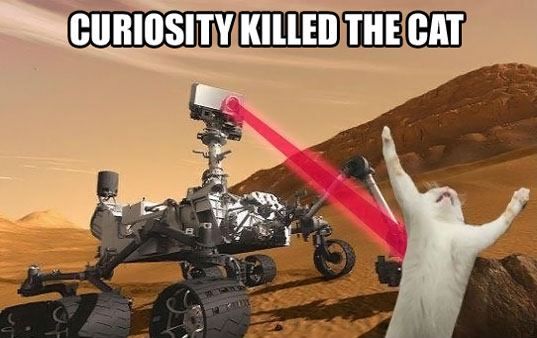
Is there life on Mars? NOT ANYMORE!

Is curiosity a bad thing?  Well, it depends how genre savvy you are.  It seemed to work out pretty well for Alice, but not quite so well for Pandora (or the rest of the ancient Greek world, for that matter).  Curious monkeys seem to come out all right, and their constantly curious counterparts also seem to do okay in the end, but anytime you run into schmuck bait you know that things aren’t going to turn out well.

The truth is, for just about every stock Aesop warning about the perils of being overly nosy, you can find another one exalting it as a virtue.  In fact, you could say that curiosity is a crapshoot.

But what is curiosity exactly?  The Merriam-Webster dictionary defines it as “desire to know,” and “interest leading to inquiry.” As you can imagine, there are situations where this could be good or bad.  Thus, what a story says about curiosity often changes depending on its genre.

For example, in most horror stories, curiosity and nosiness are usually bad, leading the protagonists to go places where they shouldn’t and uncover things that should never have been uncovered.  At the same time, a lack of curiosity can also be fatal … in fact, a lot of things can be fatal in a horror story.

In mythology and folklore, curiosity is often even worse.  From Pandora to Eve, Psyche to the proverbial cat, curiosity leads to Very Bad Things.  Perhaps this is because these kinds of stories are mostly tales of warning, passed on from generation to generation as a way to preserve our collective knowledge about the dangers of the world, rather than inspire us to go out and face them.

(As a side note, there are a few exceptions in the realm of folklore.  In the Bluebeard myth, curiosity killed off all of Bluebeard’s previous wives, but combined with cleverness, faith, and friendship, it saved the last one’s life.)

In fantasy, curiosity is often a mixed box bag.  For example, take the hobbits: most of them are perfectly content to live out their lives in the shire, but the few who are inquisitive enough to venture outside end up saving the world in a way that the elves, dwarves, and humans never could.  At the same time, it puts them through a great deal of pain, even after the world is saved–neither Bilbo nor Frodo are ever able to be content in the shire again.

Curiosity, in other words, is complicated.  It’s not just a quirk or a character flaw–it’s an underlying quality of the hero’s journey.  Without curiosity, either of the world around him or the internal struggles within, the hero would be content to live out an unremarkable life.  Certainly he wouldn’t have the capacity for the cleverness, guile, wisdom, and sensitivity that he needs in order to descend into the darkest dungeon, face his own nadir, and return with the elixir of life.  Curiosity may lead to sorrow, pain, or even death, but it also leads to adventure.

As a subgenre of fantasy, many of these issues carry over into the realm of science fiction.  And yet, as a genre unto itself, science fiction has a distinctly positive view of curiosity compared to other genres.  Science is nothing if not the primary process of human inquiry, where curiosity is not only a virtue but the virtue, one of the most important aspects of humanity.  Consider these words from Adam Steltzner, one of the leading engineers of the NASA Mars Curiosity mission:

Likewise, curiosity is a staple of science fiction.  In Star Trek, it’s the basis of the entire mission: “to explore strange new worlds, to seek out new life and new civilizations, to boldly go where no one has gone before.” In Doctor Who, it’s how the Doctor finds his companions.  In Babylon 5, it’s Delenn’s curiosity about the humans that ultimately saves all the alien races.  And in 2001: A Space Odyssey, it’s the gift from the black monolith that helps monkeys to turn bones into space stations (well, not literally, but you get the idea).

Curiosity isn’t a central theme in most of my books, but it is a major part of Genesis Earth.  If anything, that book is about the importance of balancing curiosity about our universe with curiosity about ourselves and what it means to be human.  In Star Wanderers, Noemi’s curiosity is a huge part of her story, helping her to turn around a horrible (not to mention awkward) situation.  In Desert Stars, curiosity is complicated; it leads Jalil far away from home and puts a schism between him and the girl who loves him, but it also leads him to discover the truth about who he is, giving him the strength to return.

In general, I suppose it all comes down not only to genre, but to the underlying worldview of the author of the story.  Since I have a very positive and enthusiastic view of curiosity, it usually works out for the best in the stories that I write. Then again, perhaps that’s why I’m drawn to science fiction … how about you?