Trope Tuesday: Schrödinger’s Gun

The world of a fictional universe isn’t fixed beyond what the author has revealed to the reader.

This is what happens when Schrödinger’s cat gets hold of Chekhov’s gun.  There are a whole lot of interesting and potentially useful plot points lying around, but the writers are pantsing it as they go, playing a game of Xanatos speed chess with the readers (or the gamers, as the case may be).  Consequently, the story doesn’t actually take shape until it’s been told.

As you can imagine, this trope only really works in a story medium where there’s some degree of interaction between the writer and the audience, such as video games and RPGs.  However, there are some classic examples in more fixed media, such as film and books.  The movie Clue is a good example, where the filmmakers made three separate endings, and secretly showed different ones in different theaters (the DVD has all three).  The Choose Your Own Adventure series is also a classic example.

With the changes brought about by digital media, there are all sorts of possibilities opening up right now for this kind of storytelling.  Besides the Choose Your Own Adventure type stories, there’s also the serial format, where a writer releases a chapter at a time.  This is what a lot of web comics eventually become, especially the ones like Girl Genius, Schlock Mercenary, and Freefall with a HUGE extended story arc.  The same kind of thing is happening in ebooks too, on a spectrum between straight-up serials and series of longer works.

As you can imagine, it can be quite a challenge to keep all the storylines straight.  That’s because the one rule with this trope is that you CANNOT retcon.  Until the story is told, anything can happen–but once it does, the Schrödinger wave equation breaks down, and all the possibilities drop to 0 or 1.  The story becomes fixed, and in all future installments, you have to work with it.

Another interesting thing about this type of storytelling is the possibility for ascended fanon, where fan-created stuff like fanfic or fanart actually gets co-opted into the canon of the story.  The flip side is that it encourages the fans to get together and analyze things so thoroughly that any surprising plot twists get predicted long before they actually happen.  Still, I suppose there’s a special kind of squee in finding out that your predictions were right.

The reason I’m interested in this trope is because I’m more or less doing it with my Star Wanderers series.  It’s not strictly a serial, since each novella is a complete self-contained story, but taken together they sketch out a much larger arc that I’m only starting to discover.  Parts I-IV made a complete story arc in itself, all told from Jeremiah’s point of view, but right now I’m revisiting those stories from the viewpoints of some of the other characters.  That, in turn, is seeding all sorts of other stories, with new characters and wider conflicts.

There are challenges, though.  Today I started Part VIII: Deliverance, (from Lucca and Mariya’s viewpoints) and I got stuck on the second paragraph.  The second freaking paragraph.  It starts in the Zarmina system, but what class of star is it?  Have I mentioned it in any of the previous stories?  Thank goodness for word search functionalities, otherwise I’d be ripping my hair out!

So yeah, I’m going to have to be a lot more diligent about making and keeping a world bible.  I’m usually a pantser, so outlines are kind of anathema to my creative process, but having a solid reference for the stuff that I’ve already written is quite helpful.  Currently, I’m using Wikidpad, which seems to be the perfect tool for this sort of thing.

Fortunately, the challenges are a lot more fun than discouraging.  I had a great time writing Dreamweaver, getting into Noemi’s head and revisiting that story from her point of view.  It sounds so cliché, but that story really did write itself.  I kept a window with Outworlder in the background, and whenever I needed to see what would happen next, I’d just go to it and read the next couple of paragraphs.  Benefactor and Reproach have been much the same way.

Eventually, I plan to branch out a lot further, with other interesting characters and situations.  I have no idea what those will be exactly, but that’s kind of the point.  Until you actually pull the trigger, Schrödinger’s gun can exist in any state, from a musket to an AK-47 to a rocket-propelled grenade.  Whatever form it ends up taking, the important thing is to make sure it goes off with a bang.

It’s finished! Now onto the next thing.

Well, over the weekend, I finished the first draft of Star Wanderers: Reproach (Part VII).  Technically, I finished it at 4:30 am on Saturday, but I’m counting that for the Friday May 31st deadline that I set when I started the project.  I was determined to finish the thing before I went to bed, and nearly pulled an all-nighter.  Still recovering.

Star Wanderers: Benefactor (Part VI) needs some work before I feel it’s ready to be published, but I’m not sure if that’s what I want to move on to next.  From a business standpoint, that would appear to be the most prudent decision, since my Star Wanderers books are selling fairly well and expanding the series while the momentum is still good is probably the surest way to capitalize on that.  However, from a creative standpoint, I think it might be better to give this draft some more time to mull around in the back of my head, like I did for Genesis Earth, Bringing Stella Home, and Desert Stars.

Also, I really want to finish the first draft of Lifewalker.  All of my friends and family who have read bits and pieces of it are raving for me to finish it–literally, every time I talk with my Dad, he asks me when it’s going to be done.  I really do enjoy the voice of the main character in that one, and I stopped it only to finish Reproach, not because it was giving me any troubles.  If I go ahead with that now, I can probably finish it by the end of the month, with time to start work on another project (possibly Benefactor).

It’s difficult for me to talk meaningfully about a project that only I and a couple of other people have seen, so here are the first few paragraphs from the current draft, just to give you a taste of it:

My given name is Isaac Jameson, but most people know me as the Lifewalker. It is a fitting title. I am a stranger and a wanderer; death has cheated me not once, but thrice. For more than three generations, I have wandered the Earth, watching men and women spring up as wheat, bear seed, and pass away with the autumn frost. Yet with each passing generation, I alone remain—with each new crop of humanity, death refuses to harvest me. Some would see this as a blessing, but it is not. It is a curse worse than the fever that steals an infant from its mother, or the blight that takes the mother from her newborn child. It is hard enough to say goodbye to those you have known and loved—those who have shared everything in their lives with you, holding nothing back. But to say goodbye to everyone you have ever known—to find yourself a stranger in your own homeland, a man washed up on the shores of time while the world spins wildly beneath you—yes, that is a fate that can make death seem like a mercy. But I digress.

I suppose I should start this volume with a brief description of the land of my birth. Far to the west, beyond the lakes of the north and the great river of the plains, a series of great, craggy mountain ranges cross the land. In the heart of these mountains, almost a year’s journey by wagon from the eastern coast, lies a great salty sea. It is a desolate and lifeless place, and so far as I can tell, always has been. I only visited it once, but saw no signs of habitation along its briny beaches, ancient or otherwise. However, only a few short miles to the east, the ruins of a once-great city still stands. Its rusting skyscrapers are not as tall or as numerous as those in Boss-town or Old Neyark, but there are enough to show that it was once a place of some importance, before the years of the Blight.

South of these ruins, and beyond the numerous villages and communes that thrive in its shadows, lies a wide mountain valley with a freshwater lake at its center. The lake is extremely shallow, and the reeds grow thick along its southern coasts. It is a good place for catfish and mussels, as well as heron and other waterfowl. The mountains rise sharply all around it, but more especially to the east, though none of them are quite high enough to boast a peak that is snow-capped year round. A monument to the letter Y can still been seen on the face of one of the nearer foothills, though the coloring has long since faded. The northeast border of the valley is guarded by a mountain that looks like a young maiden, sleeping on her back with a hand on her pregnant belly. Some say that the child she carries is the hope of the new world. A narrow river runs just south of this mountain to the lake, through the heart of the land of Provorem.

Just for fun, I posted a longer version on the minecraft server where I currently play.  It’s possible to make books inside of the game, and fill them with a couple thousand words of text.  I’ll probably do a couple more minecraft books with bits and pieces of Lifewalker, and possibly a couple of other projects as well.

At the same time, I’ve got an idea for another project, one that has the potential to turn into a series of heroic fantasy novellas, along the lines of Star Wanderers.  I talked it over with my brother-in-law over the weekend, and while the world and the characters still need fleshing out, I think the core idea is pretty solid.  Part of me wants to drop everything and work on that right now, but the other part feels like a deer in the headlights with a semi full of story ideas bearing down on me…

All good problems to have.  But don’t worry–if I don’t have anything new published before the end of this month, I’ll definitely have something by the end of July.  That’s my unofficial goal now: at least one new published something every two months.

Gotta write.  Later!

Sorry, no Trope Tuesday (again)

Yeah, sorry, no Trope Tuesday this week.  Third week missed in a row!  Not so good.  Thing is, I’m really focused on finishing Star Wanderers: Reproach (Part VII) right now, with a self-imposed deadline of May 31st. I figure that’s more important, and I really don’t want to break my momentum.

I’ve been vacillating a lot about this project.  Sometimes, I think it’s halfway decent, perhaps even good.  Other times, I wonder how the @#$! I came to be trapped in this story and why I’m wasting the best years of my life writing this crap.  The other Star Wanderers stories are selling decently well, but this one is so shite that it’s bound to kill the series and why am I writing this why why WHY??? 

And then I get the chains back on my inner editor and drag him down to the dungeon, where I keep him on a strict diet of bread crusts and rotten cheese.  No wonder he hates me.

I know those trope posts are a popular feature around here, so I’ll get back on top of them once this project is finished (which WILL be this week!  It WILL!!)  In the meantime, if you’re looking for a trope fix, you should check out Anita Sarkeesian’s latest Feminist Frequency video.  She does an awesome job deconstructing feminist video game tropes, in a much more meticulous and thoughtful manner than I have ever achieved here:

Part of me wants her to take my own stories and analyze them for feminist tropes.  The other part shudders in abject horror at what she might possibly find.

Whoops, looks like the inner editor just got loose again.  Better go hang out on the KBoards until I’ve got him back in the dungeon.

Later!

Author’s Note for THE JEREMIAH CHRONICLES

SW-TJC (thumb)Here’s the author’s note at the end of Star Wanderers: The Jeremiah Chronicles.  It’s the only content in the omnibus that isn’t available anywhere else, and I don’t want my readers to feel like they have to buy something they’ve already read in order to get it.  And if you do want to buy it, there’s a link in the sidebar over there. ———–>

I put an author’s note at the end of every ebook I publish.  It adds a little bit to the progress bar, which can be annoying for readers who expect “the end” to come at 100%, but I think it’s good to briefly tell the story behind the story.  It’s certainly something that I would enjoy reading at the end of some of my favorite books (especially the ones by David Gemmell!).  Whether you read them or whether you skip over them, it’s a feature I plan to keep in every ebook I release.

So, here it is!

==================================================

One of the questions writers get asked the most is ‘where do you come up with your ideas?’ Honestly, that’s probably the hardest question to answer. Orson Scott Card said that everyone runs across at least a thousand story ideas each day, and a good writer will see maybe three. To that, I would add that it might take years before you realize that you’ve seen them.

The idea that eventually grew into Star Wanderers probably came to me the first time I saw Serenity. At the beginning of the movie, there’s this long continuous shot that shows the space ship from the hangar bay doors to the cockpit. I don’t even remember what the characters were talking about, I was just mesmerized by that shot. For weeks, I dreamed about having my own starship like the Serenity, where I could escape the stresses of college and lead an adventurous life out among the stars. I still daydream about it to this day. Having my own starship and piloting it to places where I can be free and independent is one of my greatest recurring fantasies.

Another major catalyst for the idea that became this story was the Lombardo translation of Homer’s Odyssey. The Odyssey is perhaps the most famous epic work of all time, but the Lombardo translation struck a particular chord with me because of how down-to-earth and accessible it is. Instead of some stodgy 19th century translation that passes for cruel and unusual punishment in some high schools, this one made the story come alive. I was first introduced to it in a Western Civ class in college, but enjoyed it so immensely that I picked up a copy over the summer of 2009 and read the whole thing.

As I read it, I couldn’t help but notice the potential for a science fiction crossover. What if the sailing ships were starships, and the oceans the vastness of space? The islands would be like planets, with their strange and exotic cultures, and travel from world to world would be as arduous and difficult as it was for Odysseus to return to Ithaca. A new form of paganism would emerge, one that worshiped the stars and planets just as the Greeks worshiped the rivers and trees. The starfaring people would be as hardy and self-reliant as the ancient Greeks, and as antagonistic toward the more civilized Coreward peoples as the Aegeans to the Trojans. Most importantly, though, the starfarers would feel a sense of powerlessness as they faced the unforgiving vastness of space, just like Odysseus as he braved the wine-dark sea.

I actually started writing that novel in 2010, and got about a hundred pages into it before moving on to the revisions for Bringing Stella Home. Later, I trunked it, but the basic world-building stayed with me as I continued to expand the Gaia Nova universe with Desert Stars and Heart of the Nebula.

The final catalyst for Star Wanderers was the love story from one of my favorite Westerns, Jeremiah Johnson. My college roommates introduced me to that movie my sophomore year, and just like Serenity, I spent the next several days daydreaming what it would be like to be a mountain man. I went to college in Utah, so the frontier landscape where the film was shot is very familiar to me (in fact, I’m writing this author’s note from Slide Canyon just outside of Provo). But the love story—that was the best part. An accidental marriage from a cultural misunderstanding that blossoms into something touching and wonderful, in spite of the language barrier—by far, that was my favorite part of the whole movie.

All of these ideas were bouncing around somewhere in the back of my mind for years, but it wasn’t until 2011 that they all came together. I had graduated about a year and a half before, and was working a number of low-skilled temp jobs, trying to make ends meet as I grew my writing career. I was between projects, trying to work on Edenfall (sequel to Genesis Earth), but nothing was coming together and I just felt very frustrated.

One day, as I was lying on my bed daydreaming for the umptieth time about escaping this planet on my own starship, the thought “what would Jeremiah Johnson look like if it were set in space?” came to me. It was like a supernova exploding in my mind, illuminating my imagination with the power of an exploding star. For the next half hour, I worked through all the details in my head—the famine backstory of Megiddo Station, the Oddysey-like far-future space setting, the wandering lifestyle of the mountain man turned starship pilot. And then, once I’d replayed it half a dozen times in my head and worked myself up to a fever pitch, I rolled out of bed and wrote the first chapter of Outworlder almost exactly as it now stands. The rest of that novelette came just as readily, and in a couple of weeks I had a finished draft.

As a young single guy in my early twenties, I tend to think about love and relationships a lot. I think it’s a myth that women are somehow more interested in romance than men—we just express that interest in different ways. At Worldcon 2011 in Reno, Louis McMaster Bujold said that women tend to write about love and life, whereas men tend to write about love and death, and I’ve found that to hold very true, at least in my own writing. Perhaps that’s why it was so easy and natural to come up with the backstory that put Noemi on Jeremiah’s starship. The rest, with the pregnancy, the polygamy issues, and the baby at the end, all came naturally as I wrote things out. I was originally going to have Noemi miscarry about halfway through Fidelity, but realized almost immediately that that wasn’t going to fly. Once I realized that the natural ending of the story arc would be the birth of their son, everything else just came together.

My goal from the beginning was to write something that I could submit to the Writers of the Future contest. For that reason, I kept Outworlder fairly short. However, when I got to the end, I realized that there was still a lot of story left unwritten, so I decided to follow it out. I’m more of a novel writer than a short story writer, so it was natural to structure the overall story arc in that way. At the same time, I really enjoyed the intimacy of that first novelette, and the way that the shorter structure allowed me to focus on one or two characters and their relationships with each other. Those were all considerations that pushed me into following the novella format, as well as the chance to experiment with publishing a series of shorter works.

Fidelity and Sacrifice were a lot more challenging to write, in particular Sacrifice. Part of this was because I was still trying to figure out where the overall story arc was going, and part of it was because some of the subject matter (such as polygamy) seemed pretty unconventional for a science fiction story. But after taking a couple of short breaks to work on other projects, I managed to push through it, eventually getting to Homeworld which came much more easily. I’ve always been better at endings than at middles, and I went into Homeworld knowing that it would conclude Jeremiah’s main story arc.

As I was working on the later parts to the Star Wanderers series, I moved to the Republic of Georgia to teach English for a year. That had a tremendous impact on how I wrote the language barrier between Jeremiah and Noemi, mostly because my experience was quite similar. I didn’t accidentally marry a Georgian girl (though there are one or two who I still miss sometimes), but when I showed up in the airport in Tbilisi, I didn’t speak a word of Georgian and knew almost nothing about the people or the country. Needless to say, it was quite an adventure. The stresses of living in a foreign culture did slow down my writing a bit, but I managed to get it back by the end and finished Homeworld before coming back to the States for the summer.

When I first started publishing the Star Wanderers series, I saw it as a sort of side project that I would do before getting back to other projects. However, this series has proven to be more popular than any of my other books, so I’ve decided quite happily to expand it. The Jeremiah Chronicles contains the full story arc for Jeremiah, but there are a lot of other characters who I want to explore, and the novella format is perfect for that. If you have any in particular that you’d like to revisit, feel free to shot me an email at joseph [dot] vasicek [at] gmail [dot] com and let me know. I love getting fan mail and do my best to respond to it, so any comments would definitely be appreciated.

If you’ve just discovered Star Wanderers and would like to keep up with the newest books in the series, you can get them for free by signing up for my mailing list. Whenever I release a new Star Wanderers story, I put out a two-week coupon code to get it for free on Smashwords and send the coupon code out to my subscribers via my email newsletter. That way, you don’t have to feel like you’re spending too much once I have fifteen or twenty ebooks out. I figure that if you enjoy these stories enough to sign up for the mailing list, you’ll probably tell a friend or post a favorable review, so I’m happy to make my new Star Wanderers releases available for free.

I hope you enjoyed this omnibus! If you did, please consider posting a review or sharing it with a friend. Every little bit helps, and the more people discover and read this series, the more stories I’ll be able to write. My goal from the beginning has been to make a living telling stories that I love, and it looks like Star Wanderers might actually make that possible.

In the meantime, don’t be a stranger—you can find me on Twitter (@onelowerlight), Goodreads, or Facebook (Joe Vasicek), but the best way to keep up is to follow my blog, One Thousand and One Parsecs. I’ve been blogging since 2007 and plan to keep it up for the foreseeable future. You can also find links to all my books there, on all the major sites where they’re published. And of course, if you want to sign up for my mailing list, you can find the sign-up form on the sidebar.

That’s just about it. Thanks for reading! It’s readers, not writers, who really make a story come alive, and at the end of the day the greatest honor is simply to be read. So thanks for taking a chance on this one, and until next time, I hope to see you around!

STAR WANDERERS: THE JEREMIAH CHRONICLES is now available!

SW-TJC (thumb)Hey guys, exciting news!  I just published Star Wanderers: The Jeremiah Chronicles!   It’s an omnibus that contains Parts I-IV of the series.  You can find it now on Amazon, Barnes & Noble, Kobo, and Smashwords, as well as Omnilit, All Romance eBooks, and Drivethru Fiction.  It should be up on Sony, iTunes, and other eretailers in a week or two.

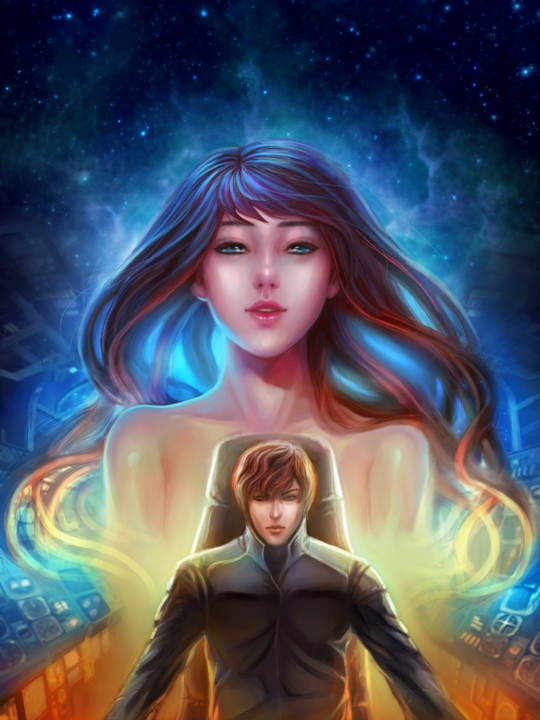
This omnibus edition doesn’t actually contain any new content, except for the author’s note which I’ll post a little later on the blog.  But if you’re just getting started with the Star Wanderers series, this is a slightly less expensive way to get the first four installments than buying them all individually.  Plus, the cover art is pretty kewl–at least, I think so. 🙂

If you’ve read the series up through Homeworld, I would really appreciate it if you’d take the time to post a review on the omnibus.  There’s no expectation to do so, of course, but it really does help things out a lot.  Also, if you’re a Goodreads user, you can add the omnibus to your library here.

That’s just about it for now.  At some point, I’d like to put out a print version, but I’m not sure whether to do the full omnibus or to do a sort of back-to-back edition, where it’s two novellas with the one printed upside down and on the other side.  What the heck–maybe I’ll do both.  But I still have to format the print version of Stars of Blood and Glory, so it might take a while before I get around to that.

In the meantime, I’d better get back to writing Part VII: Reproach.  This publishing stuff is all good fun, but the important thing is to keep writing.

See you around, and thanks for reading!

Thoughts on serials and ebook pricing

I’m going to do something potentially dangerous and discuss pricing strategies in a rather candid way.  I may risk turning off some of my potential readers, especially the ones who don’t like shorter works, but I want to be as open and transparent as I can, since I figure it’s only fair, especially to someone who’s just getting started with my books.

First of all, let me just say that if I could, I would make all my books free and write for love instead of money.  The trouble, though, is that I have to eat, and at some point in the (hopefully) not too distant future I’m going to have to feed a wife and children as well.  If I made all my books free right now, I would have to spend all my time and energy doing something other than writing, and as a result there would be far fewer books for you to read.

In the last year, I’ve discovered that the best way to make money self-publishing is to write in series, preferably at a short enough length that you can release a new installment every other month.  A lot of other writers are discovering this, which is why there is such an explosion of series and serials.

I know a lot of readers don’t like this.  And when a writer takes a perfectly good novel and splits it arbitrarily into parts, each one without a solid arc or story structure to hold it together, I get a little bit ticked as well.  But the reality is that if you can tell a story in a series of short, self-contained novellas rather than a single novel, it will probably meet with better commercial success.

The price points for novellas are kind of tricky, though.  For anything priced below $2.99, Amazon takes 65%, whereas from $2.99 to $9.99, the self-publisher takes 70%.  To give that some perspective, you would have to sell 10x the number of copies at $.99 to earn as much on one sale of a book at $4.99, and 6x for a book at $2.99.

The trouble, of course, is that for a series where each installment is priced at $2.99, the readers may end up paying a lot more, depending on the lengths of the story arcs and the size of each installment.  Novellas are kind of in a gray area, where $.99 seems kind of cheap for that much story, but three or four installments at $2.99 really add up–especially with so many other ebooks priced at $5 or below.

Now, I’d like to believe that most readers judge the value of a story by its quality and not by its word count, or by how much they have to pay per word.  There are books like City of the Saints that I don’t mind buying in $2.99 increments at all.  At the same time, though, I think there’s something to be said about keeping prices fair.

This is all on my mind right now because I’m getting ready to release the first Star Wanderers omnibus and expand that series considerably over the next year.  It’s the series that sells best out of any of my books, and the one with the most potential to make it so that I can go full time.  Plus, I really love writing in this universe, and have a lot more stories in it to tell.

Right now, this is the pricing structure I’m following:

  1. Outworlder — free (15,000 words)
  2. Fidelity — $.99 (17,000 words)
  3. Sacrifice — $2.99 (19,000 words)
  4. Homeworld — $2.99 (20,000 words)
  5. Dreamweaver — $2.99 (19,000 words)

Parts I through IV make a complete story arc, though of course each individual novella is a self-contained story on its own.  With Part I at free and Part II at $.99, I figure readers have a good way to figure out if these are the kinds of stories that they’ll want to read.  But if I keep pricing the stories at $2.99, at some point this series is going to get really expensive.

So here’s what I plan to do to alleviate that:

1) Make new releases free to newsletter subscribers.

For every Star Wanderers story up to this point, I’ve made it free for the first two weeks on Smashwords and given that code out through my email newsletter.  I did that originally as an incentive to get people to sign up for my newsletter, but I think it’s a good series strategy as well.  This way, if someone discovers Star Wanderers now, they can buy all the previous installments at the higher $2.99 price point and look forward to receiving any future installments for free.

Some may question the business sense of giving away free books to readers who are willing to buy them, but the way I see it, the fans are the ones who are selling these books, not me.  I’m willing to put a free book in the hands of someone who already loves the series, and is more likely to write a glowing review or to share it with a friend.  And since sales of this series continue to grow, that strategy would seem to be paying off (or at the very least, it’s not biting me in the ass).

2) Try to put more story into each individual installment.

If $2.99 seems a lot for a short novella, then maybe I need to expand on them, with things like extra subplots and viewpoint characters.  Of course I don’t want the stories to feel like they’re padded, but if I can enrich the story in a way that really adds to it, then that’s certainly something that I should do.

For all of the Star Wanderers series so far, each novella is told from the point of view of just one character.  This sort of focus can be good, because it really gets me into the head of that character.  However, sometimes it’s also good to play things off of another character’s story, both to act as a foil and to provide contrast.

That’s what I’m doing with Reproach (Part VII) right now.  It’s not just from Mariya’s point of view, but Noemi’s as well, and that adds a lot to the tension as you see their competing motives and the way their views of the world really clash.  It’s delicious.  Benefactor (Part VI) is just from Jakob’s viewpoint, just because I wanted the story to really focus on his character, but most of the other stories kicking around in my head have room for at least another viewpoint character without taking away from the spirit of the series itself.

3) Price the omnibus editions less than the sum of their parts.

For someone who is just getting started with Star Wanderers, $2.99 might seem like a lot to pay to get caught up.  That’s only going to get more daunting as the series gets longer.  For that reason, I’m inclined to price the omnibus editions much lower–at least $4.95, which is the price of one of my novels.  At 70,000 words or so for Parts I-IV, that seems only fair.

I am a bit worried that sales of the individual novellas will drop off once I release the omnibus, but I figure if I’m constantly releasing new ones, those should cover the slack.  Since Dreamweaver (Part V) is already out, and Benefactor (Part VI) will be out in another month or so, new readers who come in through the omnibus will have more than enough to keep them coming back.

The other benefit of doing it this way is that it reduces the chance that readers will drop out midway through the story arc.  It seems that a few of them are doing that, or at least taking a while to get from Part II to Part III to Part IV, etc.  By having them all in one omnibus and encouraging readers to buy that instead of the individual parts, hopefully they’ll have more of a chance to get hooked, making it all the more likely that they’ll keep coming back.

So that’s my plan, at least for now.  When The Jeremiah Chronicles comes out next week, I’ll price it on parity with my other novels, even though that’s somewhat less than all the individual parts.  I’ll make all new Star Wanderers novellas free for my newsletter subscribers, and do what I can to enrich them with extra viewpoints and subplots (without just padding them, of course).  This way, I hope my readers won’t feel like I’m ripping them off, and I’ll still have a good shot of making a decent living at this.

With the way things have been going, I’m actually really excited.  The slow build approach is working, and if it keeps up then I think I may be making enough to go full-time by this time next year.  I’ll be sure to keep you posted as things come along.

In the meantime, if you have any thoughts or comments, please don’t hesitate to share.  I’m still thinking this issue through, and there’s a lot I have left to learn.  In fact, I feel like I’m only just starting to figure it out, so any other perspectives on this topic would be much appreciated!

Update on STAR WANDERERS and a sneak peek at some cover art

So in case you didn’t know, I’ve been getting an omnibus edition ready for Star Wanderers.  It’s subtitled The Jeremiah Chronicles, and contains parts I-IV (Outworlder, Fidelity, Sacrifice, and Homeworld).  This covers the first major series arc, with all of the stories from Jeremiah’s point of view–hence the title.

I commissioned Ina Wong from Deviant Art for the cover, and this the result:

JV4 COMP

I must say, I’m rather pleased.  It’s got a very different feel from the current space photography covers, but I think this is a lot truer to the actual story.  I can’t commission art like this for the individual installments, of course, but for an omnibus edition, I figure it’s alright to go all out.

The only content in the omnibus that isn’t already in parts I-IV will be the author’s note, which I’ll either post here or include as a PDF to my newsletter subscribers.  In other words, don’t worry about missing out on anything if you’ve already read the individual installments.

I’m getting feedback from my alpha readers for Benefactor, the next part in the series, so I’ll probably release that one in the next six weeks.  In the meantime, I’ve picked up work on Reproach again (Part VII), and hope to finish the first draft before the end of the month.

Just as Dreamweaver is a parallel novella to Outworlder (from Noemi’s POV), Benefactor is a parallel novella to Fidelity (from Jakob’s POV) and Reproach is a parallel novella to Sacrifice (from Noemi and Mariya’s POVs).  After that, I’ll do a parallel novella to Homeworld with Lucca and Mariya as the main POV characters, and then branch out into some other characters and storylines.

The fun part about writing this series is that each new story seeds at least two or three others.  I just wish I could keep up!

I haven’t abandoned Lifewalker, but I did reach a point where I figured it would be good to take a short break just to keep things fresh.  My creative process seems to work that way.  As much as I’d like to train myself to stay on project until it was finished, creativity can’t be trained so much as fostered.  I set myself a deadline to finish something by May 31st, so now it looks like that’s going to be Reproach.

As for The Jeremiah Chronicles, all I have left is to write the author’s note and book description.  It should be out on Amazon, Barnes & Noble, and Smashwords by this time next week.  In the meantime, I’ll keep working on Reproach so you guys can have plenty more stories to read!

Chance to win GENESIS EARTH and SW-II: FIDELITY

In case you didn’t know, my fellow indie author and KBoards member Elle Casey has put together a book giveaway, and she was kind enough to include a couple of my books in it.  If you would like a chance to win a free ebook copy of Genesis Earth or Star Wanderers: Fidelity (Part II), head over to her blog and check it out.  I’m giving away 10 electronic copies of each title, but I’m only one author of many so if you sign up for my books there’s a very good chance you’ll win one.

The giveaway has a lot of different kinds of books, but they trend more toward YA and New Adult (a recently coined categorization that eludes me).  Out of all my books, Genesis Earth and Star Wanderers seemed like the titles that fit best, so those were the ones I chose.  But there are a lot of others to choose from, with no limit on how many you sign up for, so feel free to take your pick!

Tomorrow (Wednesday) is the last day of the promotion, so be sure to act quick!

Post A to Z update

So, the A to Z challenge is over, and it’s back to things as usual.  I hope you guys enjoyed it–I’ll probably compile the posts at some point, update them to add some more examples and references, and put it out as a $2.99 ebook.  When I get around to it, that is.  If that’s something that interests any of you, let me know and I’ll get it up sooner.

As far as writing goes, I just went back to work on Lifewalker yesterday, and the story is coming along swimmingly.  This is the post-apocalyptic story about a guy wandering down the ruins of I-15 with a copy of Brandon Sanderson’s Mistborn.  I checked with Peter and Brandon about that, and they said it’s okay.  In fact, they think it’s hilarious.  And it is, I suppose, though the book takes itself fairly seriously.

Just to give you an idea what I’m talking about, here’s an excerpt:

The first night, I stayed in a small village known as Sannakin. The people there were surprisingly friendly, though they assured me that they would have been more cautious if I had come from the south.

“What’s south of here?” I asked the village patriarch over dinner.

He shrugged. “Don’t know—never been that way. Get a lot of tinkers, though, and a merchant ever now and again. There’s people out there, that’s for sure—but it’s a wild and a dangerous country.”

I paid them for their hospitality by reading from Mistborn: The Final Empire. The story confused many of them, especially those who had never seen the ruins of a city. I explained to them that the forefathers used to live in great communes of thousands, or even tens of thousands of people. This sparked a vigorous discussion over how such a large community could possibly provide enough food for itself, and how it would handle the waste. Some people asked me if in the days before the Blight, ash covered the sky as it did in my book. I answered that it probably had, though doubtless the author had exaggerated it somewhat for the purposes of the story. This led to an even more vigorous discussion about the merits of fantasy stories in general, with most of the villagers forming a decidedly negative opinion of the genre. I strongly disagreed, of course, but held my tongue so as not to offend my hosts.

Today, I wrote a passage where the main character had to mediate an argument between two scholars over who was the primary god in the forefather’s pantheon: Batman or Superman.  In a few chapters, he’ll rescue a girl from a band of bloodthirsty cannibal slavers infesting in the ruins of Las Vegas.

As you can tell, this book is a lot of fun. 🙂

As for the publishing side of things, I’m working with an illustrator to get the cover ready for the first Star Wanderers omnibus.  It’s going to be for Parts I through IV, but don’t worry–if you’ve already bought the parts individually, there won’t be any new content except the author’s note.  I’ll either publish that here or send my newspaper subscribers a link for where they can read it.

I’m not sure if anyone really reads the author’s notes at the ends of my books, but I enjoy telling the story behind the story, so I’ll keep doing them.  Besides, I figure some of you have read them, since you’re signing up for my email newsletter and sending me an occasional fan emails.  I really enjoy those, by the way, so thanks for sending them!

That’s just about it for things over here.  In unrelated news, I recently discovered an excellent sci-fi webcomic.  It’s called Freefall, and the archives stretch waaaaay back to 1998 (!!!).  So yeah, I’m going to be busy for a while.

But don’t worry, I’ll still find make time for writing.  I’m doing about 2k words per day right now, so at that rate, the first draft of Lifewalker should be finished before the end of May.

Aaand my roommate wants to sleep, so I’d better get off the computer now.  Later!

W is for Wagon Train to the Stars

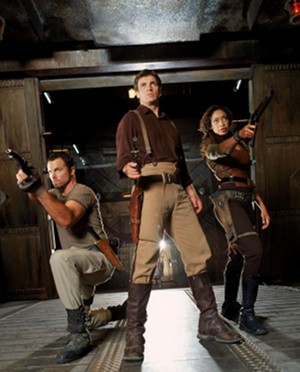
big_damn_heroes_moment_smallWhen Gene Roddenberry pitched the original Star Trek series back in the 60s, Westerns were all the rage.  Consequently, he pitched his show as a “wagon train to the stars,” where a bunch of quirky characters on an awesome starship travel from adventure town to interstellar adventure town, exploring and pioneering the final frontier.

Sound familiar?  Yeah, I thought so.  The concept proved so catchy that it’s been redone time and again, from Battlestar Galactica to Firefly to Doctor Who.  Even though Westerns aren’t nearly as popular as they used to be, many of its tropes are so well suited to Science Fiction that they drive the genre even today.

For example, adventure planets.  In a typical Western, the characters travel from town to town, with a different adventure in each one.  Well, in Science Fiction, the characters do the same thing, except that they’re traveling from planet to planet.  And really, if you’ve got the ability to travel to other worlds, how can you not have an adventure in each one?

A large reason for the Western / Science Fiction crossover is the whole concept of space as the final frontier, which we explored earlier in this series with I is for Interstellar.  There’s a very real sense of manifest destiny in the space exploration community, not because of humano-ethnocentrism (heck, we don’t even know we’re not alone in our local stellar neighborhood), but to ensure humanity’s long-term survival.  The parallels between that and the westward movement in 19th century America aren’t perfect, but they do exist.

Similarly, as we explored in R is for Rebel, the notion of space as the final frontier has a special resonance with the American audience.  The days of the old frontier may be over, but its spirit lives on in our culture, from guns to road trips to our glorification of the rugged, self-made individual.  Today’s Science Fiction, especially the space-focused SF of Space Opera, grew out of the adventure fiction of the pulps, which thrived on that frontier American ethos.

In fiction, the frontier can still be found in two major genres: the Western, which is historical and therefore more backward-looking, and Science fiction, which is futuristic and therefore more forward-looking.  Because Science Fiction isn’t burdened with all of the historical baggage of the traditional Western, it’s a much more flexible medium for story, readily adaptable to contemporary issues and concerns.

For example, where Star Trek echoes the large-scale nation to nation conflicts of the Cold War (Federation vs. Klingons and Romulans), the new Battlestar Galactica series echoes the much more asymmetrical conflicts of the post-9/11 world (Cylon agents who are indistinguishable from humans and may not even know that they are cylons).  At the same time, the wholesale co-opting of Western tropes enables a latent sense of nostalgia, evident in the look and feel of Firefly, or the famous opening lines from Star Wars: A long time ago in a galaxy far, far away.

My first real experience with a wagon train to the stars type of story was probably Star Trek: Voyager, which I watched religiously with my dad every Wednesday night until maybe 9th or 10th grade.  The Western-borrowed tropes are somewhat more muted in that series, but they exist, especially the planetville / adventure towns stuff.  However, it wasn’t until Firefly and Serenity that I really experienced the awesomeness of a true Space Western.  There were a lot of things in Firefly that I really loved, especially the character interactions, the gun-toting action scenes, and especially the starship Serenity.  There were some things I didn’t like so much, like the fact that every planet is basically Wyoming, but overall I really enjoyed the show.

It wasn’t until I started getting more acquainted with straight-up Westerns that I saw the real potential for crossover between the genres.  Stories about mountain men like Jeremiah Johnson really captured my imagination–what would this look like if it were set in space?  In that sense, I came to the Space Western more from the classic Science Fiction side first, rather than the pulp adventure stuff.  But once I discovered the crossover connection, it naturally found a way into my own work.

That’s basically how the story idea for Star Wanderers first came to me.  I was lying on my bed, daydreaming about having my own starship like the Serenity, when I wondered what it would be like for a starship pilot to get roped into an accidental marriage like in the movie Jeremiah Johnson?  The collision between the two ideas was like a supernova exploding in my brain.  I rolled out of bed and started writing, coming up with chapter one of Outworlder almost exactly like it’s written today.  And the more invested I became in those characters and that world, the more the story grew.  I’m writing Part VII right now (Reproach, from Noemi and Mariya’s POV), and so long as people read them I’ll keep writing more.

Genre mash-ups and crossovers are a great way to keep things fresh and come up with some really interesting stories.  Some genres aren’t very well suited for each other (Erotica and Middle Grade, for example), but others come together so well that they seem almost complementary.  That certainly seems to be the case with Westerns and Science Fiction, at least here in the United States where the spirit of the frontier still echoes through the popular culture.