Pulling along

Just a quick post, because it’s 3:30 am and I’ve got a TON of stuff to do tomorrow, such as:

1) cleaning checks
2) replace the air filter in my car
3) go running with my bro in law
4) finish Genesis Earth 5.0
5) band practice
6) watch Inception with a bunch of friends at the dollar theater

Yeah, tons of stuff.  So anyways…

I’m amazed at how quickly I’m pulling through Genesis Earth.  Yesterday I revised through 11.7k words, and today I did about 14.1k.

At this point, most of the work is sentence and paragraph level, and has more to do with voice and rhythm than actual story.  There were a few science issues, mostly having to do with distances and velocities, but thanks to Logan I think I’ve caught most of those.  Thanks so much!

I’m also finding out that this story is much better than I used to think it was.  With all the form rejections I’ve been getting for it, I wondered for a while whether I should put it back in the trunk and let it quietly die.  Now, however, I can see that it has a lot more promise than I’d previously thought.  Even if it isn’t published as my first novel, I really do believe that this story deserves a home.

At the same time, though, I’ve noticed some major differences between my writing in this piece and my writing in the stuff I’ve written more recently.  I’m not sure exactly how to put it, but I think it has something to do with voice.  I don’t want to say that Genesis Earth is more choppy, but it does seem a lot more…matter of fact, if that makes sense.  There are also a lot more rhetorical questions, but I think that’s an artifact of the 1st person perspective.

But even if the voice in this piece is different from my voice now, it’s different in a good way.  It feels more…YA?  I’m not exactly sure, but it seems to work.  The sequels, if/when I write them, will probably be in 3rd person (ala Spin and Axis by Robert Charles Wilson), and that’s going to create a much different feel than this book.

It worked for Axis, though, so I think I can pull it off–that is, if/when Genesis Earth gets picked up by a publisher.  I don’t want to write the other two books in this trilogy until I know the first one is sold.

In unrelated news, I had a job interview today.  It was with a wilderness therapy company, the same that wait listed me for the January training.  I really hope I get in–more than anything at this point in my life, I feel that I need to gain some major life experience.  Probably the biggest stumper question was “what three words would you use to describe yourself in your last job, and what three words would your supervisor use to describe you?” A difficult question, particularly when all your recent jobs have been temp jobs.  I think I did alright, though–now, we just need to wait and see.

In other unrelated news, I threw an awesome movie night tonight.  We watched Scott Pilgrim vs. The World, and maybe fifteen people showed up–most of them from Quark, but a couple of friends from some other places too.  Man, that Scott Pilgrim movie is epic. So hilarious, so entertaining, and at the same time, so true.  And then, we went to Dairy Queen and hung out until midnight hanging out.  It was great.

In still other unrelated news, I recently ordered the anime series Planetes on DVD.  It was at a good price, and I knew I’d buy it eventually, so I allowed myself to splurge.  I am so happy I did, because the science fiction elements are done surprisingly well.  All the little details, from the zero gravity handholds in the walls to the way the stations spin, are surprisingly true to real life, and the show’s vision of 2075 is not beyond the realm of our own possible future.  In other words, Planetes is quite possibly the best rocketpunk anime show out there, and a great source for inspiration.

Well, that’s enough for now.  Tomorrow, I will finish this novel and send it out to the agent who requested it.  In the meantime, though, it’s 4:00 am and I must sleep.

Juggling projects isn’t a good antidote to procrastination

Yeah, the title basically says it all.  I’m working on Genesis Earth 5.0 and Into the Nebulous Deep 1.0, and while I’m doing really well in the one, I’m not keeping up so much in the other.

First, Genesis Earth. Since I finished the previous draft more than a year ago, I thought I’d find a lot of problems, especially with my prose.  Instead, while a lot of the sentence/paragraph level stuff needs tightening, I’m finding to my surprise that the writing isn’t all that bad.

Today, I breezed through over 8k words, and that between running, donating plasma, FHE, and a bunch of other distractions.  If I put even a moderate amount of effort into this, I can have it finished before next week.  That’s good, because I had an agent at World Fantasy request to see it; if I can put it on her desk before Thanksgiving, that can only be a good thing.

But as for my other project, ITND 1.0…yeah, it’s not coming along as well as I’d hoped.  The reasons are stupid, too–mostly just lost momentum and writer’s avoidance.

Right now, I’m stuck in a scene where I’m trying to build romantic tension between two characters.  I feel like I have a decent handle on who they are…but for some reason, it feels a little too shallow.  Maybe that’s because I’m still discovering who these characters are, maybe it’s because I tend to go deeper than most–or maybe it’s just because it’s the kind of scene that’s hard to get into, but once you’re in, it really flows.  I just haven’t forced myself to write it–maybe once I do, these problems will go away.

I do feel like I’m doing a pretty good job setting up the story.  Last week, I ran the first chapter through my online writing group, and while it definitely had issues, everyone said that they would keep reading if this was a book they’d picked up off the shelf.  That tells me that at least I’m starting in the right place.

The characters, though, and the conflict…I worry that it’s not as deep or as hard-hitting as the first book, Mercenary Savior. I skimmed over that book just a couple days ago before sending it out to a friend from World Fantasy, and…wow.  I don’t want to brag, but I think I did a good job with that one.  A damn good job.

So can I pull off that kind of depth and impact in the second book?  That’s the fear, that it won’t live up to the first one.  And certainly, the rough draft won’t be as good–not by a long shot.  But the subsequent drafts?  I don’t know.

Maybe I should just write and worry about it later, though.  When I was in the middle of Worlds Away from Home, I constantly thought to myself how crappy the draft was.  When I got to the end, though, and looked back on how far the story had come, I realized that it had potential to be at least as powerful as Mercenary Savior–perhaps even more.  And to be honest, that came as quite a surprise.

I don’t know.  I hope I’m not just deceiving myself–it can be hard, when you’re toiling in obscurity, to separate the truth from your own self-deception.  But for now, things are going well–I’m making good progress in Genesis Earth, and while Into the Nebulous Deep has lost a lot of momentum, all it really needs is a good solid block of undistracted writing to get it going again.  Life is good.

Another excerpt from Genesis Earth

I made a lot of progress on the latest draft of my novel Genesis Earth last week, and figured it was time to post another excerpt.  This one comes from chapter 4, when Michael and Terra arrive at the star system they’ve been sent to explore.

A slightly truncated version of this excerpt won first place in the 2009 Mayhew short story contest at BYU.  I’ve made a few minor edits since then, mostly for clarification, but nothing too major.  Enjoy!

They say that cryofreeze is the closest thing to death short of actually dying.  I believe it.

First, you strip off your clothes and lower yourself down into the coffin-shaped cryo chamber.  The glass seals shut above you, and a cold, green mist fills the narrow space, penetrating your naked skin.  The mist contains chemicals that freeze your cells properly, so that they don’t crack or break when you thaw out–but it has a nauseous smell to it, and makes you feel sticky.  Your skin starts to change from pink to white to light blue, slow enough not to notice right away, but quick enough to catch if you know what to look for.

As the chemicals continue their work, you start to shiver.  Just before the cold becomes unbearable, sleeping gas seeps in through the top valves of the chamber.  You pass out, too stiff to peacefully fall asleep.  The rapid freezing process–where your heart and lungs cease their natural functions–happens while you’re unconscious.

They say that you don’t dream when you’re in cryo, but that’s a lie–they just don’t know how to explain it.  Neither do I, but I can say something about the experience.  The lines between the senses and your own thoughts blur together, until reality itself becomes utterly unrecognizable.  Imperceptible images flash across your awareness, beyond your ability to process them.

Maybe that’s what nothing itself feels like; after all, is it really possible to comprehend non-existence without thinking of it in terms of space and time?  I don’t know–I just know that I don’t want to go back there.

By the time you regain consciousness, the thawing process has already run most of its course.  The flashes and images become brighter and more perceptible.  You have a sort of falling sensation, during which you become aware of your body.

Painfully aware.

When you open your eyes, you’ve got a splitting headache and a nauseous stomach.  Every time you move, another muscle  cramps up on you.  If you aren’t careful, you empty your bowels right there in the chamber.

The glass hisses open, the chamber tilts up to a forty five degree angle, and your limp body slides down the cold metal back until you find yourself sitting on your ankles.  Your breath feels like fire in your lungs, and even though steam envelopes your body from all sides, you feel deathly cold.  Too weak to stand up, you fall forward onto your hands and knees instead.

The vomiting is the worst.  Forty year old bile splatters cold across the floor, followed by a good ten minutes of dry heaving.  Each convulsion is so painful, it makes you feel as if you’re coughing up your own stomach.  After you’re finished, you want to do nothing but lie on the ground–in your vomit or to the side, it doesn’t really matter–and cry.

But all that passes with time. After lying on the floor for what seems like hours, your body starts to take strength.  The headaches die down, and the cramps slowly diminish.  When you open your eyes again, the stars fade away like some kind of ebbing soda fizz, revealing the unfamiliar room in which you have awakened.  You bend your fingers, lift your arms, and slowly drag yourself away from that god-awful place.

After that, what is there to do?  Wash up, get dressed in your vacuum wrapped forty year old clothes, and clean up the mess.

My stomach throbbed as I walked onto the bridge, but I ignored the pain.  My aching body could wait; I had more important things to do.

The instruments showed that we had arrived nearly thirty light hours out from the central star, just outside the orbit of the fourth planet in the system.  An unfamiliar starfield shone through the windows, dimmed somewhat by the presence of EB-175 even though the star was still far away.  A quick review of the automated ship’s log showed that no significant objects had come anywhere close to the ship in the last two months.  Nothing had been sent to intercept us.

I blinked and reread the log, just to make sure.  If there was intelligent alien life, maybe they were waiting, watching us from a distance.  Or maybe the log was wrong.

My bodily needs eventually overcame my scientific obsession, however.  I stood up from my seat on the bridge and made my way to the ship’s tiny mess hall where I could find something to satisfy my cramping stomach.

I felt sick and disoriented for nearly an hour.  In that time, I ate some meal and fruit drink, but not much else.  It felt eerie to be alone on the ship, but I didn’t want to thaw Terra until I had recovered my strength.

After an hour, I was ready.  At least, I thought I was.

Terra didn’t look human–she looked like a giant doll, a pale, lifeless marionette.  Her skin was a whitish-blue, while her other features–fingernails, toenails, lips, nipples–stood out in high contrast shades of black and purple.  Her hair was darker than I remembered, as if the cryofreeze had sucked the color out of that, too.  The glass of the chamber was cold to the touch, and the expansion of her frozen bodily fluids made her body look slightly bloated.  I felt like a voyeur staring at her, but the sight was so morbidly fascinating that I could hardly turn away.

Eventually, however, I got myself together and started the thawing process.  A hissing sound came from within the chamber, and a greenish mist washed over her.  Gradually, almost imperceptibly, redness and color began to return to her skin.  Her body deflated as the temperature in the chamber rose and her bodily fluids began to melt.  A robotic arm with two suction cups fastened onto her chest and twitched as a series of quick electric shocks restarted her heart.

I periodically glanced down at the control screen, monitoring the various measures of her status.  My legs felt stiff, and my hands trembled–I’d never run through this procedure before, and I barely knew what I was doing.  The process was supposed to be fully automated, but cryonics is an imperfect science, and problems frequently arise.

About ten minutes in, I noticed something unusual.  Little blue splotches were forming on Terra’s skin at the extremities on her hands and feet.  After half a minute, they started showing up on her thighs and torso.  I frowned; that didn’t seem right.  I adjusted the heating pattern inside the chamber, but the blotches didn’t go away.  Instead, the bleeping from the computer that marked her heartbeat started drifting into an unpredictable pattern.

With sweaty palms, I accelerated the thawing process.  The uneven heating was probably causing blockages in her veins and arteries.  I’d need to break those up soon, if her heart, brain, and lungs were to fully revive their functions.  She could only last so long on the machine–

Without warning, the bleeping turned into a constant monotone.

I glanced down and cried out in shock.  The line showing her heartbeat had flatlined–according to the machine, she was clinically dead.

I frantically keyed in a series of commands on my console.  The robotic arm reattached the suction cups to Terra’s chest and reapplied the electric shocks.  To my relief, her heart started beating again, but weaker and more erratic than before.  A second later, the warning indicators on half the instruments blinked on.  My heart skipped a beat as they flashed in rhythmic chorus.  This was serious–very serious.

“Please, no,” I said, face paling.  There was no-one on the ship to hear me, though; I was alone.

Within seconds, I figured out what the problem was.  Micro-cramps in her muscles were causing uneven heating, cutting off the arteries and capillaries in various parts of her body.  Her heart hadn’t recovered sufficiently to break the blockages, so they were spreading.

My hands trembled so much I doubted my fingers could type a coherent sentence.  In spite of that, I worked as quickly as I could to counteract the complications, maintaining constant periodic shocks to her heart and significantly increasing the heat on her upper torso.  With any luck, her blood would warm up enough to relax the contracted muscles and break the blockages.    Still, most the indicators remained in the red–the electric shocks were simply unsustainable.  I waited as long as I thought I could, then crossed my fingers and shut them off.  Her heart kept pumping, but the beat soon drifted back into unpredictability.

I glanced up at the cryo chamber and caught my breath.  Her arms, legs, and chest twitched and convulsed at utter random, undulating in a slow motion seizure.  She had no control of her body.  Chills ran down my neck and arms.

She needed more than the machines could give her.  I pulled out a syringe from the medical cabinet and nervously fumbled through nearly four dozen canisters of liquid drugs.  The wrong injection could kill her, but if I didn’t give her something right away, she didn’t have a chance.  I grabbed the formula that I thought would best relax her muscles and filled the syringe.

A few of the indicators were moving out of the red when I returned, but the situation was still serious.  A brainwave scan showed that her body was operating 85% autonomously from the machines and that she had regained partial consciousness.  I waited until the indicator reached 95% and cracked open the glass.

Steam poured out of the chamber and splashed across the ceiling, while the sound of violent coughing came from within.  Terra half slid, half fell to the ground.  I rushed forward and caught her before she hit the floor, and she responded by vomiting on the front of my shirt.

Despite the heat of the steam, her skin felt cold, and her vomit even colder.  I held her off to one side and patted her back to help her force it out.  She stopped twitching and coughed a couple of times, but quickly grew weak in my arms.

“Come on, Terra!” I pleaded.  Her breathing was too ragged for her to respond.

There wasn’t any time to lose.  I pulled out the syringe and balled my fingers around it into a fist.  It was built for a fast, emergency injection–the kind that could be jammed into someone’s leg.  I brought it down on her right thigh.  Her blotchy-blue skin rippled a little, and the fluid went in almost immediately.

A couple of seconds passed before the medicine took any effect.  When it did, her whole body went stiff, and her eyes opened wide, revealing dilated pupils.  Before I could react, she started convulsing violently, as if she were going into a seizure.  I set her on the floor as gently as I could and held onto her head to make sure that she didn’t injure herself.

After about fifteen seconds, her body went limp again.  I put two fingers up to her neck and felt for a pulse.  To my relief, it was steady and strong.  I sighed and practically collapsed.

As if in response, her chest heaved and she started vomiting again.  I scrambled to my knees and turned her onto her side.  How much stuff did she have in there–hadn’t she followed the 24 hour no food rule?  No time to worry about that–just help her get it out without choking on the stuff.

She vomited and coughed until snot dripped down her face and the hoarse sound of her dry heaving filled the room.  She was still too weak to sit up, so I supported her as best I could until she stopped.  Sobs of pain slowly replaced the retching.

“Are you all right?” I asked.

What a stupid thing to say!

She looked up and gave me an icy glare.  Tears and snot mingled on her cheeks. “No!” she shouted, then went back to coughing.

I held her until she began to quiet down.  With the worst of it gone, relief came slowly to my nervous body.  Her skin was getting warmer and her heartbeat was steady now.  After forty years on the threshold of death, she was alive again.

Alive and completely naked.  My cheeks flushed, and I set her on the floor.

“Can you stand up yet?” I asked.

“Not…yet,” she groaned. “Cramps…everywhere.”

I grabbed a towel on the side of the control panel and hastily draped it over her.  She reached up with a hand and weakly held onto it.  I waited until her breathing became less labored before asking her again.

“How about now?”

She clenched her teeth and nodded.

I stood up and took her by one hand, pulling her gently to her feet.  She bent her knees carefully as she sat up, still holding onto the towel.  When she was standing up, she let go of my hand and reached out for the wall.  The towel fell off of one side, but she didn’t make any attempt to fix it.  She still seemed fairly incoherent.

“What’s…our…status?” she asked.

“Everything is going well.  We’re about two light hours out from the system.”

“Good,” she groaned, slowly wrapping the towel back around her.  I almost reached out a hand to help, but hesitated.

“D–do you need help?” I stammered.

“No, thanks, I think I’ve got it.” She glanced up at me, then down at my chest and grinned. “Sorry about your shirt.”

“What?” I looked down and saw the vomit. “Oh, that.  Don’t worry about it.”

She nodded weakly and closed her eyes.

“Are you sure you don’t need help?” I asked.

“I don’t…think so.  Getting…better.” She staggered away from the wall and nearly fell over. “So…cold…”

She had stopped shivering.  That was a bad sign.

“Here,” I said, taking her hand. “Follow me.”

If she wasn’t shivering, her body wasn’t generating enough heat yet and she was at serious risk for hypothermia.  The best way to counteract that was to immerse her in warm water.  I led her down the hall and into the narrow, cylindrical shower unit in the bathroom.  She nearly passed out on the way there, and I practically carried her the last half of the way.  The towel fell off in the hallway, making things only more awkward for me, but that was no longer important.

I leaned her up against the smooth wall of the unit, and she slid down to her knees.  Her skin was sickly pale, her arms limp, and she mumbled incoherently as her head flopped back against the wall, hair partially covering her face.

I bit my lip and reached around the side to activate the water.  Should I turn the heat up to full, or would that give her system too much shock?  My heart pounded in my chest–no time to waste.  I set the temperature to low-warm and hit the activate button.

Jets of lukewarm water shot out from all sides, drenching my already soiled shirt and running out into the room.  Rivulets ran down Terra’s face and pale skin, but she didn’t move.

“Come on,” I said, ignoring the water soaking my clothes as I knelt down and put my hands on her shoulder. “Terra, are you alright?  Terra!”

I pressed my fingers against her neck and found a pulse.  Her body shuddered and she coughed.  Nothing else to do but give her some space and let the shower do its work.

My heart still pounding, I stepped out of the unit and shut the door.  My shirt was soaking wet, and Terra’s watery vomit ran down my legs and pooled on the floor.  As I stood there dripping, Terra stumbled noisily to her feet, teeth chattering.  The diffuse glass began to steam up, indicating that she’d turned up the heat on her own.

She was recovering.

“Your clothes are outside,” I said as I pulled out the vacuum sealed bags and put them on a shelf next to the door.

“Okay,” she groaned.

“Are you okay?  Do you need any more help?”

“No…thanks,” she muttered.  I left the room.

When I reached the hallway, I leaned against the wall and promptly collapsed in exhaustion.  A puddle of grimy water formed around me on the floor, but I no longer cared.  I sat there by myself for a long time.
Word splurge and refining the query

So this morning, I worked on the fifth draft of Genesis Earth while Facebook chatting with some friends I made from World Fantasy.  Next thing I know, it’s 4:30 and I’ve revised through 6.5k words.

To be fair, most of that work was pretty simple–polishing the prose, cutting unnecessary verbage, and the like.  But…wow.  Talk about a splurge.

Because of that, though, I didn’t get any work done in my other project, Into the Nebulous Deep. However, I did do something I’ve been needing to do since before World Fantasy: draft a query letter for Mercenary Savior. Here it is:

Dear _______,

My name is Joseph Vasicek, and I am writing to query my science fiction novel, Mercenary Savior.  I thought my work would be a good fit for you because ______.

As the galactic empire slowly collapses under the onslaught of the starfaring Hameji nomads, the sixteen year old James McCoy sets out to rescue his older brother and sister, Ben and Stella, from the Hameji conquerors.

Things look bleak until he meets Danica Nova, captain of a down-and-out mercenary company, who takes him in and becomes his mentor.  James reminds Danica of her brother, whom she failed to save when the empire slaughtered her family years ago.  Now, she hopes to find some redemption from her demons by saving James from his own.

However, as the two of them spiral onto a collision course with destiny, neither of them realizes that Stella has become a concubine to the Hameji overlord–and that Ben has been brainwashed and made an elite shock trooper in the unit sent to hunt them down.

Mercenary Savior is approximately 120,000 words long.  While it stands on its own as a complete story, it has potential for at least one direct sequel and several indirectly connected novels set in the same universe.

My previous publications include one short story published in the December 2009 issue of Leading Edge.  I have also won first and second place in the annual Mayhew short story contest at Brigham Young University (for 2009 and 2007 respectively).  In addition, I keep a regular blog at http://onelowerlight.com/writing.

Thank you very much for your consideration.  As noted in your submission guidelines, I have included _____.

Cordially,

Joseph Vasicek

So what do you think?  Does the pitch work?  Does it resonate well, or is it boring / cliched / confusing in any way?  Any thing else egregious that I should fix before I send this out?  Please let me know!

I really suck at submitting stuff.  Right now, I’ve only got three or four queries out on Genesis Earth, and one on Mercenary Savior. Like most things, though, the only way to change that is with practice.  By next week, I want to send out at least five queries on Mercenary Savior and have the synopsis ready to go.

Also, my friend from World Fantasy had an interesting suggestion for me: try to break into the small presses with my science fiction stuff, to build a name for myself, and work my way up from there.

This runs directly contrary to Dave Wolverton’s break in with a bang philosophy, but it makes sense; very few major publishers seem to be publishing much space opera these days (with the exception of Baen).  From what I gathered at World Fantasy, science fiction is a difficult sell these days, and several sf writers are going this route.

I could write more, on other subjects, but that’s enough for now.  Good frickin night.

10k words and going strong

Today I crossed the 10k mark for my newest project, Into the Nebulous Deep. It’s a little bit behind in terms of nanwrimo, but I’m confident it will be on par before the end of the week.  I wrote 2.6 words today, and I’m hoping to keep that fairly steady as I move on into the month.

Since I’m between jobs at the moment, I’m hoping to get my daily word counts up to between 4k and 5k and keep it there consistently.  Sounds daunting, but I know it’s possible because I did it back in June and July of 2009.  If I could enjoy that kind of productivity again, that would be awesome.

Over the past few weeks, I’ve taken a good, hard look at my routine from that time to figure out how I did it.  Here are some of the key things that stood out to me:

1) I was waking up each morning in a timely manner.
2) I was exercising regularly.
3) I was splitting my time between two projects (one revision, one drafting).
4) I would leave my apartment and go somewhere else to write.
5) I had a short ritual I’d go through to focus myself on the project.

Of these, I think the most important were 1, 2, and 3.  A strong, early start to the day is always helpful, and exercising is not only good for you physically, it boosts your creativity for a short period of time as well.  For that reason, I recently bought a pair of good running shoes and started running.  Today was the first day, and it felt great!

Three was the most surprising, because whenever I was busy with school, I found it impossible to juggle two projects at once.  But out of school, it makes sense: work on the first one until you hit a rough patch, then shift gears and work on the other until you find what you need to pick up the first one again.  It helps to exercise two parts of the brain, so juggling between revision and drafting t is probably for the best.

As for going somewhere else, I’m reluctant to do that since my only other computer is a tiny little netbook–but if things get rough, you may start seeing me around the Provo Library more often.  I remember over the summer, this one chapter in Worlds Away from Home was just killing me, so I took my netbook to the Provo river trail, sat down on a bench, and muscled my way through it.  It surprised me how quickly I punched through it–because if I were at my apartment, I know it would never have gotten done.  It was just too tough.

The last one was kind of a quirky little thing for the second draft of Mercenary Savior (I called it Bringing Stella Home back then), but it would be a good idea to do the same with these other projects.  For Mercenary Savior, it involved watching the opening credits of Fistful of Dollars.  For Into the Nebulous Deep, I’m not sure what the ritual will be, but whatever it is I’ll make it awesome–without spending too much time on it.

So anyways, that’s what’s going on on the writing front.  In response to a nibble from an agent, I’m doing a fifth draft of Genesis Earth, but I haven’t gotten past the first chapter (which I posted).  Soon, I’d like to be doing about 2k to 2.5k on Nebulous Deep per day, and 2k to 2.5k in the revision of Genesis Earth.

There’s more, but I’m starting to fall asleep at my keyboard, so it’s time to wrap this up and post it.  Keep up the writing, nano-ninjas, and good luck!

Excerpt from Genesis Earth

I spend a lot of time posting about my writing, but up until now I’ve never posted any of it.  Well, I figured it was time to change that and post something from my second unpublished novel, Genesis Earth.

Here’s how I’ve been pitching it in my queries:

Michael Anderson is a young, obsessive planetologist haunted by the fear that he will never live up to the legacy of his astrophysicist parents. Terra Beck is the outcast child of a bitter divorce, who only wants to run away and immerse herself in her one true passion: astronomy. Neither of them has ever set foot on Earth, but when Michael’s parents construct mankind’s first artificial wormhole, both of them are naturally chosen for the exploration mission to the Earth-like planet on the other side.

Shortly after their arrival in-system, Michael finds himself in an unanticipated first contact situation when an enormous alien ship appears out of nowhere and begins to converge on their position. When it ignores all their transmissions and shoots down their probes, the situation quickly degenerates into an emergency. To make matters worse, Terra secludes her self in the observatory and stops sharing her data with him.

Alone, twenty light years from the nearest human being, they must learn to open up and trust each other. As Michael struggles to keep the mission from falling apart, he is forced to reexamine his deepest, most unquestioned beliefs about the universe–and about what it means to be human.

Right now, I’m running it through a fifth draft before I send it to an agent I met at World Fantasy.  Here is the prologue, where Michael begins his tale.

Enjoy!

Chapter 1

Earth was a ghost that haunted me. She was the single greatest thing that set us space-born apart from the older generation, the five hundred members of the original mission team. Though Heinlein station was the only home I had ever known, I soon learned that Earth, a world I had never seen except in pictures and videos, was where I was truly from.

My parents set the decorative screens in their bedroom to cycle through pictures of old Earth. While they were busy working in the lab, I would often sneak inside and stare at those images for hours. The landscapes and skyscapes they depicted were always so alien to me. Unbroken blue expanse overhead, instead of the grayish space rock of our asteroid. That line between floor and sky known as the ‘horizon.’ Solid ground underfoot, instead of the milky starfield shining up through transparent floors. Trees, plants, and shrubbery growing freely without the aid of hydroponics. Hundreds of human beings walking down wide open-air corridors called ‘roads,’–more people than I’d ever known in my life.

When I was about five years old, I used to ask my mother to bring out her photo album–the one with actual, physical pictures from the old world. I would sit on her lap and stare wide-eyed at the pictures as she explained them to me. That was my uncle, that was my grandmother, those were my cousins: faces from an unreachable world nearly half a light year away and getting further every moment.

One day, sitting on my mother’s lap, I glanced up from the album and saw tears in her eyes. That was the first time I had ever seen my mother cry. It made me feel frightened and unprotected, even in her arms. I never asked her to show me the pictures of Earth again.

Perhaps you’ve found, as I have, that the things that frighten you incite more fascination than the things you love. I trace the beginning of my career as a planetologist to that childhood incident, sitting on my mother’s lap. Years later, when I began my graduate level education, there was never a question in my mind what I would study. I had already chosen.

To me, planetology was never about physics, geology, or chemistry. Those were only the details. It wasn’t even about making a lasting contribution to the science–at least, not when I first started. I studied alien worlds simply to turn the lights on–to dispel the ever-present ghost of Earth that had haunted me from my childhood.

Did it work? Not really. But as I grew, my fascination with Earth grew with me.

Fourteen might seem like a young age to enter one’s chosen field, but you must realize that half the people on Heinlein station were highly trained physicists and engineers. With so many scientists on board, there was no shortage of teachers for those of us who grew up on the station. My parents personally tutored me, and they were two of the most brilliant physicists Earth had ever produced. They were, in fact, the chief scientists over the Mission itself.

The Mission was the closest thing to religion that I ever had. If religious devotion is measured by sacrifices incurred on the basis of unproven belief, I suppose that everyone on the station qualified for sainthood. We had set out from Earth to create mankind’s first wormhole, or prove that it could not be done. For this, my parents had given up everything: family, friends, their homes. Everything. The only safe place for such an experiment was two light years from Earth, and so we spent my entire youth and childhood in transit, not knowing whether the Mission would succeed or fail.

My study of planetology won me a great deal of admiration from the old timers, much to my surprise. Grown-ups who only a few years ago had chastised me for playing hide-and-go-seek in the labs now treated me like someone important. The scientists and engineers routinely asked me what I thought we’d find once we’d opened the wormhole. After all, why would a fourteen year old study about alien worlds if he didn’t expect to visit them someday? They treated me as if I had run some sort of gauntlet or passed a test of tremendous faith. I was one of them, united in the hope of a successful outcome to the great experiment–or, stranger still, I was a role model to them, someone with the faith they struggled so much to keep.

They could not have been more wrong. I didn’t want to explore new planets or set foot on an alien world. The closest I ever came was through the eyepiece of a telescope, and that was the way I wanted it. My studies were purely academic.

When I turned eighteen, we arrived at ground zero. The station became a flurry of nervous energy as we maneuvered into position and set up the hundred trillion kilowatt NOVA generators and focusing mirrors for the graviton beams. With everything spread out across hundreds of cubic kilometers of space, it took us nearly two months before we were ready.

Twenty two years after embarking from Earth, on June 24th, 2143 C.E., the day of the experiment finally arrived. That day forever changed the course of my life.

At the moment of truth, I lay sprawled out on the transparent floor in my room, watching the stars turn beneath me. Large crowds had gathered in other locations to watch, but I preferred to be alone. My father’s voice came over the station-wide radio, giving his moment-by-moment report. Though I was alone, the excitement on the station was so thick could almost taste it.

I hear that it’s common for people on Earth to dream about falling from a great height. I’d never had that dream–the concept of vertigo meant nothing to me. I think I got a taste of it, however, as I watched the wormhole form in the sky.

The starfield began to spread out from a single dark point, the way a film of oil on water separates when it touches a drop of soap. The hole grew surprisingly fast, pushing the stars aside and forming a circle of warped, diffused starlight around its edge. I gasped in fright; the center was pure black, the color of an abyss. As it grew larger, I felt as if it were sucking me in. Soon, however, the hole stabilized, as if it had always been there.

As the station rotated, I discovered that the wormhole had warped the starfield beyond all recognition. I tried to find the constellations I’d known so well, but could only pick out one or two. I felt sad knowing I’d never see any of them again.

The scientists didn’t take much time off to celebrate, but when they did, they went completely wild. Alcohol was everywhere in abundance, from numerous stores and hoards that had been kept for this very occasion. The shiest, most reserved people danced drunk in the hallways, and old enemies who hadn’t talked for years walked up and down the corridors with arms on each others’ shoulders. A spirit of happy, universal friendship swept over the station. People let their guards down, took off their masks, and momentarily forgot any hard hard feelings. It was a glorious time–the end of history.

Eventually, though, the celebration lost steam, the hangovers died down, and we woke up to face the inevitable future. Our robotic probes explored the wormhole and made some basic observations of the other side.

Their findings were frightening enough to sober us all.

Graviton theory told us how to create an artificial wormhole, but it gave us no way to predict where it would open up. We could expect one of three possible outcomes: first, that the wormhole opened to a different location in our present universe; second, that it opened to a different location and different time in our universe; or third, that it opened to an entirely different universe than our own. In every meaningful way, however, we were shooting blind in the dark.

The first observations showed a universe very much like our own, with stars, galaxies, and other nebulae. Just twenty light years away, orbiting a yellow-white main sequence dwarf, the probes discovered a handful of exoplanets. One of them, a terrestrial world, orbited within the star’s habitable zone. An initial spectroscopic survey revealed that the atmosphere of the planet was rich in oxygen and nitrogen–just like Earth.

That was when we detected the signal.

The last probe to return picked up an unnatural high frequency radiation burst, originating from the system with the planet. It lasted only half an hour before dissipating, but was powerful enough to be detectable halfway through the wormhole. No naturally occurring object emitted that kind of signal. The only thing we could compare it to was the radio emissions from a standard NOVA engine–but even then, the signal was more than a hundred times more powerful than anything our technology could produce.

In other words, something strange was out there–something we couldn’t explain. The only way to find out more was to send out a mission to explore the alien star.

As the only qualified planetologist young enough to survive cryofreeze, I was an obvious pick for the mission from the very start. Though I never wanted to go, I couldn’t refuse; if I had, my parents would have killed me. This, they believed, was our moment in history–our moment to make a truly historic contribution to science and humanity. Why wouldn’t I jump at such an opportunity? Of course I would go.

I didn’t become a planetologist to set foot on alien worlds. That was the last thing I ever wanted. After we opened the wormhole, however, what I wanted no longer mattered.

Or so I thought.

Update on things

Revised the first chapter of Mercenary Savior today.  I will probably revise it a couple more times before this draft is finished, but at least I’ve done it once.

For some reason, most of my alpha readers didn’t give me too many comments to work with.  I’m not sure if that’s a good thing or a bad thing, but in practical terms it means I’m mostly on my own.  Still waiting for some to get back to me, though.

Last week, I wrote the prologue, where as a young woman Danica returns to her home only to find her family massacred by hired thugs.  It was…surprisingly dark.  Charlie liked it, though, so that’s a good thing.

Charlie also complimented me on my prose, saying that it improves every time she reads something of mine.  That’s a pleasant surprise, since I certainly don’t notice any difference–but then again, I’m so close to my own writing that improvement is hard to see.  Good to know that my craft is getting better, not getting worse.  Thanks!

Last week, I realized that I didn’t have any submissions out for Genesis Earth. None at all.  I sent out a query on Saturday, but it was surprisingly difficult.  Submitting is definitely not my strongest point; I really need to work on that.

In unrelated news, I’m flying home tomorrow to spend the week with my parents.  I asked to come home for my birthday present; my mom’s health insurance through her work covers me until September, but only in Massachusetts.  Since I haven’t had a dental checkup in years, I figured it would be good to get that done.  Also, it’s a nice break and a chance to see my folks.  I’m looking forward to it.

Let’s see, what else is going on?  Oh!  The Kepler Mission announced a press conference for Thursday to discuss “an intriguing star system” they recently discovered.  Needless to say, I can hardly wait!

Also, no less than 6 fellow quarkies are moving in to my apartment complex this next semester.  Six!  And they’re all girls!  If Baggins old place was Bag End, and his new place is Rivendell, our complex is freaking Minas Tirith.  And we’re forming a dinner group, too!  This next year is going to be awesome.

And that’s just about it for what’s new in my world.  I came just shy of 4k in Mercenary Savior today, and I hope to keep that up (or do more) until I get a new job.  For now, let me leave you with this EPIC chipophone presentation from lft.  8-bit music ftw!

Almost at four

I’ve got half a dozen things I could blog about, but it’s 2 am and cleaning checks are tomorrow, so I think I’m going to give a quick update and go to bed.

Worlds Away from Home is doing quite well–I’m only two chapters and five scenes from the end.  I’d push really hard to finish it tomorrow, but I’m still waiting on some of my alpha readers for Mercenary Savior and probably won’t start that project until after I go back to Massachusetts at the end of the month.

I’ve been thinking a lot about the seven point story structure Dan Wells talked about at LTUE 2010 (which I missed, but caught on youtube), and I’ve got a TON of ideas for Mercenary Savior now.  I’m practically chomping at the bit to start analyzing this story and working out all the complex plot and character elements.  That’s very good.

While chatting with one of my alpha readers for Mercenary Savior, I had an interesting idea for a direct sequel.  Basically, while James’s storyline has some closure (or should, after I finish this next revision), he’s still got a lot of growing and maturing to do.  My mind is already working it out…should I make that my fifth novel?  Or move on to something else first?  The thing about direct sequels is you can’t sell them without the first book, and if the first book doesn’t sell…

I’m applying for Redcliff Ascent; if all goes well, I’ll be participating in the November training (since September is full).  At first, I was hesitant about this (since I kind of need a job now), but looking at it now, that’s probably the best time to do it.  It’s after World Fantasy, which gives me time to finish Mercenary Savior, and late enough in the year that I can still finish that article for Mormon Artist.  Plus, I can easily get a schedule that allows me to attend LTUE 2011.  The only disadvantage is that I won’t be able to attend all of Brandon Sanderson’s English 318 classes, but that’s not such a big deal (seeing as I’ve taken the class twice already!).

Other than that, life is good.  I’m going home in a week to see my parents and get my teeth done (since my mom’s health insurance covers me until my birthday in September–why pay for a checkup when you could have it for free?), and I’m definitely looking forward to that.  And now that I’m almost finished with Worlds Away, I can see that it’s got potential, and that’s encouraging.  Not this draft, certainly, but once I fix all the holes, it could really go somewhere.

Either way, it’s going to be nice having four novels under my belt.

Story notebook #2

A while ago I rediscovered my first story notebook and wrote a few posts on it.  I promised I’d do the same for my other story notebooks, so here’s the next one.

For those of you who may be surprised that I’m sharing all my story ideas, let me explain why I’m doing this.  First, ideas are cheap, especially in genres as imaginative and inventive as science fiction and fantasy.  What really matters is the execution, and any two people’s take on the same idea is going to be different. For that reason, I’m not too worried about anyone “stealing” my ideas.

Second, and more importantly, I believe that the only way for ideas to grow in value is for them to be shared.  Ideas that get horded only worsen with age, because they’re not being explored. Only by exploring ideas can they come into their full potential, and the best way to explore ideas is to share them.  When we fail to share our ideas, we inevitably fail to explore them from all angles, because working alone in a vacuum, we’re so much more likely to miss something crucial.

Enough of that.  Here are the story ideas from my second notebook, roughly covering the fall of ’08, right after I finished my first novel and got back from Jordan.

How will myths arise in the space exploration age? Previously, myths formed perhaps because people had very limited means of communication and limited means of world awareness. Now, technology allows much better spread of information and science, but in isolated spacecraft, will [the conditions of isolation that lead to myth formation] return?

An interesting and somewhat complicated thought. How do myths form, anyway? I suppose that at the very least, the extreme isolation of space will lead to a proliferation of wildly different cultures and worldviews.

Just as the Catholic monks set up a monastery in Iceland, so people will go beyond the explored universe in the age of space travel and set up a religious order there.

Fascinating–and I think it runs somewhat counter to the grain, too. Most people tend to see space explorers as either adventurers or absolute believers in pure science–but what about the devoutly religious? If the Catholic monks set up a monastery in Iceland, is it possible that the monks of some other religious order may set one up on Mars, or Alpha Centauri, or Gliese?

And…that’s all I’ve got in this notebook. Sorry–there’s lots of scribbling and calculating for Genesis Earth, as well as library call numbers for books about Saladin and the Crusades, but not too much else in the way of story ideas. For more, you’ll have to wait until story notebook #3.

Second Quarter 2010 report

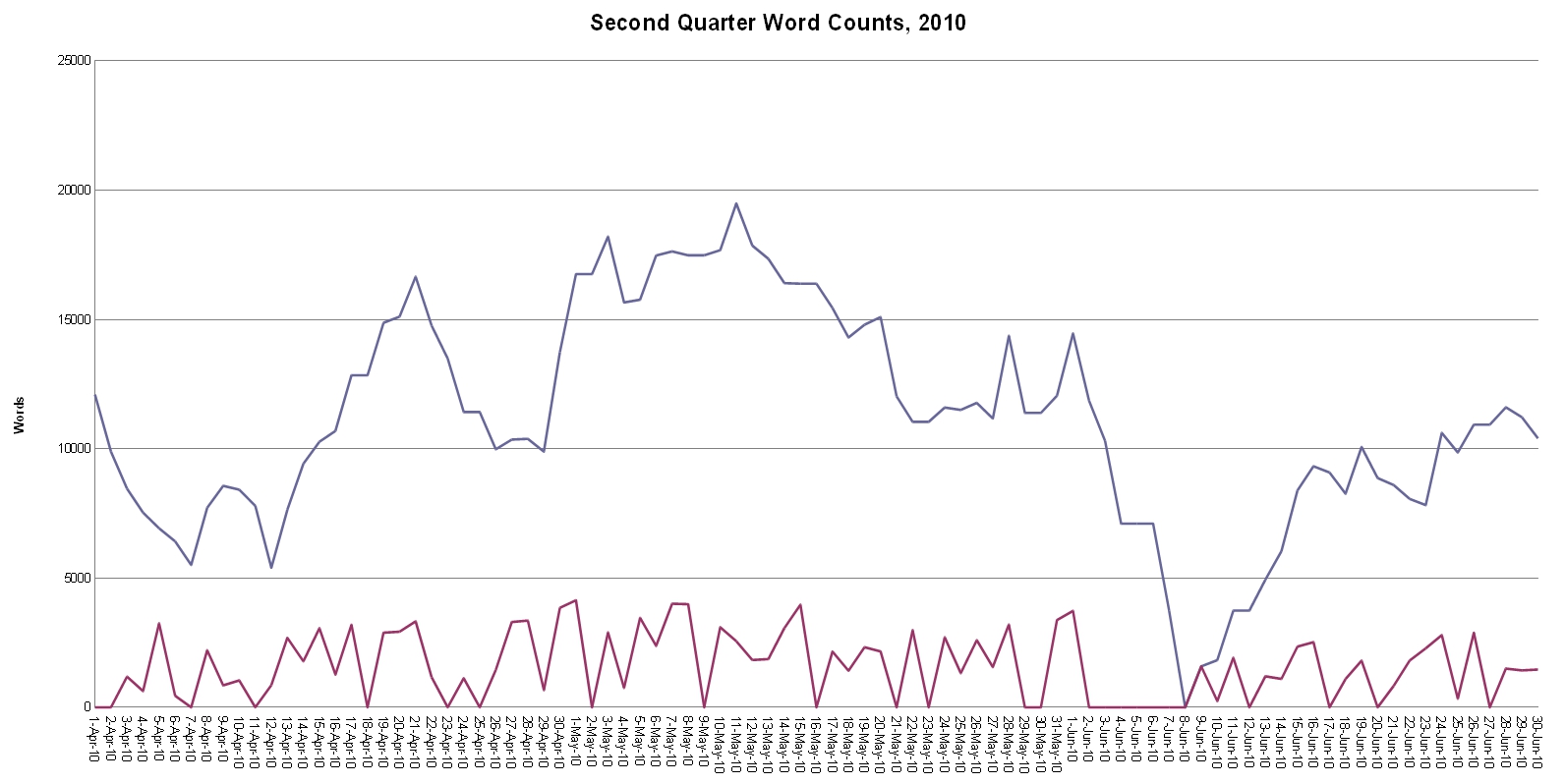
As you may or may not know, I keep a spreadsheet of my daily word counts.  Nerdy, I know, but you’d be surprised how helpful it can be with keeping goals and staying motivated.  As part of that, I’ve decided to do a quarterly report here on my blog.  Here’s my report for April 2010 through June 2010:

The red line shows my daily word count, and the blue line shows a running 7-day total.

At the beginning of April, I was somewhere in the middle of writing Mercenary Savior 3.0. I was also in the middle of a long and strenuous debacle with BYU’s Washington Seminar.  Long story short, I got kicked out under disputed circumstances.

Anyway, that explains the sharp dip in the first couple of weeks.  I returned to my parents’ house in Massachusetts on April 6th and spent a week there before moving out to Utah; that explains the short lived bump from April 6 to April 12.

So three weeks before graduation, I came back to Utah with no job, no apartment, no transportation besides my own feet–nothing.  Fortunately, some friends helped me out, and for the rest of April and most of May I at least had transportation (bike) and a roof over my head.

Without a job, I had lots of writing time, and I used it well, as you can see.  The sharp dip at the end of April corresponds with graduation, when all the family was over and I was spending most of my time with them.

Things dropped off the second half of May, though, and I’m not sure why.  Perhaps it was writing fatigue?  I was coming up on the end of Mercenary Savior, and as I remember, the revision was fairly tough.  Also, I was stressed out about not having a job, and spent much of my free time looking for work.  I found my current part-time job at the end of May, and had a few spikes, but my output never totally recovered.

As an experiment, I took a week off from writing after finishing Mercenary Savior on the first of June.  I thought that this would help me recharge my creative batteries and get off with Worlds Away from Home on a good start.  Instead, I found that taking the time off made it harder to get back into creative writing mode, and so I struggled for the first week or two to really get that project off the ground.

Lately, I’ve been trying to bump up my output above 10k per week, without much success.  For some reason, I seem to have fallen in a rut where I can’t write more than 2k per day.  2k is good, but it’s not the level where I want to be.  I want to finish Worlds Away from Home in the first couple weeks of August, so that I’ll have plenty of time to polish Mercenary Savior for World Fantasy in November.

I think that part of the problem lies in the nature of the work.  Mercenary Savior was all straight up revision, with very little new content.  Worlds Away from Home, however, involves a ton of new content.  Yes, I’ve got all that stuff I wrote back in the fall of 2008, but I’ve also added a new viewpoint character and significantly changed the basic storyline.  Only about half of the old stuff is recyclable, and I’ll run out of it in 100 pages, roughly at the midway point of the novel.

After revising for so long, it’s hard to get used to writing a first draft.  I’m not sure how to describe it, except that it takes a lot more mental energy–a LOT more.  Plus, there’s always the nagging voices that tell you what you’re writing is crap–and when you’re writing your rough draft, the voices are usually right!  Tuning them out is starting to be a challenge.

Overall, though, I’m very optimistic.  My main goal is to produce one solid, polished novel a year, and I’m still on schedule to accomplish that.  Mercenary Savior requires AT LEAST another revision before it’ll be good enough to send out to editors and agents, but I’ve got half a year to do that.  As for 2011, I’ll almost certainly have the first or second draft of Worlds Away from Home before January 1st.  Things are going well.

And on that note, I think I’m going to take a shower and go to bed.  Night.