A is for Aliens

cantinaAlien races–what would science fiction be without them?  They’re as fundamental to the genre as elves and dwarves are to fantasy.  If you’re reading a book and an alien being from another planet shows up on the page, that in itself is usually enough to make the story science fiction.

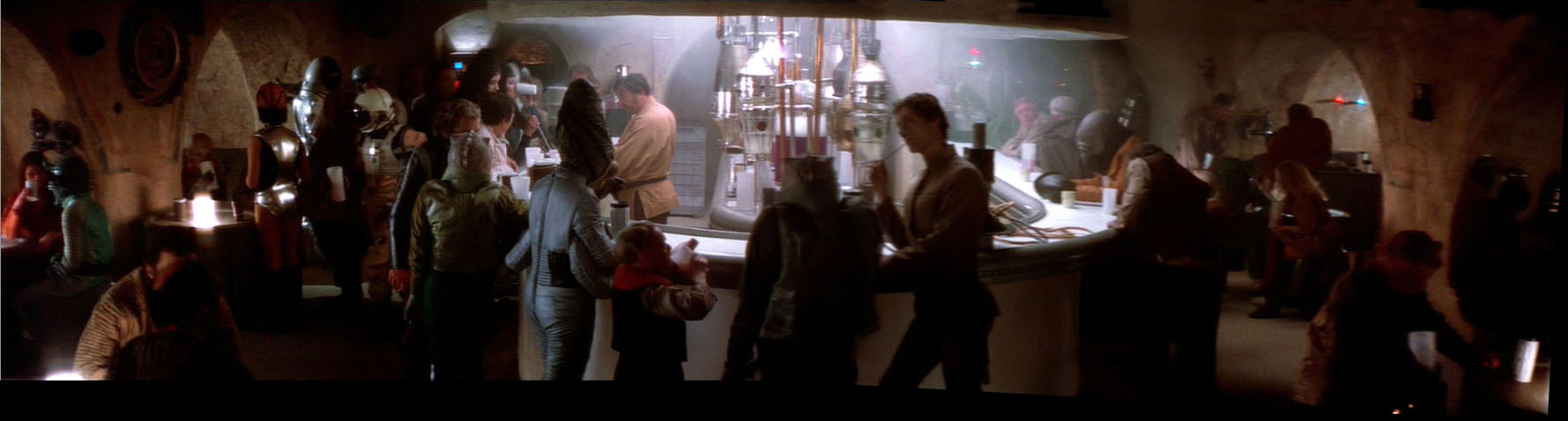
My first exposure to aliens came from Star Wars IV: A New Hope, which I saw as a kid sometime back in the early nineties.  The cantina scene with the weird, catchy music and all the frighteningly creatures both scared and fascinated me.  Here were a bunch of humans, mingling with these things that looked like monsters as if nothing were strange or unusual.  In fact, it soon became clear that these weren’t monsters at all, but regular people–that is, as regular as you can be without being human.

I think the main reason for including aliens in a space opera story is that it makes the setting feel more exotic and otherworldly.  It can also add all sorts of interesting possibilities for plot and character, depending on the different capabilities of the various alien races and the way their culture shapes them.  Babylon 5 is a great example of this, with the characters from each alien race interacting with each other in ways unique to their various cultures.

One way to think of science fictional aliens is to put them on a spectrum with two extremes.  On the one side, you have the more familiar aliens–the races from Star Trek, for example, which are basically human-like except with weird skin or bone ridges to physically distinguish them.  On the other side, you have the truly bizarre–the kinds of aliens that are so different from us, we cannot possibly conceive their thoughts or the way they see the world.

The main advantage of the more familiar alien types is that they’re easy to understand and relate to.  Yeah, they may look weird, but they don’t think or act much differently than the Russians, or the Arabs, or whatever human culture they roughly parallel.  In fact, it’s not uncommon in fiction of this type for the aliens to be less “alien” than the Japanese (at least, in Western fiction–obviously, it’s different in manga and anime).  This, in turn, is the main weakness with aliens of this type: they are so readily understandable that it’s easy to lose that sense of otherness.

The main advantage of the more extreme kind of alien is that it can make a much stronger impact, which makes for a more compelling and thought-provoking story.  For example, the Hypotheticals in Robert Charles Wilson’s Spin trilogy are so fascinating because we know so little about them.  They have the power to shape entire worlds, manipulating space and time itself, and yet none of the reasons behind what they’re doing make sense–if indeed there’s any reason behind it at all.  Or in Octavia Butler’s Xenogensis trilogy, it’s not too hard to figure out what the aliens are trying to do, but the way in which they do it, impregnating the main character through their tri-sexual biological capabilities makes for a profoundly disturbing story.

The disadvantage, of course, is that aliens of this kind are much more difficult for readers to relate to.  If the aliens are so advanced that their thoughts transcend our own, or if their sensory organs are so different that we cannot possibly conceive of how they see the world, then it’s very difficult for us to get inside of their heads.  For this reason, aliens of this kind tend to become more of a force of nature than actual characters–or characters in the aggregate, in the way that humanity is the main character of most of Arthur C. Clarke’s books.

Personally, I’m more of a fan of the extreme alien type.  The universe is so vast, and our understanding of it is so lacking, that it rings a lot truer to me.  The odds that we are alone in the universe are so infinitesimally small that refusing to believe in the existence of aliens would be akin to believing in 1492 that the Earth is flat, and yet if/when we ever make contact, I can’t help but wonder how different from us they’ll be.  So much of what we take for granted is just a fluke of our particular circumstances here on this planet–the chance combination of so many variables that changing any one of them would completely rewrite the story of how our species evolved, much less our civilization.

There is a place for the more familiar aliens of space opera, though. They make for some very entertaining stories, provide a fun escape from this world when that’s what we need.  They also give us a chance to look at ourselves through a lens that strips away our stereotypes and prejudices.  We might have some very strong opinions about immigrants, for example, or people of a different race or color, but none of us are prejudiced against Sand People, or Klingons, or Androsynth.  In space opera, most alien races are loosely based on real-world cultures, so it’s possible to draw parallels without all the cultural and historical baggage.

In a sense, all fiction is just the culture speaking to itself, so when we read about aliens we are really reading about ourselves.  Encountering the Other in a non-threatening fictional world enables us to face the real-world Other with understanding and compassion.

I haven’t written very many alien stories yet, but I have a couple cooking in the back of my mind.  Genesis Earth has an alien encounter with a bit of a twist to it, but the characters in my Star Wanderers and Gaia Nova series are all human (well, mostly).  If/when I do introduce an alien race, I plan to do it right, which will almost certainly involve a first contact story.  But that’s for Saturday’s blog post, not today’s.

LTUE 2013

Man, LTUE 2013 was this weekend, and it was AWESOME.  One of the best conventions I’ve ever attended.  I spoke on my first panel, attended my first book signing event as an author, and got to meet up with some old friends, as well as some amazing new people.

Since I live tweeted most of the panels I attended, I thought it might be interesting to repost a few of those here, with some additional thoughts.  So…here goes!

THURSDAY

I believe this was Scott Parkin from the “What Do You Write?” panel. Good advice. Megan Whalen Turner also had some very interesting things to say on the subject of genre, which I have since forgotten. But I recorded it, and the recording will eventually be made publicly available in the LTUE conference archives, or so I’ve been told.

This one was from the “What Is ‘Punk’ Literature and Its Many Genres?” panel. David Butler and Larry Correia were HILARIOUS. Nearly got into a wrestling match right in front of us.

And when the esteemed Mr. Butler began to describe his book, I swear, a choir of steampunk angel Moronis somewhere began to sing a heavenly chorus. I mean, he had me with Edgar Allen Poe faking his death to become a secret agent, but Orson Pratt’s phlogiston guns? Eliza R. Snow as chief counterintelligence officer for the Kingdom of Deseret? I will definitely be checking out this book, City of the Saints (which is apparently a finalist for the 2013 Whitney Award).

David Butler is also a way cool guy. I hung out with him a bit in the dealer’s room, chatting about Mormon history, Lyman Wight (“shoot and be damned!”), Sir Richard Francis Burton’s expedition to Salt Lake City, and all sorts of other crazy zany stuff. And the whole time, he was playing a guitar. So yeah, definitely a way cool guy.

This discovery CHANGED MY LIFE. Also, it helped me to save immensely on lunch money, as well as join in on some way cool conversations with other panelists as they desperately tried to escape their fans. Okay, not really, but the green room was AWESOME.

Howard Taylor’s presentation on teasers was tremendously insightful. In a nutshell, he said that a teaser (aka book description on Amazon / back cover) should have or at least point to the following things:

  1. The inciting incident
  2. Character action
  3. Conflict
  4. Hook

We then went over a few examples, including some good ones that broke these rules, and finished up by doctoring a couple of teasers volunteered from the audience. Howard Taylor admitted to me later that he wasn’t entirely satisfied with the way he presented it, but I get the impression that he’s never entirely satisfied with anything less than perfection. It was a great workshop.

From “Engaging the Reader.” Great panel. Lisa Mangum described the planning / drafting / revising process for each of her first three novels, and they were all wildly different. With seven novels under my belt so far, I can definitely relate. Some, like Genesis Earth and Stars of Blood and Glory, practically write themselves. Others are like having a c-section with a hacksaw. And others…yeah, I’m not going to go there.

FRIDAY

Okay, maybe I said one useful thing: when there’s a language barrier, little things become big obstacles. One of the other panelists, Anna Del C. Dye, also had a bunch of stories about adapting to a foreign language and culture (in her case, the United States).

Overall, the panel was really, really fun! I also had some cards out for Star Wanderers: Outworlder, and a bunch of people came up afterward to get them. Guess I must have said something interesting. I hope you guys enjoy the book!


From “Current Trends in SF.” Great panel–it totally wasn’t just another over-hyped discussion about what’s hot right now. I asked how the panelists think the trend cycle will change in the age of self-published ebooks, and they had some very interesting things to say. They all agreed that speed to market, while it may give some advantages, isn’t a make-or-break game changer, or even really a good strategy (unless you really love the trend you’re writing to). Some things change, others remain the same. It will be interesting to give this one a re-listen.


From “Creators in the Community.” Probably one of the best panels of the entire convention. Tracy Hickman is really on top of the changes in the publishing world, and had a lot of interesting things to say about it in all of his panels. As for the subject of writerly communities, much wisdom and insight was shared by all of the panelists. Definitely look for this one.

Man, I’d forgotten how cool the guys at Dungeon Crawlers Radio are! They interviewed me back in 2011, when I was just getting ready to publish Genesis Earth. This time, we talked about space opera, sci-fi romance, language barriers in marriage and all the crazy things I have to look forward to, and a bunch of other stuff. I also shared some of my thoughts and opinions on self-publishing myths, especially regarding the “tsunami of crap.” We coined a new word, “nerdaissance,” to describe all the awesome new stuff that’s coming out now, thanks to the ease of self-publishing.

So yeah, it was a great interview! I’ll definitely be cross-linking once it goes live.

From “Effective Book Covers.” Great panel with some very good artists and cover designers, including Isaac Stewart who does all the maps for Brandon Sanderson. Although some parts were geared toward illustrators, most of the advice was for writers (especially self-pubbing writers) who are looking to design their own covers. Lots of great and insightful perspectives from the visual arts side of things.

FRIDAY NIGHT BOOK SIGNING

Okay, I’ve got to be honest: when I went into the mass signing with my cardboard box of CreateSpace POD novels, I didn’t expect to sell anything. I figured that was just my ticket to get a seat at a table and hand out cards for Star Wanderers: Outworlder to some of the casual book browsers.

Well, I was pleasantly surprised! An uncle of one of my old mission companions was impressed enough to buy a couple of copies. I think he’s one of these guys who likes to buy things from new authors to help encourage them. It’s great to see people like that. He told me to keep writing, and I told him I definitely would!

Lots of people snagged the card for Outworlder, and I came up with a pretty decent pitch: “it’s about a starship pilot who accidentally marries a girl who doesn’t speak his language.” That raised a lot of eyebrows! A lot of people were really happy to see a science fiction story, especially a space adventure. I get the impression that there’s a craving for this kind of stuff in the market that isn’t currently being satisfied. So yeah, that was very encouraging!

After things wound down a bit, I wandered around the signing checking out some of the other books. Saw a couple that I recognized from the Kindle Boards, which was interesting. Chatted with them, as well as a bunch of geeky guys about chain mail, Halo, Frank Herbert, and all sorts of awesome stuff. Man, the best part about sci-fi/fantasy conventions is the chance to just talk with people! So much interesting stuff. It was great.

SATURDAY


From “Write For the Market or Write What You Know?” Another great panel. Definitely will be re-listening to that one.

From the main address with Megan Whalen Turner. She talked about book censorship and the need to teach children how to make their own reading choices, rather than keeping them sheltered and making the choice for them. She pointed out how every time a New York Times article comes out bemoaning some YA book for inappropriate content, it’s kind of hypocritical because there are so many other books they miss. The Golden Compass, for example, didn’t even pop up on their radar until the movie came out. Kids don’t magically become mature, well-adjusted adults when they turn 18–we have to teach them to make these choices (and mistakes) for themselves.

From “How Does Your Story Mean?” Great discussion on the writing process. Saw a lot of other good live-tweets during this one.

Okay, I take back what I said about the best panel of the convention. THIS was definitely the best. “The Engines of Exploration,” with Howard Taylor, Megan Whalen Turner, Roger White, James Owen, Kevin Evans, and Charles Stanford–the panel was packed. It basically turned into a round-robin discussion of which commodities are most essential to modern civilization, which ones will be the most valuable in the event of a societal collapse, and which ones will take us to the stars. The eventual consensus on each of these eventually came down to goats. Seriously. GOATS!


From “Writing Romance Without Erotica.” Lots of delicious awkwardness, as well as some really interesting thoughts and perspectives on the subject of romance. One of the panelists talked about the importance of “character penetration” without realizing about halfway through the panel how hilarious that phrase sounded in this context. But yeah, there was also a lot of wisdom in there as well. There are a lot of strong opinions about sex and romance floating around in this part of the world, so it was a very spirited and interesting panel.


The last panel of the convention (technically, symposium, but whatever) was “eBook Publishing” with some highly successful indies like Michaelbrent Collings. As you can tell from the tweets, it was a bit controversial, but very, very interesting. Questions were flying all over the place, on subjects ranging from formatting to building an audience. The biggest shock to me was that none of the panelists (none of them!) are on Smashwords. It’s a wild, wild west out here in indie-land. Makes me wonder, maybe I should publish to iTunes through another venue? Hmmmm…

So yeah, that was pretty much the whole convention/symposium. I finished it out by playing Alhambra with a bunch of friends from Kindal Debenham’s writing group who came down from Seattle and Idaho. Good, good times–it was actually kind of sad to say goodbye. Definitely worth coming 11 time zones to attend.

All I can say is that I am STOKED for Conduit!
Trope Tuesday: Settling the (Final) Frontier

I love stories about colonization, especially when they’re set in space.  There’s just something about a small group of rugged pioneers striking out into the harsh, unforgiving wilderness to make a new life for themselves.  Maybe it’s just something about my American heritage, or all those 4x games I played as a kid, but I doubt it.  Ever since the dawn of time, we humans have been on the move, looking for new and better places to call home.  Small wonder, then, that so many of our stories, both ancient and modern, are about settling the frontier.

Since space is the final frontier, this trope is very common in science fiction.  Heinlein was a huge fan of it, but he wasn’t the only one to play with it–not by a long shot.  John Scalzi (The Last Colony), Nancy Kress (Crossfire), C.J. Cherryh (40,000 in Gehenna), Anne McCaffrey (Freedom’s Landing), and Kim Stanley Robinson (Red Mars, Green Mars, and Blue Mars) are just a few of the many science fiction writers who have explored this trope in their works.  In recent years, several sci fi miniseries (Battlestar Galactica, Terra Nova) have used it as a major premise as well.  And of course, you have all the classic 4x games like Masters of Orion and Alpha Centauri.

Space Colonies can come in a variety of different flavors:

  • Lost Colony — What happens when the original colonists lose all contact with the outside universe and no one thinks to check up on them for a while.  Can either turn into a story of survival or a clash of cultures, if/when they ever re-establish contact.
  • Cult Colony — Religion is one of the few things that will drive massive numbers of people to leave everything behind and start over in a new world.  Just look at the Pilgrims for a real-world examples.  In space colonies of this type, you can expect to see some extremely radical people, since the isolation of deep space tends to compound their fundamentalist tendencies.  Expect these to be both weird and frightening.
  • Space Amish — Something of a combination of the two, except with much more primitive technology.  Expect to see log cabins, horse- (or giant lizard) drawn carriages, and other tropes closer to the Western genre.  Sometimes, they may be hiding a superweapon.
  • Penal Colony — Australia in space (ahem…IN SPAAACE!!!).  What happens when the empire needs a place to conveniently exile all the troublemakers and rabble rousers.  Not a place for the faint of heart.
  • Wretched Hive — What happens to a penal colony when the prisoners actually run the place.  Like the previous type, except taken up to eleven.  Or not, depending on the history and culture.  Tatooine is the eponymous example.
  • Death World — As the name would suggest, this is not the kind of place you’d want to homestead.  Anyone who does is bound to be a badass.  The Empire and the Federation often recruit most of their soldiers from here.
  • Company World — I couldn’t find this one listed on tvtropes.  Basically, it’s a planet that is owned and governed entirely by a private corporation, which expects to make a tidy profit off of the place.  The colonists are basically indentured servants (since robots simply wouldn’t do) and have almost no property or rights.  Expect the story to be about sticking it to the man.

These are just a few of the many possibilities that you can play with when settling the frontier.  In my opinion, however, the essential elements are as follows:

  • The story is not just about exploring a new world, but establishing some kind of a permanent presence there.
  • By coming to the new world, the colonists must leave everything from their old, familiar lives behind.
  • The colonists must resolve the story conflict through their own self-reliance, not by waiting for an outside force to save them.

I’ve only dabbled with this trope, but it does play a role in many of my stories, most notably in the Star Wanderers series.  Genesis Earth also has elements of it as well, though it’s not the main driver for the plot.  It is a major factor in Heart of the Nebula, though, the (currently) unpublished sequel to Bringing Stella Home.  And in my future books, you can definitely expect to see this trope again.

Trope Tuesday: I Choose To Stay

The hero’s journey can be divided into three basic phases: departure, intiation, and return.  In the departure phase, the hero receives the call to adventure and eventually leaves the familiar world.  In the initiation phase, the hero passes through a series of tests and trials eventually leading up to the climax and final confrontation with the Big Bad (if there is one).  But after the hero wins and receives the ultimate boon (aka MacGuffin), there’s nothing left except to go back home and share that boon with the rest of mankind.

Except…after having such an awesome adventure, he just doesn’t wanna.

Joseph Campbell called this stage the Refusal of the Return.  It’s a lot like the Refusal of the Call in the departure phase, except in reverse: instead of being reluctant to cross the threshold of adventure into the unfamilar world, the hero doesn’t want to cross the threshold in the opposite direction going back home.  Campbell put it this way:

When the hero-quest has been accomplished…the adventurer still must return with his life-transmuting trophy. The full round, the norm of the monomyth, requires that the hero shall now begin the labor of bringing the runes of wisdom, the Golden Fleece, or his sleeping princess, back into the kingdom of humanity, where the boon may redound to the renewing of the community, the nation, the planet or the ten thousand worlds.

But the responsibility has been frequently refused. Even Gautama Buddha, after his triumph, doubted whether the message of realization could be communicated, and saints are reported to have died while in the supernal ecstasy. Numerous indeed are the heroes fabled to have taken up residence forever in the blessed isle of the unaging Goddess of Immortal Being.

Anyone who’s ever been two years old should know the feeling.  You’re at the playground, having fun, when out of the blue your mom says that it’s time to go.  So what do you do?  Throw a hissy fit, of course!  Grab onto the cold hard steel of the swingset, and don’t let go until she drags you kicking and screaming all the way to the car.

The hero may have fallen with the new world the moment he left his home behind, but he might also have hated it initially.  In stories where the hero actually does stay, this allows the author to give him a character arc: at first, he hated the new world, but gradually he warmed up to it, until by the end he was changed so much by the adventure that he decided to settle down there.

In milieu stories (see Orson Scott Card’s MICE quotient), this often manifests as Going Native, while in stories that are more plot or character driven, it’s more likely to manifest as Can’t Stay Normal.  When the hero eventually comes around and goes home anyway, it frequently morphs into Stranger in a Familiar Land.  The polar opposite is But Now I Must Go, though that trope tends to apply more to side characters than the main protagonist.

Ultimately, however, adventures are like stories: they all have a beginning, a middle, and an end.  The hero may want it to keep on going forever, but that is not this trope.  Even if the hero does stay in the lands of adventure, those lands eventually become his new home.  It just can’t be avoided.

For that reason, there’s an important element of bittersweetness to this stage of the hero’s journey–one which, if done well, can add a crowning moment of heartwarming or turn the story into a real tear jerker.  Or both, actually.  It all depends on how invested the reader is in the story by the end.  If the reader feels like she’s been right there with the hero all this time, then you can expect the tears to flow no matter which way he ultimately goes.

I pretty much played this trope straight in Genesis Earth.  Most of my other books feature a Refusal of the Return moment of one kind or another, but the hero usually ends up going home anyway.  If there even is a home to return to, of course.  I don’t know why, but a lot of my stories are about characters who are searching for home.  Maybe that’s because at heart, I’m still a wanderer.  It will be interesting to see how that changes over the coming years.

The song at the top, by the way, is from Disney’s Tarzan, a movie which plays this trope straighter than most.  In fact, this trope is practically Disney’s bread and butter.

Back in Georgia

Hey, just a quick post to let you guys know how I’m doing.

I made it out to the village yesterday, met my new host family and got more or less settled.  Due to some mixups, I ended up in Sairme (WAY up in the mountains) before making it down to Baghdati, but everything worked out well and I got to see some beautiful Georgian scenery at the same time.

My new host family is great!  It’s a 35 year old guy and his mom, living on a farm in a village with all their uncles and cousins and stuff pretty close by.  The guy, Dato, is way cool–he does IT at the school, farms his mom’s place, and otherwise just hangs out in the village.  We played nardi last night–I actually beat him on the first go, then he slaughtered me twice.  Then his aunt played him and things got really entertaining.

The house is WAY different from the apartment where I was living before.  Much more spacious.  It’s a couple hundred years old, though, so the wires are attached on the outsides of the walls and stuff.  We’ve also got chickens all over the place.  I’ll be sure to post some pictures, probably in a week or two.

I think I’ve hit it off pretty well with the family.  They’re impressed that I already know a bit of Kartuli, especially the aunt.  Things got a little tense when I turned down the wine and told them I can’t drink because my religion forbids it, but I don’t think it will be too much of a problem (though this being Georgia, you never know).

The mom is an awesome cook.  This morning, she made one of the best breakfasts I’ve ever had in my life.  The house is old but comfortable, I’ve got all the space and privacy I need, there’s a lot more nature out here in the village–I think I’m really going to like it here.  What’s more, Kutaisi is only a short half-hour marshrutka ride away.

After I’m through here, I’ll walk up to my old host family’s place and drop off some gifts: specifically, some RAM for their broken down computer.  Then I’ll head over to my old school, say hi to my old coteachers, run downtown to pick some stuff up, then head back out to the village.  Tomorrow, I’ll meet up with a friend of mine to get some stuff for camping, then head out the next day to go backpacking in Borjomi or Tusheti.  That’s the plan at least.

Oh, and about the trip to Ani: I tried to get down to Kars, but couldn’t find a bus.  I ended up in Akhaltsikhe, the Georgian border town, but the only way out was to catch a taxi to the crossing ($$$), catch a taxi on the other side to the Turkish town on the other side, and from there to catch a bus down to Kars (about 140 km).  I was traveling alone, didn’t know any Turkish, it was about mid-afternoon and I didn’t have a backup plan, so I ended up aborting and headed back to Tbilisi.

Oh well–it happens.  I’ll try again, though, probably in a few weeks.  This time, we’ll meet up in Georgia, where I actually know how to  get around.

In other news, I bought three author copies each of Genesis Earth, Bringing Stella Home, and Desert Stars before I left the US.  They’re signed and numbered, and if you want to buy one of them, just shoot me an email (joseph [dot] vasicek [at] gmail [dot] com).  The #1 copies are already sold, but the #2 and #3 copies of each book are still available.  You can buy them from me at the current Amazon paperback price, and I’ll have my parents ship them out to you.

That’s all for now.  Take care, and I’ll see you guys around!

My mom gave my book three stars

Some people complain about how indie authors hit up their friends and family to give them five-star reviews…well, last week I gave the Createspace proof for Genesis Earth to my Mom, and today I noticed that she posted a three-star review for the book on Goodreads. 😛

It’s a cute one, though.  This is what she said:

Sci-fi is not my genre, but the author is my own son! I read it in 2 days (fast, for me); after page 100, I did not want to put the book down. Had to see what would develop–see the story. I’m hosting the author at home for a few weeks, so it has been fun to discuss his characters, etc. in person. I look forward to more discussion.

I posted this on the Kindle Boards just for laughs, and the guys over there agreed that it’s pretty hilarious.  A few of them suggested I rate her cooking!  But don’t worry, Mom, I’d give it at least a 3.5. 😉

In all seriousness, my Mom’s actually been really supportive of my writing, and I really appreciate that.  She is a tough (if loving) critic, though, so I’m sure she’ll keep me on my toes.

The most hilarious thing about this is that her catchphrase growing up was “suffer!”

New blurbs and an interview

First of all, I recently did an interview with Elizabeth Baxter on her blog, Small Blonde Hippy. In it, I discuss Star Wanderers, Stars of Blood and Glory, and a bit about my path to becoming an indie author.  You can find it here–go check it out!

Second, in preparation for the new ebook versions of my novels which I plan to release soon, I’ve been going over some of the old blurbs and updating them.  It’s harder than you might expect!  I think the new ones are getting better, but I’d appreciate some feedback before I post them.  What do you think?

For Genesis Earth:

A BOY AND A GIRL ON A VOYAGE TO AN ALIEN STAR.

Michael Anderson never thought he would set foot on a world like Earth. He only studied planetology to satisfy his parents, two of humanity’s most brilliant scientists. But when they open a wormhole to an alien planet—one emitting a signal that can only be a sign of intelligent life—he soon becomes caught up in the mission to explore it.

His sole mission partner, Terra, doesn’t care nearly as much about the science as he does, though. The child of a bitter divorce, she sees the mission as a chance to escape from the expectations of others.

Before they can work out their differences, a mysterious alien ship begins to hunt them down. Alone, twenty light-years from the nearest human being, they must learn to open up and trust each other—but how can they do that when they can’t even agree why they’re there?

As Michael struggles to keep the mission from falling apart, he is forced to reexamine his deepest, most unquestioned beliefs about the universe—and about what it means to be human.

For Bringing Stella Home:

HE’LL GO TO THE ENDS OF THE GALAXY TO SAVE HIS BROTHER AND SISTER.

The New Gaian Empire is crumbling. An undefeatable enemy from the outer reaches of space is sweeping across the frontier stars, slagging worlds and sowing chaos. No one dares to stand up to them—no one, that is, except James McCoy.

As the youngest son of a merchanter family, James never thought he would get caught up in the Imperial wars. But when his home world falls to the barbarian Hameji, his brother and sister, Ben and Stella, are taken away as prisoners and slaves. With the rest of the galaxy thrown into chaos, only James has the determination to rescue them—even if it means losing everything in the process.

For Sholpan:

SHE’D RATHER DIE THAN BE A SLAVE TO THE CONQUERORS OF HER HOME WORLD.

Stella McCoy never thought she’d fall prisoner to the barbarian Hameji. The oldest daughter of a working class family, all she wanted was to finish her apprenticeship and start a career an astrogator. But when the Hameji conquer her home world with their starfaring battle fleets, she is forced against her will to become a concubine to one of their highest ranking warlords.

Stella would rather die than spend the rest of her life as a concubine. Fortunately, as she looks for a chance to escape, she starts to make friends in high places. But in the dangerous world of harem politics, with new friends come new enemies—ones that have the power to destroy her.

One of the changes I plan to make is to insert the blurb immediately before the first chapter.  I’ve heard that a lot of ebook readers are downloading so many free books and samples that it often takes months before they get around to reading them. This parallels my own experience, so I figure it’s a good idea to have something in the beginning to remind readers what the book is and why they picked it up.

Other than that, no big changes except fixing typos and formatting errors.  I’m not the kind of writer who makes sweeping changes to a published story based on reviews, one-star or otherwise.

In other news, I’m almost finished with the second draft of Stars of Blood and Glory.  This has been a surprisingly fast revision, but then again, that might be because I haven’t sent it out yet to my first readers.  Based on their feedback, I’ll probably do another draft before putting it in the publishing queue.

Star Wanderers is going to be my main focus until the end of the year, though.  I’ve gotten a lot of excellent feedback on Part II, and should start the revisions in the next couple of days.  With luck, I’ll have it published by mid-July.  Part III is going to take a little more time, but I’m pretty confident I’ll have it up by October at the latest.

For that to happen, though, I need to get back to writing.  So long!

Yay for Kobo Writing Life!

So after a month of waiting, Kobo’s publishing platform, Writing Life, is finally up!  I just finished uploading all of my titles (except my short stories–I’ll just continue to distribute through Smashwords for now). Genesis Earth is already available, and the others should be up soon.

For those of you who are readers, this means that you’ll be able to find my books on Kobo almost as soon as they go up on Amazon.  The formatting will (hopefully) be cleaner, since I’ll have direct control.  Prices will generally be the same as on other platforms, but when I change the price on Amazon, I’ll change it simultaneously on Kobo, too–no waiting for weeks on end for the price to drop.

For those of you who are writers, I’ll be sure to keep you updated with thoughts on my experience.  So far, it looks pretty good: the royalty rates are better than Amazon (70% for titles priced $1.99 – $12.99, 45% for all other titles), the publishing process is faster, and the upload formats (.epub, .doc, .docx, .mobi, and .odt) are generally more flexible.  Downsides include a higher minimum threshold for direct deposit ($100 or every 6 months), fewer category choices, and what appears to be a forced 2:3 aspect ratio for cover art.

Besides that–oh, look, Bringing Stella Home and Journey to Jordan just went up too!  Man, that’s fast!  And it looks like the aspect ratios went back to 3:4, so I won’t have to redo the covers.  That’s a relief!  So yeah, I’ll be sure to keep you updated.

Also, in preparing my books for upload to Kobo, I discovered some pretty egregious formatting errors for the Barnes & Noble copies of Bringing Stella Home and Sholpan.  I’m not sure what happened–probably it had something to do with an older version of Calibre or Open Office, since I was overseas at the time and only had access to my netbook.  So yeah, if you downloaded one of the broken copies, just shoot me an email and I’ll send you the updated epub version, no questions asked.

In general, I need to revamp my publishing process.  Currently, it resembles jumping through a ring of fire while juggling half a dozen angry poodles.  Open Office, Mobipocket, Notepad, Calibre, KindleGen, DOS prompts, and Kindle for PC–yeah, I’d better get on that.  If you have any suggestions for free/open source software that does .mobi and .epub, please let me know.

In other news, I finished my first pass through Stars of Blood and Glory, and should be finished with draft 2.0 by the end of the week.  After that, it’s back to Star Home and Star Wanderers.

The print edition of Genesis Earth is in!

The proof for the print edition of my first novel, Genesis Earth, just came in the mail–and it looks AWESOME!  Check it out!

Front cover.
Back cover.
Page 1, Chapter 1.

Holy crap, it is so cool to have a book in my hands THAT I ACTUALLY WROTE.  So cool!

I approved the proof a couple of hours ago.  It’s currently up for sale on CreateSpace (where I get a higher royalty), but it should also be up on Amazon in 5-7 business days.  I haven’t opted for the extended distribution, which means that those are the only places where it’s going to be available for a while.  I might opt in a little later, but I haven’t made a decision just yet.

Next step: put out print editions for Bringing Stella Home and Desert Stars.  Those should be coming soon, probably by mid-August.

Man, this is so much fun!

Rivers and orphans and rivers, oh my!

So one of my goals this summer is to release POD (print-on-demand) editions for the three novels I currently have up as ebooks (Genesis Earth, Bringing Stella Home, and Desert Stars).  I started with Genesis Earth a couple of days ago, and wow!  I had no idea that getting a book ready for print could be so much fun!

I just finished formatting and typesetting the interior today, and it looks pretty awesome!  Drop caps, chapter headings, page numbers, a pleasingly arranged text–there’s something immensely satisfying about paper, an experience that ebooks (as awesome as they are) just don’t quite capture.  If I weren’t a writer, I’d be a typesetter–but because I’m an indie, I can be both!

As with ebooks, the learning curve for print formatting is pretty steep, but I think I’ve got the hang of it.  The guys over at Kindle Boards gave me a lot of helpful advice, and sent me a really awesome POD guide that’s been a lifesaver.  My editor (who’s also trained in typesetting) gave it a once over too, so I think we’re in good shape.

Barring any unforeseen complications, the print version of Genesis Earth should be up in a couple of weeks.  The cover art is more or less done–I just need to revise the blurb, send the PDFs out to CreateSpace, and wait for the proof to come in the mail.

One thing I’m wondering is whether to go with the free ISBN (which will list CreateSpace as the publisher) or to spend $10 and go with my own imprint.  My gut tells me to go with the free option–not because it’s cheap so much as because it’s less complicated–but I wonder if there might be some advantages down the road to taking the other.

ISBNs, imprints, and distribution channels, oh my…I’ll have to save that for another post a little later. 🙂