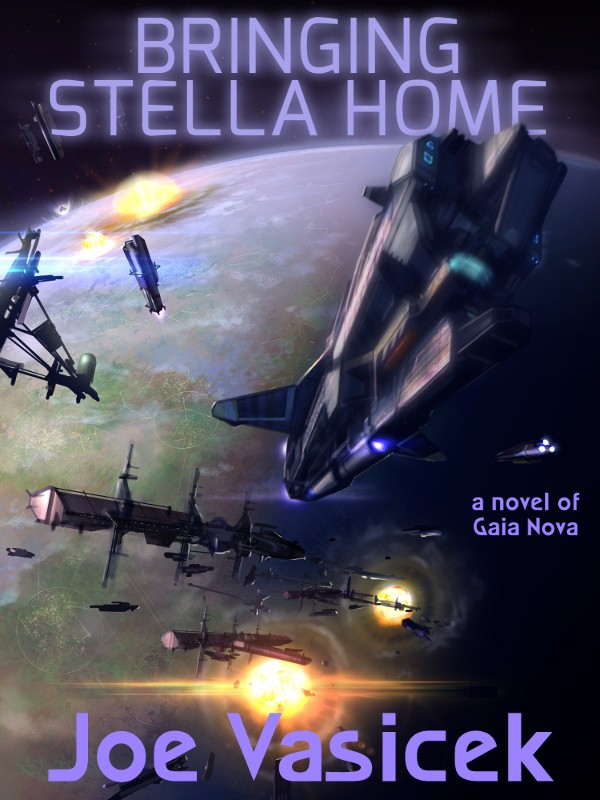
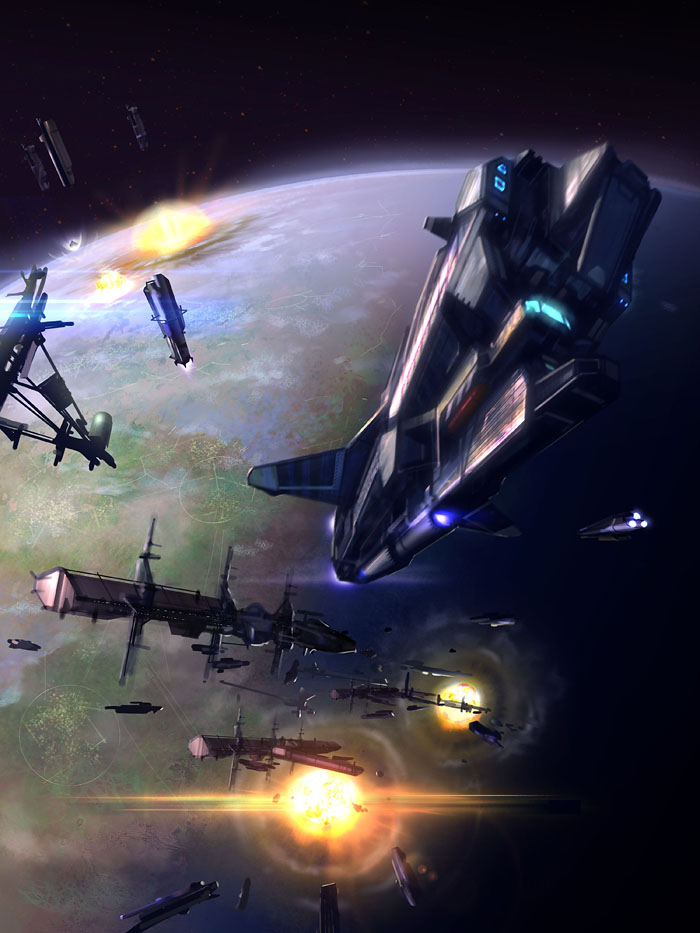
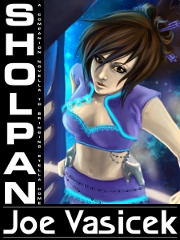
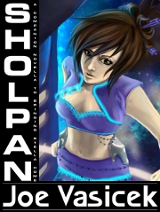
I decided to redo the cover in preparation for a print-on-demand edition which I hope to release at some point this summer. The artist is Hideyoshi, who also did the cover art for Genesis Earth and Desert Stars. He’s great to work with and does some seriously awesome work, so I’m glad he was up for the project!
The other version was okay, but based on the feedback I was getting, I didn’t think it did a good job capturing the real essence of the story. Oh well–live and learn, I guess. And when it comes to cover art, I still have a lot to learn.
I just uploaded the new ebook version to Amazon, B&N, and Smashwords. Those sites should update in the next 24 to 72 hours (Smashwords is updated already), while the Kobo, Sony, iTunes, and other versions should update in the next couple of weeks.
I’m not sure if I’ll do desktop backgrounds for this one, but if there’s demand, I’d be willing to do it. Just shoot me an email and let me know. My netbook is starting to go, so I probably won’t get to it until July when I’m back in the States, but if/when I do, I’ll release it through the email newsletter, same as the Desert Stars backgrounds.
That’s just about it. I think I’ve spent more time today staring at this cover than actually writing, so I’d better get back to that. More good stuff to come–stay tuned!
In between teaching English and putting in my daily word count (between 1k and 2k most recently), I’ve come across some interesting things worth sharing. If you’re a fellow writer, I’m sure you’ll appreciate this stuff, but even if you’re just a reader, it’s worth checking out.
First, there’s an excellent article at The Nation on the rise of Amazon and how it took the publishing world by storm. The author isn’t very pro-Amazon, but he paints a much more reasonable and far-seeing picture than anything I’ve seen from the Amazon-bashers. If you’re interested in indie publishing at all, it’s a must-read.
The way I see it, Amazon has fundamentally changed the paradigm by cutting out the middle-man, facilitating a direct connection between readers and writers. Everyone who sees them as some kind of harbinger of the apocalypse is so focused on their particular niche that they fail to see all the positive ways in which the system is being remade.
For example, ebooks never go out of print–never. Isn’t that awesome? And yet some people turn around and claim that Amazon is on some kind of crusade to destroy books and literature. Wha?? Yes, they’re probably cannibalizing mass-market paperback sales, and perhaps even hardcover sales as well, but they’re also opening all sorts of new literary possibilities, the likes of which we haven’t seen since the days of Gutenberg.
Well, so much for that. The next item is a lot less controversial: it’s a round-table discussion from Adventures in Sci-Fi Publishing in which several writers discuss productivity and various aspects of their writing process. If you’re a writer, this is definitely worth checking out–it’s probably the most comprehensive discussion on the subject that I’ve heard in a while.
Some of my takeaways: the best way to unblock yourself and get the writing flowing again is to take a walk. When I listened to the podcast, I was actually taking a walk for that very purpose–and it worked! Also, if you have the time but the writing isn’t flowing, it’s better sometimes to do something else rather than force it. If you do try to force it, chances are that you’ll just get a bunch of crap. For some writers, that’s just part of priming the pump, but for me, I’ve got to take the time to fill the well.
Third, I just listened to a fascinating interview on the Sword & Laser podcast with Todd McAffrey. I’d tell you what it’s about, but really, they went off on so many fantastic tangents, it’s really more interesting just for that. The practicalities of space exploration, human-host bacteria and emergent AI, the secrets of the human brain and the potential for long term collective consciousness–reminds me of an uber-nerdy conversation I had at the con-suite for World Fantasy 2010. Man, those were good times.
To be honest, I took issue with many of McAffrey’s comments. When it comes to science and engineering, he’s extremely intelligent, but when it comes to bio-ethics, the sociological implications of his ideas, and a general awareness of the proverbial 99% of humanity that still lives on less than $10 USD per day, I think he’s a little too short-sighted. But if you put us in a room together, the argument would be so fascinating it would definitely be worth listening to.
Finally, I just got the new cover art from Hideyoshi for Bringing Stella Home, and it is seriously kick-ass. Check it out!
Now that is what I call Science Fiction! Expect to see the updated ebook with the new cover in the next couple of weeks.
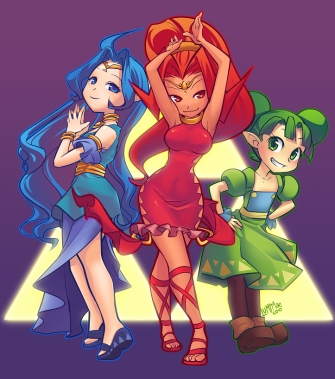
Why do so many character combinations come in groups of three? Unlike love triangles, where the combo is primarily a way to build conflict, the characters in power trios all build on each other in some way. They might be foils for each other, but as complementary archetypes, they do far more to drive the story together than they ever would apart.
One of the most interesting all-female power trios is the Three Faces of Eve, which combines the archetypes of child, seductress, and wife:
The “child” (who does not have to be a child literally) will be seen as innocent, perhaps to the point of naïveté. The wife, the wiser, calmer aspect, someone around whom one could build a home life. The third, the seductress, is sexually experienced and independent.
Roughly speaking, the characters in the trio correspond to:
The Ingenue: A naive, innocent, childlike girl who is just setting out into the world. In a Freudian Trio, this would be the Ego.
The Femme Fatale: A seductive, alluring, mysterious woman who is experienced in the ways of the world. Unlike the Vamp, she may or may not use her feminine wiles for evil. In a Freudian Trio, this would be the Id.
The Yamato Nadeshiko: A calm, steady, faithful wife, who provides the kind of marital stability and maternal strength that is ideal for settling down and raising a family. In a Freudian Trio, this would be the Superego.
You’d be surprised to see how often this trope shows up, even in works of science fiction. In Star Wars, Leia was the child in A New Hope, the wife/mother in Empire Strikes Back, and (what else?) the seductress in Return of the Jedi. Just about every Star Trek series featured some alignment of these archetypes.
Squaresoft played with this trope a lot in their Final Fantasy series, which may be illustrative to examine in greater depth. I’ve only played through FF IV, VI, VII, and Chrono Trigger, but each of these titles features some interesting variations (warning: spoilers!).
Final Fantasy IV: Porom (child), Rydia (seductress), Rosa (wife).
Porom is pretty solidly the child, though Rydia starts out as this and later grows up into the seductress role. She doesn’t get the guy in the end, though: that would be Rosa, who pretty much starts out with him as well.
In terms of story, the characters don’t really seem to build much on each other, though in terms of gameplay you definitely want to have Rydia and Rosa/Porom in your party (though not Rosa and Porom together–you only need one white mage, after all).
Final Fantasy VI: Relm (child) , Celes (seductress), Terra (wife).
This is my personal favorite in the series. Unlike IV and VII, which both center around male protagonists, Final Fantasy VI revolves around Terra (world of balance) and Celes (world of ruin) as the central protagonists. Because they also play a role in the power trio, their characters are quite complex, especially in the second half of the game. Relm is arguably more of a Mary Sue, but her relation to the other characters, especially Shadow, also makes her role more complex and interesting.
In the end, the romantic subplot is fulfilled by Celes, not Terra, which was something of a surprise to me in my first playthrough. It works really well, though, because of Celes’s heel face turn and subsequent reformation (in which Locke is arguably a Manic Pixie Dream GirlSpear Counterpart). Does that also translate into a shift from seductress to wife as well? I’m not sure, but I’d probably say no–after all, it’s Terra who takes on the mother role in the world of ruin.
Final Fantasy VII: Yuffie (child), Aeris (seductress), Tifa (wife).
The main twist with this one is that visually, you’d think Tifa is the seductress and Aeris is the wife. In terms of story archetypes, however, it’s just the opposite: Tifa is the one whom Cloud depends on, the one who helps him work through his problems, while Aeris is the shifty, mysterious one.
Unlike IV, where Rosa and Cecil are set up from the very beginning, for a while it actually looks like Aeris and Cloud are going to end up together. But then, in perhaps the most tragically gut-wrenching moment in all of video game history, Aeris dies (and doesn’t come back). Since Yuffie is kind of, well, crazy, Tifa and Cloud are pretty much garanteed to get together after that point (and as for Sephiroth…I don’t even want to go there).
Chrono Trigger is interesting because the girl who ends up with the guy in the end (Chrono) is actually the one who fulfills the child archetype, Marle. It works, though, because of the childlike feel of the story. Unlike FF VI and IV, Chrono Trigger is not a dark or an edgy tale–it’s heartwarming innocence at its best. I always did feel that Lucca got the short end of the stick, though–but she did get a cameo in Xenogears, so perhaps the last laugh was hers after all.
Ah, Xenogears. <sigh>
Anyhow, long story short, the Three Faces of Eve power trio is a fascinating way to play with feminine archetypes. Recently, I’ve become quite interested in it because it showed up quite inadvertently in my current project, Heart of the Nebula. It’s funny how tropes can sneak up on you like that, especially some of the more archetypal ones.
Anyhow, in its current form the novel is a piece of trash, but now that I’ve recognized the potential to set up this particular power trio, I think I can really make it shine. If you have any insights, please share–I’m very interested in this trope right now!
That’s probably the best term for what I’m doing with Heart of the Nebula right now. Basically, I let some of my darlings live, and they grew some extra limbs and started drooling acid without my realizing it. But now, I’ve put enough distance between myself and the first draft that I have no qualms about grabbing the axe and chopping off heads.
Don’t worry; this is all a normal part of my creative process. Maybe someday, stories will burst fully formed from my head like Athena from the brow of Zeus, but for now, my ideas are a lot more like baby turtles–if I’m lucky, one or two out of a dozen will actually reach the water and survive. Protip: don’t follow the lights.
Speaking of ancient mythology, I’m reading the Argonautica right now, and I can’t help but notice that it would make a really, really, REALLY awesome science fiction story. No, seriously–think about it. A group of legendary heroes sets out on an epic voyage in search of some applied phlebotinummacguffin, have all sorts of adventures on strange and distant planets, get the girl to fall in love with the captain, and bring her back with them to their homeworld. It would also work well as a heroic fantasy, but space is so much more awesome.
Incidently, Kutaisi was the capital of ancient Colchis, where Jason and the Argonauts came seeking the golden fleece. People still speak of Medea as if she were a real person–generally, they think she was a dirty traitor who sold out her own people. But people still enjoy the love story, and if you keep your eyes open you can see restaurants and hotels named after her.
So yeah. Ancient Greek mythology + science fiction = win. You can definitely expect to see some more of that in my own writing in the future.
In other news, I recently did an interview on fellow indie author Ty Johnston’s blog. In it, I talk a little about my travel writing, what draws me to speculative fiction, my favorite number (hint: it’s 12), and my insights into the ancient Mayan calendar and the 2012 apocalypse. It was a lot of fun–you should definitely check it out.
If you would like to host me for an interview on your blog, shoot me an email! I’m always up for stuff like that. Otherwise, I’d better roll up my sleeves and get back to hacking up operating on my book.
Some of you asked for a writing update, so I figure I might as well do a quick post on my current projects and where they are. I’ve also been experimenting with my daily schedule a bit, so it would probably be good to blog about that as well.
Right now, the main project taking up all of my attention is the 3.0 draft of Heart of the Nebula. It’s a direct sequel to Bringing Stella Home, and continues the story from James McCoy’s point of view, five years later. I’m making a lot of changes, toning down the romantic subplot and emphasizing the more interesting social and ethical issues. When I’m through, I think it will be completely different from the first couple of drafts, but in a way that’s truer to the spirit of the first book.
I’ve only been managing about 500 to 1,500 words per day, though, which is abysmally low compared to my usual word count. Part of that is because I’m throwing out entire sections and drafting new ones from scratch, but the more significant part is that I don’t have as much mental space for writing as I did back in the States.
Basically, moving to a foreign country and starting a new career has taken a lot more out of me than I thought it would. I teach 18 lessons per week, some with as many as 30 or 35 kids, across grades 1 through 12. Culturally, everything is completely different too. So far, the shock hasn’t been too bad–I really love it out here in Georgia–but it’s made the writing a little bit more difficult than I’d expected.
I have a lot of free time, though, so that’s not a problem: the problem is clearing my mind and keeping the creative juices fresh. Here’s how I’m going to do it:
Limit internet time. As tempting as it is to turn to the familiarity of the internet, it’s a huge time-suck and doesn’t really do anything for the culture shock. A much better thing for that would be to spend more time reading. From now on, I’m going to limit myself to one internet session per day, no longer than 2 hours (more if there’s something I actually need to do).
Get out more. I get cabin fever very easily, and it’s only gotten worse now that I’m in a foreign culture. Fortunately, there are tons of places to explore, and in my local neighborhood I’m kind of a celebrity (hey look, it’s the American! Let’s chase him and shout ‘hello’!). The prime time for this is the late afternoon, when everyone’s out and things are still open. If I check the internet right after school and get out immediately after, I think that will help me better to focus.
Get up early to write in the morning. I tried this last week, and it was a great way to get focused and build more momentum. Even if I only manage a couple hundred word, it gets me thinking about the story for the rest of the day, which makes it easier to pick up in the afternoon and evening.
So that’s the plan for now. My goal is to finish Heart of the Nebula before the end of May, which is going to require a significant change of pace. It should be pretty straightforward, though, and after this draft it shouldn’t need too many more revisions before it’s ready to publish. If all goes well, I foresee a publishing date sometime in the fall or winter.
Do you have any other ideas for ways to manage creativity in a totally foreign culture? If so, I’d love to hear it–that’s my biggest struggle right now.
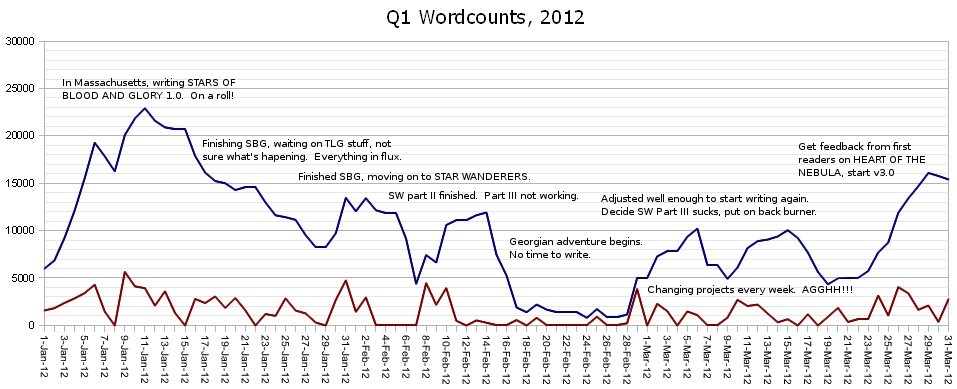
Actually, this last quarter wasn’t quite so bad as the title might make it seem. For the first part, I was on roll, writing almost 25k new words a week. But then I finished that project, started a new career, moved to the other side of the world…yeah, my writing took a hit. Or at least, that’s how it feels.
In January, I was working on Stars of Blood and Glory, and was really on a roll. The application process for TLG was still pending, but I pretty much knew I was getting in, and since I was staying with my parents until it went through, I didn’t have to worry much about money issues. With lots of writing time, I finished SBG in about 6 weeks and published Journey to Jordan. Life was good.
After Stars of Blood and Glory, I went back to Star Wanderers, finishing up Part II and starting Part III. However, something felt wrong, and I didn’t really know what it was. With my TLG departure date imminent, it was really hard to focus, and I wasn’t in much of a position to move on to anything else. That’s when the angst began.
I flew out to Georgia on February 15th, did a week of training in Tbilisi, and then was whisked about 220 kilometers away to Kutaisi. As a consequence, I didn’t get any real writing done for almost a month. However, I didn’t have any major challenges navigating the new culture, and was soon settled pretty comfortably.
The trouble was, nothing was working. Star Wanderers was broken, and I was too close to the project to fix it. But after putting it on the back burner, I didn’t know what to do. For most of March, I switched from one project to another. Nothing seemed to stick, though, and by the end, I was getting pretty antsy.
What if I’d made a mistake to come to Georgia? What if that was the reason nothing was working? It sounds silly now, but that was what was going through my mind. I still worry about it a little, but I think it has to do more with my creative process than anything here in Georgia.
I have a very non-linear way of writing first drafts. After starting the revision for Heart of the Nebula and making some good progress on that, I got an idea for Star Wanderers and moved back to that. At this point, I think the only way to get productive again is to finish that project, even if it sucks. I’ve got a lot of great ideas for other stories, but until I can close the book on this one, I don’t think I’ll be able to make much progress.
So that’s where things stand right now. All in all, it wasn’t a bad quarter, but I’ll be happy when I’ve actually finished something for a change. Hopefully, that’ll only be a couple of weeks. In the meantime, I’ll keep writing.
My novella Sholpan just went free on the Amazon site! Currently it’s at the #26 spot on the science fiction –> adventure bestseller list, and ranked #1,783 free in the kindle store overall.
If you’d like to check out some of my writing but haven’t gotten around to it yet, Sholpan is a good place to start. It takes place in the same fictional universe as my novels Desert Stars and Bringing Stella Home, with several others in various stages of planning and completion. It’s a companion novella for Bringing Stella Home, which means that it follows the first half of Stella’s storyline from the novel, with some extra scenes and backstory to flesh things out.
Of course, if you don’t like shopping at Amazon, you don’t have to be left out: Sholpan is also available as a free download from Barnes & Noble, Smashwords, Diesel, and Kobo. All of my other ebooks are also available from those sites, so you can check them out there as well.
If you’ve already read Sholpan and enjoyed it, I would appreciate it immensely if you would take the time to rate it or post a review. It only takes a moment, but it helps me out a ton. And of course, I’m only looking for honest reviews, so I won’t be offended if you don’t give it five stars if you don’t feel it deserves it.
It isn’t free yet on Amazon’s other stores (UK, Germany, France etc), but I’ve contacted Amazon so hopefully that will soon change. In the meantime, I hope you enjoy!
A neutral character does what seems to be a good idea. She doesn’t feel strongly one way or the other when it comes to good vs. evil or law vs. chaos. Most neutral characters exhibit a lack of conviction or bias rather than a commitment to neutrality.
Some neutral characters, on the other hand, commit themselves philosophically to neutrality. They see good, evil, law, and chaos as prejudices and dangerous extremes. They advocate the middle way of neutrality as the best, most balanced road in the long run.
As you might expect, this alignment doesn’t describe just one type of character. In fact, there are many different archetypes that fall under True Neutral. They include:
That’s quite a spread, isn’t it? The main thing to keep in mind is that these are the characters who refuse to take sides–not just in whatever overworld conflict is driving the story, but in the ethical questions that the story raises (unless neutrality itself is their answer).
My favorite example of this trope is the Childlike Empress from The Neverending Story. As the very embodiment of Fantasia, she transcends good and evil so completely that her power, the Auryn, cannot be used to forbid a monster from acting on its own evil nature. Truth from Fullmetal Alchemist is another good example of a transcendent True Neutral.
With everyday, down-to-earth characters, though, this alignment tends to tick me off. The Ents, for example, very much fall under this trope (as does Tom Bombadil…unless you subscribe to this theory). Most others examples either come across as weak, selfish, or cowardly to me, so I don’t really care much for this alignment–unless it’s the starting point of a well-constructed character arc.
For that reason, in my own work, most True Neutrals are either straight-up antagonists or gradually shift in alignment as the story progresses. In Genesis Earth, Michael Anderson starts out as one of the weaker True Neutral types, but changes as events in the story make him grow. In Desert Stars, Sathi probably falls into this type, though I’m not so sure; either way, he’s very easily manipulated by his Neutral Evil wife. In Bringing Stella Home, Ilya falls under this alignment due to his moral cowardice, and Anya might as well, though more as a Selfish Good than anything else. Roman probably does too, but more because he’s old and wants to give up the fight; that’s something I’m currently working on in Stars of Blood and Glory.
I haven’t done a transcendent True Neutral yet, but if I ever write a heroic fantasy tale with gods and demons, I probably will. After all, if Michael Ende did it in my favorite novel of all time, how can I resist?
One of the most controversial parts of indie publishing is deciding what price to set for your books. Epublishing is so new that there isn’t any good data to base pricing decisions off of, and everyone seems to have a different feeling as to what is “fair.” Most readers (including me) agree that $12.99 is a little outrageous for an ebook, but beyond that, the opinions are all over the map.
When I published Genesis Earth, I priced it at $2.99 and haven’t changed it since. It remains my best selling novel, but at maybe 5 to 10 sales per month, that really doesn’t mean much. Besides, it’s impossible to know whether price has been the main factor in that. I briefly dropped my other novels to $2.99, and it had absolutely no effect.
My ultimate goal is to make a living off of my writing, so if my books aren’t going to sell much better at $2.99 as they are at $4.95, from a business perspective I’d rather go with the higher price. However, as a reader, I’m opposed to paying more than about $5 for an ebook, even from an author I love. Others might be willing to pay more, but if I can build a readership large enough to support myself at the $4.95 price point, I’d much rather do that.
So, after experimenting with price points and thinking things through, here’s the scheme that I think I’m going to follow:
Short stories: $.99
Novellas and novel installments: $1.49
Short novels (under 90k words): $2.99
Longer novels (over 90k words): $4.95
The important thing, of course, is to build a readership that is willing to pay for my work. I have no idea how to go about doing that, but as far as pricing goes it’s probably important to pick a scheme and be consistent. Some of my friends are doing quite well at $2.99, while Dean Wesley Smith advises charging much more, but this is the scheme that makes the most sense to me–which honestly isn’t saying much.
About the only thing I can say is that the best way to push a title is to make it free. All of my short stories were free at one point or another, and even after the initial rush was over, I was still getting around 80 to 100 downloads per week, sometimes more. I have no idea how many of those people actually read the stories, or how many of those people went on to buy my other titles, but sales did seem to be slightly better across the board when I had at least something out for free.
Now that I’ve got eight titles out, I think it may be a good idea to drop the price of at least one of them for free and keep it there permanently. David Gaughran recently featured a guest blogger who used this strategy to push her other titles at places like Barnes & Noble, which isn’t as indie friendly/agnostic as Amazon or Smashwords.
For that reason, I’ve decided to make Sholpan free again and to keep it there for the foreseeable future. It’s already available for free at Barnes & Noble, Kobo, Smashwords, and Diesel, but Amazon hasn’t matched the price yet–and that’s where you can help me.
If you go to Sholpan’s Amazon page and scroll down to the Product Details, there’s a link that says “tell us about a lower price.” If you click on that, it asks for a link to the site that’s selling the ebook at a reduced price. If enough people fill that out, I’m hoping that Amazon’s algorithms will take notice and match the price–so if you could take a moment and do that for me, I’d greatly appreciate it!
Also, if you’ve read the novella and enjoyed it, I’d appreciate it greatly if you’d take the time to post a favorable review. Amazon has some weird thing where they copyright reviews written on their site, but for everywhere else you can just copy and paste the same review across multiple sites. And a lot of them allow you to just leave a rating without writing a review, including Goodreads (Sholpan’s page is here). I don’t want anyone to be disingenuous, of course, but if you enjoyed the book and took the time to rate it or leave an honest review, I would greatly appreciate it.
Thanks so much! Until next time, I’ll see you around.
A lawful neutral character acts as law, tradition, or a personal code directs her. Order and organization are paramount to her. She may believe in personal order and live by a code or standard, or she may believe in order for all and favor a strong, organized government.
Interestingly, while Lawful Neutrals believe in upholding some form of law, it doesn’t always have to be the law. Characters who follow a strict personal code of honor often fall under this alignment, even if that code of honor runs contrary to the law of the land. The most extreme example of this is the Übermensch, who transcends the laws of society and becomes a law unto himself (though in a lot of cases, the Übermensch ends up being Lawful Evil).
While it may seem like most Lawful Neutrals would be antagonists, that’s not always the case. In Fullmetal Alchemist, General Olivier Armstrong may be stern and austere, but she spends most of the story on the side of the good guys. And in Girl Genius, Klaus might seem like a bad guy at first, but really, he just wants to restore order and defeat the Other. Both Death and Lord Vetinari in the Discworld series are also Lawful Neutrals, but they’re never on the bad guys’ side or the good guys’ side…they’re neutral.
In my own work, the best example of this would probably be the Patrician from Heart of the Nebula. I haven’t published this one yet, but I hope to have it out later this year. Abaqa from Stars of Blood and Glory is another good example, the son of Qasar and Sholpan. But in the works I’ve already published, Ben from Bringing Stella Home is probably the most prominent Lawful Neutral.