Trope Tuesday: Chaotic Neutral

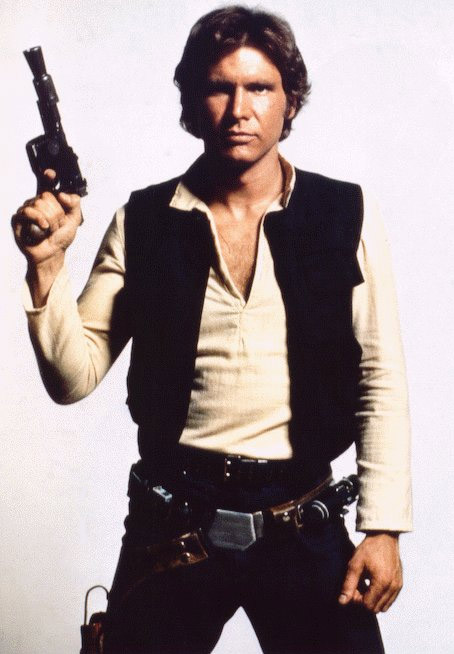
Look, I ain't in this for your revolution, and I'm not in it for you, Princess. I expect to be well paid--I'm in it for the money.

If you’ve ever read a space adventure with smugglers and pirates, or a sword & sorcery with rogue thieves and master-less swordsmen, or a western with gritty outlaws and mountain men, you know this character alignment.  If you’re a fan of any of these genres, chances are you love him, too.

The Chaotic Neutral‘s one consistent rule is to always look out for #1.  Beyond that, he’s a free spirit who believes in individuality and resists anyone or anything that tries to control him.  Rebellious spirits and lovable rogues tend to fall into this alignment, but so do tricksters and wild cards.  Their resistance to any form of personal restriction makes them unreliable allies, despite what Jack Sparrow says.

From the easydamus alignment page:

A chaotic neutral character follows his whims. He is an individualist first and last. He values his own liberty but doesn’t strive to protect others’ freedom. He avoids authority, resents restrictions, and challenges traditions.

A lot of characters start out as this but tend to shift as the story progresses.  Han Solo, for example, shifts from Chaotic Neutral to Chaotic Good as he becomes more and more involved with the Rebellion.  The Jägers from Girl Genius are Chaotic Neutral until they have a Heterodyne to lead them.  But in other stories, such as Pirates of the Caribbean and Schlock Mercenary, the Chaotic Neutral serves as an anchor.

My favorite Chaotic Neutral is probably Waylander from David Gemmell’s Drenai series.  The Jerusalem Man is another good one–in fact, just about every one of his books has a Chaotic Neutral that I love.  Haruhi Suzumiya is an excellent example of a female Chaotic Neutral–in fact, she’s probably the queen of this particular character alignment.

In my own work, the best example of a Chaotic Neutral would probably be Tamu from Bringing Stella Home / Sholpan.  Even though she’s technically a slave, she doesn’t really mind it because she has everything she wants and doesn’t have to be beholden to anybody (not even Qasar, really, since she’s his favorite).  Amina from Desert Stars is also Chaotic Neutral, in contrast with Surayya, who is more of a Lawful Neutral, though sometimes it’s hard to tell.  And in Genesis Earth, Terra is definitely a Chaotic Neutral at the beginning, though she shifts a little somewhere around the middle.

I’m hesitant to admit this, but when I took the character alignment test for myself, I tested out as a Chaotic Neutral.  As to what that means, exactly…I’m not going to say. o.0
Trope Tuesday: Neutral Good

Arguably the best of the good-aligned characters, the Neutral Good can always be counted on to do the right thing, whether that means working within the system or rebelling against it.  Whether young or old, soft or shrewd, nice or not so nice, these are the guys (and girls) most likely to save the world and defeat the enemy with love.

From the easydamus character alignment page:

A neutral good character does the best that a good person can do. He is devoted to helping others. He works with kings and magistrates but does not feel beholden to them.

The Neutral Good is not devoid of weaknesses, of course.  Although they are devoted to good, their lack of commitment to law means that they are not always willing to enforce it.  Also, for those who just want to get things done, this alignment can be somewhat limiting, in the way that a commitment to any higher ideal usually is.

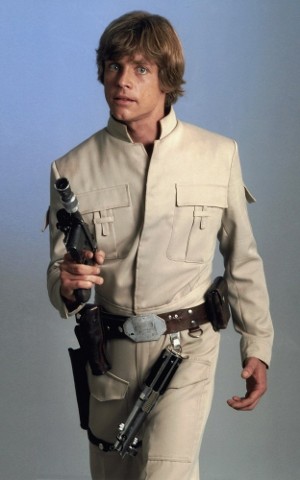
Interestingly, this is a very common alignment for heroes in space opera stories.  Case in point, Luke Skywalker: even though he’s young and reckless, he’s not above learning the ways of the force and joining the Jedi order.  Miles Vorkosigan from Lois McMaster Bujold’s Vorkosigan series also falls squarely into the Neutral Good camp.  Moving on to manga and webcomics, Alphonse and Winry from Fullmetal Alchemist both fall under this alignment, giving balance to Edward’s more chaotic outbursts.  Agatha from Girl Genius is also a Neutral Good…at least, when there aren’t any wrenches nearby.

There are quite a few characters with this alignment in my own work.  Even though she’s a mercenary captain, Danica from Bringing Stella Home falls squarely into this alignment; she’s got a tough outer shell, but she’ll do anything for her men, even…well, I don’t want to ruin Stars of Blood and Glory. 😉 Also from Bringing Stella Home / Sholpan, Stella is solidly Neutral Good, which is part of why the ending is so deliciously twisted.  In Star Wanderers, Jeremiah falls into this alignment mostly through default, which is good for Noemi because the circumstances of the novel put her totally at his mercy.  And in Desert Stars, this is probably Mira’s alignment, though she’s easily manipulated by her Neutral Evil mother.

What can I say?  I’ve got a soft spot for Neutral Goods.  Considering how well this kind of a hero fits in to a classic space adventure, it shouldn’t come as any surprise.

Trope Tuesday: Lawful Evil

If the term “villain” applies to anyone, it applies to the Lawful Evil.  Whether the evil overlord, his trusted right-hand man, or one of his devoted minions, these characters are dedicated wholeheartedly to their cause, whether they believe it will lead to a better world or not.  Taking over the world is often a major obsession, because hey, someone’s got to do it.  A staple of the evil empire, these guys often turn their country into an industrialized wasteland, though they often have propaganda machines to take care of any bad press.  Bonus points if they can transform into a freakish monster in battle.

From the easydamus character alignment page:

A lawful evil villain methodically takes what he wants within the limits of his code of conduct without regard for whom it hurts. He cares about tradition, loyalty, and order but not about freedom, dignity, or life. He plays by the rules but without mercy or compassion. He is comfortable in a hierarchy and would like to rule, but is willing to serve. He condemns others not according to their actions but according to race, religion, homeland, or social rank. He is loath to break laws or promises.

While Lawful Evils believe in following rules and keeping their word, they’re not above emotional manipulation, negotiating unfavorable contracts, or following the law in letter only.  Even so, they tend to suffer from genre blindness and bureaucratic stupidity (as well as megalomania–but hey, that’s part of the job description).

According to tvtropes, Lawful Evils come in four types:

  1. The supreme ruler, dedicated to establishing and maintaining a civic order that is itself evil.  A good example of this would be Sauron from The Lord of the Rings.
  2. A zealot or übermensch whose moral code falls outside of established social norms.  Khan from The Wrath of Khan is a pretty good example of this, as is Tyler Durden from Fight Club (though your mileage may vary).
  3. The Dragon or other minion who may have their own goals, but answers to the big bad.  Darth Vader is probably the most well-known example.
  4. A complete monster who is dedicated to the destruction of free will and liberty.  The Mormon conception of Satan fits this perfectly.

The scary thing about this trope is that it actually exists in real life.  In fact, outside of our sheltered middle-class, liberal democratic existence (a relatively recent and unusual development in the eyes of history), this type of overlord tends to be the rule and not the exception.  You don’t have to look any further than North Korea, Burma, or Syria for examples of this–which is to say nothing of the Soviet Union, the Third Reich, or the British Empire.

My favorite example of this trope is probably Darth Vader, not just because of how badass he is, but because of his heel face turn at the end of Return of the Jedi.  Ignoring how bad episodes I, II, and III were, his character arc really is the thing that makes that story.  And while we’re on the subject of history, let’s not forget this epic showdown between Stalin and Hitler.  Seriously, click that link.

In my own work, the best example of a Lawful Evil would probably be Qasar from Bringing Stella Home / Sholpan.  He’s more of the affable type than a true evil overlord, though; that would be Tagatai, who doesn’t really come to power until Stars of Blood and Glory. A much more sinister example would be Emile from Heart of the Nebula, or the villain I have planned for Edenfall–I’d better finish those!  And of course, there’s Sheikh Sathi from Desert Stars, though he’s mostly a type 3 Lawful Evil under the thumb of his Neutral Evil wife.

Perhaps one of the reasons I haven’t done a truly despicable Lawful Evil yet is because I’ve been kind of sheltered here in the states.  It will be interesting to see how my writing changes after spending some time in Eastern Europe; Georgia, after all, is the homeland of Stalin.

Darth Vader helmet taken from this site.

Trope Tuesday: Chaotic Good

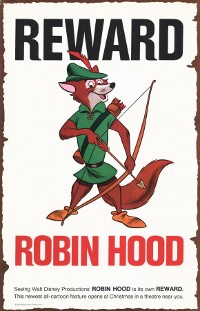
A pox on the phony king of England!

Wherever you find the evil empire, dirty cops, or a misguided crusade, chances are there’s a Chaotic Good somewhere in the shadows fighting against it.  From barbarian heroes to freedom fighters, rebellious princesses to ethical sluts, these free-spirited, noble-minded rebels are constantly at war with the man, robbing the rich to give to the poor.

From the easydamus character alignment page:

A chaotic good character acts as his conscience directs him with little regard for what others expect of him. He makes his own way, but he’s kind and benevolent. He believes in goodness and right but has little use for laws and regulations. He hates it when people try to intimidate others and tell them what to do. He follows his own moral compass, which, although good, may not agree with that of society.

Interestingly, once the evil bad guys are gone, the balance between Good and Chaotic is even more difficult to keep than the line between Good and Lawful.  For that reason, Chaotic Goods often make extremely poor rulers after the war is over.  When they win, they usually do one of the following:

Of all the character alignments, this one is my favorite.  It fits my own sensibilities almost perfectly.  Whenever a character of this type has to give up their old life to accept their new responsibilities, I can’t help but feel a little wistful and sad (maybe that’s why I haven’t settled down and married yet…hmm…).

This trope is extremely prevalent in manga and anime, with Edward Elric from Fullmetal Alchemist my personal favorite.  Agatha and Gil from Girl Genius are also really awesome–it’s going to be interesting to see how Gil shifts now that his father is out of the picture.  In science fiction, Captain Kirk is probably the most beloved character of this type, though almost all of Heinlein’s protagonists also fit the bill.

In my own work, Tiera Al-Najmi from Desert Stars is probably the best example of this trope.  She stands alone against the restrictive norms and hypocrisy of her society, urging Mira to do what’s right instead of what’s expected.  In Bringing Stella Home, James McCoy fits this trope too, though you could also make an argument that he’s more of a Neutral Good.  In Heart of the Nebula, however, he’s definitely Chaotic Good, which puts him squarely at odds with Lars, a Lawful Good who appears in all of the Gaia Nova novels thus far.

What I’ve been up to recently

I thought it would be a good idea to do a quick post explaining what I’ve been up to the past month or so, since a lot of things have changed and I’m sure they will be changing a lot more in the future.  So, here’s what’s up:

As you may or may not know, I decided about four or five months ago to leave the USA to teach English abroad.  For the past few little while, I’ve been applying for a program to teach English to elementary school kids in Georgia.  I had the interview over Skype just yesterday, and I think it went pretty well!  I should hear back in the next couple of days, so fingers crossed on that.

If they decide to hire me, I’ll leave in three weeks and stay until at least mid-June.  At that point, I’ll either sign up for another semester or go somewhere else, either the Middle East or Eastern Europe. The pay isn’t great, but it seems like a good cultural experience, and I’m a lot more interested in the Caucasus than I am in East Asia (no offense to Asians).

Ever since I graduated in 2010, I’ve been looking for a fulfilling career that I can balance with my writing aspirations.  I learned pretty quick that that simply doesn’t exist in Washington DC; either you sacrifice everything for your career, including your family, or you end up trapped in an office pushing papers all day.  In Utah, I bounced around a lot of temporary jobs while struggling to make ends meet, but I never found anything more permanent that seemed to strike a balance.

I hope that teaching English will help me to find that balance, and from what I’ve heard from some of my former expat friends, I’m optimistic that it will.  Perhaps more importantly, it will probably enrich my writing by exposing me to new peoples and cultures.  Desert Stars was certainly enriched by the time I spent in Jordan; without having lived in that culture, I don’t think I would have been able to write it.  Besides, English is something I’m good at, and so is teaching–so why not capitalize on the skills I already have?  It certainly sounds better than wasting my 20s in a warehouse.

So that’s the plan: launch a TEFL career and spend at least the next three to five years abroad.  At least.  I might not get married until my 30s–or who knows, I might find someone out there and go native–but this is something I want to do as a career, not just as temporary filler before I figure out what I want to do with my life.  I’m through with filler.  Whether it takes one year or ten for my writing career to take off, I’m going to get out and do something useful and worthwhile.

That’s the plan, anyway.  And of course, I’ll always keep writing.

Right now, I’m finishing up Stars of Blood and Glory; I’m on chapter 15, with only three more and an epilogue after that, so I should finish that well before I leave.  After that, the next big project is Star Wanderers, which is already about halfway finished.  I’ll probably take some time off and work on polishing part II, then release parts I and II sometime in the spring–unless by some weird fluke it wins Writers of the Future.  I’ll know in February.

And after that?  Well, I’m thinking it’s almost time to pick up Edenfall again, but I can’t say for sure. Probably, though–I definitely want to finish that one before the end of the year, and preferably get it published.  After Stars of Blood and Glory, I’ll probably take a break from the McCoy continuity in the Gaia Nova universe, though I may pick up something from Jeremiah’s timeline in Star Wanderers.  I really want to do a parallel novel from Noemi’s point of view–maybe that’s the one I’ll do in seven days, just to hit that resolution.  Everything has to be ready fist, though, and right now it isn’t.

So much is changing–I have no idea where I’ll be in the next six months, creatively or physically. But right now, I’m just enjoying a relaxing time with my parents and getting ready for the next big transition.  Life is good.

Trope Tuesday: Lawful Good

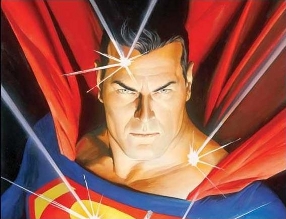
Lawful Good is the character alignment that is the most unambiguously heroic.  These are the white hats, the caped crusaders, the knights in shining armor who fight for Truth, Justice, and the American way.  They might not always be smart, and they might not always be nice, but you can always count on them to do the right thingalways.

From the easydamus character alignment page:

A lawful good character acts as a good person is expected or required to act. He combines a commitment to oppose evil with the discipline to fight relentlessly. He tells the truth, keeps his word, helps those in need, and speaks out against injustice. A lawful good character hates to see the guilty go unpunished.

Although most Lawful Good characters are unambiguous, their conflicts are often quite complicated.  This is because their dedication to the moral code is itself a weakness which an intelligent villain can exploit.  Typically, this is done by putting them in a situation where they have to choose between being lawful (catching the bad guys) or being good (saving all the innocent people who will die in the process).  A smart Lawful Good character, however, will come up with a third option that turns the ethical dilemma on its head, though it might require a heroic sacrifice.

Very often, these kinds of characters appeal to us because they represent some higher ideal which we wish we could follow.  However, that’s not always the case, especially in more cynical works like A Game of Thrones, where the most lawful good characters also tend to be the most stupid.  Ultimately, it all comes down to the bias of the writer; even when you’re trying not to be didactic, it’s hard not to use the Lawful Good character as a vehicle for some sort of message.

A shallow Lawful Good will be little more than a paragon for whatever virtue they’re meant to represent.  A more nuanced Lawful Good will have some sort of a flaw (besides the backhanded ones), or some sort of internal conflict connected with their moral code to make them more human and relatable.

My favorite Lawful Good would probably be Sir Galahad from Le Morte d’Arthur, but mostly because of the sharp counterpoint he provides next to all the thugs and criminals other Knights of the Round Table.  Carter from Halo: Reach is a pretty cool Lawful Good, though he wasn’t my favorite (that would be Jorge).  And even though he’s a complete idiot, Ned Stark is still the only adult character from A Game of Thrones that I found remotely likable.

In my own work, Jalil from Desert Stars starts out as Lawful Good, though he shifts to Lawful Neutral in the middle and up to Neutral Good by the end.  In Bringing Stella Home / Sholpan, Lars and Narju definitely fall under this alignment, putting a lot of pressure on Stella to live up to their ideals.  I explore Lars’s idealistic character a bit further in Heart of the Nebula, a direct sequel to Bringing Stella Home which I hope to release later this year.  And in Star Wanderers, Noemi tends to fall under this alignment–though the story is not so much about saving the world as it is about saving each other.

Getting back into things

Sorry I haven’t posted much lately; I just got back to Massachusetts from a cross-country train trip (after spending Christmas between Utah and Texas), and I’m still getting situated here at my parents’ house.  If all goes well, I’ll be leaving by the end of the month to teach English in Georgia; worst case scenario, I sign up for a different program and spend a few more months here than I’d bargained for.

Things on the writing front are going well, though; I’ve been pulling between 1.5k and 2.5k words per day pretty consistently, all on Stars of Blood and Glory.  It’s very refreshing to be working on a new project again, and while I don’t feel like I’m into it as much as I could, with nothing else to distract me hopefully that will soon change.

One other interesting thing I’m doing right now is keeping track of the stats for my writing sessions: how many words I write, what times I start and finish, how many words per hour I average, etc.  The data is turning out to be quite interesting, so once I get to about 50 or 100 data points, I’ll post my findings.  It’s definitely giving me some much needed insight into my writing process.

In the next couple of days, I’ll post the ebook numbers for December and my quarterly report (I might actually combine the two into one post, come to think of it).  Also, I’ll finally get around to sending out the email newsletter, with some goodies like desktop wallpaper for Desert Stars.  If you haven’t yet signed up for the newsletter, you can do that via the form on the sidebar. —>

Finally, to round things out, I’ll link you to this awesome Final Fantasy VI tribute I found on teh internets:

Man, such an awesome, awesome game. I almost did a full length novelization of FF6. Instead, I wrote my first novel. It was definitely the better choice at the time…but a part of me still wants to revisit that world through writing my own fanfic. Someday, maybe…

Trope Tuesday: Celibate Hero vs. The Fettered

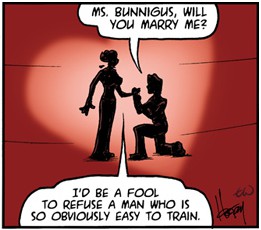
Yes, there are still good men out there...and they tend to know who's boss.

I’m mashing up two tropes this week because I’m not satisfied with the one.  There are a bazillion tropes about characters who are sexually active, but very few about sexually chaste characters that don’t portray them as weak, clueless, or socially inept.

According to tvtropes, a celibate hero is a main character who “doesn’t do the romance thing.” Unlike the chaste hero, who is just clueless, the celibate hero has made a conscious decision not to engage in sexual relations or get tied down in a relationship.  There may be any number of reasons for this, but it usually comes down to some combination of Love is a Weakness, Love Hurts, and It’s Not You, It’s My Enemies.

(As a hilarious example of this: TESLA!!!)

But what about the character who isn’t necessarily opposed to romance, but feels that they should wait until marriage to have sex?  Unfortunately, this trope is pretty rare nowadays.  I can only think of two mainstream examples: Edward from Twilight and Reverend Theo from Schlock Mercenary.

Theo in particular is a great example of this, because he’s not clueless, he’s not weak, and he not only gets the girl, he gets the girl that everyone wants.  The only reason he holds out is because his religious order forbids sex before marriage.  It does permit priests to marry, however, so Theo does manage to balance the two.

So why are characters like this so rare?  Unfortunately, I think it comes down to the widespread notion that a true man isn’t a virgin, and that sex makes people cool.  If we accept these tropes as true, then that means that men who exercise self-restraint are actually weak and pitiful, and couples who choose to wait are pathetic losers.

It’s worth pointing out that both Edward and Reverent Theo were created by writers who are practicing Mormons–people who belong to a religious community where it’s still the norm to wait until marriage.  If literature is the way that the culture speaks to itself, then this goes to show just how unrestrained the rest of Western society has become.

This is why I think that the better trope for this kind of character is The Fettered.  Unlike the celibate hero, who usually gives up sex for some kind of external reason, the fettered gives it up as a matter of principle.  Living by his ideals isn’t easy, and he’s constantly tempted to give in and break his moral code.  However, by resisting these temptations, the fettered gains great strength, and can stand like a beacon of light in an otherwise disillusioned world.

This is actually something that I tried to do with my latest novel, Desert Stars.  The main character, Jalil, is a man who believes in honor, and follows a code of abstinence before marriage.  However, to manipulate him into staying at the camp, his father charges Mira, the female protagonist, to seduce him.  Since the fettered’s strength is also his greatest weakness, if Mira can get Jalil to sully her honor, then out of shame he will return and marry her.

The catch?  She actually has feelings for him, and doesn’t want to manipulate him in this way.  In this way, merely persuading him to have sex isn’t a win condition–in fact, if done in the wrong way, it could be a very serious “game over.”

Whether or not I actually pulled it off well is up to the readers to judge.  But one thing I was definitely shooting for was to write a character who fulfills this trope in an unconventional yet powerful way.  And if you’ll permit me to step onto my soapbox for a little bit, I think our culture desperately needs more heroes like this–heroes who show that real men are capable of self-restraint, and that following a moral code is still cool, even if it means waiting to consummate a relationship.

Desert Stars is now published!

Desert Stars, my third novel (and second in the Gaia Nova series), is now available as an independently published ebook from Amazon, Barnes & Noble, and Smashwords.  Within the next couple of weeks, it’ll be available through Kobo, iTunes, Diesel, Sony, and Xinxii as well.

It’s been a long journey, and I’m thrilled to finally see it come through.  I started the first draft back in the fall of 2008, but had been working on ideas for the world since 2005, when I returned from my LDS church mission in California.  Spending the summer of 2008 in Jordan was a major catalyst for my imagination, and I soon was bursting with ideas for a far-future story on a desert world.

I got stuck in the winter of 2009, however–right before taking Brandon Sanderson’s English 318 class.  Since he encourages all of his students to work on something new, I decided to write a book in the same universe in order to work through some of the world-building things that were holding me up.  That book became Bringing Stella Home, which was a thrill to write all of its own.

The strategy worked; by the time I’d finished that one, I had a much clearer idea where to go with Desert Stars, and an awesome ending that was nothing like anything I’d planned in the first draft.  And so, after graduating in April 2010, I soldiered through and finished the rough draft that summer.

It still had a lot of problems, though.  Fortunately, my first readers were extremely helpful both in pointing those out and in giving me fantastic ideas for other things I could do.  In the second draft that winter, I completely scrapped a major subplot in the second half of the book and focused on perfecting the character arcs for the two main characters: Jalil and Mira.

Around this time, I made the paradigm shift from traditional to indie publishing.  Other projects like Genesis Earth and Bringing Stella Home took my attention for a while, as I learned the basics of the new world and prepared those books for publication.  However, I always kept coming back to Desert Stars: I knew I had a good story there, and I was just itching to bring it to its full potential.

In the fall of 2011, I finally had that opportunity.  The last draft flew by in three weeks, and was one of the funnest writing experiences I’ve had since I started writing seriously in 2007.  By the end, I knew it was ready.  I sent it out to my editor, Josh Leavitt, and started to prepare it for publication.

In writing any book, there are always moments that stand out; experiences where things come together in an unexpected yet memorable way.  One of those came to me in Jordan, while I was walking down Queen Rania street from the University of Jordan to Al-Dustour, and the phrase “Temple of a Thousand Suns” flashed into my mind and sparked the whole novel.  Another of those moments happened while I was driving from Salt Lake to Provo, and Mira’s final words in the last chapter came to me; I literally could not stop screaming for two or three minutes.

I could share more, but if I did, I’d find it difficult to maintain the illusion that I’m not a loony psychopath. 🙂

In any case, it’s just awesome to see the story come to maturity and embark out into the world.  I’m sure this isn’t the end of the journey, but it’s definitely entering a new and exciting phase.  I sincerely believe that this is my best book yet, and I hope you find it as worthwhile to read as I have found it worthwhile to write.  If you do, I would appreciate it greatly if you took the time to post a review, or share it with a friend.  Every little bit helps, and I’m grateful for whatever support you can give!

In the next couple of days, I’m going to send out a newsletter with some freebies including desktop backgrounds of the cover art.  If you’d like to get in on that, be sure to sign up for the email newsletter via the form on the sidebar; you’ll also receive notices for other giveaways, as well as new releases.  It costs nothing and you can always unsubscribe, so there’s no pressure or obligation.

And that just about wraps it up.  Now: on to the next book!

Desert Stars cover is finished!

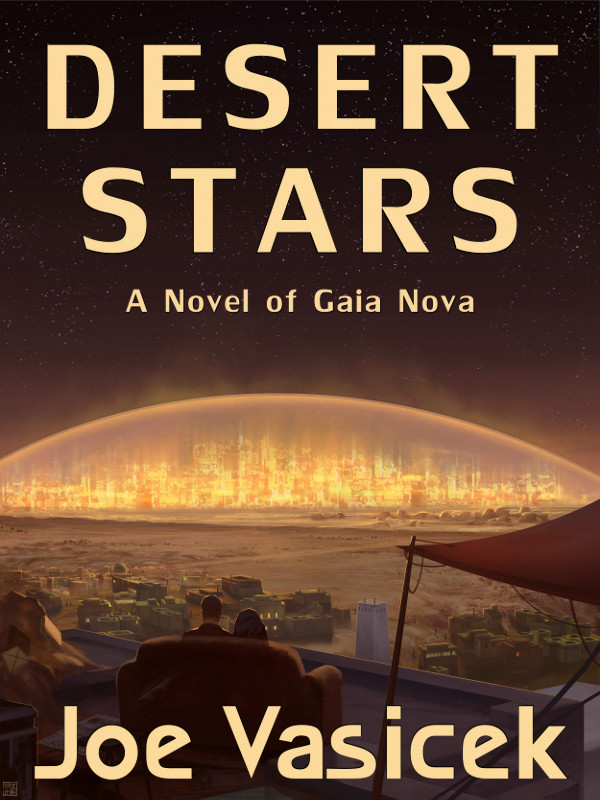
Here it is, guys!  What do you think?

I played around a little bit with the text this time, coloring it and putting in some noise to give it a hint of texture.  The title and subtitle font is LilyUPC, and the author name font is Alpha Centauri (from Sid Meier’s Alpha Centauri–best empire building strategy game ever).

If no one points out any glaring errors, I’m going to make the ebooks right now and upload them to Kindle, Smashwords, and Barnes & Noble sometime tomorrow.  I’d do it tonight, but it’s getting late, and I’m starting to come down with cabin fever.

After all these years, it’s finally happening!  Yay!