B is for Space Battles

osc_first_meetingsIf you fell in love with science fiction when you were twelve, chances were it was because of the awesome space battles.  That was certainly the case with me.  When I saw Star Wars for the first time, I spent hours running around the house pretending I was flying my own starfighter.  In some ways, I’ve never really stopped. 😛

Ever since space opera became its own subgenre, space warfare has featured prominently in it, probably for the same reasons that Homer and Tolstoy framed their sprawling epics with a tale of war.  Where else are you going to find enough drama to fill volumes?  The fact that it’s set in space makes it so much cooler.

There are a lot of things about the space setting that make war stories different from those set here on Earth.  For one thing, there’s a huge element of exploration and unknown.  Even before we took the first photographs of Earth from space, there pretty much isn’t any corner on this planet that hasn’t been discovered by somebody.  In space, though, it’s still possible to stumble on a hidden planet, or find a mysterious alien artifact that can turn the tide of the war (Halo, anyone?).

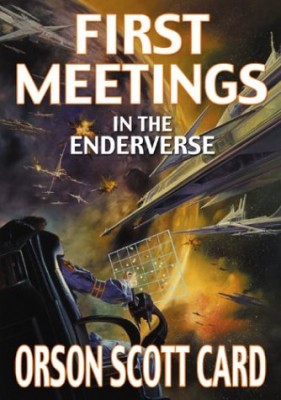
For another thing, the dynamics of battle are completely different.  Sure, some stories treat space like an ocean, and there’s certainly a place for that kind of story, but the more interesting ones (at least to me) take into account all the profound differences.  For one thing, the zero gravity means that there is no “up” or “down,” which means that you have to deal with the possibility of attack coming from any direction, not just along a horizontal plane.  That concept alone drives the battles in Orson Scott Card’s Ender’s Game series, where “the enemy’s gate is down.”

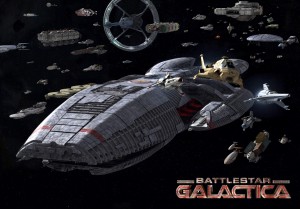
One thing that really tickles me is when the story takes things a step further and incorporates things like orbital mechanics and delta-v.  I haven’t seen many books or games that do this, but the ones that do have really engrossed me by making the world feel that much more real.  Glen Cook did it in Passage At Arms, and the new Battlestar Galactica did it in the viper dogfights (though I’m not sure if they did it on the ship-to-ship scale).

The implications of real-world space physics on warfare are quite fascinating.  Rocketpunk Manifesto is an excellent blog that’s almost entirely dedicated to exploring them all, with all sorts of fascinating discussions on what the “plausible mid-future” may look like.  But even if all you’re looking for is an entertaining romp through space, the story telling possibilities are so much greater when you take the constraints of physics into account.

For example, if it takes months or even years to travel between planets, and orbital trajectories are fairly straightforward to figure out, how does it affect things if you can see the enemy fleet coming at your planet that long in advance?  If escape velocity from a gravity well like Earth is so difficult to achieve, what does that mean about the possibility of long-term planetary sieges?  And if starships are so far apart and moving so fast as to make full-on broadsides unlikely, how does that shape the battle tactics and strategy?  In spite of the physical constraints (or indeed, perhaps because of them), the possibilities are endless.

Man, I love me some good space battles.  One of my recent sci-fi favorites that features some epic battles is Wolfhound by my friend Kindal Debenham.  In my own work, you’ll find lots of them, especially in the Gaia Nova series (Bringing Stella Home, Stars of Blood and Glory, and to a lesser extent Desert Stars).  They say that the golden age for science fiction is about twelve years old, and that’s definitely true for me.  Expect to see lots more space battles from me in the future.
Trope Tuesday: It Has Been an Honor

If there ever was a phrase that invoked manly tears, it’s this one.

It has been an honor” is pretty much the go-to catch phrase for any Heroic Sacrifice or Bolivian Army Ending.  It’s often a precursor to a Crowning Moment of Awesome, and as far as last words go, it ranks right up there with “I die free,” “I die as myself,” and “I regret nothing.” Expect to hear it a lot from blood knights, members of the proud warrior race, or anyone who belongs to a martyrdom culture.

Occasionally, you’ll hear a villain say this when he acknowledges the hero as a worthy opponent.  In such cases, the villain may evolve into a friendly enemy or a fire-forged friend. Or, if the trope is played straight, they just die.

One time you won’t hear this phrase is when someone is trying to play More Hero than Thou.  In that case, two or more good guys in a friendly rivalry basically argue over who has to bite the bullet, so the honor becomes a point of competition between them.

In my opinion, the heart and soul of this trope is the idea that some things are worth dying for.  Obviously, a character facing death is not going to say this unless he values his honor more than his life.  What exactly constitutes “honor” may be up for debate (with the potential for some unfortunate implications, especially in real-life martyrdom cultures like Japan), but the core element here is that the hero is fully willing to give up his life for something greater than himself.  Bonus points if he starts out as a coward and this trope marks the conclusion of his growth arc.

While this phrase often leads to a death of some kind, that isn’t always the case.  The cavalry can still show up to save them, or one of the characters can ultimately survive (either the one who says this phrase, or the one to whom it is said).  The important thing, though, is that the characters face death in a meaningful way.  Without that, this phrase doesn’t have nearly as much power.

In my own work, this trope tends to pop up a lot, especially in the more military sci-fi books in the Gaia Nova series.  It shows up multiple times in Stars of Blood and Glory, and also in Bringing Stella Home, though more in a posthumous way than anything else.  I suppose you could also say it happens in Star Wanderers: Homeworld, if you use a broader interpretation.

But either way, I’m definitely a big fan of this trope.  Expect to see it many more times in my own work in the future.

As a final note, it’s worth pointing out that the bandmaster’s violin from the real-life Titanic has recently been recovered and confirmed genuine.  It’s now on display in Belfast, less than two miles from where the Titanic was built.

Projects, projects everywhere …

… and not a clue where to start.

Seriously, I feel like that guy in the Russian proverb who’s chasing two rabbits.  Except, in my case, it’s more like a dozen.  Here’s what I currently have to choose from:

Stars of Blood and Glory — This one is in publishing mode, and should be out in a week or two.  I’ve gone through all the line/copy edits from my editor, finalized the book teaser–all that’s left is the formatting and cover art.  The preliminary sketches look really good, so it shouldn’t be too much longer before it’s ready to go.  Of course, it’s more of a publishing thing than a writing thing, but still important.

Lifewalker — This is a rough draft that’s only about 15% to 20% finished.  It’s in a totally different genre than I’m used to writing (post-apocalyptic / weird western), but so far it seems to be coming along fairly well.  I hit a block a couple of weeks ago and put it on the back burner for a while, but I may be ready to pick it up again.

Star Wanderers: Benefactor — This is another rough draft, about 35% to 40% finished.  It’s a parallel novella to Star Wanderers: Fidelity, except from Jakob’s point of view.  Right now, I’m in the phase where everything sucks and I don’t know where to go with it.  It’ll probably turn out just fine, but I may have to put it on hold for a while.  However, if I could just push through and finish the damn thing, that would be preferable.  It’s only another 15,000 words …

Star Wanderers: Dreamweaver — This is a first draft that I need to revise.  Last night, I looked over it for the first time in eight months.  Opening the file was like pulling out an unopened bottle of wine that’s been sitting for years in the back corner of the wine cellar.  So far, it seems pretty good, but I’m going to wait until I hear back from one of my first readers before doing any serious revisions.  After that, maybe run the first chapter through Kindal’s writing group, and if everything seems good, I’ll probably publish it sometime in April/May.

Star Wanderers: The Jeremiah Chronicles — This is purely a publishing project.  Basically, I want to bundle the first four Star Wanderers stories and release them as an omnibus.  To do this right, though, I’d have to commission some cover art, which takes time and money.  Since it’s not a writing project, and I already have enough publishing projects on my plate, I’ll probably put this one off until Dreamweaver is out.

Mercenary Savior — Long term followers of this blog might recognize this as the old title for the novel that became Bringing Stella Home.  Well, I plan to recycle that title, as well as the original prologue, in a prequel novel that basically tells the origin story of Danica Nova and her band of mercenaries.  So far, I’ve got the prologue and the beginnings of the first chapter.  Haven’t looked at it in a few months, but if I get stuck on these other projects, I just might pick it up again.

Heart of the Nebula — A second or third draft that needs a deep revision.  This is probably going to consume all my writing time for six to eight weeks, and I’d rather do it all at once rather than in chunks.  It’s been on the back burner long enough that I can probably pick it up again, but I want to finish a rough draft first.

The Sword Keeper — I’ve still got this one on the current projects bar, but it’s been a while since I’ve worked on it, so it’s pretty much on the back burner.  I think it’s at about the 40% mark, though honestly I have no idea.  It’s an epic fantasy novel, a bit outside my usual scope, and it’s turning into a beast of a book.  The story is pretty solid, though, so I’ll probably finish it before the end of the year–that is, unless the muse drops an anvil on me (which has definitely happened before).

Empress of the Free Stars — An unwritten novel that’s been kicking around in my head ever since I finished Stars of Blood and Glory.  Basically, it’s a direct sequel from Hikaru’s point of view … except that I can’t really discuss it without giving away spoilers (TO A BOOK THAT ISN’T EVEN OUT YET).  In any case, the prologue has been beating on me to get written, and I finally caved and started it last night.  I’ve got a pretty good idea for what’s supposed to happen in this novel, but there’s still a whole lot of room for the story to surprise me.

Edenfall — Ah, Edenfall … this is probably my most neglected story.  I started it a little over a year ago, but hit a block, and then Star Wanderers happened.  I’ll pick it up eventually, but to really do it justice, I feel like I need to go backpacking in the wilderness for a week or two.  The weather isn’t good for that right now, so it will probably have to wait until spring.  Or maybe I’m just making things too complicated.  We’ll see.

Star Wanderers; Wanderlust — A Star Wanderers story from Samson’s point of view.  This one is going to be tricky, but I’ve actually got the whole thing plotted out already.  However, I don’t want to write it just yet, because there’s still a bunch of other Star Wanderers stories that need to come first.  Or maybe I will write it, and let it sit for a while until I write the others.  Maybe it’s better to finish it first and let it sit for a while, just to be safe …

Those are pretty much all the projects with titles that are floating around in my head right now.  There are a few others, like parts VII and VIII of Star Wanderers (from Mariya and Lucca’s points of view, respectively), but those aren’t quite ready to start.  With all of these, I’ve at least got some words on the page.

So now that I’m in that frustrating space between projects, I think I’m going to take a week or two to just let my creative mind do whatever the heck it wants.  Hopefully, I’ll get excited enough about one of them to see it all the way through.  I’m not going to stress about word counts so much as putting time in at my chair, doing something.

Man, I wish my creative side weren’t so scatterbrained.  Though as long as I’m still finishing stuff, I guess it’s all right.

And now that I’ve procrastinated long enough by writing this blog post, it’s time to go hang out with my friends and procrastinate some more.  Later!

Trope Tuesday: Honor Before Reason

nedstarkIf you can’t do something smart, what do you do? Something right–at least, when this trope is played straight.

Characters who place honor before reason tend to be idealists, starry-eyed or otherwise.  It’s not that they’re stupid–at least, not always–but they do tend to be vulnerable to flaw exploitation.  If the Fettered can’t take a third option, this is how he often gets trapped.

On the other hand, without this trope, we wouldn’t have as many heroic sacrifices or men of their word. In the dark, everyone would turn out to be a jerkass, and the world would be a terrible place to live.

Since the best stories often have some sort of moral dilemma at their core, there’s something about this trope that speaks to us, even (or perhaps especially) in the face of sadistic choices and necessary evils.  It appeals to the more innocent part of us that still wants to believe in incorruptibility.  On the other hand, characters who follow this path don’t tend to think creatively enough to actually solve the problem–or at least, solve the problem without committing the ultimate sacrifice.

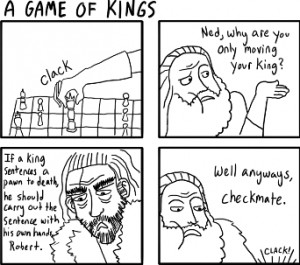
Not surprisingly, this trope is a very good indicator of where a story stands on the Sliding Scale of Idealism vs. Cynicism.  In idealistic stories, characters who place honor before reason are often vindicated, such as Bilbo in The Hobbit or Luke Skywalker in Star Wars.  In more cynical stories, the honorable characters not only get eaten alive, their noble idealism actually makes the problem worse.  The classic example of this is Ned Stark from A Game of Thrones, as the cartoon above suggests.

The opposite of this trope, reason before honor, is shoot the dog.  Interestingly enough, in the first scene in which Ned Stark appears, he commits an act that arguably fulfills both tropes at the same time (executing a man who is most likely innocent but has been found guilty by the law).  Lawful stupid doesn’t necessarily come into play, but it often overlaps.  Again, it all goes back to the scale.

This trope pops from time to time in my own writing, though I’m not nearly as cynical about it as George R.R. Martin.  Jalil from Desert Stars generally fits this trope, though Tiera is just as honorable and definitely not stupid about it.  Stella from Bringing Stella Home fits this trope at first, though her choices are vindicated later on.  In Stars of Blood and Glory, though, there’s a character who fits this trope perfectly, and I’m not sure whether he gets vindicated or not.  It will be interesting to see what the readers have to say about that.

Stars of Blood and Glory coming out soon

So last year about this time, I wrote a novel in the Gaia Nova universe.  Usually when I sit down to write a novel, it falls apart about midway through the first draft, or I have some kind of a break down, or something else comes up and I have to put it on hold for a while.

From start to finish, this one came out in about six weeks.

Even the title, Stars of Blood and Glory, really seemed to stick (usually, I go through three or four lame titles before finding one that works).  It took a lot of energy to write it, but the writing process itself was fun.  Seriously, everything just came together and the story practically wrote itself.

However, writers can often be notorious judges of their own work.  For that reason, I set it aside and tried not to touch it for a few months (I did rework the first couple chapters, but later ended up cutting out most of that stuff and going back to the original version, which was better).  Over the summer, I picked it up for the first revision, and while the scenes were out-of-order and a few of them were missing, but for the most part, everything that was there seemed pretty good.

Just to be safe, I sent it out to some first readers and laid it aside for another six months.  I didn’t hear back from everyone I sent it to, but those who did read it said it was pretty good.  The problems they found were relatively minor, or could be fixed relatively quickly, without having to overhaul the story.

To be perfectly honest, this blew me away.  My first drafts are usually really messy, and require a lot of work before they’re any good.  But this one…this one seems different.  This one, I might have just nailed it <fingers crossed>.  And if that’s indeed the case, it’s probably better not to risk revising it to death, or polishing the voice right out of it.

It’s always a scary thing to send a book out into the world.  However, I think the time to send out this one has come.  I’m going to do one last revision pass, just to make sure there isn’t anything too egregious, and then I’ll send it out to my editor and commission the cover art.  If all goes well, I’ll finish the revision next week, and publish it in ebook and print-on-demand sometime in February.

As an indirect sequel to Bringing Stella Home and Desert StarsStars of Blood and Glory has a lot of recurring characters.  Here are some of them:

  • Captain Danica Nova
  • Master Sergeant Roman Andrei Krikoryan
  • Rina Al-Najmi
  • Stella McCoy, aka Sholpan

Besides that, here are some of the other cool things you can expect to see:

  • A far future Japanese-Polynesian society on an ocean planet with giant floating cities.
  • A Hameji offensive, with massive space battles and planetary slaggings.
  • A lonely boy emperor who fears that he’ll never live up to his father’s dying wish.
  • A runaway princess who wants to experience everything the universe has to offer.
  • A young Hameji prince who yearns to prove himself in the field of battle.
  • A cyborg mercenary who feels like his humanity is slowly fading into irrelevance.
  • An unlikely assassin whose mind and body are not completely her own.

All of this comes together in a war of epic proportions that will determine the fate of the last free worlds in the galaxy.

So yeah, I’m really excited about this story.  It’s a departure from some of the more intimate (and less action-y) science fiction romances I’ve been putting out lately, but in all of the right ways.  If you read Bringing Stella Home and wondered when you’d get a worthy sequel, well, this is it.  And hopefully, it’s just the first of many.

Expect it to be out in ebook and print-on-demand sometime next month.

Trope Tuesday: Space Cossacks

I’m going to take a break from the hero’s journey trope posts for a while, until I have the time to do them justice.  In the meantime, let’s have a little fun.

Some of my favorite science fiction stories are the ones about a culture of nomadic starfaring people wandering the universe in search of a new homeworld.  Earth is usually a half-forgotten legend, and their starships have probably seen better days.  On tvtropes, the page for these stories is Space Cossacks, named after a real world culture in historic Russia that basically experienced the same thing, albeit on a terrestrial scale.

The description of this trope on the tvtropes page is so good, I’m just going to repost it here.  Seriously, every one of those cross links is worthy of your click.

There is no hope and You Can’t Go Home AgainThe Empire is spreading out. Even The Federation has too many Obstructive Bureaucrats. There is no way for free men to get out of the reaches of The Government and even mounting La Résistance will be of no avail.

So what do you do? You become Space Cossacks.

You flee to the border and live in a tough area where you all have to be sharp. You set up as Space Pirates or as Hired Guns or as Intrepid Merchants. Or all of these at once.

With you are various dissidents like people who feared being Made a Slave. There might be a Noble Fugitive or two, perhaps even a Defector from Decadence. You and your brave band of Fire-Forged Friends will struggle on to survive and maintain your freedom and heed no laws but your own.

One of the things that I think should qualify a story for this trope is that the society of space cossacks is just that: a community of people who share at least a few cultural bonds.  Battlestar Galactica definitely qualifies, but I’m a little on the fence as to Firefly, since that story is more or less about a ragtag band of failed revolutionaries.  Are the Browncoats all from the same culture, like the Kurds or the Circassians or the Ossetians, or are they just a pologlot group of frontiersmen from all over the settled worlds?  Does it even matter?

In the end, I suppose it doesn’t.  The spirit of this trope is a lot like that of Fighting for a Homeland: a bunch of displaced underdogs on the fringes of civilization trying to make their way in the universe.  The nature of the conflict is such that by the end, they can’t help but form their own distinct subculture.

I don’t know why I love this trope so much.  Maybe it has to do with the way it blends elements from the Western genre in a classic Science Fictional setting.  Maybe it’s because I was born in the wrong century and naturally dream of settling the frontier.  Maybe it’s because this is one of the best ways to get awesome space battles.

Whatever the reason, I can’t get enough of it, as you can probably guess from reading my books.  In Bringing Stella Home, Danica and her band of Tajji mercenaries fit this trope to a T.  Stars of Blood and Glory delves quite a bit deeper into their background, with Roman as a major viewpoint character.  In Heart of the Nebula, the people of the Colony basically become Space Cossacks over the course of the novel.  Both of those novels are currently unpublished, but I hope to put them up in the next year.

On the subject of roving bands of displaced Eastern Europeans, I listened to this Circassian folk song maybe a dozen times while writing this post:

Awesome stuff–I’m totally putting it in the soundtrack for my next Gaia Nova novel.  Also, I’ll have to name a moon or a planet in the Tajjur system after Mount Elrus or something.  Space Cossacks indeed!

New Kindle! And some new old projects as well

So I came out to Tbilisi today, because MY NEW KINDLE PAPERWHITE JUST ARRIVED!

Okay, sorry for the all-caps shouting, but I’m really happy that it finally got here.  My old kindle broke down a few months ago, leaving me stranded in my tiny village without any books.  With the weather getting worse and the power outages becoming more frequent, cabin fever has started to become a problem.  So really, it couldn’t have come at a better time.

It shipped out almost a month ago, but Georgia (the country, not the state) is a fairly remote place, so it’s taken a looong time to get here.  The wait has definitely been worth it, though.  I love this device, especially the cover browsing function.  And the backlight is going to be very, very useful, what with all the power outages we get in the village.

So I’m about 100 pages into The Sword Keeper, my latest project, and I realized that I need to do a lot more worldbuilding before I can continue.  I’ve got a good handle on the characters and have more or less figured out the plot, but there are still a lot of holes in the setting.  This new project is a fantasy novel, and it seems to be leaning more towards epic than heroic, so I probably should take the time to really build the world before trying to finish the story.

I’ve been drawing a lot of inspiration from my experience here in Georgia, but right now, I feel like I’m too close to it to really take it in the right direction.  The time I spent in Jordan was a huge influence in Desert Stars, but I didn’t start it until I came home (and didn’t finish the first draft until almost two years later).  Ideas are like wine: sometimes, you just need to let them sit in the back of your head and age for a while.

So long story short, I’ve decided to put The Sword Keeper on the back burner for a while.  I’m  sure I’ll come back to it, though–the story is far too interesting to let go.  Magical thinking swords that meld with the minds of those who wield them, ancient prophecies and a secret order of warrior monks–and that’s just the backdrop.  The characters themselves are much more interesting–I have got to tell their story!

But for now, I’m going to revisit the Gaia Nova universe and finish the revisions for Heart of the Nebula.  This one is a direct sequel to Bringing Stella Home, and while it definitely still needs work, I feel like it’s almost there.  The first draft had some major problems and needed to be revamped, especially toward the end.  If all goes well, I should finish this pass before the end of November, with enough time to write another Star Wanderers story before the end of the year.

Stars of Blood and Glory is still with my first readers, but if they give it the green light, I hope to publish it sometime in February.  This one is also a direct sequel to Bringing Stella Home, with Danica, Roman, Stella, and Stella’s son Abaqa, and a couple of characters from Desert Stars as well.  I’m really excited about this story, but I figure it’s best to get some more feedback first before putting it out.

Which brings me to Star Wanderers: Homeworld (Part IV).  I can’t promise that it will be out before the end of November, but that’s what I’m shooting for.  Of course, I’m not going to put it out until I’m satisfied that it represents my best work, but even my first readers do come back with problems, I’m 99% confident I can fix them all by December at the latest.  There is nothing–absolutely nothing–like the feeling you get when you finish a story where everything just comes together.  I may not be the best judge of my own work, but I know that feeling.  You can definitely expect to see this story come out before the end of the year.

That’s about all for now.  Internet is spotty out in the village, but I’ve got a couple of interesting posts brewing in the back of my mind.  I’ll probably write them up in the next few days, and post them the next time I get a chance.  Until then, see you around!

Trope Tuesday: MacGuffin

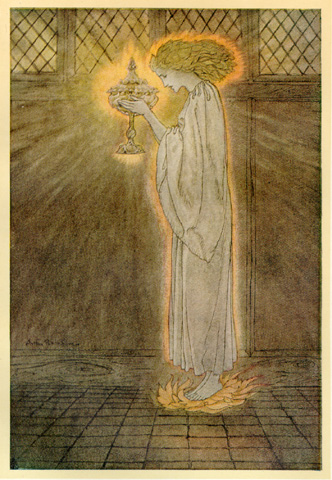
The Holy Grail of MacGuffins. Literally.

So the hero has crossed the threshold of adventure, thwarted the trickster, evaded the vamp, and met with the goddess.  He may have lost his mentor and descended into the deepest dungeon, but by calling on the supernatural aid he received at the beginning of the quest, he has passed the final test, found atonement with his father, and come back stronger than he ever was before.

So now that that’s all done, what’s left?  Just one thing, really–he has to receive the ultimate boon, or in other words, get the MacGuffin that he came out questing for in the first place.

A MacGuffin is an object whose main (sometimes only) purpose in a story is to motivate the plot.  It is usually something that everyone is chasing after, whether it be a ticking time bomb, a briefcase full of money, a priceless artifact, or some sort of superweapon.  Basically, it can be almost anything–that’s kind of the point.  If you can replace an object with something completely different that serves the exact same plot purpose–for example, a priceless stolen Picasso with a priceless stolen Dead Sea scroll–then it’s a MacGuffin.

Like it or not, MacGuffins are everywhere in fiction.  It’s such a prevalent trope, it even has its own Wikipedia page.  One of the most famous examples, at least in the Western literary tradition, is the Holy Grail.  Another example is the One Ring from Lord of the Rings–it could just as easily be a bracelet, or earring, or any other wearable artifact (though admittedly, if it were a necklace and Gollum had to bite off Frodo’s head, that would change the story quite a bit).  The MacGuffin page on tvtropes lists nearly 30 subtropes, from Egg MacGuffin to I’m Dying, Please Take My MacGuffin.

So what does this have to do with the hero’s journey?  The last phase of the initiation cycle (basically, all the stuff between the departure and return) is known as the Ultimate Boon.  It not only represents the achievement of the hero’s quest, it represents receiving something to bring to the people back home.  As Joseph Campbell pointed out:

The gods and goddesses then are to be understood as embodiments and custodians of the elixir of Imperishable Being, but not themselves the Ultimate in its primary state. What the hero seeks through his intercourse with them is therefore not finally themselves, but their grace, i.e., the power of their sustaining substance…This is the miraculous energy of the thunderbolts of Zeus, Yahweh, and the Supreme Buddha, the fertility of the rain of Viracocha, the virtue announced by the bell rung in the Mass at the consecration, and the light of the ultimate illumination of the saint and sage. Its guardians dare release it only to the duly proven.

According to Vogler, the hero has to return home with something to benefit himself or the community–otherwise, the whole journey has been a waste of time.  Before entering the return phase, then, the hero has to receive the object of his quest.

At this point, it’s worth pointing out that tropes are neither good nor bad.  Just because a story revolves around a MacGuffin doesn’t automatically make it cheap or formulaic.  Tropes themselves are value neutral–what matters is how you, as the author, use them.  Some of the greatest and most inspiring stories of all time make heavy use of MacGuffins.

Because the MacGuffin is a plot-centric trope, when you really understand how it works, you can do some interesting writerly things with it.  Michael Moorcock, for example, used this trope to formulate a method for writing a novel in just three days.  Would you like to be able to write a novel in three days?  Gosh, I’d like to.  And before you write that off as formulaic crap, remember, it wasn’t just anyone who came up with this method–it was Michael Moorcock.

In my own work, the best example of this trope would have to be Stella from Bringing Stella Home.  As you might have gathered from the title, Stella serves as a MacGuffin for her brother James (specifically, in The President’s Daughter flavor).  She does have her own character arc, of course, but as far as James’s storyline is concerned, she could just as well be his mother, or cousin, or <insert kidnapped loved one here>.  I did a similar thing in Stars of Blood and Glory, an as-yet-unpublished sequel to Bringing Stella Home, but it should be coming out in January or February of next year so you’ll have a chance to read it then.

Trope Tuesday: Came Back Strong

This trope, also kown as apotheosis, is by far my favorite part of the hero’s journey.

Up to this point, the hero has faced a lot of tests and trials.  Some of them he’s passed, some of them he hasn’t, but the setbacks haven’t yet been enough to stop him.  Sure, the costs have been high–he may have lost a friend or mentor, for example–but at least he’s still in the game.  Then, just as he experiences the power of love (meeting with the goddess) and reconciles with the ultimate power in his life (atonement with the father), what happens?

He dies.

This may be literal or metaphorical, physical or spiritual–but whatever form it takes, the hero has to lose something significant, up to and including…well, everything.  After all, there are so many things worse than death.  While all the other failures up to this point left him more or less intact, this one completely shatters him–and in the process, transforms him.

Like a phoenix rising from the ashes, the hero comes back from the dead, often with a level in badass.  By dying, he gains that last piece of knowledge, experience, or resolve that he needs to defeat the big bad and gain the ultimate boon of his quest.  Whoever or whatever he was before, that person wasn’t strong enough to pass the test–but now, he is.

When done well, this is a stand-and-cheer moment of the best possible kind.  It’s the culmination of everything the hero has gone through, not just in terms of plot, but character as well.  Years from now, you might forget everything else in the story–even the parts that you loved–but you’ll remember how you felt when you got to this part.

One of my favorite examples of this trope is in the clip I posted from the Matrix.  Seriously, when Neo realizes that he is The One, that is one of the best moments in all of cinema.  The Empire Strikes Back also has a moment like this, though since the movie is essentially a tragedy, there’s a lot more emphasis on Luke’s death (falling through the gas mine shaft after confronting Darth Vader) than his resurrection (getting a new hand and reuniting with his friends).  The oldest examples, of course, come from mythology–Odin gained the ability to use magic by sacrificing himself on Yggdrasil, and before returning to Ithaca, Odysseus first had to journey to Hades to pay his old friend Agamemnon a visit.

So as writers, how are we supposed to get this trope right?  I’m by no means an expert, but my gut instinct tells me that the way to nail it is to be as excited about this moment in the story as we want our readers to be when we get to that point.  Even though storytelling is ostensibly just making stuff up, it’s not something you can fake–if you aren’t excited about your own story, how do you expect your readers to even care?

Fortunately, this is often the part of the story that drives us to write everything else.  There have definitely been times when I could hardly wait to get through the other stuff and finally write the chapter where this happens.  Bringing Stella Home was a big one–and that’s all I can say, at the risk of giving spoilers.  Star Wanderers is another one, though it wasn’t until I was midway through Fidelity that it really came to me.  Desert Stars was more of a Heroic Second Wind, which is basically Came Back Stronger without the death.  However, there was definitely a transformation, both for Mira and Jalil.

So yeah, I really, really, REALLY love this trope.  When done well, it’s one of those things that can turn a run-of-the-mill adventure story into something both soul-searching and powerful.  You can definitely expect to see me play with it a lot in the future.

On the verge of another story

So with Star Wanderers coming to a close, at least as far as the actual writing is concerned, I’ve recently found myself back in that weird writerly place where I don’t have any pressing projects to work on.  Whenever this happens, I find that it’s generally a good idea to start something new.

Until just a couple of days ago, though, I wasn’t sure which project to start.  At first, I thought I should do the sequel to Stars of Blood and Glory, since I’m currently getting that one ready to send off to my editor, but beyond a tentative title (Empress of the Free Stars) and a really awesome opening scene, nothing has really sparked for that one.  With time, I’m sure my ideas will come together, but for now it’s just not ready to come out of the incubator.

So then I went back to The Swordkeeper, going back over the ideas that had sparked that one.  I started the opening scene back in March, but it’s currently lackluster, and none of my attempts at worldbuilding have gotten me anywhere.  For the past six months, I haven’t really touched it.

But when I took the time to just think about the story, something amazing happened.  All my ideas came together, and the ending just came to me–not just for the first book, but for the entire series.  Seriously, I must have spent hours staring out across the Georgian countryside from my farmhouse balcony, totally in awe of the story in my head.

A similar thing happened to me last summer with Stars of Blood and Glory.  It took me a few months to finally get around to writing it, but when I did, the first draft flew out in just a matter of weeks.  I’ve since made a few relatively minor fixes to the beginning and added some scenes that were missing, but otherwise haven’t made any substantial changes, and the comments from my first readers so far confirm that that’s the right decision.

So if all goes well, I’ll finish up with Stars of Blood and Glory by the end of this next week, and restart The Swordkeeper soon after that.  Things are looking good, and I can’t wait to get immersed in this next story.  It’s a fantasy, so that’s going to be a major shift, but I think it will help to keep things fresh.

Anyhow, that’s all for now.  More later.