The argument that converted me to pro-life

I’ve never been one of these pro-abort people who sees abortion as a virtue or a fundamental right. I do understand the “my body, my choice” argument and still think that it carries some weight—after all, bodily autonomy is an important component of personal liberty and sovereignty—and for a long time, that argument had won me over. I also bought into the lie (and it is a lie) that when abortion was illegal, thousands of women were dying in back-alley abortions, so therefore it’s better to legalize and regulate it than it is to just make it illegal across the board. I also believed (and to an extent, still believe) that there are circumstances where an abortion should be legal, such as ectopic pregnancies, other instances of severe health threats to the mother (including mental health), and cases of rape and incest.

But mostly, I just didn’t want to think about abortion. It’s a very icky subject. Also, because I’m a man and will therefore never be pregnant (contrary to extreme leftist dogma, which apparently holds that nothing in this world is real, or sacred, or true), I didn’t think that the issue really affected me, and was more or less bullied into believing that as a man, I wasn’t qualified to have an opinion. This was something to be left “between a woman and her doctor,” and to my shame, I was content to leave it that way.

Then I graduated from university and went out into the “real world,” declining to pursue a master’s degree (which I am totally convinced is the best life decision I have ever made). After a few years outside of the cloistered halls of academia, my political views began to change rather radically. I can’t point to a single thing as my “red-pill moment,” but the insanity of the 2016 US election brought the pot to a boil, and I found myself rethinking everything that I thought I knew.

One of the voices of reason and sanity that I discovered during this time was Jordan B. Peterson. I don’t know what Peterson’s views on abortion are, and frankly I wouldn’t be surprised to find that he adopts a position that makes most pro-lifers uncomfortable. He’s very good at being a contrarian. But while I was following Peterson, reading 12 Rules for Life and listening to a bunch of his lectures and interviews, I came across this point that he often makes:

You probably would have been a Nazi. They weren’t all that different from you—and besides, you’re probably not as virtuous or as heroic as you think.

We like to think of the Nazis as being extraordinarily evil, but the truth is that they were ordinary people who just happened to live in an extraordinary time and place.

Not unlike the times in which we currently live.

That argument really stuck with me. As the oldest child in my family, I was often told that I needed to set a good example for my younger siblings, and so I grew up thinking of myself as someone who would do the right thing, even if no one else was doing it. The thought that I am the kind of person who would have consented, or even participated, in something as evil as the holocaust was utterly hateful to me. That’s not who I thought I was.

But how could I prove to myself that I was not, in fact, that person? How could I know? I thought about that for a long time—not just about the Nazi thing, but about the Milgram experiment and the Stanford prison experiment as well. Was I the kind of person who would blindly follow the rules, no matter how horrific they were? If I wasn’t that person, how would I know?

As I pondered over this question, I began to reframe it. Instead of asking what I would have done if I’d lived in 1930s Germany—a historical counterfactual that is impossible to disprove—I began to wonder if there was anything happening today that future generations will look back on with the same horror and contempt that we look back on the holocaust.

In other words, is there anything happening today that we all blindly take for granted, or that we all just turn our heads away from, but that future generations who are removed from our historical context will look back on and ask “how could you all have gone along with that? How could you possibly be that evil?”

This prompted me to look at the abortion issue in a completely different way. And the more I studied it, the more convicted I became that this is our generation’s equivalent of the holocaust.

In fact, the more I examined our own genocide of the unborn and compared it with the holocaust, the more I came to realize that we may have actually exceeded the evil of the Nazis. Consider this:

The Nazis killed about six million Jews and several hundred thousand (at least) more people from groups such as the Roma, the Jehovah’s Witnesses, homosexuals, the mentally handicapped etc. But in the time since Roe v. Wade legalized abortion in the US, we have aborted 65 million children—an order of magnitude more than the victims of the holocaust.

The holocaust didn’t go on much longer than a decade: the Nazis came to power in 1933, and surrendered to the Allies in 1945. But our own genocide of the unborn has been happening for multiple generations now—nearly fifty years.

The holocaust happened in the context of a post-war Germany where the people were shattered and impoverished, and children were literally starving to death in the streets. Our genocide of the unborn has happened during a period of such incredible prosperity that it is unparalleled in human history.

While many of the victims of the Holocaust were innocent children, there were also many adults who perhaps were not so innocent or powerless. But no one is as innocent and powerless as the unborn.

Generally speaking, the Nazis weren’t killing their own family when they sent the Jews off to the death camps. But with abortion, we are slaughtering our own children—our very flesh and blood.

Many women who get abortions are deceived by the pro-abort arguments, and do not believe that they’re committing an evil act. But many of the German people were deceived by the Nazis as well. Is that really a valid excuse?

I won’t go into all of the pro-life arguments. There’s a lot that can be said about Margaret Sanger and Planned Parenthood’s connection with actual Nazis and other eugenicists (and how that connection still exists), as well as a lot of good arguments—both religious and scientific—about how life begins at conception, and the unborn are as deserving of human rights, including the right to life, as any other living person.

But you’ve probably already heard all those arguments. I doubt there’s much that I can rehash here that will change your mind. I will, however, link to an excellent podcast that does put forward all those arguments, so you can examine them if you’re curious:

With all of that in mind, I came to realize that there is a way to know whether I’m the kind of person who would have been a Nazi, and that involved answering the question:

“What are you doing about the genocide of the unborn?”

Now, I recognize that those who disagree with the pro-life side are not, for the most part, heartless monsters who do not deserve to live. There are a few extraordinarily evil serial killing abortionists out there, but most pro-choicers are genuinely decent folk who happen to see things differently. I get that. The same was probably true of most Germans in the 1930s: they weren’t extraordinarily evil, but ordinary folk like you and me who just happened to be caught up in the mass psychosis of their time.

I do believe that we are witnessing the formation, or perhaps the final expression, of a mass formation psychosis over the abortion issue. With all of the hysteria surrounding Dobbs v. Jackson and the Supreme Court’s decision to return the abortion issue to the states, the left is coalescing around this issue—but they aren’t content with “safe, legal, and rare” anymore. Instead, abortion is now proclaimed as something virtuous, and the women (and “men”) who get abortions as heroes. It’s perverse, deranged, pathological, and evil in the extreme.

So what should we do about that? Take up arms? Punch a Nazi? Go back in time and kill baby Hitler? No. The kind of people who fantasize about such things are also, in the abortion context, the kind of people who bombed abortion clinics in the 80s and 90s, or who send death threats to abortionists and pro-abort activists. All of those actions play right into the pro-aborts’ hands.

But the truth is that the sword cuts two ways. If most of us are the kind of people who would have gone along with the Nazis, then the people who actually did support the Nazis weren’t extraordinarily evil—and neither are most of the people who are going along with abortion. Their evil—our evil—is of the ordinary variety.

And how do we fight ordinary evil? By changing hearts and minds so that it comes to be regarded as extraordinary.

As a writer, I recognize that I’m in a unique position to do that. And it isn’t an accident that in the last few months, my writing (most of it currently unpublished) has taken a very pro-life bent. Not that I’m trying to evangelize a pro-life position—that would be propaganda, not art—but my recent work has a much more pro-life bent to it, and I don’t intend to hide or run away from that.

Not surprisingly, I haven’t been able to find a home for these stories in the traditional sci-fi magazines and anthologies. And at this point, I’m assuming that many of these editors have put me on some sort of author black list for my pro-life themes—in fact, I’d be surprised if none of them had.

But no matter. This is what rings true to me, and it would be an artistic betrayal to self-censor my pro-life sensibilities at this point. And that would be just as bad as producing mere propaganda.

In the next few months, I plan to self-publish several stories that have been influenced by my pro-life views, assuming that they don’t get picked up by a magazine or anthology first. The first one is “The Freedom of Second Chances,” scheduled for December, and another one, “The Body Tax,” is scheduled for January.

Beyond that, I don’t have anything specific planned, but I’m sure I’ll be writing more unapologetically pro-life stuff moving forward. And of course, there’s still “The Paradox of Choice,” which I’ve released into the public domain in case anyone wants to republish it or rewrite it or otherwise make it their own:
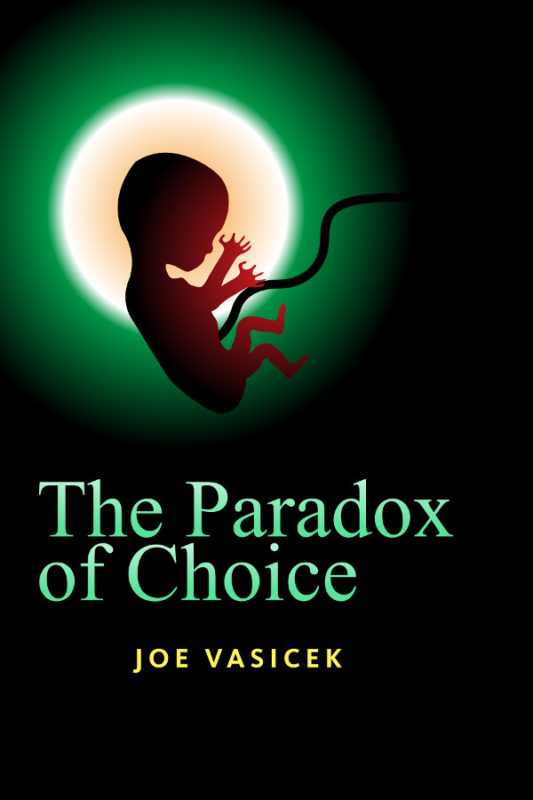
The Paradox of Choice: A Short Story

The Paradox of Choice: A Short Story

“In cases where there may be severe deformities… I can tell you exactly what would happen. The infant would be delivered. The infant would be kept comfortable. The infant would be resuscitated if that’s what the mother and the family desired, and then a discussion would ensue between the physicians and the mother.”

More info →


Rethinking some things

So I had an extremely vivid dream last Friday night where I got cancer and learned that I had only a month to live. Among other things, I found myself asking: “What am I going to do about my writing career? Who is going to finish all these books? Are they going to fade into obscurity, or will someone promote them so that my family will benefit from them after I’m gone?”

The whole thing made me feel like the race was suddenly over, and I hadn’t finished it, but had to hand off the baton to someone else who would. So instead of spending that final month of my life writing, I would have to spend it outlining things in such a way that the person who carried it all after me would be able to do it right.

(And then, hilariously, when I told my friend and cowriter Scott Bascom that I had terminal cancer, his response was: “So what? Get back to writing.” And when I told him IRL about that dream, his reaction was: “Well, was I wrong?”)

Obviously, it was an incredibly sobering and emotional dream, for reasons that had nothing to do with my writing. But it also got me to thinking about some things I’ve taken for granted about my writing process, and how I ought to change them or at least experiment with other ways of doing things.

For example, for the last fifteen years—really, since I started writing professionally—I’ve just sort of assumed that I would 1. work on one novel WIP at a time, and 2. write that novel sequentially from start to finish, rather than hopping around.

In the early years, I experimented with doing things differently and decided that I just wasn’t wired that way. But that was also when I thought I was a 100% discovery writer and didn’t have any sort of outlining process. Basically, I tried to keep the whole novel in my head, a nearly impossible task even for a veteran writer.

Now, I have a much more rigorous outlining process that divides each novel WIP into chapters and scenes, so that instead of trying to keep an entire novel in my head, I can eat the elephant one small bite at a time. So I’ve actually got the infrastructure in place right now to experiment with those things, in a way that I didn’t before.

Another thing that I’ve always taken for granted is that in order to be a working professional, I need to set strict deadlines for each project and schedule those deadlines at least a year in advance. Never mind that I have never kept an original deadline that I’ve made for a project, or kept to those schedules. Instead of finding a better way, however, those deadlines and schedules always just keep getting pushed back.

I’ve also been trying to find a way to write a novel all the way through from start to finish, without getting stuck in the middle and feeling like I need to put it aside for a while (on the “back burner,” as I used to say). In fact, that was one of the main reasons why I developed my outlining process in the first place. But even with a well-developed outline that still has some flexibility to adapt to a changing story, I still can’t write a novel straight through without having to take a break.

Another thing I’ve always failed at is hitting my daily word count goals consistently. Instead, I typically write in starts and fits, especially when I’m in the messy middle of whatever novel WIP I’m working on at the moment. However, I did have some success with those nanowrimo challenges where I worked on short stories—in other words, where I hopped from project to project.

Also, until this year, I could never manage to read very consistently. I’d go through phases where I’d read a lot, followed by long reading droughts where I’d read almost nothing. But then, I discovered some reading hacks that completely changed everything, and now I’m reading between one and two dozen books a month (most of them just the first and last chapters, but about 6-10 of them all the way through).

One of those reading hacks was—wait for it—reading more than a dozen books simultaneously and hopping from book to book. And the thing that made that possible was my reading log, which provides some structure and helps me to see how much I need to read from each book to not just totally drop the ball.

So why don’t I try something similar with my writing? What if, instead of working on one novel WIP at a time, I used these outlines to break them all up into scenes and just skipped around, writing whatever stands out as the most interesting thing to write at the moment? The outlines will help to keep it all straight, so I don’t have to keep an entire novel in my head. And when I inevitably get stuck with one WIP, I don’t have to lay it aside for months on end—instead, I can jump to something else, since I’m already jumping around in the first place.

It sounds kind of crazy, but I’ve found that my ADHD brain actually works better that way, at least when it comes to reading. So why not writing as well? It’s worth a shot, at least. And maybe one of the upsides will be that I won’t have to angst so much about those deadlines. If the focus is on hitting daily word count instead of staying on deadline for my current WIP, then solving the first problem will ultimately solve the second one, once I hit my stride.

So that’s what I’m going to experiment with: hopping from project to project, with a goal of hitting my daily word count goal rather than advancing a single project to an arbitrary deadline.

In order to do that, I need to make some outlines. Here are all of my unfinished novel(ish) WIPs that I haven’t trunked yet:

  • The Sword Bearer (Twelfth Sword Trilogy #2)
  • The Sword Mistress (Twelfth Sword Trilogy #3)
  • Captive of the Falconstar (Falconstar Trilogy #2)
  • Lord of the Faconstar (Falconstar Trilogy #3)
  • Children of the Starry Sea (Outworld Trilogy #2)
  • Untitled (Outworld Trilogy #3)
  • A Brotherhood of Swords (First Sword Trilogy #1)
  • Untitled (First Sword Trilogy #2)
  • Untitled (First Sword Trilogy #3)
  • The Lifewalker Chronicles (standalone)
  • Starship Lachoneus (standalone, may be a collection)
  • The Justice of Zedekiah Wight (collection)
  • The Mercy of Zedekiah Wight (collection)
  • Christopher Columbus, Interstellar Explorer (collection)

Of those, only Children of the Starry Sea and Captive of the Falconstar are fully outlined. So I’ve got a lot of work to do.

Instead of taking time off to outline all of these, however, I’m going to prioritize hitting word count, and work on the outlines on the side, in my voluminous spare time </sarc>. It’ll probably take a while, but I’ll eventually get it done—and that will provide some extra motivation to hit word count each day.

Also, I plan to outline all of them, even the book 3s where book 2 still hasn’t been written. The reason for that is so that I’ll have something to hand off to another writer, in case that crazy dream comes true. I don’t think that it will, but I’m gonna go sometime, so it’s better to get into the habit of doing that now. Besides, it may be helpful to skip ahead to the next book and write a few scenes: give me something to write toward.

TL;DR: I’m going to be doing a lot of experimentation in the next couple of months, skipping around in all of my WIPs instead of focusing on one at a time. It’s going to be crazy, but hopefully in a productive way. And a fun way too.

“Hell From Beneath” by J.M. Wight

I’ve been working on this short story for a while now, and the rough draft is finally finished… but I feel like it needs some work. This will likely be the final story in the first Zedekiah Wight anthology, but the story ends on quite a downer—in fact, the whole story itself is kind of a downer—and I’m not sure what to do about that.

I think the opening is pretty good, though:

In ancient times, bombs fell from the sky. People sought refuge from them underground—they did not fear that the ground beneath their feet would betray them.

Of course, until this last war—this war to end all interstellar wars—neither did we. The very thought of the ground opening up and swallowing us, or belching brimstone and hellfire, was unthinkable. We were a multi-planet species, after all. Wasn’t this sort of Biblical cataclysm something that we had evolved beyond?

Unfortunately, no. The age of galactic colonization was glorious but brief, because in the end, the bombs did not fall from above, but came up from beneath.

I should know.

I was on the team that developed them.

Interestingly, this story borrows much more from Romans than it does from Isaiah. That may change, though, as I go through and edit it. But I’m going to get some feedback first—hopefully that will help me to identify what the story needs. So it will probably be another month before it comes out.

In the meantime, General Conference is coming up, and I need to get October’s short story single out before then. Going to be rather busy!

Retro sci-fi cover fails

Back a few years ago when indie publishing was a new thing, I remember there was a blog that would take the worst self-published covers and make fun of them. It was a popular site for a while, though a lot of the indies whose covers were shamed didn’t think it was all that fun.

Thing is, it’s not just self-published books that have horrible covers. In fact, some of the worst covers probably came out of traditional publishing, partially because tradpub has simply been around longer, and partially because in tradpub, cover design is often done by a committee, as opposed to just one guy. And while it’s true that some people have a unique talent for creating some truly hideous art, the IQ of a committe is the lowest common denominator of all of its members, and if one of them happens to have that talent, God bless the poor author who got stuck with that cover art.

If you go back 50-60 years, you can find some truly hideous covers, especially in science fiction. Such as:

Ah, Farnham’s Freehold. Such an awesome book—one of my all-time favorite Heinlein novels—but such a terrible, terrible cover. What is that? A giant egg with some Salvador Dali clocks, and Polynesian war chief holding court in the lobby of the hotel from The Shining? Also, why is everything a hideous tint of fuchsia? And of course, you’ve gotta have a random 60s chick in a summer dress (though to be fair, that might be one of the actual characters).

But the thing that really gets me is how dark everything is. Seriously, if you pick this book up in a used bookstore, it’s usually so faded and time-weathered that you can barely make out any of the details at all. That was certainly true of the copy that I read, back when I was working delivery for the BYU Bookstore and snatching a couple of pages here and there between drops. Good memories, seriously.

Believe it or not, this actually isn’t the worst cover of this book. I’m so glad I picked up a copy with this cover, because the cover of the Baen edition gives away the ending! It’s not even subtle about it, either! The Baen edition features the sign to the entrance of Farnham’s Freehold at the end, and it’s totally full of spoilers for the whole book. Seriously, what kind of an idiot thought that was a good idea? See my comment about the IQ of committees up above.

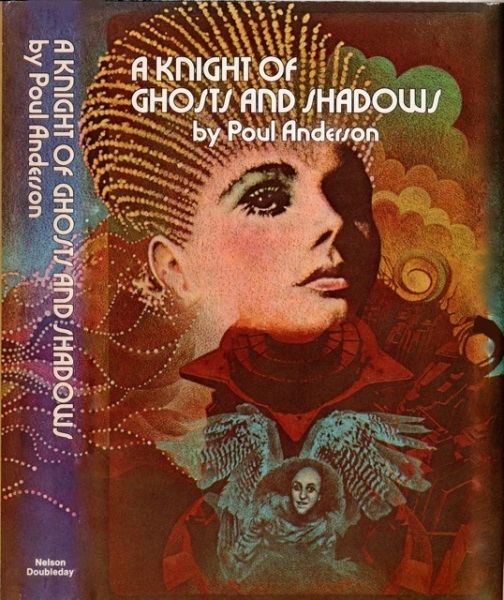
I recently picked up A Knight of Ghosts and Shadows by Poul Anderson from the library and DNFed it: too much opera, not enough space. But the cover… it takes the meaning of “hideous” to an entirely new level. In fact, this was the cover that gave me the idea of writing this blog post.

So what have we got here? There’s a psychadelic 70s chick with some hair that makes her look like Princess Leia’s grandmother, and a creepy little goblin dude in a spacesuit with random owl wings, who looks like he wants to peep on her. Also, some weird sci-fi cityscape in the background, I guess? It’s difficult to tell, because elsewhere the background looks like one of my Mom’s first-grade art projects. And of course, if that didn’t make it dated enough, you’ve got the funky 70s typography that died along with disco.

I picked up this book because 1. it was a Poul Anderson book that was at my local library, and 2. it made the Locus recommended reading list for 1975 without being nominated for the Hugo or the Nebula. Many of the other covers are surprisingly NSFW, because apparently Princess Leia’s grandmother is a futuristic sex slave—and yet, I found even the parts with her in it to be surprisingly dull. Like I said, too much opera, not enough space.

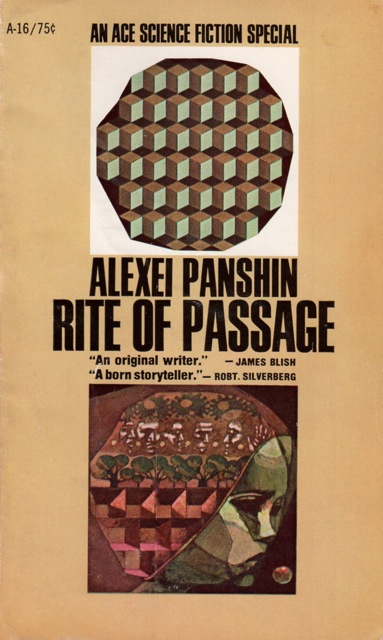
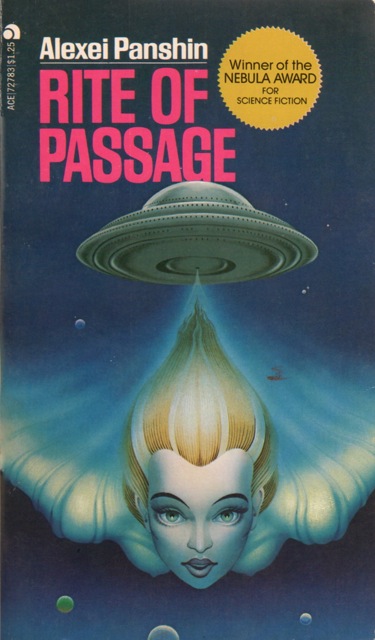
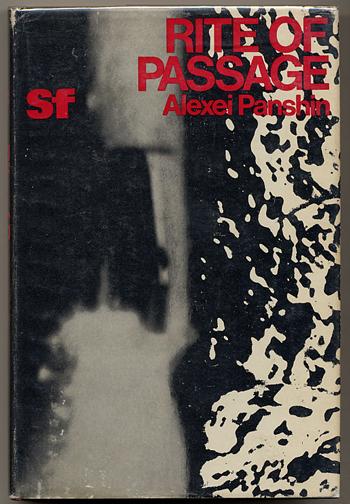
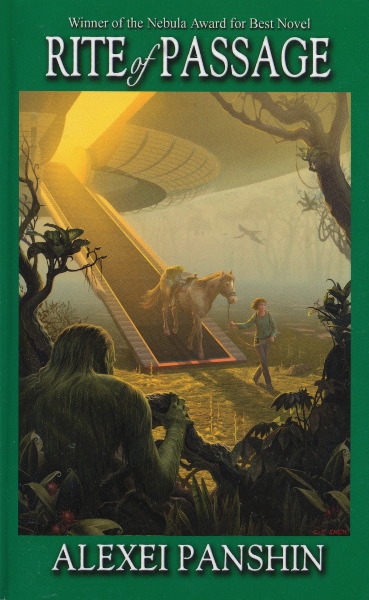
Speaking of mildly NSFW book covers that make reading in public super awkward, here is the cover of the copy of Rite of Passage by Alexei Panshin that was at the BYU Library, of all places. It’s not the cover above: I was going to post it, then thought better because it’s uncomfortably pornographic—especially when you consider that the main character is a minor. Yech. When my wife saw it, she said: “that’s a weird looking spaceship… oh wait, that’s not a spaceship!”

But even more hideous than that one (though perhaps not as terrible as this one), the cover above makes me think of nothing so much as the fact that communism ruins everything. Seriously, this cover has all the charm and aesthetic appeal of a Kruschev-era Soviet housing project in Eastern Ukraine, or maybe a ruined bus stop somewhere in the Kazakh steppes.

Seriously, when I lived in Georgia (the country, not the state), we would see old public art pieces from the communist era all over the place, in the soul-destroying style of socialist realism. This particular cover brings back a lot of memories of the Tbilisi subway. Which isn’t too surprising, because from reading this book, I’m pretty sure that Panshin was a socialist. In fact, it was right around this time that the entire science fiction genre swung super hard to the left, and with a few notable exceptions (David Weber, John Ringo, Larry Correia), it’s never really swung back.

…and looking at Alexei Panshin’s Wikipedia entry, it appears that he passed away less than a month ago. RIP. Fortunately, he got at least one good cover for Rite of Passage before he died.

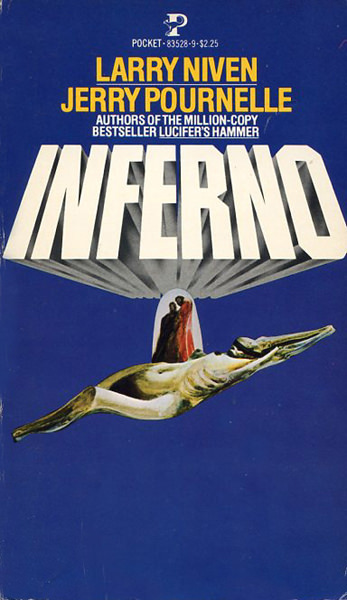
My wife recently read Inferno by Larry Niven and Jerry Pournelle, and she really enjoyed it. Based on her recommendation, I picked up a copy (not this one, thank goodness!) and I’m reading it now. It’s pretty good, but what the heck is going on with this cover? Seriously, it’s like someone puked up a mummy on the blue screen of death from Windows XP, except without any text. And what’s with the two monks standing on the mummy’s belly? Like, who saw the preliminary sketches of this cover art and thought “yup, that’s going to attract the right kind of reader and sell a bunch of books.” Thankfully, the book sold reall well in spite of this cover, not because of it.

So much for retro cover fails. What are some of your personal favorites that still stand out after all these years?

Bowing Out

Back at the end of August, I blogged about how I was going to do a writing challenge in September to produce more short stories to fill out my publishing queue. At the time, I had a couple of stories that looked like they were going to be picked up by one of the major magazines: the editor had expressed interest in buying them, and we were going back and forth with an editorial discussion about the series.

Well, to make a long story short, all of that fell through, and it looks like I’ll be self-publishing those stories after all. I’m not really sure what changed, but to give you an idea of what kind of a short story market this is, it’s been around for decades and regularly gets written up in Locus Magazine’s year-in-review. The editor said that things had gotten crazy on his end, then didn’t respond for about a month, and when I sent a polite followup email asking for an update on the status, he gave me the standard “I’m going to pass on this one, but send me your next story.” Which strikes me as kind of weird, given how our previous correspondence led me to believe that the contract was just a formality and he’d be sending one over soon, but whatever.

So now that these stories are back in the publishing queue, I no longer need to write a bunch more to fill it out. In fact, I’ve actually got enough stories to publish one a month through next April, and after I finish the third Christopher Columbus story, I’ll have enough to get through June (one of my older stories comes out of exclusivity in May 2023). Here is the schedule as of right now:

  • OCT 2022: “Blight of Empire”
  • NOV 2022: “Christopher Columbus, Wildcatter”
  • DEC 2022: “The Freedom of Second Chances”
  • JAN 2023: “The Body Tax” (needs to be revised, but it’s already been workshopped)
  • FEB 2023: “Christopher Columbus, Treasure Hunter”
  • MAR 2023: “The Library of Fate”
  • APR 2023: “Hunter, Lover, Cyborg, Slave” (needs to be workshopped and revised)
  • MAY 2023: “Christopher Columbus, Wormhole Mechanic” (partially written, needs to be finished)
  • JUN 2023: “In the Beginning” (still under exclusivity, though I got a special exception to publish it in my third short story collection, The Stars Our Destination.)

Given that I have enough stories to fill out the next nine months, I’m going to bow out of the September Shorts challenge. This is really good for two reasons: first, it allows me to focus more attention on my current novel WIP, the sequel to Star Wanderers; and second, because I’ve fallen really behind on the Zedekiah Wight stories for my J.M. Wight pen name, and this should give me some space to work on the next few of those.

So that’s the plan: refocus on Children of the Starry Sea and work on Zedekiah Wight stuff on the side.

Confessing My White Privilege

From the title of this post, you’re probably expecting a snarky takedown of the concept of “white privilege” and a good solid fisking of critical race theory. And while I thoroughly despise everything having to do with CRT, liberation theology, and Ibram Henry Roger’s X Kendi’s ideas of “anti-racism,” I do have one point of white privilege that I do need to confess. That is to say, I do indeed have an undue advantage because of the color of my skin.

I get to be the boogeyman.

As a straight white cisgender male conservative Christian, the woke intersectional left may mock me, attack me, or otherwise attack me rhetorically for my values, beliefs and opinions, but they do not ignore me or pretend that I do not exist. For example, if I write a blog post that criticizes the wokeness of science fiction, File 770 will often pick it up. I’m not on social media anymore, but if I were, I’m pretty sure that my anti-woke posts would similarly spark a very hot debate, and get passed around by intersectional leftists as an example of white supremacy.

If I were a straight black cisgender male conservative, all of those people would treat me as if I didn’t exist.

Their entire system of belief depends on black people fitting into a role defined by neo-Marxism, which separates everybody into racially-defined groups and declares that certain races are the oppressed, while other races are the oppressors. Black conservatives, especially black Christian conservatives, repudiate this theory by their very existence, which is why you’ll often hear people on the left claim that they aren’t “black enough.” Which of course is just another way of saying that they don’t exist.

You’ll often hear woke social justice types accuse conservatives of “denying the existence” of people who are trans, or queer, or in one of their other intersectional victim groups. This is nothing less than confession through projection. If you’re gay and you’re conservative, you aren’t really gay. If you’re trans and you’re conservative, you aren’t really trans… except, if your skin color is white, they can always chalk it up to “interalized whiteness” or some other such nonesense. But if you’re black? No such thing.

Of course, there are some black conservatives who are prominent enough that the woke types cannot ignore them. Justice Clarence Thomas comes to mind, as well as Thomas Sowell, Larry Elder, Candace Owens, Justin Whitlock… but here’s the thing: because these prominent conservatives are black, they get WAY more hate and vitriol from the left than white conservatives. Ridiculous amounts of hate. Larry Elder, for example, was called “the black face of white supremacy” and nearly got egged during his run for governor of California. By a leftist. Would that have happened if he weren’t black? Probably not.

Here’s the thing, though: for every black conservative who is too prominent for the woke intersectional left to ignore, there are hundreds—perhaps thousands—of small fry like me who they can effectively unperson and ignore. Which isn’t to say that every black conservative creator’s struggles are due to woke racism, but it is definitely a factor, and one that I personally don’t have to deal with because I am the great white boogeyman. Any publicity is good publicity, especially when you’re small.

Of course, there is a way to remove this white privilege and equalize the opportunities for black conservatives and white conservatives alike… and that is to remove anti-racism, CRT, liberation theology, and all of this other woke garbage from our society. If our culture were not dominated by these ideologies, I would not be privileged above black conservative creators in this way. And frankly, that’s a world I’d much rather live in.

But this does make me want to find more conservative, black authors like me who are finding it difficult to get any traction in this industry because they are black and conservative. Indie is (to my knowledge) still a pretty level playing field, but traditional publishing is not, especially with the short story markets. And of course, promo sites and newsletters are going to be a mixed bag.

So if any of you know of some black conservative authors (or if you happen to be one), please let me know! I’d like to check them out.

September Shorts 2022: Hunter, Lover, Cyborg, Slave

Whenever I do these short story challenges, the first one always feels like it’s super hard, and I end up spending way more time on it than I thought I would. It also usually ends up a lot longer than I would like. Hopefully the rest of them come faster and easier than this one did.

With that said, I’m actually fairly happy with how this one turned out. It’s kind of a cyberpunk space opera story, dark and gritty, but hopefully with some interesting twists and turns. Also, it’s not a nihilistic story at all, so it kind of breaks from a lot of cyberpunk with that. I really can’t stand nihilistic fiction.

Once again, I used the Mythulu cards to come up with the main story idea. Here are the cards that I drew:

  • JUNGLE: Supports a broad spectrum of life, so competition is fierce. Naturally brings out the strongest, biggest, brightest in everyone.
  • BIOLUMINESCENT: Light emitted by a living organism.
  • HUNTER: Searching with intent to kill. Draw +1 Relationship to explore motive.
    • FAMILIAR: Conduit for magic. Both parties are powerless and ordinary when alone. Represents how relationships transform us for the better.
  • MAN AND MAKER: Maker transforms a raw, useless thing into something extraordinary. Maker’s relationship with creation reveals narcissism or humility.
  • WANTED: Politically important and resisting subpoena or arrest. Authorities are willing to pay bounty to locate.
  • CYBORG: Trades a pound of flesh for superhuman advantage.
  • CHAOS: Source of evolution. Self-aware beings require background chaos for sanity. The amount needed varies.

That last card, CHAOS, got me to think about everything else in a certain way, but by the time the story was finished I don’t think I’d explicitly included that element in the story. That usually happens with at least one of the cards when I do this exercise: it influences how I think about everything else, but then I forget it while writing the actual story.

The thing that made everything come together was the idea of having an AI familiar, like a magic familiar, except with artificial intelligence. This AI is really just a projection of the user’s own subconscious, but augmented with artificial processes so that it interacts with the user like an intelligent, autonomous being.

My wife is getting her PhD in computer science, and she believes that we may never create a superintelligent AI because there appears to be a tradeoff between specialists and generalists. In other words, AI is very good at specializing in specific tasks or areas, but humans are very good at generalizing across all tasks or areas. It may simply be that to create an AI that is good at generalizing, you have to sacrifice its ability to specialize.

The idea of an AI familiar gets around that, because it piggybacks on the user’s own mental processes to do its generalizing, without the user being able to notice. That’s probably not how it works in real life, but this is a sufficiently advanced technology that I don’t feel bad about using a little hand-wavium to explain it. Besides, it makes for a pretty interesting story.

Final word count for the rough draft clocks in at just under 8,200 words. I will probably cut that down below 7,000 after workshopping it, making it a short story by SFWA’s definitions, which (unfortunately) are industry standard.

Why I won’t be watching Amazon’s Rings of Power

Believe it or not, I actually did not have an opinion on Amazon’s latest boondoggle, the Lord of the Rings TV series called “Rings of Power,” until about three days ago. I expected it to be a disappointment, partially because I expected it to be woke, but mostly because all the major TV series seem to suck these days and I didn’t have any reason to believe that this one would be an exception. Amazon doesn’t strike me as being as insufferably woke as Disney or Netflix, though I did hear a lot of things about their Wheel of Time series (didn’t watch it, just because I haven’t read the books yet and plan to read them soon), but when people started complaining about the wokeness in Rings of Power, it didn’t surprise me either.

With that said, it seems that most people aren’t complaining that the series is overly woke, but that it’s just badly written. Kind of like how the thing that made Star Wars VIII: The Last Jedi was so terrible just because the storytelling was so bad. A lot of people also hated it for being woke, but I’ve also heard it argued that the movie wasn’t woke at all, and if you really dig into the underlying message you’ll find that it actually repudiates many key woke tenets. But whether or not that’s true, it was just an objectively terrible movie, with plot holes large enough to drive a Death Star through and protagonists so unlikeable they make Jabba the Hutt look like a sympathetic figure. But I digress.

So anyways, I didn’t really have an opinion about Amazon’s Rings of Power yet, and was actually planning to watch the first two episodes… until I read the show’s official response to all the negative reviews it’s been getting.

Just for fun, let’s fisk it together:

We, the cast of Rings of Power, stand together in absolute solidarity

“Solidarity” is a lefty word. The left tends to favor certain words more than others (for example, they could have used “support” here instead). Also, they’re constantly trying to twist words in order to give them some advantage, however slight it might be. So right away, this word choice was a yellow flag for me.

and against the relentless racism,

Yeah, but is it really “racism” though?

threats, harassment, and abuse

Again, I can’t take these accusations at face value because most of the time, “harassment” is just lefty-speak for “someone who disagrees with me.” These people claim that speech is violence, and then turn around and use violence to try to silence—or worse, compell—the speech of everyone else.

Also, what about the fans who came to this show in good faith and were genuinely disappointed? Every book, movie, game, or TV show gets at least a few one-star reviews. Even the best ones do. Some people just have different tastes. Are you seriously lumping all of those fans into the same box with the trolls and the racists?

some of our castmates of color

Every time I read “X of color” now, I inwardly hear “colored X.” The two phrases mean the exact same thing, but one of them signals woke virtue, while the other will get you banned from the Nebulas hours after they name you a Grand Master (and against the express objections of the supposed victim, no less).

But honestly, “people of color” is just the lefty way of saying “people who aren’t white.” Which is often just another way to be racist against white people.

are being subjected to on a daily basis. We refuse to ignore it or tolerate it.

Do you remember when “tolerance” was supposed to be a virtue, and anyone who was “intolerant,” for any reason whatsoever, was considered a terrible person? But one of the key tenets of wokeism is that rules that apply to non-woke people don’t apply to you.

Also, whatever happened to being “diverse”? Because if diversity is truly the goal, then there are going to be people who genuinely hate your show—and that’s okay. It doesn’t make them racist. It just means that they have a diversity of tastes.

So once again, why are you calling everyone who hates the show a racist, abusive harasser?

JRR Tolkien created a world which, by definition, is multi-cultural.

He created a fantasy world with a lot of different cultures. That’s completely different from being multi-cultural, or promoting the ideology of multi-culturalism.

I’ve only read Lord of the Rings twice, but I don’t remember it being political or ideological. Why are you trying to make it out to fit your own political views? Have you read the books at all?

A world in which free peoples from different races and cultures join together, in fellowship, to defeat the forces of evil.

Yeah, but that’s not multi-culturalism. When the US invaded Iraq in 2003, we made a coalition with many different “free peoples from different races and cultures,” but that wasn’t multi-cultural because 1) we organized the coalition outside of, and actually in contravention of, the UN Security Council, and 2) the multi-culturalists condemned the invasion at the time, and still condemn it to this day.

It sounds to me like these people are twisting the word “multi-cultural” into pretzels to suit their own rhetorical ends. Which is typical of how leftists twist language.

Rings of Power reflects that. Our world has never been all white, fantasy has never been all white, Middle-earth is not all white.

Actually, Tolkien’s explicit goal with creating Middle Earth was to provide England with a founding mythology that was free of all Norman French influence. So that’s debatable.

But more importantly, who ever said that the goal is to make Middle-Earth, or the fantasy genre as a whole, “all white”? Are you seriously implying that everyone who hates Rings of Power is somehow a white supremacist?

BIPOC belong in Middle-earth and they are here to stay.

Yep, that’s exactly what you’re saying. Everyone who hates Rings of Power, for whatever reason, is actually just a white supremacist. Way to piss all over the Tolkien fans who just don’t like your show.

Finally, all our love and fellowship go out to the fans supporting us,

…but not to the Tolkien fans who don’t like the show. They can fuck right off.

especially fans of colour

…because if you don’t like our show, you obviously aren’t black.

who are themselves being attacked simply for existing in this fandom.

As you have just demonstrated by literally accusing all of the disappointed Tolkien fans—including the black fans—of being white supremacists. How dare those people exist!

Accusation = projection = confession with these people. In every case. No exception.

We see you,

No, you don’t.

your bravery,

No, you really don’t.

It’s much braver to speak up and be honest about what you think about shows like this, especially when all of the Big Tech and social media sites censor you and falsely accuse you of being a white supremacist for your opinions.

and endless creativity. Your cosplays, fancams, fan art, and

In all fairness to the publicity folks who wrote this, they did use the Oxford comma properly. So kudos for that.

insights make this community a richer place and remind us of our purpose.

The inverse of this is that when you call everyone who disagrees with you a white supremacist, your community becomes a poorer place, your creativity dies, and you ultimately forget your purpose. Which is exactly what is happening right now with every corner of the arts that has gone woke.

You are valid,

Once again, the left seems to favor this word. Not sure why.

you are loved,

Sorry, but I don’t turn to corporations or TV shows for love and affection. When I do need love and affection, I turn to the actual people in my life, thank you very much.

and you belong.

Unless you disagree with us, of course.

You are an integral part of the LOTR family—

Fandom is many things, but it is not and should not be a substitution for family. And frankly, given how toxic most fandoms have become, if I needed to find a new family, why would I choose such a dysfunctional one?

thanks for having our backs.

And thanks for stabbing us in our backs, you woke corporate shills.

So yeah, I won’t be watching Rings of Power at all now. Any show that turns on their fans and calls them all racists and white supremacists for not liking the show is totally undeserving of my time, attention, or respect.

But it wasn’t a total loss. We did get this from it:

Did the internet ruin fandom?

Ever since I made a spreadsheet to track all the Hugo and Nebula award-winning books, I’ve noticed some interesting patterns. I’ve already blogged about how the genre seemed to transform after the creation of SFWA and the introduction of the Nebula Awards. That seems to mark the point where the left’s long march through the institutions began in our genre, though it may be coincidental as that is also when the New Wave began. Or the two events may be connected, which wouldn’t surprise me.

In any case, I’ve expanded that spreadsheet to include the Dragon Awards and the Goodreads Choice Awards for the fantasy and science fiction categories, and I’m now in the process of adding all the books from the Locus magazine’s readers’ poll, at least for science fiction and fantasy. From what I can tell, Locus basically sets which books will be considered for nomination with most of the older awards, creating what a cynical person might call a “master slate.” And since Locus has been insufferably woke for a very long time (I still read my local university library’s copy every month, though articles like this one make me question why), that goes a long way to explaining how the Hugos and Nebulas became so woke—though I’m still not sure if Locus is woke because its core readership (and primary revenue source), the New York publishing establishment, is woke, or if the organization was captured during the left’s long march through the institutions. Or if Locus has simply been woke from its inception.

But I’ve noticed other patterns, including some with the Goodread’s Choice Awards (which include a very public vote tally) that seem to indicate that the Hugos, the Nebulas, and the Locus readers’ poll are now of minimal cultural significance: a sideshow, if you will, or a very small clique that represents the genre’s past, not its future. Which is actually pretty obvious—you don’t need to assemble a spreadsheet of thousands of books to see that. But it’s an interesting pattern nonetheless, and it’s made me wonder if perhaps the rise of the internet—in particular, social media—killed fandom, at least as we traditionally understand it.

From what I can tell, SF&F fandom began in the 20s during the era of Hugo Gernsback’s “scientifiction” and the pulps. During the Golden Age of the 30s and 40s, fandom began to organize things Worldcon and the Hugos, but the genre was still very monolothic, with so few books and magazines being published each year that it was possible for a devoted fan to read all of them. In fact, the culture generally was very monolithic, with ABC, NBC, and CBS dominating television, the New York Times dominating the newspapers, and Life and the Saturday Evening Post dominating the magazines.

Because of the monolithic nature of the culture during this time, it was possible for a single figure to dominate and shape the field, like Walter Cronkite in journalism, or John W. Campbell Jr. in science fiction. But fandom was still mostly a localized affair, with geographical distance and the limitations of communications technology keeping fannish controversies from becoming too fractious or toxic—though not for lack of effort. But in a world without internet, where arguments happened either in person at conventions or the local club, or else evolved gradually in the pages of the various fanzines, none of the factions ever tried to split or go their own way. Granted, part of that was due to the monolithic nature of the genre—if they did split off, where would they go?—but there was still a sense that everyone in their small corner of fandom was a part of a far greater whole, even with all of their passionate and sometimes fractious opinions.

But as science fiction grew, it became less monolithic, if for no other reason than that it was no longer possible to read all of the books and magazines that were coming out. From what I can tell, the genre crossed that threshold sometime in the 60s. This was also when the New Wave pushed back against the standards set by Campbell and began producing some very experimental (and also more left-wing) work. But fandom didn’t totally fracture at this time. Instead, from what I can tell, the Locus reader’s poll emerged in order to filter out everything but the very best work for consideration for the awards.

In a world where everyone considers themselves to be part of the larger community of fandom, awards—even the relatively minor ones—carry a lot of weight. This remained true through the 70s and 80s as science fiction grew to the point where it truly went mainstream. In fact, the awards became even more important, because there was no longer any way for even the most devoted fan to read (or watch, or play) all of the new books and magazines (or movies, or shows, or games) that were coming out. New subgenres and subcultures of fandom began to emerge, but everyone still looked to the awards—particularly the Hugos and the Nebulas—as the standard of excellence.

But the publishers placed even more weight on the awards, because winning a Hugo, or getting on a New York Times bestseller list, often were key to propelling sales. So over time, the publishers gradually took over the awards, as well as the organizations and infrastructure that had been built around them. With the Nebulas, it isn’t hard to see how this happened, as SFWA allows publishers to be members (creating a very obvious conflict of interest that the leadership of that organization has chosen to ignore). With the Hugos, it probably happened through Locus, since the magazine depends so much on advertising for its financials. This became even more true as the subscriber base declined in the 90s, as it did for all of the major magazines in the field.

What caused the decline in subscribers? The internet, of course. Fans no longer depended on the ‘zines to stay in touch with the broader community, but began to organize into listservs, email chains, and message board forums instead. Later, blogs and social media continued this trend. Geographic distance became increasingly irrelevant, and fandom became less of something that you connected with through your local group of friends and more something that you connected with online as an atomized individual.

But ironically, the more interconnected fandom became via the internet, the more it began to fracture. All of those passionate opinions were no longer tempered by the boundaries of time and distance, and the snarkiest and most vitriolic or self-righteous opinions were often the ones that garnered the largest audience. This became even more true with the advent of social media, which relies on amplifying outrage to addict its users and maximize profits. Social media also encouraged the formation of echo chambers, where the various corners of fandom spent so much time talking to each other than they soon had little in common with the wider fandom. Geographical distance counted much less, but ideological distance counted for more—much more.

But did the internet ruin fandom, or save it? Or in other words, was this transformation a net loss or a net gain for fans of the genre? Because, on the creation side of things, I think the internet was very much a positive development. No longer did a creator have to rely on a small clique of ossified New York gatekeepers for their work to see the light of day, and the nature of online distribution meant that a quirky book written for a tiny but underserved subculture could find and grow an audience quite effectively, even without any mainstream appeal. Of course, this only accelerated the division of fandom, but it also meant that those subcultures—many of which had been underserved for decades—now had much more content tailored specifically for them.

In the 10s, the deepening divisions within fandom manifested in a fight for control of the major awards—specifically, the Hugos. That was whate the puppies were all about. But the fight became so toxic that the awards themselves became discredited, and the victory of the wrongfun brigade proved to be a Pyrrhic one. And because the culture is no longer monolithic, and fandom is no longer a single community united by a love for the same thing, the fall of the awards has given us a world where it matters much less that you’re a fan of science fiction and fantasy generally, and much more that you’re a fan of X author, or X game, or X thing.

Gone are the days when a single author, or editor, or influencer can reshape the culture in their own image. The wrongfun brigade is still trying to do that, but all they will ultimately accomplish is to destroy everything that they touch, including all of the legacy institutions that they now control. But this also means that we’ve lost that sense of being part of a larger, broader community. Of course, it’s fair to argue that that was always just an illusion, and that we’re all much better off now that there’s something literally for everybody. But I do think that’s come at a cost of increasing social isolation.

The pandemic has no doubt accelerated this. I wasn’t at Chicon or Dragoncon this past weekend, but I have friends that were, and I plan to meet up with them at FanX Salt Lake later this month. It will be interesting to get their take on all this. In the meantime, I will continue to fill out my book awards spreadsheet and look for interesting patterns.