My most favorite banned commercial of all time!
Author: Joe Vasicek
Joe Vasicek is the author of more than twenty science fiction books, including the Star Wanderers and Sons of the Starfarers series. As a young man, he studied Arabic and traveled across the Middle East and the Caucasus. He claims Utah as his home.
The Difference Between Courage and Pride In A Hill on Which to Die
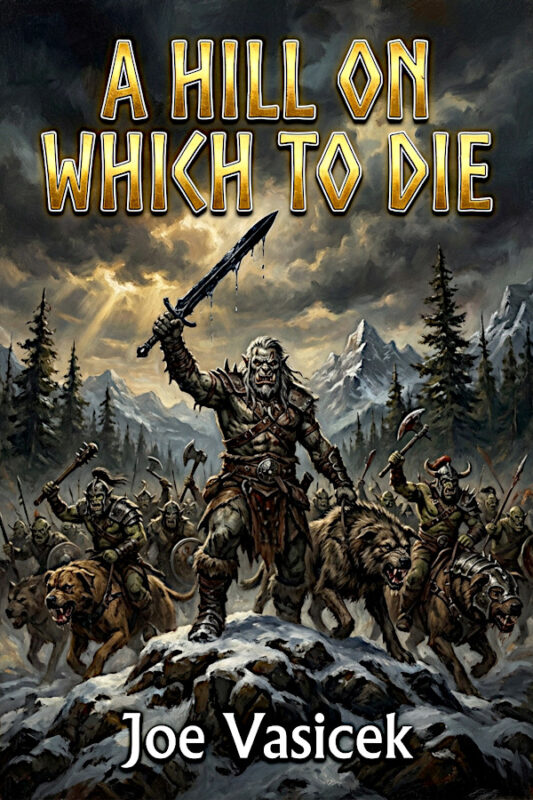
Courage and pride can look almost identical from the outside. Both can drive a warrior to stand his ground, draw his sword, and face death without flinching—but A Hill On Which To Die asks what separates a meaningful sacrifice from a pointless act of self-destruction. Through Garak-Nur, an aging orc war chief struggling to preserve his clan and his authority, this gritty dark fantasy story explores the dangerous line between risking yourself for others and risking others for your own reputation.
Where the Idea Came From
The story began with a phrase I encountered in the comments section of a news article: “Is this the hill on which you want to die?” The question was originally about choosing which arguments are worth fighting online, but it immediately suggested something much more literal—a story about an old orc warrior who must repeatedly decide whether the conflict before him is truly worth his life. Once I imagined Garak-Nur facing a younger challenger in a duel to the death, I knew the question would follow him throughout the story until he finally found the hill on which he was willing to die.
How Courage and Pride Shape the Story
At the beginning of the story, Garak’s courage is tempered by hard-earned wisdom. He is not afraid to fight or die, but he understands that violence should accomplish something. When the Witch-King’s messenger turns the younger warriors of Great Crag against him, Garak does not make a glorious but futile last stand. Instead, he abandons his ancestral home and leads his loyal followers into the wilderness, accepting exile, uncertainty, and the loss of his former power in order to preserve their freedom. Later, he enters an abandoned dwarven stronghold, confronts a dragon alone, and accepts humiliation in exchange for a safe home for the new Black Pine Clan. In these moments, Garak’s willingness to sacrifice himself makes him courageous because his actions serve something greater than his own honor.
The distinction becomes clearer after Nari-Sen defeats him in single combat. Garak swallows the humiliation and orders his warriors to accept her judgment because attacking her followers would cost the clan lives it cannot afford to lose. But once his defeat begins to weaken his authority, he becomes increasingly obsessed with restoring his reputation. He launches a dangerous raid in the middle of winter—not because Black Pine urgently needs territory, food, or captives, but because he wants to prove that he is still worthy to lead. His pride turns his followers’ suffering into a tool for protecting his position. Garak remains physically brave, but the purpose of his bravery has changed: instead of risking himself for the clan, he risks the clan for himself.
What This Theme Says About Us
Pride is dangerous precisely because it can disguise itself as courage. We may tell ourselves that we are defending a principle, protecting our dignity, or refusing to surrender when we are really trying to avoid embarrassment, admit weakness, or accept that our role has changed. True courage is not always the loudest or most defiant choice. Sometimes it means walking away from a fight, enduring humiliation, surrendering power, or allowing someone else to take our place. A Hill On Which To Die asks us to consider not only what we are willing to sacrifice for our convictions, but who else may be forced to pay the price when we mistake our wounded pride for a noble cause.
Why This Theme Matters to Me
David Gemmell has long been one of my favorite fantasy writers, especially because of the raw violence, gritty heroism, and moral clarity that give his stories such power. In writing A Hill On Which To Die, I wanted to capture some of that energy while exploring a hero who is admirable, brutal, wise, and deeply flawed all at once. Garak-Nur is not someone I would ever want to become, but following him forced me to think seriously about leadership, mortality, and the moment when a strength that once made someone heroic begins to become his downfall.
Where to Get the Book








Related Posts and Pages
Explore my other standalone books here.
Return to the book page for A Hill On Which To Die.
Why AI isn’t going to take your job
…but someone who can do it with AI might.
I’ve heard a lot of different takes on how AI is (or isn’t) going to lead to mass unemployment and a total collapse of the economy. Almost all of it is either sensationalist doom-porn, or riddled with unquestioned assumptions and lazy thinking. But this guy brings up some really interesting points, and seems to have a better answer on it than most.
Of course, we won’t really know for sure until this all plays out. And I do know some programmers who really have lost their job due to AI-driven downsizing, so depending on the career path, it’s still a very valid concern.
As for how this will all play out with books and writing, I’m not too concerned. I do think there’s a fair chance that in the long-term, most successful writers will use AI in their creative process. But the tools really aren’t anywhere close to completely replacing authors—not even the frontier models like Fable and Sol. I say that as someone who writes with AI, and who has generated and read more than a million AI words in the last 12 months. And even if the models do become that good, writing is more similar to flying and airplane than operating an elevator. I don’t think AI will ever be able to fully replace an author’s vision and voice.
Writers Cantina 2026

Writers Cantina was this last weekend. I had a great time! It was really good to catch up with my local writing friends, and there were some really great panels too. My wife was also able to come up with me on Saturday, so we had a good time together. Great little local convention!
Probably my biggest takeaway from the convention was that I should rethink how I do my blog and my newsletter. Instead of selling a book with each newsletter, as I’ve been doing for nearly the last ten years, I should only be selling every 4-5 emails or so. So instead of doing a monthly newsletter with the whole kitchen sink, I think I should channel some of my blogging energy into the newsletter and make it a shorter, weekly thing. Which shouldn’t be too hard, if I blog only 4x a week instead of daily.
So that’s something I’m going to try out, moving forward. I’m going to have to make some other adjustments, too, because my wife is going back to full-time work this week, leaving me to take care of the kids. We’re also starting homeschool next month, so that’s something else I’m going to have to figure out.
Lots of changes coming, which means a lot less writing time each day. But I’ve mapped out my current WIP (Lord of the Falconstar), and I’m reasonably confident that I can have it finished before the end of October, even at a slower rate of progress. Just need to figure out the new routine for myself and the kids.
Goal!
Saw this, though it was cute.
Congrats to Spain for winning the World Cup!
July book promotions

New titles in the Vasicek Free Library!
Lord of the Slaves: A Short Story
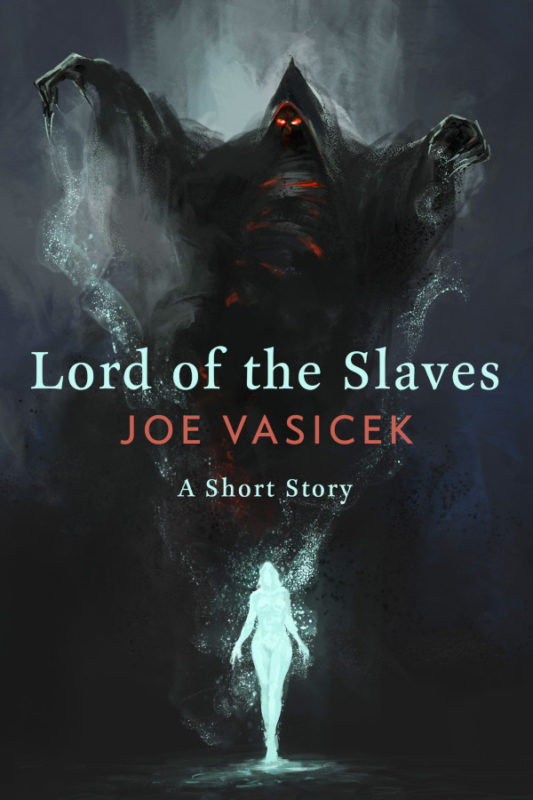
"Everyone secretly wants to be a slave. Those who deny it simply haven't found the right master."
With those words, Tamara finds herself plunged into a dark and treacherous world where she must question everything she thought she knew in order to restore her faith in humanity. Determined to rescue her sister from brutal slavery, she must decide carefully whom she can trust, because everyone has their own agenda—and not every slave wants to be free.
About the Book
Order Now

Other Books in the "Short Story Singles"
Preview
Some of the links in the page above are "affiliate links." This means if you click on the link and purchase the item, I will receive an affiliate commission. You will not receive any additional charge.
As an Amazon Associate I earn from qualifying purchases.
Captive of the Falconstar is Published!
Captive of the Falconstar
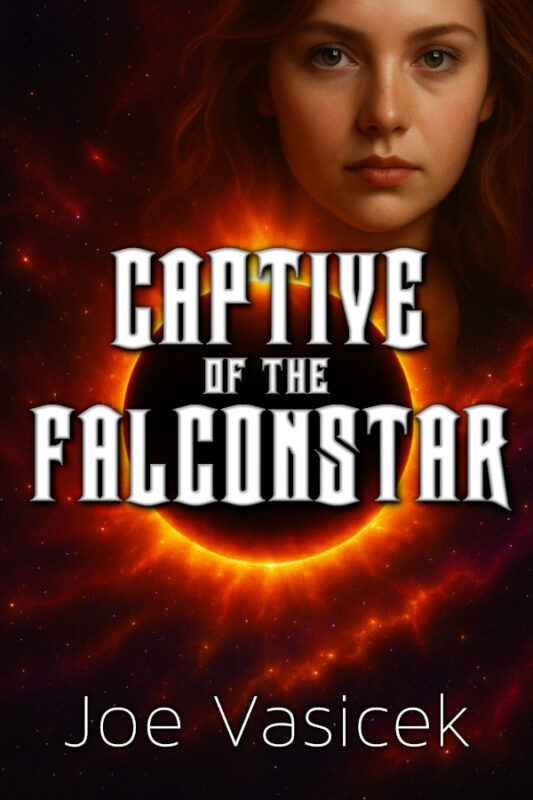
When freedom is a fantasy, only revenge is real.
Sonya has lost everything to the Hameji raiders who carried her off across the stars. To make matters worse, her only friend has become a Hameji queen and treats her as a pawn. As rival brides scheme to bear the firstborn son and heir, Sonya is drawn into a ruthless world of power, secrets, and sex. But if she can survive the role she has been forced to play, she may finally have the chance to bring her captors to their knees.
About the Book
When freedom is a fantasy, only revenge is real.
Sonya has lost her home, her name, and her freedom to the Hameji raiders who carried her off across the stars. Her only friend has remade herself as a Hameji queen—and now treats Sonya as just another pawn in her desperate game for power.
Sonya tells herself that all she wants is to escape. But beneath that hope burns a hunger for revenge.
When Lord Khasan takes a second bride to secure a powerful alliance, the women of the Falconstar are drawn into a ruthless contest to produce the firstborn son and heir. As rival queens scheme for position and an old blood feud erupts into war, Sonya is pulled into a world where a woman’s worth is measured by the sons she bears, the favors she can trade, and the secrets she can exploit.
In the ruthless game of Hameji politics, captivity takes many forms. And if Sonya can survive the role she has been forced to play, she may finally have the chance to bring her captors to their knees.
Order Now


Other Books in the "Falconstar Trilogy"
Preview
Some of the links in the page above are "affiliate links." This means if you click on the link and purchase the item, I will receive an affiliate commission. You will not receive any additional charge.
As an Amazon Associate I earn from qualifying purchases.
New shelves!
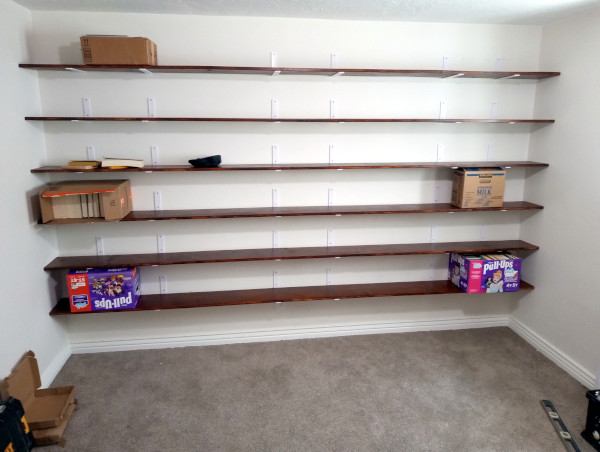
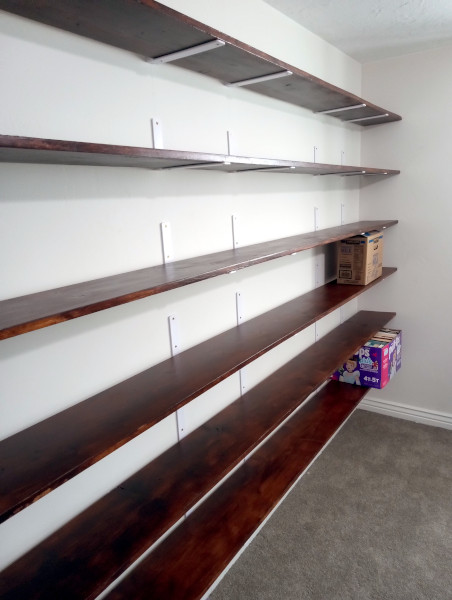
I hope you had a great 250th fourth of July! We had a bunch of family in town, so things were kind of crazy all last week. Then, on Monday and Tuesday, I buckled down and finally finished the ongoing home improvement project I’ve been working on for the last couple of months: installing new shelves in my basement office / writing den!
Those shelves are just common 10″x1″ pine board, bought at the local home depot. They each span 11’2″, which is the length of the wall. I sanded them down and stained them, then installed them all on shelving brackets that we bought on Amazon. Each bracket pair is rated for 100 lbs, so it may have been overkill to get three pair per shelf, but this way I don’t have to worry about the kids hurting themselves by doing something stupid like trying to climb up the shelves while I’m gone.
Total materials cost for the project was around $560. It would have been cheaper just to buy the BILLY shelves at Ikea, but from what I can tell from the recent online ratings, they’ve been using cheaper materials in order to keep the cost low, so nowadays those selves only have a lifespan of about a year. A new set of higher quality premade shelves would have been around $800 at Home Depot, so I figured it was better just to build them myself.
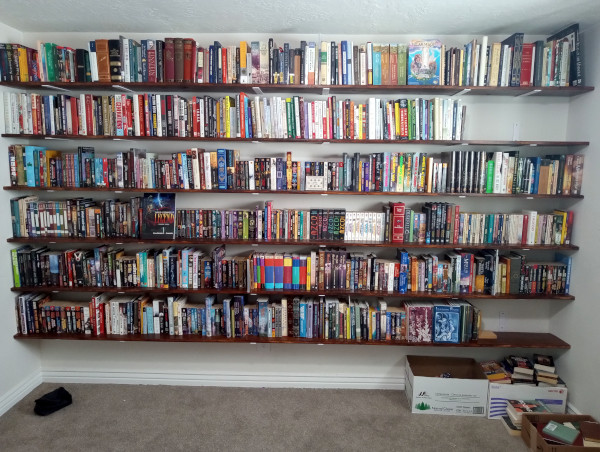
It feels so good to have all of our family’s books up and available to browse! Ever since we moved back into our Orem house, they’ve been sitting in boxes in the spare bedroom in the basement, taking up space. But with the way our family’s growing, we’ve been needing to get that de facto storage room set up as a girl’s bedroom. So the books needed to find a new home.
Next step: fix up the basement bathroom, and install a desk light in the spare bedroom, so that our oldest can move downstairs. I also want to get an easy chair, to turn this writing den into a reading nook. If we bring in a desk or an easel for the other side, we can use this room for homeschooling, too. It would be really convenient to be able to work on my writing while my daughter is in the other corner, working on schoolwork.
So yeah, things are taking shape very nicely. As far as the writing goes, I’m working hard on Lord of the Falconstar now, trying to get as far into it as I can before my wife goes back to full-time work. She goes back into the office next Monday, so I really need to buckle down and make as much headway as I can.
The Righteous Violence of In the Wake of Zedekiah Wight
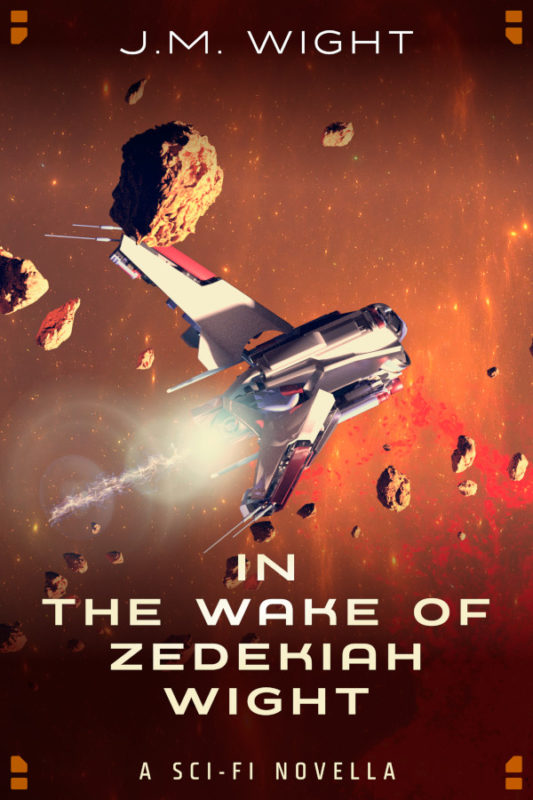
Can violence ever be righteous? That is the central question behind In the Wake of Zedekiah Wight, a religious science fiction story about vigilante justice, human trafficking, corrupt empires, and the terrible cost of refusing to compromise with evil.
Zedekiah Wight is not a safe hero, and he is not meant to be. He is a prophetic privateer in a fallen galaxy, a man whose enemies call him a pirate, a terrorist, and a madman—but whose violence is aimed at the powerful men and institutions that have made themselves untouchable.
Where the Idea Came From
The idea for Zedekiah Wight came partly from my love of Robert E. Howard’s Solomon Kane stories, and partly from my frustration with the lies, hypocrisy, and gaslighting of the modern world. I wanted to take the idea of the grim, scripture-haunted avenger and put him in a far-future space opera setting: a galaxy of corrupt governments, predatory banks, human traffickers, decadent elites, and ordinary people who have learned to look away. Zedekiah became my answer to that world—a man who refuses to call evil good, even when everyone else does.
How Righteous Violence Shapes the Story
In In the Wake of Zedekiah Wight, righteous violence is not clean, polite, or comfortable. The story begins with Captain Victor Andrecek and his crew discovering crucified bodies drifting through space in EVA suits, each one fixed to a repurposed missile and marked with scriptural warnings from Isaiah. At first, Zedekiah appears monstrous: a religious madman leaving medieval punishments in the middle of a high-tech galaxy.
But as the story unfolds, Andrecek begins to see that Zedekiah’s violence is not random cruelty. Zedekiah does not kill ordinary crewmen for convenience. He does not murder indiscriminately for loot. His targets are the people responsible for trafficking, corruption, slavery, and institutional evil—the crime lords, financiers, and powerful collaborators who profit from human suffering while hiding behind layers of respectability.
That distinction matters. The story is not asking readers to enjoy violence for its own sake. It is asking what justice looks like when every official channel has been compromised. When Andrecek discovers that the sealed cargo he nearly smuggled was actually a shipment of cryofrozen slave girls, the moral center of the story snaps into focus. Zedekiah’s crusade is brutal because the evil he fights is brutal. His violence is terrifying because the system he opposes has made peaceful accountability impossible.
And yet, the story also draws a hard line between justice and revenge. When Andrecek finally has Saif Al-Da’ib in his hands, he wants to kill him out of rage, guilt, and hatred. Zedekiah stops him. “Revenge is not justice” becomes the key to the whole theme. Righteous violence is not anger baptized by a good cause. It must be restrained by moral purpose, aimed at the guilty, and guarded against the soul-destroying pleasure of bloodshed.
What Righteous Violence Says About Us
The theme of righteous violence resonates because most of us know, deep down, that evil is not always defeated by polite systems and respectable institutions. Sometimes the people who write the laws are the ones breaking them. Sometimes the people who claim to protect the innocent are the ones selling them. In the Wake of Zedekiah Wight gives voice to the anger we feel when justice is delayed, denied, or inverted—but it also warns that anger alone is not enough. If justice becomes revenge, the avenger risks becoming another monster in a galaxy already full of them.
Why This Theme Matters to Me
This theme matters to me because I believe there comes a time when the lies, hypocrisy, and gaslighting become too much to bear. At some point, a person has to take a stand. Zedekiah Wight is that stand for me. He is politically incorrect, scripture-soaked, uncompromising, and dangerous—but he is also a man who sees evil clearly and refuses to make peace with it. In a world where so many people are pressured to stay quiet, look away, or call darkness light, I wanted to write a character who does not flinch.
Where to Get the Book
Related Posts and Pages
Explore my other standalone books here.
Return to the book page for In the Wake of Zedekiah Wight.