The dangers of relying too much on AI

I saw this really interesting video last week, and it made me think: am I relying too much on AI?

In my personal life, this probably isn’t an issue. I do occasionally ask ChatGPT to make me a recipe, or to advise me on a particular topic, but I always do a gut check and assume that it’s hallucinating if it doesn’t pass. If it gives me something that I can quickly and easily verify, I always do that… and half of the time, it turns out to be a hallucination to some degree. So yeah, I don’t rely on it nearly as much in my personal life as some of the characters in this video.

What about blogging? Don’t be too scandalized, but with my new blogging schedule, I have experimented a bit with using ChatGPT to write some of these blog posts. It’s not like I’ve been copy-pasting everything straight from the chatbot, but I have relied on it a little more heavily than I do in my own writing.

After trying that a couple of times, though, I decided to cut that out and write all of these blog posts by hand. Why? Because I felt like it was creating too much distance between myself and the people who read this blog, and the purpose for writing this blog is to foster a human connection. So it kind of defeats the purpose to rely on a chatbot to generate most of the content I post here. For that reason, I plan to keep writing all these blog posts entirely myself, with only minimal AI input.

So what about my fiction? This is where things get a little tricky. While I totally agree that simply copy-pasting from AI is a piss-poor way to write a book, I do think that AI can be a very useful tool in writing and crafting a novel, provided that you understand the limitations of the AI and don’t rely on it too much. But how much is too much? That is the question.

The biggest way that AI has helped to enhance my own writing is in giving me a birdseye view of the story as I generate a “crappy first draft.” This birdseye view allows me to see and fix major story issues before they metastatize and give me writer’s block, which is what tends to happen if I write these drafts out entirely by hand. When I’m focused on the page, I tend to lose sight of the forest for the trees, so I don’t notice that there’s a problem with the story until I’m several chapters in and find that I just can’t write.

This has happened with basically every project that I write on my own, and is the main reason why it took me anywhere from six to eighteen months (or longer) to write even a short novel, before I started using AI. However, since I began incorporating AI into my writing process, this problem has basically gone away, and I no longer experience this form of writer’s block at all.

However, while I do rely on AI to help me to craft my “crappy first draft,” that isn’t the draft that I publish. Once the AI draft is as good as I can make it, I will then go through scene-by-scene and rewrite the entire book in my own words. The purpose for this step is to make sure that I’m telling the story in my own words, and to make the story my own. I will still have the AI draft open on another screen, and refer to it as I write out the story, but I don’t do any copy-pasting. It’s all written out by hand.

Is this enough, though? Or do I need to add more steps to make sure that I’m not relying too much on AI, and thus losing my own voice? Recently, I’ve been spending a lot more time on the AI draft, generating multiple iterations and combining the best parts to (hopefully) boost the quality. I’ve also been doing a revision pass over the AI draft, tweaking it to smooth over some common AI-isms and (hopefully) adding a bit of my own voice before I move on to the human draft and rewrite the whole thing to make sure it’s all in my voice.

But while this might be enough to keep the book in my own words, is this enough to keep my own writing skills from atrophying? Or do I need to occasionally pick up a WIP that is 100% human writing, with no AI at all, just to make sure I don’t lose these writing skills? That is the question that I’m currently pondering. Perhaps this is the sort of thing that short stories could serve really well to help with. Perhaps I should go back to writing short stories again, just as a way to keep my writing skills sharp.

If I were starting out right now as a new writer, I would definitely avoid writing with AI until I’d written enough to find my own voice. And I would also make sure to write at least one novel 100% without AI-assistance, just for the experience, and to prove to myself that I could do it. Otherwise, I think there would be a very real danger in becoming over-reliant on AI to write my books, and thus risk losing my own unique voice, so that none of the books that I write ever truly become my own.

Anyhow, those are some of my current thoughts on the subject. What do you think of this problem?
“…History will call us wives.”

“Think on it, Chani: that princess will have the name, yet she’ll live as less than a concubine—never to know a moment of tenderness from the man to whom she’s bound. While we, Chani, we who carry the name of concubine—history will call us wives.”

Frank Herbert, Dune (last line)

The best take on the Epstein files that I’ve heard

Worth listening through to the end. I think Malcolm misses some of the deeper nuances of Epstein’s (alleged) operation, but there are plenty of people schooling him on it in the comments to this video.

Epstein did not kill himself… and if it ever became public who did, it would probably start WWIII (or massively escalate it, if indeed it has already started). We certainly live in interesting times.

Remember how I said that AGI is a pipe dream?

A couple of weeks ago, I posted my thoughts on AGI (artificial general intelligence) and all of the doom-porn floating around that we are years, or possibly even months, away from the emergence of an artificial superintelligence that will either usher in an Edenic post-scarcity utopia, or exterminate all of mankind. Believe it or not, this is a big fear in Silicon Valley, among the people who are building these systems (though I suspect that the top-level executives don’t really believe it and are instead exploiting that fear to serve their own ends).

My view, in a nutshell, is that we will not see the emergence of AGI or superintelligence under the current research paradigm, because the current paradigm is based on pure materialism, assuming that intelligence itself is merely an emergent phenomenon, and that if the conditions for that emergence can be replicated, a human-level (or superhuman-level) intelligence will be created. My prediction is that in the next 1-3 years, AI development will run up against a wall, and all of the scaling in the world will fail to produce the sort of drastic gains that the doomsayers are predicting.

Well, it seems that we may be much closer to that wall than I supposed. I’m not super familiar with this YouTuber, but I’ve been following a lot of his content recently, and he seems to be very intelligent and also very keyed into what’s currently happening in AI development. And in this video, he may have just pointed out the wall that we’re about to run up against—if indeed, we haven’t already.

In any case, it’s worth watching, especially if you are looking to incorporate AI into your work life. Lots of practical advice, too.

Anti-AI is the new virtue signaling

According to Merriam-Webster, “virtue signaling” is:

the act or practice of conspicuously displaying one’s awareness of and attentiveness to political issues, matters of social and racial justice, etc., especially instead of taking effective action.

Because it is much easier to signal your virtue than it is to actually be virtuous, the people who virtue signal the loudest also tend to be the ones who have something they’re trying to cover up. This hypocrisy is a big part of what makes virtue signaling so obnoxious.

Time for me to spill a little tea. A couple of years ago, after I wrote “Christopher Columbus: Wildcatter,” I got an acceptance from the editor of Interzone. It wasn’t formalized yet, but he expressed over email that he was interested in purchasing the publishing rights for that story, the sequel, and possibly others after. It got far enough along that we were going back and forth on editorial details, our vision for the stories, etc.

Then the time came for him to send me a contract. Aaand… he ghosted me. Flat out ghosted me. A month went by without any correspondence at all. I didn’t want to seem too forward, but I also was starting to get a little concerned. So I sent out a brief follow-up email, asking about the contract… and I got a response that read like something copy-pasted from a form rejection.

Now, as far as literary transgressions go, that’s kind of tame. It’s not like the editor owed me money and refused to pay. And as far as I know, Interzone is prompt with all of their payments and pays all of their authors in full. After all, everyone deserves the benefit of the doubt.

But that sort of unprofessionalism really wasn’t cool, either. In fact, it was enough that I stopped sending Interzone any submissions. After all, if the editor saw nothing wrong with yanking my chain around before he published me, that’s kind of a yellow flag. Not to mention that it left a very sour taste in my mouth.

So when I saw this story from Jon Del Arroz, with the editor of Interzone accusing Asimov’s of using AI art, and using that as a pretext to blacklist all of their authors, I immediately recognized that sort of behavior for what it is: virtue signaling. Which made me wonder: how much of the anti-AI vitriol that’s ubiquitous in online writing communities these days really just a new form of virtue signaling?

Think about it. It explains so much about the insane anti-AI faux controversies that have been blowing up around 2025 WorldCon. For more than a decade now, the people chasing the Hugo Award have been among the worst offenders of gratuitous virtue signaling (especially Scalzi). It also explains why so much of the anti-AI content on YouTube is less about presenting well-reasoned arguments, and more about sighing dramatically or making snide, sarcastic remarks. Virtue signaling always appeals to pathos before it appeals to reason.

I expect this phenomenon is going to get a lot worse in the next few years, at least until AI-assisted art and writing become normalized (which is going to happen eventually, it’s just a matter of time and degree). So the next time you see someone publicly posting about how horrible it is for creatives to use AI, take a good, hard look at the person leveling the accusations. Chances are, they’re just virtue signaling.

New permafree first-in-series: Rescuer’s Reward

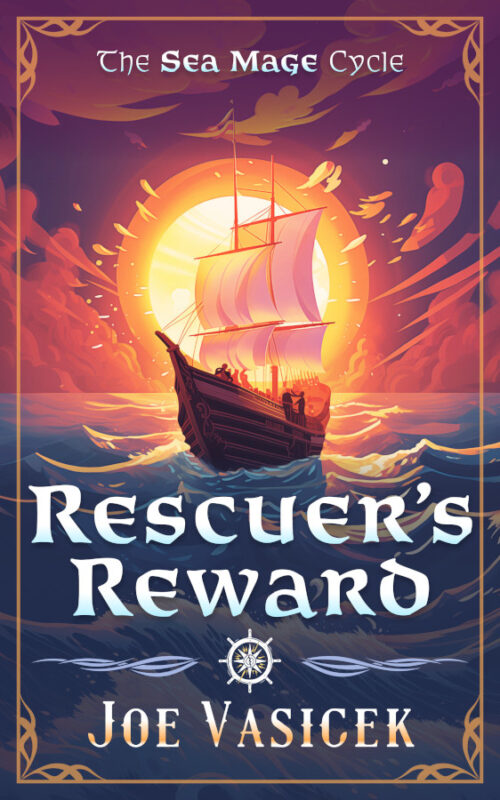
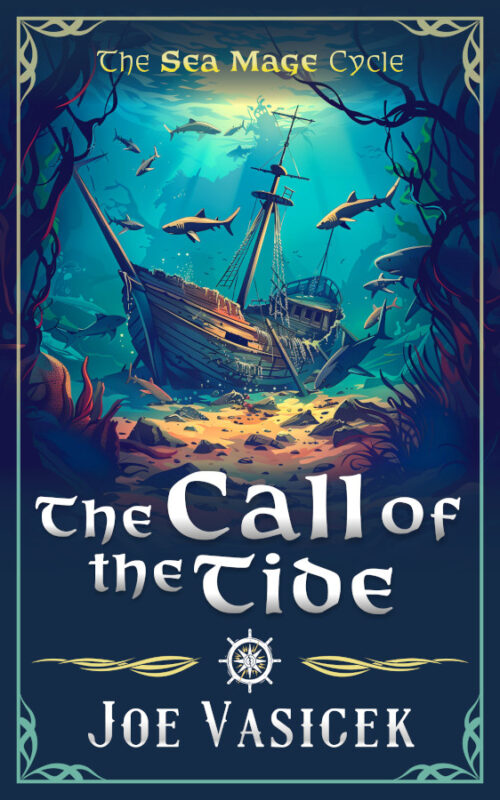
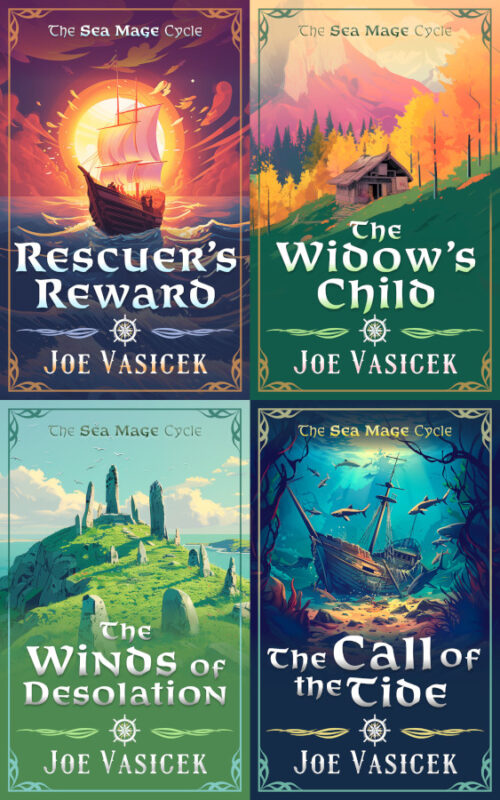
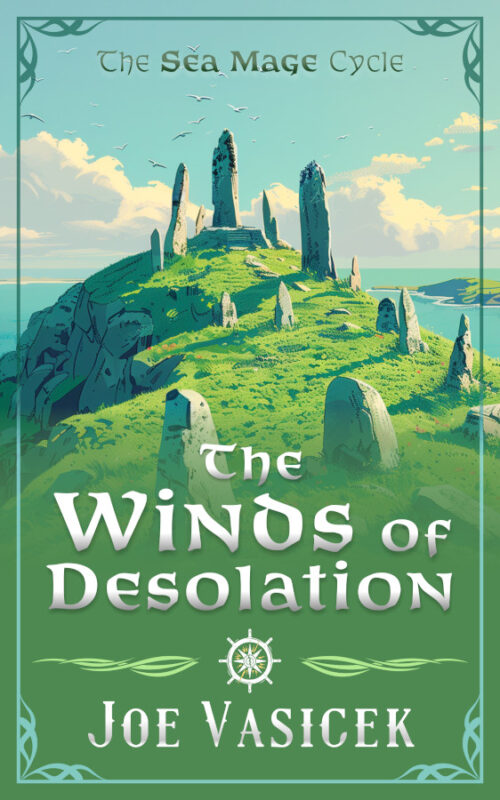
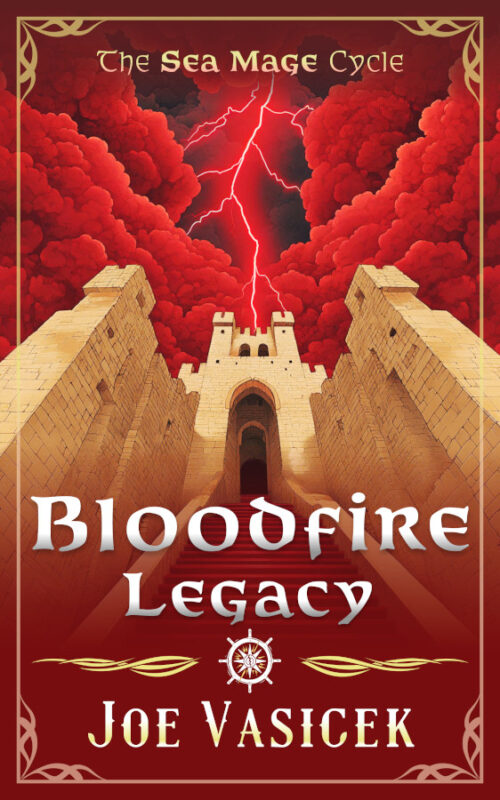
I have decided to make Rescuer’s Reward the permafree book for my Sea Mage Cycle fantasy series. If you haven’t yet read any of these books, this is a great place to start. It’s not the first book chronologically, but it is the first book that I published in the series, and since the Sea Mage Cycle is really just a series of interconnected standalones (kind of like most of Louis L’Amour’s westerns), you won’t miss anything by starting here.

Rescuer’s Reward

Rescuer’s Reward

A captain in debt, a princess in peril, and a fate that neither can foresee.

All Jason ever wanted was to sail the Azure Sea as a merchant ship's captain. But money problems have him up to his eyeballs in debt, and if he doesn't return to port with the gold, his dreams will be dashed forever. So when the princess of a far-off kingdom is kidnapped by pirates en route to her wedding, Jason merrily takes up the chase, staking his future on the reward for her safe return.

Yet the competition for the princess proves fierce, and Jason soon learns that there are far more powerful forces behind her kidnapping than any of them realize. And though Princess Julietta has no qualms about marrying for political advantage, the last thing she wants is to be a mere trophy in a different sort of game.

As duty, desire, and destiny clash, only one thing is certain: they both must risk everything to earn the ultimate reward.

Order Now!
About the Book
Details
Author: Joe Vasicek
Series: Sea Mage Cycle
Genres: Action & Adventure, Action & Adventure, Fantasy, Fantasy, FICTION, Romance, Sea Stories
Tag: 2024 Release
Publisher: Joe Vasicek
Publication Year: April 2024
ASIN: B0CTFVNKFL
List Price: $13.99
eBook Price: free!
Audiobook Price: free!
Joe Vasicek

Joe Vasicek fell in love with science fiction and fantasy when he read The Neverending Story as a child. He is the author of more than twenty books, including Genesis Earth, Gunslinger to the Stars, The Sword Keeper, and the Sons of the Starfarers series. As a young man, he studied Arabic at Brigham Young University and traveled across the Middle East and the Caucasus Mountains. He lives in Utah with his wife and two apple trees.

Preview
Some of the links in the page above are "affiliate links." This means if you click on the link and purchase the item, I will receive an affiliate commission. You will not receive any additional charge. As an Amazon Associate I earn from qualifying purchases.

Fantasy from A to Z: L is for Love

What is love? (Baby don’t hurt me…)

Seriously, though, what counts as “love” in fantasy these days? The romantasy subgenre is taking the field by storm, but much of it seems to be outright pornography, at least to me. Back when Twilight was all the rage, I at least understood the romantic angle, even if I didn’t particularly care for it. But now, there’s all this stuff about mate-bonding, consent/non-consent, something called “the omega-verse,” and a weird hierarchy of various forms of bestiality that I frankly cannot follow at all.

I should take a few steps back, and perhaps abandon romantasy altogether. I’m sure there are plenty of non-pornographic books in that subgenre—in fact, I’m fairly certain that one of my old college friends, Charlie Holmberg, was a pioneer in it. Everything of hers that I’ve read is pretty good, and also quite understandable, even to a dopey guy like me. 

Outside of romantasy (and paranormal romance, which it appears that romantasy has more or less cannibalized), the love stories are pretty straightforward. Epic fantasy in particular tends to have at least a couple of romantic subplots in every book—which makes sense, considering how expansive the subgenre is trying to be. After all, if you’re writing a story where the world itself is a major character, you’ve got to have at least a few good love stories in there too.

But as the internet has continued to spawn narrower and narrower niches and subcultures, all existing in their own little subcultures, things on the extremes have gotten… weird. And as the gender divide appears to be widening with each subsequent generation, especially in areas like politics and culture, it’s beginning to seem like we aren’t even speaking the same language, even when it comes to something as basic and essential as love.

Now, male-coded romances are pretty easy to understand (though I could be biased… I am a man, after all). It starts with a boy who really wants a girl. Like, really, really, really wants a girl. He likes her so much, he spends the whole book trying to get her—and by the end, he either wins her, or he realizes that he doesn’t actually want her, he wants this other girl he met along the way. If things get spicy, it’s all very straightforward and everyone generally has a good time. If there are issues with rape or non-consent, those are generally separate from the romantic subplot

And often, male-coded romances don’t even include much spicy content at all. Even Robert E. Howard’s original Conan the Barbarian stories were pretty mild, in terms of spiciness. Yes, there was usually a scantily-clad female love interest, described in such a way as to increase Howard’s chances of getting his story featured on the magazine cover (and thus earning double the pay). But when it came to the actual, you know, kissing and stuff, Howard never went into graphic detail. The most he would do was hide behind euphemisms like “he crushed her in his arms.” All of the ejaculations in his stories were saidisms—as in, “look out!” he ejaculated, waving his hands wildly (and you would be shocked how often he used “ejaculated” as a saidism—seriously, I think there’s at least one in every classic Conan story).

(Side note: just because Robert E. Howard’s Conan stories were pretty mild on the spiciness scale, that does not mean that subsequent authors kept it mild. Lin Carter and L. Sprague de Camp tended to keep it more in the vein of the original, but Robert Jordan’s Conan was… let’s just say, it was too much for me.)

And it used to be that female-coded romances were pretty simple, too. An ordinary, boring girl somehow finds herself the object of attraction between two incredibly powerful (and incredibly sexy) men from the other side of fairy, who are positively obsessed with her. However will she choose between them both? Oh, look—now they’re fighting each other to determine which one gets her. Stop fighting, you sexy fairy men! But seriously, however will she choose?

Somewhere along the line, that morphed into a thing called “reverse-harem,” which (as I understand it) is where the girl throws up her hands and decides that she can’t possibly choose between them, so she chooses them all. Which meant, of course, that the love triangles quickly turned into love dodecahedrons—since if you’re going to have a harem, you might as well fill it up with as many sexy fair men as you can. 

And then somehow, things got really weird—and also, really toxic. According to Malcolm and Simone Collins (who know more about this subject than I do), some of the more toxic behaviors that romantasy normalizes include:

  • Fated or “mate-bond” relationships that override consent,
  • Extreme male possessiveness portrayed as genuine love,
  • Drugging and public humiliation portrayed as romantic tension,
  • Huge age and maturity gaps between partners,
  • Serial betrayal framed as female empowerment and playing hard-to-get,
  • Intentional miscommunication, with heroines refusing to talk through their problems—again, often framed as female empowerment,
  • Violence rebranded as safety, since the love interest will never really hurt the heroine, 
  • Wish-fulfilment with serial partners, often framed as a justification for serial betrayal mentioned above, and
  • Lazy trope stacking (eg “rich-fey-boyfriend,” scent/marking, etc) without confronting the darker implications of coercive and non-consenting relationships.

Sadly, it seems that all of these toxic aspects of romantasy are reflections of the current state of modern dating and relationships. For example, in a world of online dating where ghosting and fading is all-too common, serial betrayal is a bit of a power fantasy, as is wish-fulfillment with serial partners, since if “true love” doesn’t work out, there’s always another one just a swipe away. Similarly, because women who have taken multiple sexual partners find it difficult to pair-bond with any of the later ones, the concept of “mate-bonding” may have arisen as a way to recapture that lost sense of bonding that comes with the “first time.”

Call me old fashioned or out of touch, but I preferred it when things were simpler, and the traditional boundaries around sex and relationships were still very much in force. There’s something charming about the love stories that were written before birth control and the sexual revolution, where men had to woo their women and get them to say “I do” before any of the bedroom gymnastics became a factor. Of course, I’m totally biased, because my wife and I both have a “body count” of exactly one.

I think romantic love is one of the greatest things in the world. I think that sex is also a wonderful and a beautiful thing, especially when it is used to fulfill its primary purpose: to facilitate lifelong pair-bonding between a man and a woman. In my experience, this is an even more important purpose of sex than procreation, though of course that is a very important (and very fulfilling) secondary purpose.

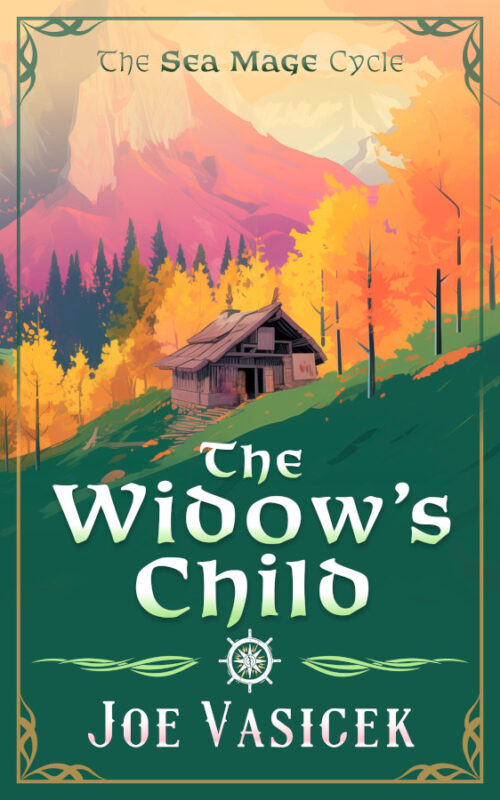
I don’t read or write romantasy, so you won’t find any of those tropes in my books. You will find a lot of romantic love, though, especially in my sea mage cycle books. Rescuer’s Reward is probably the closest thing I’ve written to a straight up romance, at least in the fantasy genre. The Widow’s Child also has a strong romantic subplot, though it goes a little further than fade-to-black. And of course, the Soulbond King books are going to have a lot of romance, since the magic system requires a man and a woman to become bonded in love in order to unlock their unique magical powers. Those books are going to be a lot of fun to write.

“Great, green, saurian things…”

The Hegemony Consul sat on the balcony of his ebony spaceship and played Rachmaninoff’s Prelude in C-sharp Minor on an ancient but well-maintained Steinway while great, green, saurian things surged and bellowed in the swamps below.

Hyperion by Dan Simmons (first line)