The technological singularity: a thing of the past?

One of the latest trends in science fiction is the concept of the technological singularity — the point in history at which technological advances occur so rapidly that we can no longer learn the new stuff fast enough to keep up with it.

I hear a lot of people talk about this at cons, and I’ve read/listened to quite a few stories about this concept.  Basically, these stories posit a world where science has become a new magic, and our world has been transformed beyond all intelligible recognition.

However, a recent post on the excellent Rocketpunk Manifesto blog made me wonder if we’ve already passed the point of singularity in our own society.  The post basically asserted that the period 1880 to 1930 saw so many sweeping technological advances that the world in 1930 would have been unrecognizable to a person from 1880, whereas our current society would still be intelligible to a person from 1930.

This made me wonder: how far into the singularity have we already come?  How much of our technological infrastructure has become so advanced that the common man lacks the capacity to comprehend it?

Think about it.  Fish around in your pockets and pull out your phone.  Do you understand how it works well enough to take it apart and put it together again?  To rebuild the device from parts?  Do you own the tools and machinery to construct the parts from which it is made?

How about the building in which you currently find yourself?  Do you possess the knowledge to build a comparable structure that performs the same functions?  That keeps you sheltered and provides the same light, heat, electricity, and internet connection that you now enjoy?

There was a time, not too long ago, when people would move out to the wilderness and homestead land by building their own homes from available natural resources.  If you needed to build your own house, as so many people used to do, could you do it?

How about your means of transportation?  If necessary, could you take apart your car and rebuild it again from the ground up?  Could you perform basic maintenance on it if you needed to?  How many of us can change our own oil–and how many of us are dependent on others for such a simple service?

Or what about the things we take most for granted–our understanding of the way the universe works.  Do you really understand the principles of physics?  Do you comprehend how electricity or magnetism really works, or are you still thinking in overly-simplified terms like electrons flowing through a circuit like water?  Even the most intelligent physicists can’t reconcile electromagnetism with Newtonian physics, so what makes you think you know so much?

How much of what we think we know is really just an illusion, meant to keep us pacified and docile?  To give us a false sense of security–that someone is in control, so we can rest easy?  Does anyone REALLY understand 100% how the economy works?  Do any of us know who or what is really in charge anymore?  Have we unwittingly handed over the reigns of control to some digital algorithm so basic to our newly networked way of life to be practically invisible?

Looking at how few of us are truly self-sufficient, and how much power we’ve ceded to forces beyond our control, our modern society seems so delicate and fragile.  Can anyone REALLY say that our society is not in danger of falling apart?  That our way of life is not an unnatural and unsustainable aberration?

Anyhow, those were some of my initial thoughts.  The more I compare the science fiction of the past with the reality of the present, the more predictions I see coming true in the most unexpected of ways.  The singularity may have less to do with uplinked consciousnesses and more to do with Google’s SEO algorithms than we are comfortable admitting.  And realistically, the light bulb may prove to be more revolutionary than anything Apple has ever or will ever produce.

Slogging through a funk

Just a quick update, since it’s 3 am and I’m kind of in a daze after playing Halo: Reach on Xbox live with my roommate.  Whoa, decompressing…

This whole week, I’ve been in a weird funk.  It sucks to be unemployed, especially since I can’t commit to anything long term because I’m waiting to hear back from the wilderness job.  Man, I really hope I get it–but even if I do, I’ll need to raise some cash to keep me going through January until the paychecks start coming in.  And if I don’t get the job, I have no idea what I’ll do.

But mostly, it has to do with my writing.  I’ve been running through the rough draft of Worlds Away from Home, and…holy crap, it REALLY sucks.  It sucks to the point where I’m not sure exactly how to fix it.

Part of it probably has to do with my initial ambitions for it, which I probably set too high.  I originally wanted to write a science fiction romance that turned the “romance” element on its head by having the sex be the thing pushing the characters apart rather than bringing them together.  I got a little too didactic in the rough draft, though, and failed to tell a story that, at it’s root, is meant to entertain.

That’s probably the most important thing–to tell a story that’s fundamentally entertaining.  So I’ve been looking at that, and I’m finding that there are significantly fewer plot threads here than there were in Mercenary Savior.  That, and there’s considerably less suspense.  The character arcs are still sufficiently complex, I think, but there aren’t nearly as many hooks and cliffhangers as my other work.

This whole week, I’ve been vacillating between “alright, I can do this” to “this novel sucks and I should just throw it out and never work on it again.” In fact, I drew up a chart today of all the novels I’ve started, finished a first draft, and finished a polished draft–and the results are a little stark.

I only just produced a fully polished draft for Genesis Earth, so at 2010 I’ve finally gotten one novel to the point where I think it’s as good as I can make it without an editor/agent to help.  One freaking novel–and that’s after two years of work.  Mercenary Savior, I’m finding, isn’t quite where it needs to be, though it’s close–probably I’ll nail it down in early 2011.  But other than those two?  I’ve got nothing.

I started Worlds Away from Home back in 2008, and I’m wondering whether I was even good enough back then to craft a story that could carry through a complete novel.  Ashes of the Starry Sea was probably a bit too ambitious, and Genesis Earth, while it ended up working out, was so small in scope that it wasn’t that hard to pull off.

Is something fundamentally flawed with Worlds Away from Home? Did I bite off more than I could chew?  Is the story premise so screwed up that I should just abandon it and reuse it occasionally for scraps?

I have no idea.  Maybe I’m just being too angsty–after all, I started Genesis Earth BEFORE I started Worlds Away from Home, and that one turned out great.  It took two years, of course, but it worked out in the end.

So will this one work out?  Probably, I suppose–but only if I can solidly get behind it.  I’m trying to put together a detailed plot outline to figure out what the story needs, but if I can’t find something else–something on par with the cryo scene and the first line of Genesis Earth, which for the longest time were the only two things keeping me from trashing that project–if I can’t find something redeemable like that, I might just drop this monstrosity and let it die.

Blarg.  I hate this.  I might just take a break from things and write a couple short stories.  This whole week, I’ve been writing nothing but outlines and revision notes–I need to do something a little more creative.

Anyhow, that’s what I’m currently slogging through.  Before the end of next week, I’m hoping to find out whether I’ve got that wilderness job or not.  Let’s hope…

Change in direction

Just a quick update on things before I go to bed.

After giving it some thought, I’ve decided to put Into the Nebulous Deep on hold for the time being.  The main reason for this is that it’s a direct sequel to Mercenary Savior, and if the first one doesn’t sell…yeah, not the best business decision.

I figure the best way to do it is to have a series of indirectly linked standalone novels set in the same world.  That way, a publisher could pick up any one of them after rejecting all the others, but if you want to bundle them into a series and sell them together, you can do that too.

That’s my strategy–I like the universe I built for Mercenary Savior, and I’m going to keep it for the foreseeable future, but for now, the trilogies and duologies will have to wait.  In any case, I’ve written down my major ideas for ITND, so I’m sure I’ll be able to pick up where I left off if/when MS sells.

Instead, I’m going to start working through the second draft of Worlds Away from Home. It needs a ton of work, but having finished the rough draft, I know that the story has potential.  At this point, I’m actually very enthusiastic about it, so hopefully that will help drive momentum.

Right now, I’m in the outlining stage.  I’m taking a page from Dan Wells and using his seven point story structure to draw out all the plot lines and character arcs.  When I did this for MS 4.0, I had to outline about fifteen arcs before I felt it was sufficiently tight; it will probably be the same for WAFW 2.0 as well.

Currently, I’m in the middle of outlining chapter six.  If all goes well, I’ll finish outlining and start writing by the end of the week.

In the meantime, I’ve been doing a lot of submitting.  Sent out another short story to Leading Edge–oh, and by the way, they accepted a poem of mine, so expect to see that in a forthcoming issue.  I also submitted the latest draft (5.0) of Genesis Earth to a few agents, so hopefully that will lead to something positive.

In other news, I’m looking for a job again.  Oh joy.  I’m hoping things will work out with the wilderness job, but if not, I still need something to tide me over for the Christmas season.  It’s stressful, but at least I’m not broke yet, which is good.  If I can’t find work and have to buy gear for the wilderness training, however, I just might be.

I’m confident things will work out, however.  I’ve found that they always do, even if not in the way I wanted or expected.  Just keep swimming.

In the meantime, check out this AWESOME 8-bit remix of one of the tracks leaked from Daft Punk’s upcoming album for the movie Tron. Dude…this makes me so incredibly happy.  And the 8-bit art!  I nabbed it and turned it into my avatar for the Quark forums.  In case you want to use it, here’s a copy.

8-bit Daft Punk FTW! The only thing more epic would be if Daft Punk and E.S. Posthumus joined forces–but if that happened, hosts of heavenly angels would descend upon our planet and usher in an era of global peace and universal prosperity. But dude, I would give my firstborn son to acquire that music.

You laugh, but I’m only half joking…

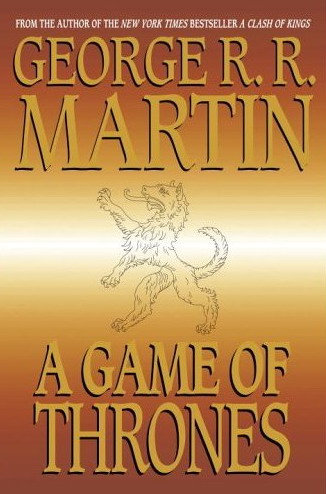
A Game of Thrones by George R. R. Martin

Almost twenty years have passed since the fall of the Targaryen dynasty–twenty years since the last of the dragons was seen in the Land of the Seven Kingdoms.  Now, the libertine Robert Baratheon sits on the Iron Throne, blind to the conspiracies and secret combinations that surround him.

In this dangerous time, Ser Jon Arryn, the King’s Hand, dies of mysterious causes.  Most of the realm accepts the official story that the death was natural, but when Arryn’s wife Lysa sends a letter to her sister, Catelyn and her husband Ser Eddard Stark immediately suspect that the death was orchestrated by the Lannisters.  Only one thing remains: to travel to King’s Landing and uncover the proof.  Soon, King Robert calls on Ser Eddard to become his new Hand, giving them the perfect opportunity to do this.

Little does Ser Eddard know, the intrigue goes much deeper than any of them realize.  For the Lannisters are gathering an army, and Queen Cersei and her brother, Ser Jaime, harbor a secret that would tear the realm apart.  Meanwhile, the last of the Targaryens bears a child prophesied to rule the world, while far to the North, an ancient evil bides its time, waiting to sweep the seven kingdoms with horror the likes of which has not been seen in a thousand years.

Winter is coming–and the people of the Seven Kingdoms are ill prepared to face it.

Everyone seems to be talking about George R. R. Martin’s Song of Ice and Fire series these days–next to The Wheel of Time, it’s probably the biggest epic fantasy line of the last ten or fifteen years.  Martin is well known for killing off his characters and writing in shades of gray, so I thought it would be good to give this series a try.

As soon as I picked up the book, I was hooked.  Martin knows how to craft a beautiful, engrossing fantasy world.  In order to leave no doubt on that point, observe:

Yeah, that pretty much sums up what Martin did with his Land of the Seven Kingdoms. It’s an awesome fantasy world, and I found myself lost in it from the first page.

I must admit, however, after hearing so much about the Song of Ice and Fire series, I was surprised at how few characters died in this book. That’s not to say everyone survived–in fact, Martin killed my favorite character, which made me feel HORRIBLE–but I was expecting there to be more. However, this is the first book in the series, so I assume that the really crazy stuff happens later.

While overall I loved A Game of Thrones, I admit I did have a few misgivings about the book. Martin really does write in shades of gray, and while that makes the story unpredictable and surprising, it also makes things very dark and austere. Martin seems to have no interest in redeeming his characters, and when any of them try to be noble, he cuts them down at every turn.

Personally, I don’t care for that. Flawed characters may be more relateable, but seriously flawed characters (or characters with no interest in overcoming their flaws) turn me off. In this way, Martin is practically the antithesis of David Gemmell; whereas Gemmell makes you love his characters despite their flaws, Martin keeps you reading in spite of the fact that you hate all his characters.

How does he do it? By creating a beautiful, wondrous world. By crafting a masterful story full of intricate twists and turns. By making you hate some of the characters so #%$^! much that you have to stick around and see how they die. It’s all entertaining and extremely engrossing, but at the end of it all, I didn’t come away with any real love for Martin’s characters–except perhaps for a couple of Eddard’s kids, who are still young enough to be somewhat innocent.

I suppose it’s all a part of this new non-conciliatory movement in fantasy. Don’t get me wrong; A Game of Thrones is an EXCELLENT book, but it’s very…non-conciliatory. If that’s your thing, more power to you, but I personally prefer stories about redemption, where romance still lives and even the most unlikely character can be a True Hero, if only for a few fleeting, glorious moments.

Thanksgiving report from Texas

So for Thanksgiving this year, I drove down with my sister and brother in law to have Thanksgiving in Houston with my other sister’s family.  It’s Friday night, and I’m about to hit the sack to get prepped for the long 24+ hour drive back to Utah, but let me say, this vacation has been great!

It’s so good to spend time with family, especially when you live across the country and can’t see each other very often.  My niece has grown so much in the past year, and she is so freaking cute it’s unbelievable.  Earlier tonight, we were watching slide shows on my sister’s projector and playing around with my niece: “Where’s Aunt Dot?  Where’s Oopah?  Where’s Uncle Joe?” Heh, Uncle Joe.  I will do my best to live up to the awesomeness of that title.

Thanksgiving dinner was AMAZING.  Holy freaking crap, my sisters can cook.  They put together a traditional dinner from scratch, and everything was perfect.  I’m so glad they’re sending a bunch of leftovers with us on the drive tomorrow, because I would much rather subsist on that than random junk food from gas stations.

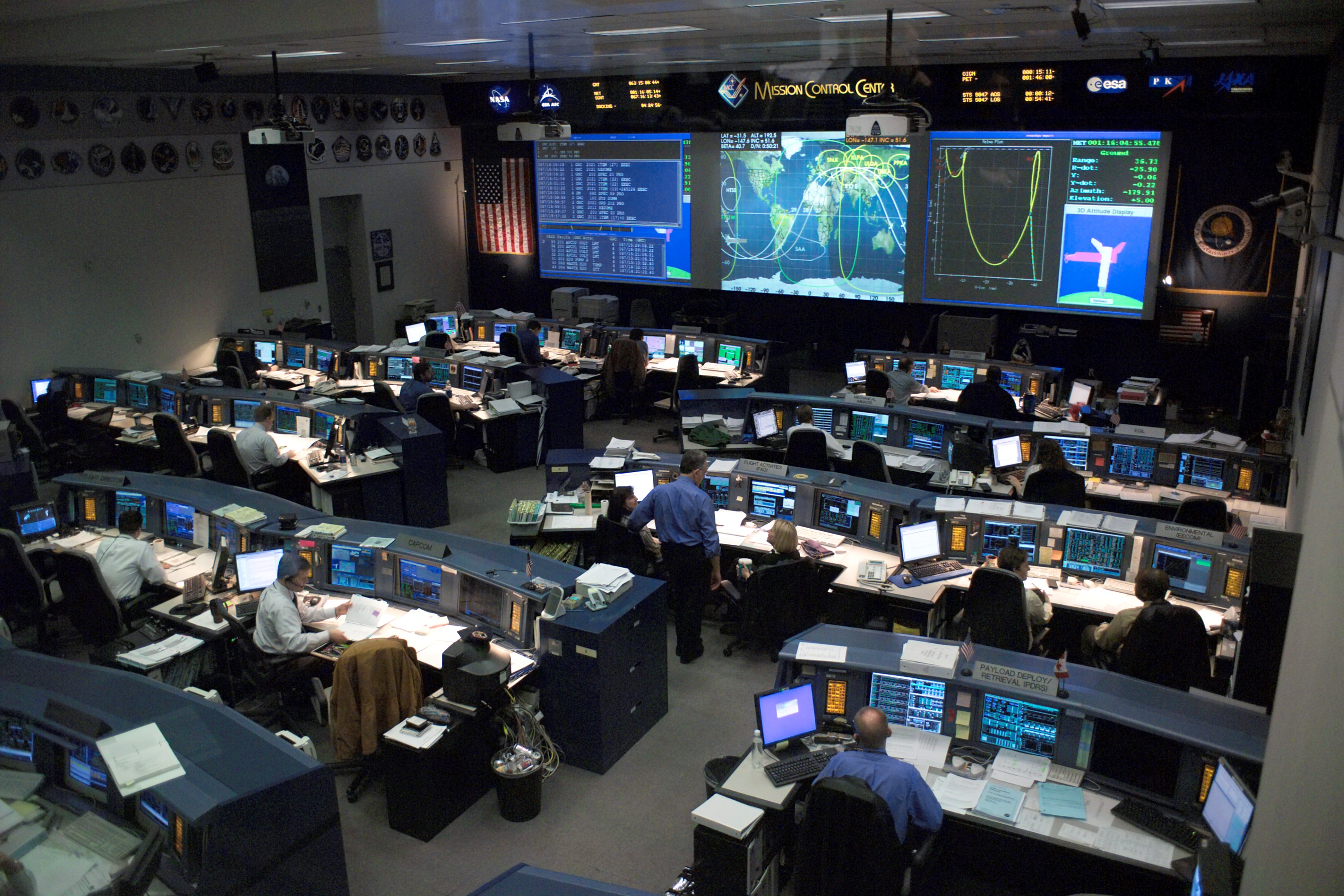
Besides family, though, one of the coolest parts of the vacation was visiting the Houston Space Center and seeing mission control and one of the original Saturn V rockets.  That’s right–see that room in the picture?  I was there.

Which immediately begged the question: Why am I not in space right now?  Seriously, I would do just about anything to go up in space.  Thinking about the Pilgrims made me think about colonizing other planets, and how the difficulties may be similar and yet different.  It also made me think about my latest novel, Into the Nebulous Deep, which (I’m hoping) is a colonization story set in space, and how I can use some of the stuff from the Pilgrims in my own work.

Speaking of which, the writing has been going very slow recently.  A lot of it has to do with interruptions from the vacation (which frankly are more important), but it also has to do with my growing frustrations with the current project.  I’m about 15k in the rough draft of ITND, and…it just doesn’t seem as good as my other work.  Of course, it’s just a mental thing–none of my rough drafts has ever been any good–but man, it’s tough to get through.

To complicate things, I’m going to have to find a job for the Christmas season, at least to tide me over.  I’m really hoping to get that wilderness job, but the training starts January 13th, and I don’t have the funds to spend all my time writing, like I have this past month.

I’ll know for sure the first week of December whether I’ve been invited to the training–and if I am, it’s going to throw a real kink in my writing routine.  Each job shift lasts a full week, during which time I’ll be completely unplugged, living in the wilderness.  I might get some time to work on poetry or short stories, but no novels.

The upside is that I get six days off completely free to do whatever I want, but I’m worried that it’ll be difficult, at least at first, to regain sufficient momentum in that short time.  I’m sure I can get used to it eventually, but for the first few months, it will probably be tough.

For that reason, I want to get as far in ITND as I can before January 13th, perhaps even finish it (HAHAHAHA!!!  As if that’s going to happen).  So the fact that I haven’t progressed from this one scene for like a week is really killing me.  Throw in a temporary job for the Christmas season, and I’ll probably go crazy.

That’s what my writing angst says, anyways.  In other words, everything is fine and life is great.  Now I’m going to get some sleep before driving across the freaking country all day tomorrow and Sunday.  Night!

Genesis Earth 5.0 is finished!

That’s right; the fifth draft of Genesis Earth is complete. It was a quick, easy edit, but there were quite a few problems with the last draft, mostly having to do with the physics and timing/distances.

Anyway, here are the stats:

ms pages: 335
words: 71,500
file size: 164 KB
chapters: 16, prologue & epilogue
start date: 2 Nov 2010
end date: 20 Nov 2010

And the wordle:

Wordle: Genesis Earth 5.0

I used to describe this novel as a “hard sf romance,” but after this last revision I can see that it’s not hard sf at all–though the science (or pseudo-science) plays an important role, the story really is driven by the characters.

Thanks to some of my recent first readers, I also realize now that Genesis Earth is solidly YA. Based on their recommendations, I lowered the age of the protagonists to sixteen and seventeen, and made some adjustments to the query letter.

I’m not sure what this means for agent hunting, since it seems that many YA agents do YA exclusively, and while this novel is definitely YA, my other ones are much more adult (at least in terms of content and character).

Anyway, the song that was playing when I finished this draft was The Mummer’s Dance by Loreena McKennit, one of the songs from the soundtrack that Charlie put together a couple years ago. I think it’s very appropriate, especially for the last scene with the Icarian natives before the epilogue:

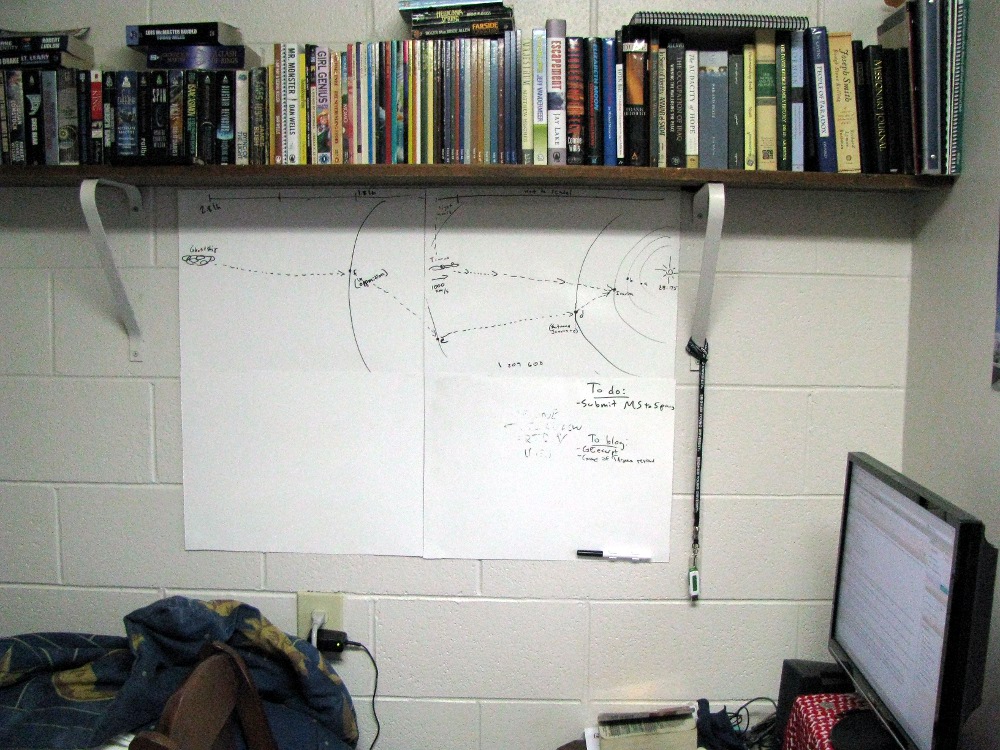
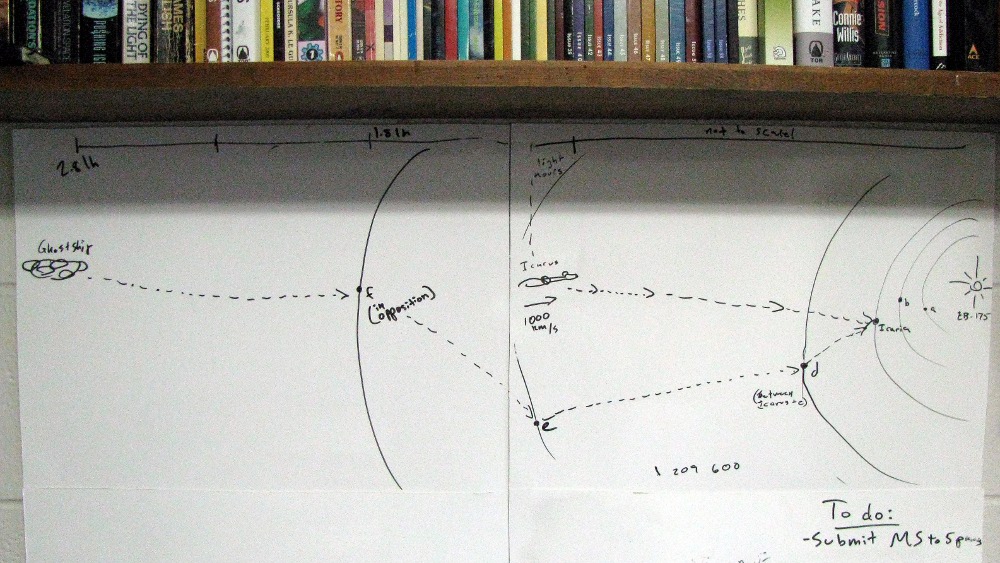
Finally, I thought you guys might want to see the “map” of the Icarian star system that I drew out on the whiteboard on my bedroom wall. Man, you have no idea how much I’ve been geeking out to this in the past few days. It’s a map…of a star system!


Pulling along

Just a quick post, because it’s 3:30 am and I’ve got a TON of stuff to do tomorrow, such as:

1) cleaning checks
2) replace the air filter in my car
3) go running with my bro in law
4) finish Genesis Earth 5.0
5) band practice
6) watch Inception with a bunch of friends at the dollar theater

Yeah, tons of stuff.  So anyways…

I’m amazed at how quickly I’m pulling through Genesis Earth.  Yesterday I revised through 11.7k words, and today I did about 14.1k.

At this point, most of the work is sentence and paragraph level, and has more to do with voice and rhythm than actual story.  There were a few science issues, mostly having to do with distances and velocities, but thanks to Logan I think I’ve caught most of those.  Thanks so much!

I’m also finding out that this story is much better than I used to think it was.  With all the form rejections I’ve been getting for it, I wondered for a while whether I should put it back in the trunk and let it quietly die.  Now, however, I can see that it has a lot more promise than I’d previously thought.  Even if it isn’t published as my first novel, I really do believe that this story deserves a home.

At the same time, though, I’ve noticed some major differences between my writing in this piece and my writing in the stuff I’ve written more recently.  I’m not sure exactly how to put it, but I think it has something to do with voice.  I don’t want to say that Genesis Earth is more choppy, but it does seem a lot more…matter of fact, if that makes sense.  There are also a lot more rhetorical questions, but I think that’s an artifact of the 1st person perspective.

But even if the voice in this piece is different from my voice now, it’s different in a good way.  It feels more…YA?  I’m not exactly sure, but it seems to work.  The sequels, if/when I write them, will probably be in 3rd person (ala Spin and Axis by Robert Charles Wilson), and that’s going to create a much different feel than this book.

It worked for Axis, though, so I think I can pull it off–that is, if/when Genesis Earth gets picked up by a publisher.  I don’t want to write the other two books in this trilogy until I know the first one is sold.

In unrelated news, I had a job interview today.  It was with a wilderness therapy company, the same that wait listed me for the January training.  I really hope I get in–more than anything at this point in my life, I feel that I need to gain some major life experience.  Probably the biggest stumper question was “what three words would you use to describe yourself in your last job, and what three words would your supervisor use to describe you?” A difficult question, particularly when all your recent jobs have been temp jobs.  I think I did alright, though–now, we just need to wait and see.

In other unrelated news, I threw an awesome movie night tonight.  We watched Scott Pilgrim vs. The World, and maybe fifteen people showed up–most of them from Quark, but a couple of friends from some other places too.  Man, that Scott Pilgrim movie is epic. So hilarious, so entertaining, and at the same time, so true.  And then, we went to Dairy Queen and hung out until midnight hanging out.  It was great.

In still other unrelated news, I recently ordered the anime series Planetes on DVD.  It was at a good price, and I knew I’d buy it eventually, so I allowed myself to splurge.  I am so happy I did, because the science fiction elements are done surprisingly well.  All the little details, from the zero gravity handholds in the walls to the way the stations spin, are surprisingly true to real life, and the show’s vision of 2075 is not beyond the realm of our own possible future.  In other words, Planetes is quite possibly the best rocketpunk anime show out there, and a great source for inspiration.

Well, that’s enough for now.  Tomorrow, I will finish this novel and send it out to the agent who requested it.  In the meantime, though, it’s 4:00 am and I must sleep.

Juggling projects isn’t a good antidote to procrastination

Yeah, the title basically says it all.  I’m working on Genesis Earth 5.0 and Into the Nebulous Deep 1.0, and while I’m doing really well in the one, I’m not keeping up so much in the other.

First, Genesis Earth. Since I finished the previous draft more than a year ago, I thought I’d find a lot of problems, especially with my prose.  Instead, while a lot of the sentence/paragraph level stuff needs tightening, I’m finding to my surprise that the writing isn’t all that bad.

Today, I breezed through over 8k words, and that between running, donating plasma, FHE, and a bunch of other distractions.  If I put even a moderate amount of effort into this, I can have it finished before next week.  That’s good, because I had an agent at World Fantasy request to see it; if I can put it on her desk before Thanksgiving, that can only be a good thing.

But as for my other project, ITND 1.0…yeah, it’s not coming along as well as I’d hoped.  The reasons are stupid, too–mostly just lost momentum and writer’s avoidance.

Right now, I’m stuck in a scene where I’m trying to build romantic tension between two characters.  I feel like I have a decent handle on who they are…but for some reason, it feels a little too shallow.  Maybe that’s because I’m still discovering who these characters are, maybe it’s because I tend to go deeper than most–or maybe it’s just because it’s the kind of scene that’s hard to get into, but once you’re in, it really flows.  I just haven’t forced myself to write it–maybe once I do, these problems will go away.

I do feel like I’m doing a pretty good job setting up the story.  Last week, I ran the first chapter through my online writing group, and while it definitely had issues, everyone said that they would keep reading if this was a book they’d picked up off the shelf.  That tells me that at least I’m starting in the right place.

The characters, though, and the conflict…I worry that it’s not as deep or as hard-hitting as the first book, Mercenary Savior. I skimmed over that book just a couple days ago before sending it out to a friend from World Fantasy, and…wow.  I don’t want to brag, but I think I did a good job with that one.  A damn good job.

So can I pull off that kind of depth and impact in the second book?  That’s the fear, that it won’t live up to the first one.  And certainly, the rough draft won’t be as good–not by a long shot.  But the subsequent drafts?  I don’t know.

Maybe I should just write and worry about it later, though.  When I was in the middle of Worlds Away from Home, I constantly thought to myself how crappy the draft was.  When I got to the end, though, and looked back on how far the story had come, I realized that it had potential to be at least as powerful as Mercenary Savior–perhaps even more.  And to be honest, that came as quite a surprise.

I don’t know.  I hope I’m not just deceiving myself–it can be hard, when you’re toiling in obscurity, to separate the truth from your own self-deception.  But for now, things are going well–I’m making good progress in Genesis Earth, and while Into the Nebulous Deep has lost a lot of momentum, all it really needs is a good solid block of undistracted writing to get it going again.  Life is good.

Another excerpt from Genesis Earth

I made a lot of progress on the latest draft of my novel Genesis Earth last week, and figured it was time to post another excerpt.  This one comes from chapter 4, when Michael and Terra arrive at the star system they’ve been sent to explore.

A slightly truncated version of this excerpt won first place in the 2009 Mayhew short story contest at BYU.  I’ve made a few minor edits since then, mostly for clarification, but nothing too major.  Enjoy!

They say that cryofreeze is the closest thing to death short of actually dying.  I believe it.

First, you strip off your clothes and lower yourself down into the coffin-shaped cryo chamber.  The glass seals shut above you, and a cold, green mist fills the narrow space, penetrating your naked skin.  The mist contains chemicals that freeze your cells properly, so that they don’t crack or break when you thaw out–but it has a nauseous smell to it, and makes you feel sticky.  Your skin starts to change from pink to white to light blue, slow enough not to notice right away, but quick enough to catch if you know what to look for.

As the chemicals continue their work, you start to shiver.  Just before the cold becomes unbearable, sleeping gas seeps in through the top valves of the chamber.  You pass out, too stiff to peacefully fall asleep.  The rapid freezing process–where your heart and lungs cease their natural functions–happens while you’re unconscious.

They say that you don’t dream when you’re in cryo, but that’s a lie–they just don’t know how to explain it.  Neither do I, but I can say something about the experience.  The lines between the senses and your own thoughts blur together, until reality itself becomes utterly unrecognizable.  Imperceptible images flash across your awareness, beyond your ability to process them.

Maybe that’s what nothing itself feels like; after all, is it really possible to comprehend non-existence without thinking of it in terms of space and time?  I don’t know–I just know that I don’t want to go back there.

By the time you regain consciousness, the thawing process has already run most of its course.  The flashes and images become brighter and more perceptible.  You have a sort of falling sensation, during which you become aware of your body.

Painfully aware.

When you open your eyes, you’ve got a splitting headache and a nauseous stomach.  Every time you move, another muscle  cramps up on you.  If you aren’t careful, you empty your bowels right there in the chamber.

The glass hisses open, the chamber tilts up to a forty five degree angle, and your limp body slides down the cold metal back until you find yourself sitting on your ankles.  Your breath feels like fire in your lungs, and even though steam envelopes your body from all sides, you feel deathly cold.  Too weak to stand up, you fall forward onto your hands and knees instead.

The vomiting is the worst.  Forty year old bile splatters cold across the floor, followed by a good ten minutes of dry heaving.  Each convulsion is so painful, it makes you feel as if you’re coughing up your own stomach.  After you’re finished, you want to do nothing but lie on the ground–in your vomit or to the side, it doesn’t really matter–and cry.

But all that passes with time. After lying on the floor for what seems like hours, your body starts to take strength.  The headaches die down, and the cramps slowly diminish.  When you open your eyes again, the stars fade away like some kind of ebbing soda fizz, revealing the unfamiliar room in which you have awakened.  You bend your fingers, lift your arms, and slowly drag yourself away from that god-awful place.

After that, what is there to do?  Wash up, get dressed in your vacuum wrapped forty year old clothes, and clean up the mess.

My stomach throbbed as I walked onto the bridge, but I ignored the pain.  My aching body could wait; I had more important things to do.

The instruments showed that we had arrived nearly thirty light hours out from the central star, just outside the orbit of the fourth planet in the system.  An unfamiliar starfield shone through the windows, dimmed somewhat by the presence of EB-175 even though the star was still far away.  A quick review of the automated ship’s log showed that no significant objects had come anywhere close to the ship in the last two months.  Nothing had been sent to intercept us.

I blinked and reread the log, just to make sure.  If there was intelligent alien life, maybe they were waiting, watching us from a distance.  Or maybe the log was wrong.

My bodily needs eventually overcame my scientific obsession, however.  I stood up from my seat on the bridge and made my way to the ship’s tiny mess hall where I could find something to satisfy my cramping stomach.

I felt sick and disoriented for nearly an hour.  In that time, I ate some meal and fruit drink, but not much else.  It felt eerie to be alone on the ship, but I didn’t want to thaw Terra until I had recovered my strength.

After an hour, I was ready.  At least, I thought I was.

Terra didn’t look human–she looked like a giant doll, a pale, lifeless marionette.  Her skin was a whitish-blue, while her other features–fingernails, toenails, lips, nipples–stood out in high contrast shades of black and purple.  Her hair was darker than I remembered, as if the cryofreeze had sucked the color out of that, too.  The glass of the chamber was cold to the touch, and the expansion of her frozen bodily fluids made her body look slightly bloated.  I felt like a voyeur staring at her, but the sight was so morbidly fascinating that I could hardly turn away.

Eventually, however, I got myself together and started the thawing process.  A hissing sound came from within the chamber, and a greenish mist washed over her.  Gradually, almost imperceptibly, redness and color began to return to her skin.  Her body deflated as the temperature in the chamber rose and her bodily fluids began to melt.  A robotic arm with two suction cups fastened onto her chest and twitched as a series of quick electric shocks restarted her heart.

I periodically glanced down at the control screen, monitoring the various measures of her status.  My legs felt stiff, and my hands trembled–I’d never run through this procedure before, and I barely knew what I was doing.  The process was supposed to be fully automated, but cryonics is an imperfect science, and problems frequently arise.

About ten minutes in, I noticed something unusual.  Little blue splotches were forming on Terra’s skin at the extremities on her hands and feet.  After half a minute, they started showing up on her thighs and torso.  I frowned; that didn’t seem right.  I adjusted the heating pattern inside the chamber, but the blotches didn’t go away.  Instead, the bleeping from the computer that marked her heartbeat started drifting into an unpredictable pattern.

With sweaty palms, I accelerated the thawing process.  The uneven heating was probably causing blockages in her veins and arteries.  I’d need to break those up soon, if her heart, brain, and lungs were to fully revive their functions.  She could only last so long on the machine–

Without warning, the bleeping turned into a constant monotone.

I glanced down and cried out in shock.  The line showing her heartbeat had flatlined–according to the machine, she was clinically dead.

I frantically keyed in a series of commands on my console.  The robotic arm reattached the suction cups to Terra’s chest and reapplied the electric shocks.  To my relief, her heart started beating again, but weaker and more erratic than before.  A second later, the warning indicators on half the instruments blinked on.  My heart skipped a beat as they flashed in rhythmic chorus.  This was serious–very serious.

“Please, no,” I said, face paling.  There was no-one on the ship to hear me, though; I was alone.

Within seconds, I figured out what the problem was.  Micro-cramps in her muscles were causing uneven heating, cutting off the arteries and capillaries in various parts of her body.  Her heart hadn’t recovered sufficiently to break the blockages, so they were spreading.

My hands trembled so much I doubted my fingers could type a coherent sentence.  In spite of that, I worked as quickly as I could to counteract the complications, maintaining constant periodic shocks to her heart and significantly increasing the heat on her upper torso.  With any luck, her blood would warm up enough to relax the contracted muscles and break the blockages.    Still, most the indicators remained in the red–the electric shocks were simply unsustainable.  I waited as long as I thought I could, then crossed my fingers and shut them off.  Her heart kept pumping, but the beat soon drifted back into unpredictability.

I glanced up at the cryo chamber and caught my breath.  Her arms, legs, and chest twitched and convulsed at utter random, undulating in a slow motion seizure.  She had no control of her body.  Chills ran down my neck and arms.

She needed more than the machines could give her.  I pulled out a syringe from the medical cabinet and nervously fumbled through nearly four dozen canisters of liquid drugs.  The wrong injection could kill her, but if I didn’t give her something right away, she didn’t have a chance.  I grabbed the formula that I thought would best relax her muscles and filled the syringe.

A few of the indicators were moving out of the red when I returned, but the situation was still serious.  A brainwave scan showed that her body was operating 85% autonomously from the machines and that she had regained partial consciousness.  I waited until the indicator reached 95% and cracked open the glass.

Steam poured out of the chamber and splashed across the ceiling, while the sound of violent coughing came from within.  Terra half slid, half fell to the ground.  I rushed forward and caught her before she hit the floor, and she responded by vomiting on the front of my shirt.

Despite the heat of the steam, her skin felt cold, and her vomit even colder.  I held her off to one side and patted her back to help her force it out.  She stopped twitching and coughed a couple of times, but quickly grew weak in my arms.

“Come on, Terra!” I pleaded.  Her breathing was too ragged for her to respond.

There wasn’t any time to lose.  I pulled out the syringe and balled my fingers around it into a fist.  It was built for a fast, emergency injection–the kind that could be jammed into someone’s leg.  I brought it down on her right thigh.  Her blotchy-blue skin rippled a little, and the fluid went in almost immediately.

A couple of seconds passed before the medicine took any effect.  When it did, her whole body went stiff, and her eyes opened wide, revealing dilated pupils.  Before I could react, she started convulsing violently, as if she were going into a seizure.  I set her on the floor as gently as I could and held onto her head to make sure that she didn’t injure herself.

After about fifteen seconds, her body went limp again.  I put two fingers up to her neck and felt for a pulse.  To my relief, it was steady and strong.  I sighed and practically collapsed.

As if in response, her chest heaved and she started vomiting again.  I scrambled to my knees and turned her onto her side.  How much stuff did she have in there–hadn’t she followed the 24 hour no food rule?  No time to worry about that–just help her get it out without choking on the stuff.

She vomited and coughed until snot dripped down her face and the hoarse sound of her dry heaving filled the room.  She was still too weak to sit up, so I supported her as best I could until she stopped.  Sobs of pain slowly replaced the retching.

“Are you all right?” I asked.

What a stupid thing to say!

She looked up and gave me an icy glare.  Tears and snot mingled on her cheeks. “No!” she shouted, then went back to coughing.

I held her until she began to quiet down.  With the worst of it gone, relief came slowly to my nervous body.  Her skin was getting warmer and her heartbeat was steady now.  After forty years on the threshold of death, she was alive again.

Alive and completely naked.  My cheeks flushed, and I set her on the floor.

“Can you stand up yet?” I asked.

“Not…yet,” she groaned. “Cramps…everywhere.”

I grabbed a towel on the side of the control panel and hastily draped it over her.  She reached up with a hand and weakly held onto it.  I waited until her breathing became less labored before asking her again.

“How about now?”

She clenched her teeth and nodded.

I stood up and took her by one hand, pulling her gently to her feet.  She bent her knees carefully as she sat up, still holding onto the towel.  When she was standing up, she let go of my hand and reached out for the wall.  The towel fell off of one side, but she didn’t make any attempt to fix it.  She still seemed fairly incoherent.

“What’s…our…status?” she asked.

“Everything is going well.  We’re about two light hours out from the system.”

“Good,” she groaned, slowly wrapping the towel back around her.  I almost reached out a hand to help, but hesitated.

“D–do you need help?” I stammered.

“No, thanks, I think I’ve got it.” She glanced up at me, then down at my chest and grinned. “Sorry about your shirt.”

“What?” I looked down and saw the vomit. “Oh, that.  Don’t worry about it.”

She nodded weakly and closed her eyes.

“Are you sure you don’t need help?” I asked.

“I don’t…think so.  Getting…better.” She staggered away from the wall and nearly fell over. “So…cold…”

She had stopped shivering.  That was a bad sign.

“Here,” I said, taking her hand. “Follow me.”

If she wasn’t shivering, her body wasn’t generating enough heat yet and she was at serious risk for hypothermia.  The best way to counteract that was to immerse her in warm water.  I led her down the hall and into the narrow, cylindrical shower unit in the bathroom.  She nearly passed out on the way there, and I practically carried her the last half of the way.  The towel fell off in the hallway, making things only more awkward for me, but that was no longer important.

I leaned her up against the smooth wall of the unit, and she slid down to her knees.  Her skin was sickly pale, her arms limp, and she mumbled incoherently as her head flopped back against the wall, hair partially covering her face.

I bit my lip and reached around the side to activate the water.  Should I turn the heat up to full, or would that give her system too much shock?  My heart pounded in my chest–no time to waste.  I set the temperature to low-warm and hit the activate button.

Jets of lukewarm water shot out from all sides, drenching my already soiled shirt and running out into the room.  Rivulets ran down Terra’s face and pale skin, but she didn’t move.

“Come on,” I said, ignoring the water soaking my clothes as I knelt down and put my hands on her shoulder. “Terra, are you alright?  Terra!”

I pressed my fingers against her neck and found a pulse.  Her body shuddered and she coughed.  Nothing else to do but give her some space and let the shower do its work.

My heart still pounding, I stepped out of the unit and shut the door.  My shirt was soaking wet, and Terra’s watery vomit ran down my legs and pooled on the floor.  As I stood there dripping, Terra stumbled noisily to her feet, teeth chattering.  The diffuse glass began to steam up, indicating that she’d turned up the heat on her own.

She was recovering.

“Your clothes are outside,” I said as I pulled out the vacuum sealed bags and put them on a shelf next to the door.

“Okay,” she groaned.

“Are you okay?  Do you need any more help?”

“No…thanks,” she muttered.  I left the room.

When I reached the hallway, I leaned against the wall and promptly collapsed in exhaustion.  A puddle of grimy water formed around me on the floor, but I no longer cared.  I sat there by myself for a long time.

DAFT PUUUNK!!

So a few days ago I discovered this French techno group called Daft Punk.  They are freaking amazing!  I’ve been listening to them nonstop ever since–and when I say non-stop, I mean it quite literally.  Their music is so awesome, it blows my mind!

Take the stuff they’re doing for the new Tron movie, for example.  When I listened to Derezzed for the first time, I was like “whoa.” I’m not really all that into techno, but that track really grabbed me (I actually prefer this edit, which is even more epic than the original).  The highly compressed quality of the sound, the awesome industrial tone, the intensity and power behind it–immediately, I was like “this is good stuff.”

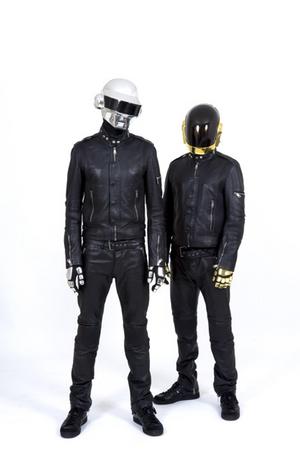
So then I looked a little more into Daft Punk, and I discovered some interesting things.  Probably the most interesting is their image: as you can see from the picture, they wear these crazy robot helmets every time they’re in public.  I guess it started because the two guys are kind of shy, or maybe because they wanted to distance their personal lives from their public persona–either way, you’ve got to admit, the concept is just freaking awesome.  Robot DJs in leather and chrome FTW!

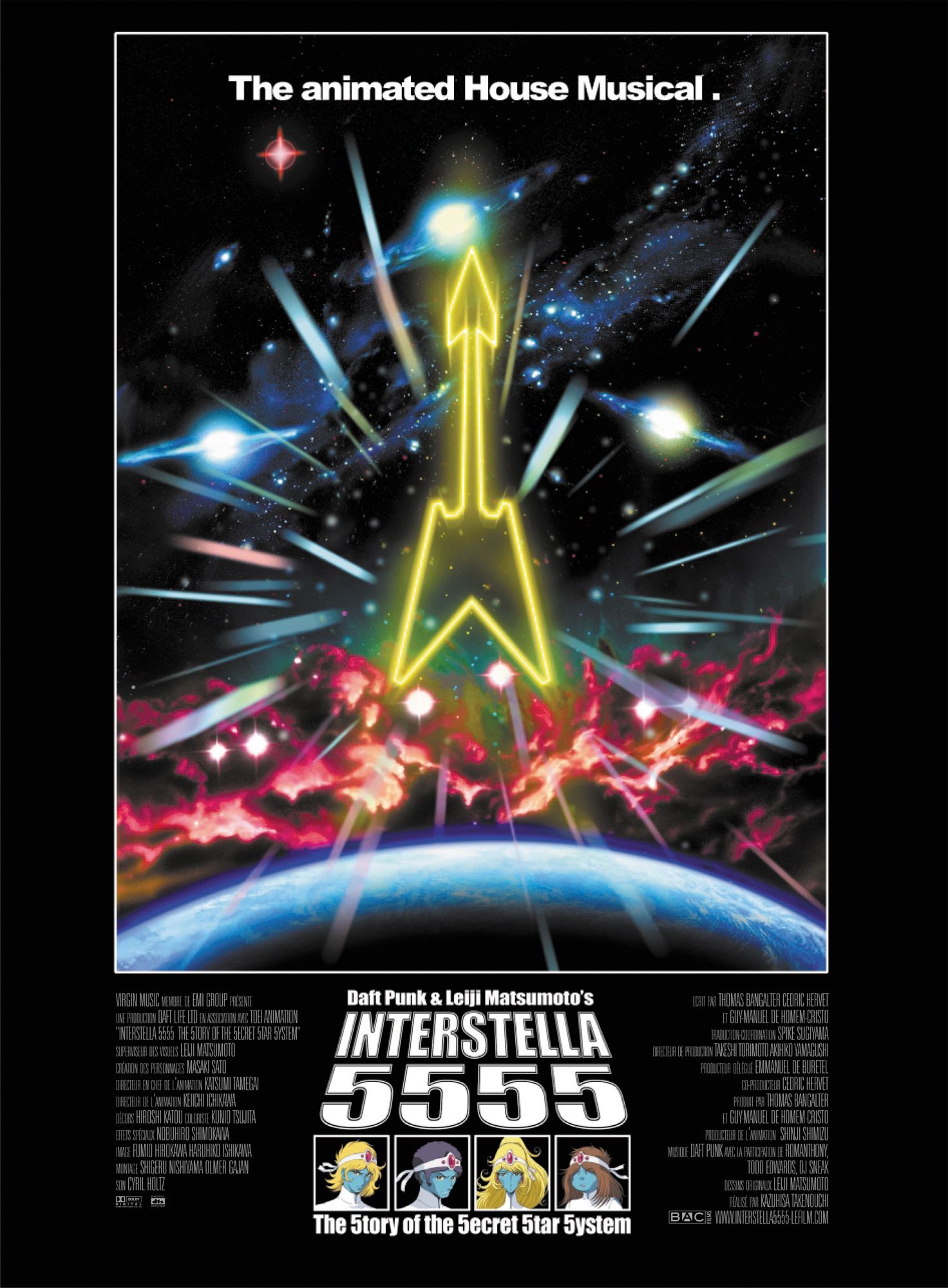
The more I found out about them, the awesomer it got.  For example, did you know that they released a feature length anime to go along with one of their albums?  That’s right–a feature length film, set to nothing but music.  And what’s more, it’s science fiction! 

Interstella 5555 is just about the cheesiest, awesomest sci fi you can get–it’s like it’s taken right out of the 70s, when Star Wars was the big new thing and space was still this magical place that everyone felt we were destined to go some day.

But the music–man, this isn’t the throbbing powerhouse kind of stuff they’re doing for Tron.  This music has depth and emotion; it’s much more innocent, and resonates on a more personal level with me than their hardcore techno stuff–which, don’t get me wrong, I still like.  It’s just that with their Discovery album (which became the basis for Interstella), I feel that I can listen to any song no matter what mood I’m in, and by the end of the track I’ll be smiling.

In short, Daft Punk is AMAZING.  What more can I say?  Squeeee! You should totally give their stuff a try.  Maybe it’s not for you, but who knows–maybe you’ll be surprised.  At least check out Interstella 5555, because it is awesome.

Man, I’ve watched and/or listened to this film maybe half a dozen times in the past four days, and it just doesn’t get old.  Like so many other things, it makes me wish I’d grown up in the 70s and 80s, when science fiction was good. Even though it came out in 2003, Interstella 5555 just seems to channel the spirit of that time.

Anyhow, I’d better wrap this up before I get all fanboy crazy and start slathering at the mouth.  But if you want to be the most amazing person on the planet, please!!! get me Interstella 5555 for Christmas!  Are you reading this, Mom?  And as for the rest of you, don’t worry–I’d be totally happy with any of their other albums, hint hint.

🙂 🙂 🙂