“Who would have thought…”

I would like to address this post to my fellow Mormon readers.

A couple of days ago, I got a discouraging message from some old mission friends of mine.  It said, more or less: “who would have thought that the missionary that taught us the gospel would write such a lurid book?” They were referring to my latest release, Sholpan.

To be honest, it’s been very difficult for me to publish it, because I knew that this sort of thing would happen.  I worry that my friends and family will think that I’ve done something inappropriate, or violated some moral standard, or made myself unworthy in some way.  It’s very difficult to put your writing out there under normal circumstances, much less with complications like these.

However, I would like you to know that I have prayed about this, and that the answer I’ve received is that this is a story worth telling.

Sholpan is about a girl who lives essentially LDS moral standards and falls into what may be the worst situation any of us could imagine for such a girl: slavery in the harem of a powerful warlord who has the power not only to rape her, but to kill her.  By refusing to compromise her values–and risking death to do so–she makes friends in unexpected places and gains a whole lot more power than she ever would have if she’d taken the easy path and compromised.

In other words, it’s a little bit like the story of Esther.  Yes, there are sexual themes, but they aren’t there to be gratuitous or titillating; they’re there to show that even in the face of such horrible immorality, you don’t have to compromise your values.

I know this kind of story isn’t for everyone, which is why I’ve put up warnings in the book descriptions and made it abundantly clear that this book has adult content.  And if you decide you don’t want to read it, I won’t be offended at all.  But please, don’t assume that I’ve gone off the deep end or betrayed my faith, because that’s not the case at all.

It’s a difficult position to be in; I’m sure that Stephanie Meyer’s and Orson Scott Card’s bishops get a lot of mail from fellow Latter-day Saints who feel that they ought to be excommunicated.  But these are the kinds of stories that I feel driven to write: stories that address difficult moral issues and don’t shy away from portraying evil for what it really is.

I appreciate your concern on my behalf, but my faith and spirituality are still quite strong.  You may or may not believe that after reading my books, but please don’t feel like you have to save me.  The best thing you can do is continue to be a positive influence, and let me be a positive influence for you.

“What was your purpose in writing this?”

Yesterday I heard back from one of my first readers for Star Wanderers, and the feedback she gave me was awesome.  You know you’ve got a good first reader when their comments make you go “aha!” and you find yourself with a host of new ideas for the story.

Anyway, at one point, she asked me: “what was your purpose in writing this?” To which I answered “I don’t know; I was supposed to be working on something else, and all of a sudden I found that I’d written this story!”

Her eyes widened a little, and she kind of got this look on her face that said: “how could you possibly write something like this and not put a ton of thought into it?” Which struck me as amusing, because she’s an editor who writes on the side, and I’m a writer who edits on the side.

This is the thing about discovery writing: it’s not about how much sweat and tears you put into your work, but how much energy you get out of it.  If a project just totally drains you, chances are it’s not going to be as good as something so exciting that you can’t not write it.  And once you improve your craft to the point where you’re no longer committing all the stupid new writer mistakes, if you’re having fun, chances are that the readers are going to enjoy it too.

Ah, the joys of spontaneous creativity.  Would that it was always this much fun.

🙂

The interior designer’s approach to story

I recently read a fascinating post on John Brown’s blog with an interesting exercise for analyzing the kinds of stories you most like to read.  By finding out what really turns you on in a story, you can have a much better idea what to write, and how to make your own stories better.

He prefaced the exercise with a story about the interior designer who helped them to decorate their house.  The designer spread out a number of home magazines in front of them, and told them to go through and tear out the pictures that most turned them on.  After doing this, they analyzed the pictures to see what they had in common, and thus discovered how to best decorate their house.

The exercise works much the same way.  First, pick out five books you really like that immediately come to mind.  Mine are:

As many of you know, these are some of my favorite books of all time.  I’ve reread three of them, and I intend to reread the other two at some point.

Next, pick out the elements that these books have in common.  Here’s what I came up with:

1) Set in a different time and place.

Not all these books are science fiction, but the all take place in a world far removed from our own.  Only Spin takes place largely on Earth, but the events of the story transform the world as we know it so much that by the end of the novel, it’s completely different. SPOILER (highlight to see) Besides, at the very end, the two main characters leave Earth by going through the giant portal to another planet, so the novel is arguably about escaping the world as we know it.

2) Stakes that are much more personal than global.

This was interesting, and highlights something I realized when I compared Merchanter’s Luck with Downbelow Station.  In all of these stories, the central driving conflicts are extremely intimate and personal.

To be sure, many of these stories also have an epic backdrop; Mistborn certainly does.  However, I was much more interested in Vin’s growth and development than I was in how the Ska would overthrow the Lord Ruler–in fact, Mistborn is my favorite book in the trilogy for that very reason.

3) Encourages deep introspection.

This shouldn’t come as too much of a surprise if you’ve followed this blog for a while, but I love love LOVE stories that make me see the world in a new way.  Thrillers and adventures are all fun and good, but if it doesn’t make me think, I’m usually like “meh” at the end.

4) Female characters who aren’t weak or passive.

This one might be a bit more controversial, but in all of these stories, I’ve noticed that the female characters are pretty strong, even if they aren’t all kick-butt Katniss wannabes (ugh…I hate Katniss).  Even in Legend, which is largely dominated by men, you still have the earl’s daughter, who is one heck of a spirited woman.

5) Life and death conflicts.

This is interesting: in all of these books, the threat of death is immanently real.  Some of them, such as Legend and On My Way to Paradise, are among the most violent books I’ve ever read.  I’m not sure what it is, but there’s something about life and death struggles that really draws me.

6) Romantic in a broad sense.

I’m using Tracy Hickman’s definition here, in which romance is all about teaching us to feel and bringing us in touch with our deepest feelings.  That’s the central theme of On My Way to Paradise: learning how to be a man of passion after witnessing some of the worst atrocities of war.

All of these books not only make me feel, they are about the feelings that they inspire.  In other words, the emotional elements of the story are both a part of and deeply embedded in the story’s central theme.

The exercises isn’t complete after this, though.  For the last part, take another five books and analyze them to see how they compare.  My second list includes:

So how does the list stack up?  Let’s see…

  1. Definitely true.  NONE of these stories take place in the world as we know it–and that’s awesome.
  2. A Canticle for Leibowitz might seem like an exception, since it follows the broad rise and fall of human civilization after the nuclear apocalypse.  But the things that really drew me to the story were the more personal elements: the novice who makes the illuminated manuscript of the electrical diagram, for example, or the abbot at the very end who SPOILER tries desperately to convince the single mother not to take her baby to the mercy killing station after the bomb fatally irradiates them.  In any case, it’s telling that A Canticle for Leibowitz made this list, whereas none of Arthur. C. Clarke’s books even came to my mind.
  3. Definitely true.  Even Citizen of the Galaxy, which is more adventure fiction than high concept sf, features a fascinating society of interstellar traders that really made me sit back and think about the way we structure our society.  Heinlein has a really awesome way of doing that with everything he writes.
  4. The only possible exception here might again be Heinlein, who had some very extremist views of women (putting it lightly).  However, if I recall, Citizen of the Galaxy has a female character at the end who helps pull out the main character from his indigent circumstances and helps him to come into his own.  Again, they might not all be kick-butt tramp-stamp vampire slayers, but they certainly aren’t weak.
  5. Less true of The Neverending Story and The Dispossessed, but while the central conflicts might not be about life and death, the threat of death (or a total loss of identity) certainly comes into play.
  6. Definitely true.  Few books have taught me to feel more deeply than The Neverending Story.  An absolutely magnificent piece of literature.

So there you have it.  According to this exercise, I should write books set in another time and place, where strong female characters face life and death decisions that personally impact the people in their lives and make the readers think and feel.  Interestingly enough, that is a PERFECT description of Bringing Stella Home, as well as Desert Stars and Into the Nebulous Deep.

Cool stuff.  Makes me want to write.  So on that note, I think I will.
Q3 Report, 2011

Before I move on to other, more interesting subjects, I want to take a little bit of time to review how my writing went in the past three months.  For those of you who may be new, this is something I like to do at the start of each new quarter.  Keeps me honest, I guess.

Anyhow, here goes:

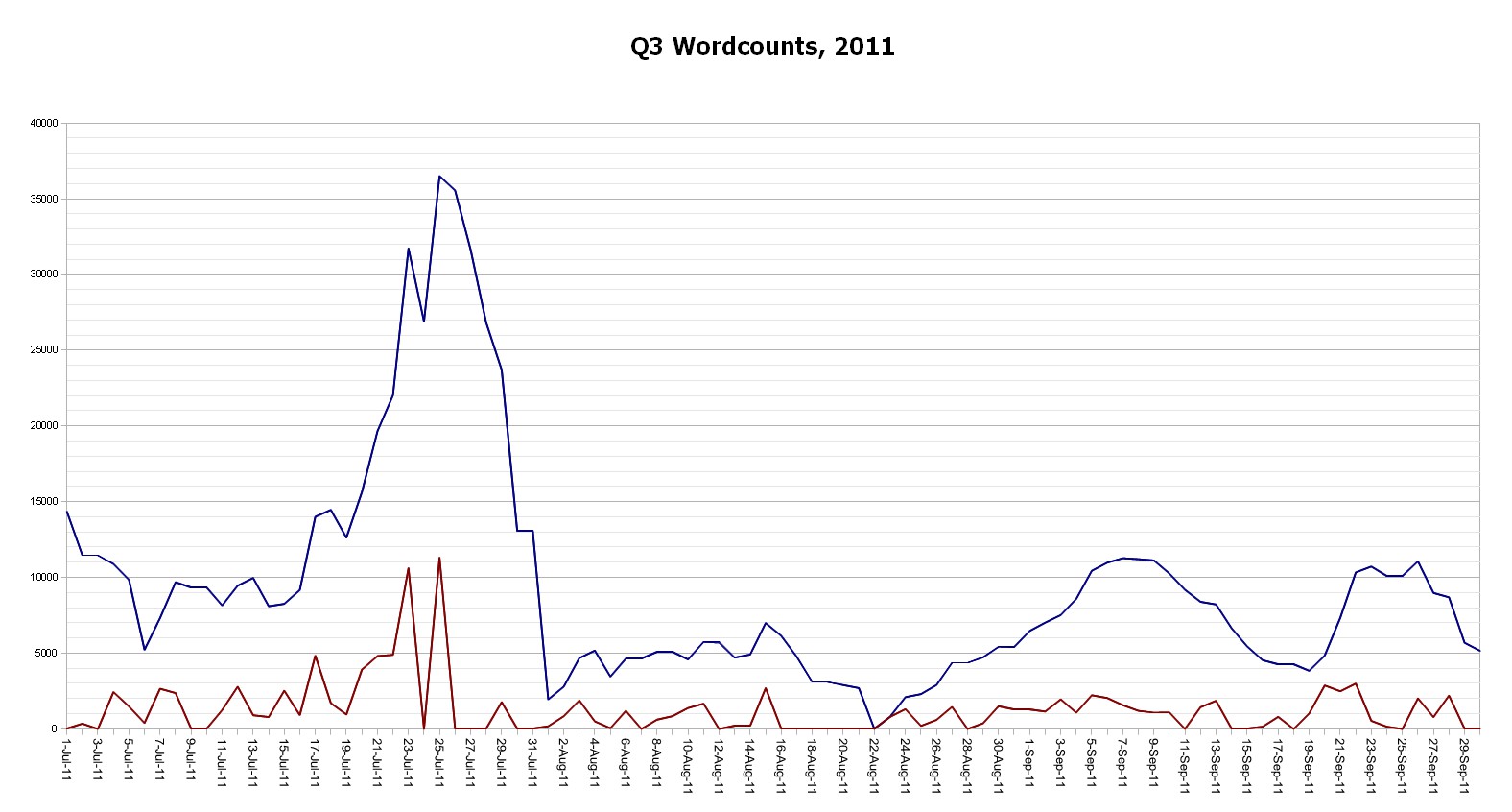
This is a graph of my word count totals for the past quarter.  The red line shows how many words I wrote each day, while the blue line shows a running seven day total.  I include substantive revisions in the totals, but if all I’m doing is proofreading or running through copy edits, I don’t count it.

For the first half of July, I was finishing up the third draft of Desert Stars while working 40 hours per week.  I wasn’t writing as much as I’d have liked, but still managed to keep some good momentum.

The HUGE peak at the end of the month represents my first draft of Sholpan, which I finished in only a week.  I spent the next week in a weird writerly limbo, not sure what else to work on, then picked it up again and made some substantial changes before sending it to my editor in in mid-August.  Then Worldcon happened, and I didn’t get any writing done while I was out at that.  Should have, but oh well.

After Worldcon, I had maybe three or four different projects I wanted to do, but since I wanted to do the final draft of Desert Stars in October, I wasn’t sure which project to pick up.  After several false starts, I ended up writing the first part of Star Wanderers, which is that hump you see at the beginning of September.  The second hump is the second draft; my writing took a dip in between because I didn’t know what else to do with only a couple weeks before October.

Overall, though, my personal word counts were a lot lower than I’d like.  Part of that was due to the effort I put into publishing Sholpan (it takes a lot of time and energy to publish something, which can eat into your writing if you aren’t careful); part of it was because the project I was most excited about was Desert Stars, and I had to wait until October to hear back from my first readers; but another major part was that I was trying to balance a 40 hour job on top of everything.

This is the dilemma: I want to build up my writing career to the point where I can support myself on it, but to do that I have to work a day job to make ends meet, which makes it very difficult to work on the writing career.  When I was in school, I used to think a 9-5 job would make things easy, since I wouldn’t have any homework or papers to bring home.  Now, though, I think school was easier, because I was only in the classroom 15 to 20 hours per week, and could allocate the rest of my time as I saw fit.  Working full time is a lot harder, because half of your waking time doesn’t belong to you.

What I’d really like to find is a part time job, maybe 30 hours per week, where I earn just enough to get by but don’t feel drained when the workday is over.  A lot of TEFL jobs are only about 20 hours or so per week, so I’m thinking very seriously about doing that.  Then again, all the attendant difficulties of adjusting to a new culture might be even more draining than grunt labor.

I guess there’s only one way to find out…

In any case, now that October is here, I’m back to work on Desert Stars, hopefully the final draft before publication.  I know I said I’d finish Star Wanderers, but since I’m going to come back to it anyway after I get the feedback from my first readers, I figure it will be better to finish Desert Stars and move on.  Also, I can revise a lot faster than I can write new material, so it makes a lot more sense to get the revisions out of the way instead of pushing a rough draft harder than it wants to come.

And after that?  Who knows!  I’ve so many half-finished novels and projects I want to start, all I can really say is I’d better throw this up on the blog and get back to writing.  So on that note

What does it mean to be “published”?

One interesting thing about making the shift from traditional to indie publishing is that it changes your perspective on what it means to be “published,” and not in ways that you might expect.

Before I made the shift, I felt as if I were at the base of a giant mountain, where climbing to the top meant getting published and that was all I could see.  Sure, I knew there was more to it than getting that first book deal, but I figured I’d learn all about that at some point later–and besides, there’d be people along the way to help me.

Once I started indie publishing, though, my paradigm changed completely.  Instead of focusing all my efforts on trying to land that lucky break, I started thinking in ways that were much more concrete and practical, like “how can I build my readership?” “how high (or low) should I price my books?” “how can I improve my ebook formatting?” etc.

All of a sudden, it was as if I were on top of that first mountain, with a whole range of even taller mountains to climb.  And while that’s a very daunting place to be, it’s also quite encouraging, because I can see what lies in front of me and figure out what path I want to take.

One of the side effects of all this is that “getting published” is no longer a big deal to me.  Whenever I see aspiring writers obsess over getting an agent or a book deal, as if that’s the single greatest thing that could ever happen to them and all their hopes and dreams hang on the balance, I have to stop and scratch my head. 

Don’t get me wrong; it’s still a big deal to get picked up by a major publisher, and kudos to everyone who is.  It’s just that that is not and shouldn’t be the end of your publishing journey; it’s only the beginning.

For this reason, I really don’t like the words “published” or “author” anymore.  People throw those terms around as if it makes you part of a select elite, one of those godlike beings who lives up in the clouds and periodically descends from On High to grant blessings to all the poor unpublished wastrel folk on the surface.  That’s complete and utter BS, and I never ever ever want to buy into it, not for an instant.

The problem is, so many people still do.  They still think that there’s some kind of a divide between them and Big Name Authors, like peasants in the face of royalty.  They labor endlessly over their manuscripts, terrified that one misplaced comma will forever their chances of fulfilling their hopes and dreams.  And whenever anyone tries to tell them that there’s a better way, that it doesn’t have to be like this, they cling to the old paradigm like battered women who refuse to get help–or worse, like religious zealots who dream of being martyrs for their cause.

It used to be that self-published writers were the ones who constantly obsessed about being “published,” but now, I think it’s the exact opposite.  Sure, there are crazies in both camps, but it seems that the balance of aspiring professionals–the ones who actually treat writing like a business–are turning to independent self-publishing.

The point is, I don’t like to think of myself as an “author,” or as an “indie published” whatever; I like to think of myself as an “indie writer”–or better still, just a “writer.” All the other terms are just too misleading and destructive.

Star Wanderers 0.2 is finished!

That’s right; I just finished the second draft of the beginning of Star Wanderers, the novel that came out of nowhere like a surprise baby.  I’m sending it out to my alpha readers now, so I can get some feedback before submitting it to Writers of the Future.  If I know you in real life and you want to give it a test read, let me know; it’s only about 15k words long, so it shouldn’t take long to read.

So what’s next?  Honestly, I really want to finish Star Wanderers, just to see where it goes.  But I also want to get back to Desert Stars, and after that I’ll probably want to write the untitled sequel to both Desert Stars and Bringing Stella Home…man, so much to write!

One thing I do feel I need to learn, though, is how to write fast.  This might sound crazy, but I’m going to try to finish Star Wanderers in the next two weeks.  The fastest I’ve ever been able to finish a novel before is 6 weeks, but with my job ending on Friday, freeing up a large chunk of time, I think I can do this.

I’d write more, but it’s late and I’ve got work at 8:00 am tomorrow, so I’ll leave you with this: it’s the song that became the unofficial theme song for Star Wanderers.  If you listen to it with the premise of the story in mind, I think it’ll make sense.

Have a good night!

Conquering the mountain

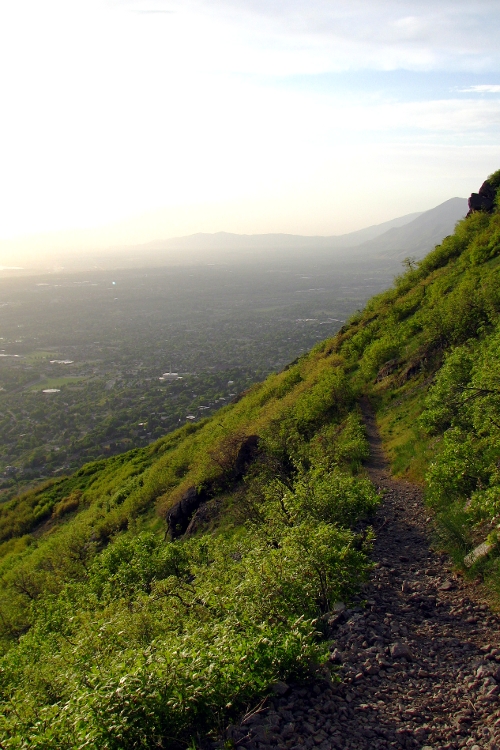
So this last weekend, I decided to solo climb Y Mountain.  For those of you who don’t know, Y Mountain is one of the smaller mountains along the Wasatch range local to the Provo/Orem area.  It’s called Y Mountain because of the enormous letter “Y” painted on its side (yeah, that’s what they do to mountains in this part of the country).

Of course, the only reason I did a solo hike was because I’ve been up this mountain multiple times before and I know the trail.  Plus, it’s kind of a smaller mountain–it’s still over 8,000 feet, but the trail is only about 2 miles long.  I’m a slow hiker, so it took me about three hours to get to the top.

To get to the top, you first have to hike the Y, which is the most boring part.  The trail is literally wide enough for a truck to drive up–that’s how they repaint the Y every few years–and it’s all on the side facing the valley, so all you can really see is city.

After the Y, you go up a much smaller trail that cuts across the face of the mountain south, into Slide Canyon.  At the entrance to the canyon is this really cool rocky outcropping that some people call Lover’s Point–I like to call it the Citadel.  The trail winds up the canyon a ways, passes another really cool overlook, and turns a couple of bends before you reach the canyon head.

This is where things get interesting.  At the head, there’s a small meadow surrounded on all sides by forest.  On the right is a campsite, where the trail forks and heads up to Maple Mountain.  If you stay left, though, the trail eventually takes you to the summit of Y Mountain.

The next half mile or so is pretty strenuous.  The trail goes through an aspen grove, past another meadow, into this freaky dark forest, past another meadow, into another forest…and then you find yourself in this vast meadow, above the trees, surrounded on all sides by mountains.

I have to be honest: when I got to this point, I was absolutely terrified.  The roar of the city was gone (and yes, the city roars–it’s a very distinct sound), the only other people around were a couple of hikers somewhere behind me, whom I hadn’t heard in maybe an hour, and all around was such incredible vastness…it’s hard to explain without actually being there.  I just felt so small and isolated, surrounded by this immensity of nature that didn’t know who or what I was, or even that I was…

It was AWESOME.

By the time I got to the peak, the sun had set and the stars were already coming out.  I only climbed to the false summit–the one with the view of the entire valley–and from there, I could see past Point of the Mountain all the way north to Sandy, with Spanish Fork and Elk Grove to the south, and Utah Lake a giant puddle in between.  It was pretty cool.

But again, the alone-ness of the place really got to me.  It made me wonder: is this how future space explorers will feel, when they’re traveling between stars?  I can’t imagine how much greater is the vastness of space, compared to what I felt.  If so, what kind of an effect with that have on the people who live out there on the fringes of settled space?  How will it affect their culture, their religion, their sense of who they are and what their place is in this infinite universe?

I wish I could say I felt this huge sense of triumph after getting to the top, but honestly all I could think was: “oh crap, now I’ve got to walk all the way down.”  I did it the same way anyone does anything–one step at a time–and thankfully, I made it down without incident.

Passed a young couple up on a date; they were pretty impressed that I hiked by myself, and gave me some water (which was fortunate–I ran out at the summit).  Passed another pair of backpackers who were hoping to camp overnight on the summit, but other than that, I didn’t see anyone else until I got to the Y.

So that was my adventure this weekend, and how I celebrated my 27th birthday.  It was totally worth it.  In a couple of days, I’ll share the photos.

Still alive

This post is just to let you know that I’m still alive, that I haven’t gone anywhere, and that I’m still writing.

I’ve been a little disorganized recently, with job obligations (this is my last week), a TEFL course to finish, and other stuff…can’t quite remember what other stuff, but I’m sure there was something.

Anyhow.

Point is, things have been upside down recently, but I plan on posting more frequently once I fall back into a routine.  Here’s what I hope to blog about:

  • Blog awards: I recently got tagged by two of my blogging friends, so I’ll be passing those on.
  • My solo hike up Y Mountain last Saturday.  Expect to see this soon, with some pictures.
  • Thoughts on dreams and dream interpretation.  I had a really interesting experience with this recently.
  • Update on Star Wanderers; I hope to finish draft 2 in a couple days and send it out to alpha readers.
  • “Does it ever bother you to do bad things to your characters?” A question I got recently, which is a blog post just begging to be written.

Also, I’m putting together a blog tour right now for Bringing Stella Home and Sholpan, so if you’d like to have me on as a guest blogger, feel free to shoot me an email at joseph dot vasicek at gmail dot com.

In the meantime, this might interest you: I wrote a poem Sunday based on a first line I got from work.  My coworkers were talking about dating, saying how they were going through a drought, and I replied with “my life is a drought, and my soul is a desert.”  Great first line, huh? 🙂 If you want to read the poem, you can find it on my deviant art page here.

Other than that, there’s not much else to say.  My daily routine is all shot to @#$! right now, but that’s what happens when you’re a freelancer; you’re productive for a while, until projects and schedules change, then you go through a period of chaos until you fall back into a productive routine.  All a part of the lifestyle.

And now, in order to promote a more healthy lifestyle, I’m going to go to bed.  G’night, interwebs.  Be good.

To publish or not to publish?

That’s what I’m wondering about right now with my latest project, Star Wanderers. The full-length novel isn’t complete yet, but the first part forms a self-contained novelette that has been sooo much fun to write.

The story takes place in the Gaia Nova universe, about five hundred Earth years before the events of Bringing Stella Home.  The main character is a 20-something boy who, as is customary in the outworlds, left his home to wander the stars, searching for a suitable place to settle down and start a family.

While visiting a remote space station, he unwittingly gets roped into marrying this girl, whose father is trying save her from starvation by sending her away. The problem, though, is that neither the boy nor the girl speak the same language.

So basically, he just wants to drop her off at the next port and be done with it, while she thinks that she’s his wife and is trying to live up to those expectations.  Over the course of their voyage, though, they gradually fall in love and become a couple.  That’s where the novelette ends, and the second part of the novel begins.

Because I’m a total dork, I looked up all the major tropes in Star Wanderers on tvtropes.  Here’s just a few of them:

So yeah, I’m really excited to share this story with people.  The only problem is I want to submit it to the Writers of the Future contest, and I’m not sure if they’ll consider it if it’s already self published.  The contest guidelines say that all the rights remain with the author, and defines “professional publication” as something with >5,000 sales/downloads, but that doesn’t say whether it’s okay to publish the piece you’re submitting.  I’ll probably have to shoot someone an email or something.

In any case, I’ll probably put up the first part of Star Wanderers before I publish the novel.  For everyone who’s signed up for the newsletter, I”ll probably give it out as a free ebook.  If Writers of the Future is okay with it, I’ll  do that in the next month or so; if not, I’ll submit it to the contest first and wait to see what happens.

But either way, I really want to share this story!

Difficult choices and keeping perspective

So I have some news, and it’s probably going to freak my parents out a little bit…I decided to turn down the full-time job offer that I mentioned a few weeks ago.

The company is great, they treat their employees well, I got along well with everyone there–so why not take the job?  Because it wasn’t helping me make progress toward my long-term goals, it wasn’t teaching me any new or useful skills, and it wasn’t in a field where I’d like to make a career.  After weighing the benefits vs. the costs, especially the opportunity costs, it just didn’t make sense to stay.

I know what a lot of you might be thinking: “Dude, a job’s a job.  In this economy, you should take it and count yourself lucky!” I reject that, though.  Last year, I managed to cut my expenses to less than $950 per month.  I’ve been saving up my paychecks, and I’ve got enough to float me for a couple of months until I find a job that fits better, hopefully part-time.

The big thing I’m worried about is whether I’m digging myself into a hole.  Since graduating in April 2010, here are the jobs I’ve held:

  • Conducting unsolicited phone interviews at a call center.
  • Picking, packing, and shipping at a costume company warehouse.
  • Delivering phone books from my car.
  • Miscellaneous unskilled labor at a candy factory.
  • Miscellaneous unskilled labor at an alarm company warehouse.
  • Processing inventory and shipments at an alarm company warehouse.

So yeah, nothing all that great.  I’ve been doing some volunteer stuff in the interim, though, especially with Leading Edge and the “class that wouldn’t die” article from last year.  But in general, it feels like I’m getting stuck in a rut, and that the longer I stay stuck, the harder it’s going to be to break out.

What I really want is something that will expand my mind and/or give me another major cultural experience.  That’s why I’m thinking seriously again about teaching English abroad.  But grad school is definitely another attractive option, especially if it gives me a chance to work on my Arabic.

With that in mind, here are the options I’m considering right now:

  • Travel to the Caucasus in January and volunteer teach English with the TLG program.  It’s not particularly lucrative, but if I can balance my writing career on the side while having an awesome cultural experience in a region of the world that interests me, it might be perfect.
  • Study Arabic and/or Middle Eastern Studies at a university in the Middle East, ideally AUB or AUC.  I don’t really want to be a security analyst, but I would love to make a career as an Arabist of some sort–provided, of course, that I could balance it with my writing.
  • Pursue a graduate degree in History, Anthropology, or Sociology in the United States.  I’m less sure of this option, mainly because I don’t know if I’m passionate enough about any of those subjects to really succeed at them.
  • Take a chance and travel to the Middle East to teach English.  I’d probably go to Jordan or Oman, where I actually know people, but Egypt, Libya, or Tunisia might be good too, especially with the Arab Spring opening them up.  It might also be dangerous…but hey, at least it’s an adventure.
  • Finding a graveyard desk job, like night auditor at a hotel, and use that to support myself until the writing career start to take off.  Even though this is the most boring option, it’s probably the most likely one I’ll follow…which probably isn’t a good thing.

The main goal, of course, is still to go full time with the writing career.  That’s like the holy grail.  I’m still optimistic about that; it’s just a matter of finding something useful to do in the interim.  The last thing I want is to settle, or to get stuck in a comfort zone, or lose sight of my long term goals…

…I don’t know.  I’m still figuring all this stuff out.  But regardless, I just don’t think working full-time at an unskilled labor job is going to get me anywhere–and that’s an opportunity cost I can’t afford to take.