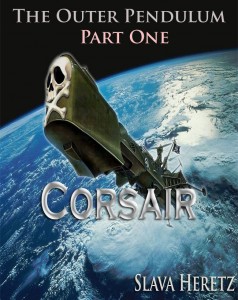
Interview with Slava Heretz

I met Slava Heretz online shortly after I started publishing my books.  He’s another indie writer who specializes in science fiction and space opera.  I’m reading his short story / novelette series Outer Pendulum right now, and it’s pretty good.  If you like a good space adventure, I think you’ll like his stuff.

Anyhow, we decided it would be fun to interview each other on our blogs, so here he is.

Tell us a little bit about your books.

The Outer Pendulum is a space opera which I am releasing in monthly 10,000 word installments. The story is set in a galaxy where humans are the unwanted newcomers, escaping an oppressive life back in the Milky Way, only to find themselves facing another kind of tyranny: the seemingly endless stream of piracy and corruption in their new land. Our hero is Captain Eli Saffinger, a former New Alliance Navy captain turned mercenary fleet commander. His mission, which he accepts reluctantly, is to escort a freighter carrying extremely valuable mining equipment to the only allies of the weakening colonial state. So his journey begins in Corsair (Outer Pendulum, Book 1), where he must immediately confront the most ruthless and dangerous privateer in the galactic region.

How long have you been a writer, and what got you started?

I started serious work on a near-future technothriller back in late 2007. I think that’s really when I began to consider myself a writer. As opposed to earlier dabbles with fiction back in my youth, I actually spent a very large portion of my days dedicated to this project — and to be perfectly honest, I’m still not exactly sure why. I just suddenly had a story to tell. It came to me one day in the shower and I said to myself, “Hey, Slava, let’s write a novel.” So when the idea for The Outer Pendulum popped into my head this past spring, I had the wisdom and experience from my many many mistakes to give this story more life, energy and passion.

What draws you to space opera and science fiction?

As an only child I had a lot of time to just sit there by myself and dream up wildly imaginative tales of space travel and cool technology. Some of these ideas were good, some not so much. But I always marveled (and still do) at the things which I have no hope of ever accomplishing. Theoretically I could be a rock star. I have no talent for it, but at least the occupation exists. But no matter how hard I work at, there is no way in my lifetime, save a true miracle, that I will ever travel to another solar system. And because of that, the possibilities of the imagination are endless. I love that.

Who are some of your favorite authors?

Dan Simmons for his wonderful characters and settings. Iain M. Banks for that touch of witty humor we all love and need. And M. John Harrison for anytime I want a truly warped, weird, yet poetic reading experience — he’s kind of the Stanley Kubrick of sci-fi noir.

Why did you decide to self publish?

I had submitted several pieces of fiction to traditional publishers in the past. Many of them flat out ignored me. Others, however, sent very positive rejection letters. That’s when a light bulb appeared over my head. I asked myself: why am I waiting for months to have one person tell me I write well, when I could let the world of hungry readers decide for themselves? It wasn’t long before I discovered Amazon Kindle Direct Publishing and Smashwords. I soon realized what a revolutionary idea it was to allow authors to simply create and let the market speak for itself.

What have you learned from your indie publishing experience thus far?

I’ve actually learned quite a bit about readers of indie literature as a whole. I’ve heard the complete spectrum of praise and criticism about my series. Some have absolutely loved the story. Some have vehemently hated it. But if I were to pick out some things that they all had in common they would be a) a seemingly insatiable appetite for reading within the genre b) that MOST of them actually do read samples and/or product descriptions before buying and c) that this growing community of open-minded folks is truly willing to ignore the stigma of indie publishing and seek out works by self-published authors. I can’t say that for them it’s an easy job. But they try, and I thank each and every one that contacts me — because it seems in the end, the reward of finding a few self-published diamonds far outweighs the possible tedium of sifting through the ever-growing rough.

What are your goals and plans for the future?

First and foremost, I have to finish The Outer Pendulum. I envision eight or ten installments culminating into a complete saga by summer of 2012. There is also an audiobook/podcast in the works. There will even be a multiplayer online card game based on the universe within the story. I mean, I have a ton of other ideas kicking around in the ol’ noggin — such as books in other genres. But this will certainly keep me busy for the next several months. It’s really been a lot of fun writing the series.

If all of us have at least one impossible dream, what is yours?

I would love to meet a sentient alien. I can’t say with 100% certainty that they exist, but I really hope so. If I may quote one of my favorite TV shows — “I want to believe”

Slava lives in Brookline, MA with his beautiful wife Alyssa, his neurotic dog Duke and his passive aggressive cat Chester.
Trope Tuesday: Walking the Earth

Oh there’s sober men in plenty
And drunkards barely twenty
There are men of over ninety
That have never yet kissed a girl.
But give me a wandering rover
From Orkney down to Dover
We will roam the country over
And together we’ll face the world.

When a character decides to walk the Earth, they leave behind friends, family, and earthly possessions to wander from town to town in search of adventure. In real life, we think of these people as bums, but in fiction these characters are often the protagonists–or if not, then some sort of wise figure or noble adversary.

There are two character archetypes that tend to fill this trope: the drifter (or “the stranger” as Joseph Campbell called him) and the knight errant. For the knight errant, walking the Earth is simply part of the job description: always in search of evil to slay and damsels to rescue, he cannot stay in one place for long. It’s the same with the drifter, though he might not have the same skill set or code of honor.

As you can imagine, this trope tends to be most prevalent in Westerns, with the knight errant transformed into a gunslinger and the drifter wandering the wide frontier. American culture has definitely embraced this trope; what else did you expect from the nation that invented cars, highways, and the road trip? However, it’s also quite prevalent in East Asia as well, with the ronin and other wuxia archetypes.

Of course, this trope is only possible in a society that has a long tradition of sacred hospitality; otherwise, the wandering hero will almost certainly starve. That’s one way to spot stories where this trope is done poorly: if the wanderer has no visible means of support, yet appears clean and well-fed, the author hasn’t connected the dots. Also, characters who walk the earth are almost always male, since women who travel alone are more likely to get raped or assaulted.

One of my favorite examples of this is Van Hoenheim from Full Metal Alchemist. <SPOILER: highlight to read>After he unwittingly helps the first humunculous to sacrifice the population of Xerxes to make two giant philosopher’s stones, Hoenheim sets off to wallk the Earth as an immortal being, his sorrow too great to allow him to settle down. However, while the humunculous uses his stone to acquire even greater power, Hoenheim becomes familiar with every damned soul trapped in his and enlists their help. In the final battle, we learn that Hoenheim has used his centuries of walking the Earth to bury the damned souls in such a way to counter the humunculous’s transmutation circle, thus saving the people of Amnestria.</SPOILER>

There’s a dark side to this trope, however: the flying dutchman, cursed to wander the earth forever. By definition, every adventure must come to an end; when it doesn’t, it becomes instead a sentence of exile. Perhaps this is why characters who walk the Earth in a post-apocalyptic setting (like the wandering Jew in A Canticle for Leibowitz) tend to lean more towards this: after the world ends, there is no going home.

Which makes me wonder: in order for this trope to be positive, is it necessary for the main character to have the option of settling down whenever he wants to? Certainly there are those who choose a life of eternal adventure, but that implies that they have a choice. Even if they would have chosen not to settle, when that option is taken from them does that always make the story darker and less hopeful?

Either way, this trope intrigues me. Expect to see it in my own work soon.

Lyrics from “The Ramblin Rover” by Silly Wizard.

Random updates before leaving

I’m spending Thanksgiving with my parents this year, which means I’m leaving for Massachusetts tomorrow…by train.  Well, technically, Sunday morning, since the cross-country trains come through Salt Lake City in the wee hours, but to my way of thinking it’s tomorrow and not Sunday.  Either way, I won’t be posting anything until Tuesday night, since that’s when I arrive.

You may have noticed that Amazon recently bumped the price of my two short stories, Memoirs of a Snowflake and Decision LZ1527,” back up to $.99.  I decided to raise the price because giving them away for free wasn’t having any sort of effect on sales of my other novels.  Sure, it exposed my work to more readers, but I want to be known for my science fiction series, not because of a couple of cute stories that aren’t a whole lot like anything else I’ve written.

However, after reading Kris Rusch’s recent post on this subject, I decided to drop the price of Sholpan to free for the next couple months.  Sholpan is a novella taken from Bringing Stella Home, and is a great place to start for my Gaia Nova series.  It’s a complete story on its own, but I’m hoping it will drive interest in the full length novel, and later in Desert Stars.

If the price dropping process is anything like it was for the short stories, though, it will be a while before Sholpan is free across all platforms.  Amazon doesn’t allow you to set the price to free yourself; you have to get all the other places to do it first, so that Amazon’s bots will detect it and price match.  To do that, you have to drop the price on Smashwords first and wait for it to trickle down.

In short, it will probably take three to five weeks for Amazon to make Sholpan free.  Hopefully it’ll happen in time for the holiday season, and probably for a month or two afterward.

In the meantime, I just noticed that Memoirs of a Snowflake is on both the science fiction anthology and fantasy anthology top 100 lists on Amazon.  Woot!  It’s not going as fast as it was when it was free (I think I’ve had just five sales in the past 48 hours), but it’s still going.  It will be interesting to see how long it holds up; it would be awesome to crack the top 10 on either of those categories!

And that’s about it.  I’ll leave you with the following quote:

All journeys have secret destinations of which the traveler is unaware.

–Martin Buber

Story Notebook #7

All right, it’s been forever since my last story notebook post, so I figure it’s time to do another one.

Last time, I shared the story ideas I from my fifth story notebook, during my time in Washington DC.  This next notebook is pretty tattered, and it covers my time from graduation to winter of last year.  One of the reasons it’s falling apart is probably because I didn’t have a car and had to bike everywhere.  That’s probably why I weighed fifteen pounds less, too.

EDIT: This notebook actually covers the end of summer to the the winter, after I’d gotten a car.  Minor point, but it’s worth noting to clarify.

Anyhow, here we go:

Machu Pichu…IN SPAAACE!!!  Seriously, an exploration mission that finds abandoned ruins on another planet.

Happens fairly often in science fiction, though it isn’t something I’ve tried my hand at yet.  Although I guess there was some of that in Genesis Earth, and I’ve got a couple of ideas for something similar in the Gaia Nova Universe…moving on!

A knight sets out to rescue the damsel from the dragon, but the damsel slays the dragon and becomes the monster that the knight must slay.

Hmm, this one sounds promising.  Of course, “knight,” “dragon,” and “damsel” are all archetypes, not literal characters.  For example, if Raoul is the knight, the Phantom is the dragon, and Christine is the damsel in distress…wow, that would be disturbing.

What if Earth is a wildlife preserve for an interstellar species that is far more advanced than us?

Kind of like “They’re Made of Meat”?  I think Predator might have done something like this, except that Earth was a hunting preserve.

A society where people achieve immortality by uploading their consciousnesses to a normal human fetus through a process called “reconception.” They do this because computer hardware is incompatible with human wetware.

I’m pretty sure I retrofitted this story idea from a play on the word “inception.” Man, that was a good movie.

Planetary colonization scheme: send down a group of genetically modified humans, who are hardy, extremely fertile, have shorter gestation periods, etc, and have them do the dirty work of building the first settlements.  Then send the regular humans after a couple of generations, when they’ll be revered as gods for their superior technology, and have the two cultures intermarry.

I had a long involved dream about this story idea shortly after I had it.  Sounds like a good idea for a series; one of these days, I’ll have to write it.

A character who sees right through all the pretenses and lies of society to know people for what they are–a magnificent judge of character who isn’t swayed by power, position, or pretend honors (eg high paying jobs)

In other words, Captain Moroni–IN SPAAACE!!!

An offworld version of Australia or Siberia, where convicts create their own country.

This idea could single handedly save the US space program.

A society in which everyone must remarry every X number of years.

Wow–I want to use this right now in my current WIP!  Okay, maybe that would be a bad idea.

What if dreams are not only the subconscious working through the events of the past day, but of events that our consciousness perceives as lying in the future?  That the subconscious transfers information non-linearly through time and space?

So shiny…must..resist…

A character who can read minds, knows every dirty thought inside your head, and isn’t disgusted by it.

If I ever met a girl like that, my first question for her would be “will you marry me?”

What if the evolution of our society in the information age is like simple celled organisms evolving into complex ones?  Where the AI overmind will organize into a giant organism as complex as a human being?

Reminds me of an excellent story on Escape Pod titled “Endosymbiont.” You should drop whatever it is that you’re doing and listen to that story right now!

An evil overlord who wants to unite mankind under the overmind instead of under his own rule

Kind of like a mashup between Sauron and Javier.

Perhaps every generation has an impossible battle, and whether they rise to meet it or fail to overcome it defines that generation’s place in history.

If that’s true, I’m pretty sure my generation is failing.

A fantasy that romanticizes the minion.

An AI that falls in love with its creator.

A person who appears schizo but actually jumps between close possible universes.

Better yet, a story that mashes all of those ideas together!

A character who loses the mental ability to translate sounds into words and language–who sees everyone else as animals.

I’m pretty sure this happened in The Silmarillion at some point.

A character who believes that existence itself is an epiphanic prison.

…and appears schizo but actually jumps between close possible universes…

What if war and terror is normal everywhere else in the world, and all of us Americans living our quaint middle class lives are ridiculously sheltered?

Uh, I’m pretty sure that’s not fiction…

A fast food place that uses time travel to delver full course meals.

<facepalm> Oh man, there are so many ways that could go wrong.

And finally:

A future world in which smiles have been turned into a commodity.

WE…ARE..THE NINETY NINE PERCENT!

And that concludes my sixth story notebook.  I sense an encouraging trend; some of these ideas were pretty good!  Or maybe I’m still too close to them…in any case, there’s no telling until someone actually sits down and writes the story.

So if you feel like taking one of these ideas and running with it, feel free!

Trope Tuesday: Bittersweet Ending

WARNING! CONTAINS SPOILERS FOR AMERICAN GODS, LAGAAN, LORD OF THE RINGS, TREASURE ISLAND, AND CROUCHING TIGER HIDDEN DRAGON.

And he sang to them, now in the Elven-tongue, now in the speech of the West, until their hearts, wounded with sweet words, overflowed, and their joy was like swords, and they passed in thought out to regions where pain and delight flow together and tears are the very wine of blessedness.

Tolkien, J.R.R. The Return of the King.

I love bittersweet endings.  I love stories that warm my heart even as they make me cry.  There’s something about reading them that makes me feel alive, and something about writing them that makes me feel like I’ve truly told a story worth telling.

The tvtropes page claims that bittersweet endings fall more to the cynical side of the sliding scale of idealism vs cynicism, but I disagree.  Without tasting the bitter, how can we know the sweet?  Too many of our modern stories are like high fructose corn syrup, where everything gets tied up with a pretty bow and the characters remain essentially unchanged.  I firmly believe that it’s only through sacrifice that we can know true joy, and stories that follow this often end up being bittersweet on some level, even if they are idealistic.

The tvtropes page lists six types of bittersweet endings, which are:

  • Did Not Get the Girl: When the hero either loses the girl or has to give her up to win the day.  American Gods is a good example of this, I think: Shadow never actually gets back with Laura, even though he spends most of the book looking for a way to bring her back.
  • The Greatest Story Never Told: When the hero fades into obscurity after winning the day.  Lagaan, one of my favorite Bollywood movies, is an excellent example of this.  The last line of the movie is the narrator explaining how after the events of the story, the village faded into history until it was forgotten.
  • End of an Age: When the triumph over evil transforms the world so completely that there is no going back to the way things used to be.  Lord of the Rings is the best example of this: after the one ring is destroyed, all the other rings lose their power, and the elves must pass into the west.
  • Heroic Sacrifice: When victory comes only after the death of many or all of the main characters.  This is basically every David Gemmell book ever written, which is why I can’t get enough of him.
  • Only the Leads Get a Happy Ending: Where life is great for the main characters but everyone else ends up suffering.  I can’t think of any examples where this is done well; it’s probably just bad storytelling.
  • Karma Houdini: When the bad guy doesn’t get what’s coming to him.  The best example of this is probably Treasure Island, where Long John Silver gets away with the treasure in the end, leaving the good guys to say “I can almost find it in my heart to hope he makes it.”

It’s important to point out that this trope is not simply a tragic tale with a heart-wrenching twist.  Crouching Tiger Hidden Dragon, for example, is a straight up tragedy: even though Mu Bai confesses his love to Shu Lien, he promptly dies, and Jen commits suicide.  It’s an awesome ending to an awesome story, but there is no sweet in it.

When done poorly, a bittersweet ending can feel confusing or anti-climactic.  When done well, however, I think it adds a wealth of depth and feeling, as well as a degree of believability and realism.  After all, how many of our victories are complete?  How often do we have to give up something good for something greater?

So yeah, I love this trope.

Struggling not to settle

I’m in the middle of my first revision pass through Heart of the Nebula, direct sequel to Bringing Stella Home, and…I don’t know exactly how to put this, but the story seems to be simultaneously smoother and more shallow.  Plot-wise, everything works great; character-wise, there just doesn’t seem to be as much depth as my other work.

I remember finishing the first draft in May, and being surprised at how well structured it was.  Each of the three major plot points happened after exactly five chapters, and each of the chapters was almost perfectly balanced–a far cry from my previous work.  I had a few stops and starts in the first part, but everything after the first hundred pages was smooth as gravy.  What’s more, I’m finding in this revision that not a whole lot needs to change; it works pretty well as-is.

And yet…I can help but feel as if something is missing.  The characters just aren’t coming alive the way they did in my previous works.  The story isn’t quite as engaging, the climaxes quite as gut-wrenching as I would like.  It feels like a good story, but not a great story.

Here’s the thing: my previous stories were all broken in this phase.  Desert Stars was so broken I had to write another novel to figure out how to finish it–and even then, the second half of the book went entirely in the wrong direction and had to be thrown out.  Bringing Stella Home had a solid storyline, but Stella’s character was completely broken and had to be rebuilt from the bottom up.  And Genesis Earth had half a dozen false starts, and at least as many chapters that had to be thrown out because they did nothing to advance the plot.

But Heart of the Nebula isn’t exactly broken, it’s just…not at the level I would like.  And I worry that because it isn’t broken, I won’t feel as compelled to make it better.  I worked hard on the others, and learned a lot of lessons which helped me to write this book, but even if I’ve hit my stride and this is the result, it feels too much like settling.  I can do better.

None of this probably makes any sense if you haven’t read the manuscript, but I hope it doesn’t sound too much like whining.  Even if these are problems, these are good problems and I’m happy to have them.  When I share this with my first readers, they will probably have all sorts of insights that will make me smack my forehead and make everything awesome again.

I guess my point is that I don’t want to settle, even though this draft will probably not be as good as I’d like it to be.  I’ll fix all the known problems, then send it out to my first readers and trust them to help me find the unknown problems.

In the meantime, I should probably start something new.  I have a ton of great ideas for the fantasy novel, and bouncing them off of friends has really helped me to figure out what else the story needs.  After I finish reading American Gods, I’ll stock up on some fantasy to get into the right mindset, starting with David Gemmell (incidently, at dinner group tonight, I literally squeed while talking about David Gemmell.  It was simultaneously embarrassing and really awesome).

Enough of this.  Time for sleep.

Kickstarter update, new blurb, and cover art for Journey to Jordan

First things first: with sixteen days to go, Desert Stars is currently about 36% funded.  If you haven’t picked up any of my books yet, this is a good place to start: I feel confident that it’s my best work yet.  $10 will get you a copy with your name in the front under “special thanks”–$25 will get you that plus everything I’ve published so far.  So check it out!

To keep the kickstarter campaign moving, I decided to update the blurb for Desert Stars.  Here’s what I came up with:

He was the sole heir to the Najmi camp, a young man raised by tribesmen after falling to the desert from the stars. She was the sheikh’s most beautiful daughter, promised his hand in marriage–if she can convince him to stay.

Together, they must travel to a land where glass covers the sky and men traverse the stars as easily as tribesmen cross the desert. Here, at the ancient temple dedicated to the memory of Earth, they hope to find the answers that will show them the way home.

But when love and honor clash, how can they face their destiny when it threatens to tear them apart?

So what do you think?  Does it grab you, or do I need to change anything?

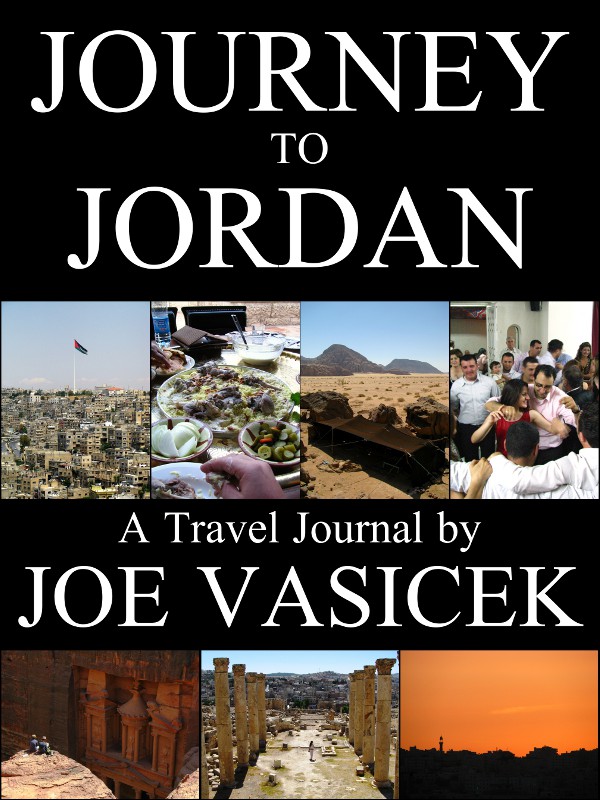
Finally, I’m currently in the process of preparing my travel journals from the 2008 BYU Jordan study abroad trip for publication.  This is one that I’m doing 100% by myself–editing, cover art, etc.  If anyone wants to volunteer to make a proofreading pass, I would greatly appreciate it.  Currently, I’m about 1/3 of the way through; I hope to finish putting it together by December 1st.

In the meantime, here’s the cover art:

Pretty nifty, eh?  What do you think?

Managing excitement and an idea for an epic fantasy novel

After getting about 40% through Star Wanderers 1.0, I hit a wall and decided to put the project on the back burner for now.  The beginning part, which I’m hoping to shop around as a novelette, has some issues with it and those are keeping me from making any real progress in the rest of the story.

I wish I could just wave my hand and pretend as if I’ve already fixed those problems, but my creative process just doesn’t work like that.  I guess I’m more of a discovery writer in that way, because I can only build on stuff that I’ve already written.  I have to figure out my characters as I write, otherwise they just fall flat.

It’s discouraging, because I feel like I don’t have enough control or discipline over my creative process.  Other writers seem to be able to pick up a project and finish it, even when that project is commissioned by someone else (editors, franchise owners, etc).  But with me, if I can’t get excited about a project, I can’t finish it.

Fortunately, even if I can’t always control which project I’m excited about, I always seem to be excited about something.  After finishing the last revision for Desert Stars, I felt this unusually strong urge to work on Into the Nebulous Deep (which, after the last post, I’ve tentatively decided to rename Heart of the Nebula).  I totally didn’t see that coming, but I’m glad that it did, because that project is getting due for its first major revision.  It’ll probably be a quick one, just to fix some major known issues before sending it off to first readers.

As for new projects, I’m not quite sure what to pick up next.  I’ve got a feeling I could give Edenfall another shot, though it’s dubious at this point, and I still have a bit of lingering excitement over the untitled Gaia Nova novel that involves Roman, Danica, Rina, and Stella’s son.

At the same time, though, I have a really cool idea for a fantasy novel involving magic swords.  The idea is that the swords are actual characters, with the ability to think, feel, remember, and communicate with those who wield them.  They can only be wielded by those whose minds have been melded to them, however, kind of like the Dragonriders of Pern.

As the swords get passed down from generation to generation, they pass on their skills and memories, so that those who wield them become legendary warriors.  However, all but one of the swords goes insane, turning their wielders to evil.  The one sword that remains has refused to take on a new master, even though war and destruction sweeps the land.  A prophecy states that the one who wields this sword will eventually defeat the evil of the others, but when the good sword finally does take on a new owner, it ends up being a farmgirl / tavern wench (I haven’t really decided).

I don’t have a lot of experience writing fantasy, but this story is starting to really excite me.  If I can combine it with a few other ideas and read some good fantasy novels to get into that mood, I think I can make some good progress on it.

So yeah–I have plenty of projects to work on, so things aren’t that bad.  I just need to find one that I can really get into for the next couple of months; if I keep bouncing around from project to project without finishing any of them, that’ll be bad.

The ever elusive title

Man, titles are so freaking hard.  I just spent the last two hours trying to think of a better title for Into the Nebulous Deep, my current work in progress.  Here’s what my brainstorming looked like:

Deep Nebula

Heart of the Nebula

Serve and Protect

Love in the Deep

A Light in the Deep

Through to Freedom

We Won’t Surrender

Our Own

A Wolf in the Deep

To a New Place

In Search of a New Place

Flight to a New Place

Finding a New Place

Hope of a New Place

To Hope for a New Place

Hoping for a New Place

Reaching for a New Place

Striving for a New Place

Searching for a New Place

Heading for a New Place

Flying to a New Place

Voyage to a New Place

Journey to a New Place

Reaching for a New Place

Together in a New Place

Home to a New Place

Free in a New Place

Forward to a New Place

Forth to a New Place

Starry New Place

To a New Place

Some of those are pretty bad–but hey, it’s brainstorming right?  There are no stupid questions, only stupid…

Anyway, I think I’m leaning more toward “To a New Place” or “Home to a New Place.” I’m curious, though, to hear what you guys think. If you have a better idea for a title, please let me know.

The story takes place five years after the events of Bringing Stella Home, when James has become something of a maverick pilot in the Colony’s militia.  However, life under the Hameji occupation has become so difficult that their only real option is to evacuate the Colony and settle somewhere else.  In the process, James gets tied up in a love triangle that ends in a way that’s only possible in science fiction.

So what do you think of “To a New Place?” It might not be the best when viewed side by side with “Bringing Stella Home,” but yeah.  Actually, if I turn it into a trilogy within the series, it would be kind of cool to have all the titles form one giant sentence.

Or maybe it would be cool to get some sleep and think about it tomorrow.

Trope Tuesday: Childhood Friend Romance

Oh come on--you just KNOW that they get together!

There’s something heartwarming about a romantic couple that knew each other as children.  Maybe it’s that return to innocence, or a sense that destiny is on your side, but I find these kinds of stories hopeful and encouraging.

My favorite example of this is probably Deanna and Michael from For Better or for Worse.  My sister was obsessed with that comic growing up, so my parents bought her just about every book and I got to read them all.  I still remember when Deanna showed up again, after seven or eight books: at first, I was like “holy cow, is it the same girl from way back when Michael was a little boy?” And then he started dating her, and I was like “YES!!!”

Another good example is Phantom of the Opera, with Christine and Raoul.  Lloyd Alexander’s Chronicles of Prydain also had a long-running friendship between Taran and Eilonwy, which eventually took a romantic turn.  Apparently, Jane Austen was also fond of this trope, though I haven’t read enough of her to be able to say.

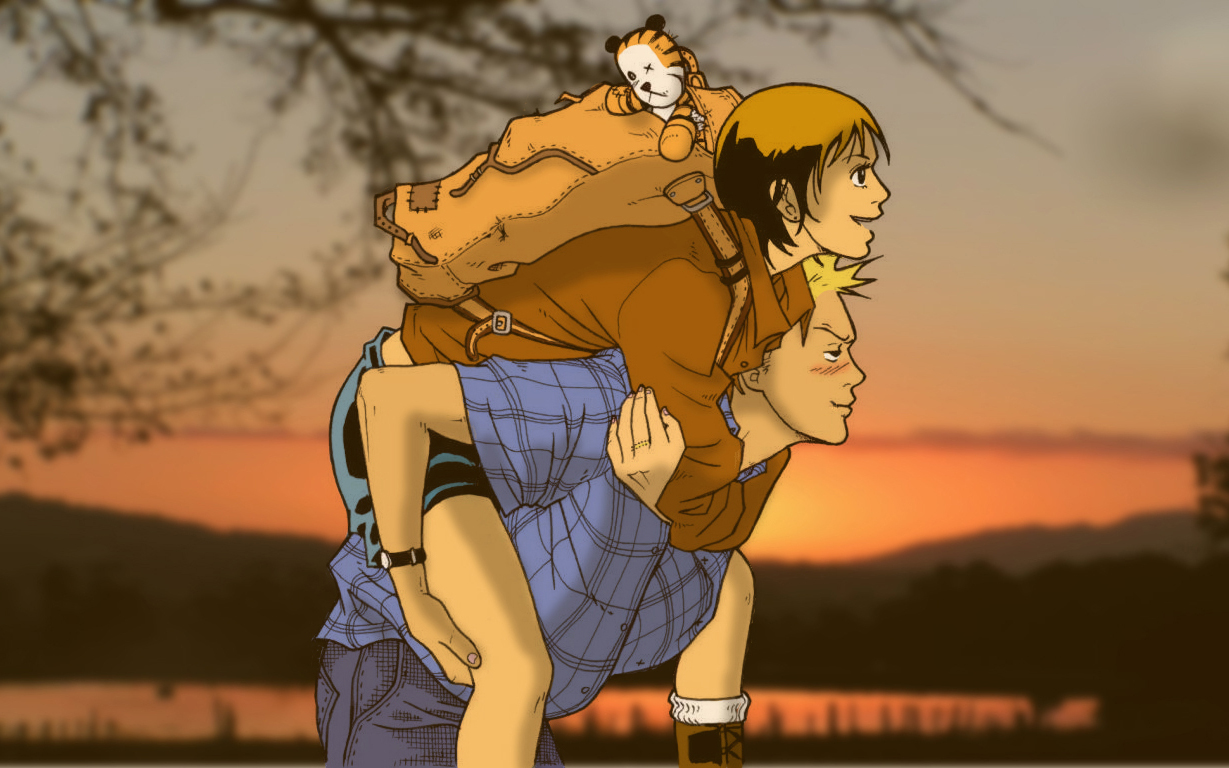
A lot of times, this trope is coupled with a childhood marriage promise.  It doesn’t have to be, though; I just love the thought that Calvin and Susie eventually end up together, even though they hate each other as kids.  As a storytelling device, this trope can also work well in conjunction with first girl wins.

Sometimes, though, the love is unrequited.  In many stories, this happens when one of the friends thinks their relationship is more like a brother and sister thing.  The scientific rationale for this is called the Westermarck effect, where people become sexually desensitized to those with whom they grow up together.  A good example of this would probably be Cyrano de Bergerac; the whole nose thing was more a self-esteem issue for Cyrano than a turnoff for Roxane.

In the Middle East, where it’s still common for first cousins to marry, this trope tends to be a lot more prevalent.  In Arabic 202, we read several magazine stories about couples who fell in love after growing up together.  There might be a bit of a squick factor there for Western readers, though–and that’s something you have to look out for with this trope.  If the characters really are like brother and sister, and they get together anyway…ew.

So there you have it.  For an innocent, hopeful, satisfying romance or romantic subplot–or a crushingly depressing tale of unrequited love–the childhood friend romance trope can be used to great effect.

Image courtesy sora1589. Line art by nami86.