The Self-Sufficient Writer: Lifestyle Choices

Before I go on with this series, I feel I should take a step back and discuss the topic of lifestyle choices.

The Merriam-Webster dictionary defines lifestyle as “the typical way of life of an individual, group, or culture.” According to Wikipedia, this includes “interests, opinions, behaviors, and behavioral orientations,” and is constrained by things like demographic background, personal values, preferences, and outlooks.

In other words, your lifestyle is the way you choose to live your life within the constraints of your own circumstances. Some circumstances can be more constraining than others, but still, lifestyle is fundamentally a choice. Even in abject poverty, there are people who choose to live differently than others.

So what sort of constraints does a writing career place on your lifestyle? Well, let’s talk shop for a minute.

If you’re a writer, you’re going to need the tools of the trade. Today, that normally means a computer with a word processor, though you can also use a typewriter or pen and paper. If you have a publisher, you’re going to need some way to contact them, either by snail mail or email. If you are your own publisher, you’ll need an internet connection, a bank account, and a computer with basic formatting and image editing software (Calibre, Gimp, Blender, etc).

In other words, all you really need to be a professional writer is a computer, an internet connection, and a bank account. You may need more depending on what you’re writing and who you’re writing it for, but those are the basic tools.

So what does this mean in terms of lifestyle choices? It means that writers have a lot of options. For most careers, your income earning potential gets lower the farther out you live from a large city. Not so for writing. You could actually live in rural Mongolia with nothing but a backpack and a horse, and so long as you can come into Ulaanbataar every couple of months and find an internet cafe, you can self-publish just like anyone else.

In other words, there is no “writing lifestyle.” There are only writers who have adapted their writing careers to the kind of life they want to live.
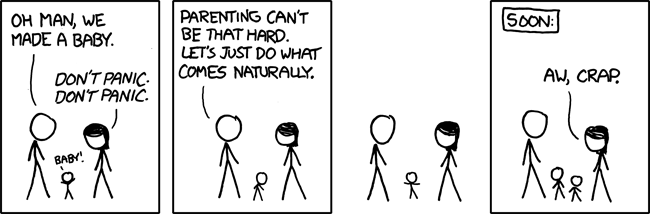
On one hand, every single one of my ancestors going back billions of years has managed to figure it out. On the other hand, that's the mother of all sampling biases.This makes it all the more important to consciously choose what sort of lifestyle you’re going to live, rather than letting circumstance choose it for you. If you don’t, it won’t be long before you find yourself in your underwear, eating nutella straight out of the jar, sitting in front of a grease-stained monitor clicking through an endless loop of Youtube videos. Just like no one is going to force you to meet your deadlines or write everyday, no one is going to force you to put your life in order.

Self-sufficiency is a lifestyle choice. It’s not a life hack, or a weird trick, or something you can learn in an afternoon. It takes work. It requires change. You will have to pay tuition by making mistakes along the way. And even though it can be fun, it can also be frustrating and painful.

When making a lifestyle change, it’s generally a good idea to take a step back first and figure out your goals and vision. By having a vision of what you want for your life, you’re much more likely to get there. This vision will be a reflection of your values and your deepest desires. Specific, measurable goals will help you to translate this vision into action, and provide the direction that you need to achieve your vision.

I have three main goals for the kind of lifestyle I hope to live. I haven’t achieved these goals yet, but I’m working toward them and hope to achieve them in the next three to five years.

Goal 1: Prepare my family well enough to survive any disaster and rebuild.

Emergency preparedness is a very important thing to me. It gives me both a sense of security and a sense of independence to know that if crap ever hits the fan, I won’t be a helpless victim.

Disasters come in a variety of flavors. There are natural disasters like hurricanes and earthquakes, man-made disasters like an economic collapse, and personal disasters like bankruptcy or the unexpected death of close family members. While it’s important to have contingency plans for each one, it’s also important to recognize that every plan falls apart upon contact with the enemy.

I plan to blog extensively about preparedness later on in this series. In the meantime, I’d recommend checking out Listening to Katrina for some very interesting perspectives on this subject. I learned a lot from reading that blog.

One of the most important things I learned is that prepping is about more than just surviving the disaster: it’s about surviving it well enough to rebuild. As much as I love reading post-apocalyptic stories, I don’t want to be stuck in a fallout shelter eating canned beans forever. We invented civilization for a reason, and if it ever falls, I want to be one of the guys who helps to rebuild it.

As a writer, I feel that emergency preparedness is even more important because the likelihood of facing a personal disaster is that much greater. If my writing career ever takes a wrong turn and falls out from under me, I want my family to be able to survive that long enough for me to successfully reinvent myself. According to Kristine Katherine Rusch, it’s common for working writers to face a major career crisis every ten to fifteen years or so, and I don’t think I’ll be an exception to that rule.

Goal 2: Develop a home economy that can provide for my family’s basic needs.

Most households in the United States produce consumer debt and not much else. If the US dollar became worthless and we all had to live off of what we had at home, within a couple of weeks, most of us would be screwed.

In a previous post, I talked a little bit about the concept of a home economy and how I experienced that concept while living overseas. It’s one of the things that I hope to implement once I have a family of my own. Instead of producing nothing but debt, I want my home economy to produce food, water, and even things like electricity and heating if it ever becomes necessary.

For me, one of the most important components of self-sufficiency is being able to produce most, if not all, of the food my family eats. Growing a garden, keeping chickens, baking bread, making cheese and yogurt—these are all things that I hope to do, and am working now to learn.

Two books that helped me get started on this path were The Forgotten Skills of Self-Sufficiency and More Forgotten Skills of Self-Sufficiency by Caleb Warnock. I’m also sharecropping this season with a local friend, building garden plots in his yard and growing cabbage, peas, radishes, broccoli, tomatoes, peppers, and zucchini. In a few weeks, we’ll build a chicken coop and get some bantams, which should make for an interesting blog post.

The goal here is not to become 100% self-sufficient in absolutely everything, but to produce enough that we can barter for the things we can’t produce on our own. For example, I don’t expect to ever own my own cow, but I do want to produce enough of a surplus of other things that I could barter with someone who does. Also, while I might not own the cow that produces the milk, I do want to have the capacity to turn that milk into things like cheese and yogurt.

This goal also encompasses being able to live off-grid. At some point, I’d like to switch to solar and become energy self-sufficient. Here in Utah, it’s legal to own and operate your own solar panels, so long as you don’t sell back so much energy to the grid that your electricity bill becomes negative. In other states, though, you have to lease your roof to a third party that technically owns the panels. I’m still learning up on all that, so I’ll probably invite a friend who knows more than me to come on with a guest post.

Goal 3: Make my home a refuge from the world where my family can feel close to God at all times.

This is the most important thing, and the one that will probably make everything else come together. Wherever I live, I want it to actually feel like a home, not just the place I live. I want it to be a safe zone for everyone in my family—a place apart from all of the bad things happening elsewhere. Most importantly, I want it to be a place of love where we can all feel close to God.

I grew up in a home that was very much like this, so for a large part of my life, it’s something that I’ve taken for granted. Having lived on my own for more than a decade and moved on average two or three times each year, I know that it’s something you’ve got to work towards.

Homemaking is often considered to be a womanly thing, but that’s exactly what this goal encompasses. At some point, I’d like to have a woman in my life who could help out with that aspect, but it’s something that I’m sure we’ll both be working on together. In the meantime, I have a sister whose brain I can rack whenever I have a question on the subject.
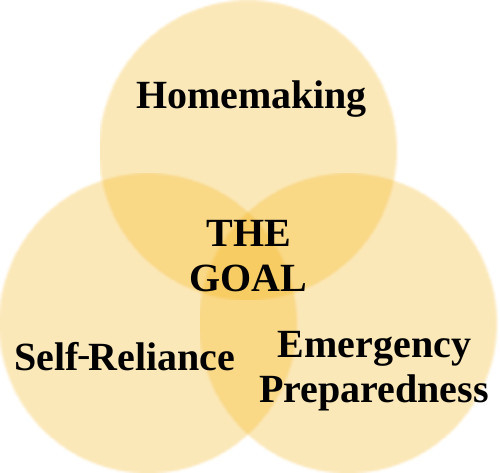
goalSo that is the kind of self-sufficient lifestyle that I personally want to live. As you can probably tell, family is one of the main themes running through everything. I’m single right now, but I do want to have a family of my own and that’s what I’m working towards.

And while my writing career isn’t explicitly mentioned in any of those goals, it’s definitely wrapped up in all of them. As a writer, my income earning potential is not dependent on how close I live to a major city. That means I can live a little farther out in the country, where we can have enough land to support a substantial home economy. Also, the flexibility of a writing career means that I can be home to spend time with my family, or still have an income if a major disaster happens and we have to bug out.

It’s quite a journey that I’ve set out on. I stumbled onto the path rather accidentally, but have since decided that this is what I want to do—that this is the kind of life I want to live. Your goals will probably look different, based on your own values and desires. If there’s anything about these goals that you find interest, though, I hope you’ll stay for the rest of this blog series where I share some of the more specific aspects of self-sufficiency that I’ve learned and how it all ties in to being a writer.


The Self-Sufficient Writer (Index)

SSF-IV: FRIENDS IN COMMAND now available for pre-order!

Hi guys! Great news! Friends in Command (Sons of the Starfarers: Book IV) is now up for pre-order on Kindle, Nook, Smashwords, Kobo, and iBooks! The ebook goes live on July 1st (which coincidentally happens to be the 152nd anniversary of the Battle of Gettysburg), but if you pre-order it now, you can have it delivered automatically to your ereader of choice when it’s released.

Over the next few weeks, I’ll post some 300 word excerpts to give you guys a taste of it. This book has been a looong time coming, but I’m now confident that this is a book I can be proud of.

At 42,000 words, Friends in Command is more of a short novel than a novella. The later books in this series keep getting longer, and I suspect that trend will continue until the end. However, I can promise you definitively that there will be no more than nine books in this series. Even if the last book is the size of a freaking Sanderson novel (unlikely, but possible), there will only be nine books, and each book will cost no more than $2.99 for the ebook version ($5.99 for the omnibus editions).

So yeah, check it out!

Friends in Command

Friends in Command

The future of the Outworlds now lies in uncertain hands.

The Imperials are back, and this time, a ragtag flotilla isn't going to stop them. But they aren't the only enemies of the new Outworld Confederacy. Together, Aaron and Mara must face a threat from within.

Order Now!
About the Book

The future of the Outworlds now lies in uncertain hands.

The war for the Outworlds is on. The Imperials may have lost the first round, but they’re back—and this time, a ragtag flotilla isn’t going to stop them.

When Aaron recieves a captain’s commission in the new Outworld Confederacy, Mara is his natural choice for second in command. But Mara never expected to live past the first few battles. She only joined the resistance to avenge her father, and fears the monster she’s starting to become. The only thing she has left to live for now is her friends.

The Imperials aren’t the only enemy in this war, though. The friends must face a threat from within in

SONS OF THE STARFARERS
BOOK IV: FRIENDS IN COMMAND

Details
Author: Joe Vasicek
Series: Sons of the Starfarers, Book 4
Genres: Science Fiction, Space Opera
Tag: 2015 Release
Publication Year: July 2015
Length: short novel
List Price: $9.99
eBook Price: $2.99
Joe Vasicek

Joe Vasicek fell in love with science fiction and fantasy when he read The Neverending Story as a child. He is the author of more than twenty books, including Genesis Earth, Gunslinger to the Stars, The Sword Keeper, and the Sons of the Starfarers series. As a young man, he studied Arabic at Brigham Young University and traveled across the Middle East and the Caucasus Mountains. He lives in Utah with his wife and two apple trees.

Some of the links in the page above are "affiliate links." This means if you click on the link and purchase the item, I will receive an affiliate commission. You will not receive any additional charge. As an Amazon Associate I earn from qualifying purchases.

The Self-Sufficient Writer: First Steps Toward Food Storage

For various reasons, after a year I decided to come home from overseas and move back to Utah. A lot had changed in that year, and my books were starting to earn enough that I could cover all my publishing expenses and pay myself a small salary. It wasn’t much, but the cost of living in Utah is much cheaper than it is elsewhere in the US, so I figured I’d make it work.

Right away, I started looking for ways to cut my expenses. When you’re self-employed doing what you love to do, cutting expenses is the difference between living the dream and working a dead-end job that you hate. I realized very quickly that one of my biggest expenses was food.

Backtrack a little bit. For most of my life, I’ve been a huge fan of breakfast cereal. In fact, my parents tell me that that was my very first word: “breakfast cereal.” But the thing about breakfast cereal is that it’s expensive. When I graduated college and my dad told me I was financially on my own, I realized very quickly that my cereal habit was making me broke. So I switched to oatmeal.

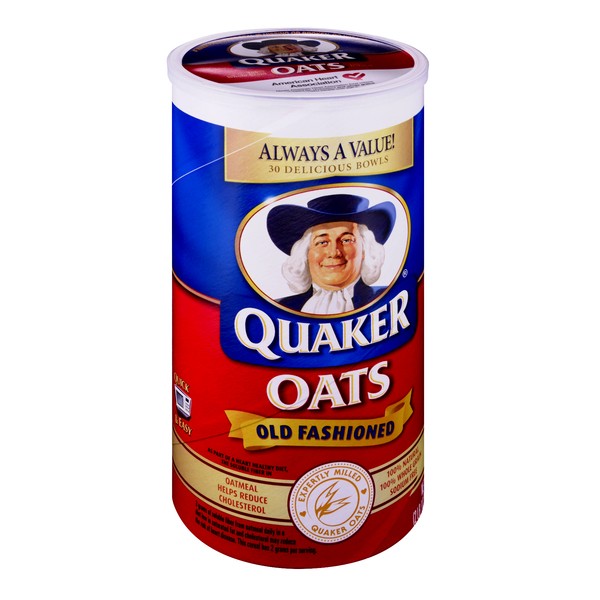
At first, I bought my oats in tins like this. The price was reasonable, and it lasted much longer than a box of cereal. But then I started shopping at a whole food store, and I realized that oats were much cheaper if you buy them by the pound. Some stuff you don’t want to buy that way, but oats are oats, so it really doesn’t make much of a difference where you buy them. So I switched.

Fast forward to 2013. While browsing through the grocery store looking for ways to cut my food expenses, I found one of these:

A fifty pound bag of anything is prone to give you sticker shock, but when I calculated the price per pound, I realized that the value was almost twice as good as the stuff I was buying at the whole food store. And since I had completely switched to oatmeal by this point, I knew that I would eat it.

I stood there and thought about it, checked the price again and thought some more. Then I threw caution to the winds and loaded the 50 lb bag into my cart.

The great thing about oats is that if you store them right, they will keep for decades. When food goes bad, it’s usually because something else (mold, fungus, bugs, etc) is eating it. That’s all mold is: a really disgusting organism that’s eating your food while it sits there in the fridge. In order to live, these organisms need water and/or oxygen. Since rolled oats are a dry food, if you store them in a sealed container without any oxygen in it, you can keep out the mold and the bugs practically forever.

After I hauled this giant cement-bag sized thing of oats to my third floor apartment, I realized very quickly that I needed to figure out a way to store it. Fortunately, my dad knew exactly what to do. He told me to get some dry ice, put a 1 lb. chunk of it in the bottom of a lidded bucket, and fill up the bucket with oats. Dry ice is carbon dioxide in a solid form, which sublimates (turns to gas) at room temperature. Since carbon dioxide is denser than oxygen, as the ice sublimates it will fill up the bucket from the bottom up, pushing out all of the oxygen. Put the lid on the bucket but leave it partially open, to allow the gas to escape. When you can seal the lid without the bucket starting to bulge, that means the ice has all sublimated and the bucket is ready for long-term storage.

So that’s what I did. I bought a bunch of cheap 3-gallon empty ice cream containers from the BYU Creamery, a small local grocery store owned and operated by BYU. They sell the buckets for $.50 each, so I got five and sealed up four of them after removing the oxygen with the dry ice. I then took the internet for more oatmeal recipes and came across The Oatmeal Artist, where I discovered all sorts of great recipes. Who knew you could do so much with oats?

That was how I got started with food storage. Though I have to backtrack again in order to explain.

I grew up in a devout Mormon household, where we practiced our religion as faithfully as we could. One of those principles is food storage. The idea is that in order to best help others, you first have to help yourself. Self-reliance enables you to provide for yourself and others through times of hardship and trial. By keeping this principle, the Mormon pioneers were able to thrive in a desert wilderness more than a thousand miles from civilization.

Food storage is an important component of self-reliance, not only for the major emergencies like the zombie apocalypse, but for the personal emergencies like declining book sales and a stalled career. If you only buy your food one or two weeks in advance, you’re living hand-to-mouth—literally. If you can learn how to store some of that food long-term, then even if your income streams dry up, you know that you’re still going to eat.

The #1 principle of food storage, though, is to eat what you store and store what you eat. These days, it’s pretty typical in a faithful Mormon household to have a couple buckets of rancid wheat in the basement that no one has opened in decades. We keep food storage because our religion teaches us to, but we don’t really know what to do with it because we never actually eat from it. The principle becomes just another empty practice—another rote tradition.

I knew right from the start that I didn’t want to do it that way. For one, I couldn’t afford to. But as I learned to store food that I actually liked to eat, I found that it reduced my food expenses significantly. Instead of buying oats every couple of weeks, I just gradually ate through what I already had. Since I ate oatmeal every day, and since buying in bulk cost roughly half as much as buying it by the pound, I came out ahead.

From oats, I expanded to other dry foods like rice and beans. Both of those are also easy to store long-term, and a 20 lb bag give you a significantly better value than the smaller bags (especially if you buy it on sale). I also expanded into wheat, which deserves a whole blog post of its own. And later on, I got a slow cooker to help with cooking the beans. If you’ve never cooked beans in a slow cooker, you don’t know what you’re missing. More on that in another post.

The best prices you will ever find for bulk dry goods is at an LDS Home Storage Center. It’s part of the religion, after all—many of the people who work there are volunteers doing missionary service. The last time I went there, it was $10.00 for a 25 lb. bag of oats—that’s only $.40 per pound. Beans, rice, wheat, and pasta is similarly cheap. Most of the Home Storage Centers are located in the western United States, but you can also order the products online. Or if you prefer, you can also find most of this stuff at your local grocery store.

Through food storage alone, I was able to cut my monthly food expenses by 25%. I also had the peace of mind of knowing that I would never have to starve for my art. Even if times get tough, I now have enough of a food security buffer to ride it out.

The Self-Sufficient Writer (Index)

The Self-Sufficient Writer: What I Learned by Leaving the Country

When I left the United States in 2012, I didn’t have self-reliance in mind. The plan was to break out of the cycle of poverty I’d been living in by starting a career teaching English overseas, bouncing around the world as a global nomad. If I landed a good paying ESL job somewhere like the Persian Gulf, I could come back to the States with a couple hundred thousand dollars and not have to worry about money for a long, long time. And even if I didn’t, I’d still get to see the world.

As a side note, there are quite a few people who do exactly that. While I was overseas, I met a lot of ex-pats who haven’t been back to their home country in years, traveling the world as global nomads picking up jobs wherever they can. While ESL can be something of a dead-end if it’s the only thing you pursue, there are tons of opportunities all over the world to teach English. In a lot of places, all you have to do to find work is show up.

After researching my options, I decided to volunteer with the Teach and Learn with Georgia program. The TLG program was set up by the Ministry of Education of the Republic of Georgia (formerly part of the Soviet Union) to put a native English speaker in every school in the country. I didn’t speak Georgian at all and I didn’t know anything about the country or the people, but they would take just about anybody and pay for my plane tickets up front. After getting a year of ESL experience, I could get a free ticket basically anywhere in the world—exactly the kind of launching pad that I’d been looking for.

That was the plan anyway. Like most plans, however, it fell apart and turned into something completely different. Instead of launching an ESL career, I learned that I really had no interest teaching English. I did, however, learn quite a lot about self-sufficiency.

Georgia is an interesting country. It’s got a population of about 5 million, with a little over a million people living in the capital and largest city, Tbilisi. The rest are basically scattered across the countryside in towns and villages. Kutais is the second largest city, but it’s really just a very big village with a quaint European town in the center. Yes, people live in fifty year-old communist-era apartments (“Krushchevkas”), but they still kept chickens and livestock in the yard, and usually had a grandparent or two still living in one of the outlying villages who tended to the family land.

For five months, I lived in the Avtokarkhana district in Kutaisi with a local family. After the summer, I spent another four months in Rokhi, a small village between Kutaisi and Vani, at a farmhouse owned by the math teacher at the village school.

I learned a lot of unexpected lessons from my time in Georgia, many of which I’m still parsing through. The two biggest ones that set me on a course of self-sufficiency are this:

Lesson 1: What a collapsed society looks like.

Contemporary Georgia is not a collapsed society. They’re actually growing pretty well, with a large influx of foreign investment and all sorts of recent improvements (including a new police force that makes it one of the safest countries to visit in all of Europe). But in the nineties, the country suffered a major socio-economic collapse, resulting in a civil war and the secession of three separatist regions: Adjara, Abkhazia, and South Ossetia.

All around me, I saw signs of that collapse. Most of the basic infrastructure was built during the communist era, and most of it was dilapidated or barely functional. In Kutaisi, we saved our plastic water bottles and kept them full for times when the water went out (which happened frequently in the summer). In the village, power outages happened almost daily, sometimes forcing me to go to bed at 7:00 pm just because it was too dark to do anything else.

Of course, there was a lot that had survived the collapse. In some places, people probably hardly noticed that a collapse had happened at all. A collapse does not hit all people equally, and there’s a very big difference between the collapse itself and people’s experience of it. The old women who grew up under communism had mostly fond memories of that time and wished that they could return to it. Everyone else’s attitude toward that was basically “hell, no!”

When I came back to the United States, something very strange and disturbing happened. I started to notice ways in which our own society is starting to slide toward the same state of collapse that the people in Georgia are currently pulling themselves out of. Our infrastructure is not as dilapidated as Georgia’s, but give it another ten years and it will be. In some sectors, most notably the state-run sectors like Amtrak, it already is.

We may have won the Cold War, but that doesn’t prove that our socio-economic system works. All it proved was that the Soviets collapsed faster. Our modern American society is not immune from collapse.

Lesson 2: What a home economy looks like.

According to the Merriam-Webster dictionary, an economy is “the process or system by which goods and services are produced, sold, and bought in a country or region.” A home economy, then, is the system by which goods and services are produced, sold, and bought within the home. If your home does not produce anything, you do not have a home economy.

As a volunteer, I received a 500 GEL (approximately $300) stipend each month from the Ministry of Education. This was actually more than the base salary for most Georgian school teachers at the time. Georgia is a poor country, but living expenses are certainly much higher than $300 a month—especially for a family. How, then, did school teachers manage to get by?

They had a home economy.

This was especially true in the village. We kept chickens, cows, sheep, and pigs, made our own cheese, grew our own grapes, made our own wine, etc etc. We had our own well, kept a large garden, went hunting when the weather was good, and baked most of our own bread. More than half of what we ate was easily produced right there on our own farm. And because we had a couple of fairly large vineyard, when grapes were in season, we loaded up the back of a truck and sold them at the market in Kutaisi.

For someone who grew up in a middle-class American suburb, this was absolutely fascinating. Most people here in the States do not have a home economy because they do not produce anything. They do not keep a garden, grow their own food, or do much of anything else that would be useful if the US dollar were suddenly to collapse. The only way most people can support themselves is to earn an income outside of the home—that, or go into debt. For almost half of the US population, an unexpected $400 expense would force them to either beg, borrow, or steal.

I have no idea what the personal finances looked like for the family I stayed with, but I know that if all of the outside income dried up, we would still have food on the table. Why? Because we grew it. We grew a lot of it, in fact—enough that we could probably barter for what we didn’t grow. It was hard work living that sort of lifestyle, but it brings a sense of security—real security—that you cannot get in any other way.

More than anything else I saw or experienced, this self-sufficient lifestyle had the greatest impact on me. By the time I was ready to come home, I was already thinking about how I would implement it in my own life. I had learned that true economic security comes not from the government, your job, or society at large, but from living in such a way that you can provide for your own needs and wants—from living a self-sufficient lifestyle. And that’s what I set out to do.

The Self-Sufficient Writer (Index)

The Self-Sufficient Writer: How I Got Started

One of the best things my father ever did for me was tell me that when I graduated from college, I was on my own. No more rent money or financial support from my parents—I had to become financially independent, and I had to do it soon.

I had a rather unusual college experience. I went to BYU, one of the most affordable colleges in the United States, and I had a full-ride scholarship for all four years. In addition, I started at 21, so that I qualified for the Pell Grant my junior year. Because I was studying Arabic, I also received the Smart Grant. And as if that weren’t enough, I worked an on-campus job for seven out of eight semesters while I was there. My parents paid for my rent probably just because it was the only expense left that they could help with.

All of those scholarships, grants, and jobs allowed me to graduate 100% debt free, which was extremely helpful later on. But the truth was, as a college student, I knew almost nothing about money. I didn’t know much about the world outside of academia either, since that was where I spent all my time. Even the jobs that I worked were all on-campus jobs that only put me at 20 hours per week, doing stuff that didn’t feel all that different from school. So when I graduated in 2010, I was in for a really big shock.

I graduated in the middle of the so-called “jobless recovery,” which was basically a euphemism for “the worst economic collapse in a generation, but hey it’s getting better, right? Right??” Things weren’t nearly as bad in the US as they were (and to a large part, still are) in places like Europe, but still, it was pretty hard. At the height of the recession, a job ad on KSL (the Utah equivalent of Craigslist) would get hundreds of applications in the first 24 hours, never mind how horrible the job was. People were desperate for some kind of income, and so was I.

Fortunately, I had enough time to see this coming. In 2009, I started keeping a daily budget in order to track my expenses and learn how to manage my money. At first, I used the same spreadsheet template that my father uses, but I soon figured out that that wasn’t going to cut it. So I started from the basics, dividing wants from needs, and made separate categories for things like food, rent, health, transportation, etc. I learned very quickly that I was spending too much on food, so I subdivided that into groceries and eating out. It took a while to organize my personal finances to a place where I felt I had a handle on it, but by the time I graduated, I was pretty much on top of it.

A lot of my peers were (and to a large extent, still are) moving back in with their parents after they graduated. I decided early on that I wasn’t going to do that. First of all, my father told me that if I was going to move in with them, I would have to pay rent. I’m sure that if things were really tough, they would have waived that requirement long enough to let me get on my feet, but the arrangement would not have made anyone happy. Second, all of the people I knew—and therefore, all of my best opportunities for getting on my feet—were in Utah, not in Massachusetts.

Now, a little bit of background. I was raised in a devout Mormon household, where we were all taught about the importance of self-reliance and emergency preparedness. Growing up, we had a modest food storage, and we even ground our own wheat to make bread (the most delicious bread you will ever eat is always homemade!). That said, I had never really connected any of that with my own situation. In college, I figured that I wouldn’t worry about stuff like that until I was comfortably established in my own home.

But then, things got tough. I went from working in a call center to taking temp jobs while looking for other employment. Then the temp jobs dried up, and I had to scramble for paying gigs on Craigslist. At the lowest point, I was distributing phone books from the trunk of my car just to earn enough to eat (it’s a decent paying gig if you have a pickup truck and four or five kids (ie slave labor) to do it quickly, but if you’re just one guy with a beat-up Buick, forget it). Money was drying up fast, and I didn’t know what to do.

I learned a lot from the experience, though. Probably the most important thing I learned was that 90% of the time, “security” is just an illusion. If you think you’re secure because you have a job that gives you a reliable paycheck, think again. Markets change, and your company could go down at any time, taking your job with it. That was a lesson we all learned the hard way back in the Great Recession. And if you think the government is there to help you, think again. In a lot of ways, the government only made the recession worse.

I realized very quickly that the only security I could ever hope to have was the security that I provided for myself. In other words, if I didn’t learn self-reliance, I would never have any control over my future. I wanted control—I craved it. I found myself trapped in a system where I had to trade time, one of the most limited and valuable resources, for money. No matter how much (or how little) value I created, I was still paid the same for it. It was a soul-sucking system, and I wanted out of it.

It was around this time that I started self-publishing. I saw the opportunity to take control of my own career and leaped at it. But I was still scraping by on only four figures a year, and while that’s not as bad as it sounds when you’re a healthy single man with no debts and no dependents, it was still pretty tough. With my books barely selling a dozen copies each month in that first year, I knew I couldn’t keep it up for long.

So I ran away—literally. I left the country and decided to start over.

The Self-Sufficient Writer (Index)


The Self-Sufficient Writer: Introduction

Before I graduated from college five years ago, I decided that I was going to pursue writing as a full-time career. That was my dream: to make a living telling stories that I love.

It’s been a crazy ride so far, and I don’t doubt that it’s only going to get crazier. For the better part of a year now, I’ve managed to live that dream, but a changing book market combined with a shift to writing longer books has made for rocky times ahead. That’s just the way things go when you’re self-employed: you never know how much you’re going to make each year, or when your income streams are going to dry up unexpectedly.

As a career writer, there are a lot of other economic challenges I expect to face. Health insurance, for example: the current system here in the US is completely slanted against self-employed people, especially those who don’t want to be totally dependent on the government. Without a steady paycheck, I also expect that I won’t be able to get a traditional mortgage. And self-employment taxes… don’t even get me started.

Point is, it’s tough to make a living as a career writer—and that’s without taking into account how anyone actually makes any money at it. It’s an oft repeated truth in the entertainment industry that no one knows anything, and that’s true of books more than any other segment. No one knows why some books flop and others take off, which can be really frustrating when your ability to make a living depends on that.

Fortunately, there are two sides to the “make a living” equation. It’s not just about building your income streams, it’s also about reducing your expenses. So long as the money flowing in is greater than or equal to the money flowing out, you’re in the black.

Over the past five years, I’ve come to realize that the best security I can ever hope to have comes from learning to live a self-sufficient lifestyle. That means learning how to make, store, and ideally grow my own food, how to fix, reuse, or re-purpose things that are old or broken, and how to DIY as much as reasonably possible. Basically, I’ve learned how to be something of an urban homesteader, insulating myself from economic shocks through developing the skills of self-sufficiency.

It’s been an ongoing process, and I still have a lot to learn. At the same time, though, I’ve managed to cut my expenses fairly significantly, living on just four-figures with little or no debt and still managing to put aside a little each month into savings. I’ve also learned how to eat really well on food that I’ve grown myself, which beats anything you can buy in the store. So while I’m not yet an expert, I do think I’ve learned a few things that are worth sharing.

Over the next couple of months, I plan to write a few blog posts where I share my experiences and explain what I’ve learned. If you’re an aspiring writer like I was five years ago and you want to learn how to make it, or if you’re just someone who’s interested in becoming more self-sufficient in general, I hope you’ll find this blog series interesting and informative. And if you’re already an enthusiast for self-reliant lifestyles, feel free to stick around and share your own experiences! I’m definitely interested in hearing what you guys have to say.

The Self-Sufficient Writer (Index)

#WIP excerpts: THE SWORD KEEPER, chapter 2.1

I really like this excerpt. I wrote it while I was living in a farmhouse in rural Georgia (the country, not the state). A lot of the stuff from this scene was pulled directly from my own experience. We had chickens, cows, pigs, sheep (dumbest animals I’ve ever seen!), and grew grapes, pomegranates, persimmons, and a whole bunch of other stuff. It was pretty awesome.

In the late summer, the hens had chicks. At first, there were about twenty little fuzzballs following each hen, but as the chicks got bigger, their numbers became fewer and fewer. Then, just as the winter snows started to hit, a wolf came down from the mountains and ate one of the mother hens. Only one of her chicks survived—the smallest of the brood. He almost didn’t make it, but I went out the way to take special care of him, and he survived.

So yeah, this section is pulled almost directly from my own experience. Nika is the kind of gentle boy who would do exactly that sort of thing, and that carries over into his friendship with Tamuna.

====================

“Hey! Where do you think you’re going?”

Nika stopped at the farmhouse gate and sheepishly turned to face his father. “To the tavern,” he muttered, hoping that was an acceptable response.

“Why, son? The tavern’s closed.”

“Sopiko said she still needs me.” And Tamuna’s been sick all day.

His father jabbed the pitchfork into the ground and cursed. “That damn woman had better be paying you for this. Have you had your supper yet?”

“No, sir, I—”

“Good. Eat it there.” He turned to the yard, where Nika’s two older brothers had paused in their work. “Giga! Lasha! What are you doing standing around? Get back to stacking those cornstalks!”

“Yes, sir.”

“Remember, who doesn’t work, doesn’t eat!”

Nika took that as his cue to leave. He slipped out the gate and pulled it shut before dashing across the dusty lane and into the fallow field across the farmhouse. The tall grass brushed against his legs, ticking his skin through the holes in his pants, but he kept running until he was well out of his father’s sight. Only then did he slow down enough to catch his breath.

Tamuna had been sick all day, so sick that Sopiko had closed down the tavern, which she never, ever did. When he’d arrived in the morning, the door had been locked—only after knocking for several minutes had Sopiko finally opened it.

“You’d better come back later,” Sopiko had told him when he’d come around back. “Tamuna’s taken ill, and we’ve closed down the tavern until she comes around again.”

“She has?” Nika had asked, his stomach falling. “What do you mean? Is she going to be all right? What happened?”

“We don’t know. We found her passed out on the floor in the private room, and she hasn’t woken up since. Come back this evening—we may need you then.”

Nika had wanted to ask more, but Sopiko had pressed a few coppers into his hand and sent him on his way home. His father had thrown the money angrily against the wall, and probably would have beaten him, except that his mother had intervened. He was a harsh man, and as the youngest, Nika wasn’t his favorite. Sometimes, Nika wondered if his father cared about him at all.

Thoughts like these always made him feel dark and oppressed, as if he carried a heavy weight on his shoulders. But the cool autumn breeze and the splash of gold across the evening sky soon lightened his spirits. A rooster crowed somewhere in the distance, and the sound of cows mooing in the thicket made him smile. Old Tom’s cow had had a calf just a few days ago, and he’d been there to see the birth. It was amazing, how the little ones could walk almost from the moment they left the womb. He always loved the way the mothers cared for their young—not just cows, but every animal.

Sometimes, when he wasn’t busy, he liked to sit in the shade of a tree and watch the mother hens roam the yard with their brood. While the little chicks pecked and played, the mothers always stood watch over them, chasing away anyone who dared come close. And in the evening, while the other chickens flew into the trees to roost, the mother would stay on the ground and gather all her chicks under her wings, keeping them safe throughout the night.

Of course, there was always a straggler who was smaller than all the others, who didn’t get to the food as fast, or couldn’t keep up with the rest. Nika’s heart always went out to them—he knew that the mother hen wanted to help, but with so many other chicks to look after, there wasn’t much she could do. He would often take the straggler aside and hand-fed him to make sure he grew up strong. It didn’t always work, but sometimes, it was enough to save them.

The footpath through the field opened up to the wide lane that led from the village to the mountains just beyond. He passed a few cows and a small clutch of geese, who moved to the other side of the road as he walked past. He stepped quickly, almost running even though the tavern wasn’t far and there was still a good hour of daylight left. If Tamuna was still sick, that would be very bad. He wished there was something he could do for her.

She had a habit of coming to him, after her chores were all done and she had a chance to talk. He often stayed in the stables late into the night just to hear from her. In a lot of ways, she was a straggler just like him. She didn’t have any older brothers or sisters to push her around, but she didn’t have a lot of friends either. Everyone in the village still saw her as an outsider, including her own aunt. Just as the mother hens knew the difference between their chicks and the ones that didn’t truly belong to them, Sopiko knew that Tamuna wasn’t her true daughter. It showed in the stern way she often treated her, though Tamuna would never believe it, no matter how much he tried to point it out to her. When she needed someone to talk to, though, he was always there. Life was tough without a friend to confide in—he knew that all too well.

When he arrived at the tavern, the CLOSED sign hung on the front door, but a strange commotion seemed to be coming from inside. Nika frowned as he opened the gate and walked over to the stables. To his surprise, he found them almost completely full—not with the short, gray-haired Kartlis that were so common in the Kevonas, but mighty Arbuli war horses. They whinnied and stomped their hooves as he entered, clearly not used to being confined.

“There, there,” he said, picking up his brush. “It’s all right, it’s all right.” He glanced over his shoulder at the house—something was clearly happening over there, but much as he wanted to see what it was, he knew he’d be chided for lapsing in his chores. Still…

Tamuna is in there, he told himself as he returned the brush to its hook on the wall. I have to make sure she’s all right.

$.99 sale for TALES OF THE FAR OUTWORLDS

SW V-VIII (thumb)Hi guys! Just a quick announcement that Star Wanderers: Tales of the Far Outworlds (Omnibus V-VIII) is on a special $.99 for the week!

While this omnibus contains the last four parts of the series, they stand on their own a little bit better and can be read independently of the first four. My favorite book is probably Deliverance (Part VIII), which was a lot of fun to write. Also, Dreamweaver (Part V) is basically a retelling of Outworlder (Part I), but from Noemi’s point of view.

I’m also running a Goodreads giveaway for the print edition, which came out just a couple of months ago. The giveaway ends when the sale ends, at the end of the week. To enter the giveaway, click here.

In the meantime, you can pick up the ebook edition of Tales of the Far Outworlds basically everywhere for $.99 until Sunday. So check it out!

Nothing Found

#WIP excerpts: THE SWORD KEEPER, chapter 1.1

I thought it might be fun to post an excerpt every week or so from my current WIP. It’s been a few months since I published anything, and I figure this would be a good way to keep in touch and let you guys know what I’m up to.

The big project I’m working on right now, and the one that I hope to finish by the end of April, is an epic fantasy novel titled The Sword Keeper. It’s the first part of what will eventually become The Twelfth Sword Trilogy. The basic premise is that there’s an ancient brotherhood of enchanted swords that bond telepathically to their bearers and pass on knowledge, skills, memories, and experiences. Over hundreds of years, these swords and their bearers become so powerful, they are able to unite most of the world in peace under a benevolent empire. But then the swords go insane, the empire falls into civil war, and SHTF, so to speak.

That was all a thousand years ago. The twelfth sword, recognizing what was happening, went dormant and refused to take a new bearer. Its last bearer formed a secret order of monks to keep the sword safely hidden, carrying it from place to place until it finds the one who fulfills the prophecy to become the last sword bearer. According to the prophecy, the last sword bearer will rise in a day when darkness sweeps the land and save the world from an enemy who seeks to enslave all mankind.

So yeah, pretty standard for epic fantasy. Instead of a farmboy, though, the heroine of the trilogy is a young tavern girl. Here’s the opening scene of the first chapter.

(SIDE NOTE: Since this is a WIP, it might need some editing or have some other issues that need work. Also, this scene might turn out substantially different in the final published version from its current form. Still, I thought it would be fun to post it. Let me know what you think!)

====================

The candles were lit and the tables had already been served when the mysterious traveler arrived from the west. Tamuna was tending the bar as the clatter of hooves on the old stone road announced his arrival. She paused in her work to peer out the tavern window, but the sky had already faded, blending the leaves with the shadows.

“Better put another spit on the fire,” Aunt Sopiko said as she came back from serving the tables. “When that’s done, see to the room upstairs.”

“Yes, ma’am,” said Tamuna. She ran to the kitchen, hoping to finish her chores in time to catch a glimpse of the unexpected guest. The harvest season had just ended, and the villagers had already put away their corn and grain for the winter. Occasionally, a herder would come down from the mountains, but only during the day—never at night.

The tavern was one of the last places for room and board before the Kevona Mountains. In the spring, travelers from the south and west sometime came down from the mountain passes in the waning twilight. Tamuna loved to hear their stories of faraway lands and peoples, and often stayed up into the early hours of the morning listening spellbound to them. But this late in the season, it was rare for travelers to come down from the mountain pass. Perhaps, then, it was someone from the east on their way to Khevsura or Aramand? But why would they stop at a village tavern when they could sleep in comfort at Kutaisa?

As she stoked the cooking fire, the door to the yard swung open, and Nika the stable boy came in carrying a bucket of water from the well. His curly brown hair spilled out beneath his woolen skullcap, and his boots were covered in mud.

“Hi Tamuna,” he said, setting the bucket on the table with both hands. “Thought you might need this.”

“Thanks,” she said, smiling in gratitude. “Any news from the village?”

“Old Tom’s cow gave birth to a beautiful little calf. He’ll probably sell her in the spring—the calf, not the cow.”

“Of course.”

“Anyway, she’s a gorgeous animal. I really wish I could save up and buy it. Do you think your aunt could… well…”

Tamuna drew in a long breath. She knew what Nika was asking, but Aunt Sopiko was far too miserly to ever agree to such a request. If Tamuna asked her to raise Nika’s pay by even a few meager coppers, she’d probably be whipped for it. But Nika couldn’t save very much either, since his family took almost everything he earned from his job at the tavern. They needed the money as badly as they needed a cow.

“I’ll do what I can,” she said softly. Then, putting a hand on his arm, “maybe we can save up enough together.”

His face brightened. “You really think so?”

“Sure. And with all the eggs the chickens are laying, maybe Sopiko will let us sell some at the Kutaisa market.”

“Oh, Tamuna!”

Nika threw his arms around her, kissing her enthusiastically on the cheek. He still smelled like dirty hay and horse manure, though, so she squealed and pushed him away.

“By the seven rivers, Nika, haven’t you had a chance to wash up yet? You smell like you’ve been bathing with the pigs!”

“Sorry,” he said, grinning sheepishly.

“Well, what are you still here for? Go and wash up already!”

She shooed out of the kitchen, but just as he turned to leave, she remembered the traveler.

“Wait—did you see the man who just came in?”

He frowned. “Who?”

“The traveler who rode in not fifteen minutes ago. When I’m finished here, I—”

“Oh my gods!” said Nika, his eyes widening like saucers. “I wasn’t in the stable when—sorry, gotta run!” Without another word, he dashed out the door and disappeared into the deepening twilight.

Tamuna put her hands on her hips and sighed. Nika was a good boy, and without a doubt her most loyal friend, but he had a way of missing what was right before his face. As she glanced down at all the mud he’d tracked in, she couldn’t help but shake her head.

The door to the main room swung open, and Aunt Sopiko came in with a stern look on her face. “What was that?” she asked. “Were you chatting with Nika instead of doing your work?”

“No, ma’am,” Tamuna said quickly. “That is, I—”

“Well, no more distractions. Our guest wants to take his dinner upstairs, so go up and fix the room double quick—no dallying.”

“Yes, ma’am,” Tamuna said dutifully. She hurried out of the kitchen, her cheeks reddening at her aunt’s rebuke. How foolish of her to let herself get distracted so easily, especially when there was work to be done. She would have to do her best to make sure that Sopiko wasn’t disappointed in her.

From the hallway closet, she pulled out a thick woolen blanket and linen bed sheets. A half-burned candle waited on the ledge by the base of the stairway. The old wooden stairs creaked all the way to the top, and the light from her flickering candle made shadows dance along the walls. She paused for a moment to light the lamp at the head of the stairway, then opened the door to the private room and set the candle on a ledge near the doorway. Outside, the cool autumn wind blew hard against the window, whistling through the gaps in the panes and making the wall groan and creak.

I’ll have to light a fire before I leave, she thought to herself as she made the bed. The chill air made her shiver a little, so she worked quickly, wishing that she’d brought a shawl. Fortunately, it didn’t take her long. She’d readied the private room more than a hundred times, and knew exactly what needed to be done. Soon, she was engrossed her work—so engrossed that when she turned to start the fire, she was surprised to find the guest standing in the doorway.

“Oh!” she said, taking a quick step back. “I’m sorry, sir, I didn’t know you were coming. If you want, I’ll—”

“That’s all right,” said man, laying down down a heavy rucksack in the corner. He was old, probably in his fifties, with silver-gray hair and a well-trimmed beard. Even so, he stood very tall, with a broad chest and muscular arms and shoulders. His brow was deeply furrowed, his jawline sharp, yet his eyes exuded a thoughtful kindness that put Tamuna at ease almost immediately.

“Here,” she said as he slipped off his heavy woolen cloak. “Let me help you with that.” He turned and let her pull it off his shoulders, revealing a simple white tunic underneath. A gold embroidered cross took up most of the back of the garment, but other than that, his clothing bore no ornamentation.

“Are you a monk?” she asked, her curiosity getting the better of her.

“I am,” said the man. He knelt over the rucksack and pulled out a sword, sheathed in a dull black scabbard. With great care bordering on reverence, he laid it on the wooden table.

Something about the sword drew Tamuna’s gaze. The hilt was made of steel and burnished with what appeared to be silver, though it was difficult to make out in the dim candlelight. Intricate carvings appeared to tell a story, one that she very much wanted to hear. The handle was long and straight, designed for two hands, with a dark leather cord wrapped tightly around it for the grip. At the pommel, a single emerald jewel glowed in the mouth of a dragon, pulsating in the flickering candlelight.

Something about the sword almost seemed to call out to her. Tamuna blinked and shook her mind clear, turning to the traveler who had stooped down to start the fire. She was about to offer help, but his body language told her that he would rather be left to himself.

“Let us know if you need anything,” she said on her way out. The man grunted his assent, and she shut the door quietly behind her, sneaking one last glance at him and the sword.

Back in the kitchen, Sopiko was cutting bread and stacking it on the tray for the stranger. A kebab sizzled over the fire, while the pot of beans bubbled by the edge. Tamuna opened the cabinet and pulled out a small plate of cheese, cutting off generous slices onto the tray.

“Did the traveler say where he’s from?” she asked.

Sopiko shook her head. “No, he didn’t say a word about that. Just asked the price of a room and where he should leave his horse.”

“Did you see the markings on his tunic? I don’t think he’s from around here. Maybe even—”

“Best not to pry,” said Sopiko. She finished with the bread and turned to the spit over the fire.

Tamuna bit her lip, but went on preparing the food without asking again. She could tell from Sopiko’s tone of voice that any more questions would not be tolerated. Her aunt wasn’t a harsh woman, but she could be stern, especially when it came to how she ran the tavern. Tamuna sometimes wondered if her mother had been like that: stern and domineering. She had no memory of her, having been taken from her home when she was just a little girl. All that she had of her were stories.

As she finished with the cheese and spooned the beans into a clay bowl, her mind drifted back to the sword on the table. She didn’t know why, but something about it still seemed to call out to her. The more she tried to clear her head, the more it seemed that the feeling would not go away.

“Here,” said her aunt, taking the spit off of the fire and putting it onto the tray with the rest of the food. “Take this to our guest upstairs, but don’t linger too long.”

“Yes, ma’am.”

“I mean it, Tamuna. I know how you like to stay and chat every time we put up a traveler, but this time,” she made a cutting motion across her neck with her hand. “Understand?”

“Yes, Aunt Sopiko. I won’t disturb him.”

“Good. Now see to your work, and be quick about it.”

He must be a very important man for her to say that, Tamuna thought to herself as she climbed the stairs with the tray. Usually, her aunt had no qualm with her listening to the stories of their guests. Through them, she’d heard all sorts of fascinating things about the world outside the village—of the vast rocky deserts to the south, with ancient ruins buried beneath the sifting sands, or the warrior kingdoms on the grassy plains beyond the western sea. But lately, it was the people of the north that everyone seemed to be talking about. Some travelers warned that the northern armies were moving toward the Kevonas, while others claimed that they were just fighting among each other. Perhaps their new guest was an envoy, or an advisor to a king—or perhaps he was the leader of a band of warrior monks, preparing himself to take part in a holy war.

All these thoughts raced through her mind as she walked down the hallway and knocked on the door to the private room.

“Sir,” she called, holding the tray against her hip. “I have your dinner, sir. May I come in?”

No answer.

She waited for a moment, then knocked again. “Uh, sir, are you there? I’ve brought your dinner.”

Again, no answer.

He’s probably just gone to the outhouse, she thought to herself. The tray weighed heavily on her arms, so she nudged the door open with her toe and stepped in.

Sure enough, the room was empty. A newly lit fire blazed in the fireplace, while the man’s cloak and rucksack lay exactly as he’d left them. She carefully set down the tray of hot food, noticing the sword that still lay on the other side of the table.

Something about the sight of it rooted her to the spot. She knew that she should return to the kitchen to help out her aunt with the chores, but all she could do was stare at the dull, black scabbard and the old, faded hilt. The blazing light of the fire made the emerald on the pommell glisten and shimmer in a way that it hadn’t before. She almost felt as if the dragon’s eyes were watching her.

I should go, she told herself, lifting her dress as if to tiptoe out of the room. Instead, her feet seemed to move of their own accord, taking her closer to the sword. One of the floorboards creaked, and she froze, glancing hurriedly at the door, but the hallway was empty—she was alone.

Aunt Sopiko is going to kill me if she finds out what I’m doing, she thought anxiously. Every part of her screamed to leave the room before someone discovered her, but something else told her not to be afraid—that she was on the right path, and that this was her destiny. She felt as if she stood on the edge of a tall cliff, with a perilous drop before her and nothing but wilderness behind. Or perhaps it felt more like a crossroads, where the path she chose now would determine the course of the rest of her life. She hesitated, an inexplicable fear threatening to overwhelm her, but an even greater curiosity drove her forward—the same curiosity that had seized her from the moment she’d heard the clatter of hooves on the stone-paved road outside the tavern.

She felt a slight tremor, like the churning of the air immediately around a fire. It made her stop and pull back, uncertain. What if the sword is magic? she wondered. What if it’s cursed? But it was too late to stop now. She took a deep breath and touched the cold metal of the hilt.

A tremendous shock surged through her, from the top of her head to her outermost toes. She gasped for air as her legs gave out beneath her. It felt as if every muscle in her body had turned to water, and she was melting all over the floor. She swooned, and her last conscious thought before falling to the floor was that her aunt was going to skin her alive.

Thoughts on Clean Reader

cleanreaderIn case you haven’t heard, there’s a new app in the book world that is stirring up quite a bit of controversy. It’s called Clean Reader and it basically goes through an ebook and filters out the profanity, with settings for “clean,” “cleaner,” and “squeaky clean.” It was designed by the parents of a teenager who expressed dismay at finding profanity in an otherwise clean book.

The response from authors has been vociferous. Chuck Wendig (WARNING: Chuck uses so much profanity, he probably deserves a Clean Reader filter setting of his own) predictably came down hard against it, as well as Joanne Harris, the author of Chocolat. Over on KBoards, there’s an ongoing thread of indie authors slamming it as a denial of artistic expression, as a copyright violation, as malicious censorship—basically, the whole gamut. Interestingly, though, Cory Doctorow came out in defense of it.

Personally, this app reminds me a lot of CleanFlicks, a movie rental place here in Utah that edited out objectionable content such as sex, violence, and profanity. I watched the edited version of Zombieland while I was in college, and while I enjoyed it, it was… short. CleanFlicks did a lot of business, right up until the US Supreme Court shut it down.

While I can see why some writers would hate this app, I actually sympathize more with the readers. Living in Utah, I know a lot of people (some of them in my own family—hi Kate!) who are exactly the kind of people for whom Clean Reader was made. And much like Cory Doctorow, I think that their right to control their own reading experience trumps the writer’s right to freedom of expression.

The act of reading is fundamentally a collaborative experience. Until someone opens a book and reads it, that book is just symbols on a page, or bytes of data on a storage device. Meaning is only generated through the act of reading—in a very real sense, the story is created by the reader just as much as by the writer. As much as we writers like to think of ourselves as free to write whatever we want, without readers, that freedom counts for very little. And that’s exactly the way it should be.

A lot of writers are making fun of Clean Reader on the basis that the very premise is flawed—that filtering out profanity won’t do anything to clean a fundamentally dirty story. But while that’s true of some books, I do think there’s a middle ground where the app can give some value.

For example, my first novel Genesis Earth is a mostly clean science fiction adventure romance with a few tense moments where the characters use a mild level of profanity. As a writer, it didn’t feel right to have my characters say “darn” instead of “damn,” or “crap” instead of “shit.” Sanitizing the book on that level would have kicked most readers right out of the story. But if a reader who is sensitive to that use of language wants to read a filtered version of Genesis Earth, the story is not going to be fundamentally changed by filtering out those words.

Probably the biggest objection to Clean Reader is that it enforces or promotes a censorship regime that many writers find objectionable. Of course, most of the people who make that argument probably have no idea what “censorship” really entails, just like the people who throw out accusations like “socialist,” “sexist,” “racist,” etc. But putting that can of worms aside, is it right for people to use apps like this—say, parents of young children—to control what other people read?

I am a diehard libertarian, but I actually think that beneath a certain age, parents do have a right to censorship. As legal guardians of their children, parents have a right and a responsibility to raise them as they see fit. If you don’t allow parents to censor what their children are exposed to, then you’re basically saying that society as a whole should raise them, or (God forbid!) the government. I think that’s a horrible idea. Children should be raised by the people who are closest to them, and responsible parents/guardians should be free to raise their children as they (and only they) see fit.

So I’m actually rather supportive of the Clean Reader app. I personally wouldn’t use it, either for myself or for my children, but if other readers do then I have no objection to that. Writers should be free to write whatever they want, and readers should be free to read whatever they want, however they want to read it.