Fantasy from A to Z: Q is for Quests

What is your quest in life? What is your driving goal, the thing that gets you up in the morning? What do you hope to accomplish before you go the way of all the Earth and depart this mortal coil?

Quests are huge in fantasy literature, because they resonate so much with our own lives. Most of us are not just merely existing, drifting aimlessly from one life event to another—or, if we are, there is something deep within us that yearns for greater meaning and purpose in our lives. Quest stories give us that sense of meaning and purpose.

I asked Grok to define “quest” in the context of fantasy literature, and this is what it told me:

In fantasy literature, a quest is a narrative framework where a protagonist or group embarks on a challenging journey to achieve a specific goal, often involving adventure, trials, and personal growth.

Grok then gave me a list of five things that all quest stories typically include:

  • a clear objective,
  • a journey,
  • challenges and trials,
  • some kind of character transformation, and
  • some kind of symbolic meaning.

One of the best-known examples of this is Frodo’s quest in Tolkien’s Lord of the Rings, which is actually a subversion of the traditional quest story, because instead of seeking to acquire the object of the quest (in this case, the ring of power), Frodo is seeking to destroy it. 

The objective is to take the ring to Mount Doom and drop it into the lava, because that is the only place where it can be destroyed. 

The journey takes Frodo far from his home in the Shire, across nearly the whole length of Middle Earth to the desolate lands of Mordor, where the Dark Lord is gathering his forces. 

Frodo faces all sorts of challenges and trials, from the attack of the ringwraiths at Weathertop to the near-death experience with Shelob the spider. But perhaps the greatest challenge comes from the ring itself, which is constantly tempting him to submit to the Dark Lord’s will.

The story transforms Frodo so completely that by the end, he finds that he cannot return to his former life in the Shire. He leaves Middle Earth for the Grey Havens and sails with the last of the elves to the Undying Realms beyond the western sea.

As for symbolic meaning, the whole book is rife with it, from Gandalf as the Christ figure to the ring as a metaphor for the temptation of absolute power.

But what does an epic story like this have to do with us? How and why does a quest story like this one resonate so deeply with us? After all, very few of us have been attacked by giant spiders, or had a murderous experience with a ghost-like entity from beyond the veil. So why do we resonate with the idea of a quest? 

I can only speak to my own experience, but this is how my own life has resembled something of a quest:

My objective, ever since my college days, has been to make it as a professional fiction writer.

The journey has been more of an internal one than an external one, though I have traveled a bit for conventions and the like. I also spent a year teaching English overseas, not only to make ends meet, but to gain the sort of life experience that I thought would lead to better writing. In fact, I’ve taken a lot of odd jobs along the way, all of which have given me experiences that I’ve later drawn on.

As for challenges and trials, it’s been an extremely difficult road, because the vast majority of aspiring writers never manage to make a living at it. I’ve made just about every mistake that it’s possible to make (except writing porn—though some people would argue that not writing porn is the greater mistake). Overall, I can say that pursuing this writing career has been one of the most difficult things I’ve ever done in my life.

Has it transformed me? Yes, it has—and I know this because one of the major things that attracted me to my wife was my passion for writing, and the diligence with which I have pursued it. If I’d taken the path of least resistance instead of pursuing this difficult quest, I probably would have ended up as a morbidly overweight slob, addicted to porn and video games—in other words, the kind of person my wife would have never given a second glance.

As for symbolic meaning, I’ll say this: when my first child was born and I held her in my arms for the first time, I had the distinct impression that “this is her story now.” As a writer, I’ve pored over lots of writing advice, and one of the best pieces of advice I’ve received is to remember that every character is a hero in their own story. So when I had this powerful experience of holding my child for the first time, is it any surprise that one of the lessons I’d learned from my quest to become a professional writer helped me to understand the deeper meaning of that moment?

Those are some of the ways that quest stories resonate with me. I’m sure it will be different in your own life, but the main points are likely all there—which is why the quest story has become such a powerful archetype.

Of course, not all fantasy books involve a quest of some kind. In recent years, “cozy fantasy” has become something of a thing, where the story is less of a quest than a low stakes, slice-of-life sort of tale. Perhaps the most successful example of this is Travis Baldree’s Legend and Lattes.

Why do those stories resonate so much? Frankly, I think it’s because so many of my fellow Millennials feel like they have failed to launch. We came of age during the Great Recession and the Global Financial Collapse, saddled with way too much student loan debt. With all of the bankruptcies, mass layoffs, hiring freezes, and delayed retirements, many of us struggled to find meaningful work. As a consequence, many of us were forced to move back in with our parents and put off major life decisions like buying a home, getting married, and starting a family. Far too many of us have sadly put off those decisions indefinitely. And things haven’t gotten much better in the decades since. Indeed, our Boomer parents have the dubious distinction of being the only generation in American history to enjoy more prosperity than every generation before and since.

But I do think that is changing with the rising generation. There are a few key ways in which Zoomers are the diametric opposites of Millennials, and one of them has to do with this hunger for stories about quests. Just compare Epic: The Musical to Legends and Lattes. The contrast is stark. So as Zoomers come into their own, I think this subgenre of cozy fantasy is going to fade. It may stick around for a while, but I don’t think it’s going to be more than a tiny niche.

After all, what is your driving goal in life? What is your own personal quest?
What it’s like to write after a life interruption

Stage 0: Procrastination

I guess I should write… but first, I should check my email. Also, there’s a couple of publishing tasks I need to do. I’m also kind of hungry, come to think of it.

Wow, those publishing tasks took a lot longer than I thought they would. I could start writing now, but I’d only have half an hour, and what can I possibly get done in that time? Maybe I should just relax for a bit and play this addictive online game…

Stage 1: BIC HOC

All right, no more excuses. It’s butt in chair, hands on keyboard time!

What’s wrong with my chair? Did someone put a magnet in it? It seems like my butt gets repulsed every time I try to sit down in it. I can knock off a couple of paragraphs, but then I have to get up and pace for a while. Or do some chores. Or—

No! I’ve got to focus. But man, it feels like I’m pulling teeth. The words just aren’t coming. It’s been more than an hour, and how much have I written? Holy crap, that’s pathetic.

Well, it’s the end of the day, and I only managed a few hundred words, but that’s better than nothing I guess.

Stage 2: Progress

Is something different? It still feels like I’m pulling teeth, but my writing time is only half over and I’ve already passed a thousand words. Also, that last scene was kind of awesome. I could probably improve it in the next pass, but it turned out better than I thought it would.

I’m still way behind from where I need to be, and I have no idea if I’ll ever make my deadline, but I’m slowly making progress. Not bad. Let’s lie down for a while or go for a long walk and think about what happens next. This is actually turning out to be a pretty good story.

Stage 3: Acceleration

It’s getting late and I really should be doing other things, but I’ve got a great idea for this next scene and I just have to write it.

What’s that? My emails are piling up, and my to do list of publishing tasks has been neglected? Yeah, yeah, I’ll get around to that, but first I really have to knock out this scene. And what if I changed this one three chapters ago to foreshadow it? Then I would also have to change how that one character reacted when the big reveal happened on page 128, and…

Wow, that was incredibly invigorating! I feel like I’m reading this story for the first time. The words are really flying, but that actually doesn’t matter because this next chapter is the big one and I’ve got to focus on that. No time to count how many words I’ve written!

Stage 4: Peak Creativity

I can’t wait to wake up in the morning because the next chapter is going to be totally awesome. I spent my whole shift at the day job thinking about it, and it’s really going to tie the plot and thematic elements together.

What is this character thinking right now? What is it like to be in her shoes? Does this other character have any idea what she’s feeling right now? Is he too caught up in his own concerns? Where did those concerns come from? Obviously, they came from the difficulties in his childhood. Let’s take a few moments to work that out. What’s the story behind how this character came to be who he is today, and how does that impact everything else in the book?

All right, time to take a quick break and refill the creative well. What’s this? A mountainous stack of emails and publishing tasks? Let’s chip away at it for a while, and maybe write a blog post while we’re at it.

Enough for now. Back to writing!

Life Interruption

Oh crap. Time to go back to stage 0 again.

The Self-Sufficient Writer: Makers vs. Takers

There are two kinds of people in the world. No, not those who can count and those who can’t. No, not those with loaded guns and those who dig. Stay with me for a minute, because this is important. In fact, it may be the most important realization I’ve ever had.

We have a tendency to see the world in terms of haves and have-nots. This is because it’s so easy for us to see the difference. The haves tend to live in nice houses, drive nice cars, and have (hence the term “haves”) lots of nice stuff. The have-nots, on the other hand, tend to scrape the bottom of the barrel just to get by.

This distinction between haves and have-nots, while real and present, isn’t actually that useful. Why? Because it doesn’t get to the crux of the issue: it doesn’t explain why some people have and some people have-not.

Sometimes, a have-not is just a have going through a downturn or temporary setback. Sometimes, a have is just a have-not who won the jackpot and is spending himself back to poverty as fast as he can.

This doesn’t just apply to socioeconomics, by the way. A writer who “lacks talent” may just be the next Kevin J. Anderson writing his way through his first million words. A bestselling author may just be a one-hit wonder who hit the current zeitgeist in just the right way. This also applies to personal virtues and character traits: there are haves and have-nots of honesty, compassion, generosity, charisma, etc etc.

Ultimately, it doesn’t matter at any given moment who has and who has-not. What matters is what you—what anyone—chooses to do about it. And that’s where we get to the heart of the matter.

There are two kinds of people in this world: the makers and the takers. A maker, when presented with a narrow slice of the pie, immediately thinks “I should go make more pie,” while a taker grabs the knife and tries to re-slice everyone’s piece.

Makers recognize that there isn’t a fixed amount of wealth, or success, or happiness in the world. They don’t feel threatened by another person’s success because they know that it doesn’t take away from their own. They are confident in their ability to go out and create, knowing that their only limitation is their ability to innovate and solve problems.

Takers, on the other hand, are obsessed with fairness and equality. They view wealth as a finite resource that need to be redistributed in order for everyone to get their “fair share.” They are threatened by other people’s success and feel that it diminishes their own. This often leads them to sabotage their relationships, leading to things like gaslighting, manipulation, and abuse.

Makers believe in freedom; takers believe in control. Makers judge people by what they do; takers judge people by what they are. Makers pursue opportunity; takers try to shut other people out. Makers are pioneers and entrepreneurs; takers are parasites and thieves.

I’m deliberately oversimplifying this in order to show the two extremes. Of course, no one is 100% to one side or the other. There are areas in our lives where we are makers, and other areas where we are takers. Humans are complex variables that don’t fit neatly into any equation.

What isn’t gray is that making is a virtue and taking is a vice.

So what does this have to do with writing and self-sufficiency? In the age of indie publishing, just about everything.

The publishing industry today is full of both extremes. In the contract clauses of traditional publishing, we have some of the most eggregious rights grabs that have ever been penned. Non-competes, rights reversions, right of first refusal—it’s a minefield out there, littered with the bloody, dismembered limbs of broken dreams.

On the other end of the spectrum in indie publishing, there is a perfect confluence of opportunity for makers to do what they do best: make. In the indie world, you have no one but yourself to blame for your failures, but your successes are all your own. Yes, there are a lot of failures—but there are also a hell of a lot of successes.

In other words, publishing is the wild, wild west right now. And just as the west was notorious for robbers and bandits, it also saw some of the greatest pioneering the world has ever seen.

Do you want to be self-sufficient as a writer? Do you want to be able to live off of your writing through the good times and the bad?

Be a maker, not a taker.

When you see an author outselling you with a crappy-looking cover and a blurb/sample rife with grammar and spelling errors, don’t fall prey to jealousy. Don’t be petty about it. That book is not preventing people from reading yours. That author’s success does not diminish your own. Don’t try to take his success away from him; go and make success of your own.

When you’re talking shop with other writers and things get into an argument, don’t throw down the gauntlet by demanding that everyone share their sales numbers. Don’t turn it into a dick measuring contest. The only circumstance in which sales numbers prove one side right is a controlled A/B test, where everything else is constant except for the thing that you’re trying to test.

Again, it’s not about the haves and the have-nots. Just because another writer doesn’t currently have as much success as you doesn’t make them wrong. Be a maker: strive to learn from everyone.

Avoid your toxic writer “friends” who seek to diminish your success because you haven’t hit such and such bestseller list, or won such and such award. Don’t attach your emotional well-being as a writer to the opinions of other people. Hell, don’t attach your emotional well-being to anything that isn’t in your control. Be independent, not codependent. Cultivate self-sufficiency by making your own success.

Don’t obsess about book piracy. If your books are fairly priced, DRM free, and widely available, a pirated book is almost never a lost sale. Instead of playing whack-a-mole with takedown notices, focus that energy on finding new readers who are willing to pay for your books.

Don’t obsess over book reviews. Don’t try to control every little thing that people say about your books. Let readers freely and honestly express what they liked and didn’t like about your books, without any interference from you. And if it turns out you wrote a stinker, learn what you can from it and write a better one next time.

Be a maker, not a taker.

Only makers are truly self-sufficient. When the takers run out of haves to take from, they inevitably tear each other apart. If you’re in a writing group or online community where that is currently happening, don’t let yourself get caught up in that. Leave.

A maker is someone who can leave everything behind and start over with nothing. It’s never easy, but when it has to be done, you will always be better off for it. The self-sufficient writer recognizes this, and strives to live and writes in such a way that they can start over if they have to.

Being a maker is a choice. It is something that you can always control. Even as an indie writer, there are a lot of things you can’t control. You can’t control how well your books will sell. You can’t directly control how much success you experience, or how soon you will experience it.

You can’t always choose to be a have or a have-not. But you can always choose to be a maker instead of a taker.

Be a maker, not a taker.

The Self-Sufficient Writer (Index)

Recalibrating

One of the things about being a creative person is that it’s very hard to keep an organized daily routine for very long. Usually you’ll have one that works out well for a couple of weeks before something happens to make it fall apart completely, and then you have to recalibrate and start over. Nothing necessarily wrong with that, but it is something you have to adjust for.

I’m in one of those recalibrating phases right now, as you can probably tell by the fact that my unfinished WIP is past the self-imposed deadline and I haven’t posted in this blog in over a week. Don’t worry, though—things are going well, and I’ll soon be back up to speed.

Interestingly enough, it wasn’t LTUE that blew up my writing routine. I actually managed to write every day while I was there. It was a bunch of stuff that happened afterward, most notably taxes and car issues. The taxes are completely squared away, but the car issues are ongoing, so I dropped the writing to take a temp job all last week.

Gunslinger to the Stars is still unfinished but at a good stopping point. What I’m probably going to do is put it on the back burner for a month or two as I work on other projects.

Top on that list is to get Captives in Obscurity (Sons of the Starfarers: Book V) ready for publication. The copy edits are back and I have the cover now, so it should be up for pre-order before the end of the week.

Also, there’s another J.M. Wight short story I’m getting ready to put out. Just need to get some feedback and write the author’s note. Though what I may do is bundle that with another J.M. Wight story that I haven’t written yet, so that I can justify putting it out at the $2.99 price point. And the author’s note for this one is going to be a bit unusual too: an essay that tells my own personal story of how I got into family history and some of the spiritual things I’ve experienced from it.

So it may be another month or two before that J.M. Wight bundle comes out. But one thing that definitely is coming out is my short story “L’enfer, C’est la Solitude.” It will be appearing online at Perihelion for their March issue, where you can read it for free. More links as that becomes available.

I’ve also got some short story ideas that I want to flesh out. I’ll probably take the next week or two to work on those, but you won’t see them for a while since they’ll be on submission. But I do have a lot of blog posts that I want to write as well, including:

  • #RIPTwitter and the ongoing controversy there.
  • Thoughts on making a living with short fiction.
  • The guest lecture I gave to Sanderson’s English 318 class.
  • Cover reveal for Captives in Obscurity.
  • Some book reviews.

As for the personal issues that blew up my writing routine in the first place, don’t worry—everything’s fine. Right now, my plan is to buy a scooter and sell my car, just because a scooter would fit my needs better (and would be a lot of fun to ride!). It would also help me to save up for another vehicle next winter, possibly a truck. I’m not too keen on taking out an auto loan, but with taxes out of the way my personal finances are actually in a pretty good place—much better than I expected them to be. So things are looking up.

In any case, that’s what’s going on with me. I haven’t dropped off the face of the Earth yet, just recalibrating and making some adjustments. Expect to see some more stories very soon!

On the way to 10k

A couple of weeks ago, I wrote about how I plan to achieve my writing goal of hitting 10k words of fiction in a single day. The steps I laid out to getting there were:

  1. Write first thing every day.
  2. Write in timed, focused sessions.
  3. Strive to achieve 2k words per hour.
  4. Strive to hit at least 6 writing sessions.
  5. Pre-write each day for the next day.

I’m happy to report that the writing has been coming along very well! Ever since I started timing my sessions and keeping track of how much and how fast I write, it’s been as if someone turned on a switch inside my brain. The words are flowing, the story is coming along very well, and I’m a lot happier and more productive than I was only a month ago.

The main thing that does it is, ironically, forcing myself to stop every half hour or so. When I wake up in the morning and thing of how much I want to write that day, it can be a little daunting. By writing in short bursts, it helps to break the big goal down into parts. When you think too much about all the writing you want to achieve, it’s very easy to get caught up in the procrastination trap. But when you think of it as just a half-hour session of 400-600 words, it seems a lot more doable. And it is!

So things are coming along very well with Gunslinger to the Stars. My goal is to finish the first draft by February 6th and send it out to my first readers shortly thereafter. If things keep going the way they have been, I may actually finish it sooner.

As for reaching 10k words, I’m still a ways off but headed in the right direction. For now, I’m laying the foundation for it: building good habits and hitting a consistent stride. Once I’ve got that laid out, I’ll start to stretch myself, pushing the limits further and further until I’m ready to make the final approach to the summit. No sense in pushing too hard and burning out along the way.

In other news, I’ve sent Captives in Obscurity (Sons of the Starfarers: Book V) off to my editor, and should be getting it back in early February. The cover art should be ready around the same time. If all goes well, the book should be up for pre-order by the end of February, with a release date of May 15th.

I’m not sure when Patriots in Retreat (Book VI) will come out, since I’m still writing it, but as of right now I’m tentatively planning for a release sometime in August. After I’ve finished with Gunslinger to the Stars, I’ll move on to Patriots and see if I can’t knock that out before the end of February. If so, I might actually push the release date up to July.

As for other WIPs I intend to tackle, The Sword Keeper and Edenfall are on the top of the list. The free month for Genesis Earth went a lot better than I had expected, leading me to believe that there’s enough potential to make finishing the trilogy worthwhile. Besides, Edenfall is already plotted out, so if I can keep up the 10k pace it should be a cinch to write. Same with The Sword Keeper.

That just about does it for this post. I intended to write another Self-Sufficient Writer post responding to some of the craziness going on in the world right now, but that will have to hold off until next week. I’ve also got another trope post planned for Monday, so that should be interesting.

In the meantime, I’ll leave you with this video about how many twinkies it would take to power the Death Star. Take care!

George R.R. Martin may not be your bitch, but I am

Last week, George R.R. Martin surprised no one and disappointed everyone when he announced that The Winds of Winter would not come out before the next season of the Game of Thrones TV series that covers the events in that book. He apologized profusely to his fans, most of whom seemed to take it graciously, at least to his face. However, it spawned some heated discussions in the online communities that I frequent (most notably The Passive Voice) about the implicit contract between writers and reades.

This discussion is not new, even with regard to Mr. Martin. Way back in 2009, Neil Gaiman addressed this issue in a blog post where he stated quite memorably that “George R.R. Martin is not your bitch”:

People are not machines. Writers and artists aren’t machines.

You’re complaining about George doing other things than writing the books you want to read as if your buying the first book in the series was a contract with him: that you would pay over your ten dollars, and George for his part would spend every waking hour until the series was done, writing the rest of the books for you.

No such contract existed. You were paying your ten dollars for the book you were reading, and I assume that you enjoyed it because you want to know what happens next.

So that’s one end of the spectrum: that writing is an art, that it can’t be forced, that trying to force it is wrong, and that writers have no obligation to their readers to force anything. Readers should not stalk their favorite writers or tell them what they should or should not be doing to produce the next book. As Mr. Martin said in his latest post:

Unfortunately, the writing did not go as fast or as well as I would have liked. You can blame my travels or my blog posts or the distractions of other projects and the Cocteau and whatever, but maybe all that had an impact… you can blame my age, and maybe that had an impact too…but if truth be told, sometimes the writing goes well and sometimes it doesn’t, and that was true for me even when I was in my 20s.

On the other end of the spectrum, we have Larry Correia. Two days after Mr. Martin announced that The Winds of Winter would not be finished in time for the TV series, Mr. Correia announced his own plans for the year: which of his books are coming out, which books he plans to write, which project he’s going to collaborate on, and which conventions and events he will (or more notably, will not) be attending.

I don’t know whether he meant this as a dig at Mr. Martin specifically, but he included the following statement:

To all those sensitive artist types who whine about how they can’t rush art, and can’t get any writing done, oh, BS. Quit your crying, put your big girl panties on, and treat it like your job. Because it is a REAL JOB. And like all real jobs, if you don’t work then you shouldn’t GET PAID. So shut up, quit screwing around, and get back to work.

The part that really stood out to me, though, was his announcement that he would not be at DragonCon or GenCon this year:

I’m skipping DragonCon and GenCon this year, which pains me because I love those, but again, I’m trying to up the novel production, and all those cons in a row over the summer kick my butt.

I found it interesting because George R.R. Martin is well-known as a frequent convention attendee, to the point that by his own admission attending these conventions is his “way of life.” Larry Correia knows that his writing productivity takes a hit when he attends too many conventions, but George R.R. Martin either doesn’t know or has chosen to prioritize attending fannish events over his own writing.

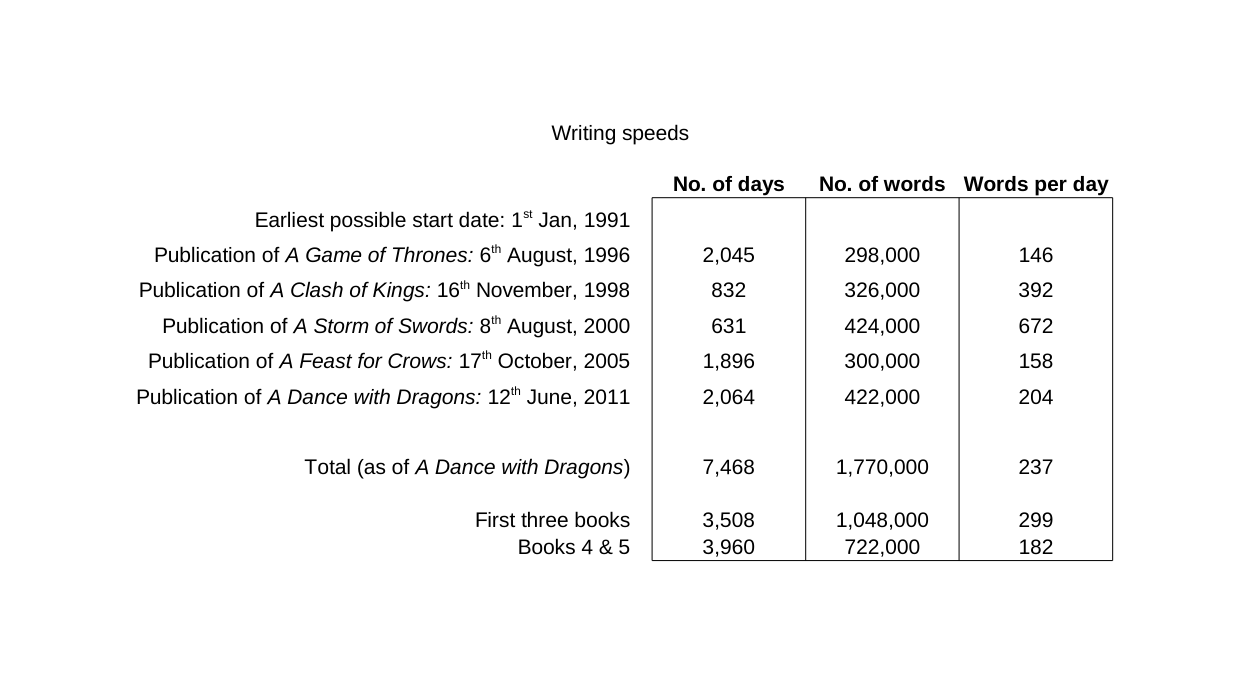
This made me curious about Mr. Martin’s writing productivity, so I did a little digging and found the following figures, calculated by his fans:

grrm_wordcount

Those numbers are rather stunning. He averaged only 200 words a day when writing A Dance with Dragons? Just for reference, this blog post is about seven hundred words so far, and I’m writing it while taking a break from my other writing (word count so far today: 1,100 words, and that’s a little low). Even if we allow for five drafts written at the same speed, five drafts still only comes to 1,000 words a day.

Now, I do think Mr. Gaiman makes a good point that it is neither healthy nor helpful to try and micromanage everything that a writer does. We can’t spend every waking hour working on the next book, and even if we did, it probably wouldn’t turn out as well, because refilling the creative well is an important part of the writing process. And I also have to admit that if you ran a similar calculation on my own books (especially the early ones), you would probably find some similarly embarrassing figures.

(Though to be fair to myself, I tend to have multiple irons in the fire at any given time, so a straight start date to publication date calculation doesn’t tell the whole story—and it probably doesn’t tell the whole story with George R.R. Martin as well. But still, even if those figures were twice as high, they would still be absurdly low for a working writer.)

When Mr. Gaiman and Mr. Martin say that the writing “comes when it comes” and there’s nothing they can do about it, I think they’re wrong. Dead wrong. Writing is an art, but it is also a craft. It can’t be forced, but it can be structured. Mr. Correia has evaluated how productively he writes and structured his convention-going plans accordingly. Has Mr. Martin?

I also think they’re dead wrong about the writer having no obligation to the reader. That’s total bunk. Reading is an act of collaboration between the writer and the reader: without readers, stories would never exist. They would just be markings on a page, or electrons on a drive, or at best ideas and daydreams in the writer’s head. If a tree falls in the forest, does it really make a sound? If a book is never opened, does it ever tell a story?

Part of this may be the difference in perspective between indie writers and traditionally published writers. In the traditional system, writers were paid an advance on royalties by their publishers. The contract also allowed for royalties, but those figures were set so low that most books never earned out their advance. Publishers made up for it by raising the advances for the writers they wanted to keep.

In contrast, indie writers live and die by their royalty checks. Had a good month? Congratulations, you can afford to eat. Had a bad month? Tsk, tsk. Better hurry up with that WIP of yours, because the longer it takes to publish it, the longer it takes for you to get paid.

But even for the fantastically successful writers who never have to worry about how they’ll pay their bills, I still believe that they have as much of an obligation to their readers as the rest of us. Without readers, we would not be able to do what we do. Without readers, it would be impossible to pursue writing as a career. We all want to live the dream, and the only way to do that is by treating our readers well.

So George R.R. Martin may not be your bitch, but I most certainly am. Writing is not something that happens only sometimes: it’s my job, and I do it every day. And as for accountability, I absolutely feel that I’m accountable to my readers. They are the whole reason I am able to do this in the first place. If that makes me their bitch, then so be it.

The Self-Sufficient Writer: Preparedness vs. Self-Sufficiency

No, I haven’t abandoned the Self-Sufficient Writer series. The path to self-sufficiency is an ongoing journey for me, and I wanted to take some time to learn a few things before I shared them here. My attempts at gardening this year ended rather badly, but I learned a lot from it and I’m carrying those lessons to other projects like an indoor herb garden, which seems to be doing well. Expect some interesting posts in the next month or two.

I started this blog series in order to explore topics like homesteading, emergency preparedness (also known as “prepping”), and the self-sufficient lifestyle from the perspective of a career writer, or really anyone who freelances in a creative profession that affords them a great deal of flexibility.

When you are a writer, you are your own boss. You set your own hours. You can work from anywhere in the world (or in space, I suppose), so long as you have an internet connection. And while it takes a lot of work to be successful, it’s not like a nine-to-five assembly line job where you’re doing the same thing all the time. Creative work requires periods of down-time where you “refill the well,” so to speak, where you typically switch focus to something more mindless in order to allow your creative batteries to recharge.

In short, writing is a profession that allows a great deal of space for pursuing a self-sufficient lifestyle. And that’s important, because it’s also the sort of profession that requires a degree of self-sufficiency, at least for those who intend to make it a lifelong career. With writing, there is no security. There is no minimum wage, $15 or otherwise. You never know when the market will fall out from under you. You’re constantly vacillating between feast and famine, and when you first start out, it’s usually more famine than feast. If you don’t have all the other aspects of your life in order, it’s going to be a really rough (and potentially deadly) roller-coaster ride.

But there are other reasons to pursue a self-sufficient lifestyle—reasons that apply not only to writers, but to people of all walks of life. With the tragic events in Paris last week, those reasons are becoming more and more apparent to everyone with the courage to recognize them.

We live in a global society that is on the verge of a catastrophic collapse. The economic and geopolitical pillars that held up the old order are buckling, the chaos and bloodshed in the developing world has started to spill over, and our modern consumer lifestyle is completely unsustainable. A detailed discussion of all these factors would require multiple blog posts, but for a writer like me who studies this sort of thing, it’s becoming increasingly apparent that the strain on our culture’s failure points is becoming more severe.

One of the responses to this has been the prepper movement, also known as survivalism. It’s been around for a long time, but has grown significantly in recent years. And there’s a lot of good that’s come out of it. Preppers believe that individuals should take personal responsibility for themselves and their families, in order to be prepared when shit hits the fan (SHTF).

There’s certainly a lot of overlap between preparedness and self-sufficiency, and the more seasoned and experienced preppers tend to fall in the space between the two. But there are also some key distinctions between the typical prepper mentality and true self-sufficiency which can be quite instructive.

The typical prepper spends a lot of time and energy on guns and ammunition, and is more likely to see their neighbors as the enemy in the event of a collapse. In contrast, those who are self-sufficient are more likely to reach out and help their neighbors, understanding that the first step to helping others is to take care of yourself.

The typical prepper is obsessed with doomsday scenarios where the entire society collapses all at once. In contrast, those who are self-sufficient are more focused on personal emergencies, such as accidents, unemployment, medical conditions, etc. They understand that it is far more likely that they will face a personal catastrophe than a widespread general one.

The typical prepper spends a lot of money on stockpiling supplies and equipment that they may never use. In contrast, those who are self-sufficient actually save money by buying the things they know they are going to use and getting it in bulk or when it goes on sale.

The typical prepper stocks up on dehydrated foods and MREs that they probably would not enjoy living off of, since they do not rotate through it. In contrast, those who are self-sufficient understand the principle of “eat what you store and store what you eat.” For them, food storage is a lifestyle as much as a contingency plan.

The typical prepper has a lot of camping gear and a massive “bug-out bag” that probably has more stuff than they can carry. In contrast, those who are self-sufficient are much more prepared to “bug-in,” with a garden that yields fresh food, livestock such as chickens or bees, and other aspects of a home economy that enable them to withstand disruptions without having to abandon their homes.

The typical prepper tries to do everything himself, so that he can face the post-apocalyptic world on his own. In contrast, those who are self-sufficient understand the importance of community and are more likely to band together and barter with others for the needs that are more difficult to fulfill on their own.

In his book More Forgotten Skills of Self-Sufficiency, Caleb Warnock devotes an entire chapter to the differences between the prepper mentality and the self-sufficient lifestyle, with the controversial chapter title “STOP BEING PREPARED.” While I think there’s a lot of good to be said about emergency preparedness, it’s important to understand that the intersection between preparedness and self-sufficiency is the optimal place to be.

Preppers who do not develop the skills of self-sufficiency tend to let their preparedness lapse, and people who pursue a self-sufficient lifestyle without understanding the need to be prepared end up missing some of the most important reasons for pursuing self-sufficiency in the first place.

In the Mormon scriptures, there is a verse that reads: “if ye are prepared ye shall not fear.” That is one of the most important points of both preparedness and self-sufficiency: it gives you security and peace of mind, both to face the major disasters and the personal ones as well. For those pursuing a creative career that has little to offer in the way of security, that peace of mind is key. It allows you to be more creative, because you don’t have to worry as much about your basic needs. It gives you confidence and helps you to think positively, even in the face of hardship. And while this series is more about self-sufficiency than it is about preparedness, the two go hand-in-hand. Because without a mentality of personal preparedness, the self-sufficient lifestyle is ultimately incomplete.

The Self-Sufficient Writer

The Self-Sufficient Writer: How I Got Started

One of the best things my father ever did for me was tell me that when I graduated from college, I was on my own. No more rent money or financial support from my parents—I had to become financially independent, and I had to do it soon.

I had a rather unusual college experience. I went to BYU, one of the most affordable colleges in the United States, and I had a full-ride scholarship for all four years. In addition, I started at 21, so that I qualified for the Pell Grant my junior year. Because I was studying Arabic, I also received the Smart Grant. And as if that weren’t enough, I worked an on-campus job for seven out of eight semesters while I was there. My parents paid for my rent probably just because it was the only expense left that they could help with.

All of those scholarships, grants, and jobs allowed me to graduate 100% debt free, which was extremely helpful later on. But the truth was, as a college student, I knew almost nothing about money. I didn’t know much about the world outside of academia either, since that was where I spent all my time. Even the jobs that I worked were all on-campus jobs that only put me at 20 hours per week, doing stuff that didn’t feel all that different from school. So when I graduated in 2010, I was in for a really big shock.

I graduated in the middle of the so-called “jobless recovery,” which was basically a euphemism for “the worst economic collapse in a generation, but hey it’s getting better, right? Right??” Things weren’t nearly as bad in the US as they were (and to a large part, still are) in places like Europe, but still, it was pretty hard. At the height of the recession, a job ad on KSL (the Utah equivalent of Craigslist) would get hundreds of applications in the first 24 hours, never mind how horrible the job was. People were desperate for some kind of income, and so was I.

Fortunately, I had enough time to see this coming. In 2009, I started keeping a daily budget in order to track my expenses and learn how to manage my money. At first, I used the same spreadsheet template that my father uses, but I soon figured out that that wasn’t going to cut it. So I started from the basics, dividing wants from needs, and made separate categories for things like food, rent, health, transportation, etc. I learned very quickly that I was spending too much on food, so I subdivided that into groceries and eating out. It took a while to organize my personal finances to a place where I felt I had a handle on it, but by the time I graduated, I was pretty much on top of it.

A lot of my peers were (and to a large extent, still are) moving back in with their parents after they graduated. I decided early on that I wasn’t going to do that. First of all, my father told me that if I was going to move in with them, I would have to pay rent. I’m sure that if things were really tough, they would have waived that requirement long enough to let me get on my feet, but the arrangement would not have made anyone happy. Second, all of the people I knew—and therefore, all of my best opportunities for getting on my feet—were in Utah, not in Massachusetts.

Now, a little bit of background. I was raised in a devout Mormon household, where we were all taught about the importance of self-reliance and emergency preparedness. Growing up, we had a modest food storage, and we even ground our own wheat to make bread (the most delicious bread you will ever eat is always homemade!). That said, I had never really connected any of that with my own situation. In college, I figured that I wouldn’t worry about stuff like that until I was comfortably established in my own home.

But then, things got tough. I went from working in a call center to taking temp jobs while looking for other employment. Then the temp jobs dried up, and I had to scramble for paying gigs on Craigslist. At the lowest point, I was distributing phone books from the trunk of my car just to earn enough to eat (it’s a decent paying gig if you have a pickup truck and four or five kids (ie slave labor) to do it quickly, but if you’re just one guy with a beat-up Buick, forget it). Money was drying up fast, and I didn’t know what to do.

I learned a lot from the experience, though. Probably the most important thing I learned was that 90% of the time, “security” is just an illusion. If you think you’re secure because you have a job that gives you a reliable paycheck, think again. Markets change, and your company could go down at any time, taking your job with it. That was a lesson we all learned the hard way back in the Great Recession. And if you think the government is there to help you, think again. In a lot of ways, the government only made the recession worse.

I realized very quickly that the only security I could ever hope to have was the security that I provided for myself. In other words, if I didn’t learn self-reliance, I would never have any control over my future. I wanted control—I craved it. I found myself trapped in a system where I had to trade time, one of the most limited and valuable resources, for money. No matter how much (or how little) value I created, I was still paid the same for it. It was a soul-sucking system, and I wanted out of it.

It was around this time that I started self-publishing. I saw the opportunity to take control of my own career and leaped at it. But I was still scraping by on only four figures a year, and while that’s not as bad as it sounds when you’re a healthy single man with no debts and no dependents, it was still pretty tough. With my books barely selling a dozen copies each month in that first year, I knew I couldn’t keep it up for long.

So I ran away—literally. I left the country and decided to start over.

The Self-Sufficient Writer (Index)


The Self-Sufficient Writer: Introduction

Before I graduated from college five years ago, I decided that I was going to pursue writing as a full-time career. That was my dream: to make a living telling stories that I love.

It’s been a crazy ride so far, and I don’t doubt that it’s only going to get crazier. For the better part of a year now, I’ve managed to live that dream, but a changing book market combined with a shift to writing longer books has made for rocky times ahead. That’s just the way things go when you’re self-employed: you never know how much you’re going to make each year, or when your income streams are going to dry up unexpectedly.

As a career writer, there are a lot of other economic challenges I expect to face. Health insurance, for example: the current system here in the US is completely slanted against self-employed people, especially those who don’t want to be totally dependent on the government. Without a steady paycheck, I also expect that I won’t be able to get a traditional mortgage. And self-employment taxes… don’t even get me started.

Point is, it’s tough to make a living as a career writer—and that’s without taking into account how anyone actually makes any money at it. It’s an oft repeated truth in the entertainment industry that no one knows anything, and that’s true of books more than any other segment. No one knows why some books flop and others take off, which can be really frustrating when your ability to make a living depends on that.

Fortunately, there are two sides to the “make a living” equation. It’s not just about building your income streams, it’s also about reducing your expenses. So long as the money flowing in is greater than or equal to the money flowing out, you’re in the black.

Over the past five years, I’ve come to realize that the best security I can ever hope to have comes from learning to live a self-sufficient lifestyle. That means learning how to make, store, and ideally grow my own food, how to fix, reuse, or re-purpose things that are old or broken, and how to DIY as much as reasonably possible. Basically, I’ve learned how to be something of an urban homesteader, insulating myself from economic shocks through developing the skills of self-sufficiency.

It’s been an ongoing process, and I still have a lot to learn. At the same time, though, I’ve managed to cut my expenses fairly significantly, living on just four-figures with little or no debt and still managing to put aside a little each month into savings. I’ve also learned how to eat really well on food that I’ve grown myself, which beats anything you can buy in the store. So while I’m not yet an expert, I do think I’ve learned a few things that are worth sharing.

Over the next couple of months, I plan to write a few blog posts where I share my experiences and explain what I’ve learned. If you’re an aspiring writer like I was five years ago and you want to learn how to make it, or if you’re just someone who’s interested in becoming more self-sufficient in general, I hope you’ll find this blog series interesting and informative. And if you’re already an enthusiast for self-reliant lifestyles, feel free to stick around and share your own experiences! I’m definitely interested in hearing what you guys have to say.

The Self-Sufficient Writer (Index)

Idea for a new blog series

So a little background information: about a month ago, I tripped over my brand new laptop’s power cord and broke the DC port, making it impossible to recharge my battery. After sending it in to a local shop to get it worked on, I discovered that the motherboard itself was broken and that the computer was now useless except for parts. Fortunately, I was able to find the exact same model for less than $300. It should arrive on Tuesday.

This whole debacle made me realize how much better I write when I’m somewhere other than where I live. Whenever I sit in front of my desktop machine, it’s like I have this uncanny aversion to doing anything writing related. It’s stupid, and I probably need to get over it, but I am definitely looking forward to having a laptop again so that I can get out and write.

Which made me think: why don’t I do a blog series on interesting places to write? There’s quite a few around here in Provo that I frequent: the city library, the HBLL, Pioneer Book (their new location), the Wash Hut, Slide Canyon. Branching out a bit, there’s Amtrak and the Frontrunner, two places where I’ve done a lot of good writing. Beyond that, I’m sure there are a ton of other places that I’ve never been to, but would be fun to explore and try out.

Besides giving each place a standard 1-5 star rating, I could review it based on how many distractions it has, how comfortable it is, whether it has wi-fi (not always a good thing!), ambient noise, people-watching opportunities, etc. It would be fun to break things down and see what makes a place good for writing, and what makes it not so good.

What do you guys think? If I did this, what sort of criteria would you like me to look at? Are there any places around Provo or Salt Lake that you think I should try out? This new computer cannot come soon enough!