None of these books/authors are so terrible (or so woke) (except maybe for Kim Stanley Robinson) that I would have ranked them below “no award.” With that said, I just didn’t think any of these books were good enough for me to vote for.
Greg Bear’s Moving Mars is basically a sci-fi retelling of the 60s student protest movement on Mars. That’s the big draw. The more I learn about what was actually happening in the 60s, though, the more insufferable I find the hippies and their ideological descendants to be. Needless to say, I DNFed this one.
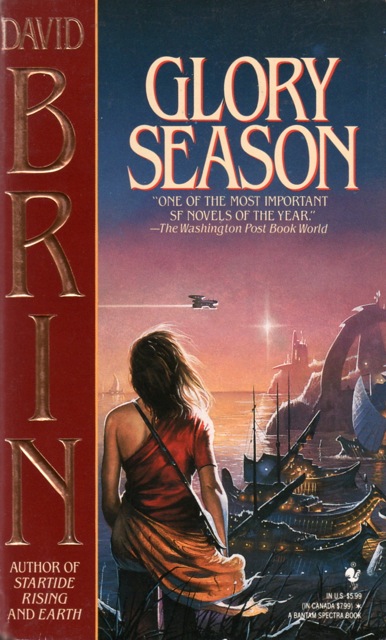
I skipped the book by David Brin, because he’s just such a dogmatic atheist. I tried his Uplift books and DNFed them for much the same reason. If you’re going to be so dogmatic in your religious views that you cannot build a fictional world where the opposite views might plausibly be true, I have no time for you. That’s equally true for theists as for atheists (unless, of course, the book falls into the religious fiction genre).
I tried Virtual Light, but DNFed it only a couple of pages in, due to some explicit violence against children. Now that I’m a father, I have a really low tolerance for that kind of stuff. I’ve also found Gibson to be a bit too dark and gritty for my taste. He seems to occupy the same literary niche as Neal Stephenson, and rub me wrong in much the same way.
It’s been so long since I DNFed Beggars in Spain that I’ve forgotten what my issue with it was. I found the basic premise to be quite interesting, and got about halfway through the book. Ultimately, though, I think I just got bored with it. But I might come back to this one. Of all the books on the Hugo ballot this year, this is the one I’m most willing to try again.
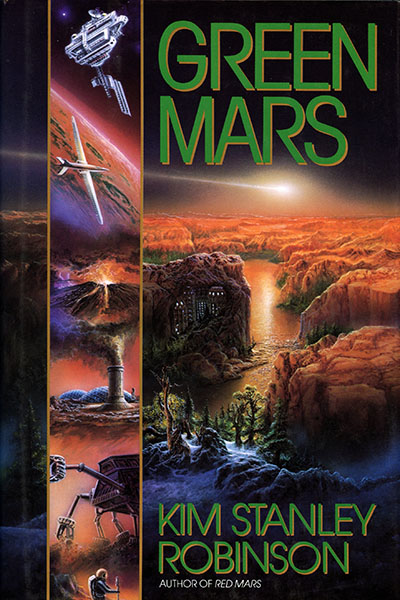
As for Green Mars, I just couldn’t get into it. Part of that is how insufferable I find KSR’s self-righteous liberal politics to be, but another part was the sexual content in the first few pages. I read Red Mars back in college, when my threshold for those kind of content issues was much lower, but I did come very close to DNFing it after the farm orgy scene. Also, Red Mars was a bit of a slog for my younger self, since I never really latched on to any of the characters. Same with Green Mars. Just a lot of people doing a lot of things, when it was clear that all the (crunchy liberal) author really cared about was the capital “I” Idea. Pass.
(Side note: Why is this book excluded from the Amazon Associates program? It couldn’t possibly have anything to do with Amazon’s woke political bias, could it? Surely not!)
Another year where the books were fine, but not to my personal liking (or else they were, but… we’ll get to that). I found no reason why I should give “no award” a vote over any of these books, but I DNFed most of them, though I could be persuaded to try some of them again. But overall, there was nothing in this year’s ballot that really blew me away (except… we’ll get to that shortly).
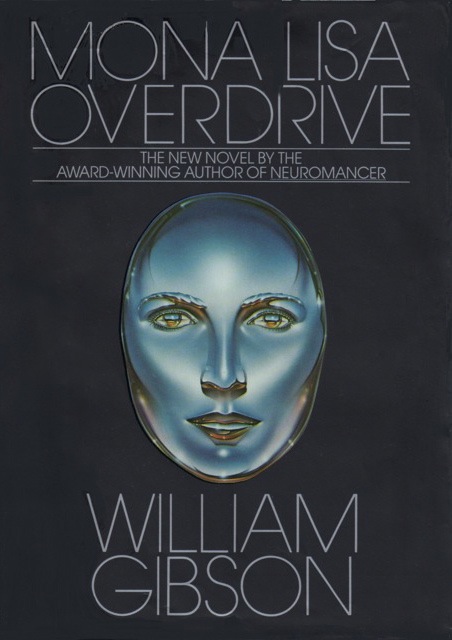
First, I didn’t read Mona Lisa Overdrive because it was the third book in a trilogy, and I DNFed the series with the second book. The first book, Neuromancer, I read back in college, and while I enjoyed it at the time, even back then I felt that it was right on the edge of being too explicit. Today, I would certainly find it too explicit—in fact, that’s why I DNFed the second book. These days, I just really don’t want to read a book with lots of sex, drugs, and pointless violence. Just not interested in any of that.
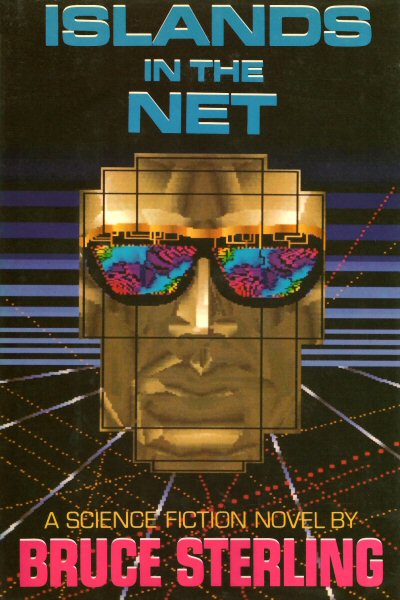
Islands in the Net is another gritty cyberpunk novel, but I actually didn’t find it too explicit at all. Perhaps that’s because the two main characters were married and had a family. In fact, compared to Neuromancer, or even The Matrix, it didn’t feel all that gritty at all to me. But reading it in the 2020s, all of the future predictions just made me laugh, especially the idea that internet piracy would allow the quasi-failed states of South and Latin America to get super, super rich, by hacking into the banking networks and siphoning off everyone’s money. Also, while I can understand (and even, to a degree, agree with) the idea that corporations would exercise more power over people’s lives than their own governments, I don’t think Sterling portrayed it in a realistic way. He should have studied East Asian history and society, particularly the Yakuza, to see what that would really look like.
Ultimately, though, the story just slowed down so much that I decided to skip to the end, and I’m glad I did, because the married couple broke up for the stupidest reason in the world, and the big bad turned out to be a bunch of terrorists stealing a nuclear submarine and threatening to launch their nukes and end the world… which is honestly such a boomer trope that it made me role my eyes. Don’t get me wrong—I’m very sanguine about the threat of nuclear war, especially with what’s going on in Ukraine right now (hopefully things haven’t gone nuclear by the time this post goes live), but it’s a uniquely boomer trope to think that history will end when the first nuke of the war goes off, and that all stories have to have clear good guys and bad guys (or at least clear bad guys) and that the whole story can be reduced to “stop that nuke!”
Anyways, I don’t know if that mini-rant makes any sense, but the point is that Islands in the Net didn’t impress me. It wasn’t terrible, but it didn’t hold my interest or blow me away.
I DNFed Cyteen because I got bored around the second or third chapter, though I probably could be persuaded to try it again. I’ve enjoyed many of Cherryh’s other Alliance-Union books, especially Merchanter’s Luck and Voyager in Night, but it’s been years since I read any of them. Just couldn’t get into this one.
Of all the books from this year, Falling Free is the one that I should probably try again. I forget why I DNFed it, which probably means that I just lost interest, or didn’t connect with any of the characters. Also, this was around the time that I was becoming disillusioned with Lois McMaster Bujold, after my wife DNFed Gentleman Jole and the Red Queen and told me all about that one. I used to really love all of Bujold’s novels, and still do enjoy the early Vorkosigan books. But this one, while technically in the same universe, isn’t really a Vorkosigan novel, which is probably a big reason why I just lost interest. But I could be persuaded to try it again.
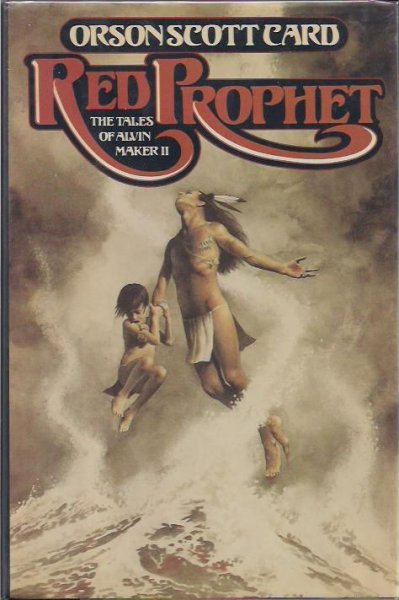
Which brings us to Red Prophet by Orson Scott Card…
I thoroughly enjoyed this book. It’s definitely a worthy sequel to Seventh Son, and while it had some minor issues, especially toward the end, it definitely ranks up there with Card’s best.
However… this is book two of a seven book series, where the first book came out in 1987, nearly forty years ago… and the seventh book hasn’t even been written yet! In fact, it’s been twenty-one years since book six came out—in fact, more time has passed since the sixth book came out than between the publication of the first book and the publication of the sixth!
What the heck, Card? It’s bad enough that you probably won’t ever finish your Women of Genesis series—will you never finish your flagship fantasy series either? At this point, you’re worse than George R.R. Martin, since at least Martin has only dropped the ball on one fantasy series, not two.
For that reason, I refuse to read any more Alvin Maker books until the last book has finally come out. Also, if the 1989 Hugo Awards were held today and I got to vote on them, I would not vote for Red Prophet, even though it’s a fantastic book. I just can’t justify voting for an author who lets multiple decades go by without doing the damn work to finish what he’s started.
(And yes, I know I have a couple of unfinished trilogies of my own. I’m working on it. Captive of the Falconstar and Lord of the Falconstar should come out next year, and I will probably start work on The Sword Bearer and Return of the Starborn Son in just a few months. In my defense, though, I haven’t let more than a decade pass since I published the last book in any of those series.)
My 2022 Reading Resolution: Read or DNF every novel that has won a Hugo or a Nebula award, and acquire all the good ones.
I was going to keep track of my reading resolution this year by mentioning each book and what I liked or didn’t like about it, why I DNFed it if I did, etc… and then I thought about it a little more and realized that that’s a terrible idea. Perhaps if I weren’t an author myself, I could risk bringing down the wrath of the internet by broadcasting everything that I really think about these books, but that’s still a really stupid thing to do—not to mention, a great way to burn a bunch of bridges that, as a writer, I really shouldn’t burn.
Instead, I’m going to post a monthly update where I list all of the books that I read and want to acquire, all the books that I read and probably won’t acquire, and all of the books that I DNFed, without any book-specific commentary. I do think that having some public accountability will help me to keep this resolution, and I do intend to keep it. But because I anticipate DNFing a lot of books that have very, um, merciless fans, this seems like a better way to do it.
So here is how things stood on the morning of January 1st, 2022:
Books that I read and want to / have already acquired:
Double Star by Robert A. Heinlein (1956 Hugo)
Starship Troopers by Robert A. Heinlein (1960 Hugo)
A Canticle for Leibowitz by Walter M. Miller Jr. (1961 Hugo)
The Man in the High Castle by Phillip K. Dick (1963 Hugo)
Dune by Frank Herbert (1966 Hugo and Nebula)
The Left Hand of Darkness by Ursula K. Le Guin (1970 Hugo and Nebula)
The Dispossessed by Ursula K. Le Guin (1975 Hugo and Nebula)
Downbelow Station by C.J. Cherryh (1982 Hugo)
Neuromancer by William Gibson (1985 Hugo and Nebula)
Ender’s Game by Orson Scott Card (1986 Hugo and Nebula)
Speaker for the Dead by Orson Scott Card (1987 Hugo and Nebula)
Barrayar by Lois McMaster Bujold (1992 Hugo)
Mirror Dance by Lois McMaster Bujold (1995 Hugo)
The Mule (included in Foundation and Empire) by Isaac Asimov (1946 Retro Hugo, awarded in 1996)
Harry Potter and the Goblet of Fire by J.K. Rowling (2001 Hugo)
Farmer in the Sky by Robert A. Heinlein (1951 Retro Hugo, awarded in 2001)
Fahrenheit 451 by Ray Bradbury (1954 Retro Hugo, awarded in 2004)
Spin by Robert Charles Wilson (2006 Hugo)
The Sword in the Stone by T.H. White (1939 Retro Hugo, awarded in 2014)
Network Effect by Martha Wells (2021 Hugo and Nebula)
Books that I read and don’t plan to acquire:
The Demolished Man by Alfred Bester (1952 Hugo)
The Forever War by Joe Haldeman (1975 Hugo and Nebula)
Gateway by Frederik Pohl (1977 Hugo and Nebula)
Red Mars by Kim Stanley Robinson (1993 Nebula)
American Gods by Neil Gaiman (2001 Hugo)
Books that I did not finish:
The Moon is a Harsh Mistress by Robert A. Heinlein (1966 Hugo)
Flowers for Algernon by Daniel Keyes (1966 Nebula)
Lord of Light by Roger Zelazny (1967 Hugo)
Ringworld by Larry Niven (1970 Hugo and Nebula)
Rendezvous with Rama by Arthur C. Clarke (1973 Hugo and Nebula)
Green Mars by Kim Stanley Robinson (1993 Hugo)
Blue Mars by Kim Stanley Robinson (1996 Hugo)
Forever Peace by Joe Haldeman (1997 Hugo, 1998 Nebula)
The Fifth Season by N.K. Jemisin (2015 Hugo)
The Obelisk Gate by N.K. Jemisin (2016 Hugo)
The Stone Sky by N.K. Jemisin (2017 Hugo and Nebula)
WARNING: This post contains spoilers for Inception and Neuromancer.
So I just saw Inception for the first time today, and I couldn’t help but notice the uncanny similarities between between it and Neuromancer by William Gibson. It made me wonder if Inception represents some kind of reincarnation of cyberpunk.
Before I go on, I should confess that I’m not an expert on cyberpunk. I’ve read Neuromancer, seen Blade Runner, and read a couple of books that are on the borderline (such as On My Way to Paradise). That’s about it.
However, Inception and Neuromancer have too many parallels to be just a coincidence. For example, in both stories:
1) the main character is a “hacker,” or someone with an uncanny ability to control or manipulate the virtual reality, 2) the main character gets entangled with hostile corporate entities that threaten his life and are far more powerful than himself, 3) the main character agrees to work for the corporate entities in an illegal, high-stakes heist involving private interests, 4) the main character is haunted by memories of a dead love interest from a past relationship and ultimately confronts that love interest in the virtual reality, 5) the main character rejects the objective reality for the virtual reality.
There are other, broader similarities as well: the near future dystopian setting, corporations weilding more power than governments, significant portions of the population abandoning the objective reality for the allure of the virtual reality, etc. In particular, the ending of Inception reminded me of the ending of Neuromancer, in terms of ambiguity as well as the emotional twist.
So what does all this mean? I see I’m not the only one to notice this–apparently, the discussion is already underway. Is this the next incarnation of cyberpunk, and if it is, what can we expect to see come out in the next few years?