Fighting for a Homeland

For the past few weeks, I’ve been brainstorming ideas for my next big novel project.  One of the ways I’ve been doing this is to by trawling tvtropes and putting together a mashup of the story tropes I’d like to play with.

By far, the one that’s struck me the most is Fighting for a Homeland.  This is basically when a band of displaced warriors is wandering the Earth, trying to find their own promised land.  There are a lot of examples of this on the tropes page, but the coolest one is probably this from real life:

The first Czech legion, after World War one. Their country was then merely a province of Austria-Hungary, who started the war and teamed up with the Germans. The Czechs had very little reason to fight for them, and surrendered to the opposing Russians whenever they could. Through a lot of political scheming, the Russians were convinced to raise a Czech legion of 60,000 men to fight against the Austrians.

Then the Revolution broke out, and with the peace treaty between Russia and Austria, and the vicious warfare and politicking in Russia, they would not get their goal, an independent Czechia, so they turned to the western allies. They could not leave the country through the western side, so the allies chose to rendezvous with them in the port of Vladivostok, on the other side of Russia.

They crossed the country in three years, using the railways that they hijacked, joined with the Russian White Army (anti-communists) and the allies, stole the Tsar’s gold, traded it for free passage to Vladivostok with the advancing reds when they lost, and safely sailed home, to the newly founded country of Czechoslovakia.

Isn’t that friggin awesome?  What’s even cooler is that I might have ancestors who fought in the legion.  My great grandfather emmigrated from Moravia right around that time, perhaps a little before.  Man, if I ever write a historical novel…

But yeah, the trope almost perfectly characterizes Danica and her band of mercenaries, who feature prominently in Bringing Stella Home.  Their homeworld, Tajjur V, was fighting for independence right before the Hameji conquests began, and the New Gaian Empire put down the rebellion rather forcibly.  Later, when the system fell to the Hameji, their homeworld was bombarded and slagged into oblivion, leaving them with nowhere to call their own.

Long story short, the story of the Czech Legions and their epic journey across Siberia has totally inspired me for this next novel.  I’m going to make Roman (Danica’s NCO) a major viewpoint character, bring back the old mercenary team, throw in a few new ones (including a character from Desert Stars)…man, it’s going to be AWESOME!

In other news, “Decision LZ1527” and “From the Ice Incarnate” are both available for free from Diesel Ebooks.  Genesis Earth is also up there too, so if you feel inclined to post a review, I would certainly appreciate it!

Also, if you REALLY want to help, drop by the Amazon pages for “Decision LZ1527” and “From the Ice Incarnate” and fill out the little form where it says “tell us about a lower price.” I’m trying to get Amazon to offer my short stories for free, but the only way to do that is to make it free somewhere else and get Amazon to price match.

Hopefully, by making them free it will get me more exposure and drive more interest in the novels.  Moses Siregar did a guest post on that just this morning.

Also, I think I’ve found a new template that might work well for this blog.  What do you think?  Obviously, I would tweak the background and header (and possibly the color scheme as well). The main thing is that it has multiple sidebars, which will make more room for my books.  But if you have a better suggestion, please let me know.

First Radio interview and other such stuff

Dude, check it out–my first radio interview just went live on the Dungeon Crawler’s Radio website!

I met these guys at CONduit last month, where they had a booth and were recording all sorts of authors and artist.  They were way cool when I talked with them, and when they found out I was a writer invited me on!

Hehe, considering how many big name authors they have on their show, I think I totally bombed–but it was still awesome.  The guys who run the show were really great, too; it was a ton of fun hanging out with them.  So thanks, guys, for having me on!

In other news, I just uploaded Genesis Earth to Smashwords, and I think it’s already live.  So for all those of you who want to get it from somewhere other than Amazon, it’s now available!  I’m still working through all the formatting kinks, so if you buy it and find some errors, let me know and I’ll send you a fixed copy.

Also, the cool thing about Smashwords is that you can generate coupon codes and even give the book away for free.  What I’m hoping to do is print up a few business cards with the code for a free book, then distribute them at conventions like Worldcon.  Hehe, imagine walking up to an editor and being like “hey, want my book?  Here you go!” Or even just dropping off a stack at the freebies table; I think it could be an awesome way to get exposure.

Man, there’s so much exciting stuff going on!  This is a great time to be a writer.

On the writing front, I’m making excellent progress on my current WIP (work in progress), Desert Stars. I’ve read through all the feedback from my first readers, and have a ton of fantastic ideas for how to make this story really shine.  I revised through about 2.1k words this morning before work, and I’m hoping to do at least two and a half chapters before this weekend.

Also, a couple days ago at work, I was trawling through tvtropes (one of the advantages of doing data entry is that you can afford to feed the addiction, hehe), and I had a SUPER awesome idea for the next book in the Gaia Nova series.

Since Bringing Stella Home is basically the Mongol conquests set in space, the big story to conclude that arc would be the battle of Ayn Jalut, where the Mongols suffered their first decisive defeat.  I did a little bit of setup for that in Into the Nebulous Deep, with the remnants of the Gaian Empire gathering at New Rigel.

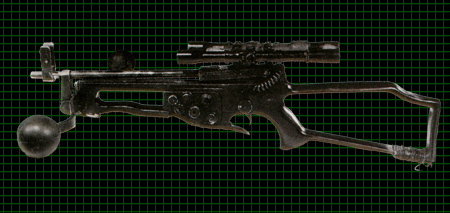
Well, here’s what I’m thinking: I’ll bring back Danica’s team of mercenaries from Bringing Stella Home, make Roman a viewpoint character, and have Rina from Desert Stars join up with them as a quiet little girl in black who seems painfully shy, but is actually a deadly effective assassin whose weapon of choice is a bowcaster.

Oh yeah, I think this has some crazy awesome potential.

In any case, I should probably get to bed so I can get up early and write tomorrow. I hope to finish Desert Stars 3.0 by July 10th, and even though it’s going to take a lot of work, I think I can make it happen.

And after that…well, things just keep getting more and more awesome. I love writing!

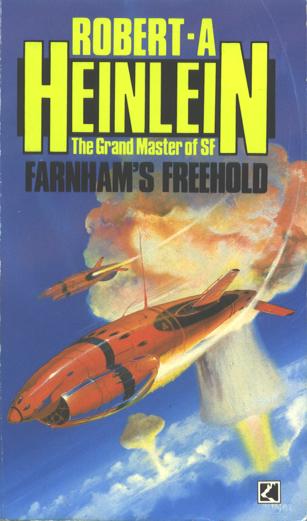
Farnham’s Freehold by Robert Heinlein

Bomb warning.  Third bomb warning.  This is not a drill.  Take shelter at once.  Any shelter.  You are going to be atom-bombed in the next few minutes.  So get the lead out, you stupid fools, and quit listening to this chatter!  TAKE SHELTER!

Thus begins the wild and crazy story of Hugh Farnham, a middle aged suburban American, with his alcoholic wife Grace, his law student son Duke and daughter Karen, their black house servant Joseph, Karen’s sorority sister Barbara, and the cat Mr.-Livingston-I-Presume.  When the Russians nuke the peaceful town of Mountain Springs into oblivion, only the uncanny foresight and resourcefulness of Hugh keeps them alive.  When they open their bomb shelter and climb outside, however, they find themselves in a world that defies anything they could ever imagine.

This book was incredible. I finished it at 4:00 am on a Sunday night, and honestly I wouldn’t have it any other way.  The characters are memorable and engaging, the plot face-paced and thrilling, the world fantastically imaginative, and the story both entertaining and thought provoking.  Wow.

Heinlein is an unparalleled storyteller, and I think he does it by creating worlds that are innately fascinating and imaginable and populating them with characters who act like real people, with the full range of reactions and motivations that real people have.

Consider the basic premise: who hasn’t wondered what World War III would be like?  No one who grew up during the Cold War, certainly.  And as for surviving and colonizing an uncivilized wilderness, people of all ages have been enthralled with that idea since Robinson Carusoe and The Swiss Family Robinson.  Heinlein capitalizes on this urge by telling us a story that we love to tell ourselves.

But the thing that really drew me in was the characters.

I’ll confess, when I got to the part where they open the bomb shelter and find themselves in a pristine, virgin wilderness instead of a blasted city, I threw the book across the room.  Up to that point, everything about the nuclear attack had been so realistic that the cross-dimensional time travel element totally threw me out.

However, even after I put the book down, I couldn’t stop thinking about Hugh Farnham.  The down to earth, no nonsense resourceful man who took the Boy Scout motto “Be Prepared” to a whole new level–who had the chutzpah to draw a gun on his own son when his rebellious behavior threatened to unravel the group–his undying attitude of “never surrender”–I just couldn’t stop thinking about him.  So I picked the book back up and finished it, and am I ever glad I did!

But it wasn’t just Hugh Farnham.  Grace, with her debilitating alcoholism and irrational outbursts, was a character I really loved to hate EVEN THOUGH she reminded me of people in my own family.  Joe, the longsuffering polite servant who changes so frighteningly with the reversal of fortune in the second half of the book; Duke, whose dysfunctional relationship with his father leads to so many problems; Barbara, the 60s era divorcee who goes from outsider to one of the closest members of the group–man, there were some memorable characters.  And NONE of them were caricatures; all of them had strengths and weaknesses, and while some fell prey to their flaws, others rose above them and triumphed magnificently.

I suppose that Farnham’s Freehold is a good example of pulp science fiction at its best: an imminently entertaining story that is also meaningful and thought provoking.  If so, then this is definitely the kind of stuff I want to write.  The descriptions may be sparse and the prose rather unremarkable–but man, the story…what a wild and crazy ride!

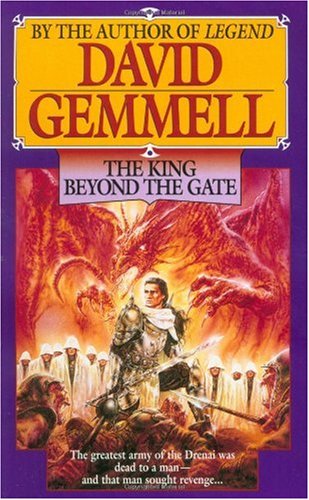
The King Beyond the Gate by David Gemmell

Tenaka Khan was a child of two nations and an outsider to both.  Half Nadir, half Drenai, the only home he ever knew was in the ranks of the Dragon, the elite fighting forces of the Drenai.  But now, a mad dictator rules the land, and the Dragon has been destroyed.

With all his friends dead at the hand of the evil Drenai emperor, Tenaka has only one desire: to steal into the palace and assassinate him.  Along the way, however, he makes a number of friends, all of whom seek the same thing, but all for different reasons.  As they join forces with the Skoda rebels, Tenaka realizes that he not only has something to die for–he has something to live for.

But in order to defeat the mad emperor, the rebels must fight the Joinings–terrible creatures made from man and beast, who slaughtered the Dragon years before.  Only the Nadir can save them–but the Nadir want nothing more than to ravage the Drenai.

If  you’ve read my review of David Gemmell’s Legend, you know why I love his books.  This one was no less incredible.  Parts of it were just as poignant as anything in Legend, and the ending, while bittersweet, was no less satisfying.

It’s really fascinating to me, because Gemmell’s books are not particularly flowery or well written.  His descriptions are sparse, his prose is unassuming, his characters, while distinguished from each other, sound more or less the same, and his viewpoint is often inconsistent.  But in terms of raw storytelling, his books are unequaled by anything else I’ve ever read.

He makes me fall in love with his characters: I cheer for them when they rise to the heroic deeds that circumstances demand of them, I cry when they fall short of what they could have been, and I weep when they give their lives in the service of something greater than themselves, which is almost invariably the case.

My favorite part of any David Gemmell book has got to be the order of warrior priests known as the Thirty.  They don’t show up in every book, but they show up in many of them, and they always share the same characteristics.  The warrior priests are dedicated to the Source (Gemmell’s equivalent of God in his Drenai universe), and have the supernatural abilities to speak telepathically, put thoughts into others’ minds, shield their comrades from the magic of the Chaos brethren, and leave their bodies to fly across the world and do battle in other dimensions beyond the grave.

The way the order is run is absolutely fascinating.  One person is the mouth, the other the ears, the other the heart, etc.  The most unlikely characters always fill the particular roles–but always for good reason.  They fight to defend the innocent and pure, but more than that, they always have some great destiny to perform–a destiny that invariably pits them against the forces of Chaos in some great, decisive battle.  In that battle, all of them invariably die, except for the weakest among them, who goes out to found the next order of the Thirty.

I don’t know about you, but this kind of stuff, just makes me want to jump up and down.  This is fantasy at its best–good versus evil, warriors facing death, and the most unlikely heroes rising to the level of greatness that war and honor demand of them.  Throw in a little magic, a brotherhood of evil sorcerers bent on crushing all that is good in the world, and terrible monsters the likes of which exist only in nightmares, and I am so there, man–I am so there.

In short, this book was nothing less than awesome.  If you love any book by David Gemmell, I think you’ll enjoy this one.  It’s got everything you could possibly expect from heroic fantasy, and more.

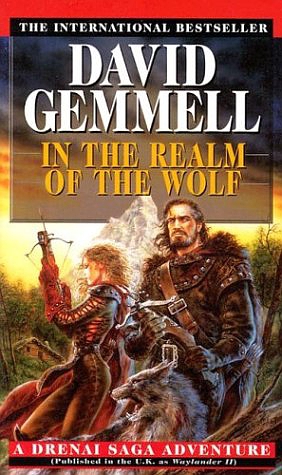
In the Realm of the Wolf by David Gemmell

Never leave home without a weapon, Dakyras taught his adopted daughter Miriel.  Though they live a quiet life alone in the mountains, death is never far from the man known as Waylander.

When the Assassin’s Guild puts out a high price on Waylander’s head, both Waylander and Miriel find themselves on the run.  With them come two ill-fated gladiators from Drenai: the loyal and steady Angel, and the arrogant and reckless Senta.  Both men vie for Miriel’s hand–and both are honor bound to kill each other.

But in the face of the evil hunting Waylander, Angel and Senta must lay aside their vendetta and take up arms against the Gothir army hunting the Wolf clan, tribe of the prophesied chieftain that will one day unite the Nadir.  For deep in the realm of the Wolf lies a castle more ancient than the three empires–a castle whose dark secrets threaten to upset the global order forever.

This book was awesome.  I loved every moment of it.  With each page, the story just got better and better, right up to the climactic finish.  If you’re looking for a rousing adventure, you can’t go wrong with David Gemmell.

One of the things I loved the most about this story was the love triangle between Miriel, Angel, and Senta.  At first, I thought I knew who was good, who was bad, and which one she’d end up with, but then things changed and I wasn’t too sure.  Even though I hated Senta at first, I spent most of the book vacillating with my feelings on him.  And the way things ended–I wasn’t disappointed.  Not one bit.

Even though the overall story conflict was much, much larger than life, Gemmell’s characters always felt very real.  Perhaps it has to do with the way their true nature always seems to come out in battle–and Gemmell gives them plenty of opportunity to show their true nature.

It also has to do with the things they’re fighting for, though–the stakes are always clear for each character, and when they’re confused what they’re fighting for, that’s made clear too.  Though the conflict itself is larger than life, the stakes for each individual character never are.

The ending really took the cake for me, though.  When I finished the book, I couldn’t help but smile.  Gemmell is a master at writing endings that make you want to stand up and cheer.

As awesome as this book was, though, the last book in the trilogy, Hero in the Shadows, is so much better.  The last scene of that book stands out so much more to me, now that I know everything about Waylander’s past.  So.  Freaking.  Epic.

But do yourself a favor: don’t read the last book first, like I did.  Start with Waylander, which is a good book–not great, but good–and read through the trilogy.  If you love stories about true heroes and epic adventures, you won’t be disappointed.

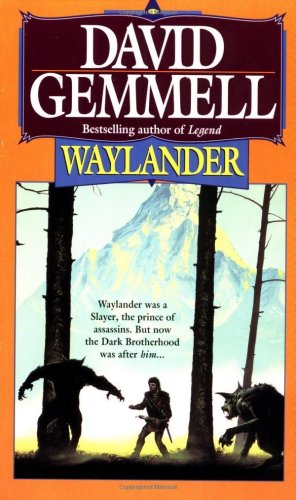
Waylander by David Gemmell

The Drenai lands have been overrun, and the Vagrian conquerors, led by Kaem and the Dark Brotherhood, are laying waste to all that lies before them.  Only the stronghold at Purdol withstands them, but unless the Drenai can rally a counterattack, all will be lost.

In these trying times, a strange old man visits the assassin Waylander and urges him to go to the sacred Nadir mountain of Raboas and retrieve the legendary Armor of Bronze.  With this armor, the Drenai commander Egel can rally the army that will save the kingdom.

But Waylander is a hunted man–a man of dark secrets and many enemies.  Kaem wants him dead for killing his son.  The Nadir want him dead for violating their lands.  And the Drenai want him dead for assassinating their king.

I love David Gemmell.  When you pick up one of his novels, you know exactly what you’re going to get: gritty, complex characters, bloody battles, ruthless villains, and difficult moral decisions that transform even the most depraved individuals into true heroes, if only for a few moments before they die.  Waylander is no exception.

Perhaps the most interesting part of the book is the story behind the founding of the Thirty.  When the young Source priest named Dardalion forsakes the pacifism in order to save the lives of his fellow countrymen, twenty nine fellow priests join him to form the band of legendary warrior monks.  This religious order goes on to play a pivotal role in some of Gemmell’s best works.

Waylander himself is also an interesting, memorable character.  During the events of Waylander, he’s basically hit rock bottom, but as he learns again what it means to love and fight for what he loves, he climbs out of that dark place.

I really enjoyed this book.  My only complaint is that the ending felt a little rushed.  All the plots and subplots get tied up, but some of them so abruptly that there’s little room to savor the emotional impact.  Still, the novel was quite satisfying overall.  I look forward to reading the next book in the Waylander saga.

The Madness Season by C. S. Friedman

In the 21st century, Earth was conquered by an alien collective consciousness known as the Tyr.  Now, five hundred years later, humankind has been scattered across the Tyr-occupied worlds as slaves.  It is a dark and uncertain existence, under the rule of masters who do not care whether their charges live or die.
For the last five hundred years, Daetrin has been a survivor.  An anomaly among humans–a man with the power to live indefinitely–Daetrin is used to keeping his true nature hidden.  But when the Tyr learn of his strange abilities and take him away for further study, he finds himself on the run, out in the open.

In order to survive, however, he must face his greatest fear–the fear that he isn’t entirely human.

This book was interesting.  C. S. Friedman’s prose is quite good, and her main character has a very unique and engaging voice.  For some reason, she wrote all of Daetrin’s stuff in first person, while the other characters in third person.  I think that the main reason for this was to preserve the sense of surprise and horror when he made certain discoveries while at the same time revealing certain critical aspects of her world that the reader absolutely needed to know in order for the story to make sense.  It didn’t bother me–in fact, I think she did it quite well–but it might not work for you.

In terms of story, this book was interesting but a little confusing.  It lagged at times, especially towards the beginning, and towards the end so many things came together at once that it was difficult for me to keep track of them.  I’m not entirely sure why that was, but I think it’s related to the fact that I never felt a very clear sense of progression.  Plotwise, things happened, but I didn’t see how one led necessarily to the next, or where things were going overall.

That said, the ending was satisfying, and I enjoyed reading this book.  You don’t realize it until the end, but the whole book is basically Friedman’s sf take on a certain type of well known, very popular mythical monster.  I won’t spoil the book by telling you which one, but when I saw it, it made me smile.

In terms of science fiction, there are a lot of old tropes with very few new ideas, except for the shapeshifting alien species known as the Marra.  Their culture was interesting, and I thought Friedman did a very good job conveying both the familiarity and the alien-ness of that species.  The Tyr weren’t quite as interesting, because they were basically just the Borg with scales and spikes, but the Hraas and the Tekk (who are a type of human) were also well done.

This is definitely the kind of book you’d want to sit down and read, rather than take everywhere with you and read whenever you get a spare moment.  Without sitting down and dedicating some time to it, it’s very difficult to really get into the story or feel immersed in the world.  I made that mistake, and it took me nearly a month to finish it.  That said, it was a good book; I’ll definitely be reading some Friedman again.

Near scare and an awesome idea for the next novel

I wrote 1,780 words this morning–not bad.  After such a good start, I figured I’d finish the last 720 for the day after finishing the day’s errands.

Long story short, when I finally settled in at 11pm to do a little writing before going to bed, I had some weird problems.  Openoffice froze up, I ended it prematurely, and it turned out that that somehow corrupted one of the files I had opened.  Instead of being 370 KB, it was now over 1,000 KB, and every time I tried to write something,  it froze up for nearly half a minute.

In the end, I had to delete it.

Fortunately, this was NOT the main file for Mercenary Savior. Thank goodness!  It was just the revision notes.  I had copies of both (both about a week old), but I’m glad it wasn’t the main file, because I’d have lost over thirty pages of revisions.  Yikes.

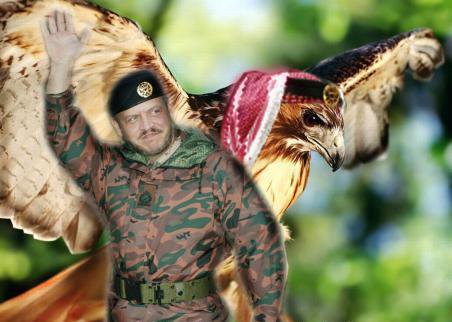
On a totally different note, I had an awesome dream this morning–one that I’m totally using in next novel I’m going to write (probably recycling much of Hero in Exile).  It’s hard to describe it exactly, which is why I added this really weird picture to this post.

You may be wondering, “what the crap is that supposed to be?” I’ll tell you: it’s Arab.  It’s Arab on so many different levels it makes me happy inside.  I took it from the facebook profile pictures album of an old friend of mine from the ELC in Provo.  What’s so Arab about it?  Well, there’s 1) King Abdullah II 2) in battle fatigues 3) waving to the people 4) with an eagle in the background 5) wearing a Bedouin hutta 6) and some kind of military insignia on the agal.  So freaking Arab.

So what was my dream?  Well, it was kind of like a cross between Lawrence of Arabia and…a lot of weird stuff.  At one point, King Hussein of Jordan commanded me to go into the desert east of Jerusalem and raise an army.  I had a lot of questions, so he explained exactly what he wanted me to do–and in so doing,  he explained exactly how the Bedouin fight wars.

Instead of keeping a standing army, a military leader must draw the warriors of the other tribes to his banner through his charisma, egalitarianism, reputation, etc.  The warriors join his campaign, not to serve some grand concept of country, but to win spoils and glory.  Once the campaign ends, they disband and return to their tribes until the next leader rallies them together.

Because of the way this works, a charismatic leader can pass through the desert virtually by himself, only to come out on the other side with a fearsome army.  This is what happened in Lawrence of Arabia when Lawrence took Aqaba–he passed through the desert with a token force of barely fifty men, but the feat (and his brilliant diplomatic skills) so impressed the Bedouins on the other side that they rallied to him and stormed the city.  From the Turks’ point of view, the army came out of nowhere and crushed them.

So that’s what I’m thinking I need to do at some point in my next novel: have the main character, poor and destitute, go out to the desert and rally the tribes with nothing but his charisma.  I’ve already got the rough (VERY rough) outline of the story in my head, and this plot point fits perfectly into this one section where I was worrying that things lagged too much.

Oh man, I’ve got such awesome plans for this book!  But first, must revise Mercenary Savior and send it out.  Don’t worry, I’m enthusiastic about that project, too. It will get done!  Momentum is building–I’ll  more than make up those 720 words tomorrow.

LTUE 2009

Wow. Life, the Universe, and Everything 2009 is over, and it’s hard to believe that only three days have passed. It feels as if this symposium has been going on for a week, and that’s a good thing. Friday and Saturday, I spent practically every waking moment in the Wilk, the student center where the symposium was held. By the end, I think some of the professionals there were starting to recognize me and strike up conversations with me instead of the other way around. Kind of interesting. Way fun. Loads and loads of helpful advice and information to process. I’ll be lucky if I can soak it all in before the end of the year.

I’m glad to say I was able to open up and talk with a lot of people these past few days–in fact, I got a chance to talk with just about everyone who was on a panel that I’d attended. It was fun to shake their hands, compliment them on what they said, and strike up a conversation around that. It was surprisingly non-threatening, to be honest. I definitely feel more prepared for World Fantasy 2009 now–definitely.

By far, my favorite part of the convention was Tracy Hickman’s main address. It was titled Creative Reading 201, and it was all about how the reader and the writer are both collaborators in the creative experience, something that’s fascinated me for a long time. The implications of this simple fact are tremendous. First of all, it means that a story does not come to life until it is read. Anyone can get published, especially with the technology today, but all of those words are empty symbols until someone takes the time to read it. Second, it means that the spirit speaks to us in the white spaces between the lines. Just as people with different needs take the unique message they need from the scriptures through the power of the holy spirit, so each work of fiction speaks differently to us. Finally, all of this means that stories change as we change, even as they inevitably change us. As we grow, the stories that touched us the most simultaneously grow with us even as they help us to become better people.

Tracy Hickman then shared an incredible story about a book signing he and collaborator Margaret Weis had recently at a veteran’s home. A man in a wheelchair came up to them with an extremely tattered copy of one of their earlier works, about a knight who sacrifices his life in battle to save the order, even though all of his fellow knights in the order look down on him as less than a true knight. This wounded soldier then told them that this tattered book had traveled with him in his pocket throughout his military career, through parajumps, underwater operations, and into war theaters like Afghanistan. While fighting in Afghanistan, this soldier was shot in the lower back. As he went down, his first thought was “what would the knight in Tracy’s book do?” He saw the Taliban forces setting up a mortar on the opposite ridge, and in spite of his wounds and the risk to his life, he took down the enemy and saved twelve of his fellow soldiers fighting in that battle. The soldier then presented his purple heart and bronze star to Margaret Weis and Tracy Hickman, for writing the story that inspired him to be a hero.

Sometimes, as I’m sludging away with my writing and wondering what I’m going to do in 2010 when I finally graduate, I wonder if I’m somehow being lazy. I worry that I’m somehow being irresponsible by not going into some other profession, some kind of respectable 9 to 5 job in an office, the kind of thing that everyone else goes into. I wonder if I’ll ultimately become some kind of a parasite on society, trying to make it big as a writer. In the worst moments, I worry that even if I make it big, I’ll still be some kind of parasite, not really producing anything respectable or useful. After all, fiction is entertainment, especially in genre fiction–don’t we have enough of that already?

Then I remember the impact that one good book can have on people–the way it changes us, the way it opens our eyes and helps us to become better people than we were before we picked up the book. Then I realize: what could possibly be more respectable than telling good, honest, life-changing stories? And then, as I think about it a little more, I realize that that 9 to 5 office job isn’t what I think it is. I realize that I’m not slacking off by trying to be something more than a cog in the corporate machine, producing widgets.

If I strive to tell the truth as a storyteller, and to write the kinds of stories that truly inspire people to do marvelous things and become better people, what greater career is there than that? Teaching, I suppose, comes close to having a similar impact, as well as some kinds of therapy work. Certainly there are other careers that have tremendous opportunities to sacrifice and have a meaningful impact on one’s fellow men. However, my talent is in writing and telling in stories–and it’s a talent that I cannot suppress, from which I cannot escape. So long as I live, I will always tell stories–it’s just hardwired into who I am. Certainly I can use this talent to serve my fellow men in a way that is both respectable and meaningful. And really, for me personally, what else could be better?

It doesn’t mean that it isn’t scary. However, thanks to LTUE this year, I feel that I’ve learned a lot that can help me break in and make it. Whether it was something said in one of the panels or just the experience of attending, it was a truly awesome experience for an aspiring writer like myself.

As far as the files, I’ll post links to the audio files from the conference after I get them uploaded. I should be able to do that sometime within the next 24 to 48 hours, so look out for that.