In a lot of ways, this trope reflects the age-old tension between Romanticism and Enlightenment, hearkening back to a simpler time rather than looking ahead to a glorious future. Perhaps that’s why many of these weapons tend to be swords rather than guns. And since science fiction is traditionally the more forward-looking genre, perhaps that’s why it’s invoked so often in subgenres like space opera that lean more toward fantasy–to provide ready contrast.
When used well, the effects of this trope can be awesome. It wasn’t just the shiny blade and the cool sound effects that made lightsabers so awesome as a kid–it was the sense that something about the weapon was special. None of the mooks had one, after all, and Luke’s came from his long-lost father. It probably helped that Star Wars paired this trope with the call to adventure (in a very specific way).
In my own work, this appears in Desert Stars with the heirloom rifle that Sathi gives to Jalil. At least, I think it qualifies. The rifle is more of a status symbol than a combat weapon, but it does figure prominently in the story. However, my forthcoming novel Stars of Blood and Glory goes a lot further with this trope than Desert Stars. It has Katanas, and a far-future Polynesian-Japanese society that knows how to use them.
It’s Christmas, but for whatever reason (most likely because you’re Jewish), you don’t celebrate. Or maybe you do celebrate Christmas, but you live in a place where no one else does.
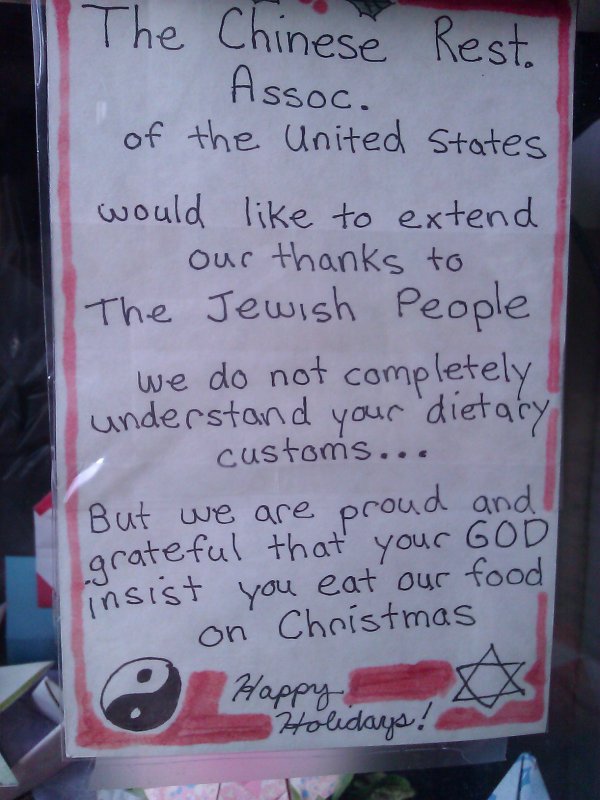
So December 25th comes around and you feel left out. What do you do? Simple–you find a cheap Chinese place, or somewhere similarly non-festive that’s open, and you eat out there. As the tvtropes page adds, bonus points if you bond with the owner despite the language barrier.
This trope is more of a one-liner than anything else, but it pops up here and there. Jon Stewart used it a couple of times on his show, and Brandon Harris Walker wrote his break-out song about it. Also, at Elena Kagan’s congressional hearing for the U.S. Supreme Court, she referenced this trope:
Sen. Lindsey Graham (R-SC): Christmas Day bomber. Where were you at on Christmas Day?
Supreme Court nominee Elena Kagan: Senator… I assume the question you mean is whether a person who’s apprehended in the United States—
Graham:(interrupting) Nah, I’m just asking where you were at on Christmas.
Kagan: (laughs) You know, like all Jews, I was probably at a Chinese restaurant.
(Laughter from crowd)
Graham: Great answer!
Sen. Patrick Leahy (D-VT): I could just see that one coming…
So yeah, there’s actually a fair degree of truth to this trope, as I’m finding out this year. Due to some poor planning on my part, I’m spending Christmas in Georgia, a full 14 days before the Georgian Orthodox Church celebrates it. Yeah, December 25th in Tbilisi is pretty much the same as the 24th, or the 26th.
But it’s actually not so bad. I didn’t eat Chinese last night, but I did go to a local Georgian place with two Frenchmen, an Iranian, a guy from Singapore, a guy from Japan, a Georgian-American, and a global nomad who doesn’t know where he’s from anymore. Today, I went to the Dry Bridge bazaar and bought myself an ornate mosaic chess board. I’ll probaby fix some spaghetti tonight and Skype with my family before going to bed.
So yeah, to those of you celebrating Christmas in the western hemisphere right now, merry Christmas! And to everyone else, I hope you have a great day too!
The fantastical element here isn’t that Mars could actually look like this in a millenia or two, but that NASA might actually get the funding.
One of the problems with interplanetary colonization is that Earth-like worlds are fairly rare (though possibly not as rare as we once thought). In our own solar system, the only other world that comes anywhere close (Mars) is a radiation-blasted desert with only the barest hint of an atmosphere and a surface temperature colder than Antarctica. To get around this problem, you can do one of two things: build an artificial enclosed environment to house the colony, or change the world itself to make it more Earthlike–in other words, terraform it.
The actual science of terraforming is far too complex (not to mention way over my head) to do it justice in this post. Instead, I’ll just point you to the Terraforming Wikipedia page as a starting point and focus on how the concept is used as a story trope.
According to tvtropes and Wikipedia, the term came from a 1942 novella by Jack Williamson titled “Collision Orbit.” The concept of changing the environment of an entire planet actually goes back much further, with H.G. Wells subverting the trope in War of the Worlds (instead of humans terraforming other worlds, the hostile Martians try to xenoform Earth to make it habitable for them). Before the U.S. and U.S.S.R. put probes on the surface of Mars and Venus, it was fairly common for writers to speculate that those planets were able to support human life, at least on a basic, rudimentary level. Once the science showed that that isn’t actually the case, terraforming as a story trope really began to take off.
Today, this trope occurs commonly across all ranges of the Mohs scale. Soft sci-fi stories (such as Firefly) use it as an excuse to have planets that look and feel like Earth. Hard sci-fi stories (such as Red Mars, Green Mars, and Blue Mars) use it as a fundamental premise, or to pose questions like “what is the ultimate destiny of human evolution?” or “how important is it to our species’ survival that we spread out beyond Earth?” Although it’s not something that we as a species have (yet) done, our present science seems to place it well within the range of the plausible, and that means that makes it fair game for any kind of science fiction.
In order to be believable, however, any significant terraforming project requires two things: resources and time. LOTS of time. We’re talking on the order of centuries and millenia here. Because of that, stories that use this trope generally fall into the following categories:
The terraforming happened a long time ago and is part of the world’s ancient (or near ancient) history.
The terraforming is on-going and directly impacts almost every element of the world’s culture and setting.
The terraforming has failed in some way, which may (or may not) make it a key element in the story conflict.
As with generation ships, the scope of this trope spans more than just the interests of a single character–it deals with the ultimate destiny of entire cultures and civilizations. In hard sci-fi stories, the planet that’s being terraformed may actually become more of a character in itself than the individual people who are terraforming it. Unless they have some form of immortality, they have little hope of ever seeing the ultimate end of it.
Of course, that almost makes the project more of a religion to the colonists than a science, with all sorts of interesting philosophical and story implications.
Why is this trope so widespread in science fiction? I can think of a few potential reasons. First, it hits on some of the key issues that lie at the very heart of the genre, such as the ultimate destiny of humanity and the ethical issues surrounding our ability to play God through the wonders of science. Also, it captures the imagination in a way that few other tropes can equal. Because the scope of any terraforming project is so vast, the implications touch on almost every key element of the story, including setting, character, and conflict.
But on an even more fundamental level, it hits on one of the key elements of any fantasy magic system: limitations. We can’t live on an alien world because the conditions are too hostile, but we can’t just wave our hands to make it Earth-like either. We have to undergo a painstaking, laborious process that could unravel at any point and throw everything we’ve worked for into chaos. We have to dedicate our whole lives to the project for dozens of generations before it will ever pay off. There are no shortcuts–none that won’t strain our readers’ suspension of disbelief, anyway. But if it all works out, then we will have created a new Earth–and how is that not magic?
Needless to say, I’m a big fan of this trope. I’ve used it in just about every science fiction story I’ve written, though I probably play with it the most in Star Wanderers. The main character of that story comes from a world where a terraformation project failed, having severe religious implications that drive the whole series. Sacrifice is largely set in orbit around a world that is midway through the terraforming process. Elswhere in the Gaia Nova universe, people build domes just as often to keep humanity from screwing over a terraformed world as they do to provide room to live on one that isn’t. After all this, though, I feel like I’ve only begun to scratch the surface of this trope. You can definitely expect to see it in my work in the future.
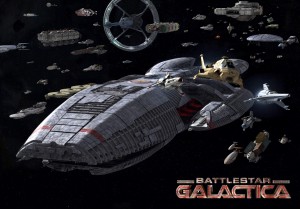
Since space is the final frontier, this trope is very common in science fiction. Heinlein was a huge fan of it, but he wasn’t the only one to play with it–not by a long shot. John Scalzi (The Last Colony), Nancy Kress (Crossfire), C.J. Cherryh (40,000 in Gehenna), Anne McCaffrey (Freedom’s Landing), and Kim Stanley Robinson (Red Mars, Green Mars, and Blue Mars) are just a few of the many science fiction writers who have explored this trope in their works. In recent years, several sci fi miniseries (Battlestar Galactica, Terra Nova) have used it as a major premise as well. And of course, you have all the classic 4x games like Masters of Orion and Alpha Centauri.
Space Colonies can come in a variety of different flavors:
Lost Colony — What happens when the original colonists lose all contact with the outside universe and no one thinks to check up on them for a while. Can either turn into a story of survival or a clash of cultures, if/when they ever re-establish contact.
Cult Colony — Religion is one of the few things that will drive massive numbers of people to leave everything behind and start over in a new world. Just look at the Pilgrims for a real-world examples. In space colonies of this type, you can expect to see some extremely radical people, since the isolation of deep space tends to compound their fundamentalist tendencies. Expect these to be both weird and frightening.
Space Amish — Something of a combination of the two, except with much more primitive technology. Expect to see log cabins, horse- (or giant lizard) drawn carriages, and other tropes closer to the Western genre. Sometimes, they may be hiding a superweapon.
Penal Colony — Australia in space (ahem…IN SPAAACE!!!). What happens when the empire needs a place to conveniently exile all the troublemakers and rabble rousers. Not a place for the faint of heart.
Wretched Hive — What happens to a penal colony when the prisoners actually run the place. Like the previous type, except taken up to eleven. Or not, depending on the history and culture. Tatooine is the eponymous example.
Death World — As the name would suggest, this is not the kind of place you’d want to homestead. Anyone who does is bound to be a badass. The Empire and the Federation often recruit most of their soldiers from here.
Company World — I couldn’t find this one listed on tvtropes. Basically, it’s a planet that is owned and governed entirely by a private corporation, which expects to make a tidy profit off of the place. The colonists are basically indentured servants (since robots simply wouldn’t do) and have almost no property or rights. Expect the story to be about sticking it to the man.
These are just a few of the many possibilities that you can play with when settling the frontier. In my opinion, however, the essential elements are as follows:
The story is not just about exploring a new world, but establishing some kind of a permanent presence there.
By coming to the new world, the colonists must leave everything from their old, familiar lives behind.
The colonists must resolve the story conflict through their own self-reliance, not by waiting for an outside force to save them.
I’ve only dabbled with this trope, but it does play a role in many of my stories, most notably in the Star Wanderers series. Genesis Earth also has elements of it as well, though it’s not the main driver for the plot. It is a major factor in Heart of the Nebula, though, the (currently) unpublished sequel to Bringing Stella Home. And in my future books, you can definitely expect to see this trope again.
I’m going to take a break from the hero’s journey trope posts for a while, until I have the time to do them justice. In the meantime, let’s have a little fun.
Some of my favorite science fiction stories are the ones about a culture of nomadic starfaring people wandering the universe in search of a new homeworld. Earth is usually a half-forgotten legend, and their starships have probably seen better days. On tvtropes, the page for these stories is Space Cossacks, named after a real world culture in historic Russia that basically experienced the same thing, albeit on a terrestrial scale.
The description of this trope on the tvtropes page is so good, I’m just going to repost it here. Seriously, every one of those cross links is worthy of your click.
With you are various dissidents like people who feared being Made a Slave. There might be a Noble Fugitive or two, perhaps even a Defector from Decadence. You and your brave band of Fire-Forged Friends will struggle on to survive and maintain your freedom and heed no laws but your own.
One of the things that I think should qualify a story for this trope is that the society of space cossacks is just that: a community of people who share at least a few cultural bonds. Battlestar Galactica definitely qualifies, but I’m a little on the fence as to Firefly, since that story is more or less about a ragtag band of failed revolutionaries. Are the Browncoats all from the same culture, like the Kurds or the Circassians or the Ossetians, or are they just a pologlot group of frontiersmen from all over the settled worlds? Does it even matter?
In the end, I suppose it doesn’t. The spirit of this trope is a lot like that of Fighting for a Homeland: a bunch of displaced underdogs on the fringes of civilization trying to make their way in the universe. The nature of the conflict is such that by the end, they can’t help but form their own distinct subculture.
I don’t know why I love this trope so much. Maybe it has to do with the way it blends elements from the Western genre in a classic Science Fictional setting. Maybe it’s because I was born in the wrong century and naturally dream of settling the frontier. Maybe it’s because this is one of the best ways to get awesome space battles.
Whatever the reason, I can’t get enough of it, as you can probably guess from reading my books. In Bringing Stella Home, Danica and her band of Tajji mercenaries fit this trope to a T.Stars of Blood and Glory delves quite a bit deeper into their background, with Roman as a major viewpoint character. In Heart of the Nebula, the people of the Colony basically become Space Cossacks over the course of the novel. Both of those novels are currently unpublished, but I hope to put them up in the next year.
On the subject of roving bands of displaced Eastern Europeans, I listened to this Circassian folk song maybe a dozen times while writing this post:
Awesome stuff–I’m totally putting it in the soundtrack for my next Gaia Nova novel. Also, I’ll have to name a moon or a planet in the Tajjur system after Mount Elrus or something. Space Cossacks indeed!
The hero’s journey can be divided into three basic phases: departure, intiation, and return. In the departure phase, the hero receives the call to adventure and eventually leaves the familiar world. In the initiation phase, the hero passes through a series of tests and trials eventually leading up to the climax and final confrontation with the Big Bad (if there is one). But after the hero wins and receives the ultimate boon (aka MacGuffin), there’s nothing left except to go back home and share that boon with the rest of mankind.
Joseph Campbell called this stage the Refusal of the Return. It’s a lot like the Refusal of the Call in the departure phase, except in reverse: instead of being reluctant to cross the threshold of adventure into the unfamilar world, the hero doesn’t want to cross the threshold in the opposite direction going back home. Campbell put it this way:
When the hero-quest has been accomplished…the adventurer still must return with his life-transmuting trophy. The full round, the norm of the monomyth, requires that the hero shall now begin the labor of bringing the runes of wisdom, the Golden Fleece, or his sleeping princess, back into the kingdom of humanity, where the boon may redound to the renewing of the community, the nation, the planet or the ten thousand worlds.
But the responsibility has been frequently refused. Even Gautama Buddha, after his triumph, doubted whether the message of realization could be communicated, and saints are reported to have died while in the supernal ecstasy. Numerous indeed are the heroes fabled to have taken up residence forever in the blessed isle of the unaging Goddess of Immortal Being.
Anyone who’s ever been two years old should know the feeling. You’re at the playground, having fun, when out of the blue your mom says that it’s time to go. So what do you do? Throw a hissy fit, of course! Grab onto the cold hard steel of the swingset, and don’t let go until she drags you kicking and screaming all the way to the car.
The hero may have fallen with the new world the moment he left his home behind, but he might also have hated it initially. In stories where the hero actually does stay, this allows the author to give him a character arc: at first, he hated the new world, but gradually he warmed up to it, until by the end he was changed so much by the adventure that he decided to settle down there.
In milieu stories (see Orson Scott Card’s MICE quotient), this often manifests as Going Native, while in stories that are more plot or character driven, it’s more likely to manifest as Can’t Stay Normal. When the hero eventually comes around and goes home anyway, it frequently morphs into Stranger in a Familiar Land. The polar opposite is But Now I Must Go, though that trope tends to apply more to side characters than the main protagonist.
Ultimately, however, adventures are like stories: they all have a beginning, a middle, and an end. The hero may want it to keep on going forever, but that is not this trope. Even if the hero does stay in the lands of adventure, those lands eventually become his new home. It just can’t be avoided.
For that reason, there’s an important element of bittersweetness to this stage of the hero’s journey–one which, if done well, can add a crowning moment of heartwarming or turn the story into a real tear jerker. Or both, actually. It all depends on how invested the reader is in the story by the end. If the reader feels like she’s been right there with the hero all this time, then you can expect the tears to flow no matter which way he ultimately goes.
I pretty much played this trope straight in Genesis Earth. Most of my other books feature a Refusal of the Return moment of one kind or another, but the hero usually ends up going home anyway. If there even is a home to return to, of course. I don’t know why, but a lot of my stories are about characters who are searching for home. Maybe that’s because at heart, I’m still a wanderer. It will be interesting to see how that changes over the coming years.
The song at the top, by the way, is from Disney’s Tarzan, a movie which plays this trope straighter than most. In fact, this trope is practically Disney’s bread and butter.
So now that that’s all done, what’s left? Just one thing, really–he has to receive the ultimate boon, or in other words, get the MacGuffin that he came out questing for in the first place.
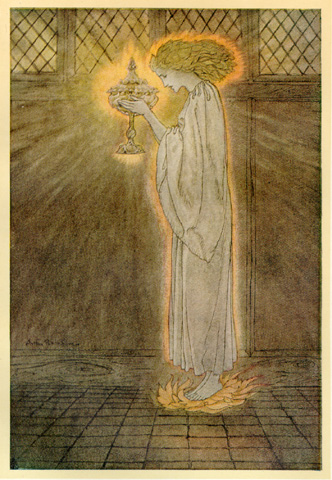
A MacGuffin is an object whose main (sometimes only) purpose in a story is to motivate the plot. It is usually something that everyone is chasing after, whether it be a ticking time bomb, a briefcase full of money, a priceless artifact, or some sort of superweapon. Basically, it can be almost anything–that’s kind of the point. If you can replace an object with something completely different that serves the exact same plot purpose–for example, a priceless stolen Picasso with a priceless stolen Dead Sea scroll–then it’s a MacGuffin.
Like it or not, MacGuffins are everywhere in fiction. It’s such a prevalent trope, it even has its own Wikipedia page. One of the most famous examples, at least in the Western literary tradition, is the Holy Grail. Another example is the One Ring from Lord of the Rings–it could just as easily be a bracelet, or earring, or any other wearable artifact (though admittedly, if it were a necklace and Gollum had to bite off Frodo’s head, that would change the story quite a bit). The MacGuffin page on tvtropes lists nearly 30 subtropes, from Egg MacGuffin to I’m Dying, Please Take My MacGuffin.
So what does this have to do with the hero’s journey? The last phase of the initiation cycle (basically, all the stuff between the departure and return) is known as the Ultimate Boon. It not only represents the achievement of the hero’s quest, it represents receiving something to bring to the people back home. As Joseph Campbell pointed out:
The gods and goddesses then are to be understood as embodiments and custodians of the elixir of Imperishable Being, but not themselves the Ultimate in its primary state. What the hero seeks through his intercourse with them is therefore not finally themselves, but their grace, i.e., the power of their sustaining substance…This is the miraculous energy of the thunderbolts of Zeus, Yahweh, and the Supreme Buddha, the fertility of the rain of Viracocha, the virtue announced by the bell rung in the Mass at the consecration, and the light of the ultimate illumination of the saint and sage. Its guardians dare release it only to the duly proven.
According to Vogler, the hero has to return home with something to benefit himself or the community–otherwise, the whole journey has been a waste of time. Before entering the return phase, then, the hero has to receive the object of his quest.
At this point, it’s worth pointing out that tropes are neither good nor bad. Just because a story revolves around a MacGuffin doesn’t automatically make it cheap or formulaic. Tropes themselves are value neutral–what matters is how you, as the author, use them. Some of the greatest and most inspiring stories of all time make heavy use of MacGuffins.
Because the MacGuffin is a plot-centric trope, when you really understand how it works, you can do some interesting writerly things with it. Michael Moorcock, for example, used this trope to formulate a method for writing a novel in just three days. Would you like to be able to write a novel in three days? Gosh, I’d like to. And before you write that off as formulaic crap, remember, it wasn’t just anyone who came up with this method–it was Michael Moorcock.
In my own work, the best example of this trope would have to be Stella from Bringing Stella Home. As you might have gathered from the title, Stella serves as a MacGuffin for her brother James (specifically, in The President’s Daughter flavor). She does have her own character arc, of course, but as far as James’s storyline is concerned, she could just as well be his mother, or cousin, or <insert kidnapped loved one here>. I did a similar thing in Stars of Blood and Glory, an as-yet-unpublished sequel to Bringing Stella Home, but it should be coming out in January or February of next year so you’ll have a chance to read it then.
This may be literal or metaphorical, physical or spiritual–but whatever form it takes, the hero has to lose something significant, up to and including…well, everything. After all, there are so many things worse than death. While all the other failures up to this point left him more or less intact, this one completely shatters him–and in the process, transforms him.
Like a phoenix rising from the ashes, the hero comes back from the dead, often with a level in badass. By dying, he gains that last piece of knowledge, experience, or resolve that he needs to defeat the big bad and gain the ultimate boon of his quest. Whoever or whatever he was before, that person wasn’t strong enough to pass the test–but now, he is.
When done well, this is a stand-and-cheer moment of the best possible kind. It’s the culmination of everything the hero has gone through, not just in terms of plot, but character as well. Years from now, you might forget everything else in the story–even the parts that you loved–but you’ll remember how you felt when you got to this part.
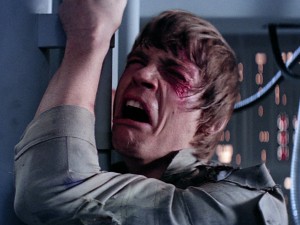
One of my favorite examples of this trope is in the clip I posted from the Matrix. Seriously, when Neo realizes that he is The One, that is one of the best moments in all of cinema. The Empire Strikes Back also has a moment like this, though since the movie is essentially a tragedy, there’s a lot more emphasis on Luke’s death (falling through the gas mine shaft after confronting Darth Vader) than his resurrection (getting a new hand and reuniting with his friends). The oldest examples, of course, come from mythology–Odin gained the ability to use magic by sacrificing himself on Yggdrasil, and before returning to Ithaca, Odysseus first had to journey to Hades to pay his old friend Agamemnon a visit.
So as writers, how are we supposed to get this trope right? I’m by no means an expert, but my gut instinct tells me that the way to nail it is to be as excited about this moment in the story as we want our readers to be when we get to that point. Even though storytelling is ostensibly just making stuff up, it’s not something you can fake–if you aren’t excited about your own story, how do you expect your readers to even care?
Fortunately, this is often the part of the story that drives us to write everything else. There have definitely been times when I could hardly wait to get through the other stuff and finally write the chapter where this happens. Bringing Stella Home was a big one–and that’s all I can say, at the risk of giving spoilers. Star Wanderers is another one, though it wasn’t until I was midway through Fidelity that it really came to me. Desert Stars was more of a Heroic Second Wind, which is basically Came Back Stronger without the death. However, there was definitely a transformation, both for Mira and Jalil.
So yeah, I really, really, REALLY love this trope. When done well, it’s one of those things that can turn a run-of-the-mill adventure story into something both soul-searching and powerful. You can definitely expect to see me play with it a lot in the future.
Before passing the ultimate test, the hero must first confront the force that holds the ultimate power in his life. This is often some sort of father figure, though it can also be a close friend or a rival. Often, the main reason the hero set out on the journey in the first place was because he felt a need to prove himself and gain the respect of this figure. For that reason, the climax often involves some sort of reconciliation or closure between these two characters.
In discussing this trope, Joseph Campbell said the following:
Atonement consists in no more than the abandonment of that self-generated double monster—the dragon thought to be God (superego) and the dragon thought to be Sin (repressed id). But this requires an abandonment of the attachment to ego itself, and that is what is difficult. One must have a faith that the father is merciful, and then a reliance on that mercy…
The problem of the hero going to meet the father is to open his soul beyond terror to such a degree that he will be ripe to understand how the sickening and insane tragedies of this vast and ruthless cosmos are completely validated in the majesty of Being. The hero transcends life with its peculiar blind spot and for a moment rises to a glimpse of the source. He beholds the face of the father, understands—and the two are atoned.
While this may, on the surface, seem just like a simple “I’m proud of you” moment, the full significance goes much deeper. This is the moment where the hero finally receives validation for all his struggles, where he realizes that everything he’s been through has been worth it. It’s a tremendous moment, and an important element of any story that follows the hero’s journey paradigm.
The reason why the hero’s journey resonates so strongly throughout our culture is because it powerfully and effectively fulfills one of the major purposes of all story–to help us better understand ourselves, the world we live in, and what it means to be human. For that reason, this trope is one of the things that can either make or break a story. When done well, it can turn the work into a classic. When done poorly, it can make us wish we had our money back.
I’d talk about this trope in my own work, but I don’t want to give any spoilers. In Bringing Stella Home, there’s something of a gender inversion, as the title would imply. In fact, there’s a gender inversion in Star Wanderers as well, though you’ll have to wait until part IV to read it. In Desert Stars, it’s more of a personal moment, but the whole novel is a lot more intimate and personal than a save the world type of adventure.
Getting back to our discussion of the Hero’s Journey, I think it’s important to briefly touch on one of the earlier stages: supernatural aid. At some point between refusal of the call and crossing the threshold of adventure, the hero typically encounters a mentor figure from the unfamiliar world who gives him something supernatural or otherworldly to help him on his quest. While the mentor often dies (as we saw last week), the supernatural aid that the mentor gives later proves to be a key to defeating the big bad and passing the ultimate test.
Often, this is an actual object. In Lord of the Rings, for example, Galadriel gives each member of the fellowship a specific object. She gives Sam a magical vial, which he uses later to defeat Shelob and save Frodo and the ring. In The Lion, The Witch, and the Warderobe, Aslan gives each of the kids a weapon item specially suited to their characters (except Edmund, who was a prisoner of the queen at the time). In Star Wars IV: A New Hope, Obi Wan gives Luke his father’s lightsaber–though for the purposes of this trope, we can also count his special training with the force, since Luke doesn’t use the lightsaber until episode V.
In discussing this trope, Joseph Campbell said the following:
Having responded to his own call, and continuing to follow courageously as the consequences unfold, the hero finds all the forces of the unconscious at his side. Mother Nature herself supports the mighty task. And in so far as the hero’s act coincides with that for which his society is ready, he seems to ride on the great rhythm of the historical process.
So if the mentor is supposed to die (or get put on a bus) in order for the hero to stand on his own feet, why does the hero need some kind of supernatural aid? Isn’t that just cheating?
Not exactly. Often, the aid is itself part of the ultimate test, and the hero doesn’t figure out how to use it properly until after he’s already experienced everything from the adventure that he needs. The silver slippers from The Wizard of Oz are a good example of this. So is AURYN from The Neverending Story. The hero doesn’t fall back on the supernatural aid until after he’s completed his growth arc.
That’s not the only reason, though. In order for the adventure to have meaning and impact, the stakes have to be really high. Having some sort of mysterious character from the outside world grant the hero something supernatural is a great way to do this, especially at the beginning. If the hero is part of something bigger than himself–saving the world, for example–then it makes sense that he would get some kind of help from the people depending on him, especially if those people have something supernaturally powerful to give.
The Force from Star Wars is one of my favorite examples of supernatural aid. I hear that when episode IV debuted in the theaters, the crowds jumped up and screamed when Obi Wan said “use the force, Luke!” in the clip at the top of the post. Just because it’s so awesome, here’s the full scene (more or less):

 I love